Click here to Purchase Digital Marketing KPI Scorecard in HTML
Digital Marketing KPI Scorecard in HTML is a browser-based performance tracking template that monitors 10 key marketing metrics with traffic-light indicators, sparkline trends, and MTD/YTD comparison toggles. According to a 2025 Gartner survey, 67% of marketing teams still rely on manual spreadsheets for KPI reporting, spending an average of 4-6 hours per month compiling performance data. This scorecard reduces that reporting time to under 5 minutes by automating metric visualization from a single Excel data upload.
Whether you manage website traffic, email campaigns, social media engagement, or paid advertising, tracking the right metrics against targets is essential for data-driven decision-making. The Digital Marketing KPI Scorecard in HTML gives marketing managers, agency owners, and freelancers a single-page view of all 10 KPIs with instant status indicators — no SaaS subscription, no login, no internet connection required. Built by NextGenTemplates, this template joins a library of 2,000+ dashboard and scorecard templates used by 8,400+ teams in 40+ countries.Digital Marketing KPI Scorecard in HTML
Key Features of Digital Marketing KPI Scorecard in HTML
The Digital Marketing KPI Scorecard in HTML packs serious analytical functionality into a clean, browser-based interface. Here is a detailed breakdown of what this scorecard template offers for marketing teams of all sizes.Digital Marketing KPI Scorecard in HTML
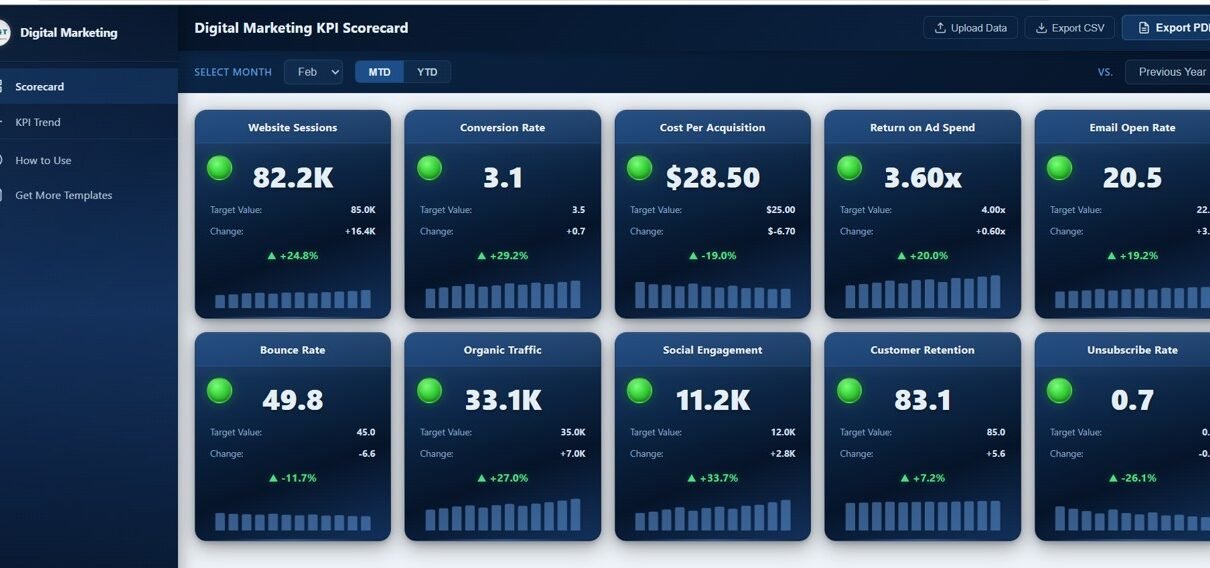
- 10 Marketing KPIs Tracked — Website Sessions, Conversion Rate, Cost Per Acquisition, Return on Ad Spend, Email Open Rate, Bounce Rate, Organic Traffic, Social Engagement, Customer Retention, and Unsubscribe Rate. Each metric covers a distinct marketing function from acquisition to retention.
- Traffic-Light Status Indicators — Every KPI card displays a green, amber, or red indicator based on how the actual value compares to the target. This makes it possible to scan 10 metrics in seconds and identify which areas need immediate attention.
- Sparkline Trend Charts — Embedded monthly trend lines in each KPI card show directional movement over time, helping you spot improving or declining metrics before they become critical.
- MTD and YTD Toggles — Switch between Month-to-Date and Year-to-Date views with a single click. This dual perspective is critical for teams that need both short-term operational visibility and long-term strategic tracking.
- Target vs Previous Year Comparison — A built-in dropdown lets you benchmark current performance against target values or previous year figures. No manual calculations needed.
- KPI Trend Deep-Dive Page — Select any metric from a dropdown to see 4 detailed trend analyses: MTD Actual vs Target, MTD Actual vs Previous Year, YTD Actual vs Target, and YTD Actual vs Previous Year. An info bar displays KPI Group, Unit, Type, Formula, and Definition.
- Browser-Based and Offline-Ready — Opens in Chrome, Edge, Firefox, or Safari. Works completely offline once loaded — no internet connection required.
- Excel Data Upload — All metrics are driven by an included Excel data file. Replace sample values with your own marketing data and upload — no coding or HTML knowledge needed.
- PDF and CSV Export — Built-in export options let you generate professional reports for client presentations or internal reviews.Digital Marketing KPI Scorecard in HTML
Dashboard Pages Explanation
Click here to Purchase Digital Marketing KPI Scorecard in HTML
1. Scorecard Page
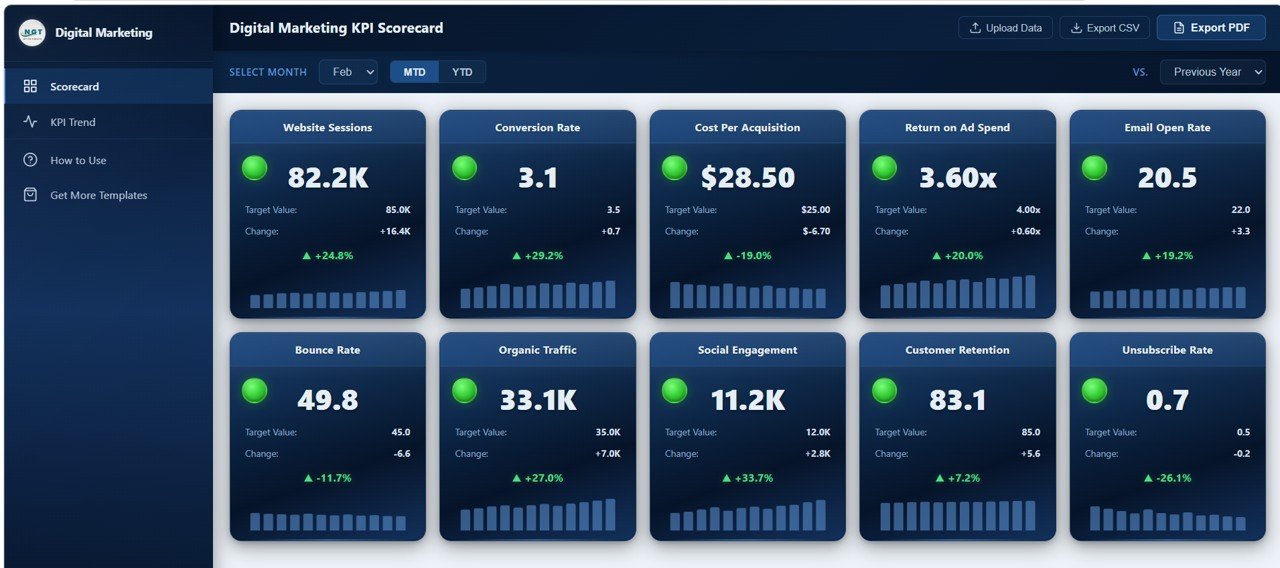
The Scorecard Page is the main landing view of the Digital Marketing KPI Scorecard in HTML. It displays 10 KPI cards arranged in a clean grid layout. Each card shows the KPI name, current value, target value, change from comparison period, percentage change, a traffic-light status indicator (green for on-track, amber for at-risk, red for off-track), and a sparkline showing the monthly trend.
At the top of the page, three filter controls let you customize the view: a Month selector to choose the reporting period, an MTD/YTD toggle to switch between cumulative views, and a Vs. dropdown to compare against either Target or Previous Year. These filters apply to all 10 cards simultaneously, making it easy to see a consistent snapshot of your marketing performance for any given period.
Digital Marketing KPI Scorecard
Click here to Purchase Digital Marketing KPI Scorecard in HTML
2. KPI Trend Page
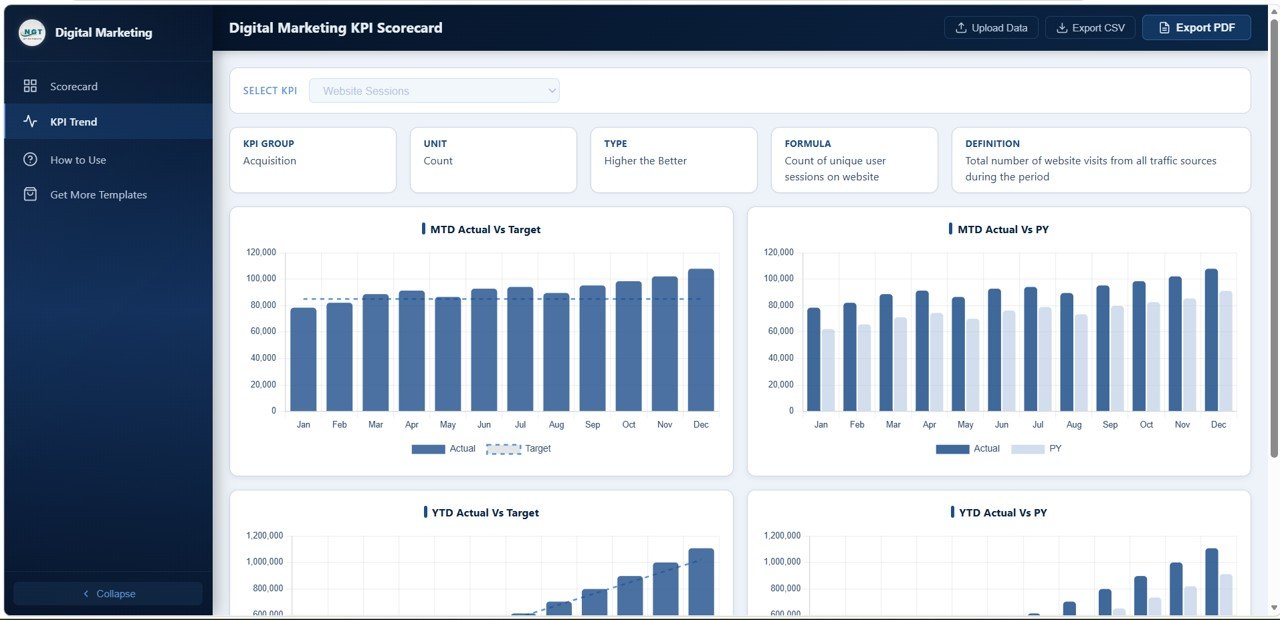
The KPI Trend Page provides detailed time-series analysis for any individual metric. Users select a KPI from a dropdown at the top of the page, and the page renders 4 charts: MTD Actual vs Target by Month, MTD Actual vs Previous Year by Month, YTD Actual vs Target by Month, and YTD Actual vs Previous Year by Month. These four views cover every common comparison scenario that marketing teams use in performance reviews.
Above the charts, an info bar displays contextual information about the selected KPI: its KPI Group (e.g., Acquisition, Engagement, Retention), Unit (percentage, number, currency), Type (higher-is-better or lower-is-better), Formula, and Definition. This is especially useful for teams where multiple people use the scorecard and need consistent understanding of what each metric means and how it is calculated.
KPI Trend Page
3. How to Use Page
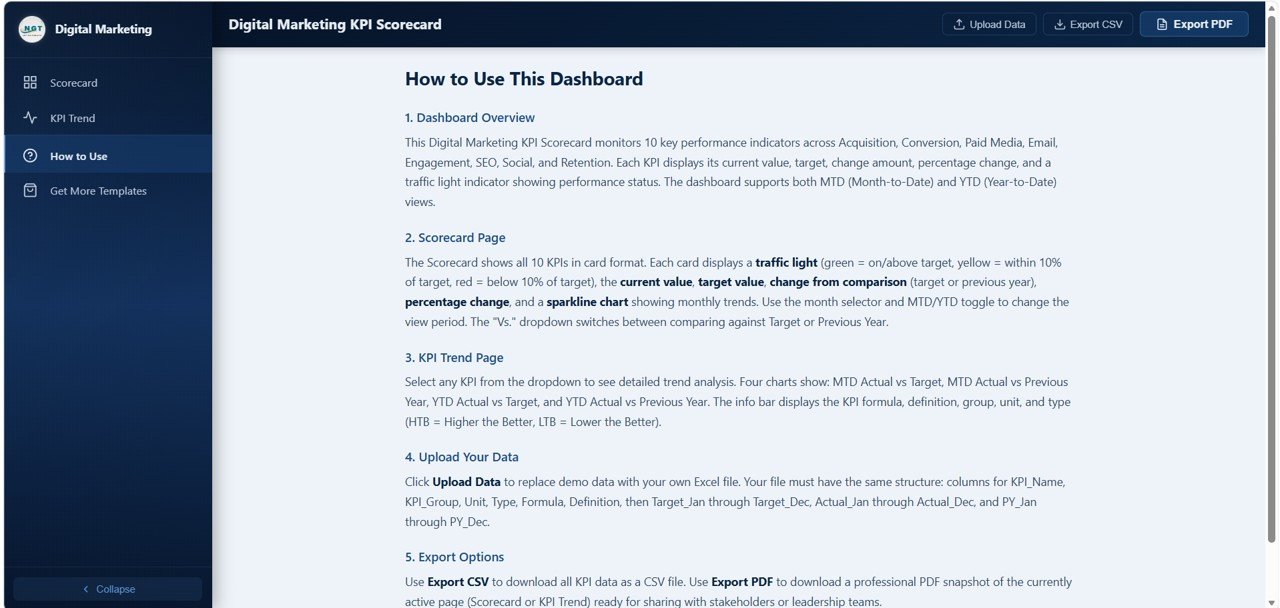
The How to Use Page serves as a built-in instruction manual for the scorecard. It covers five sections: Dashboard Overview explaining the overall structure, Scorecard Page Navigation showing how to use filters and read KPI cards, KPI Trend Page Features describing the trend analysis capabilities, Upload Your Data walking through the Excel data file editing and upload process, and Export Options explaining how to download scorecard views as CSV or PDF files.
This page makes the template accessible to users of all skill levels. Whether you are a marketing analyst who is comfortable with data tools or a business owner seeing a KPI scorecard for the first time, the How to Use page provides enough guidance to get started in minutes.
How to Use Page
Click here to Purchase Digital Marketing KPI Scorecard in HTML
Digital Marketing KPI Scorecard in HTML vs. Google Sheets Scorecard vs. HubSpot Marketing Hub — Feature Comparison
| Feature | Digital Marketing KPI Scorecard in HTML | Google Sheets Scorecard | HubSpot Marketing Hub |
|---|---|---|---|
| Cost | $6.99 one-time | $9.99 one-time | $800+ / month (Professional) |
| Platform | Any modern browser | Google Sheets | Cloud SaaS |
| Setup time | Under 5 minutes | Under 10 minutes | 2-4 weeks |
| Traffic-light indicators | ✅ Built-in | Conditional formatting | Custom reports |
| MTD / YTD toggle | ✅ One-click switch | Manual filter | ✅ Built-in |
| Offline access | ✅ Works offline | ❌ Requires internet | ❌ Requires internet |
| Customizable KPIs | ✅ Edit Excel data file | ✅ Edit cells | ✅ With setup |
| Export to PDF / CSV | ✅ Built-in | Google export | ✅ Built-in |
| Year-1 cost at 5 users | $6.99 total | $9.99 total | $9,600+ |
For marketing teams that want instant KPI visibility without paying $800/month for HubSpot, the Digital Marketing KPI Scorecard in HTML sits in the sweet spot.
Who Should Use This Template
Perfect for:
- Digital marketing managers at small-to-medium businesses who need a monthly KPI snapshot for leadership reporting
- Marketing agencies creating branded KPI scorecards for client quarterly reviews
- Startup founders tracking marketing spend efficiency across multiple channels
- Freelance marketers consolidating SEO, PPC, email, and social metrics into one view
Not a fit if:
- You need real-time API connections to Google Analytics, Meta Ads, or other ad platforms — this template uses manual Excel uploads
- Your organization requires multi-user role-based access with audit trails and enterprise compliance
- You need automated daily data refresh without any manual intervention
Real-World Use Cases
Rachel leads digital marketing at a 45-person e-commerce company. She uses the Digital Marketing KPI Scorecard in HTML to present monthly performance reviews to her CEO. The traffic-light indicators instantly highlight which of the 10 metrics are on target and which need attention — cutting her monthly reporting time from 5 hours to 30 minutes. For campaign-level deep dives, she pairs this scorecard with the Digital Marketing Campaign Dashboard in Google Sheets.
Tom runs a boutique marketing agency serving 8 clients. He customizes the scorecard for each client by updating the Excel data file with their specific metrics. The professional HTML layout and PDF export feature let him attach branded scorecards directly to client reports. For clients focused on content strategy, he supplements with the Content Marketing KPI Scorecard in Excel.
Priya is a solo freelance marketer managing SEO, PPC, and email campaigns. She consolidates all 10 KPIs into one scorecard instead of switching between Google Analytics, Mailchimp, and ad platform dashboards. The YTD comparison against targets keeps her accountable to quarterly goals, and the sparkline trends help her spot patterns early enough to adjust strategy.
Advantages of Digital Marketing KPI Scorecard in HTML
- Single-Page KPI Visibility — All 10 marketing KPIs visible on one screen with traffic-light status indicators. No scrolling through multiple tabs or reports.
- Zero Technical Barrier — No coding, no formulas, no software installation. Edit the Excel file, upload, and the scorecard updates automatically.
- Offline Capability — Unlike cloud-based tools, this HTML scorecard works entirely in your browser without an internet connection — useful for presentations in conference rooms with spotty WiFi.
- Client-Ready Exports — Built-in PDF and CSV export means your scorecard is presentation-ready without any additional formatting or screenshot workarounds.
- Cost Efficiency — At $6.99 one-time versus $800+/month for HubSpot Marketing Hub Professional, this template delivers the same monthly KPI reporting for a fraction of the cost. Explore more cost-effective options in our HTML Dashboard Templates collection.
Opportunities for Improvement
- API Integration — Adding direct API connections to Google Analytics 4, Meta Ads, or Google Ads would eliminate the manual Excel upload step for teams with technical resources.
- Multi-Period Comparison — A quarter-over-quarter or custom date range comparison beyond MTD/YTD would add flexibility for teams with non-standard reporting cycles.
- Alerting and Notifications — Email or browser notification triggers when a KPI drops below its target threshold would add proactive monitoring capability.
- Additional KPI Slots — Expanding beyond 10 KPIs to 15-20 would accommodate teams tracking more granular metrics like click-through rate by channel or landing page conversion rates.
Best Practices
- Update Monthly — For the most accurate scorecard, update your Excel data file at the start of each month with the previous month’s final numbers.
- Use YTD for Strategic Reviews — Switch to YTD view during quarterly planning meetings to show cumulative progress against annual targets.
- Benchmark Against Previous Year — Use the “Vs. Previous Year” comparison regularly to understand seasonal patterns and year-over-year growth.
- Focus on Red Indicators First — The traffic-light system is designed for triage. Address red KPIs before optimizing amber or green metrics.
- Export Before Meetings — Generate a PDF export before every performance review meeting so stakeholders can reference the scorecard even without a browser open.
Explore Relevant Templates
If the Digital Marketing KPI Scorecard in HTML fits your reporting needs, explore these related templates from NextGenTemplates:
- Marketing Dashboard in HTML — Full multi-page marketing analytics dashboard with campaign-level charts, KPIs, and interactive filters.
- YouTube Channel Analytics Dashboard in HTML — Track video performance, subscriber growth, and engagement metrics in a browser-based dashboard.
- PPC Campaign KPI Dashboard in Google Sheets — Monitor paid advertising KPIs including CPC, CTR, and ROAS across multiple ad platforms.
- Digital Marketing Campaign Dashboard in Google Sheets — Campaign-level spend, ROI, and conversion tracking for digital marketing teams.
- Content Marketing KPI Scorecard in Excel — Track content performance metrics with traffic-light scorecards in Excel format.
Browse all HTML Dashboard Templates and Marketing Templates for more options. For more insights on marketing analytics, read Google’s guide to GA4 key events and conversions.
Frequently Asked Questions
What KPIs does the Digital Marketing KPI Scorecard in HTML track?
The Digital Marketing KPI Scorecard in HTML tracks 10 key metrics: Website Sessions, Conversion Rate, Cost Per Acquisition, Return on Ad Spend, Email Open Rate, Bounce Rate, Organic Traffic, Social Engagement, Customer Retention, and Unsubscribe Rate. Each metric includes traffic-light status, target comparison, and sparkline trends.
How does this compare to using HubSpot for marketing KPI tracking?
HubSpot Marketing Hub Professional costs $800+ per month and requires 2-4 weeks of setup. The Digital Marketing KPI Scorecard in HTML costs $6.99 one-time, works in any browser in under 5 minutes, and tracks 10 KPIs with traffic-light indicators. For teams that need a visual scorecard without a SaaS subscription, this template delivers equivalent KPI visibility at a fraction of the cost.
Can I customize the KPIs in this HTML scorecard?
Yes. All 10 KPIs are driven by an Excel data file included in the download. You can modify KPI names, targets, actual values, and comparison benchmarks by editing the Excel file and uploading it to the dashboard. No HTML or coding knowledge is required.
Does the Digital Marketing KPI Scorecard work offline?
Yes. Since this is a self-contained HTML file, it runs entirely in your browser without needing an internet connection. Once you open index.html, the full scorecard with all charts, filters, and KPI cards works offline — useful for conference room presentations.
How long does it take to set up this marketing scorecard?
Setup takes under 5 minutes. Unzip the download, open index.html in your browser, update the Excel data file with your marketing metrics, and upload it. All 10 KPI cards, traffic-light indicators, and trend charts update automatically.
What file format do I need for my marketing data?
The Digital Marketing KPI Scorecard in HTML accepts data through an Excel (.xlsx) file. The download includes a pre-formatted data template with sample values. Replace the sample data with your actual monthly KPI figures, save the file, and upload it through the dashboard interface.
Can I use this scorecard for client reporting?
Yes. The built-in PDF export feature generates professional scorecard reports for client presentations. Marketing agencies frequently use this template to deliver monthly KPI reports to clients. The clean HTML layout and traffic-light indicators make the scorecard presentation-ready without additional formatting.
About the Author
Built by PK — Microsoft Certified Professional with 15+ years of Excel, Google Sheets, and Power BI experience. Founder of NextGenTemplates, reaching 300K+ subscribers across YouTube channels. Every template is hand-built and tested before release.
Conclusion
The Digital Marketing KPI Scorecard in HTML gives marketing teams a fast, visual, and offline-ready way to track 10 critical performance metrics with traffic-light indicators, sparkline trends, and flexible MTD/YTD comparisons. Whether you are a solo marketer, an agency managing multiple clients, or a marketing director presenting to leadership, this scorecard replaces hours of manual reporting with a 5-minute Excel upload and a clean browser-based dashboard.
Click here to Purchase Digital Marketing KPI Scorecard in HTML
Visit our YouTube channel for step-by-step video tutorials: Youtube.com/@NeoTechNavigators