Mobile apps lose 77% of their daily active users within the first three days after install, according to research published by Google Firebase. Yet most product and growth teams still track their key metrics across a dozen disconnected spreadsheets, Slack threads, and ad-hoc reports — leaving leadership with no consistent view of whether the app is actually performing. In this article, we have created the Mobile App Performance KPI Scorecard in Google Sheets: a ready-to-use scorecard template that consolidates 20+ mobile app KPIs into one structured, color-coded view with MTD and YTD trend analysis.
This template is built for product managers, growth marketers, and tech leads who need a clear, shareable KPI dashboard without Firebase’s engineering overhead or AppsFlyer’s $2,000/month price tag. Explore our full library of Google Sheets KPI scorecard templates for more ready-to-use reporting tools.
Get the Mobile App Performance KPI Scorecard in Google Sheets
Key Features of Mobile App Performance KPI Scorecard in Google Sheets
The Mobile App Performance KPI Scorecard in Google Sheets tracks 20+ KPIs across five app performance groups. Here are the standout features:
- MTD and YTD Dual-Mode Reporting — Toggle between Month-to-Date and Year-to-Date performance on the Scorecard sheet with a single dropdown.
- Color-Coded Visual Indicators — Each KPI displays a traffic-light status (green/amber/red) based on actual vs. target variance. Lower-the-Better KPIs use inverted logic automatically.
- Per-KPI Trend Charts — Select any KPI from the dropdown in the KPI Trend sheet and instantly generate MTD and YTD line charts showing Actual, Target, and Prior Year performance side by side.
- Editable KPI Definition Library — Define each metric’s name, group, unit, formula, and plain-English definition in the KPI Definition sheet.
- No Software Required — 100% Google Sheets. Share via link, collaborate in real time, access from any device.
Dashboard Pages Explanation
1. Scorecard Sheet
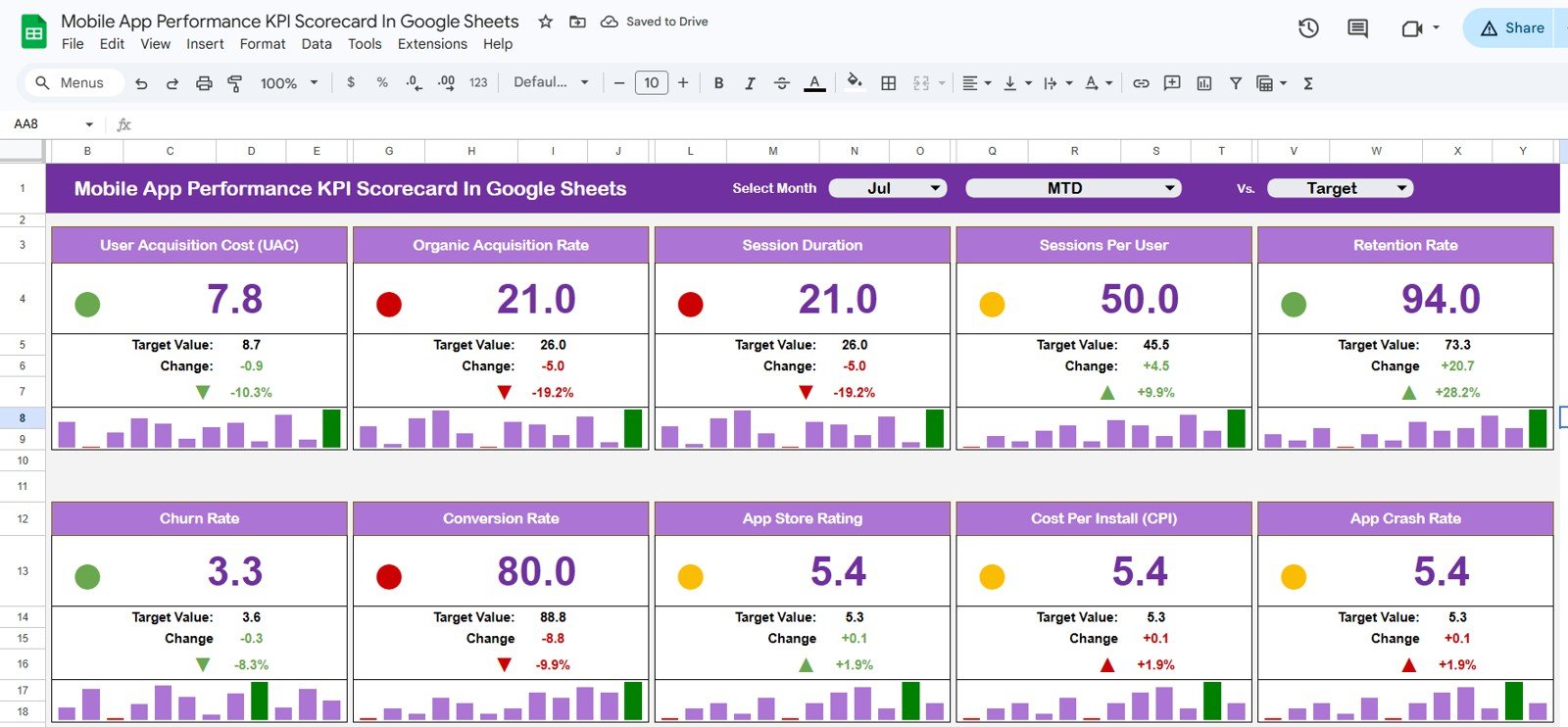
Mobile App Performance KPI Scorecard in Google Sheets
The Scorecard sheet is the main interface where you view KPI performance at a glance. Key features include:
- Dropdown Menus — Select the month and toggle between MTD or YTD for performance analysis.
- Actual vs. Target Values — Compare actual performance against targets and prior-year benchmarks for each KPI.Mobile App Performance KPI Scorecard In Google Sheets
- Visual Indicators — Color-coded conditional formatting (green = on target, amber = near miss, red = off track).Mobile App Performance KPI Scorecard In Google Sheets
- Comprehensive KPI Overview — All KPI information including group, unit, actual, target, prior year, variance %, and status in one scrollable view.Mobile App Performance KPI Scorecard In Google Sheets
2. KPI Trend Sheet
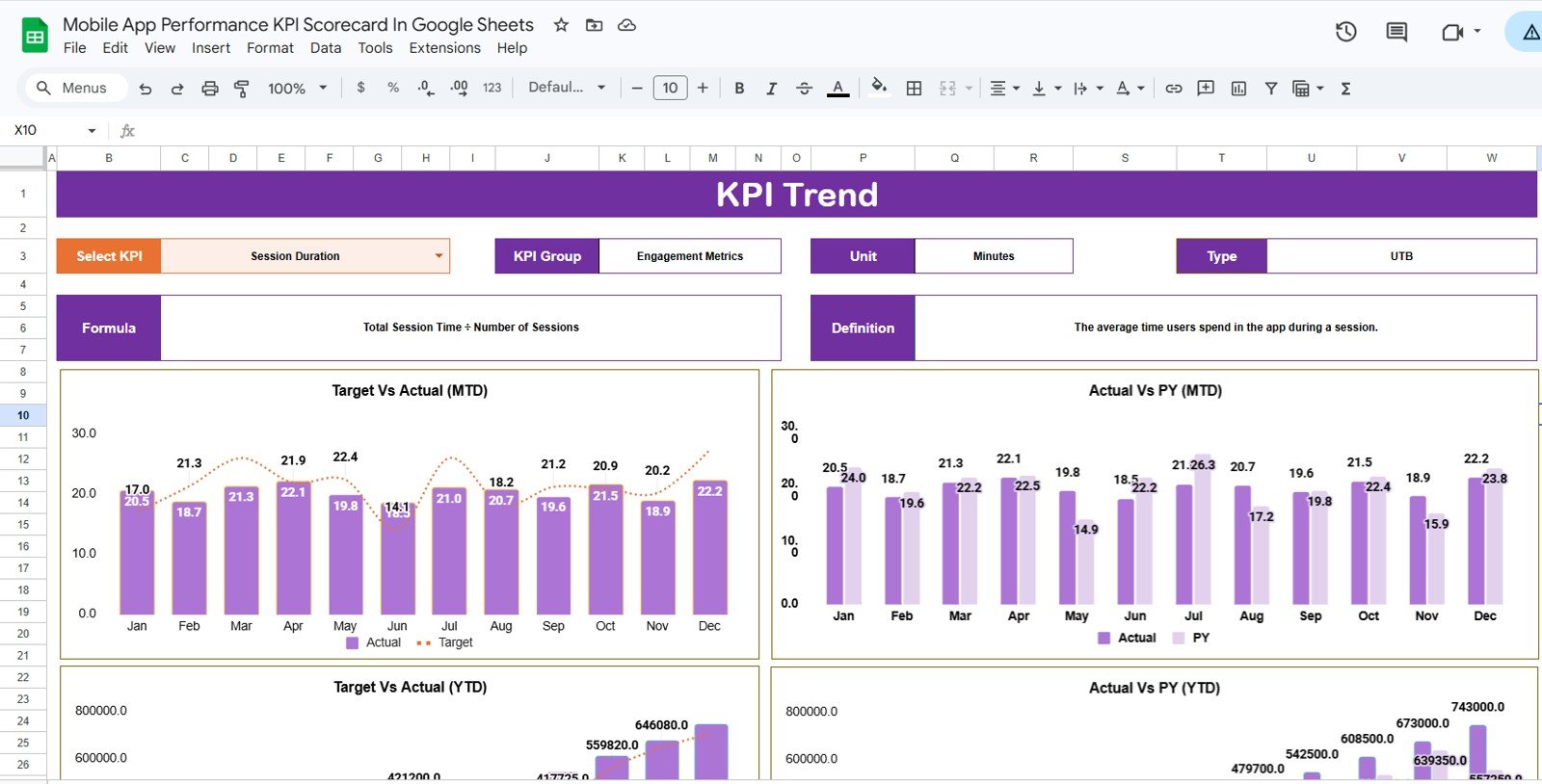
KPI Trend Sheet
Select any KPI name from the dropdown on cell C3. The sheet displays the KPI Group, Unit, Type (Lower the Better or Upper the Better), Formula, and Definition. Two dynamic trend charts (MTD and YTD) show Actual, Target, and Prior Year performance across the full reporting year — essential for spotting seasonality and trend breaks in any individual metric.
3. Input Data Sheet
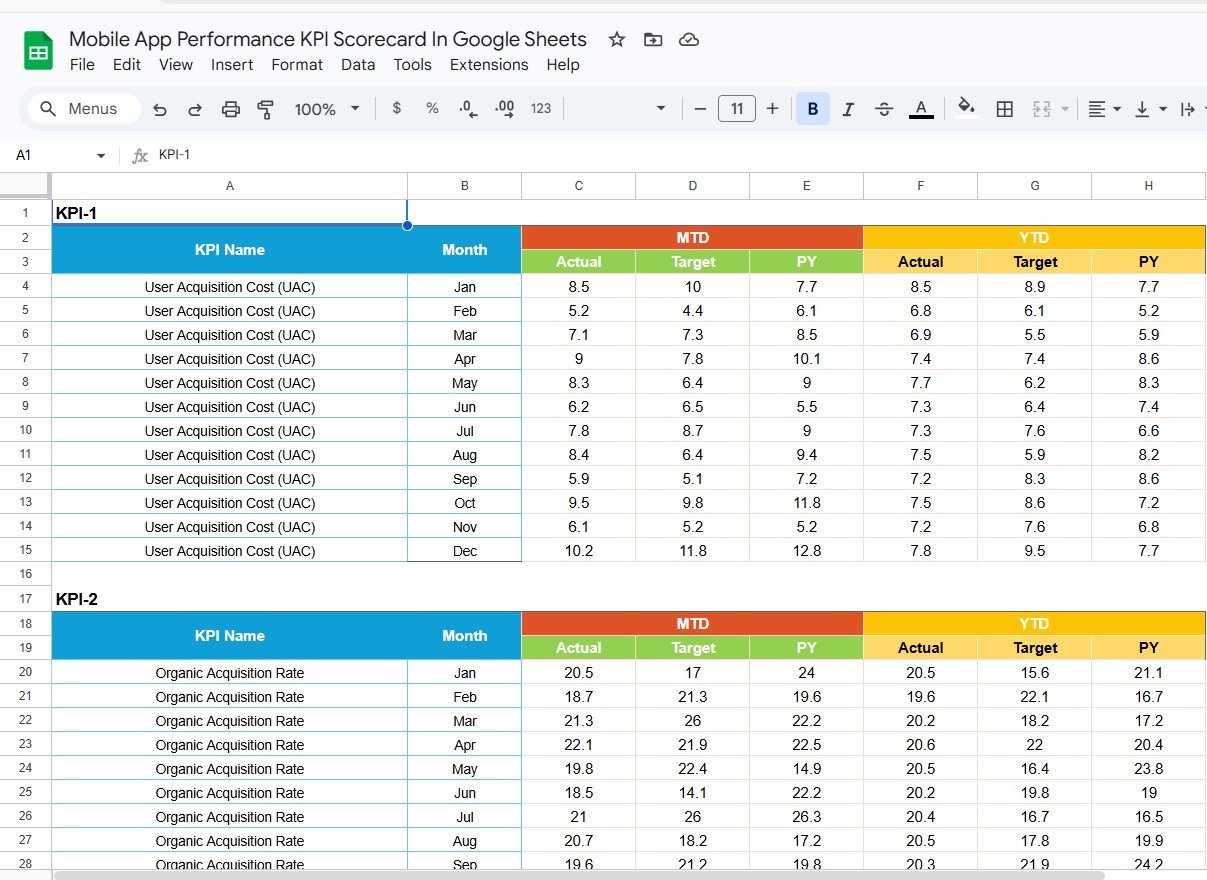
Input Data Sheet
The Input Data sheet is where you enter all KPI data. Record actual values, targets, and prior-year figures for each KPI on a monthly basis. Update as new results become available — every other sheet in the scorecard pulls from this one source automatically.
4. KPI Definition Sheet
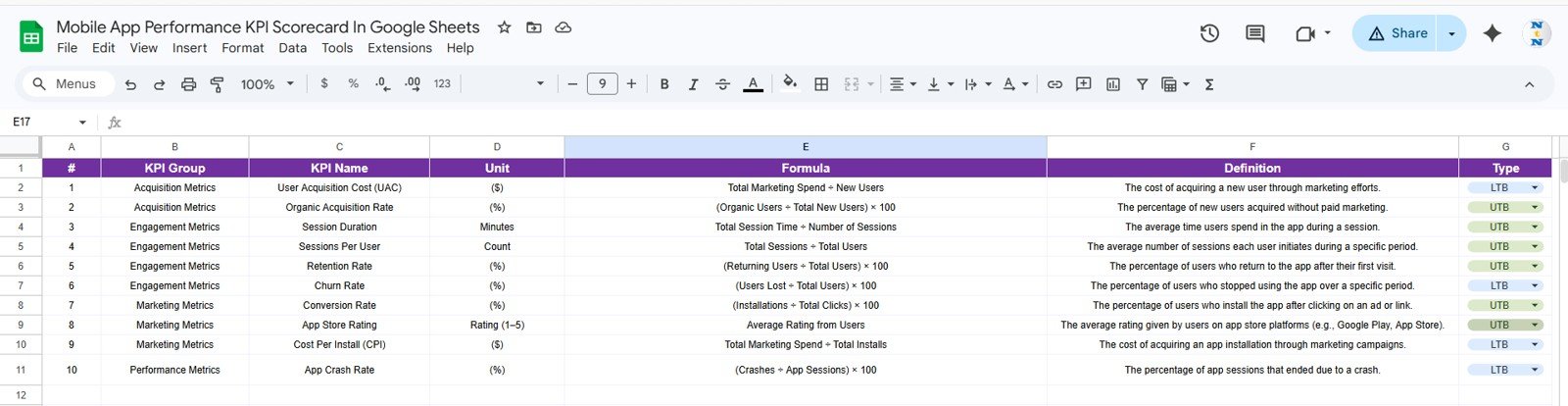
KPI Definition Sheet Tab
In the KPI Definition sheet, enter the KPI Name, KPI Group, Unit, Formula, and definition for each metric. This is your team’s shared performance dictionary — ensuring everyone from analyst to CEO uses the same calculation method when discussing DAU, ARPU, or Day-30 retention.
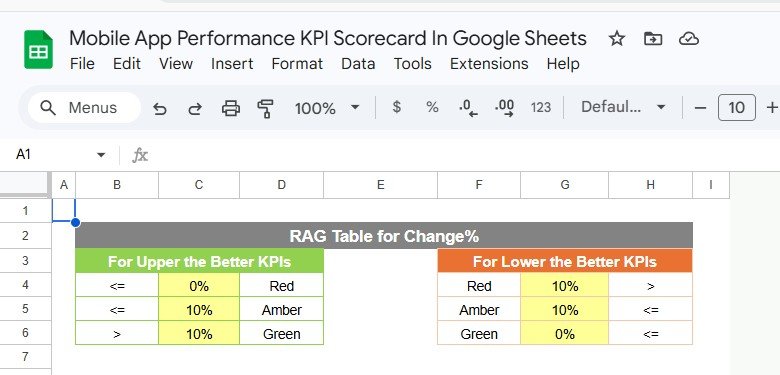
Mobile App Performance KPI Scorecard — Full Template Overview
Mobile App Performance KPI Scorecard vs. Excel Dashboard vs. Firebase Analytics — Feature Comparison
| Feature | Mobile App Performance KPI Scorecard (Google Sheets) | Microsoft Excel KPI Dashboard | Firebase Analytics / AppsFlyer |
|---|---|---|---|
| Cost | $8.99 one-time | Requires Excel license (~$10/mo) | $500–$2,000+/month |
| Platform | Google Sheets (browser-based) | Desktop Excel required | Web SaaS + SDK integration |
| Setup time | Under 5 minutes | 15–30 minutes | 2–4 weeks engineering |
| Real-time collaboration | ✅ Built-in Google link sharing | Requires OneDrive | ✅ Yes |
| Customizable KPI definitions | ✅ Full control | ✅ Editable | ❌ Locked to SDK events |
| MTD + YTD trend charts | ✅ Per-KPI dynamic charts | Manual setup | Custom dashboards only |
| Annual cost (5 users) | $8.99 total | ~$60/year | $6,000–$24,000/year |
| Engineering required | ✅ None | ✅ None | ❌ Yes — SDK required |
For product managers who need clear app performance visibility without Firebase’s engineering overhead, the Mobile App Performance KPI Scorecard in Google Sheets sits in the sweet spot.
Who Should Use This Template
Perfect for:
- Product managers at mobile app startups needing a lightweight KPI tracking system for weekly leadership reviews
- App developers and tech leads monitoring crash rate, load time, and session metrics in one place
- Growth marketers tracking CAC, install rates, and Day-30 retention month over month
- Indie developers and bootstrapped app studios that need structured reporting without SaaS pricing
- Agencies and consultants managing multiple client apps needing a standardized KPI report format
Not a fit if:
- You need real-time event-level analytics — Firebase or Mixpanel are purpose-built for that
- You need automated data ingestion from app stores — this is a manual-entry scorecard
- You need user-level cohort analysis — Amplitude or Heap would serve you better
Real-World Use Cases
Ravi leads product at a 15-person fintech app startup. He uses the Mobile App Performance KPI Scorecard in Google Sheets to prepare his weekly leadership sync, tracking DAU/MAU ratio, crash rate, and ARPU in one color-coded view. The visual indicators let him flag deteriorating metrics before they surface in App Store reviews, without paying $800/month for a dedicated analytics platform.
Priya runs growth marketing for a fitness app with 200K installs. She monitors acquisition KPIs (CAC, install rate, organic vs. paid split) and retention KPIs (Day-1 and Day-30 retention) in the same scorecard. Sharing it via Google Sheets link with her CEO means no Excel version conflicts and no file attachments in Slack.
Tom is a freelance app consultant managing three client apps. He creates one copy per client, customizes the KPI Definition sheet for each app’s business model, and presents the Scorecard sheet directly in monthly client reviews. The template pays for itself on the first engagement.
Advantages of Mobile App Performance KPI Scorecard in Google Sheets
- Single Source of Truth — Update the Input Data sheet and the Scorecard, Trend charts, and KPI definitions all refresh automatically.
- Zero Setup Friction — No SDK, no API, no developer dependency. Open the template, enter your data, get a board-ready app performance report in minutes.
- Platform-Agnostic — Works for iOS, Android, or cross-platform apps. Add platform-specific KPI groups to compare iOS vs. Android performance side by side.
- Fully Customizable — Add, remove, or rename KPIs without breaking any formula logic. Adapts to gaming, SaaS mobile, or consumer marketplace apps.
- One-Time Cost — $8.99 once. No monthly billing, no user seat fees, no annual renewals.
Opportunities for Improvement
- Manual Data Entry — Teams managing 50+ KPIs or needing daily updates may want to pair it with a Google Sheets API connector or Zapier integration for automated data flow from app store dashboards.
- No Real-Time Event Tracking — The template tracks aggregated monthly KPIs, not session-level data. It complements rather than replaces Firebase or Amplitude.
Best Practices
- Update on a fixed cadence — Set a monthly or weekly ritual for updating the Input Data sheet. Consistency makes trend charts actionable over time.
- Define KPIs before tracking them — Fill in the KPI Definition sheet first. Aligned definitions prevent metric disputes in leadership reviews.
- Use the KPI Trend sheet in presentations — Select the KPI you want to highlight and screenshot the trend chart for board decks and investor updates.
- Set realistic targets quarterly — Revisit targets as your app grows. The color-coded indicators are only as useful as your targets are accurate.
Explore Relevant Templates
- Cyber Incident Response KPI Scorecard in Excel — Track IT security KPIs including incident response time and breach rate.
- UX/UI Design KPI Scorecard in Excel — Monitor design team performance with usability score and iteration cycle KPIs.
- Product Development KPI Scorecard in Excel — Measure sprint velocity, feature delivery rate, and product quality metrics.
- Small Business KPI Scorecard in Google Sheets — A versatile KPI tracking template for small business owners.
Explore the full library of KPI Dashboard Templates in Google Sheets.
Curious how the reporting side works under the hood? The Excel Pivot Tables & Dashboards course on NextGenTemplates Academy covers KPI reporting step by step, with practice files.
Get the Mobile App Performance KPI Scorecard in Google Sheets
Frequently Asked Questions
What KPIs does the Mobile App Performance KPI Scorecard in Google Sheets track?
The scorecard tracks 20+ mobile app KPIs across five groups: Acquisition (installs, CAC, organic split), Engagement (DAU, MAU, session duration, stickiness), Retention (Day-1, Day-7, Day-30 retention, churn rate), Monetization (ARPU, LTV, revenue), and Quality (crash rate, app rating, load time). All KPIs are editable in the KPI Definition sheet.
Do I need any software to use this Google Sheets scorecard?
No software installation needed. The Mobile App Performance KPI Scorecard runs entirely in Google Sheets in your browser. Open the PDF guide from your download, click the copy link, and your editable version is live in Google Drive in under a minute.
Can I add custom KPIs beyond the 20+ pre-built ones?
Yes. The KPI Definition sheet is fully editable. Add new KPI rows with your name, group, unit, formula, and definition. New entries flow through to the Input Data and Scorecard sheets automatically — no formula editing required.
How does this compare to Firebase Analytics for tracking mobile app KPIs?
Firebase is an event-level real-time analytics platform requiring SDK integration by developers. This scorecard is a manual MTD/YTD leadership reporting tool that complements Firebase — Firebase tracks events, this scorecard tracks strategic KPI targets. Cost: $8.99 one-time vs. Firebase paid tiers at $200+/month.
Does this scorecard work for both iOS and Android apps?
Yes. The KPI structure is platform-agnostic. Track iOS and Android separately by adding platform-specific KPI groups in the KPI Definition sheet, or use combined totals if managing both platforms together.
How long does it take to set up the scorecard?
Most users are up and running in under 5 minutes. Open the PDF guide, click the copy link, customize the KPI Definition sheet, then enter your first month of data in the Input Data sheet. The Scorecard and Trend charts auto-update immediately.
About the Author
Built by PK — Microsoft Certified Professional with 15+ years of Excel, Google Sheets, and Power BI experience. Founder of NextGenTemplates, reaching 300K+ subscribers across YouTube channels. Every template is hand-built and tested before release.
Conclusion
The Mobile App Performance KPI Scorecard in Google Sheets gives product managers, growth teams, and app consultants a structured, color-coded view of 20+ mobile app KPIs — with MTD/YTD trend charts, visual indicators, and an editable KPI library — for a one-time cost that’s less than a single month of most analytics platforms.
✅ Instant download · One-time payment · No subscription · Lifetime access
📅 Last updated: May 2026