Pest-control companies sit on more data than they realize. Every visit carries a service type, a region, an assigned technician, an infestation severity, a payment method, and a customer rating. The Pest Control Dashboard in Google Sheets pulls all of that into one file: four headline KPIs, six working sheets, 14 pre-built charts, and native slicers. It tracks Total Revenue, Total Jobs, Average Job Value, and Average Rating, and it recalculates as soon as a new job is added to the Data sheet.
The alternative for most small operators is either a tangled spreadsheet nobody trusts, or field-service software billed per user every month. This template is the practical middle ground: a one-time-purchase Google Sheets dashboard you own outright, customize freely, and open on any device. Below, we break down every sheet, the analysis on each, who it suits, and how to get the most out of it.
Get the Pest Control Dashboard
Key Features of the Pest Control Dashboard in Google Sheets
The dashboard is built on Google Sheets pivot tables and native slicers instead of brittle array formulas, which keeps filtering quick and the file responsive as records grow. The highlights:
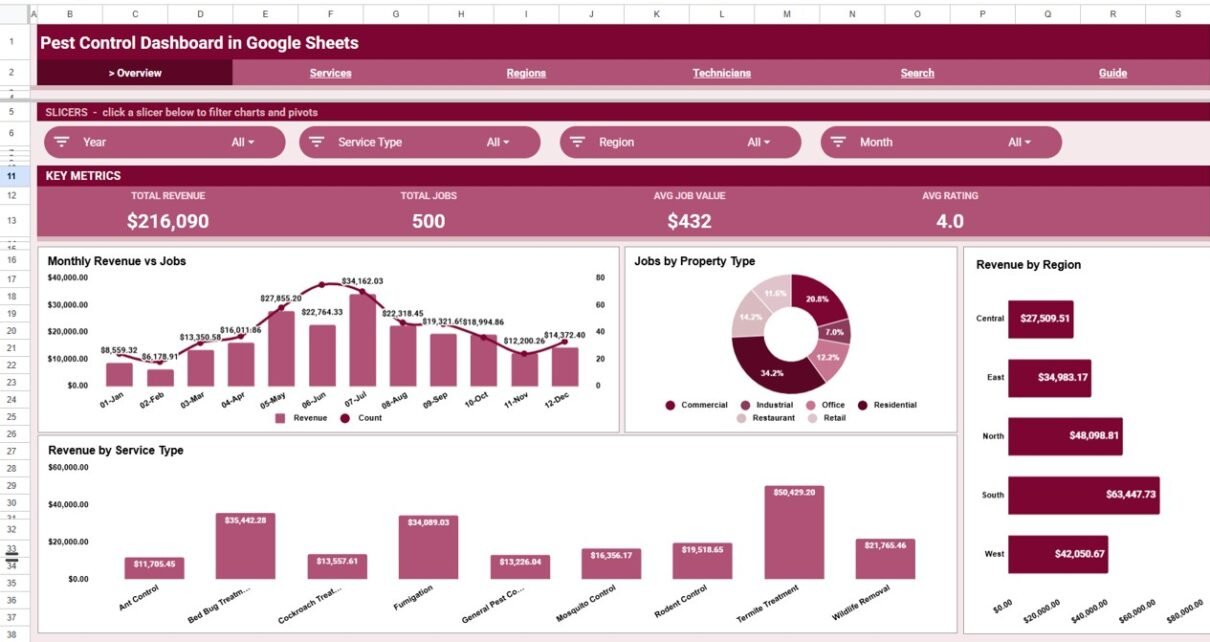
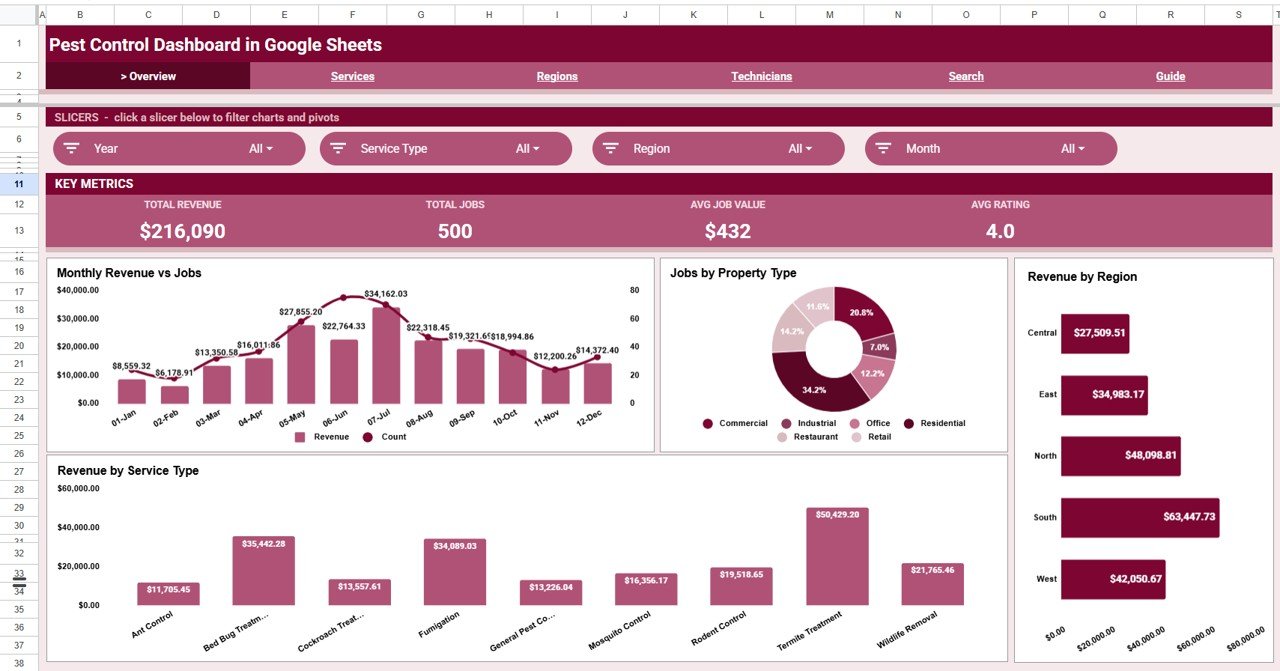
- Four automatic KPI cards: Total Revenue, Total Jobs, Avg Job Value, and Avg Rating update the moment data changes. With the 500 sample jobs, they read $216,090, 500, $432, and 4.0.
- 14 charts across four analysis sheets covering revenue, jobs, severity, ratings, and service plans.
- Native slicers on every analysis sheet: Year, Service Type, Region, and Month on the Overview, plus Property Type, Severity, Technician, Job Status, and Service Plan on the other pages.
- A Job ID Search sheet that returns 13 fields for any single job in seconds.
- One Data sheet that powers every page, so all updates happen in one place, plus a Guide tab with usage notes.
Dashboard Pages Explanation
1. Overview Page
The Overview sheet leads with the four headline cards and a row of slicers (Year, Service Type, Region, Month). Its four charts are Monthly Revenue vs Jobs, which plots income against job volume to expose seasonality; Jobs by Property Type, splitting work across Commercial, Industrial, Office, Residential, Restaurant, and Retail sites; Revenue by Region, ranking the Central, East, North, South, and West territories; and Revenue by Service Type, showing which of the nine services earn the most.
2. Services
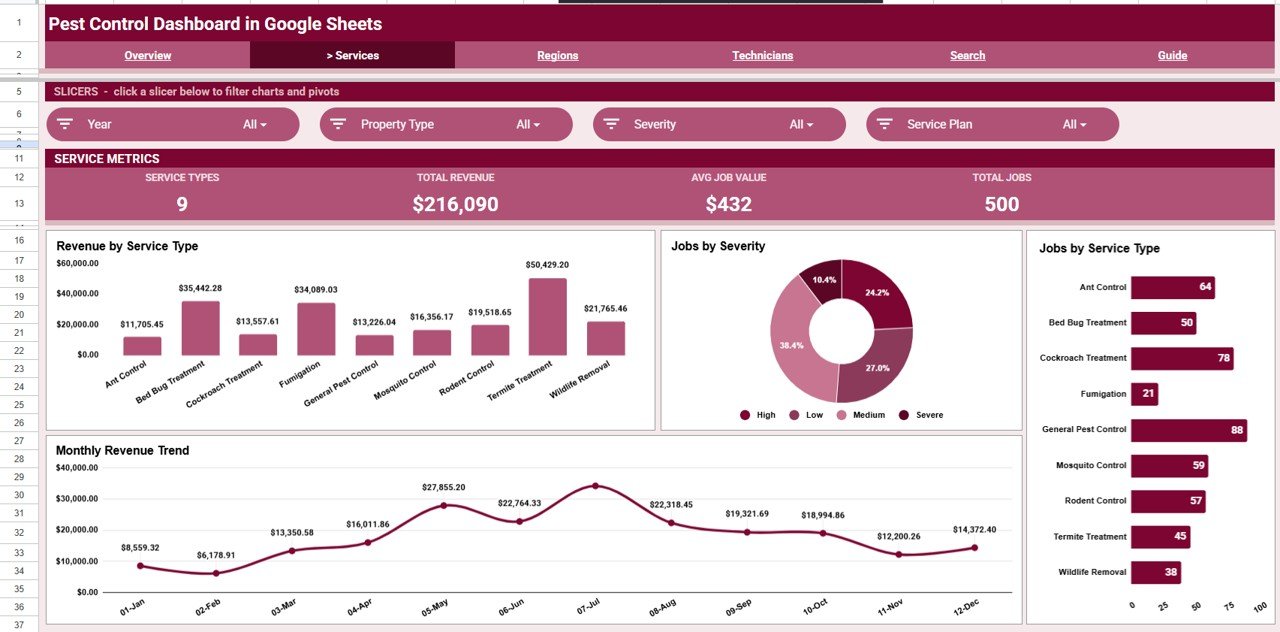
The Services sheet drills into what you sell. Four cards show Service Types, Total Revenue, Avg Job Value, and Total Jobs, followed by Revenue by Service Type, Jobs by Severity (Low, Medium, High, Severe), Jobs by Service Type, and a Monthly Revenue Trend. Use it to see which services drive income and how infestation severity is distributed across the job mix.
3. Regions
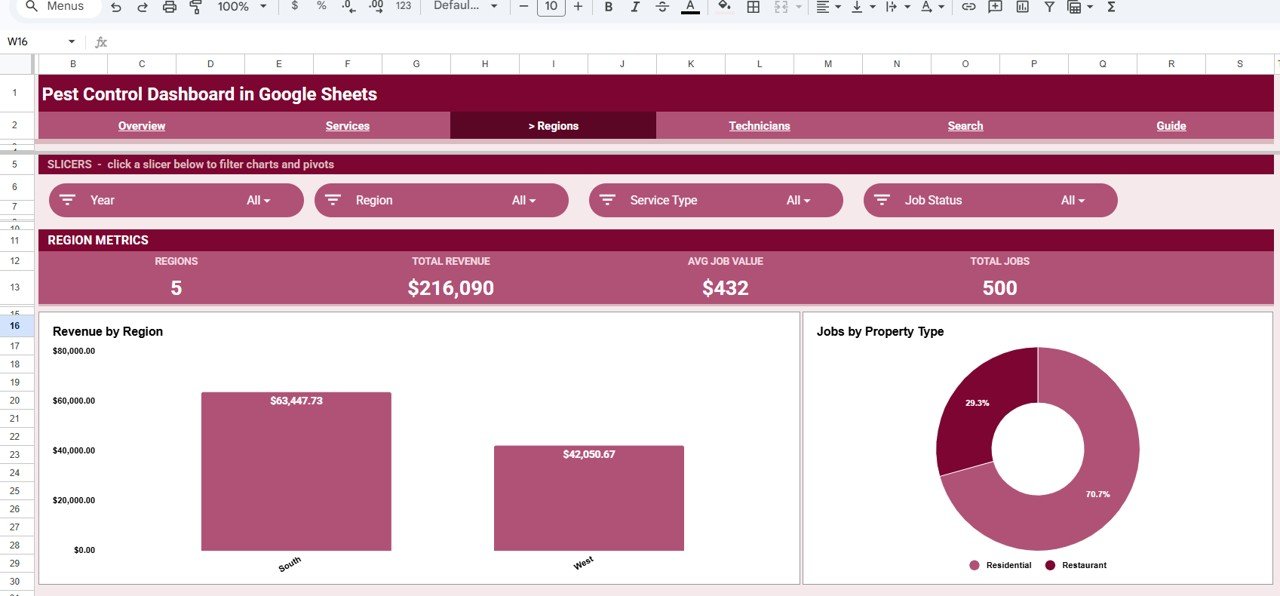
The Regions sheet focuses on geography. Its cards show Regions (5), Total Revenue, Avg Job Value, and Total Jobs, and it pairs Revenue by Region with Jobs by Property Type so you can see both where revenue originates and what kinds of properties generate work in each area. Its slicers (Year, Region, Service Type, Job Status) let you isolate a single territory quickly.
4. Technicians
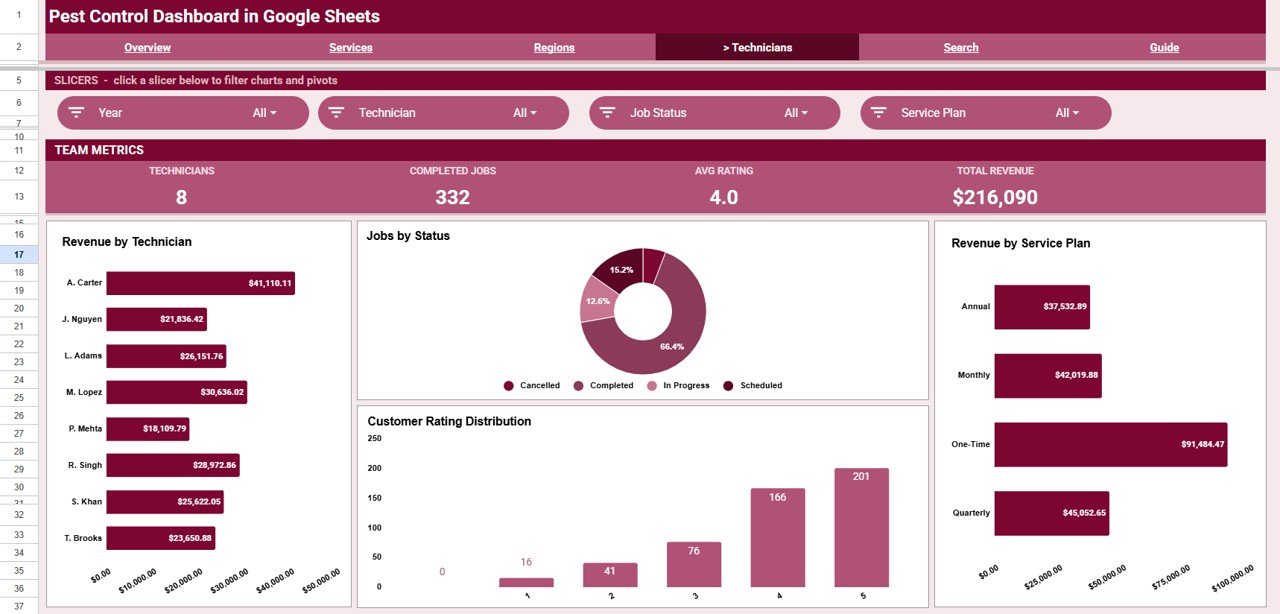
The Technicians sheet measures delivery and quality. Its cards show Technicians, Completed Jobs, Avg Rating, and Total Revenue, and its charts cover Revenue by Technician, Jobs by Status (Completed, Scheduled, In Progress, Cancelled), Customer Rating Distribution on a 1 to 5 scale, and Revenue by Service Plan (One-Time, Monthly, Quarterly, Annual). Use it to compare technician output, watch open versus completed jobs, and see how one-time and recurring plans contribute to revenue.
5. Search Sheet
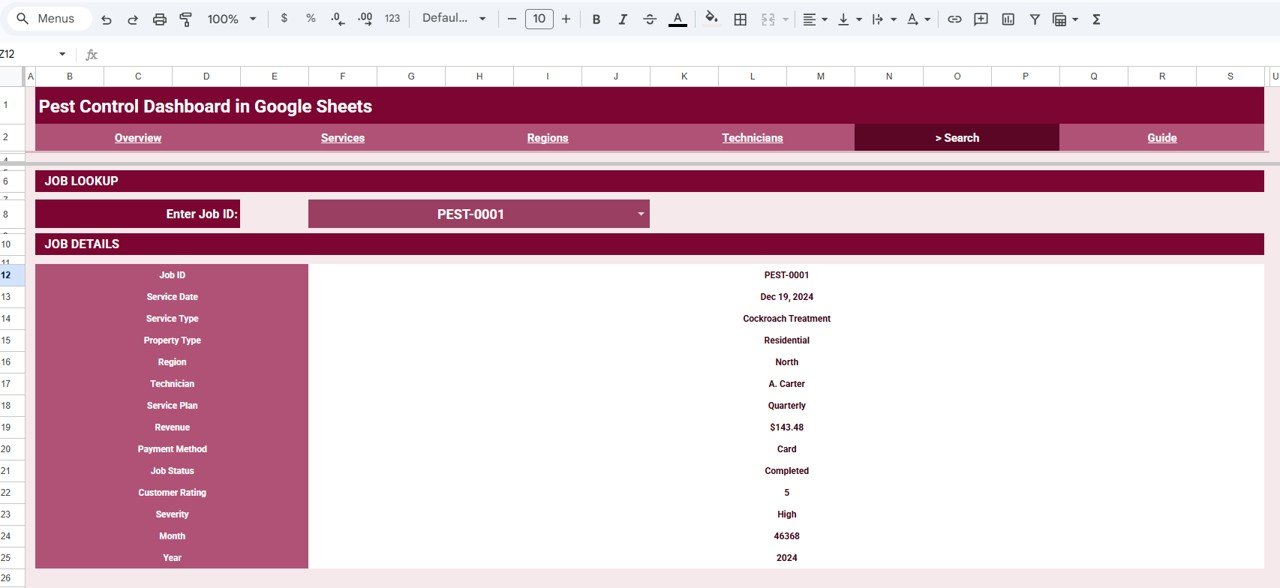
Pick any Job ID (for example PEST-0001) on the Search sheet and it returns that job’s Service Date, Service Type, Property Type, Region, Technician, Service Plan, Revenue, Payment Method, Job Status, Customer Rating, Severity, Month, and Year. It is a fast lookup without scrolling the raw data.
6. Data Sheet
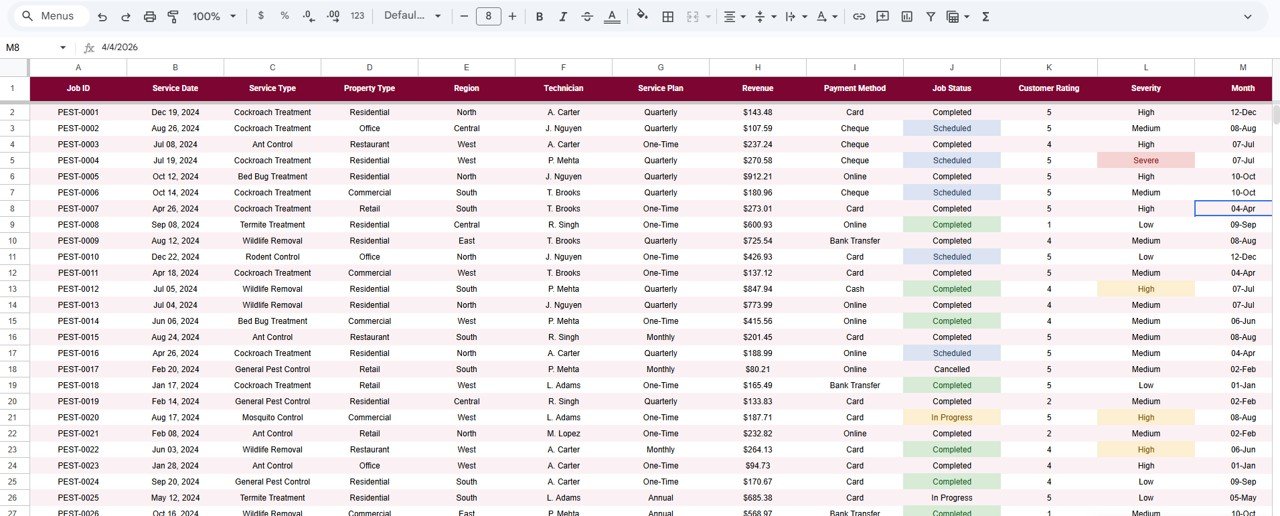
The Data sheet is the single source of truth. Each row is one job with Job ID, Service Date, Service Type, Property Type, Region, Technician, Service Plan, Revenue, Payment Method, Job Status, Customer Rating, Severity, and Month. Add new jobs in the same column layout and the Overview plus all four analysis sheets update together.
Pest Control Dashboard in Google Sheets vs. Excel vs. Paid Field-Service SaaS: Feature Comparison
| Feature | Pest Control Dashboard (Google Sheets) | Microsoft Excel Dashboard | Jobber / Housecall Pro |
|---|---|---|---|
| Cost | One-time purchase | One-time template price | Monthly subscription, often per user |
| Platform | Google Sheets (cloud, free) | Desktop Excel | Proprietary web and app |
| Setup time | Under 10 minutes | Under 10 minutes | Hours plus onboarding |
| Real-time team collaboration | Yes, built in | Limited | Yes |
| Mobile access | Yes, Sheets app | Limited | Yes |
| Customizable fields | Yes, fully editable | Yes, fully editable | No, vendor-locked |
| Share with a link | Yes | No | Yes |
| Per-technician fees | None | None | Usually charged per seat |
| Dispatch, scheduling, invoicing | No (reporting only) | No | Yes |
For pest-control operators who want clear revenue, job, and technician analytics without paying per-seat SaaS fees, the Pest Control Dashboard in Google Sheets sits in the sweet spot.
Who Should Use This Template
Perfect for:
- Independent and small-to-midsize pest-control companies tracking jobs, revenue, and technicians in one place
- Field-service owners already on Google Workspace who want analytics without new software
- Operations managers who need fast regional, service, and technician breakdowns for weekly reviews
Not a fit if:
- You need live route optimization, GPS dispatch, or automated customer SMS
- You require built-in invoicing and payment processing in the same tool
- You need enterprise role-based permissions and audit logging at scale
Real-World Use Cases
Marcus owns an eight-technician pest-control firm. He pastes last month’s jobs into the Data sheet and uses the Technicians page to compare revenue per technician and spot who has the most cancelled jobs, without paying for extra field-service seats.
Priya manages operations for a regional pest company. Every Monday she filters the Overview by region with slicers, then screenshots Revenue by Region and Monthly Revenue vs Jobs for her leadership update.
Dan is a solo operator. He uses the Search sheet to look up a customer’s last service date and severity before a callback, treating the dashboard as a combined job log and analytics tool.
Advantages of the Pest Control Dashboard in Google Sheets
The biggest advantage is cost. A single one-time purchase replaces a recurring per-seat subscription for the reporting side of the business. Because the file lives in Google Sheets, there is nothing to install and nothing to maintain.
The second advantage is speed to insight. With pivot-table-driven charts and slicers, you can move from a flat list of jobs to a filtered revenue-by-region view in seconds. The third is ownership: your data stays in your Google Drive, fully exportable and never locked behind a vendor. If you want to build similar pivot-driven reports yourself, the Pivot Tables and Dashboards course on NextGenTemplates Academy walks through the same techniques step by step.
Opportunities for Improvement
This template is an analytics and reporting tool, not an operations platform. It does not dispatch technicians, optimize routes, or send automated customer reminders, so businesses that need live scheduling will still want dedicated field-service software alongside it. It also does not process payments or generate invoices.
Because it relies on manual data entry, the quality of the dashboard depends on consistent input. Teams that paste data weekly will get far more value than those who update sporadically.
Best Practices
- Update the Data sheet on a fixed schedule (weekly works well) so trends stay current.
- Keep service types, regions, and plan names consistent to avoid splitting one category into several.
- Use the native Google Sheets slicers to build filtered views for each manager or region.
- Duplicate the file at year-end to archive each year cleanly.
Explore Relevant Templates
If you only need the headline numbers, the Pest Control Business KPI Dashboard in Google Sheets and the Pest Control Business KPI Scorecard focus on monthly targets, while the Pest Control Checklist in Google Sheets covers on-site inspections. Other service-business dashboards with the same slicer layout:
- Landscaping Dashboard in Google Sheets
- Moving Company Dashboard in Google Sheets
- HVAC Service Dashboard in Google Sheets
Prefer another platform? The same topic is available as the Pest Control Dashboard in Excel and the Pest Control Dashboard in Power BI.
Frequently Asked Questions
What KPIs does the Pest Control Dashboard in Google Sheets track?
It tracks four headline KPIs (Total Revenue, Total Jobs, Average Job Value, and Average Rating) plus breakdowns by service type, region, technician, property type, severity, job status, and service plan across its analysis sheets.
How long does it take to set up?
Under 10 minutes. Make your own copy, paste your jobs into the Data sheet using the existing columns, and the KPI cards, 14 charts, and slicers update on their own with no formula work.
Do I need Excel or paid software?
No. The Pest Control Dashboard in Google Sheets runs entirely in free Google Sheets. You only need a Google account; there is no subscription, install, or per-technician fee.
How does it compare to Jobber or Housecall Pro?
Those platforms are monthly subscriptions that handle scheduling, dispatch, and invoicing, and they keep your data inside their system. This dashboard is a one-time purchase you fully own and customize, focused on analytics rather than dispatch and invoicing.
Can my whole team use it at once?
Yes. Since it lives in Google Sheets, you can share it with your team and multiple people can view or edit simultaneously, with changes syncing in real time.
Can I add my own service types and regions?
Yes. Every field is editable. Add your own service types, regions, technicians, and plans in the Data sheet and the charts and slicers pick them up automatically.
About the Author
Built by PK, Microsoft Certified Professional with 15+ years of Excel, Google Sheets, and Power BI experience. Founder of NextGenTemplates. Every template is hand-built and tested before release.
Wrapping Up
For pest-control operators who want clear, current analytics without paying per-seat SaaS fees, the Pest Control Dashboard in Google Sheets is a practical choice. It turns your raw job log into revenue, region, technician, and service insights in minutes. Copy it, paste in last month’s jobs, and review the Overview page at your next team meeting.
Get the Pest Control Dashboard in Google Sheets
Instant download. One-time payment. No subscription.
📅 Last updated: October 2026