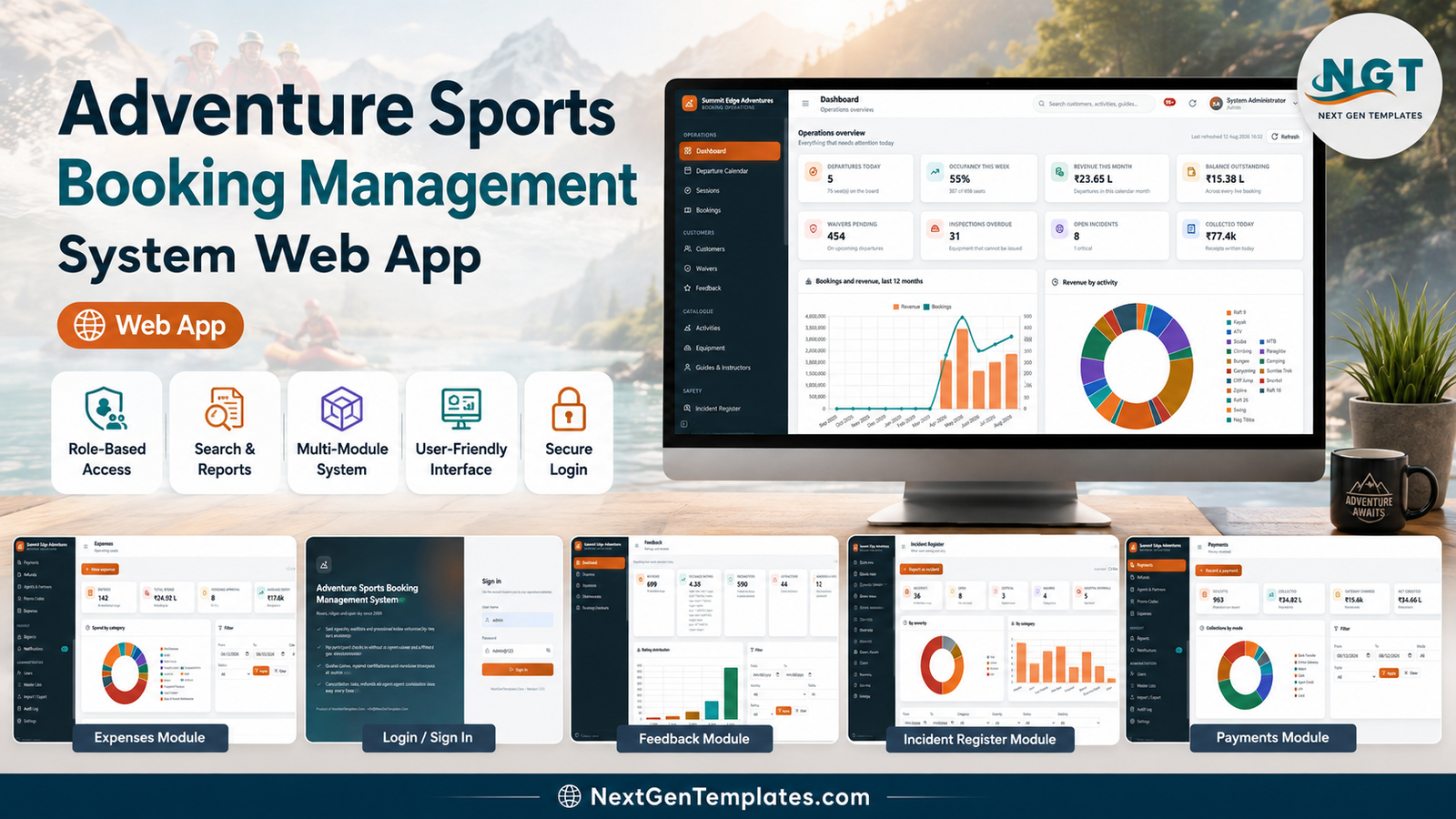
The Adventure Sports Booking Management System Web App is a 25-page operations system for adventure operators, built entirely on Google Apps Script and Google Sheets. It ships with 7 role-based user accounts, 24 configurable master lists holding 187 values, 24 operating reports and a fully seeded demo database of 430 customers, 18 activities, 619 sessions, 994 bookings and 5,843 waivers. You deploy it into your own Google account, so there is no server to rent and no per-seat licence.
Adventure operators lose money in four specific places: seats sold twice, participants who board without a signed waiver, gear issued past its inspection date, and refunds argued over case by case. None of those are analysis problems – they are enforcement problems. This system is built to enforce them at the point of entry rather than report on them afterwards.
Get the Adventure Sports Booking Management System Web App
🚀 Try the Live Demo Before You Buy
We have deployed this web app in our own Google account so you can test every page, every role and every report – with the full sample data set of 430 customers, 619 sessions and 994 bookings – before purchasing. No signup, no email required.
🔑 Test Login Credentials – All 7 Roles
Sign in as admin to reach all 25 pages including Users, Master Lists, Settings and the Audit Log. Then sign out and try safety – it lands on the waiver register, the equipment inspection list and the incident log, and genuinely cannot reach anything else. That is the role separation this system is built around, and the demo is the fastest way to see it.
💡 What you get after purchase: the full source code (Code and Index files) plus the complete user manual and a step-by-step deployment guide, so you can deploy your own private instance in your own Google account in under 30 minutes. The demo is shared and resets periodically – your instance is yours alone.
Key Features of the Adventure Sports Booking Management System Web App
- Seat capacity enforced by the system. Every activity carries a capacity, a per-guide ratio and age and weight limits. Bookings take provisional holds that expire on the schedule you set, and expired holds are released in one action.
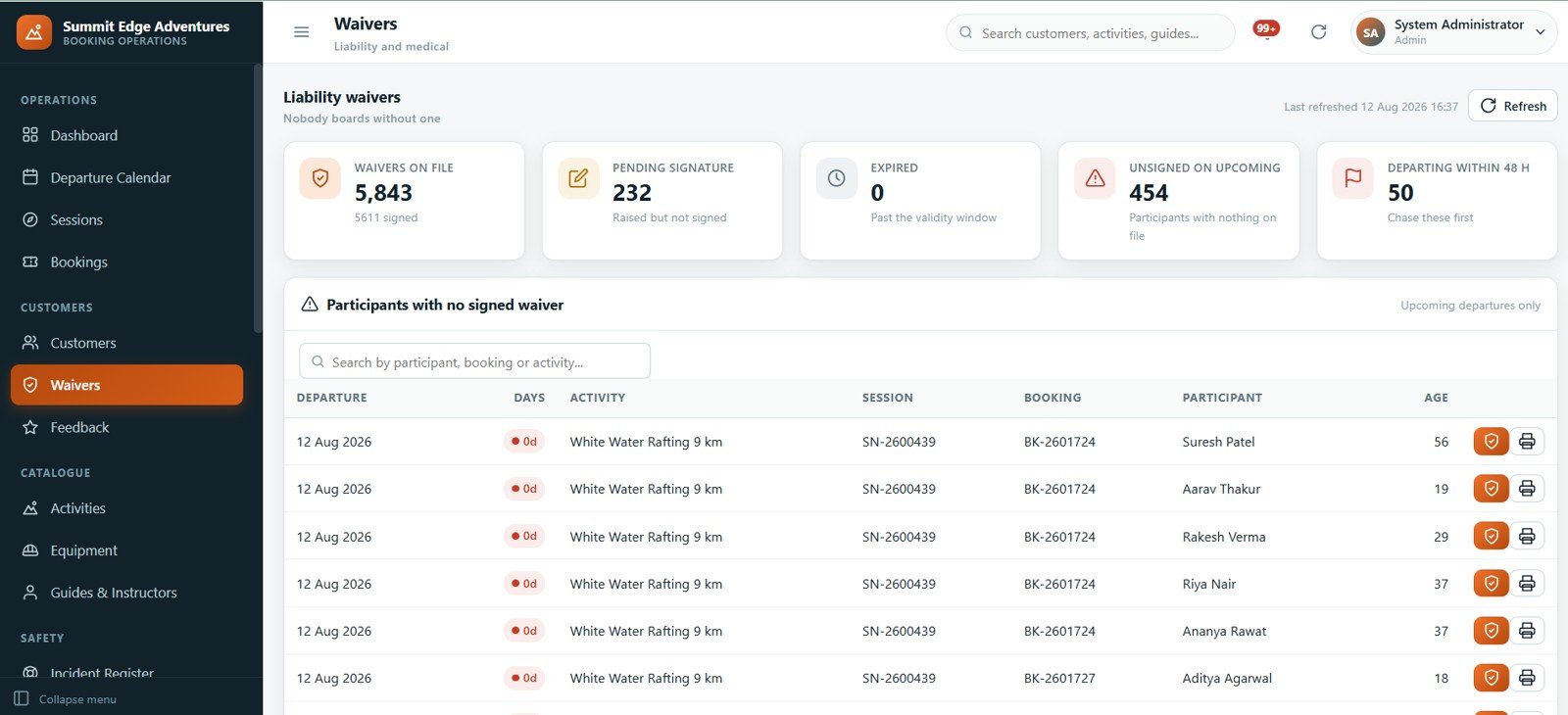
- A waiver register that blocks boarding. The Waivers page lists every participant with nothing signed, ordered by days to departure, with a separate count for departures inside 48 hours. The demo data carries 5,843 waivers on file and 454 unsigned participants on upcoming trips.
- Equipment that cannot be issued when overdue. 71 items with inspection intervals, condition and serial numbers. An item 31 days past inspection shows as Blocked and stays that way until it is signed off.
- Guide certifications policed automatically. 22 team members with certification bodies and expiry dates. An expired certification stops that guide leading a session; a configurable warning window flags the ones about to lapse.
- One cancellation policy, applied identically every time. Five refund bands, all editable, with the refund figure calculated and shown before you confirm.
- Agent, OTA and corporate commission. 12 partners with per-partner rates on base fare or grand total, plus lifetime business sent, commission earned, commission due and agreement-expiry flags.
- Server-side role security. Every entry point re-checks the caller’s session and role before touching data, and passwords are stored only as salted SHA-256 hashes.
- Live alerts. The Notifications page rebuilds 306 alerts across money, bookings and safety, surfacing the 62 critical ones first.
Three numbers worth stating plainly: 25 pages, 24 reports, 7 roles. Everything below is inside that, and all of it is open in the live demo above.
Template Structure – Page by Page
All 25 pages, in the order they appear in the sidebar.
Sign In – Role-Based Access
Seven seeded accounts cover a whole operation: Admin, Operations Manager, Booking Agent, Lead Guide, Guide, Accounts and Safety Officer. Each role sees a different subset of the 25 pages, and guide accounts can be linked to a specific guide record so a guide sees only their own sessions.
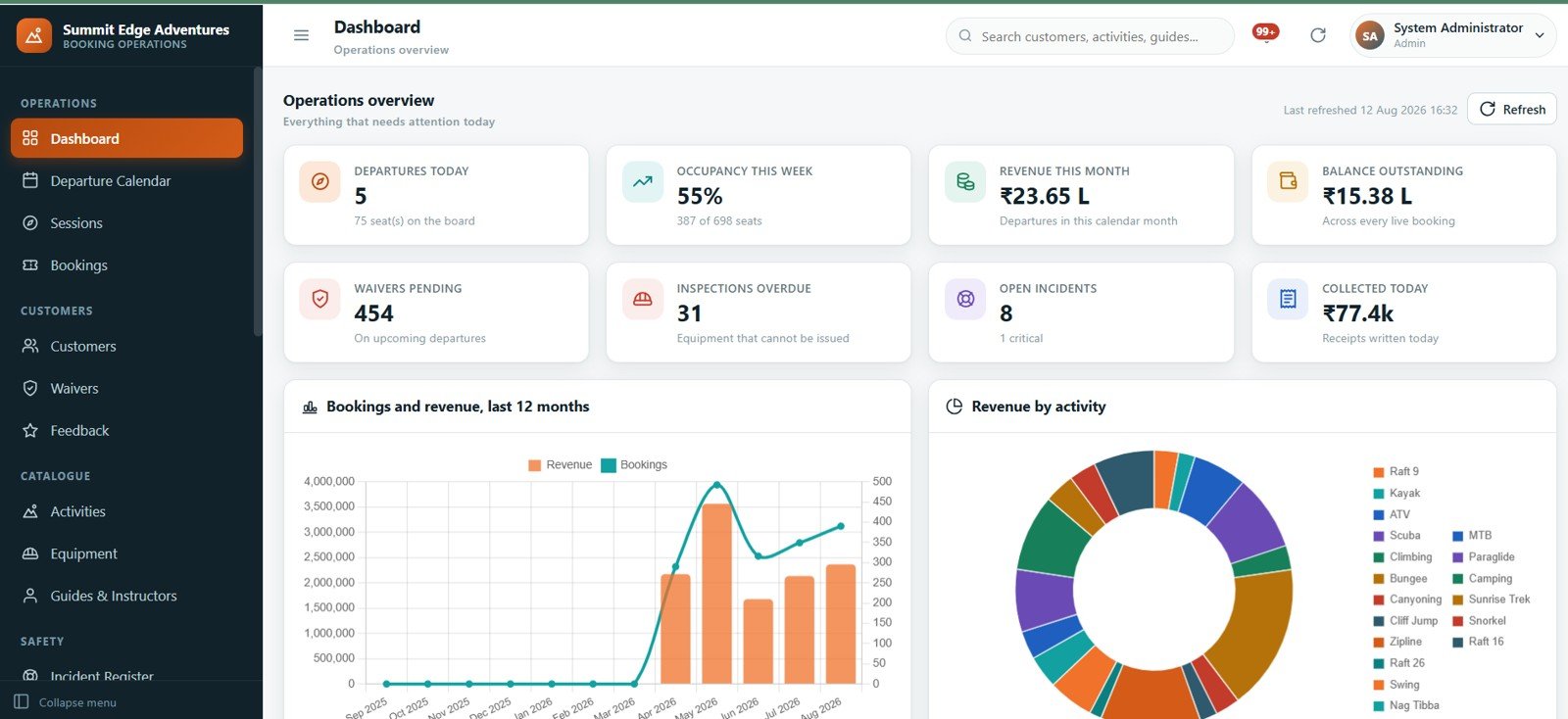
Dashboard – Everything That Needs Attention Today
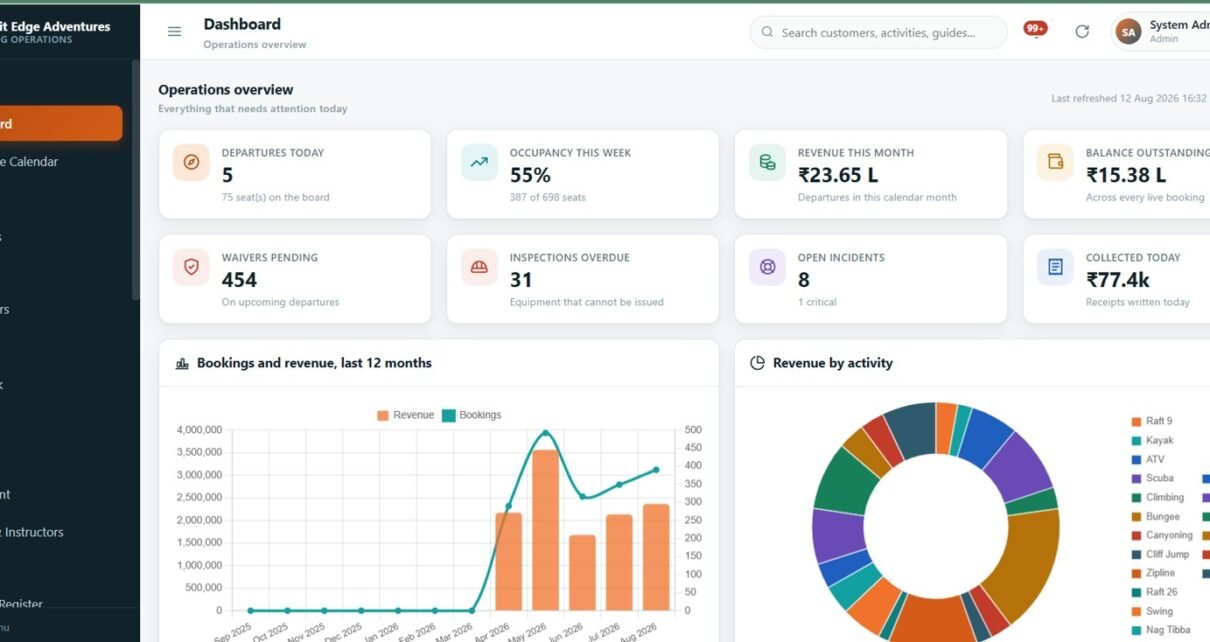
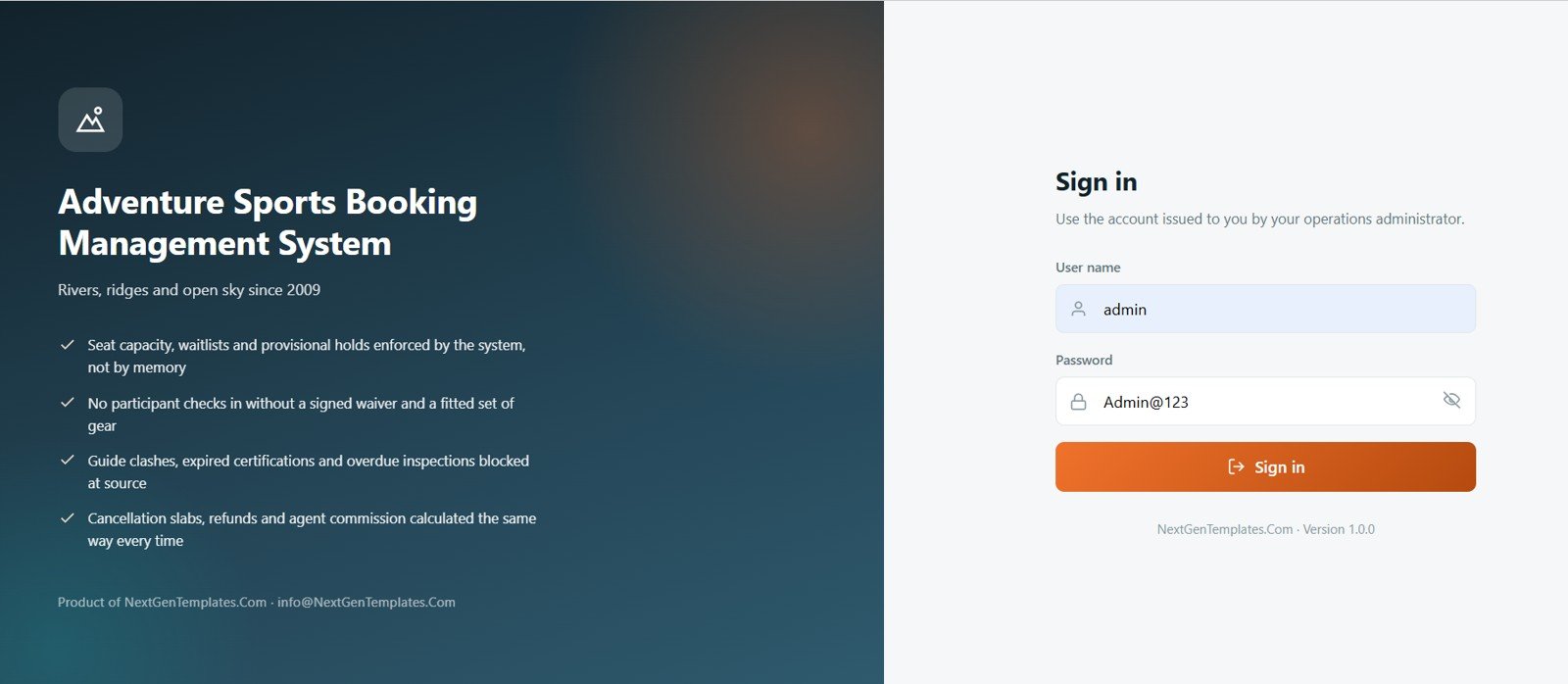
Eight cards: departures today, occupancy this week, revenue this month, balance outstanding, waivers pending, inspections overdue, open incidents and cash collected today. Beneath them, a 12-month bookings-and-revenue chart and a revenue-by-activity donut covering all 18 activities.
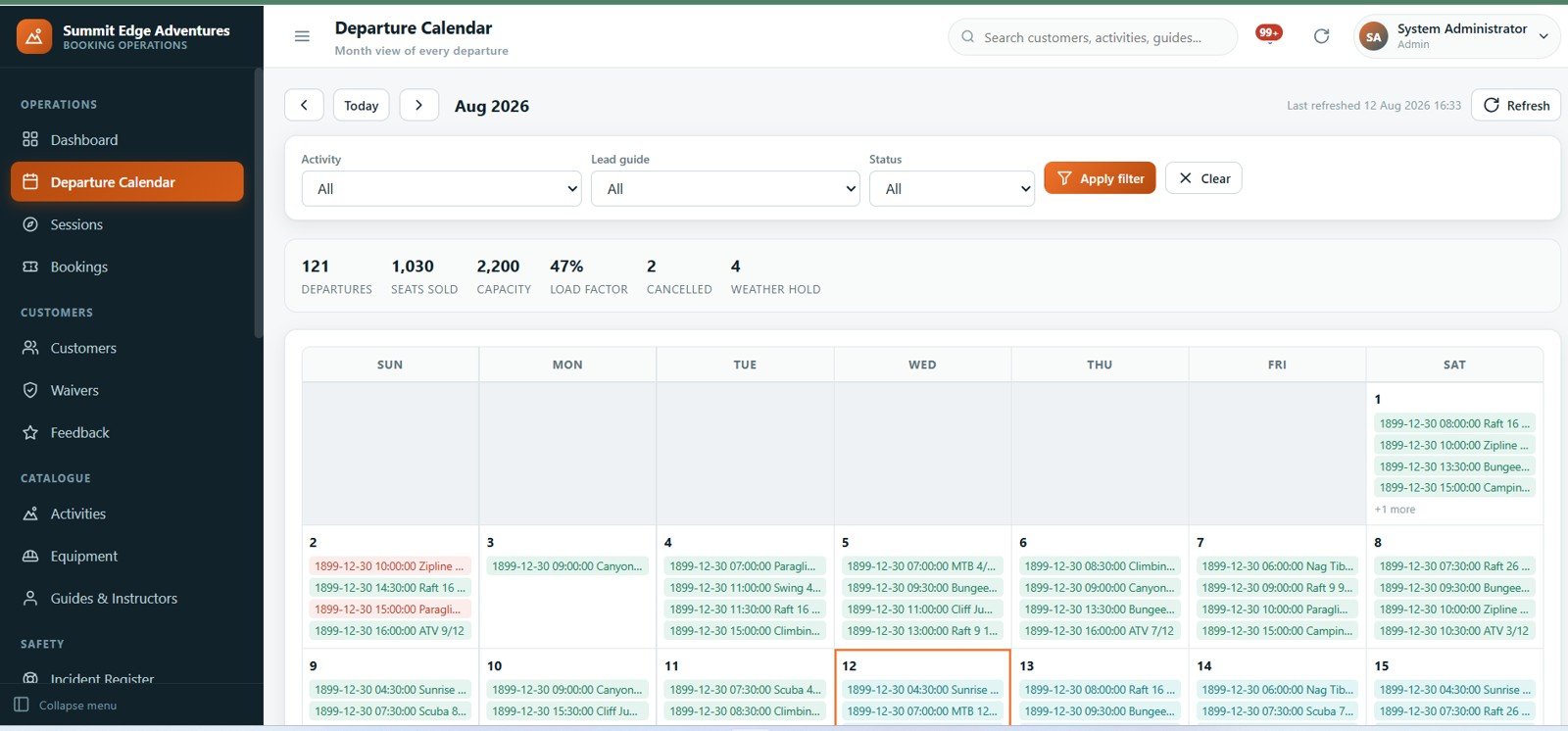
Departure Calendar – Month View of Every Departure
A month grid of every departure, filterable by activity, lead guide and status, with a strip reporting departures, seats sold, capacity, load factor, cancellations and weather holds for the month on screen.
Sessions – Scheduled Departures
Create sessions individually or use the schedule generator to lay out a whole season at once. Each row shows date, time, session number, activity, meeting point, lead guide, seats sold against capacity, a fill bar and status, with cards flagging sessions below the minimum to run and sessions with no lead guide assigned.
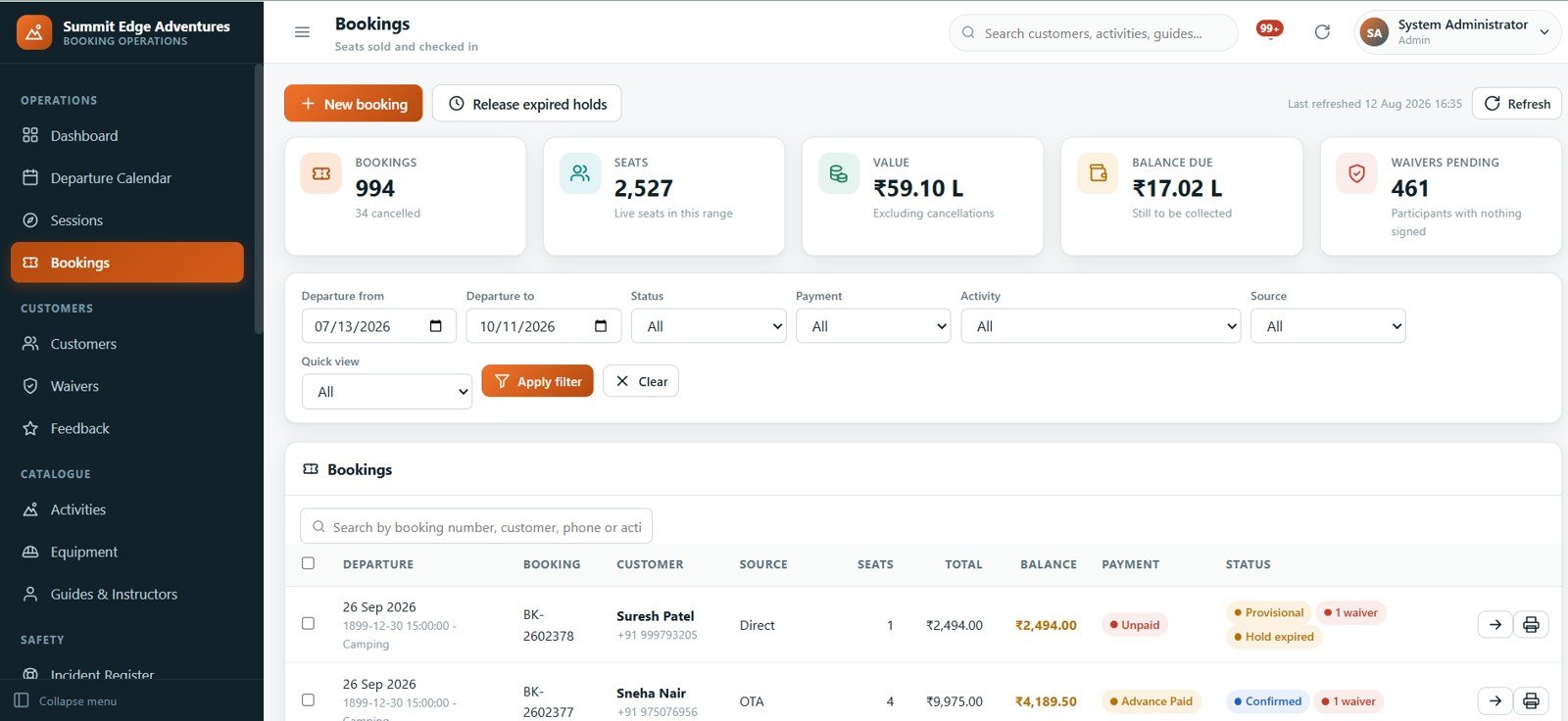
Bookings – Seats Sold and Checked In
The booking register carries source (direct, OTA, agent, phone), seats, total, balance, payment state and status badges for provisional, confirmed, hold expired and waiver outstanding. Filters cover departure range, status, payment, activity and source.
Customers – The Guest Register
430 records with customer code, phone, email, city, booking source, bookings taken, lifetime spend, loyalty tier and last activity date, filterable by status, tier, source, partner and city.
Waivers – Nobody Boards Without One
5,843 waivers on file, with counts for pending signature, expired, unsigned on upcoming departures and departing within 48 hours. The table lists every participant with nothing signed, ordered by days to departure, so the front desk knows who to chase first.
Feedback – Ratings and Reviews
699 reviews with average rating, promoter and detractor counts, a rating distribution chart and a queue of reviews awaiting a reply, filterable by date, activity, guide and rating.
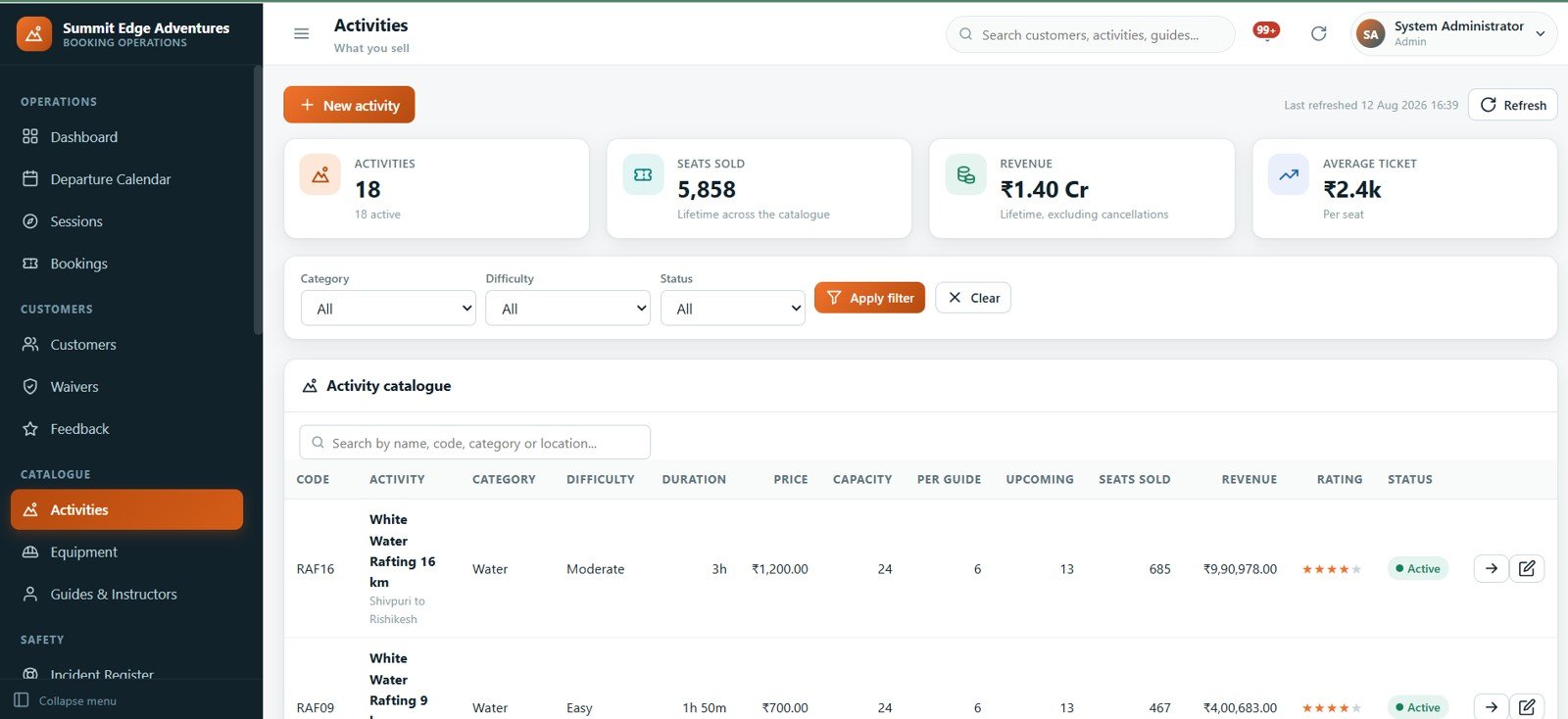
Activities – What You Sell
18 activities with code, category, difficulty, duration, price, capacity, guides required per ratio, upcoming departures, seats sold, lifetime revenue, rating and status – plus the safety briefing checklist behind each one.
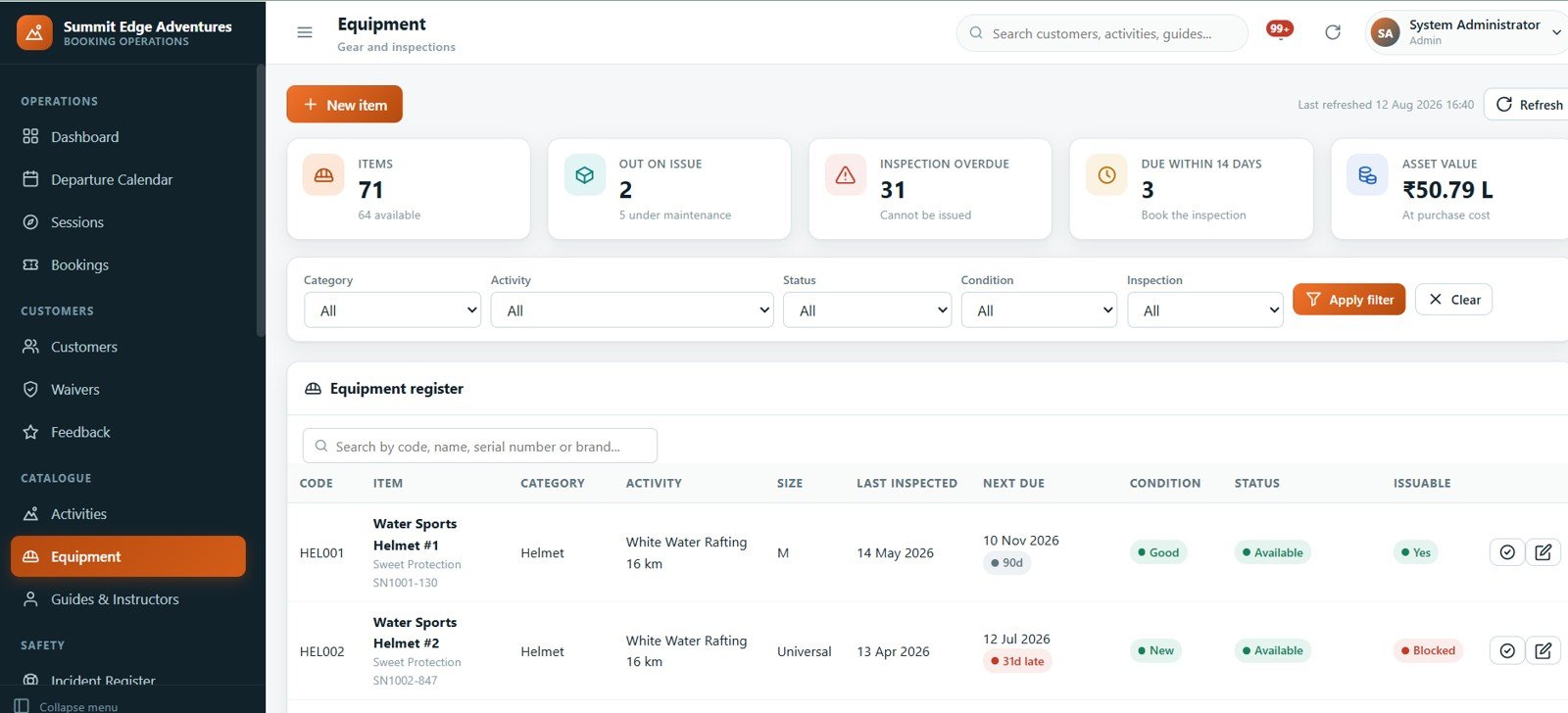
Equipment – Gear and Inspections
71 items tracked by code, brand, serial number, size, category and the activity they belong to, with last inspected and next due dates, condition, availability and an issuable flag. Anything past its inspection date is Blocked and cannot be issued to a departure.
Guides & Instructors – Team and Certifications
22 team members with designation, what they are qualified for, certifying body, certification expiry, years of experience, sessions led, upcoming sessions and rating. Expired certifications are flagged and stop that guide leading a session.
Incident Register – What Went Wrong and Why
36 incidents classified by severity and by category: weather, injury, lost property, near miss, complaint, medical, equipment failure and other. Cards report open, critical, injury and hospital-referral counts, so a safety officer can see the shape of a season at a glance.
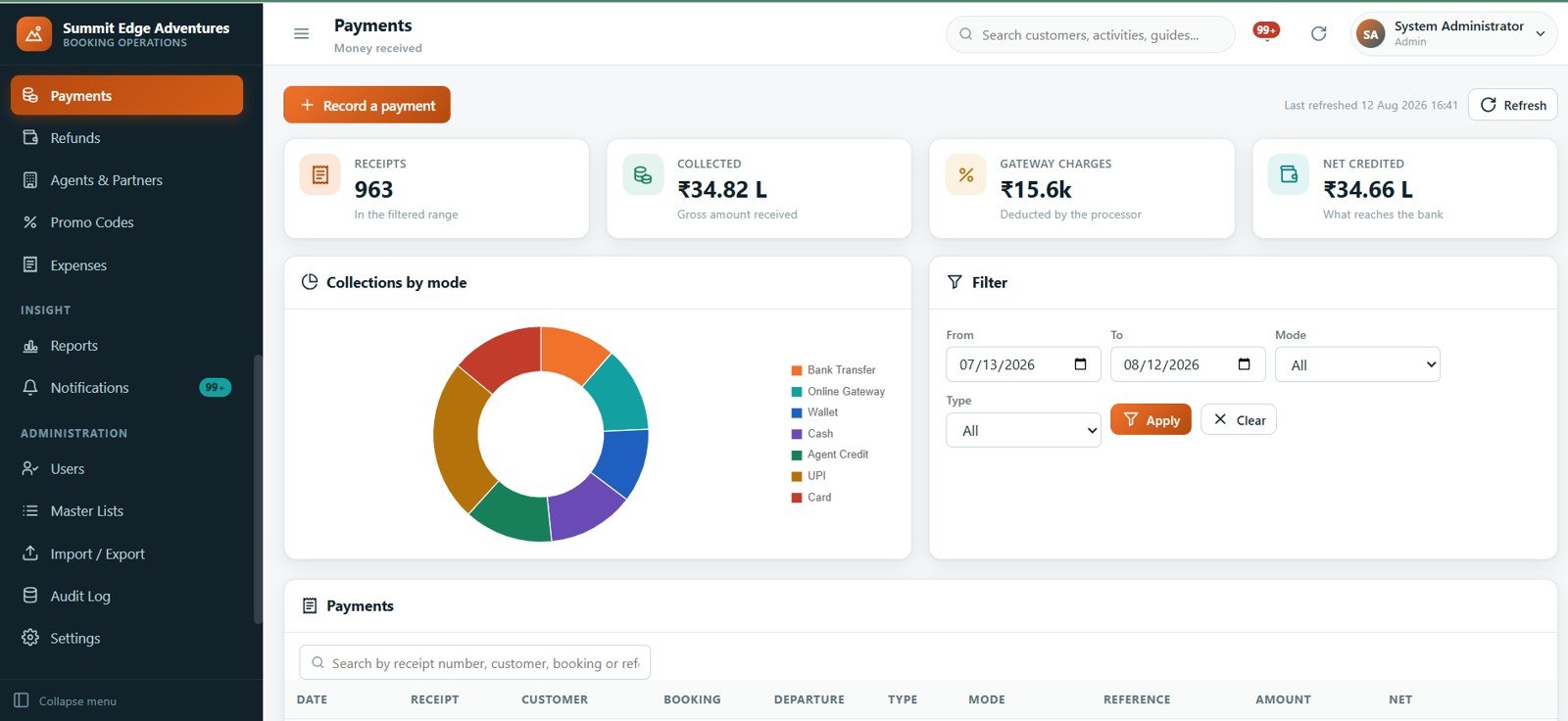
Payments – Money Received
963 receipts with a collections-by-mode breakdown across bank transfer, online gateway, wallet, cash, agent credit, UPI and card. Gross collected, gateway charges and net credited are reported as three separate figures – the three numbers that rarely match.
Refunds, Agents & Partners, Promo Codes and Expenses
Refunds shows the five-band cancellation policy in force above 171 settled refunds. Agents & Partners covers 12 corporate, travel-agent and OTA partners with per-partner commission rates, business sent, commission earned and commission due. Promo Codes covers 10 campaigns with percent or flat value, minimum booking, scope, validity, usage cap and discount given. Expenses tracks 142 entries across 12 categories with tax and an approval state.
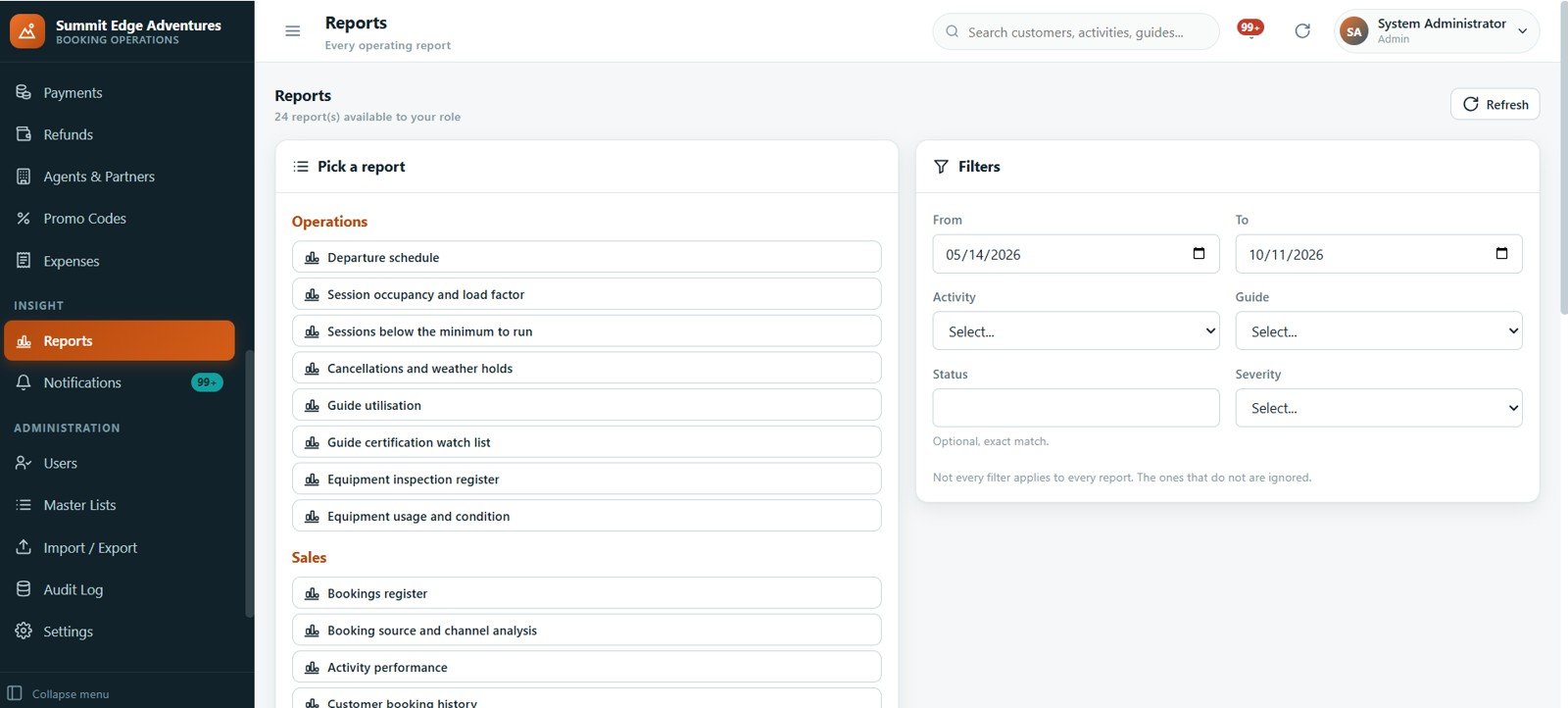
Reports – 24 Operating Reports
Grouped into Operations, Sales and beyond: departure schedule, session occupancy and load factor, sessions below the minimum to run, cancellations and weather holds, guide utilisation, guide certification watch list, equipment inspection register, equipment usage and condition, bookings register, booking source and channel analysis, activity performance and customer booking history. Each report respects the date, activity, guide, status and severity filters.
Notifications – What Needs Attention
306 alerts rebuilt live from the data and targeted at your role, split across money, bookings and safety, with 62 critical ones surfaced first and each row linking straight to the record that raised it.
Settings – Company Profile and Policy
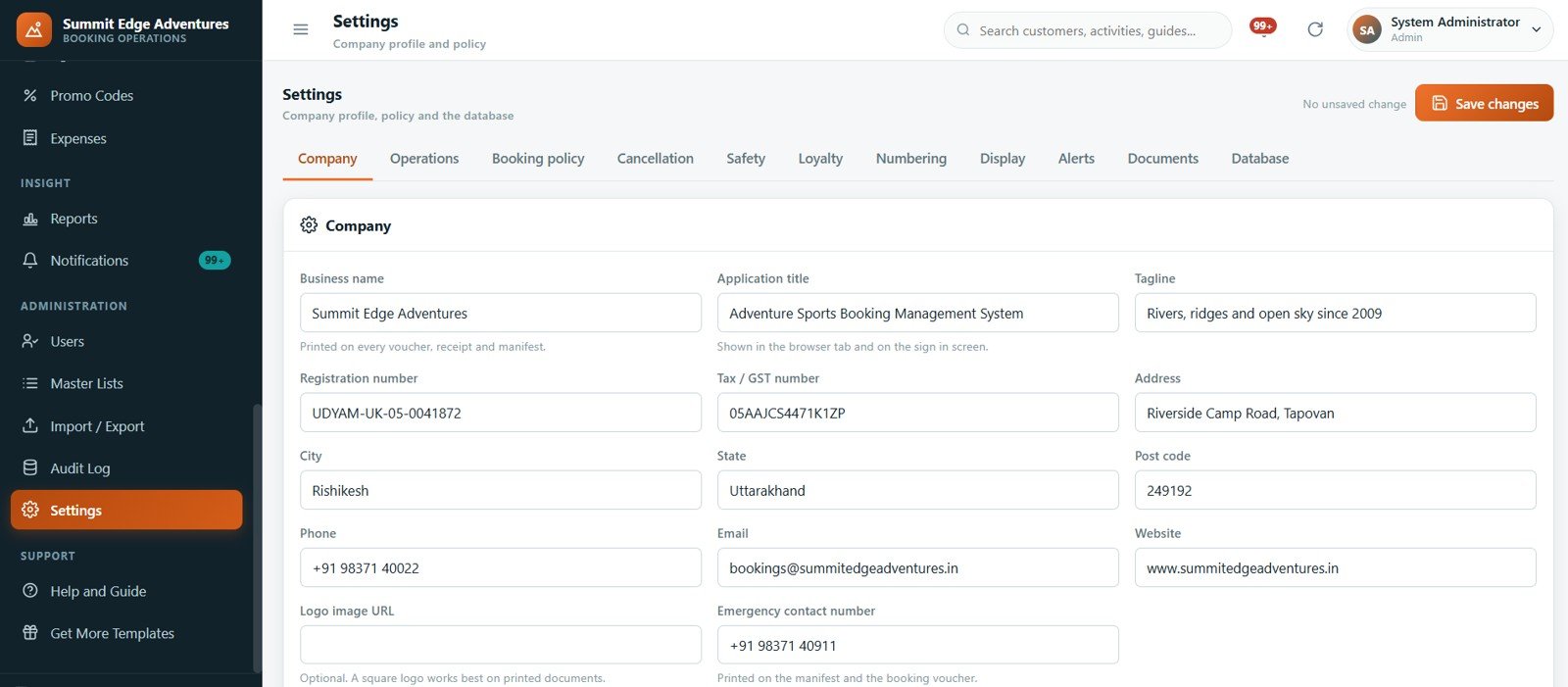
Eleven tabs: Company, Operations, Booking policy, Cancellation, Safety, Loyalty, Numbering, Display, Alerts, Documents and Database. This is where the currency, surcharges, hold expiry, refund bands, print size and document templates live.
Users, Master Lists, Import/Export and Audit Log
Users manages accounts and roles. Master Lists holds 24 dropdown lists and 187 values, so meeting points, payment modes, expense categories and incident types are edited without touching code. Import/Export moves any table in or out as CSV, validating every row on its own so one bad line does not stop the rest. The Audit Log records who did what, when, and to which record.
Help and Guide
An in-app guide covering the recommended setup order, the session lifecycle, the booking lifecycle and how a refund is worked out, so a new front-desk hire can find the answer without calling you.
The Two Lifecycles That Run the System
The session lifecycle: Scheduled (created by hand or by the recurring generator) then Filling or Full (derived from seats sold against capacity), then optionally Weather Hold (paused with a reason, released when conditions improve), then Departed (which requires a lead guide, every mandatory safety step closed, and enough guides for the ratio), then Completed. A Cancelled session cascades to every booking on it with a full refund raised automatically.
The booking lifecycle: Enquiry (interest recorded, no seat held), then Provisional (seats held until the hold expiry set in Settings), then Confirmed once the advance is collected, then checked in and Completed – or No Show. Every state change is stamped with who moved it and when.
Adventure Sports Booking Web App vs. a Google Sheets Tracker vs. FareHarbor / Peek Pro / Checkfront – Feature Comparison
| Feature | Adventure Sports Booking Management System Web App | Google Sheets booking tracker | FareHarbor / Peek Pro / Checkfront |
|---|---|---|---|
| Cost | $39.99 one-time | $7-19 one-time | Monthly fee or a commission on every booking |
| Platform | Your own Google account, browser-based | Google Sheets | Vendor-hosted |
| Setup time | Under an hour to deploy and configure | Minutes | Days, usually with an onboarding call |
| Role-based accounts | Yes – 7 roles, checked server-side | No – whoever has the link sees everything | Yes, per seat |
| Waivers that block boarding | Yes, built in | A manual column at best | Yes, often a paid add-on |
| Equipment inspection blocking | Yes – overdue gear cannot be issued | No | Rarely included |
| Guide certification expiry control | Yes – expired certs cannot lead | No | Varies by tier |
| Agent and OTA commission | Yes – per-partner rates and payouts | Manual | Yes |
| Year-1 cost at 5 users | $39.99 total | Under $20 | Several hundred to several thousand |
| Who owns the data | You – it sits in your own Google Sheets | You | Vendor |
For operators who want real booking control without handing over a percentage of every seat sold, the Adventure Sports Booking Management System Web App sits in the sweet spot.
Who Should Use This Template
Perfect for:
- Rafting, trekking, paragliding, bungee, zipline, scuba, ATV and mountain-biking operators running 5 to 200 departures a month
- Multi-activity companies that need one booking desk across water, aerial, mountain, motor and underwater categories
- Operators with a real safety obligation – waivers, gear inspections and guide certifications they must be able to evidence
- Businesses selling through travel agents, corporate clients and OTAs who need commission calculated rather than argued about
- Teams that want role separation between front desk, accounts, guides and a safety officer
Not a fit if:
- You need a public-facing booking page that takes card payments at checkout – this is the back office, not the storefront
- Your guides need an offline mobile app at a trailhead with no signal
- You process thousands of bookings a day, where a dedicated database will simply be faster
- Policy prevents you holding customer data in a Google account
Real-World Use Cases
Vikram runs a rafting and kayaking outfit with eight guides. Seat counts used to live in a WhatsApp group, and two staff once sold the same raft. Capacity is now enforced at booking time, expired holds are released in one click each morning, and the guide certification watch list flagged a lead instructor’s lapsed ABVIMAS certification before the trip rather than after it.
Anjali handles accounts for a multi-activity operator with three OTA partners. She reconciles 963 receipts across seven payment modes and reads gateway charges separately from what actually reached the bank. Commission due per partner is a figure the system produces, so the monthly payout conversation takes minutes instead of an afternoon of spreadsheet archaeology.
Tenzin is the safety officer. His sign-in shows only safety pages: the waiver register, the equipment inspection list and the incident log. The 31 overdue inspections on his dashboard are a work queue, and blocked gear cannot be issued to a departure while it sits there. You can see exactly this by signing into the demo above as safety.
Advantages of the Adventure Sports Booking Management System
- Enforcement, not reporting. Overselling, unsigned waivers, overdue gear and lapsed certifications are blocked at the point of entry, not discovered in a month-end review.
- No commission on your revenue. Platforms that charge a percentage of every booking cost more the better you do. A one-time purchase does not.
- Configuration, not code. 24 master lists, five refund bands, numbering formats, alert thresholds and eleven settings tabs are all edited through the interface.
- Genuine role separation. Because the checks are server-side, a guide account cannot reach the accounts pages even by typing the URL.
- Your data stays yours. Everything sits in Google Sheets in your own Drive, exportable to CSV per table at any time.
Opportunities for Improvement
Worth knowing before you buy. This is a back-office system, not a storefront: there is no public booking widget and no card capture at checkout, so online payment still happens wherever it happens today and gets recorded here. Being Apps Script, it is also subject to Google’s Apps Script quotas – generous for an operator’s daily volume, but a real ceiling at very high transaction rates.
The interface is responsive but designed for a desk or tablet rather than a phone at a riverbank, and it needs connectivity – there is no offline mode for guides in a gorge. One small cosmetic point in the shipped build: the Average Rating card on the Feedback page renders its star markup as text instead of stars. The underlying 4.38 figure is correct and every other page renders cleanly.
Best Practices
- Open the live demo first and sign in as each of the seven roles. It takes ten minutes and tells you more than any feature list.
- Configure Settings first – company profile, currency, numbering, cancellation slabs and safety rules – before you enter a single booking. Changing numbering later is messy.
- Load guides and their certification expiry dates before activities, so the ratio and certification checks work from day one.
- Set the hold expiry to match how you actually sell. A 24-hour hold on a same-week departure gives seats away.
- Run Release expired holds as a morning routine, before you look at occupancy.
- Give the safety officer their own account rather than sharing the admin login – the audit log is only useful if actions map to people.
- Use Import/Export to bring in your existing customer list rather than typing 400 records.
- Change every seeded password immediately after deployment.
Explore Relevant Templates
- Car Rental Management System Web App – the same Apps Script architecture applied to a rental fleet.
- Catering Business Management System Web App – event-driven bookings with staffing and costing.
- Sports and Recreation Dashboard in Google Sheets – a reporting layer if you only need the analytics.
- Fitness and Wellness Dashboard in Google Sheets – for membership-led operations.
- Adventure Trip Gear Checklist in Google Sheets – a lightweight companion for kit lists.
- Browse every Web App template on NextGenTemplates.
Get the Adventure Sports Booking Management System Web App
Want to build spreadsheet skills like this step by step? The NextGenTemplates Academy learning paths walk you through trackers and management systems with practice files.
Frequently Asked Questions
Can I try it before buying?
Yes. The live demo linked near the top of this post is a full deployment of the Adventure Sports Booking Management System Web App with all 25 pages, the complete sample data set and all seven role logins. No signup and no email address are required.
What do I actually download?
A zip containing the Apps Script code file, the HTML interface file, the login details and a full user manual. The Adventure Sports Booking Management System Web App is deployed into your own Google account, so there is no hosting to buy and no monthly fee attached to it.
How long does setup take?
Deploying the script takes under 30 minutes with the included tutorial video, and configuring your company profile, cancellation slabs, activities, guides and equipment typically takes another hour. The system ships fully seeded, so you can explore all 25 pages before loading your own data.
Do I need to know how to code?
No. You paste two files into a new Apps Script project and click Deploy. Every operating rule in the Adventure Sports Booking Management System Web App – master lists, refund bands, numbering formats, alert thresholds – is edited through the interface, never in the code.
How does this compare to FareHarbor or Peek Pro?
Those platforms include a public booking widget and card processing, and charge either a monthly fee or a commission on every booking. The Adventure Sports Booking Management System Web App is a one-time purchase back-office system covering sessions, seats, waivers, gear, guides, payments and commission – but it does not take card payments from the public.
Can several people use it at the same time?
Yes. Seven role accounts are seeded and you can add more. Every server call re-checks the caller’s session and role, so a guide account cannot reach the accounts pages even by typing the URL directly – something you can verify yourself in the live demo.
Does it handle weather cancellations?
Yes. A session can be placed on Weather Hold with a reason and released when conditions improve. Operator and weather cancellations sit in their own refund band at 100%, and cancelling a session cascades to every booking on it with refunds raised automatically.
Can I change the currency and the printed documents?
Yes. Currency, surcharges, numbering formats, print size and document templates all live under Settings. The demo data uses Indian Rupees; change it once and every page, voucher and receipt follows.
About the Author
Built by PK – Microsoft Certified Professional with 15+ years of Excel, Google Sheets and Power BI experience. Founder of NextGenTemplates, reaching 300K+ subscribers across YouTube channels. Every template is hand-built and tested before release.
Conclusion
If your booking desk currently runs on a spreadsheet, a WhatsApp group and somebody’s memory, the Adventure Sports Booking Management System Web App replaces all three with a system that enforces capacity, waivers, gear inspections and guide certifications at the point of entry. It deploys into your own Google account, costs nothing per booking, and the data stays yours. Try the demo above before you decide.
✅ Instant download · One-time payment · No subscription · Lifetime access
📅 Last updated: August 2026