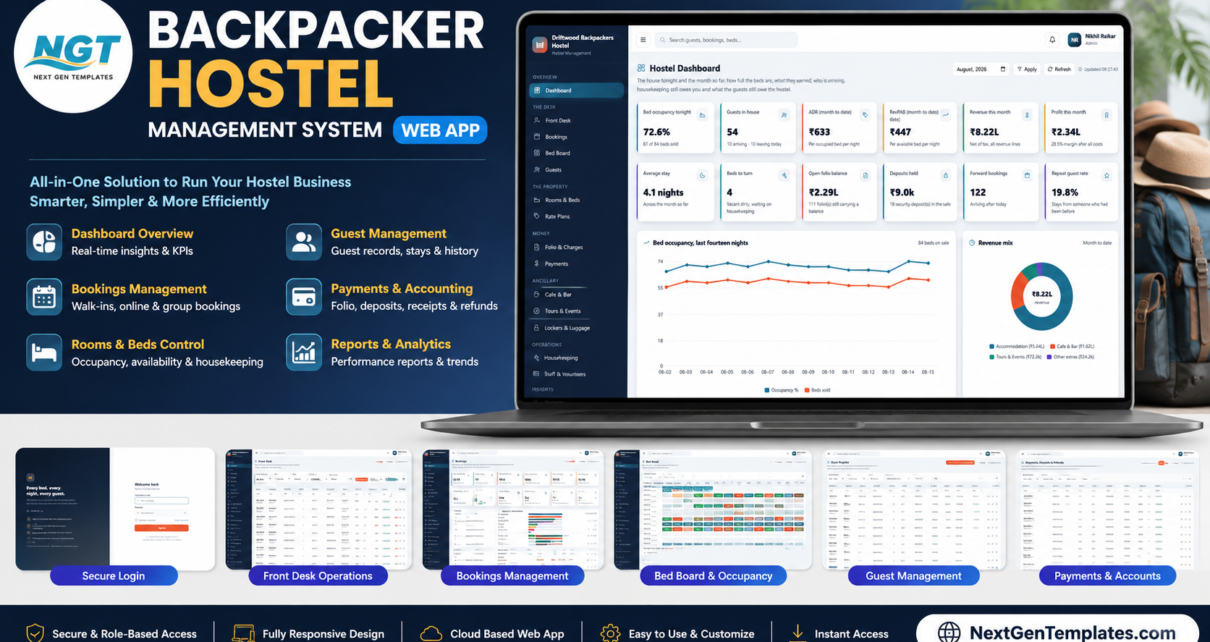
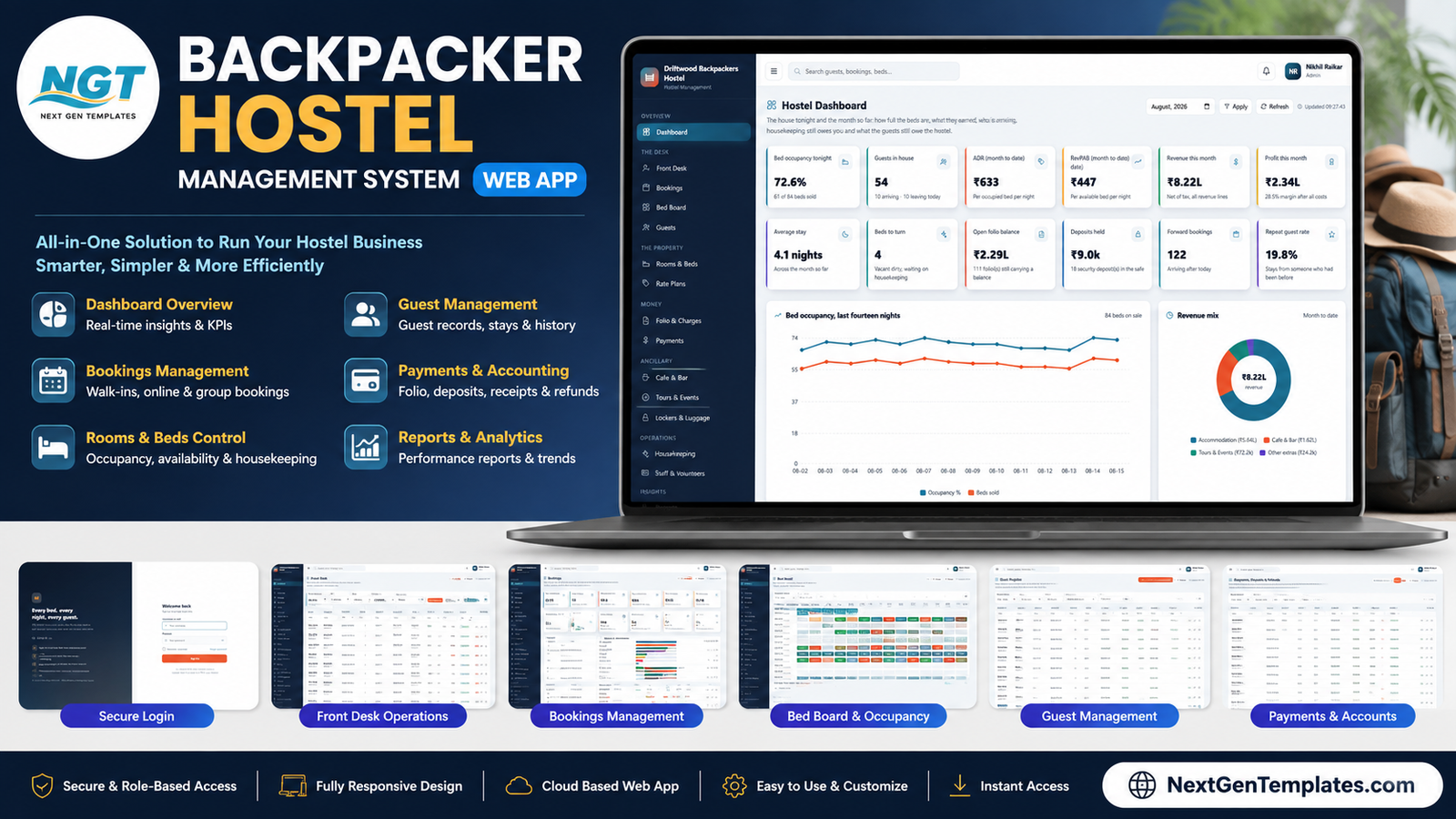
A hostel does not sell rooms. It sells beds — and a twelve-bed mixed dorm is twelve independent sellable units, each on its own rate, each with its own folio, each with its own housekeeping state. Every tool built around rooms gets this wrong, which is why so many hostels end up running a whiteboard and a shared spreadsheet instead. The Backpacker Hostel Management System Web App is built the other way round: bed-level inventory from the ground up, delivered as one Google Apps Script web app with a Google Sheet behind it.Backpacker Hostel Management System Web App
Press one button and setup builds 27 sheets and 13,498 seeded rows — 86 beds across 16 rooms, 10 rate plans, 1,130 guests, 1,315 bookings, 2,076 bed assignments, 2,602 folio charges, 1,493 payments, 74 lockers, 42 cafe products, 18 tours and 24 staff. That data is generated by a night-by-night simulation of the house rather than by random rows, so on the very first sign-in the dashboard shows a coherent trading day: 72.6% bed occupancy, 54 guests in house, an average stay of 4.1 nights, and ADR sitting sensibly above RevPAB.Backpacker Hostel Management System Web App
Get the Backpacker Hostel Management System Web App
Access is issued by the hostel manager — there is no public sign-up, and a locked account can only be released by an administrator.

🚀 Try the Live Demo Before You Buy
We have deployed this web app in our own Google account so you can test every page, every role and every one of the ten server rules — with real sample data — before purchasing. No signup, no email required.
🔑 Test Login Credentials
Sign in as admin to see every module including User Management and the Audit Log, then sign in again as volunteer to see how little a work-exchange volunteer can reach. The role separation is the product, and thirty seconds in the most restricted account demonstrates it better than any feature list. All seven seeded accounts are below.
💡 These credentials are public on purpose. They are the seeded logins of one shared demo instance that resets — not a customer’s hostel. What you get after purchase: the full source code (Code.gs + Index.html) plus a step-by-step deployment guide, so you can deploy your own private instance in your own Google account in under 15 minutes.
Key Features of the Backpacker Hostel Management System Web App
- Bed-level inventory. Property → Room → Bed. Occupancy, ADR and RevPAB are all computed per bed, never per room.
- A fourteen-night bed board with every bed down the side and each cell colour-coded by state.
- Ten rules enforced in Code.gs, not in the browser — so no amount of clicking, or editing a URL, gets around them.
- Accommodation charges post themselves from nights × nightly rate on the bed assignment, and can never be typed by hand.
- Seven roles and twenty-two permissions, with a matrix that drives both the sidebar and the server-side checks.
- Ancillary revenue that settles with the bed — cafe tickets, tour seats, locker hire and luggage storage all push onto the guest folio.
- Seventeen reports, each filtered by date, charted, and exportable to Excel or CSV.
- Thirty-nine editable dropdown lists holding 225 values, all maintained without touching code.
- A full audit log that cannot be edited from the interface, plus a database archive that trims only closed trading.
Application Pages Explanation
Twenty working modules sit in eight sidebar groups. Here are the ones that carry the weight.
Hostel Dashboard
Twelve cards for the house tonight and the month so far: bed occupancy, guests in house, ADR, RevPAB, revenue, profit, average stay, beds still to turn, open folio balance, deposits held, forward bookings and repeat-guest rate. Underneath sit a fourteen-night occupancy line, a revenue-mix ring split across accommodation, cafe, tours and extras, a forward-occupancy curve, a booking-channel bar chart and a nationality breakdown of who is actually in the house.

Front Desk
Deliberately one day at a time. Beds sold, free beds tonight, arrivals, departures, guests in house and balance in house across the top; then three tabs — Arriving, Departing, In house — and the two buttons that move a guest between those states. Each arrival row shows the channel, the beds allocated, the ETA, whether ID is on file and what is still owed, so the person on the desk can see the whole picture without opening anything.Backpacker Hostel Management System Web App

Bed Board
The fortnight grid, and the page that justifies the whole architecture. Rooms are broken out bed by bed, each cell is one bed for one night, and the housekeeping state is printed under each bed code so you can tell instantly which units are genuinely sellable. An occupancy line across the board sits above it.

Guest Register
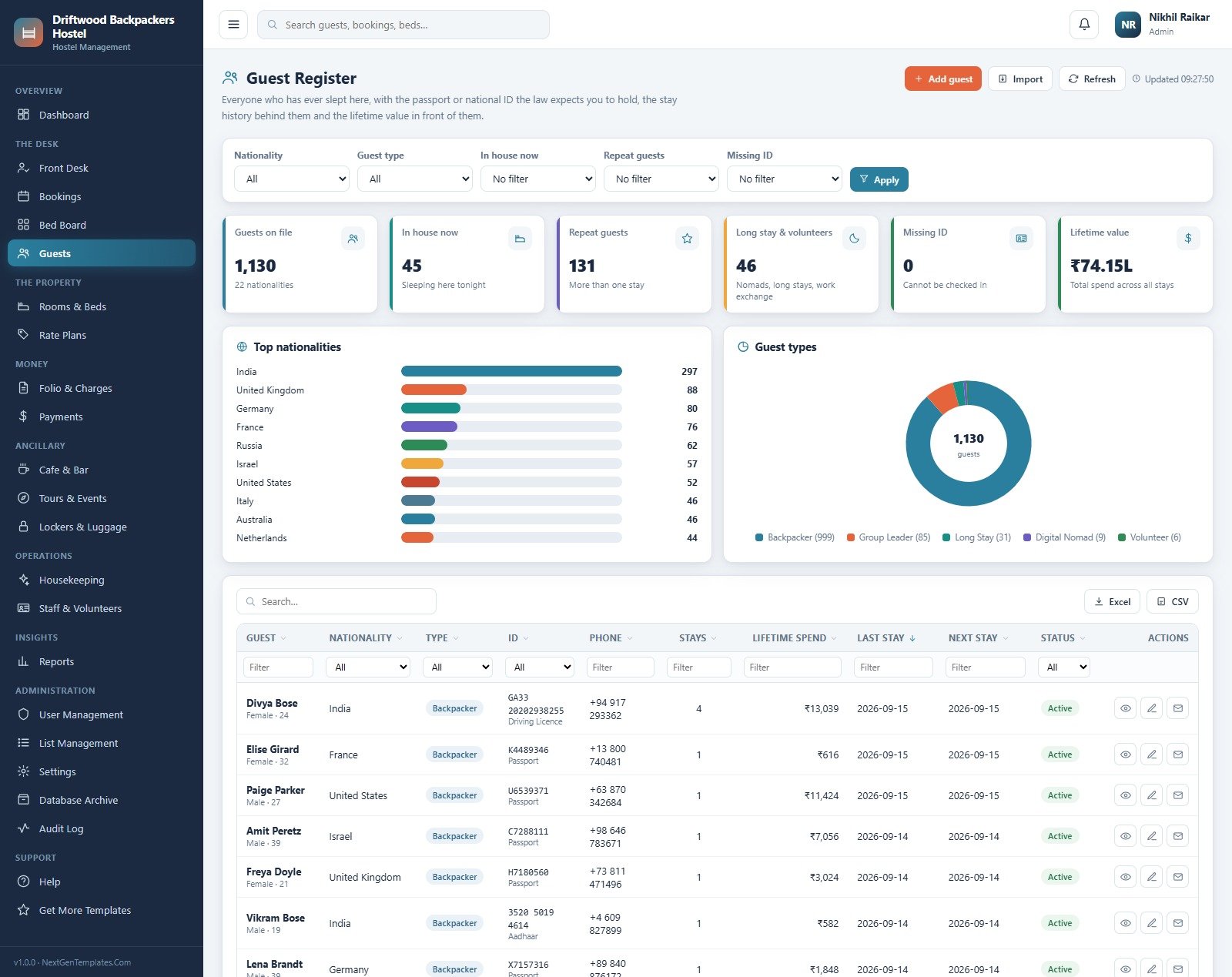
Everyone who has ever slept here, with the passport or national ID number the law expects a property to hold, the stay history behind them and the lifetime value in front of them. A Missing ID counter makes the gap visible, and filters cover nationality, guest type, in-house-now and repeat guests.Backpacker Hostel Management System Web App
Folio & Charges
Every line posted against a guest, with accommodation separated from extras and tax broken out. The distinction matters: accommodation is posted by the system from the bed assignment, extras are posted by whoever sold them. Open folios are listed on their own tab so nothing walks out unsettled.Backpacker Hostel Management System Web App

Cafe & Bar
A working till. Build a ticket, take cash or card, or charge it to a folio so it settles with the bed at check-out. Sales, cost of sales, gross margin, average ticket, the amount charged to folio and the cash taken over the bar all sit above a sales-by-day line, a category ring and a top-sellers list.Backpacker Hostel Management System Web App

Housekeeping
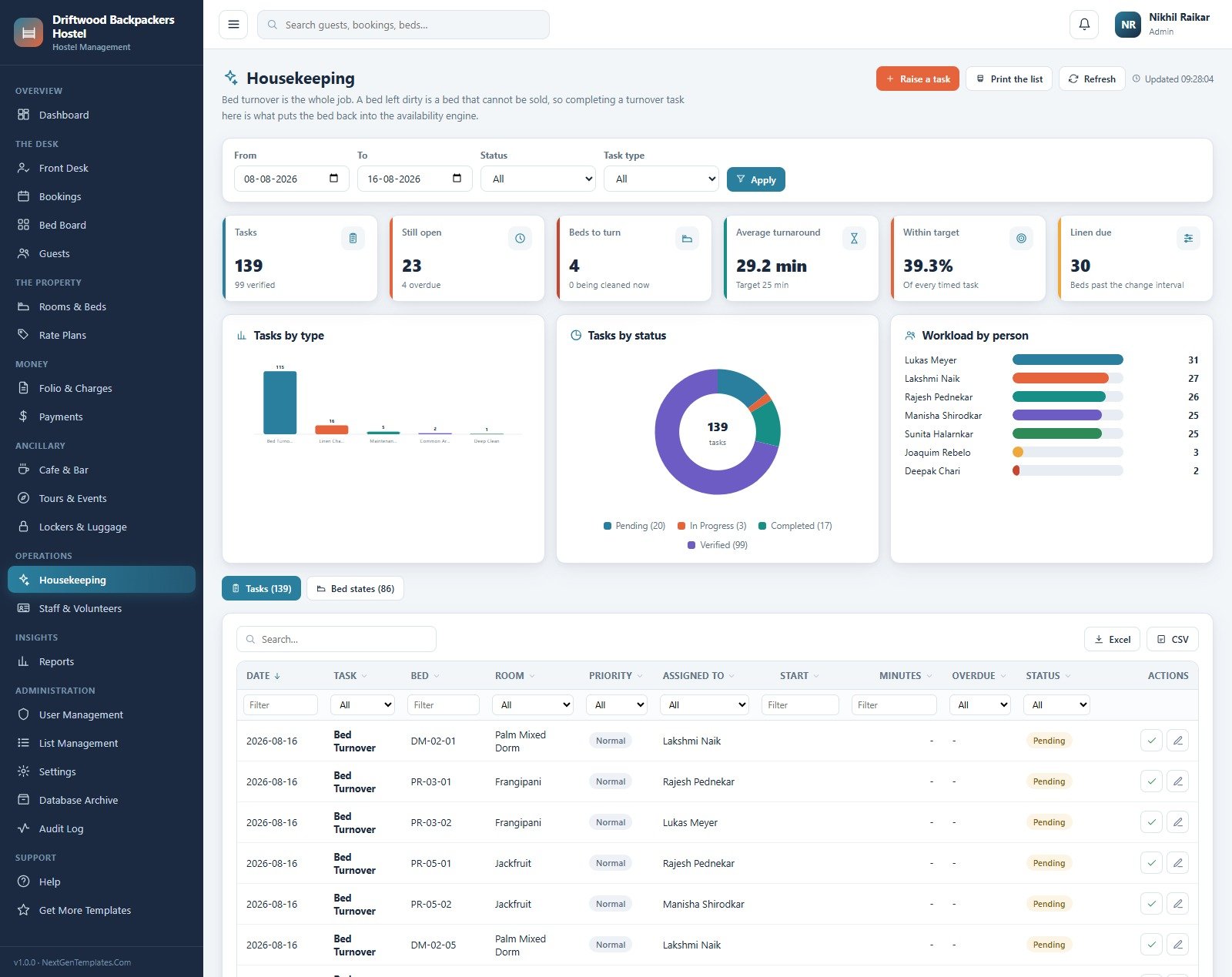
A bed left dirty is a bed that cannot be sold, so this page is wired directly into availability: completing a turnover task is what returns the bed to the engine. Tasks by type and status, average turnaround against target, the number of beds past their linen-change interval, and workload by person.Backpacker Hostel Management System Web App
Reports
Seventeen reports on one page, grouped the way a hostel manager thinks about them: Occupancy, Front Desk, Commercial, Guests, Ancillary, Operations and Money. Pick one, set a date range, and it charts itself and exports.

User Management
Seven accounts, seven roles and twenty-two permissions. The matrix drives both what a person sees in the sidebar and what the server will let them do, so nothing is reachable by guessing a URL. The Admin role is locked on purpose, so a hostel can never accidentally lock itself out.

The rest of the sidebar
Bookings holds every reservation with the cancellation fee computed for you. Rooms & Beds is the physical property. Rate Plans carries weekday, weekend, weekly and monthly prices, a peak multiplier, group discount and cancellation window. Payments, Deposits & Refunds is the cash side. Tours & Events is the upsell desk with hard seat capacity. Lockers & Luggage tracks keys and left bags against a deposit. Staff & Volunteers holds the paid roster and the work-exchange ledger. List Management, Settings, Database Archive, Audit Log and a built-in Help page close it out.
Backpacker Hostel Management System vs. a Spreadsheet vs. Paid Hostel PMS — Feature Comparison
| This Web App | Shared spreadsheet | Paid hostel PMS | |
|---|---|---|---|
| Cost | One-off purchase | Free | Monthly, usually per bed |
| Platform | Apps Script web app + Google Sheet | Google Sheets or Excel | Vendor-hosted SaaS |
| Setup time | Under 15 minutes | Immediate, then weeks of patching | Days plus onboarding |
| Real-time team collaboration | Yes, with real permissions | Yes, with none | Yes |
| Mobile access | Yes, browser-based | Yes, awkwardly | Yes |
| Customisable fields | 39 dropdown lists plus the source code | Anything you build | Only what the vendor exposes |
| Share with link | Yes, one deployment URL | Yes | Login required |
| Year-1 cost at 5 users | The purchase price, once | Nothing, plus the double-bookings | Hundreds to thousands, recurring |
| Double-booking prevention | Server-enforced, per bed | None | Yes |
| OTA channel manager | No | No | Yes |
| You own code and data | Yes, both | Yes | No |
Who Should Use This Template
Independent backpacker hostels, guesthouses with dorms, surf and dive camps, pod hotels, work-exchange houses and long-stay nomad hostels in roughly the 20–150 bed range — particularly properties taking most bookings by walk-in, phone, WhatsApp and their own website, and currently running a whiteboard or a shared sheet. It suits a manager who wants ADR, RevPAB, cancellation fees and deposit settlement handled correctly without a per-bed subscription, and who is comfortable inside Google Workspace.
It is the wrong tool if your beds are sold mostly through OTAs and you need inventory pushed back automatically. It records the channel a booking came through and reports on channel performance and commission, but it is not a channel manager and does not connect to Hostelworld, Booking.com or Agoda. It is also not an accounting package, not a room-based hotel PMS, and it will not work offline.
Real-World Use Cases
The 2am double-booking. A 60-bed hostel taking late walk-ins onto a whiteboard was losing two or three beds a week to clashes discovered the following afternoon. On the bed board the clash is refused at the point of allocation and the message names the conflicting booking, which turns a 3pm argument into a 2am re-allocation.
The bar that never reconciled. Cafe charges taken sometimes in cash and sometimes “on the room” with no record made month-end impossible. Pushing tickets onto the folio puts ancillary and accommodation revenue in the same ledger, and the Charged to folio card shows exactly how much is riding on check-out.
Housekeeping as a gate, not a shout. With turnover completion wired into availability, the front desk simply cannot sell a bed the supervisor has not signed off — and the average-turnaround card surfaces which turnovers are running past the target.
Volunteers who under-deliver quietly. Work-exchange beds are real revenue given away. The system flags any volunteer who has logged under three quarters of their agreed weekly hours, on the dashboard and in the alerts, so the conversation happens in week two rather than week eight.
Advantages of the Backpacker Hostel Management System Web App
- The arithmetic is not optional. Because accommodation is posted by the server from the bed assignment, the folio, occupancy and revenue reports cannot drift apart.
- Permissions are real. The matrix is checked server-side, so a Volunteer Assistant cannot reach payroll by typing a different URL.
- Deterministic sample data. Build the database twice and you get exactly the same hostel, so a screenshot, a support answer and the documentation always describe the same numbers.
- You own everything. Code and data both sit in your own Google account. There is nothing to cancel and no one to export from.
- Idempotent setup.
setup()creates missing sheets, adds columns a newer schema introduced and re-seeds only what is still empty — it never overwrites entered data.
Opportunities for Improvement
An honest list, because it is better to know before you buy:
- No OTA channel management. The single biggest gap versus a paid PMS. Channel is recorded and reported; availability is not synced anywhere.
- No payment gateway. Payments are recorded, not taken. There is no card capture, no online pre-authorisation and no deposit collection at booking time.
- Google Workspace quotas apply. This is an Apps Script app, so execution time and daily quotas are Google’s, not ours. Comfortable for a hostel team; not built for hundreds of concurrent users.
- Online only. If reception loses internet, reception loses the system.
- The seeded property is Indian. Currency, tax rate and address in the demo are Goa-flavoured. All of that is editable in Settings, but you will be editing it on day one.
- Sheets has practical size limits. The Database Archive exists precisely because of this; a very busy property will be archiving annually.
Best Practices
- Change all seven seeded passwords before you share the URL. This is the first item in the built-in Day One checklist for a reason.
- Decide the three enforcement switches deliberately. RequireIDAtCheckIn, BlockCheckoutOnBalance and BlockOverpayment can each be relaxed in Settings → Operations. Relax them because your property genuinely needs it, not because someone found them annoying on a busy night.
- Attach a rate plan to every bed before you take a real booking, or the self-posting accommodation charge has nothing to compute from.
- Reseed rather than delete. Use the spreadsheet menu’s Reseed Hostel Data, which rebuilds only the transaction sheets and leaves your rooms, beds, rate plans and menu alone.
- Run the integrity check after any bulk edit — Settings → Maintenance — and again before month end.
- Redeploy after every code change. Apps Script only serves the version you published: Deploy → Manage deployments → Edit → New version. Saving the editor alone changes nothing for your users. Google’s own web apps documentation covers this and the access settings in detail.
Explore Relevant Templates
- Backpacker Hostel Management System Web App — the product page for this system.
- Backpacker Hostels Dashboard in Excel — reporting only, if you already have a booking system.
- Backpacker Hostels Dashboard in Power BI — the same analysis on a DAX model.
- Airport Transfer Management System Web App — pairs naturally with a hostel that sells pickups.
- Buffet Restaurant Management System Web App — for when the kitchen outgrows a cafe till.
If you want to learn the spreadsheet skills behind trackers and booking systems, the NextGenTemplates Academy learning paths teach them step by step with practice files.
Get the Backpacker Hostel Management System Web App
Frequently Asked Questions
Can I try it before buying?
Yes — the green box near the top of this post links a fully seeded live demo with all seven role logins. It is a shared instance that resets, so treat anything you enter as public and temporary.
Does it connect to Hostelworld or Booking.com?
No. Channel is recorded and reported on; availability and rates are not synced to any OTA. If two-way channel management is your core requirement, this is not the right tool.
Why is RevPAB always lower than ADR?
Because ADR divides accommodation revenue by bed nights sold and RevPAB divides it by bed nights available. They are only equal when the house is completely full. ADR tells you what you charged; RevPAB tells you what the building earned.
Where does my data live?
In a Google Sheet in your own Google Drive, under your own Google account. Nothing is hosted by us and we have no access to your deployment.
Can I change the roles?
Yes — User Management → Role permissions is a full matrix across 22 permissions. Only the Admin role is locked, so the hostel cannot lock itself out.
Can I run it on a spreadsheet I already own?
Yes. For a standalone project, run setDatabaseId('<spreadsheet id>') once before running setup.
Does it make my hostel legally compliant?
No. It stores the ID details you choose to collect and can refuse a check-in without them, but it performs no police or immigration registration, verifies no visa, and makes no claim about tax invoicing, licensing, fire safety or data-protection law in your jurisdiction.
About the Author
Built by PK – Microsoft Certified Professional with 15+ years of Excel, Google Sheets, and Power BI experience. Founder of NextGenTemplates, reaching 300K+ subscribers across YouTube channels. Every template is hand-built and tested before release.
Conclusion
Most hostel software is hotel software with the word “bed” pasted over the word “room”. This one starts from the bed and works outwards, which is why the bed board, the folio and the housekeeping queue all agree with each other without anybody reconciling anything. It will not replace a channel manager and it will not take a card payment — but for an independent property running on a whiteboard, it closes the gap between what the desk knows and what the manager can see, for a single purchase rather than a per-bed subscription.
The fastest way to judge it is not to read further. Open the live demo, sign in as volunteer, and count how many pages the system refuses to show you. Then sign in as admin and look at the same sidebar. If that separation is what your hostel needs, the full source and deployment guide are here.