The SaaS Product Usage Dashboard in Google Sheets tracks 4 high-level KPIs across 6 interactive sheets, with 16 pre-built charts and slicer-driven filters covering Plans, Regions, Devices, Industries, and Segments. Setup takes under 10 minutes — paste your user activity data into the Data sheet and every chart, MRR roll-up, and segment breakdown updates automatically. At $9.99 one-time, it replaces $250–$2,000+/month subscriptions to Mixpanel, Amplitude, or Pendo for early-stage and bootstrapped SaaS teams.SaaS Product Usage Dashboard in Google Sheets
Get the SaaS Product Usage Dashboard in Google Sheets
Product usage analytics is where most early-stage SaaS founders get stuck — you don’t have the budget for Mixpanel, your data lives in Stripe and three databases, and you still need to walk into Monday’s standup with a clean view of MRR, active users, and feature adoption. The SaaS Product Usage Dashboard in Google Sheets is built exactly for that gap: a one-time spreadsheet that turns a 12-column user-activity export into a board-ready dashboard, on any free Google account.SaaS Product Usage Dashboard in Google Sheets
Key Features of the SaaS Product Usage Dashboard in Google Sheets
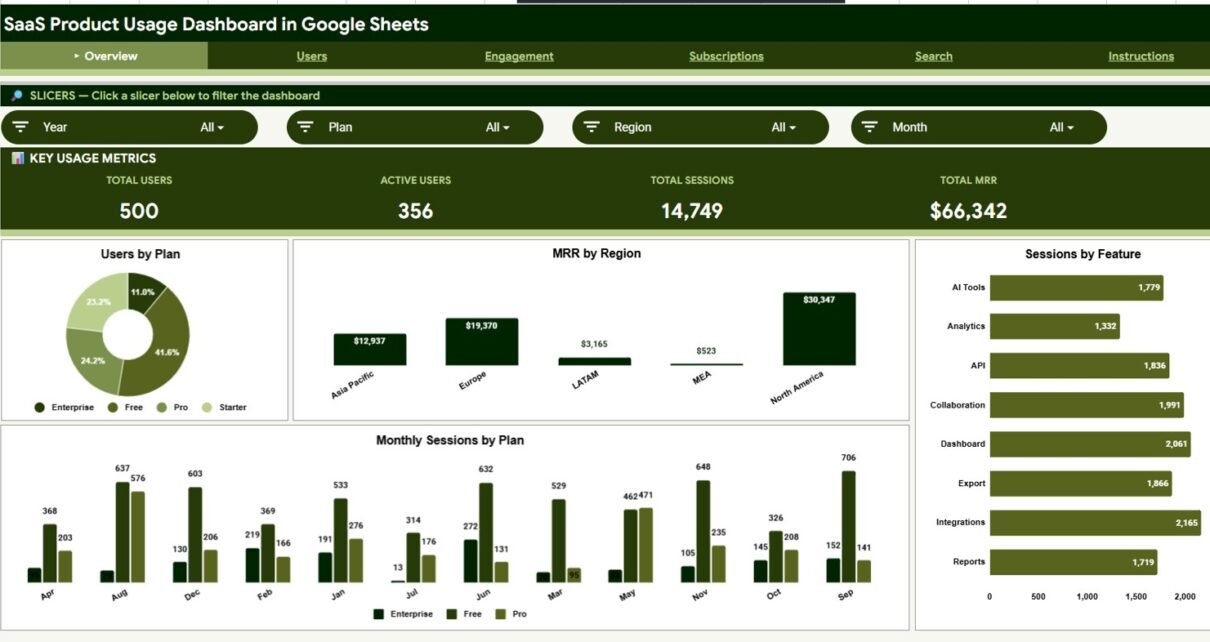
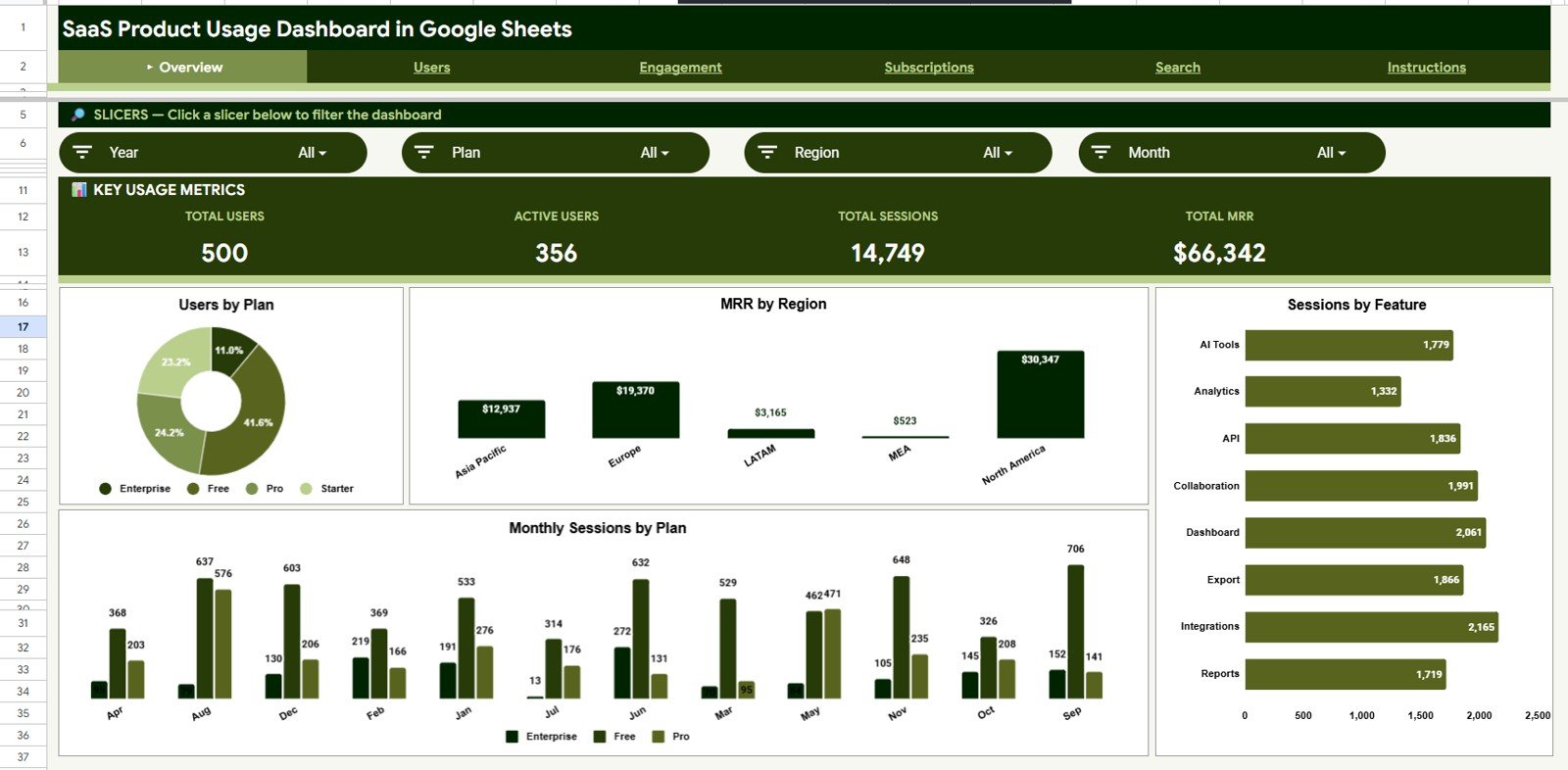
- 4 live KPI cards on the Overview sheet — Total Users, Active Users, Total Sessions, and Total MRR — that recalculate the moment any slicer is applied.SaaS Product Usage Dashboard in Google Sheets
- 16 pre-built charts spread across Overview, Users, Engagement, and Subscriptions sheets, covering plan mix, regional revenue, feature adoption, device split, session trends, and MRR direction.
- Slicer-driven filtering on every analysis page — filter by Plan, Region, Industry, Device, or Segment in one click without touching a single formula.SaaS Product Usage Dashboard in Google Sheets
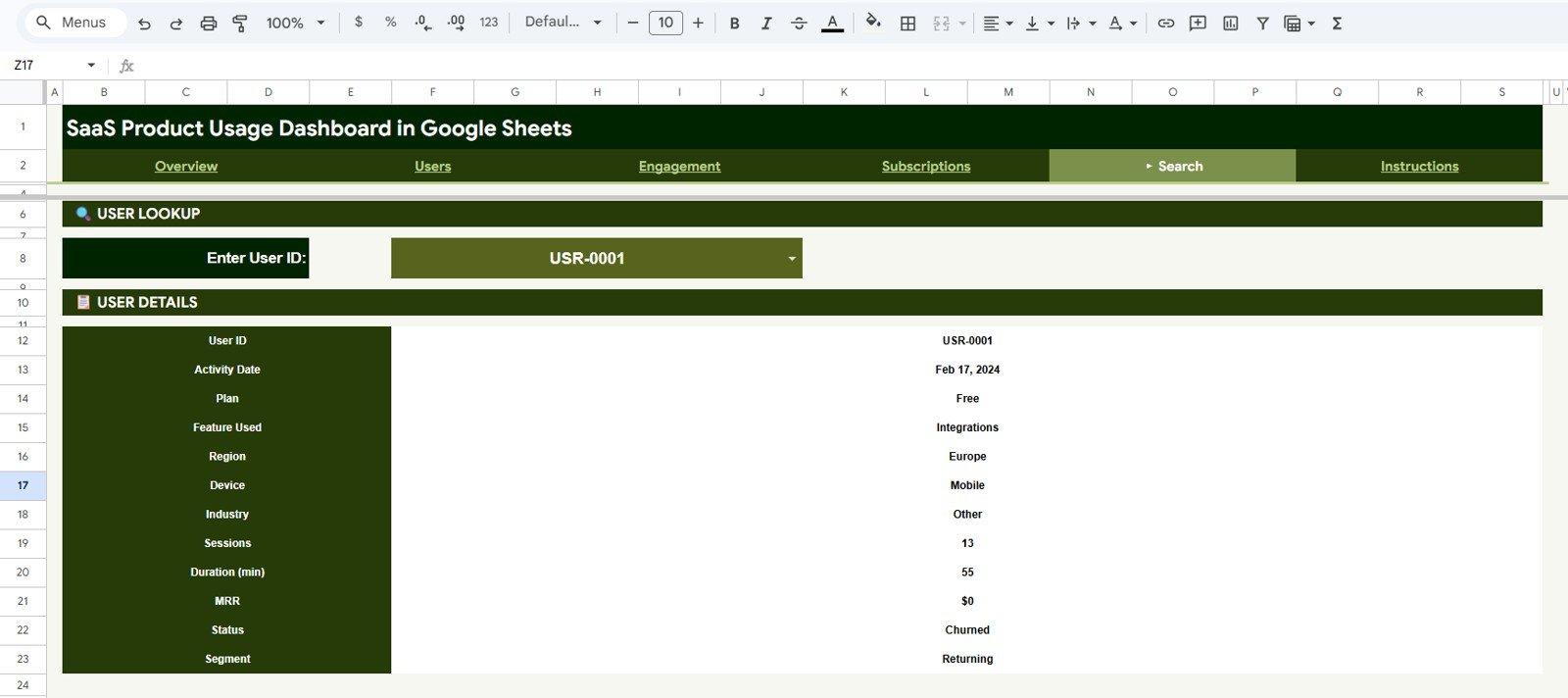
- A built-in Search sheet that turns User ID lookups into a 5-second answer — ideal for customer success investigations and churn triage.
- Pure Google Sheets — no add-ons, no Apps Script triggers to authorize, and no paid Workspace tier required. Works on any free Gmail account.SaaS Product Usage Dashboard in Google Sheets
- One-time $9.99 purchase — lifetime access, unlimited copies in your Drive, no subscription.
Dashboard Pages Explanation
Page 1: Overview
The Overview sheet anchors the SaaS Product Usage Dashboard with four KPI cards — Total Users, Active Users, Total Sessions, and Total MRR — and four charts: Users by Plan, MRR by Region, Sessions by Feature, and Monthly Sessions by Plan. Slicers across the top filter every card and chart in one click, so a founder can answer “how did Enterprise users perform in EMEA last month” in under five seconds.
Page 2: Users
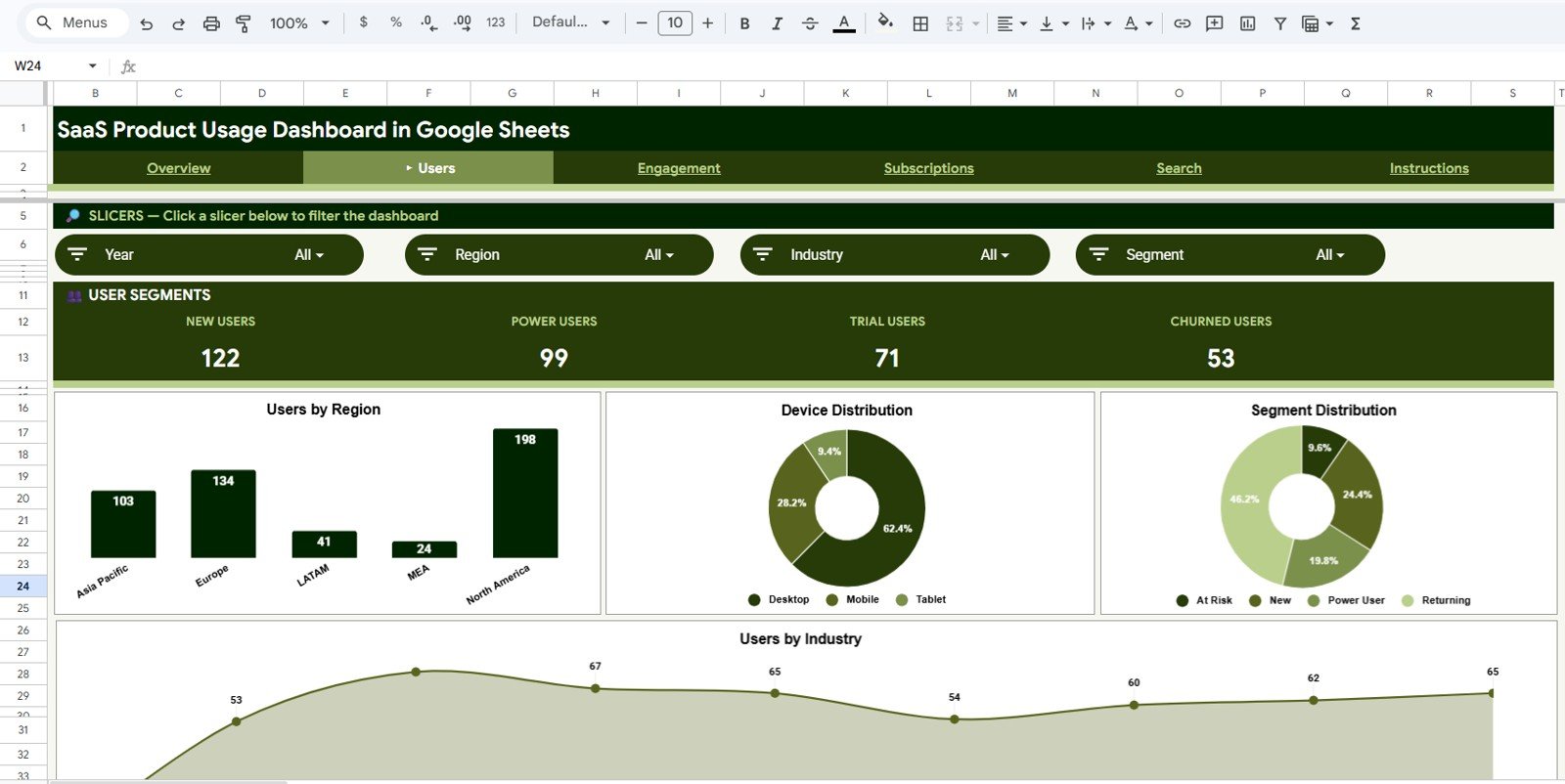
The Users sheet profiles your customer base across four dimensions — Users by Region, Device Distribution, Segment Distribution, and Users by Industry. This is the page to open when leadership asks “which industries are over-represented in our growth this quarter” or “are we shifting from desktop to mobile.”
Page 3: Engagement
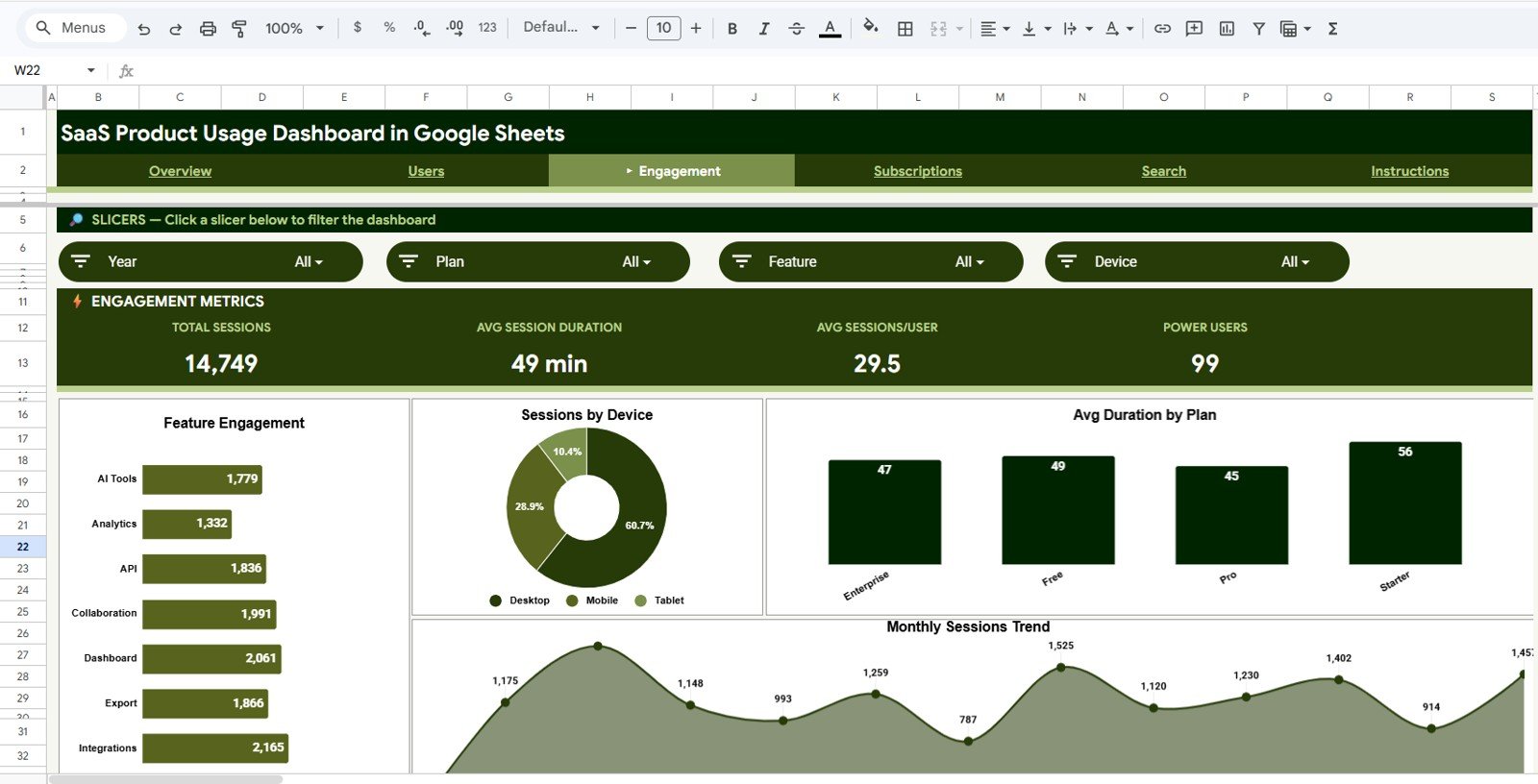
The Engagement sheet quantifies how users actually interact with your product through Feature Engagement, Sessions by Device, Avg Duration by Plan, and Monthly Sessions Trend. These four charts answer the questions product managers care about most: which features drive depth of use, which plan tiers deliver the longest sessions, and where engagement is decelerating month-over-month.
Page 4: Subscriptions
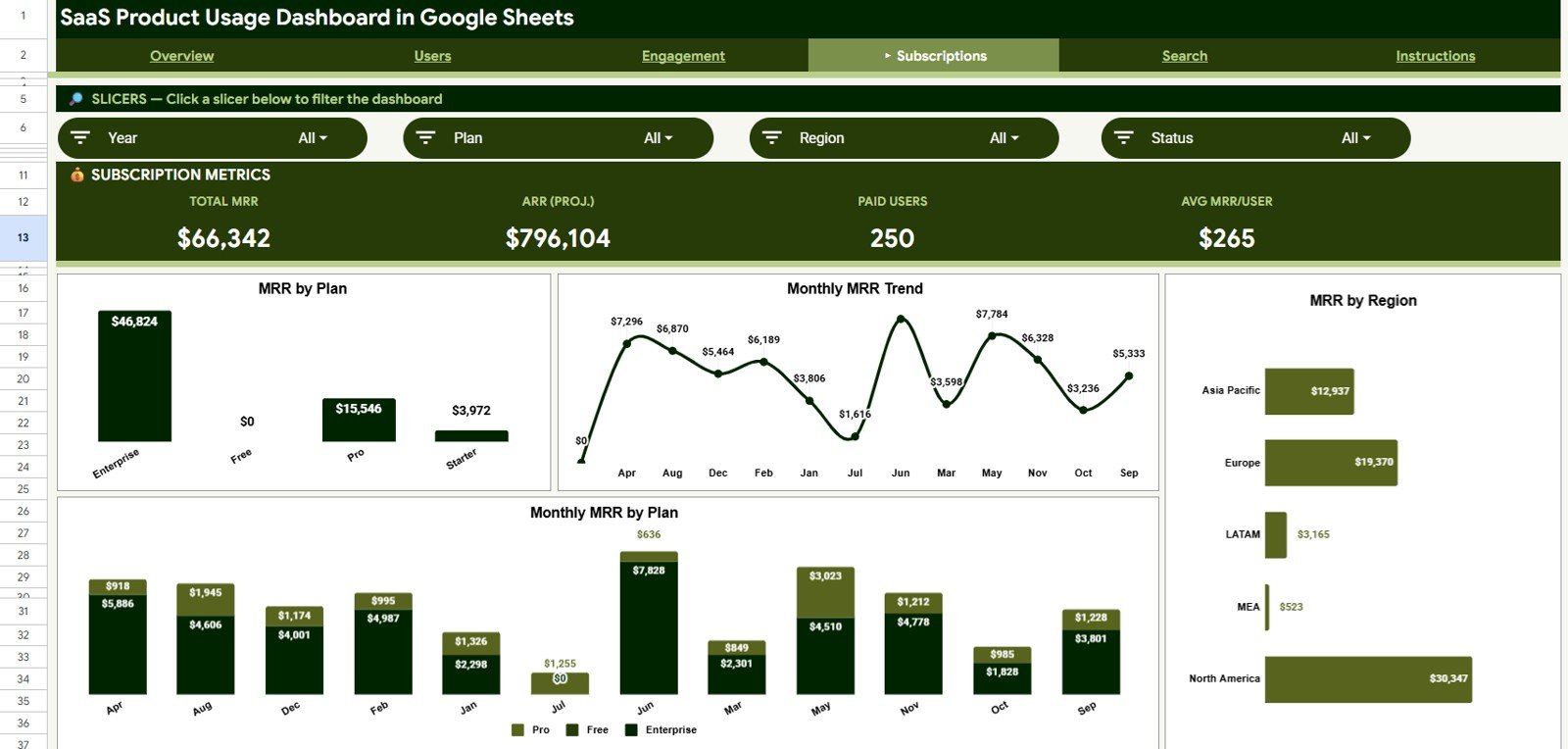
The Subscriptions sheet centers on monthly recurring revenue with MRR by Plan, Monthly MRR Trend, MRR by Region, and Monthly MRR by Plan. This is the page leadership wants in board decks — total MRR, plan mix, geographic revenue concentration, and month-over-month direction in a single view.
Page 5: Search Sheet
The Search sheet is built for one-user investigations. Pick any User ID from the dropdown and the page instantly displays User ID, Activity Date, Plan, Feature Used, Region, Device, Industry, Sessions, Duration, MRR, Status, and Segment. It is the difference between a customer success rep guessing on a call and arriving with full context.
Page 6: Data Sheet
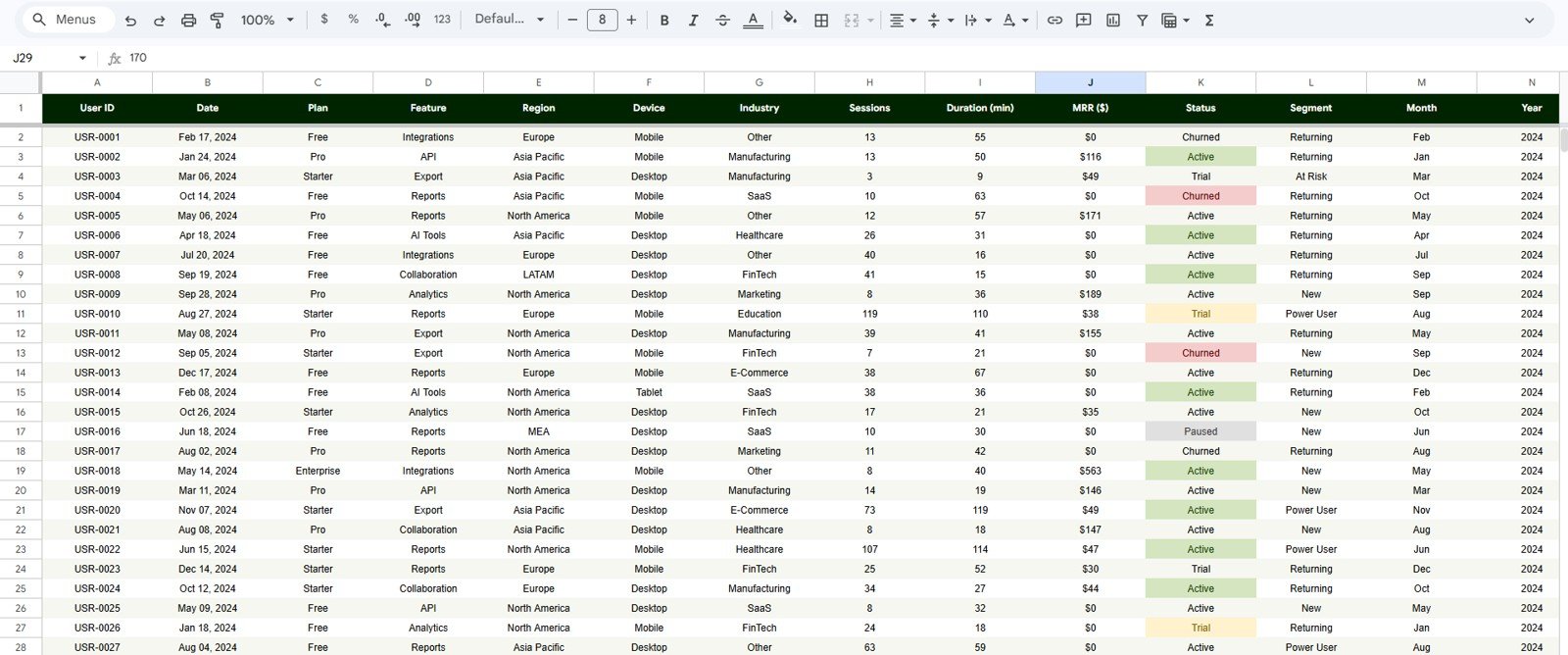
The Data sheet is the input layer — paste your own user activity records here in the same column order and the entire dashboard re-renders. Columns are fixed at User ID, Activity Date, Plan, Feature Used, Region, Device, Industry, Sessions, Duration, MRR, Status, and Segment, which means existing chart ranges keep working as you add rows.
SaaS Product Usage Dashboard vs. Excel Dashboard vs. Mixpanel/Amplitude — Feature Comparison
| Feature | SaaS Product Usage Dashboard (Google Sheets) | Microsoft Excel Dashboard | Mixpanel / Amplitude / Pendo |
|---|---|---|---|
| Cost | $9.99 one-time | $17.99 one-time | $0–$2,000+ / month |
| Platform | Google Sheets (browser, free) | Microsoft Excel (desktop) | SaaS web app |
| Setup time | Under 10 minutes | Under 10 minutes | Days to weeks (SDK install) |
| Real-time team collaboration | ✅ | ❌ (file-based) | ✅ |
| Mobile / tablet access | ✅ (browser + Sheets app) | Limited | ✅ |
| Customizable fields and charts | ✅ | ✅ | Limited (vendor schema) |
| Share with link | ✅ | ❌ | ✅ (seats required) |
| User-level profile lookup | ✅ (built-in Search sheet) | ❌ (separate template) | ✅ |
| Year-1 cost at 5 users | $9.99 | $17.99 | $3,000–$12,000+ |
For SaaS founders and growth teams who want MRR, user, and feature-engagement visibility without paying $250+ per month for Mixpanel or Amplitude seats, the SaaS Product Usage Dashboard in Google Sheets sits in the sweet spot.
Who Should Use This Template
Perfect for:
- Early-stage SaaS founders tracking their first 50–5,000 paying users on a sub-$50 monthly tools budget.
- Product managers preparing weekly MRR + engagement snapshots for standup or board updates.
- Customer success and growth teams running monthly user-cohort reviews by Plan, Region, and Industry.
- Solo operators and bootstrapped founders already exporting user activity from Stripe, a product DB, or a BI tool.
Not a fit if:
- You need SOC 2-compliant data warehousing and SDK-based event capture for an enterprise SaaS.
- You need real-time clickstream analytics — Google Sheets refreshes when you paste, not as users click.
- You are tracking 100,000+ active users per month — Sheets row limits will eventually push you to BigQuery.
Real-World Use Cases
Priya runs growth at a 12-person B2B SaaS in Bengaluru. Every Monday morning, she opens the SaaS Product Usage Dashboard, applies the EMEA slicer on Overview, and pulls Total MRR, Active Users, and Sessions by Feature into the founders’ standup deck. The whole exercise takes 8 minutes — and saves the team $1,500/year they would otherwise spend on Mixpanel’s Growth tier.
Marcus is a solo indie hacker shipping a productivity tool. He exports a CSV from Stripe and his app database once a week, pastes it into the Data sheet, and uses the Search sheet to investigate the three power users who churned this week — all from his laptop on café Wi-Fi. When a feature looks underused on the Engagement page, he knows where to invest next sprint.
Lina leads customer success at a mid-stage SaaS with 1,800 paying accounts. Her team uses the Subscriptions sheet’s MRR by Region and Monthly MRR Trend charts to flag which geographies are decelerating, then drills into the Users sheet to see industry-mix shifts before they show up in the QBR deck. The Search sheet is her account managers’ go-to before every renewal call.
Advantages of the SaaS Product Usage Dashboard in Google Sheets
- Massive cost savings: One-time $9.99 vs. $3,000–$12,000+ in Year 1 for Mixpanel, Amplitude, or Pendo seats.
- 10-minute setup: Copy the file, paste your data, ship the dashboard — no SDK install, no event-mapping workshop.
- Full data ownership: Your user activity lives in your own Drive, not a third-party vendor’s warehouse.
- Native collaboration: The same share-link model your team already uses for every other Sheet — view-only for execs, edit for the data owner.
- Customizable without code: Add columns, rename plan tiers, or swap slicer fields — the dashboard keeps working.
- Zero lock-in: Export to Excel, CSV, or PDF whenever you outgrow the template.
Opportunities for Improvement
Honest limitations every buyer should know before purchasing the SaaS Product Usage Dashboard in Google Sheets:
- Not real-time: The dashboard refreshes when you paste new data. If your standup needs second-by-second event capture, a paid platform is the right tool.
- Row-volume ceiling: Google Sheets handles a few hundred thousand rows comfortably; once you exceed that, a BigQuery + Looker Studio setup will outperform.
- No automated ETL: You’re responsible for the export step from Stripe / app DB / BI tool. Most teams build a 30-minute Apps Script or Zapier flow to handle this weekly.
- Single-currency by default: MRR fields assume USD — multi-currency teams will need a small FX-conversion column in the Data sheet.
Best Practices
- Keep the column order intact on the Data sheet — the 12 columns drive every chart and slicer. Add new columns to the right rather than inserting between existing ones.
- Refresh weekly, not daily — weekly cadence is the sweet spot for spotting MRR and engagement trends without drowning in noise.
- Use one segment definition across the Data sheet — “Enterprise/Mid-Market/SMB” works better than mixing case or wording, since charts group by exact match.
- Lock the Data sheet for everyone except one designated data owner — prevents accidental row deletion that breaks the dashboard.
- Pair with a free Looker Studio dashboard if you want public-facing or always-on charts — Looker reads directly from the same Sheet.
- Use the Google Sheets slicer feature for any new pages you build — the template ships with slicer best practices baked in.
Explore Relevant Templates
Cross-platform versions of this template:
- SaaS Product Usage Dashboard in Excel — same KPIs and analysis, packaged for Microsoft Excel users.
- SaaS Product Usage Dashboard in Power BI — Power BI version with DAX measures and interactive slicers.
Related Google Sheets templates worth pairing:
- SaaS Customer Success Dashboard in Google Sheets — health scores, NPS, and renewal risk on a single sheet.
- SaaS Financial Model Dashboard in Google Sheets — MRR, ARR, burn, and runway in one model.
- Startup Growth KPI Scorecard in Google Sheets — weekly growth scorecard for early-stage teams.
Related reading from our blog: SaaS Customer Success Dashboard in Google Sheets and Subscription Business Dashboard in Google Sheets.
Interested in learning how dashboards like this are put together? The Excel Pivot Tables & Dashboards course on NextGenTemplates Academy walks through the process with practice files.
Get the SaaS Product Usage Dashboard in Google Sheets
Frequently Asked Questions
What KPIs does the SaaS Product Usage Dashboard track?
The SaaS Product Usage Dashboard in Google Sheets tracks 4 headline KPIs — Total Users, Active Users, Total Sessions, and Total MRR — plus 16 chart-level metrics covering Users by Plan, MRR by Region, Sessions by Feature, Feature Engagement, Avg Duration by Plan, Monthly MRR Trend, and Users by Industry. Every number recalculates in real time as you apply slicers.
How does this compare to Mixpanel or Amplitude?
Mixpanel and Amplitude are real-time SDK-based platforms that cost $250–$2,000+ per month. The SaaS Product Usage Dashboard in Google Sheets is a $9.99 one-time spreadsheet you paste your own export into. You trade real-time event capture for a 10-minute setup, zero recurring cost, and full data ownership in your own Drive.
How long does setup take?
Setup takes under 10 minutes. Click the copy link in the PDF guide, copy the SaaS Product Usage Dashboard to your Drive, paste your user activity rows into the Data sheet using the 12-column layout, and the entire dashboard re-renders automatically. No formulas to edit, no scripts to authorize.
Do I need a paid Google Workspace plan?
No. The SaaS Product Usage Dashboard in Google Sheets works on any free Google account. There are no Apps Script triggers, no add-ons, and no Workspace-only features required. Personal Gmail accounts run the entire template without limitations.
Can I customize the columns or charts?
Yes. Every chart in the SaaS Product Usage Dashboard is built directly from the Data sheet, so you can add columns, rename plan tiers, or change slicer fields. Keep the original column order intact and existing charts continue to update — added columns can drive new pivots you build.
What data do I need to bring?
A per-user-per-activity export with these 12 fields: User ID, Activity Date, Plan, Feature Used, Region, Device, Industry, Sessions, Duration, MRR, Status, and Segment. Most teams generate this from a Stripe + product DB join or a Metabase/Mode export.
Is the SaaS Product Usage Dashboard a one-time purchase or subscription?
It is a one-time $9.99 purchase. You get lifetime access and can copy the SaaS Product Usage Dashboard to your Drive as many times as you need. No monthly fees, no per-seat costs, no expiry.
About the Author
Built by PK — Microsoft Certified Professional with 15+ years of Excel, Google Sheets, and Power BI experience. Founder of NextGenTemplates, reaching 300K+ subscribers across YouTube channels. Every template is hand-built and tested before release.
Conclusion
If you are running an early-stage or bootstrapped SaaS and need an honest read on MRR, active users, feature engagement, and plan mix without burning a quarter of your tools budget on Mixpanel or Amplitude, the SaaS Product Usage Dashboard in Google Sheets is the most direct path to that view. Four KPI cards, 16 charts, six interactive sheets, slicer-driven filtering, and a built-in user-profile search — all updating from a single 12-column Data sheet you paste your own export into.
✅ Instant download · One-time payment · No subscription · Lifetime access
📅 Last updated: May 2026