Time tracking plays a critical role in managing productivity, billing accuracy, cost control, and profitability. However, many organizations still rely on manual timesheets or scattered spreadsheets. As a result, tracking billable hours, overtime, revenue, and costs becomes difficult and time-consuming.
This is exactly where a Time Tracking Dashboard in Google Sheets becomes extremely valuable.
This ready-to-use dashboard helps organizations track time utilization, billable performance, revenue, costs, and margins using a single, interactive Google Sheets dashboard.
In this article, we will explain how the dashboard works, its sheet structure, charts, benefits, and best practices.
What Is a Time Tracking Dashboard in Google Sheets?
A Time Tracking Dashboard is a centralized reporting and analytics tool that converts raw time-tracking data into visual insights. Instead of reviewing multiple timesheets, managers can view performance metrics such as billable hours, overtime, revenue, and costs in one place.
Because this dashboard is built in Google Sheets, it provides:
- Real-time updates
- Easy collaboration
- Automatic calculations
- Cloud-based access
- No additional software cost
This dashboard suits project managers, finance teams, HR teams, operations managers, and leadership.
Key Features of the Time Tracking Dashboard
Click to Buy Time Tracking Dashboard in Google Sheets
This dashboard is ready to use and includes an Overview sheet, multiple analytical sections, and a Data input sheet.
Overview Sheet Tab
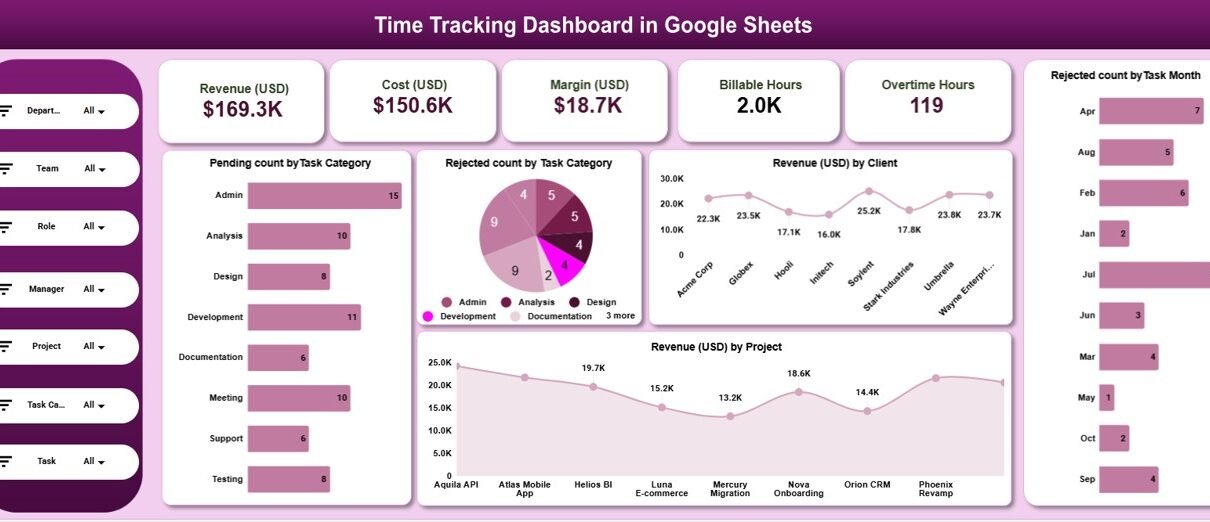
The Overview Sheet provides a high-level summary of time, cost, and revenue performance.
🔹 KPI Cards Display:
- Revenue (USD)
- Cost (USD)
- Margin (USD)
- Billable Hours
- Overtime Hours
These cards help decision-makers quickly understand overall financial and time utilization health.
Overview Charts
Pending Count by Task Category
Shows pending tasks by category to identify workflow bottlenecks.
Rejected Count by Task Category
Highlights rejected tasks to improve approval quality and compliance.
Revenue (USD) by Client
Displays client-wise revenue contribution.
Revenue (USD) by Project
Shows which projects generate the most revenue.
Rejected Count by Task Month
Helps identify time periods with higher rejection rates.

Click to Buy Time Tracking Dashboard in Google Sheets
Department Analysis
This section analyzes time and financial performance across departments.
Charts Included:
-
Revenue (USD) by Department
-
Cost (USD) by Department
-
Billable Hours by Department
-
Overtime Hours by Department
It helps organizations compare productivity and cost efficiency department-wise.

Click to Buy Time Tracking Dashboard in Google Sheets
Manager Analysis
This section evaluates performance at the manager level.
Charts Included:
-
Revenue (USD) by Manager
-
Cost (USD) by Manager
-
Billable Hours by Manager
-
Overtime Hours by Manager
It helps leadership assess workload distribution and managerial efficiency.

Click to Buy Time Tracking Dashboard in Google Sheets
Role Analysis
This section focuses on role-based performance.
Charts Included:
-
Revenue (USD) by Role
-
Cost (USD) by Role
-
Billable Hours by Role
-
Overtime Hours by Role
It supports workforce planning and role-based cost optimization.

Click to Buy Time Tracking Dashboard in Google Sheets
Monthly Trends
This section shows time-based trends.
Charts Included:
-
Revenue (USD) by Month
-
Cost (USD) by Month
-
Billable Hours by Month
-
Overtime Hours by Month
These trends help organizations forecast workload and financial performance.

Click to Buy Time Tracking Dashboard in Google Sheets
Data Input Sheet Tab
The Data Sheet is where users enter or upload time-tracking data.
Typical fields include:
- Employee Name
- Department
- Role
- Manager
- Client
- Project
- Task Category
- Billable Hours
- Overtime Hours
- Cost
- Revenue
- Task Status
Once data is updated, all dashboard visuals refresh automatically.
Why Organizations Need a Time Tracking Dashboard
Click to Buy Time Tracking Dashboard in Google Sheets
Without a centralized dashboard, time tracking becomes reactive and inaccurate. This dashboard helps organizations:
-
Track billable and non-billable hours
-
Control overtime
-
Improve billing accuracy
-
Monitor profitability
-
Support project cost control
A single dashboard ensures transparency and accountability.
Advantages of the Time Tracking Dashboard
-
Centralized time and cost tracking
-
Clear visibility into billable and overtime hours
-
Client and project-wise revenue insights
-
Better resource utilization
-
Faster management decisions
-
Cost-effective Google Sheets solution
Opportunities for Improvement
Click to Buy Time Tracking Dashboard in Google Sheets
You can enhance this dashboard further by adding:
-
Utilization rate KPIs
-
Approval turnaround time tracking
-
Employee productivity scores
-
Project margin analysis
-
Automated data import from time-tracking tools
These enhancements increase analytical depth.
Best Practices for Using the Time Tracking Dashboard
Click to Buy Time Tracking Dashboard in Google Sheets
-
Update time entries regularly
-
Standardize task categories and statuses
-
Review overtime trends monthly
-
Share insights with managers
-
Protect data with access controls
-
Maintain historical data for trends
Conclusion
A Time Tracking Dashboard in Google Sheets provides a structured and visual way to manage time, revenue, and costs. It replaces manual reporting with actionable insights, improves productivity monitoring, and supports better financial decisions. Because it is ready to use and cloud-based, teams can adopt it quickly without technical complexity.
For organizations focused on productivity, billing accuracy, and profitability, this dashboard becomes an essential operational tool.
Frequently Asked Questions (FAQs)
Click to Buy Time Tracking Dashboard in Google Sheets
1. Who should use this dashboard?
Project managers, finance teams, HR teams, and operations leaders.
2. Can it handle multiple clients and projects?
Yes, it supports multi-client and multi-project tracking.
3. Is the dashboard customizable?
Yes, charts and fields can be modified easily.
4. Does it support billing analysis?
Yes, it tracks billable hours and revenue clearly.
5. Is Google Sheets secure?
Yes, with proper sharing and access permissions.
6. Does it require technical expertise?
No, basic Google Sheets knowledge is enough.
Visit our YouTube channel to learn step-by-step video tutorials
Youtube.com/@NeotechNavigators
Watch the step-by-step video tutorial: