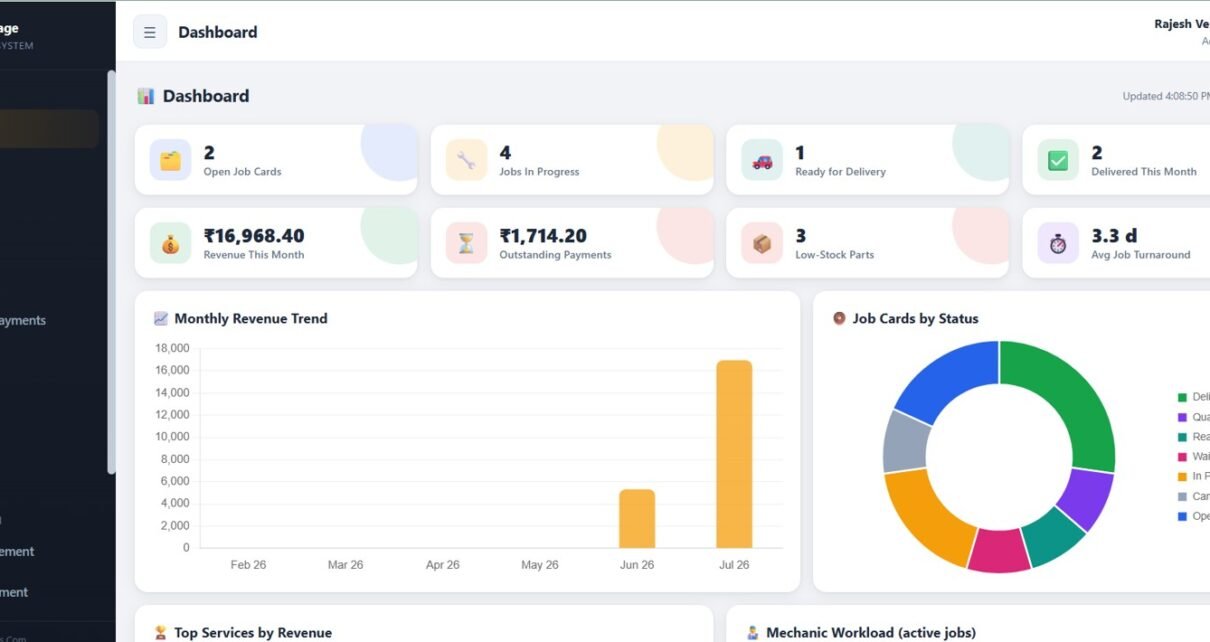
The Auto Garage Job Card Management System Web App gives auto repair garages a 14-screen browser workspace for job cards, customers, vehicles, spare parts, invoices, payments, mechanics, reports, users, settings and audit logs. Its dashboard has 8 KPI cards and 4 analysis charts, so a workshop owner can see open jobs, revenue, outstanding payments, low stock and mechanic workload without maintaining several disconnected registers.
The app is built on Google Apps Script and runs from your own Google account. For background on how these browser apps work, see the official Google Apps Script web app documentation. Full details are on the Auto Garage Job Card Management System product page.
Get the Auto Garage Job Card System
🎥 Watch the Video Tutorial
Try the Live Demo Before You Buy
A demo copy is deployed in our own Google account, so you can test every page, every role and the full job-card workflow with sample data before purchasing. No signup or email is required.
Sign in as admin for full access (all modules, Settings, User Management, List Management, Audit Log and Database Archive), as manager to handle customers, vehicles, job cards, estimates, invoicing, payments, inventory and reports, or as mechanic to see only assigned job cards and update work status, notes and actual parts and labour used. Log in as both mechanic and mechanic2 to see how each mechanic sees only their own jobs.
| Role | Name | Username | Password |
|---|---|---|---|
| Admin | Rajesh Verma | admin | Admin@123 |
| Manager / Service Advisor | Priya Sharma | manager | Manager@123 |
| Mechanic | Suresh Yadav (MEC-001) | mechanic | Mech@123 |
| Mechanic | Imran Khan (MEC-002) | mechanic2 | Mech@123 |
What you get after purchase: the full source code (Code.gs and Index.html) plus a step-by-step deployment guide, so you can deploy your own private copy in your own Google account.
Key Features of the Auto Garage Job Card Management System Web App
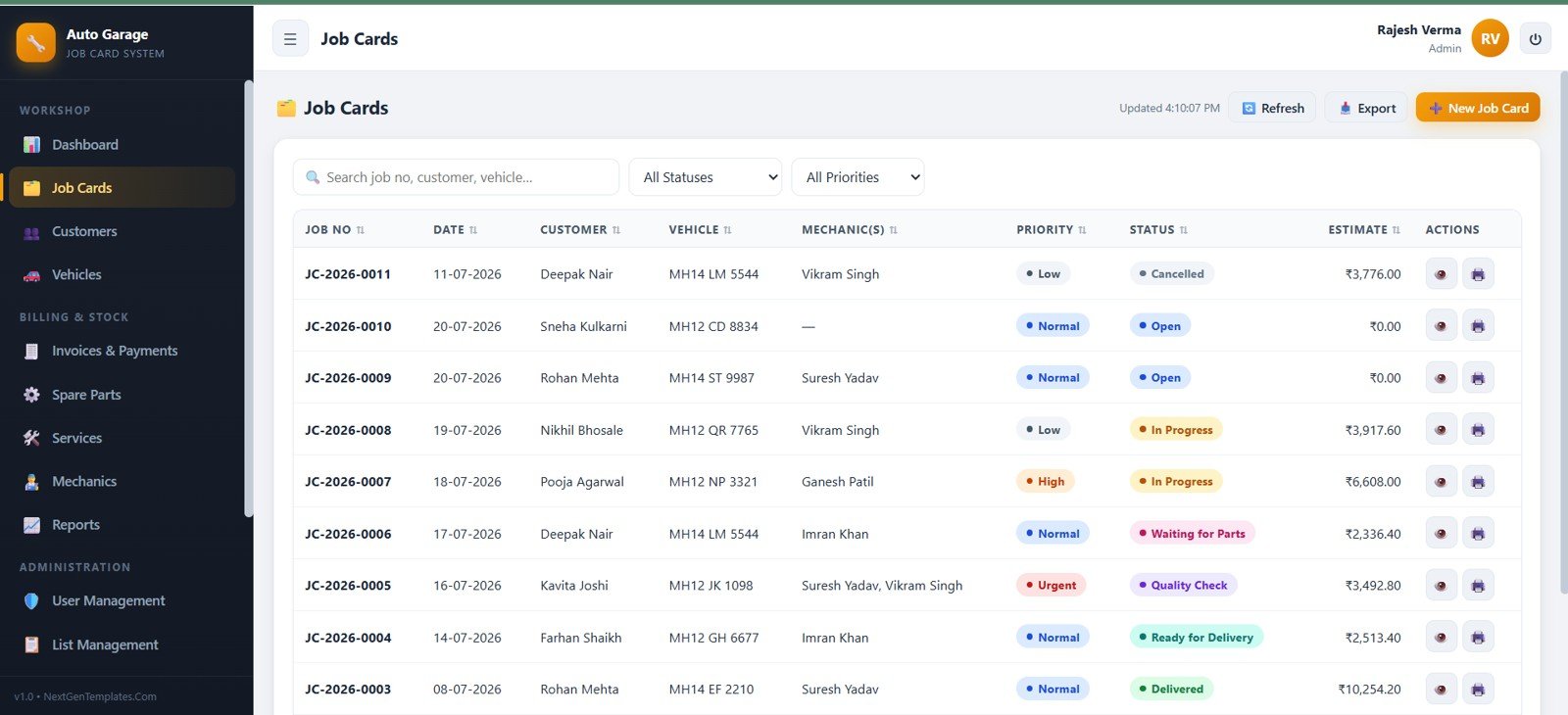
- Job cards: job number, date, customer, vehicle, mechanics, priority, status and estimate, with search, filters, export and new job-card creation.
- Customer and vehicle management: customer IDs, contact details, GST numbers, registration numbers, make, model, year, fuel type, insurance date and service history.
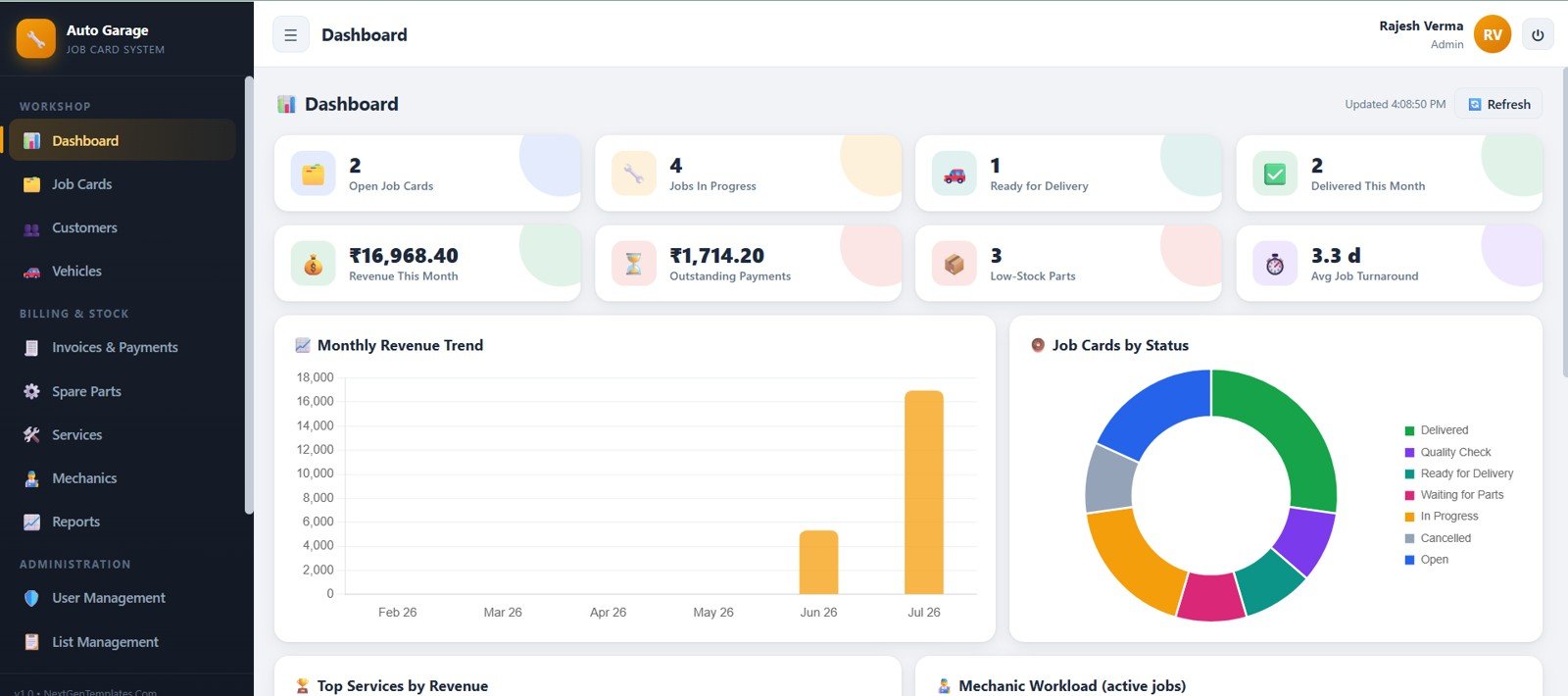
- Garage dashboard: open job cards, jobs in progress, ready for delivery, delivered this month, revenue this month, outstanding payments, low-stock parts and average job turnaround.
- Spare parts and labor: part IDs, categories, sell rates, stock, reorder levels and rack locations, plus a services list with labor charges and estimated time.
- Invoices and payments: invoice totals, received amounts, balances, payment modes and references, with print, email and export actions.
- Administration: mechanics, user roles, dropdown lists, audit log, tax and numbering settings, print size, database archive and garage profile.
Job Card Statuses and Priorities
The Job Cards screen and the dashboard’s Job Cards by Status chart use these values from the sample data:
| Field | Values shown in the app | What it tells the service desk |
|---|---|---|
| Status | Open, In Progress, Waiting for Parts, Quality Check, Ready for Delivery, Delivered, Cancelled | Where each vehicle is in the repair workflow |
| Priority | Low, Normal, High, Urgent | Which jobs mechanics should pick up first |
| Invoice status | Paid, Partial | Whether the customer still owes a balance |
The 14 Screens Explained
1. Login Page
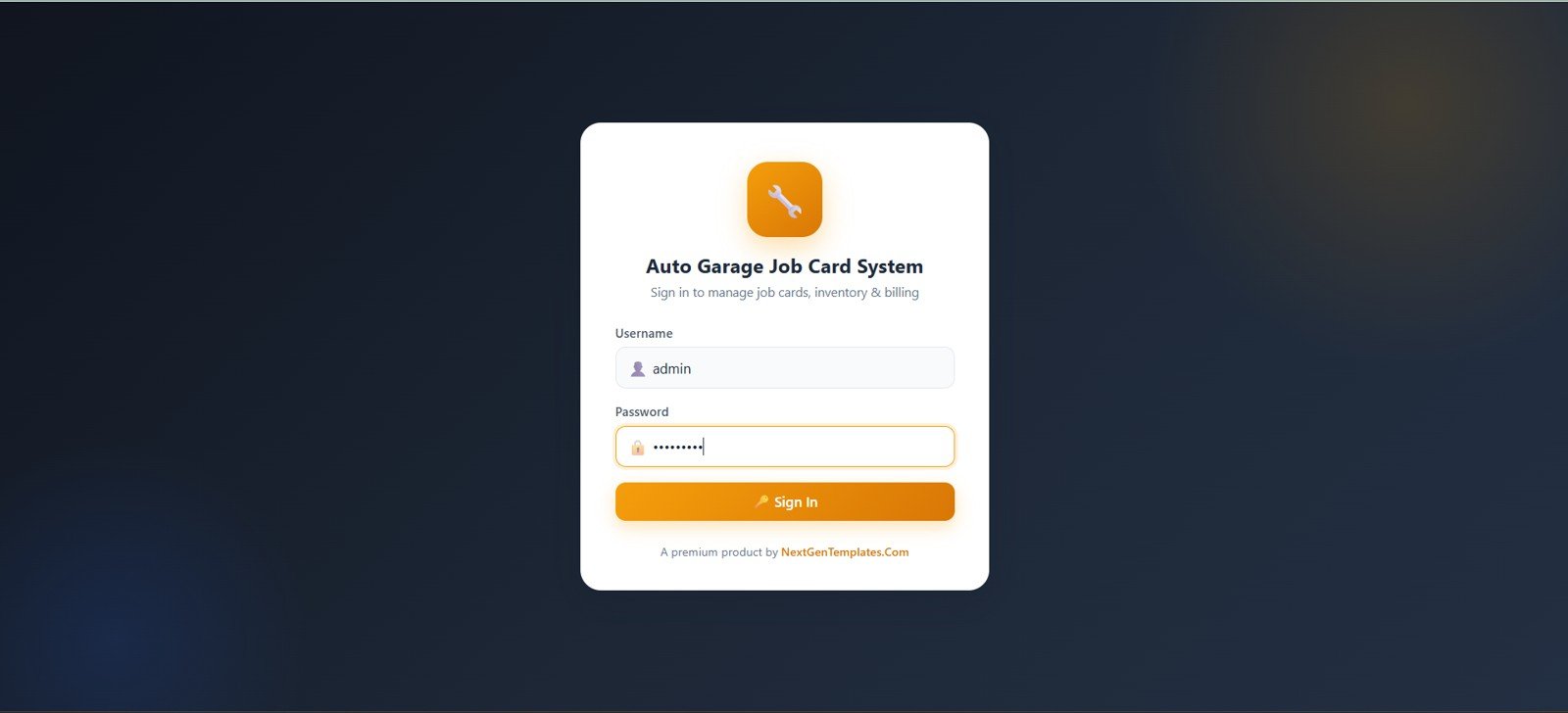
The login page gives authorised users a secure entry point with username and password fields and a Sign In button.
2. Dashboard
The dashboard shows workshop activity through eight KPI cards: Open Job Cards, Jobs In Progress, Ready for Delivery, Delivered This Month, Revenue This Month, Outstanding Payments, Low-Stock Parts and Avg Job Turnaround. Below them, Monthly Revenue Trend shows revenue movement, Job Cards by Status shows the stage mix, Top Services by Revenue highlights the highest-earning services, and Mechanic Workload (active jobs) compares staff allocation.
3. Job Cards
The Job Cards module manages the core repair workflow. Each row shows job number, date, customer, vehicle, assigned mechanics, priority, status and estimate, while search and status and priority filters help the service desk find the right job quickly.
4. Customers
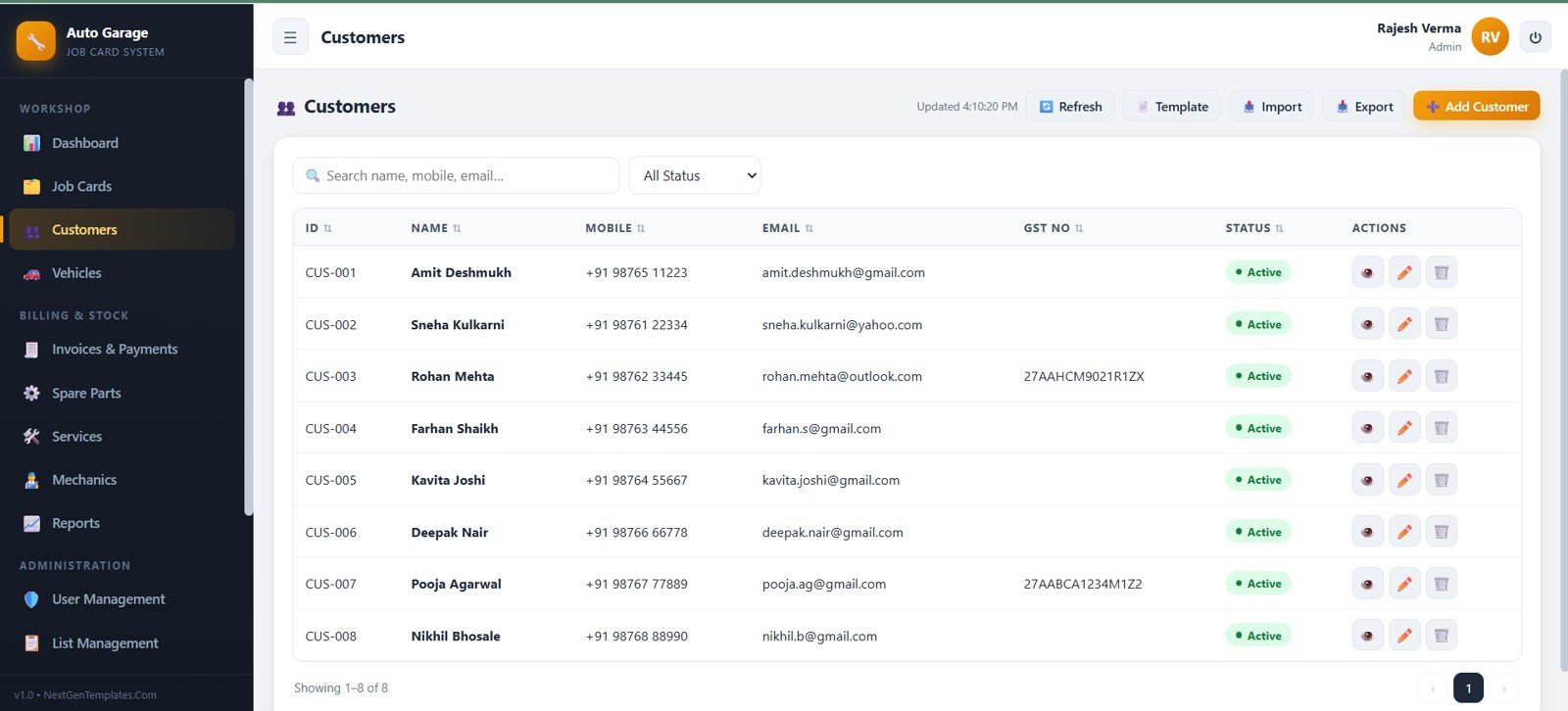
The Customers module stores customer ID, name, mobile number, email, GST number and status. Search, status filtering, template, import, export, add, view, edit and delete actions keep the customer master useful for daily counter work.
5. Vehicles
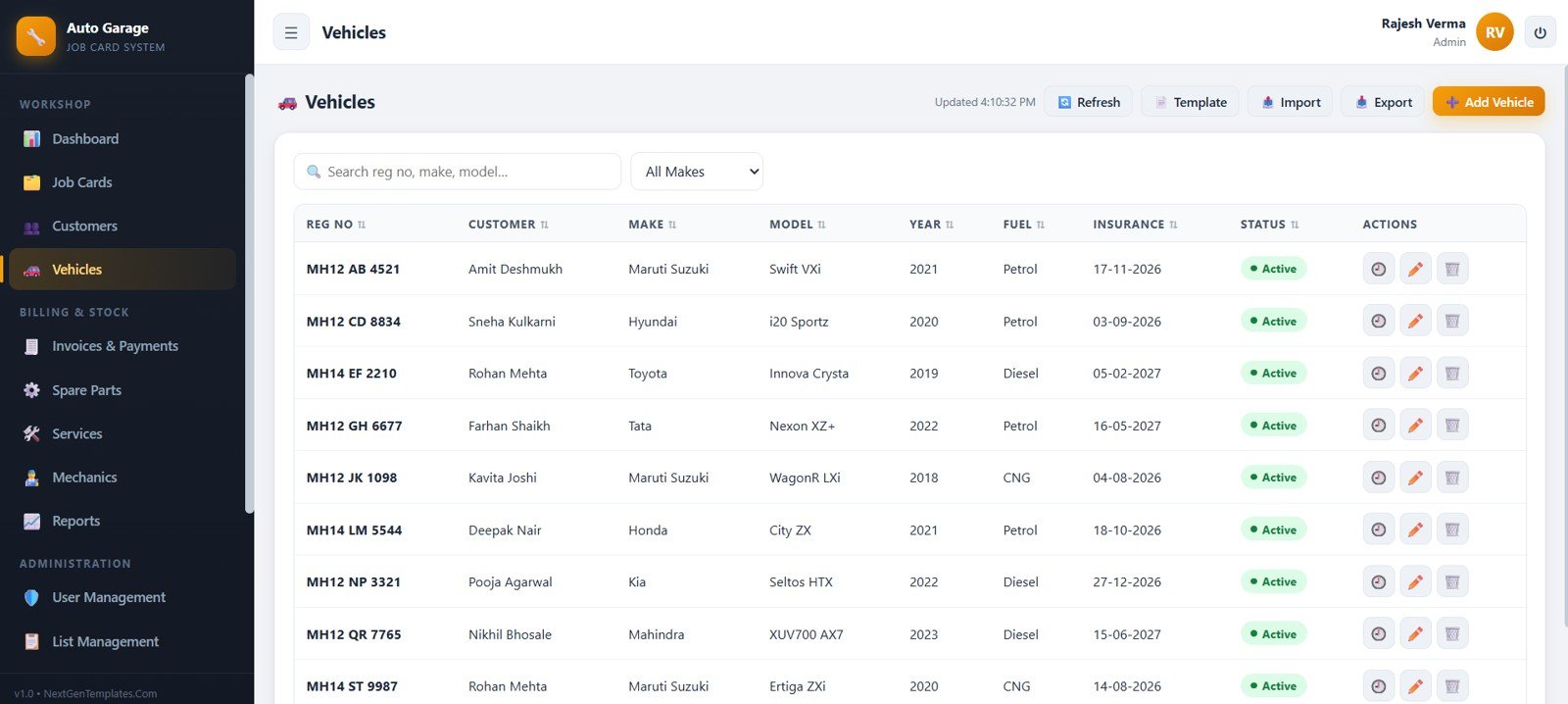
The Vehicles module links registration numbers to customers, make, model, year, fuel type, insurance date and status. Service history, edit, delete, template, import, export and add vehicle actions help garages keep a clean vehicle register.
6. Invoices and Payments
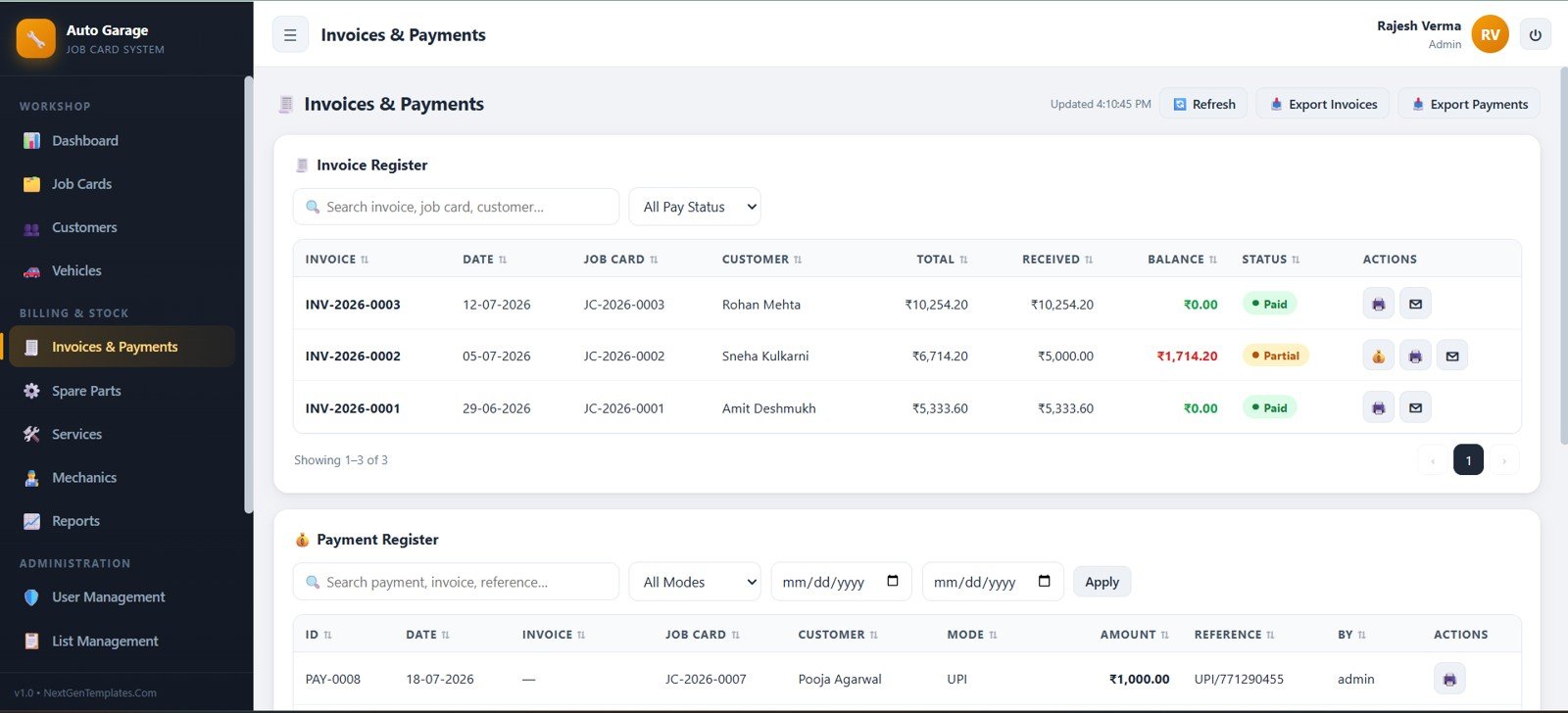
This module combines an Invoice Register and a Payment Register. Invoices show invoice number, date, job card, customer, total, received amount, balance and status; payments show payment ID, date, invoice, job card, customer, mode, amount, reference and who recorded it, with separate export buttons for each register.
7. Spare Parts Inventory
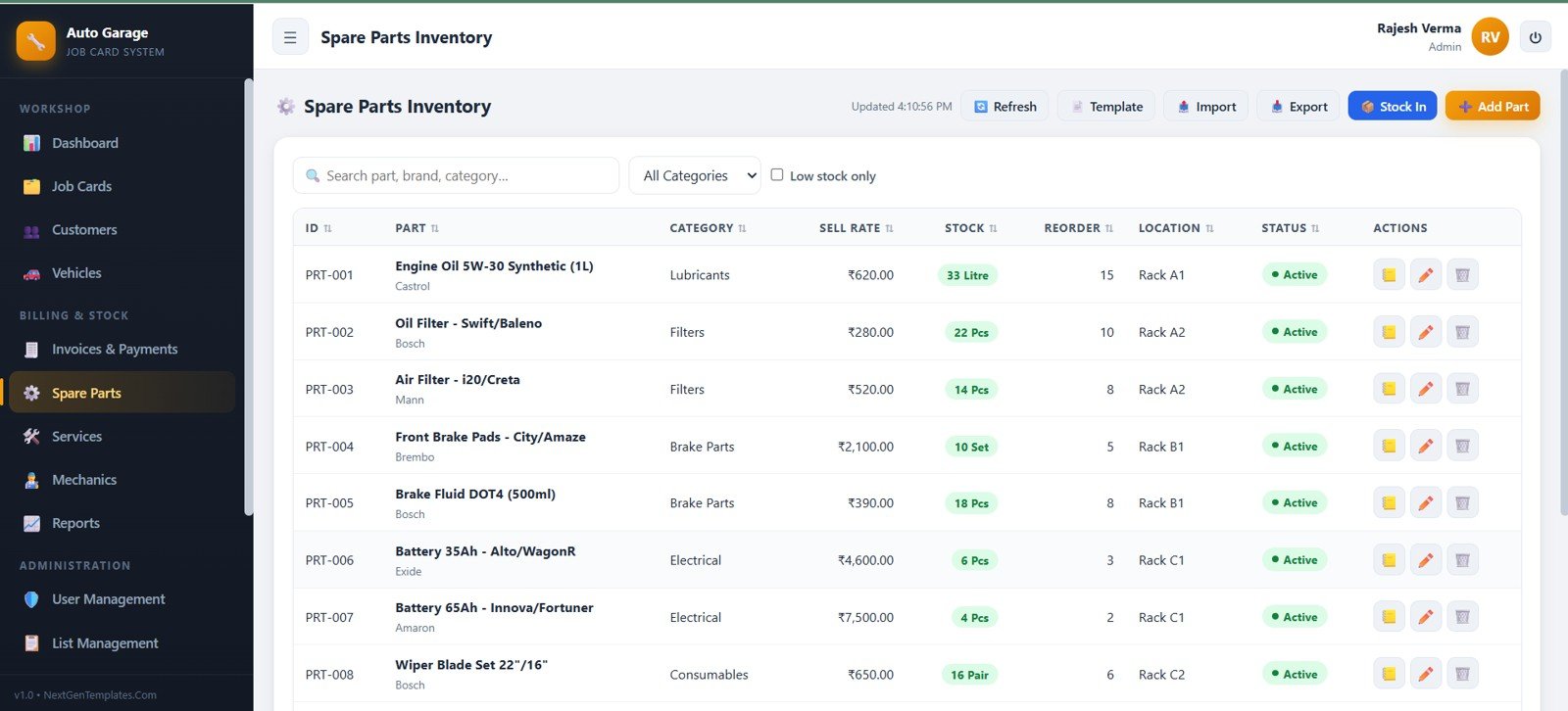
Spare Parts Inventory tracks part ID, part name and brand, category, sell rate, stock, reorder level, rack location and status. A low-stock filter, Stock In, template, import, export, edit and delete actions support inventory discipline.
8. Services (Labor)
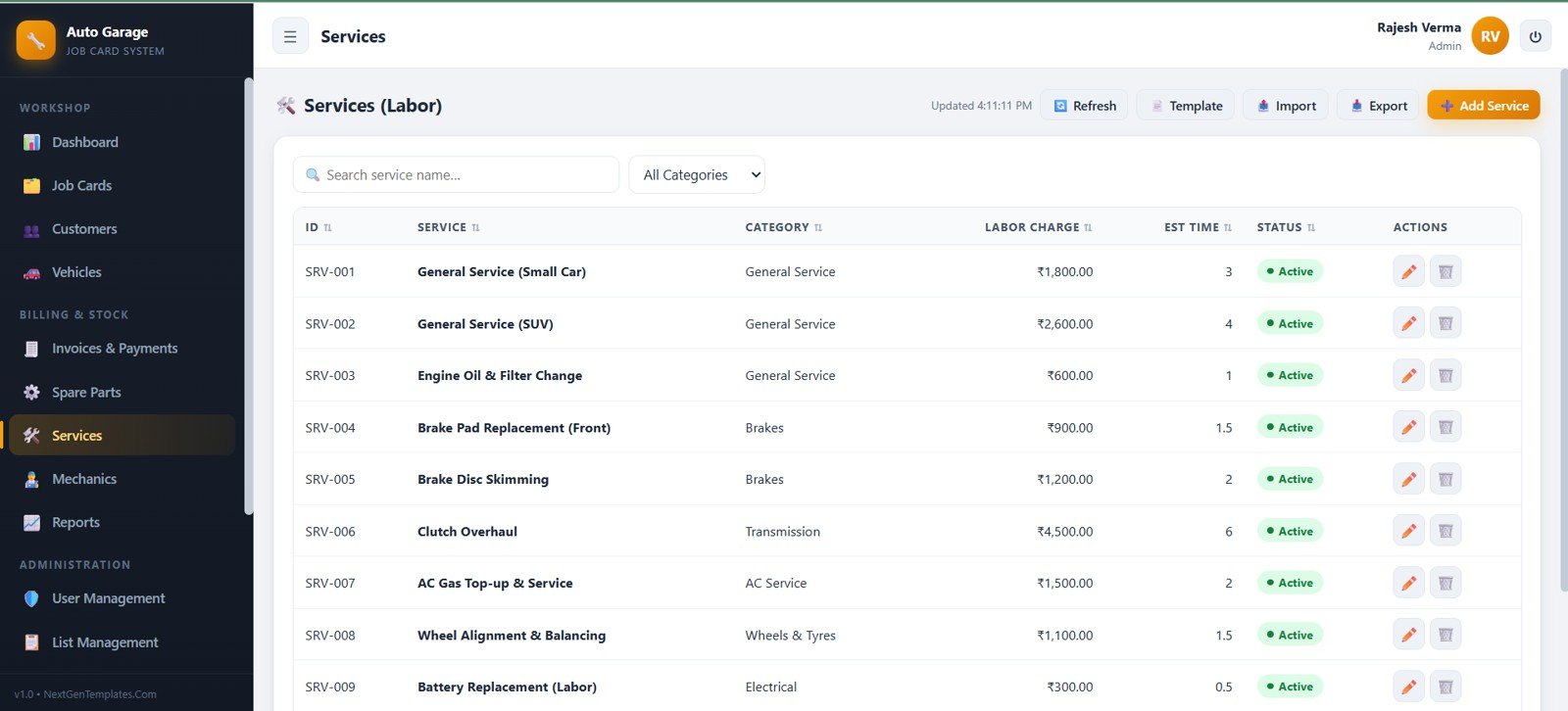
The Services screen keeps standard service pricing with service ID, service name, category, labor charge, estimated time and status, so routine rates stay consistent before invoicing.
9. Mechanics and Staff
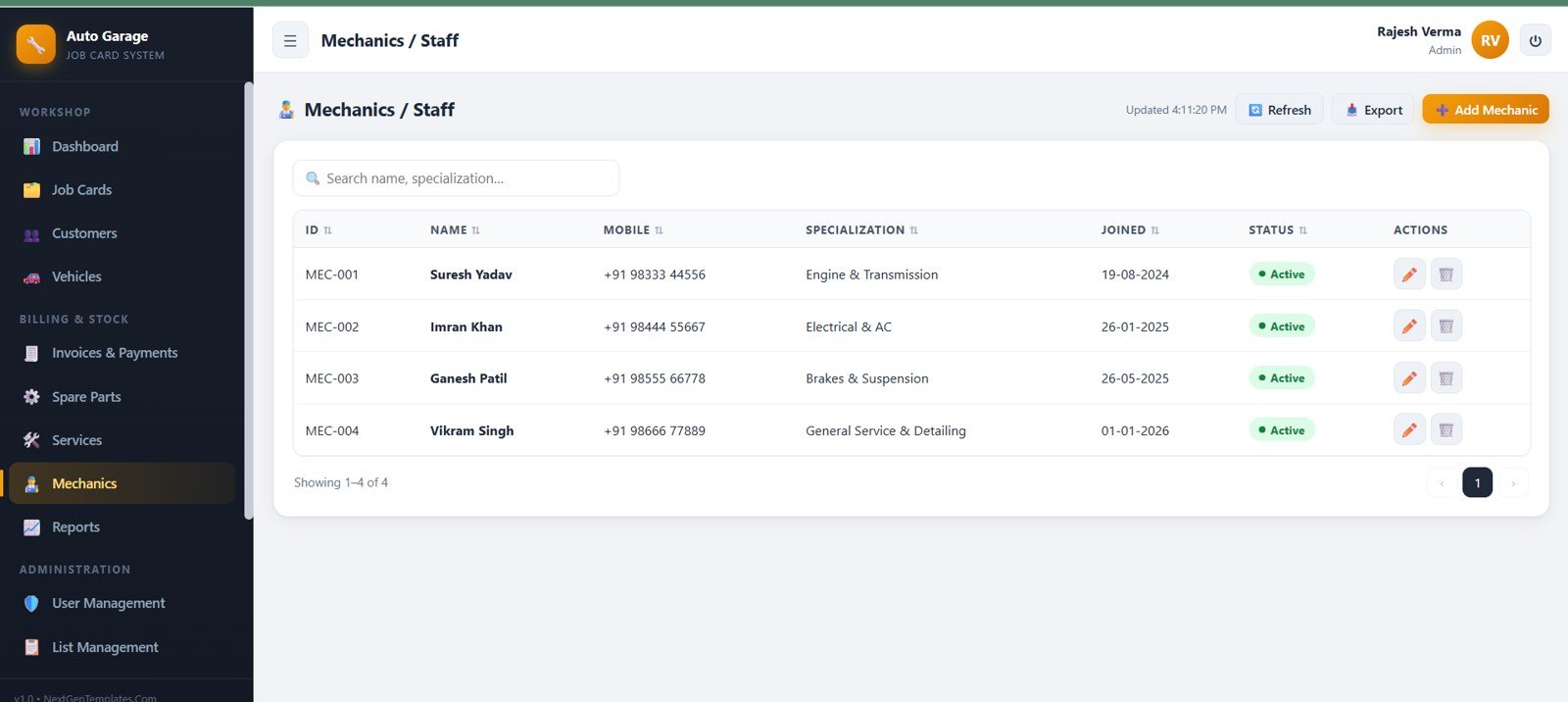
Mechanics and Staff keeps mechanic ID, name, mobile, specialisation, joined date and status in one list, with search, export, add, edit and delete actions.
10. Reports
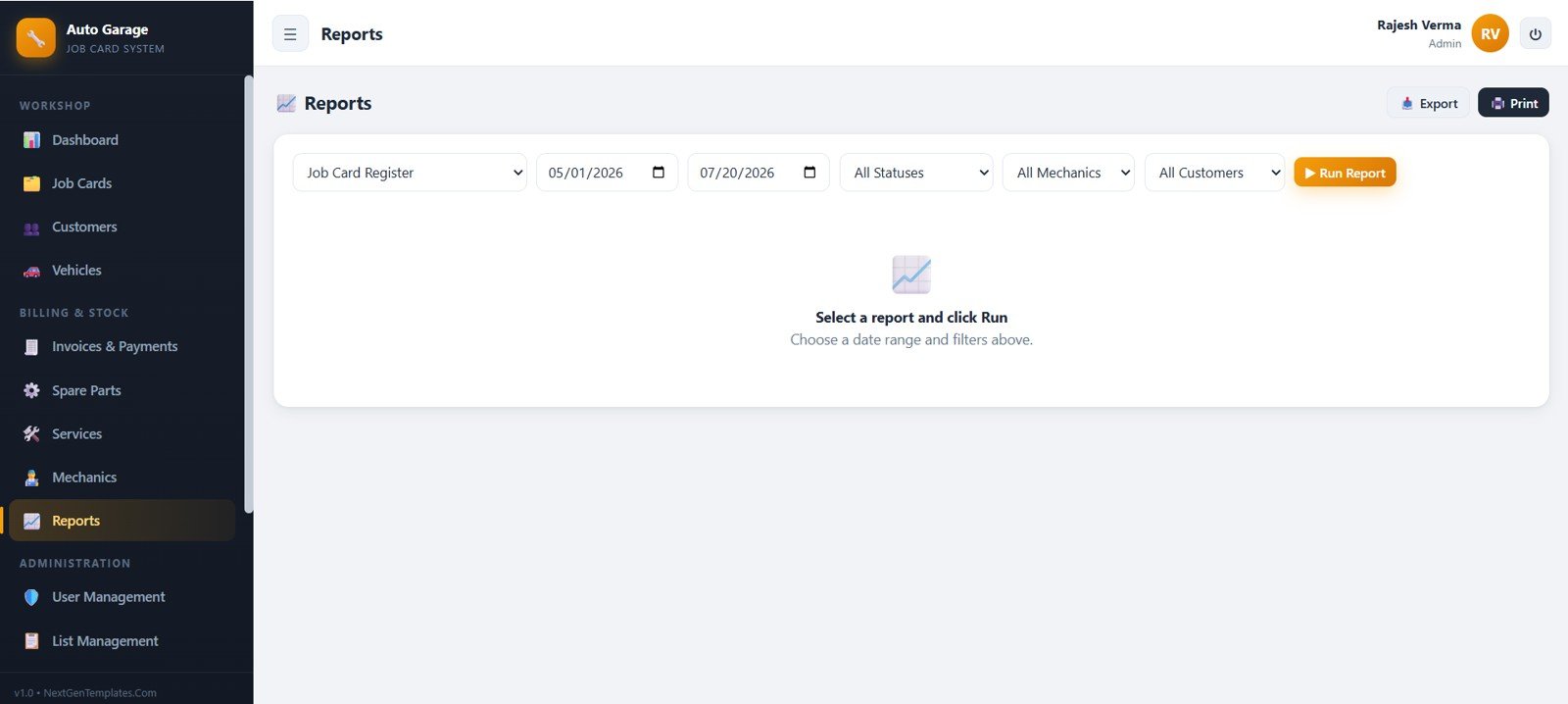
The Reports screen has a report selector (for example Job Card Register), start and end dates, status, mechanic and customer filters, a Run Report button, and export and print controls.
11. User Management
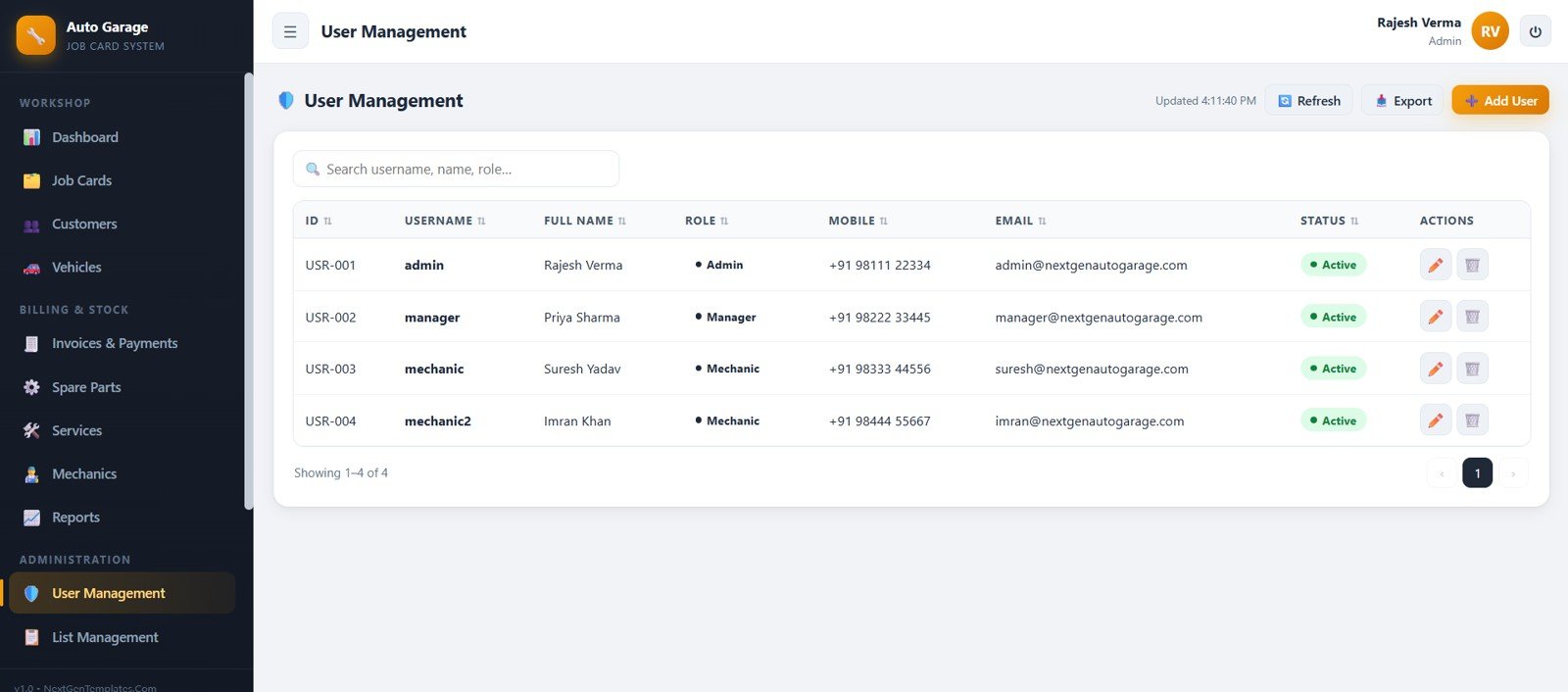
User Management lets an admin maintain user ID, username, full name, role, mobile, email and status, with search, export, add, edit and delete actions.
12. List Management
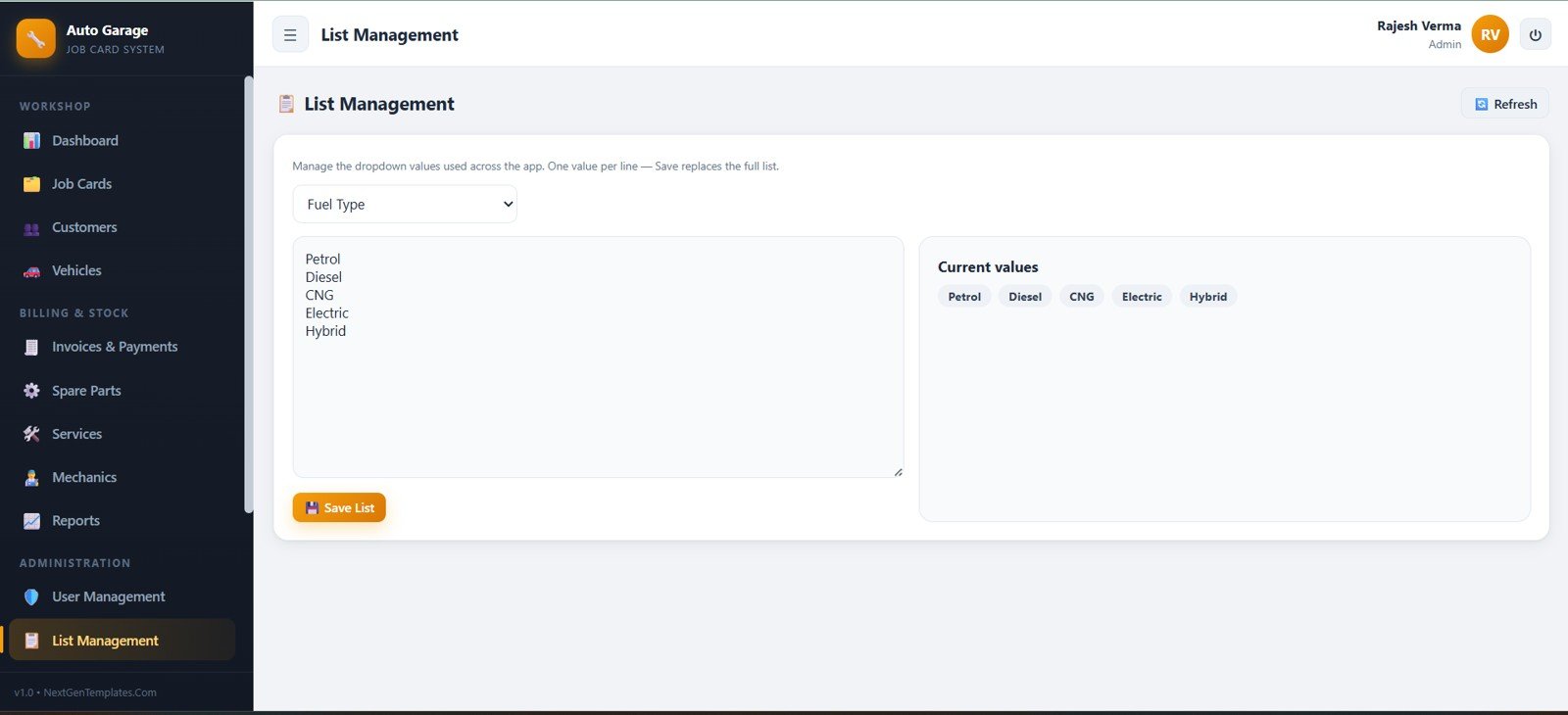
List Management controls the dropdown values used across the app, one value per line. The Fuel Type list shown includes Petrol, Diesel, CNG, Electric and Hybrid.
13. Audit Log
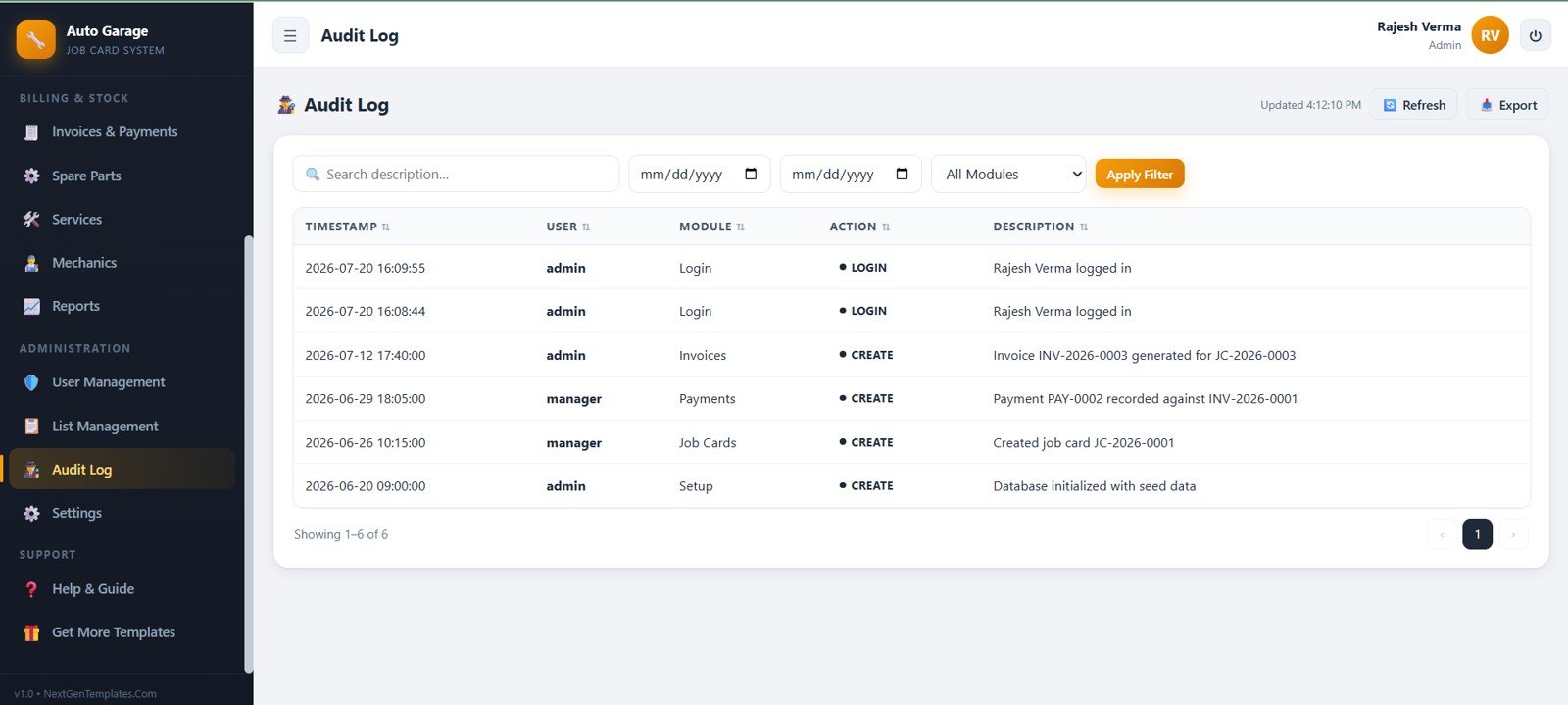
The Audit Log records timestamp, user, module, action and description, such as logins, created job cards, generated invoices and recorded payments. Search, date filters, a module filter and export support reviews.
14. Settings
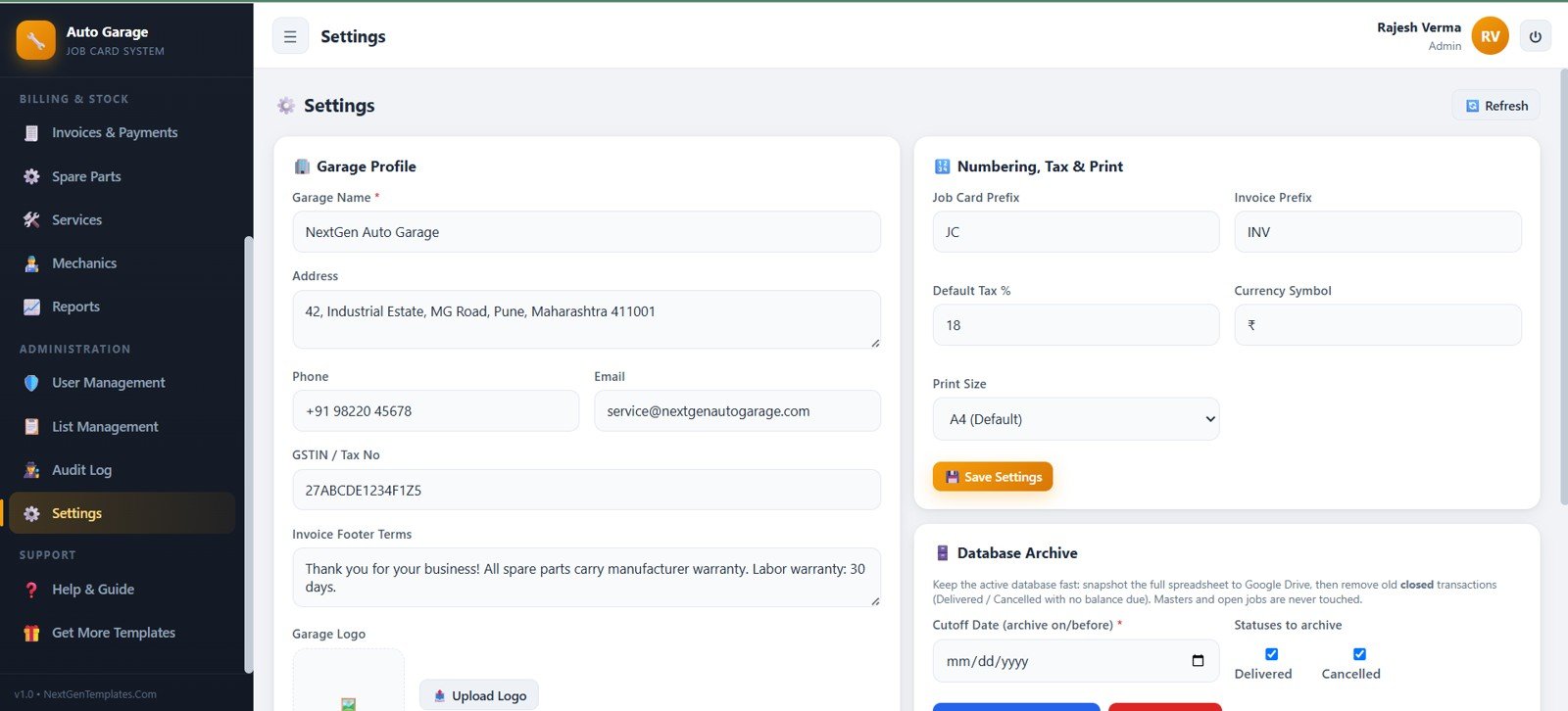
Settings holds the garage profile (name, address, phone, email, GSTIN or tax number, invoice footer terms, logo), numbering and tax (job card prefix, invoice prefix, default tax %, currency symbol, print size) and Database Archive (cutoff date and statuses to archive, such as Delivered and Cancelled).
Web App vs Spreadsheet Tracker vs Paid Garage Software
| Feature | Auto Garage Web App | Spreadsheet tracker | Paid garage SaaS |
|---|---|---|---|
| Cost | One-time purchase | Low software cost, more build time | Recurring subscription |
| Platform | Browser app in your Google account | Excel or Google Sheets tabs | Vendor-hosted web app |
| Setup | Start from 14 prepared screens | Build tables and formulas | Import and onboarding |
| Role-based access | Admin, manager and mechanic roles | Shared file editing | Usually included by plan |
| Customisable fields | Editable lists and settings | Highly editable, less controlled | Depends on plan |
| Job card workflow | Dedicated module | Manual structure required | Usually included |
| Parts and billing | Inventory, invoices, payments and reports included | Requires linked sheets | Depends on plan |
Who Should Use This Template
The app suits independent auto garages, repair workshops, vehicle service centres, fleet maintenance coordinators and consultants replacing paper job cards with a cleaner internal system. It works best when the team wants a one-time purchase, editable lists, a controlled job-card flow and practical reporting without paying for a large SaaS platform.
Real-World Use Cases
- Neighbourhood garage: the service desk creates job cards, mechanics update progress, the parts lead checks stock, and billing records payments in one connected workflow.
- Multi-mechanic workshop: the owner compares mechanic workload, watches ready-for-delivery vehicles and follows outstanding balances before closing the day.
- Fleet service team: vehicle records, service history, invoices and reports separate routine maintenance from repair jobs and keep parts stock visible.
Advantages and Limitations
- Connects job cards, customers, vehicles, mechanics, services, inventory, invoices, payments and reports in one workflow.
- Gives owners a quick view of jobs, revenue, payments, low stock and turnaround.
- Editable dropdown lists and settings adapt the app to local garage terminology.
- Audit log and user roles add administrative control for growing teams.
The app still depends on disciplined data entry and regular backups. Larger garages may want accounting integrations, automatic customer messaging, VIN lookup, OEM dealer-system integrations, online payment gateways or barcode scanning. Those are outside the template’s scope and would need custom development.
Best Practices
- Clean customer, vehicle, mechanic, service and parts records before importing live data.
- Standardise statuses, priorities, payment modes and fuel types in List Management.
- Review open jobs, ready vehicles, low-stock parts and outstanding payments every morning.
- Record payments right after collection to keep balances accurate.
- Keep admin access limited to trusted users and review the audit log regularly.
- Export reports and archive closed jobs on a regular schedule.
Running a different kind of workshop? See the Service Center and Repair Shop Management System Web App, the Appliance Repair Service Management System Web App or the Car Wash Management System Web App. If you only need reporting, the Auto Repair Dashboard in Google Sheets is a lighter option, and the Vehicle Maintenance Checklist helps with routine service planning.
Curious about the spreadsheet skills behind systems like this? The NextGenTemplates Academy learning paths teach them step by step with practice files.
Frequently Asked Questions
What is the Auto Garage Job Card Management System Web App?
It is a downloadable Google Apps Script web app for managing garage job cards, customers, vehicles, spare parts, invoices, payments, mechanics, reports, users, list values, audit history and settings.
How many screens are included?
14: Login, Dashboard, Job Cards, Customers, Vehicles, Invoices and Payments, Spare Parts Inventory, Services (Labor), Mechanics and Staff, Reports, User Management, List Management, Audit Log and Settings.
Can I try it before buying?
Yes. Use the live demo above with the admin, manager or mechanic test logins to explore every screen with sample data.
Can it manage spare parts stock?
Yes. The Spare Parts Inventory screen tracks stock against reorder levels and rack locations, with a low-stock filter and a Stock In action.
Is this a full dealer management system?
No. It is a practical garage-management web app for small and mid-size teams. Dealer-system integrations, OEM data, payment gateways and telematics are outside its scope.
Does it require a monthly subscription?
No. It is sold through NextGenTemplates as a one-time download. Deployment in your own Google account and any customisation are the buyer’s responsibility.
About the Author
Built by PK, a Microsoft Certified Professional with 15+ years of Excel, Google Sheets and Power BI experience and founder of NextGenTemplates. Every template is hand-built and tested before release.
Wrapping Up
The Auto Garage Job Card Management System Web App gives garage teams a structured way to manage job cards, vehicles, parts, invoices, payments, staff, reports, users, settings and audit history. It sits between a fragile spreadsheet tracker and a recurring garage SaaS subscription. Try the demo with the mechanic and manager logins, and if the workflow fits your workshop, deploy your own copy.
Get the Auto Garage Job Card System
📅 Last updated: October 2026