Most dialysis units run their week on something that was never designed for it: a paper diary at the nursing station, a whiteboard that only exists in one building, a printed shift list that is out of date by Tuesday, and a group chat where the real changes actually happen. It works, right up until the morning somebody wheels a machine away for a service that nobody had written down.
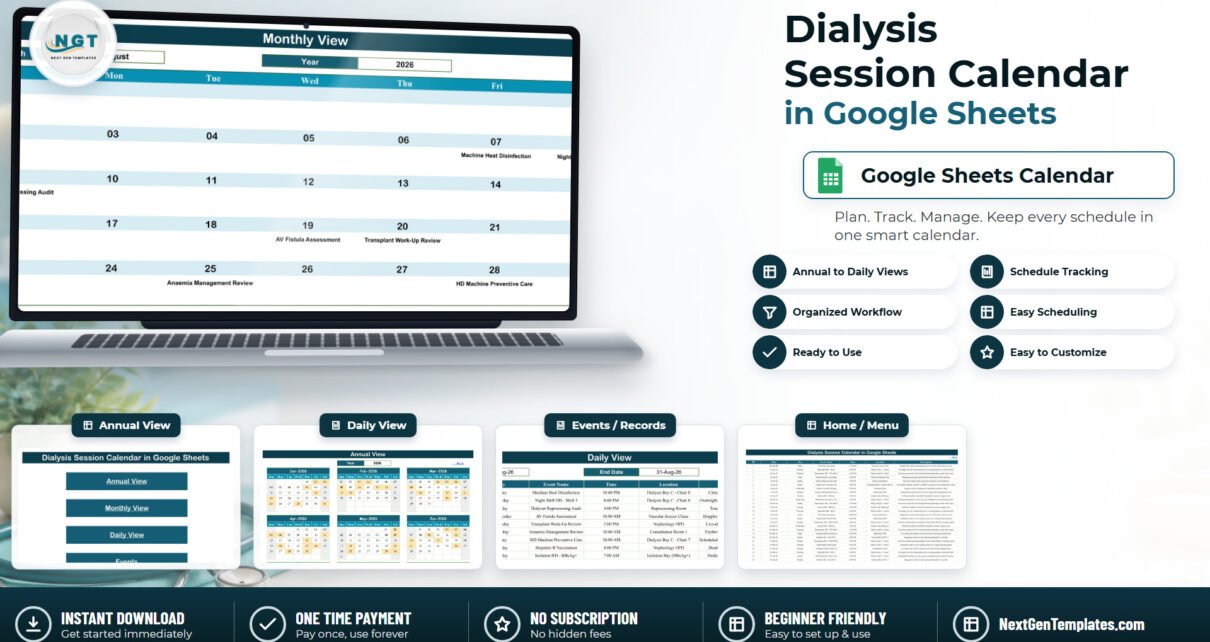
The Dialysis Session Calendar in Google Sheets is a small, deliberate fix for that one problem. It is a ready-to-copy scheduling workbook with six tabs, three linked calendar views and 100 sample entries loaded across 2026, covering 20 session and unit-task labels in 25 named chairs, bays and rooms. Open the PDF in your download, click the copy link, and the whole thing lands in your own Google Drive in about two minutes.
One thing to be completely clear about before we go any further. This is a spreadsheet that holds dates, times and room labels. It is not a patient record, not an EHR or EMR, not a dialysis or renal-unit management system, not a medical device, and not a treatment-planning tool. It does not determine, validate or optimise anybody’s treatment schedule. It makes no HIPAA, GDPR, CMS, ESRD-network, Joint Commission, NABH, CQC or any other regulatory or accreditation claim, and it will not help you achieve compliance with any of them. Your clinical scheduling, your patient safety and your record-keeping obligations stay exactly where they already are: with you and your clinical team.
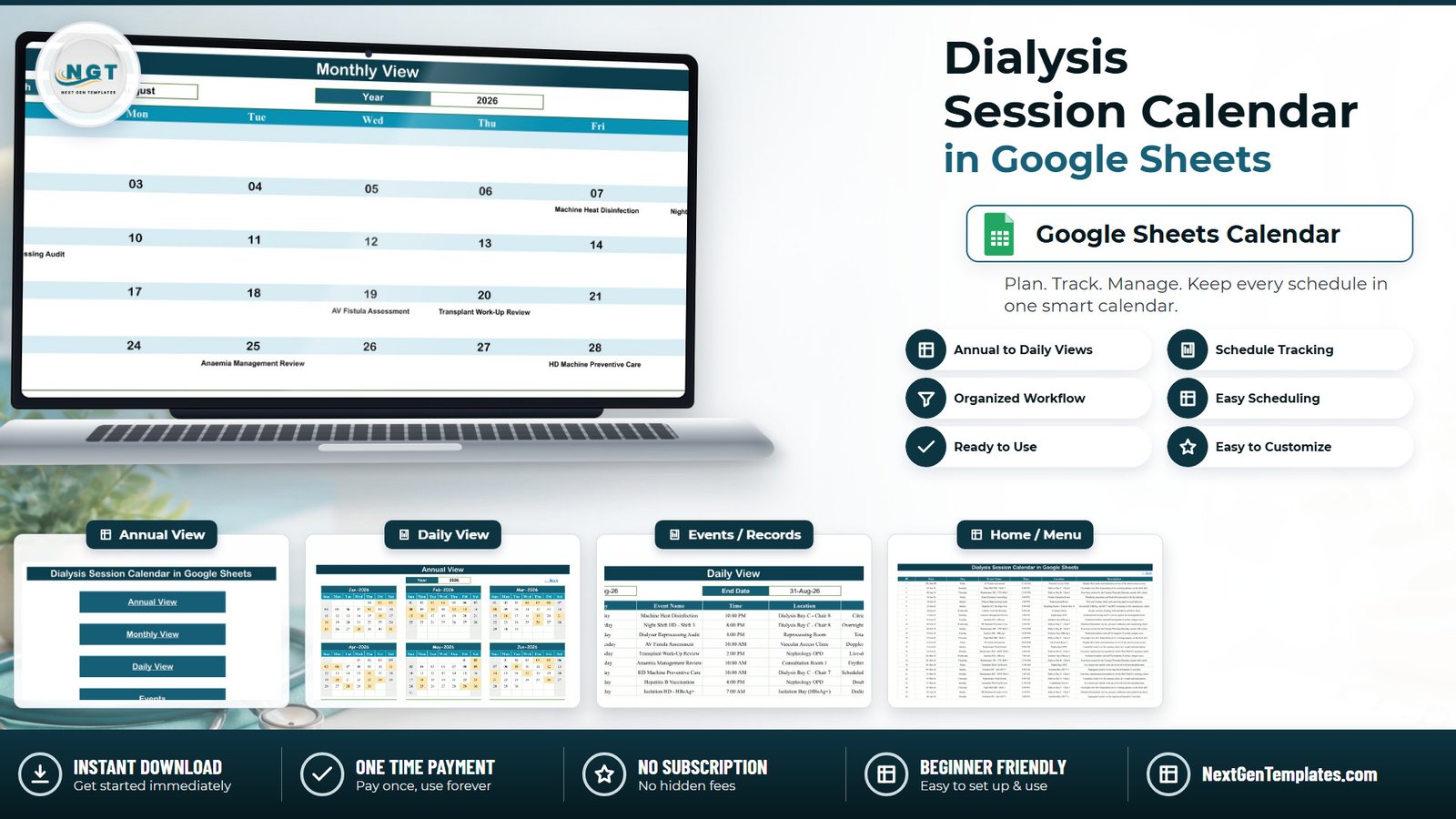
Key Features of Dialysis Session Calendar in Google Sheets
- Six tabs, five visible – Home, Annual View, Monthly View, Daily View and Events, plus one hidden List tab that feeds the Month and Year dropdowns.
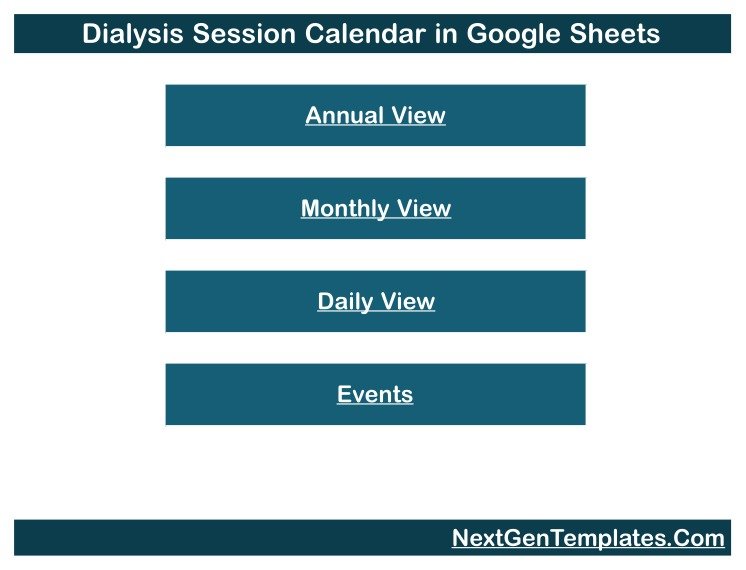
- Four navigation buttons on Home jump straight to each view, and every view carries a “Back” link home.
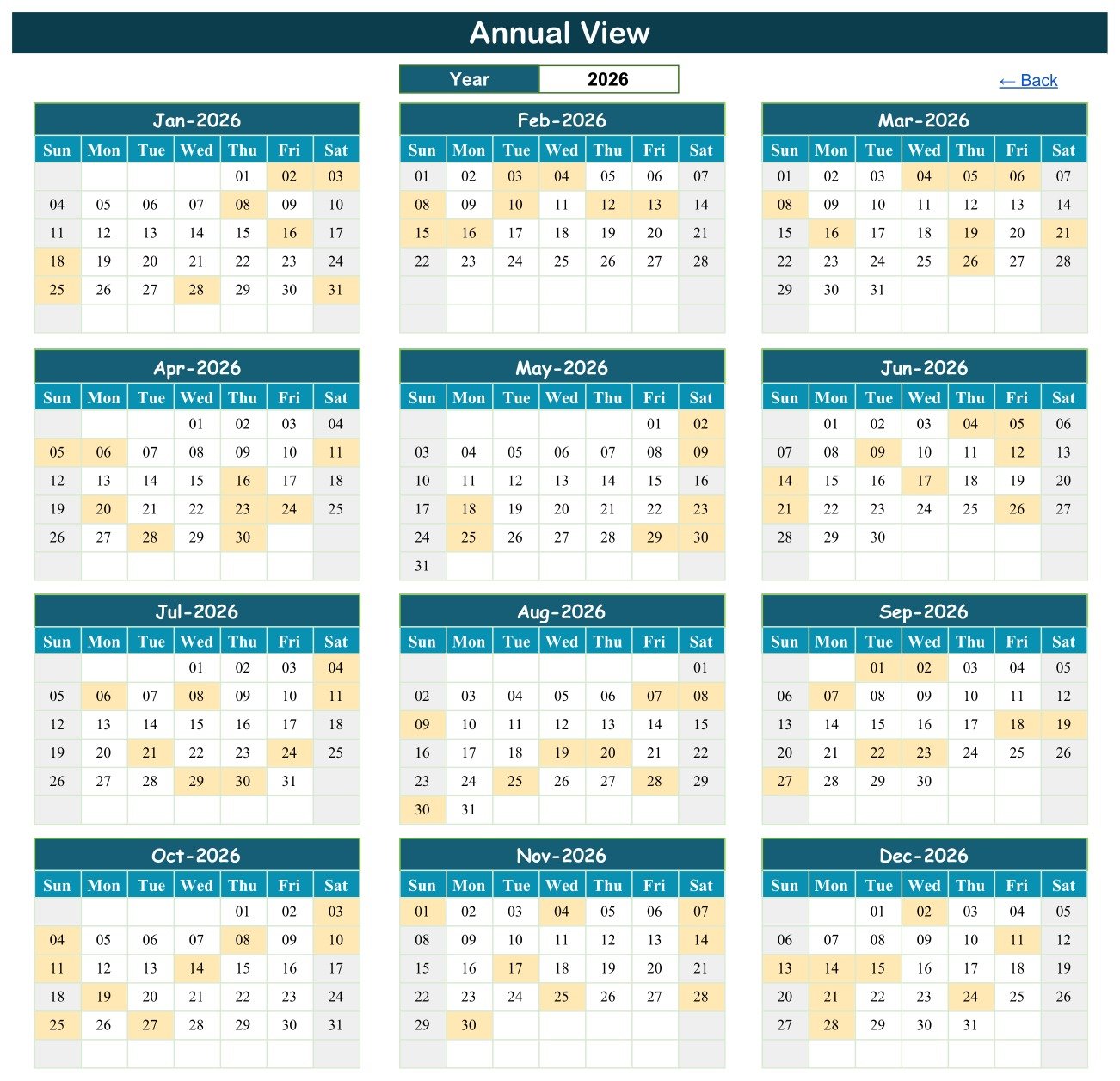
- Annual View driven by one cell – type a year into the Year box and all twelve month grids rebuild, three across and four down, with every scheduled day shaded. In the sample data January 2026 shades the 2nd, 3rd, 8th, 16th, 18th, 25th, 28th and 31st.
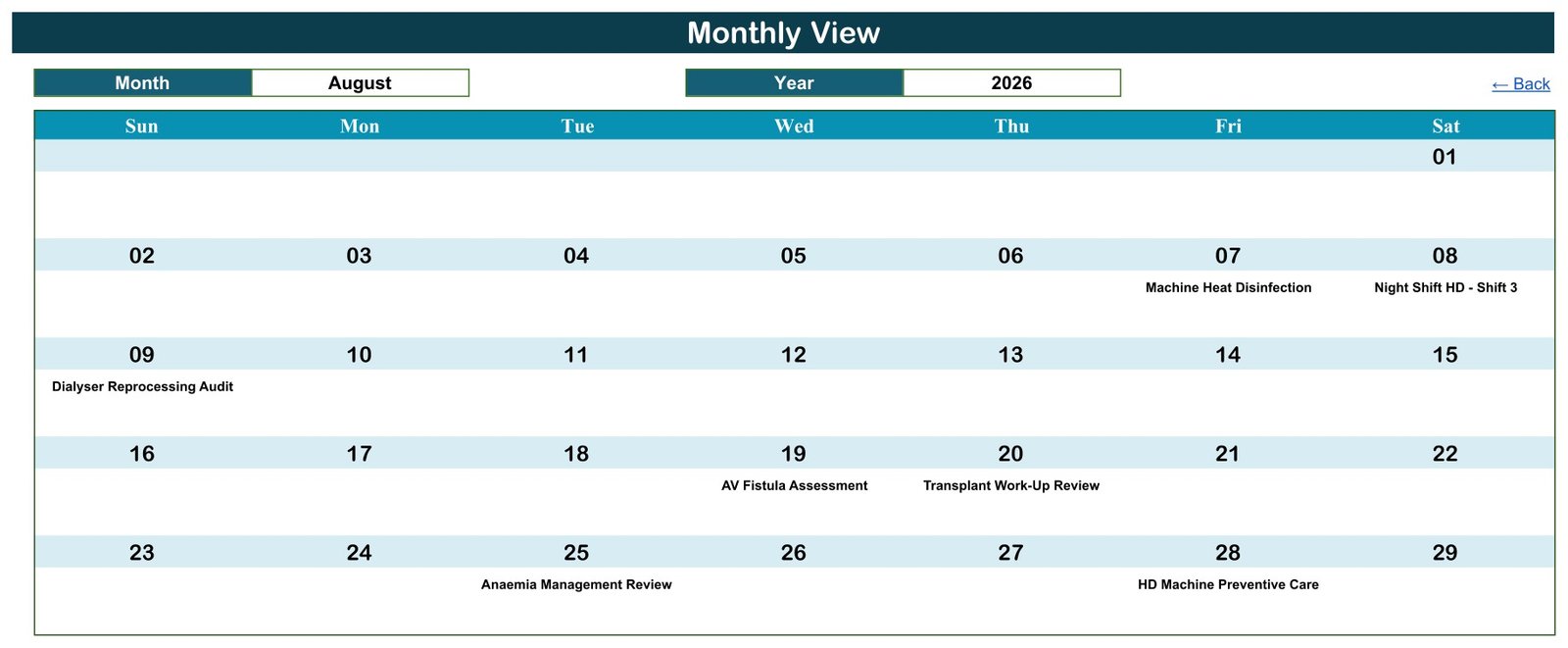
- Monthly View with Month and Year dropdowns – pick August and 2026 and the Sun-to-Sat grid fills with that month’s entries under their dates.
- A “1 more…” counter on stacked days – the month grid prints the first entry on a date and a
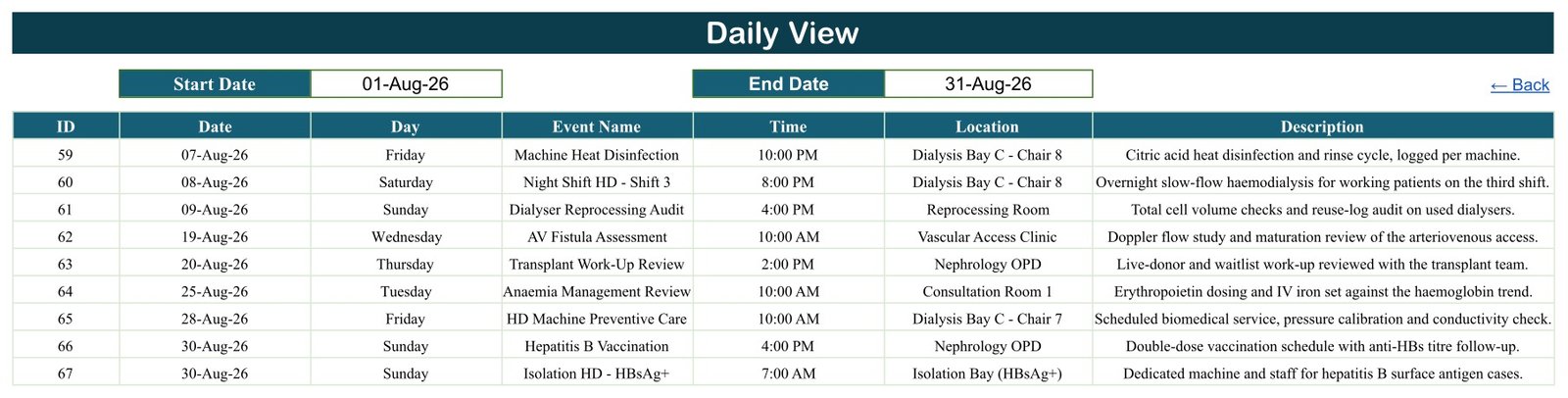
COUNTIFline adds a note when a second one exists, so a busy day never looks like a quiet one. - Daily View date range – set a Start Date and an End Date and a
FILTERformula returns every entry between them, all seven columns, in date order. - 100 sample entries numbered 1 to 100 and dated 02-Jan-2026 to 28-Dec-2026, eight or nine a month across all twelve months, with room for roughly 896 more rows.
- Seven columns and nothing else – ID, Date, Day, Event Name, Time, Location, Description. No patient name, no patient ID, no hospital number, no date of birth, no contact, no diagnosis, no clinical value, no notes.
- 20 session and unit-task labels in the sample data, covering maintenance and night shifts, unscheduled sessions, isolation sessions, peritoneal-dialysis training, ward rounds, vascular access and transplant review clinics, dietitian and anaemia reviews, adequacy and serology lab days, vaccination clinics, machine servicing and heat disinfection, dialyser reprocessing audits and water-quality testing.
- 25 named locations – individual chairs across Dialysis Bays A, B and C, an acute bay chair, two isolation bays, the reprocessing room, the RO plant room and water loop sampling point, the biomedical workshop, the unit-side laboratory, two sampling stations, the vascular access clinic, an ultrasound room, the nephrology OPD, a consultation room, a treatment room, and the CAPD training and patient education rooms.
- 27 distinct start times from 5:00 AM to 11:30 PM, so early shifts, daytime clinics and late machine tasks all sit on the same grid instead of collapsing into “all day”.
- Rolling year list – the hidden List tab carries 2021 to 2056, so the Year dropdown outlives the sample data by three decades.
- Nothing to install – native Google Sheets functions only. No Apps Script, no macros, no add-on permissions.
Why There Is No Patient Column – and Why That Is Deliberate
Open the Events tab and count the columns. Seven: ID, Date, Day, Event Name, Time, Location, Description. There is no eighth column waiting for a name, a hospital or MRN number, a date of birth, a phone number or a clinical note, and there is no hidden one either. Every one of the 100 sample rows was checked: not a single individual is identified anywhere in the file.
That is not a gap to fill in. A Google Sheet is not appropriate storage for protected health information. A shared spreadsheet has no meaningful access control, no encryption you control, no audit trail, no retention policy, and no way to prove afterwards who saw what and when. The instant a patient’s name goes into a cell, a convenient wall-planner becomes a records liability – and it becomes your liability, not the template’s.
So the calendar answers one question and one question only: what is scheduled, when, and in which chair or room. Who is in the chair is a clinical record, and it belongs in the system your unit is licensed and governed to keep it in. Nothing physically stops you adding a column – it is your copy of a spreadsheet. Please talk to whoever owns information governance where you work before you do.
What’s Inside the Dialysis Session Calendar in Google Sheets
Home is a title banner over four stacked buttons – Annual View, Monthly View, Daily View, Events. It is a menu rather than a dashboard: no counters, no charts, no totals. Its whole job is that a colleague you have shared the sheet with can find the right view without being told which tab to click.
Annual View puts the year on one screen. A single Year box drives everything below it through DATE formulas: twelve month grids, three across and four down, each a proper Sun-to-Sat calendar, with every day that carries an entry shaded. Change 2026 to 2027 and the whole page rebuilds around the new year’s weekdays. This is the view for reading the shape of a quarter – which weeks are dense, where the maintenance days cluster, which month has been left thin.
Monthly View is the working view. Two dropdowns – Month and Year, both fed by the hidden List tab – fill a Sun-to-Sat grid with that month’s entries printed under their dates. It runs on a VLOOKUP against the Events tab, so it prints the first entry on a given date, and a COUNTIF line underneath adds “1 more…” when the date carries a second. In the sample year exactly three dates do: 30-May-2026, 04-Jun-2026 and 30-Aug-2026.
Daily View is the range view, and the one you print for a handover. Set a Start Date and an End Date – the sample ships with 01-Aug-26 to 31-Aug-26 – and one FILTER formula returns every matching row with all seven columns intact. Narrow it to a single day for the morning meeting, or a week for planning. Unlike Monthly View, it hides nothing on a stacked date.
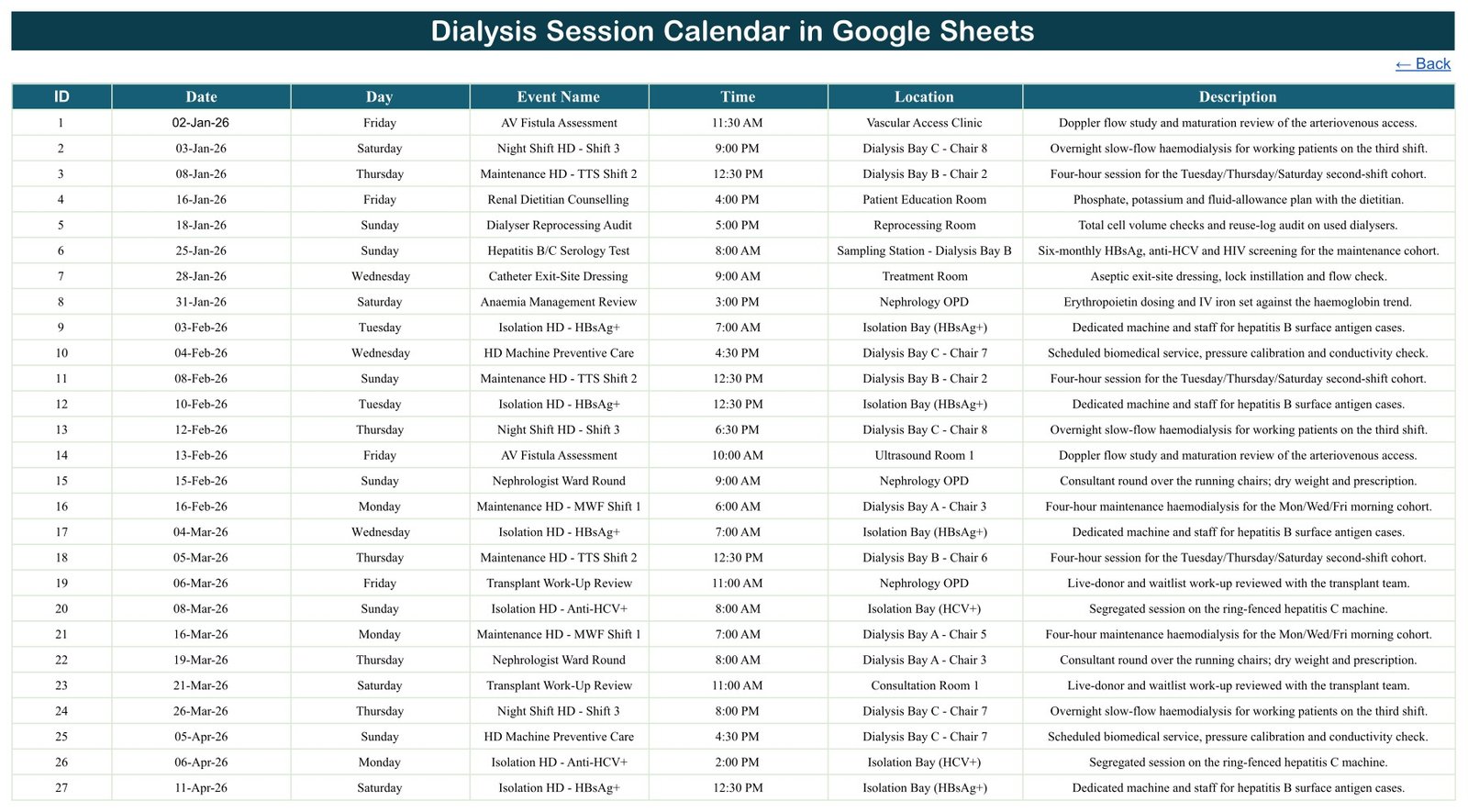
Events is the single source of truth and the only tab you type into. One hundred rows are already there, spread across all twelve months of 2026 at eight or nine a month. All three views read from this one table, so a corrected time, a renamed session or a brand-new row appears everywhere the moment you press Enter. The view formulas are written against rows 4 to 999 – about 896 free rows once the samples are cleared.
List is hidden and can stay that way. It holds the twelve month names and a 36-year range from 2021 to 2056, and those two columns are what the Month and Year dropdowns read.
Dialysis Session Calendar in Google Sheets vs. the Excel Edition vs. Renal Unit Software – Where This Fits
| What you need | This Google Sheets calendar | The Excel edition | Dialysis / renal unit software |
|---|---|---|---|
| Year, month and date-range views of scheduled sessions and unit tasks | Yes – three linked views off one table | Yes – plus a This Month summary page | Yes |
| Share with the whole unit and edit together, live | Yes – share the link | No – a file you email or drop on a drive | Yes, with accounts and licences |
| Works on a phone or tablet at the nursing station | Yes – browser or the Sheets app | Desktop Excel for Windows, macros enabled | Usually yes |
| Store patient identities, clinical values or treatment records | No – deliberately | No – deliberately | Yes, that is what it is for |
| Prevent a double-booked chair, warn on a clash, enforce a rule | No – it validates nothing | No – it validates nothing | Yes |
| Reminders by text or email | No | No | Usually yes |
| Audit trail, access control, retention, certification | No | No | Yes – that is the whole difference |
| Cost | $4.99 once | $4.99 once | Recurring, per seat or per unit |
The honest summary: if your unit already runs proper renal software, this is a shareable wall-planner beside it, not a replacement for it. If your unit currently runs on a paper diary and a group chat, this is a real step up for the price of a coffee – and it is still not clinical software.
Who This Template Is For – and Who It’s Not For
It is for whoever keeps the unit’s diary. A dialysis unit manager or charge nurse planning shift patterns and chair allocation. A renal ward clerk who wants the month on a screen instead of on paper. A small standalone or satellite unit with no scheduling software at all. A biomedical or technical lead who wants servicing, disinfection cycles and water testing on the same calendar as the treatment shifts, so a machine coming out of service is visible weeks early. A nephrology practice manager fitting clinic sessions around dialysis days. A trainer who needs the training room booked and visible.
It is not for anyone who needs to hold patient records – that is your clinical system’s job. It is not for anyone who needs the calendar to decide something: it will not build a shift pattern, will not check a clash, will not balance chair utilisation and will not flag a gap. It is not for a unit that needs an audit trail or access control over the schedule itself. And it is never a substitute for your unit’s official rota or your clinical system’s booking record – if the two disagree, the official one wins.
How to Use the Dialysis Session Calendar in Google Sheets
- Open the PDF in your download and click the “Make a copy” link. Google makes a private copy of the whole six-tab workbook in your own Drive, under your own account.
- Explore with the sample data still in. Change the Year on Annual View, the Month dropdown on Monthly View, the Start and End dates on Daily View. Five minutes tells you whether the layout suits your unit.
- Clear Events rows 4 to 103 – values, not rows. The view formulas are written against the range, and deleting whole rows is the one thing that can disturb them.
- Type your own schedule in. ID, Date, Day, Event Name, Time, Location, Description. Keep the Date column as a real date so the views can match on it, and leave the person out of it.
- Rename the locations to your own bays, chairs and rooms. Plain text – whatever you type appears in every view immediately.
- Look at a date that carries two entries before you rely on the month grid. Monthly View shows the first plus “1 more…”; Daily View and Events show them all.
- Share read-only with everyone who only needs to look, and edit access with the one or two people who actually keep the diary.
- Print or export Daily View for the handover – File to Print, or File to Download as PDF.
Four Honest Limitations
Every template on this site gets this section, and this one earns it more than most.
It prevents nothing. There is no validation anywhere in the workbook. It will let you put two sessions in the same chair at the same time, and it will not say a word. The sample data deliberately stacks three dates so you can see what a clash looks like before it happens to you for real.
Monthly View hides the second entry. Because the month grid uses VLOOKUP, it prints the first match on a date. The “1 more…” note tells you something is behind it, but you have to open Daily View or the Events tab to see what. If your unit routinely stacks a date, treat Daily View as the authoritative view.
There is no end time and no numbers. The Time column is a start time, and there is no duration or end-time field, so you cannot calculate chair utilisation, session length or throughput from this file. There is no numeric column at all, so nothing sums or charts.
It notifies nobody. No reminders, no texts, no emails, no alerts of any kind. Someone has to open the sheet and look at it.
Frequently Asked Questions
Is this a dialysis management system, an EHR or a patient record?
No. It is a calendar of scheduled sessions and unit tasks. There is no patient record, no treatment record, no prescription, no lab result and no clinical workflow of any kind. It sits alongside your clinical system, never instead of it.
Where do the patient names and hospital numbers go?
Nowhere, by design. The seven columns are ID, Date, Day, Event Name, Time, Location and Description, and none of the 100 sample rows identifies anybody. A Google Sheet is not appropriate storage for protected health information – no reliable access control, no encryption you control, no audit trail, no retention policy. Schedule the session here; keep the person’s identity where your unit is licensed to keep it.
Does it decide, validate or optimise treatment schedules?
No, and it must not be used as if it does. It performs no validation whatsoever, knows no shift pattern, session frequency, chair-capacity limit or clinical rule, and will accept any date, time and room you type. Every scheduling and clinical decision, and the patient safety that follows from it, stays with your clinical team.
Is it certified, compliant or approved for clinical use?
No. It is a spreadsheet of dates and text. It is not a medical device and it makes no HIPAA, GDPR, CMS, ESRD-network, Joint Commission, NABH, CQC or any other regulatory or accreditation claim. It must not be used as a system of record.
Will it stop me double-booking a chair and a time?
No. Nothing prevents a clash and nothing warns you about one. Three dates in the sample data carry two entries each – 30-May-2026, 04-Jun-2026 and 30-Aug-2026 – precisely so you can see how that behaves before it matters.
Can I track session counts or chair utilisation?
No. There is no numeric column and no end-time field, so nothing sums, counts or calculates. The calendar answers “what is scheduled, when and where”.
What exactly is in the download?
A PDF holding the “Make a copy” link to the Google Sheet, plus how-to notes. Click it and the whole six-tab calendar, all 100 sample entries included, is copied into your own Google Drive under your own account.
Can I change the session names, times and rooms?
Yes, and you should. The sample entries are illustrative placeholders written to fill a year of calendar – they are not a recommended schedule and not clinical guidance. Everything is plain text you overwrite, and all three views update the moment you type.
Do I need Apps Script, macros or an add-on?
No. Native Google Sheets functions only – DATE, DATEVALUE, TEXT, VLOOKUP, COUNTIF and FILTER. Nothing to authorise, nothing to install, and it opens on the free tier of a personal Google account.
The sample data is 2026 – does it expire?
The rows are dated 2026 because that is the year they were written for, and you overwrite them. The calendar does not expire: the hidden List tab carries 2021 to 2056.
Get the Dialysis Session Calendar in Google Sheets
One payment, no subscription, no per-user licence, and a copy that lives in your own Google Drive under your own account.
Get the Dialysis Session Calendar in Google Sheets on NextGenTemplates
If you would rather have a desktop workbook than a browser sheet, the Dialysis Session Calendar in Excel is the same idea as a macro-enabled Excel file with Annual, Monthly, Daily and This Month views. Its sample data is its own, so the two editions are companions rather than duplicates.
Related Google Sheets Calendars
The same six-tab layout runs across the rest of the hospital diary: the Operation Theatre Booking Calendar in Google Sheets for theatre lists, the Radiology Slot Booking Calendar in Google Sheets for imaging rooms, and the Patient Follow-Up Visit Calendar in Google Sheets for the review clinics around a treatment programme.
For the staffing side there are the Nurse Duty Roster Calendar in Google Sheets and the Doctor On-Call Calendar in Google Sheets; for a general clinic diary, the Medical Appointment Calendar in Google Sheets; and for outpatient therapy, the Physiotherapy Session Calendar in Google Sheets. A Mood and Mental Health Tracker in Google Sheets is on the way as well, for personal rather than unit-level use.
And when a calendar stops being enough – when you need records, roles, logins and reports rather than a shared diary – the Hospital Management System Web App is the step up.
About the Author
Built by PK – Microsoft Certified Professional with 15+ years of Excel, Google Sheets, and Power BI experience. Founder of NextGenTemplates, reaching 300K+ subscribers across YouTube channels. Every template is hand-built and tested before release.