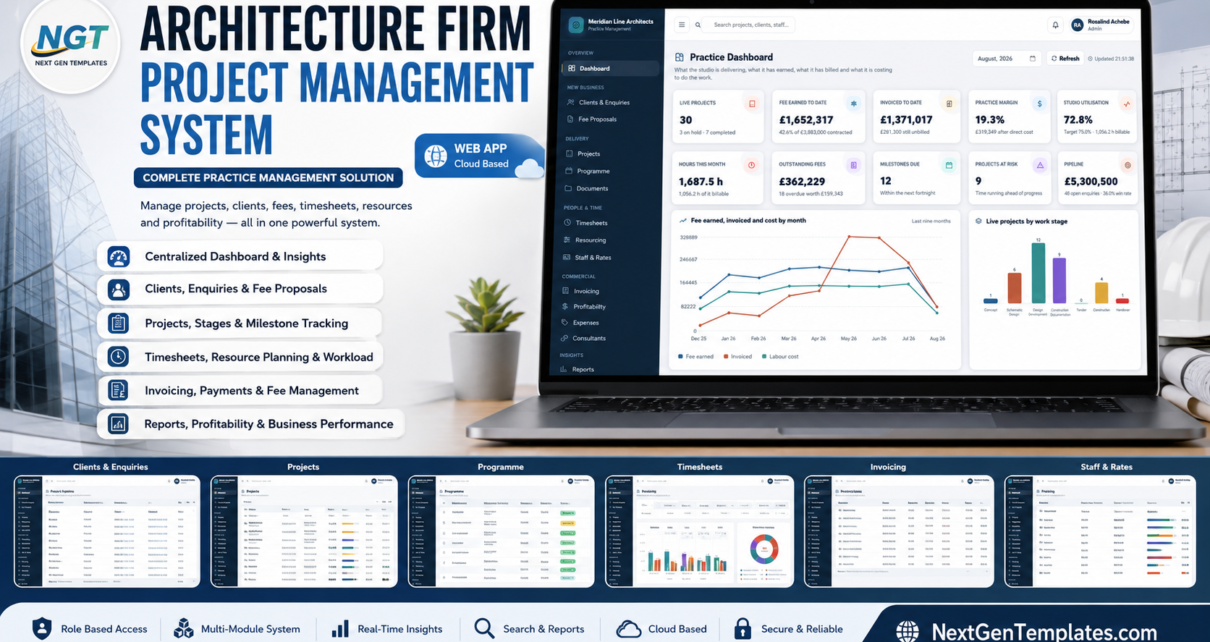
Most architecture practices know two numbers with confidence: what they have invoiced, and what is in the bank. The four numbers that actually decide whether the studio survives – fee earned, fee invoiced, work in progress and margin – usually live in three spreadsheets that only one person can reconcile, and only at month end. The Architecture Firm Project Management System is a Google Apps Script web app built to hold all four in one place, and to compute them rather than ask you to type them.Architecture Firm Project Management System
It ships as a finished system: 20 modules, 6 sign-in roles, a seven-stage fee schedule, 14 exportable reports and 10,811 seeded records across 22 sheets. The demo practice – a fictional studio called Meridian Line Architects – carries 44 projects worth GBP 3,883,000 of contracted fee, 46 clients, 26 staff, 7,414 timesheet lines, 173 fee notes, 402 milestones and 106 consultant appointments. Nothing is a placeholder, and every figure reconciles to the one above it.
Get the Architecture Firm Project Management System Web App
Try the Live Demo Before You Buy
We have deployed this web app in our own Google account so you can test every page, every role and every report – with the full seeded practice behind it – before purchasing. No signup, no email required.
Test Login Credentials
Sign in as admin to see all 20 modules including User Management, List Management, Settings and the Audit Log – then sign back in as design and watch every fee, charge-out rate and margin vanish from the interface. That contrast is the whole point of the role model.
These credentials are public on purpose. The demo is a shared instance seeded with the fictional practice “Meridian Line Architects” and it resets periodically – it is not anybody’s live data, and you are not buying access to a shared system. After purchase you get the full source (Code.gs + Index.html), the Word user manual and a deployment guide, so you stand up your own private copy in your own Google account.
Key Features of the Architecture Firm Project Management System
A seven-stage fee schedule that everything hangs off. When a fee proposal is accepted the system opens the project and writes its work stages: Concept, Schematic Design, Design Development, Construction Documents, Tender, Construction Administration and Handover. There are 308 of those stage rows across the 44 demo projects. Move a stage percentage and the fee earned, the work in progress, the billable amount and the margin all move with it – which is why the Projects screen is the one the practice actually maintains.Architecture Firm Project Management System
Margin computed at cost rate, not charge rate. This is the detail most home-grown spreadsheets get wrong. Fee earned is stage fee multiplied by percent complete. Labour cost is the timesheet valued at each person’s fully absorbed cost rate. Margin is the difference. In the seeded practice that produces GBP 1,652,317 earned against GBP 1,332,967 of direct cost – GBP 1,191,314 studio labour plus GBP 159,250 of consultants – for a 19.3 per cent margin against a 20.0 per cent target, and a recovery of GBP 83.50 per hour with 20 projects sitting below it.Architecture Firm Project Management System
Six roles enforced on the server. Permissions decide what appears in the sidebar and are then checked again before any endpoint touches data. A user who edits the page in their browser still cannot read a module their role does not hold.
Fourteen reports, all exportable. Project Fee & Progress, Project Profitability, Fee Earned vs Invoiced (WIP), Timesheet Summary by Person, Timesheet Summary by Project, Staff Utilisation, Work Stage Progress, Invoice Ageing & Debtors, Client Fee History, Consultant Fee & Recharge, Expense & Disbursement, Enquiry Pipeline & Conversion, Resource Allocation Forecast, and Milestone & Deadline. Each one filters by date, project, client, stage and lead, then prints or exports to CSV and Excel.Architecture Firm Project Management System
Everything else is configurable. Nine setting groups (Business, Finance, Numbering, Operations, Print, Email, Theme, Security, Archive), 32 dropdown lists holding 229 values, an audit log covering every create, change, approval, fee note, sign-in and archive, and a database archive that copies the file to Drive and trims only closed transactions.Architecture Firm Project Management System
Module-by-Module Walkthrough
Practice Dashboard
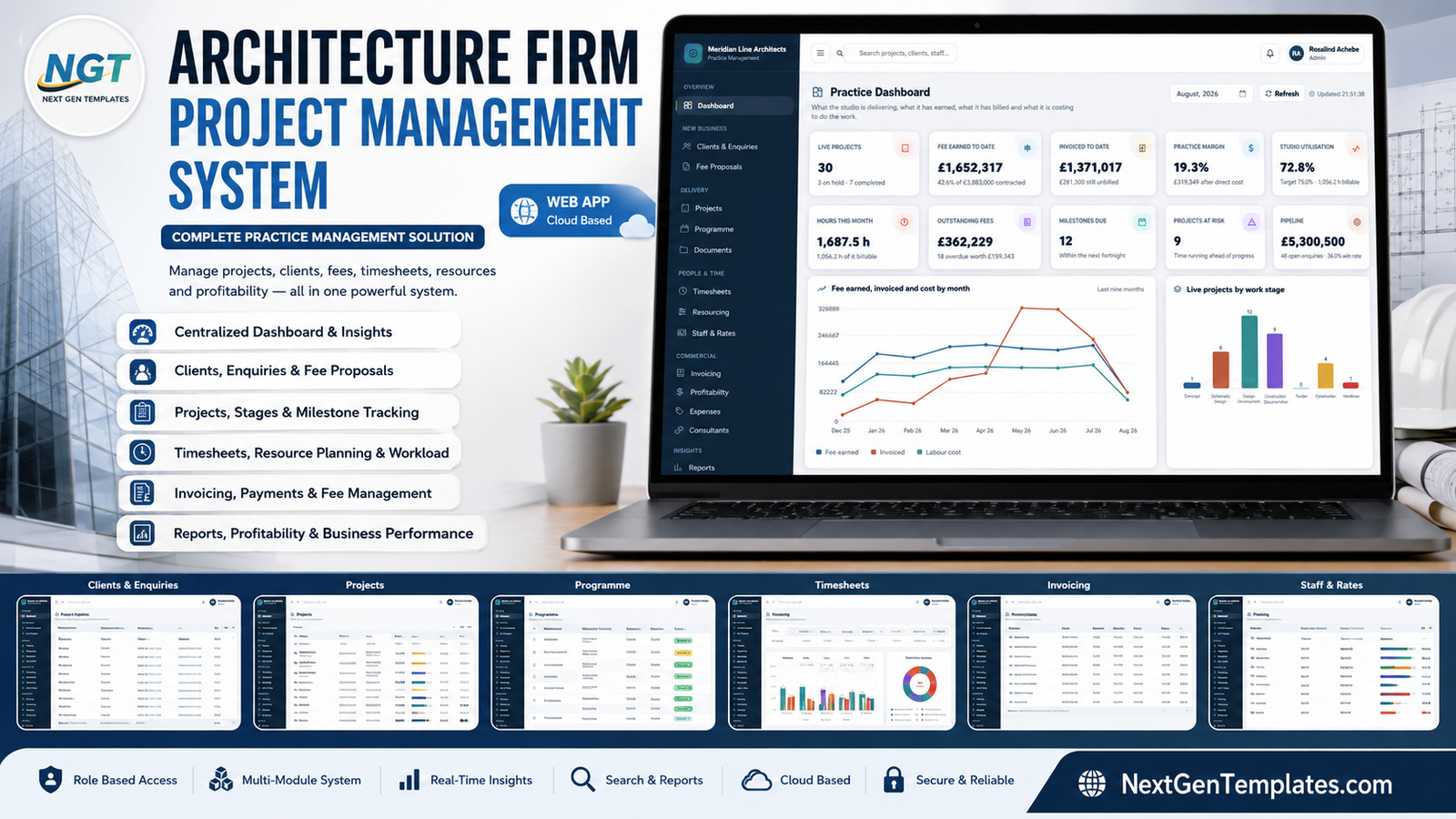
Ten KPI cards across two rows: Live Projects (30, with 3 on hold and 7 completed), Fee Earned to Date (GBP 1,652,317, 42.6 per cent of the contracted book), Invoiced to Date (GBP 1,371,017, with GBP 281,300 still unbilled), Practice Margin (19.3 per cent), Studio Utilisation (72.8 per cent against a 75 per cent target), Hours This Month (1,687.5 h), Outstanding Fees (GBP 362,229, 18 of them overdue), Milestones Due (12 in the next fortnight), Projects At Risk (9) and Pipeline (GBP 5,300,500 across 48 open enquiries at a 36 per cent win rate). Below them sit five charts: Fee earned, invoiced and cost by month; Live projects by work stage; Utilisation by person; Projects by type; and Outstanding fees by age.Architecture Firm Project Management System
Architecture Firm Project Management System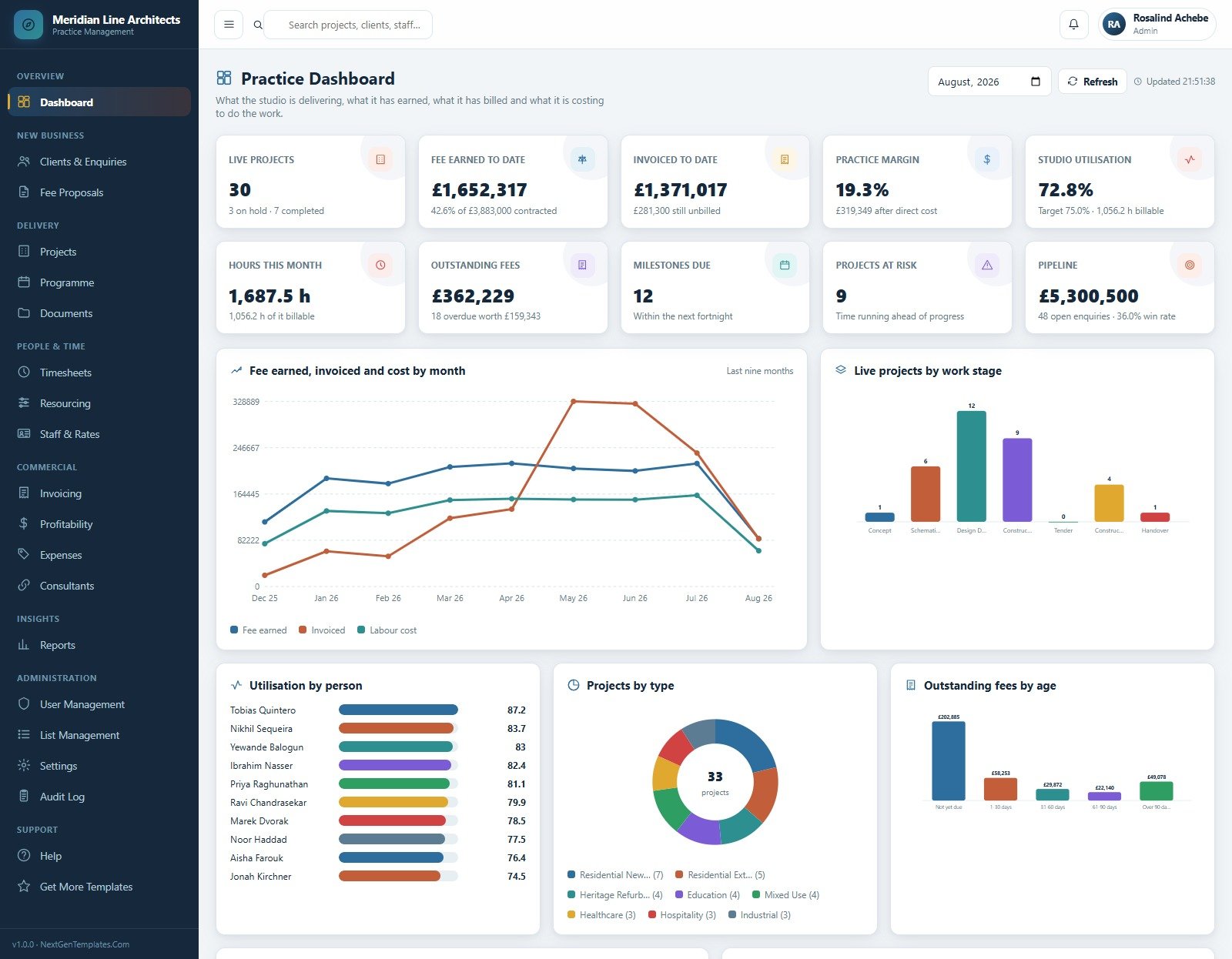
Clients & Enquiries, and Fee Proposals
The client register holds 46 clients worth GBP 4,748,500 of lifetime fee, each with type, city, live jobs, outstanding balance and credit status, and a second tab carrying 158 enquiries with source, stage and lost reason. Fee Proposals then tracks 54 documents through Sent, Accepted and Expired, with build value, fee percentage, proposed fee and an “open until” date that turns red when it lapses – 13 open on GBP 1,222,500, 40 accepted on GBP 3,883,000, 9 past validity.Architecture Firm Project Management System
Projects and Programme
Projects is the register plus a work-stage tab, showing type, current stage, progress bar, contract fee, fee earned, hours logged against budget, burn percentage and lead for all 44 jobs – and it is where a job like Ashcombe Grove Phase 1 shows 100.9 per cent burn against 89.9 per cent progress, which is the entire early-warning system in one row. Programme carries 402 milestones (237 open, 18 overdue, average slippage 2.8 days, criticality per row) and a site-visit tab with 161 visits totalling 467.3 hours, 129 of them chargeable.Architecture Firm Project Management System
Timesheets, Resourcing and Staff & Rates
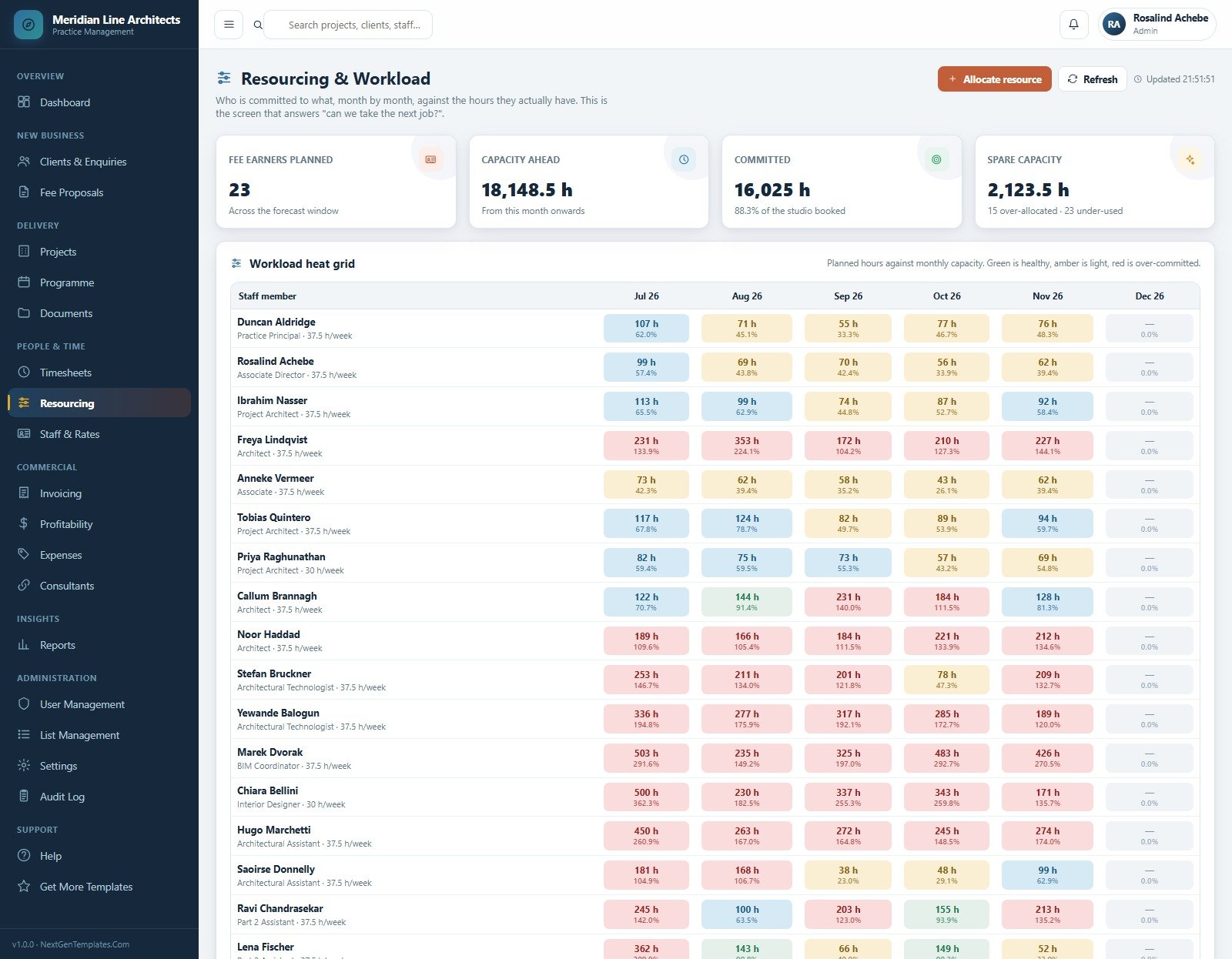
Timesheets gives every person a weekly grid with a warning when the week is short of contracted hours, plus all-time and by-person views over 7,414 lines – 3,750 hours in the current window, 63.3 per cent billable, GBP 211,732 of charge value, 245 lines awaiting approval. Resourcing is the screen that answers “can we take the next job?”: a workload heat grid of planned hours against monthly capacity per person, green healthy, amber light, red over-committed, summing to 16,025 committed hours against 18,148.5 of capacity. Staff & Rates holds all 26 people with job title, discipline, charge-out rate, cost rate, hours, billable hours, utilisation and target – and marks non-fee-earning roles as overhead rather than pretending they are 0 per cent utilised.Architecture Firm Project Management System
Invoicing, Profitability, Expenses and Consultants
Invoicing raises stage fee notes and refuses to bill a stage past the work it has actually delivered – GBP 1,276,747 billed over 156 notes, GBP 1,290,242 collected at an average 26.7 days to pay, GBP 146,978 overdue across 16 notes. Profitability breaks the money into “Where every pound of fee went” and “Margin percent by project type”, from Masterplan at 33 per cent down to Mixed Use at 15.8 per cent. Expenses & Disbursements records GBP 159,983 over 218 entries and splits it into GBP 141,601 recharged and GBP 18,382 quietly absorbed. Consultants holds 22 sub-consultant firms and 106 appointments worth GBP 1,814,750, tracks GBP 103,675 of handling income, and flags the one firm whose professional indemnity cover has lapsed.Architecture Firm Project Management System
Administration and support
User Management (6 accounts against 6 roles, with lockout tracking), List Management (32 lists, 229 values), Settings, the Audit Log, an in-app Help section with nine topics, and a Get More Templates page. Documents completes the delivery side with a 209-entry issue register across 41 projects, carrying revision, issue date, issuer and file size.Architecture Firm Project Management System
Architecture Firm Project Management System vs. Spreadsheets vs. Paid Practice SaaS – Feature Comparison
| This web app | A folder of spreadsheets | Paid practice SaaS (Monday.com, Smartsheet, Deltek) | |
|---|---|---|---|
| Cost | USD 39.99 once | Free, plus the hours spent repairing it | USD 20-45 per user per month |
| Platform | Google Apps Script + a Google Sheet you own | Excel or Sheets files | Vendor cloud |
| Setup time | About 15 minutes, seeded and ready | Weeks of building | Days to weeks, often with paid onboarding |
| Real-time team collaboration | Yes – one shared database, six roles | Version conflicts | Yes |
| Mobile access | Yes – responsive browser app | Painful | Yes |
| Customisable fields | Yes – 32 dropdown lists plus full source | Yes | Only what the vendor exposes |
| Share with a link | Yes – your own deployment URL | File sharing only | Yes |
| Year-1 cost at 5 users | USD 39.99 | USD 0 plus rebuild time | USD 1,200-2,700 |
| Fee earned from a stage schedule | Built in, seven stages | Hand-maintained | Usually an add-on module |
| Margin at cost rate, not charge rate | Built in | Rarely done correctly | Yes, on higher tiers |
| You own the source code | Yes – Code.gs and Index.html | N/A | No |
Who Should Use This Template
Independent architecture, interior design, landscape and multidisciplinary practices of roughly 5 to 60 people that already win work on staged fee proposals. Practice managers who currently reconcile a timesheet export, an invoice list and a project tracker every month. Principals who want to read a resourcing grid before they price the next job. And developers who want a finished Apps Script codebase – roles, permissions, CRUD, reports, printing, archive – to rebrand for a client.Architecture Firm Project Management System
It is not for anyone who needs CAD or BIM: there is no drawing, model or clash detection here, and document issue is a register rather than a viewer. It is not accounting software – it records the fee notes, payments and disbursements you enter and exports them, but it does not post a ledger, file accounts or calculate tax. It performs no planning, building-regulations, structural, fire-safety or professional-registration checks of any kind, and nothing in it constitutes professional, legal or financial advice. Sole practitioners with three live jobs will find it heavier than they need.Architecture Firm Project Management System
Real-World Use Cases
Month-end WIP in an afternoon. A practice manager at a 22-person studio used to rebuild a work-in-progress spreadsheet by hand from two exports. Now she opens the Fee Earned vs Invoiced report, sees GBP 281,300 of delivered-but-unbilled work broken down by project, and raises the fee notes in the same session.Architecture Firm Project Management System
Pricing a bid against real capacity. Before committing to a GBP 3.7m mixed-use block, a principal opens Resourcing and reads the heat grid: several people are already above 130 per cent for the next three months. The fee proposal gets phased around that instead of promising a start date the studio cannot meet.Architecture Firm Project Management System
Catching an overrun at four weeks, not fourteen. A project architect sees a heritage refurbishment reporting 100.9 per cent burn against 89.9 per cent progress and raises it at the design review. His role deliberately carries no margin figures at all – he sees the hours and the work, which is exactly what he needs to act.Architecture Firm Project Management System
Advantages of the Architecture Firm Project Management System
The single biggest advantage is that the four commercial numbers are derived rather than declared, so they cannot silently disagree with each other. Beyond that: it runs entirely inside your own Google account, so there is no vendor, no subscription and no per-seat fee; it arrives already populated, so you can evaluate it in ten minutes instead of spending a week entering test data; the role separation is genuine rather than cosmetic, which matters when junior staff need timesheets but should never see charge-out rates; and you get the source, so the practice is never blocked waiting for a vendor roadmap.
Opportunities for Improvement
Being honest about the edges: the Documents module is a register, and the seeded practice shows 0 of 209 entries linked to an actual Drive file – the link field exists, but the demo data does not exercise it. Everything is denominated in GBP out of the box; the symbol is one setting away, but the seeded figures will still read as sterling until you reseed. A Google Sheet is not an unbounded database, which is why the archive tool exists – a practice booking thousands of timesheet lines a year should run it annually rather than treat it as optional. And there is no built-in accounting integration, so the handover to your bookkeeper is still an export.
Best Practices
Change all six default passwords on day one – the in-app Help page says so first, and it is the right instinct. Enter both rates for every person, with the cost rate fully absorbed (salary, employer costs and a share of studio overhead, usually around two thirds of charge-out); every margin in the product is computed at that number, so a lazy cost rate makes every profitability screen fiction. Book time daily rather than reconstructing Friday afternoon. Move stage percentages weekly, because everything else is derived from them. Raise fee notes on a fixed day each month instead of when somebody remembers. Take a backup copy from Settings > Database before any bulk import. If you are new to deploying Apps Script web apps, the official Google Apps Script web apps guide covers the Execute as and Who has access settings in detail – and remember that Apps Script serves the last published version, so a code change needs a new deployment version before it goes live.
Explore Relevant Templates
- Architecture Firm Project Management System Web App – the system described in this article.
- Architect Drawing Approval Management System Web App – the drawing issue and approval workflow that pairs with it.
- App Development Project Management System Web App – the same fee, timesheet and margin engine aimed at software delivery.
- Auditing Firm Management System Web App – another professional-services practice system with roles, WIP and recovery.
- Architecture & Design Dashboard in Power BI and Architecture and Design KPI Dashboard in Excel – reporting layers if your operational data already lives elsewhere.
- Browse the whole library of Web Apps.
Curious about the spreadsheet skills underneath a system like this? The NextGenTemplates Academy learning paths take you from the basics to building your own tools, with practice files.
Get the Architecture Firm Project Management System Web App
Frequently Asked Questions
Can I try it before buying?
Yes. The live demo above is a complete deployment with all 20 modules and all 10,811 seeded records, and you can sign in with any of the six accounts in the table. It is a shared demo instance that resets periodically, so nothing you type there is kept.
Do I need to know how to code?
No. You paste two files into an Apps Script project, run one function, and deploy. The user manual walks through every step with screenshots. Knowing JavaScript only matters if you want to change how the system behaves.
Does it replace accounting software?
No. It records what you enter and exports it. It does not post a ledger, file accounts or calculate tax, and it makes no accounting or tax representation.
Does it check planning permission, building regulations or structural compliance?
No. It stores the project, milestone and document records you enter. It performs no code, permit, structural, fire-safety or professional-registration checks of any kind.
Who can see my data?
Only the people you give the deployment URL and an account to. The database is a Google Sheet in your own Drive; nothing is sent anywhere else.
Can I change the currency, work stages and branding?
Yes. Currency symbol, tax percentage, payment terms, numbering, print size and theme colours live in Settings, and the seven work stages plus 31 other dropdown lists are editable in List Management. You also have the full source.
What is in the download?
A ZIP containing Code.cs.txt, Index.txt and the user manual PDF. No subscription, no licence key, no per-seat fee.
About the Author
Built by PK – Microsoft Certified Professional with 15+ years of Excel, Google Sheets, and Power BI experience. Founder of NextGenTemplates, reaching 300K+ subscribers across YouTube channels. Every template is hand-built and tested before release.
Conclusion
The Architecture Firm Project Management System is worth your attention if your practice can invoice confidently but cannot say, on any given Monday, what it has actually earned or what a given job is making. It puts the fee schedule, the timesheet, the fee note and the margin in one workspace, derives the numbers instead of asking you to maintain them, separates what a director sees from what a design assistant sees, and hands you the source code so the system can follow the practice rather than the other way round. Ten minutes in the live demo, signing in first as admin and then as design, will tell you more than any description – and if it fits, you can get the full system here and be running your own private copy the same afternoon.