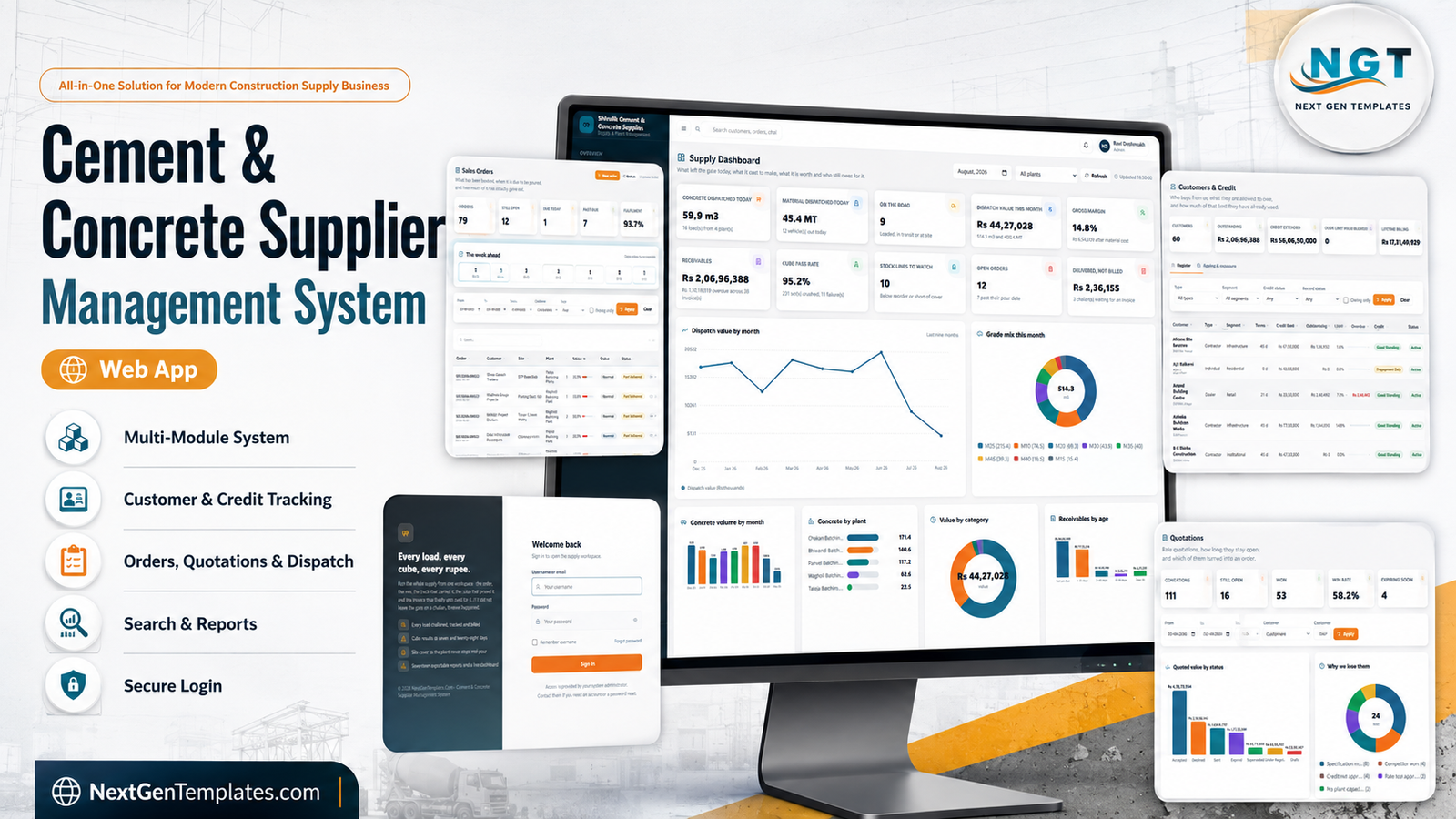
A ready-mix concrete business fails in the gaps between people. The gate writes a challan, the plant writes a batch slip, the laboratory writes a cube result, the office writes an invoice — and four days later nobody can say whether the load that left at 09:20 was ever billed. The Cement & Concrete Supplier Management System Web App closes those gaps by putting all four on the same record. It is a Google Apps Script web application with 22 modules, 7 roles and 17 exportable reports, running on a Google Sheets database you own, and it arrives seeded with 12,647 rows across 31 sheets — 60 customers, 46 priced products, 12 mix designs, 2,734 delivery challans, 1,987 production batches, 663 cube tests, 521 invoices and 505 receipts. Nothing is empty on day one. Cement & Concrete Supplier Management System Web App
🚀 Try the Live Demo Before You Buy
We have deployed this web app in our own Google account so you can test every page, every role and every one of the 17 reports — with real sample data — before purchasing. No signup, no email required.
🔑 Test Login Credentials
Sign in as admin to see all 22 modules, the role editor and the database archive. Then sign out and come back as dispatch. A dispatch supervisor loads trucks and never sees a rate or an invoice — that difference, enforced on the server, is the whole point of the product.
💡 These credentials are public on purpose. They are the seeded logins of a shared demo instance that resets — not a customer’s live system. What you get after purchase: the full source code (Code.gs + Index.html) plus a step-by-step deployment guide so you can deploy your own private instance in your own Google account in under 15 minutes.
Key Features of the Cement & Concrete Supplier Management System
- One chain, one truth. Quotation → sales order → delivery challan → production batch → cube test → invoice → receipt. The challan is the unit of truth: nothing is sold until it leaves the gate on one, and nothing gets billed twice.
- 22 modules on a single sidebar, grouped Overview, Sales, Operations, Supply Chain, Money, Assets, Insights, Administration and Support.
- 7 roles, checked on the server. Each role holds a module list plus Create, Edit, Delete, Export and Approve rights. The sidebar is a convenience; the server is the boundary, so a user cannot reach a module by editing the address bar.
- Credit control that stops a truck. Every customer has a limit, payment terms and live exposure. A dispatch to a customer over their limit needs an approver, and the override is written to the audit trail with their name on it.
- Batch-against-design costing with 12 mix designs, actual cement kg/m³ against design, a variance percentage per batch and a cost per cubic metre.
- Cube register at 7 and 28 days with pass rate, failures, marginal passes and average margin over the required grade.
- Days-of-cover stock across 151 lines and 7 locations, with reorder levels and a warning window.
- 17 reports, each filtered, printable and exportable to CSV or Excel; printing at 3 inch, 4 inch or A4.
- A staged setup that survives the six-minute Apps Script limit — 10 stages, resumed automatically about a minute later if it runs out of budget. Cement & Concrete Supplier Management System Web App
Module Walkthrough
Supply Dashboard
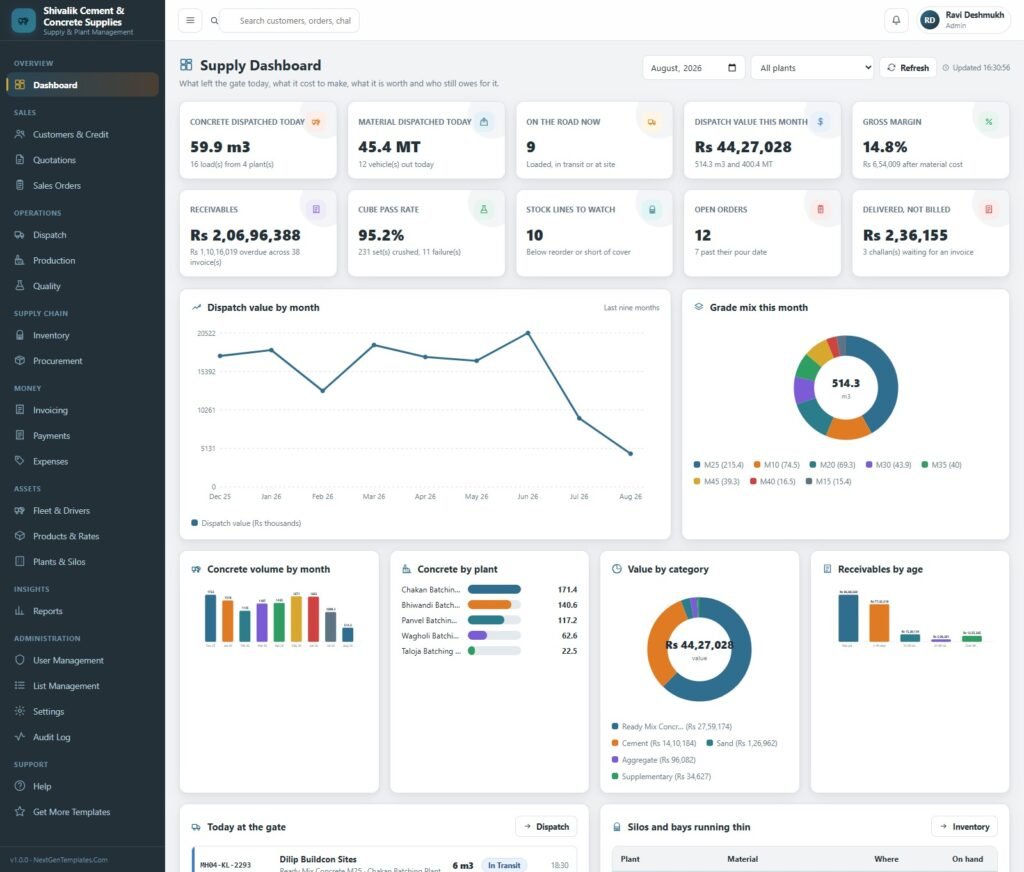
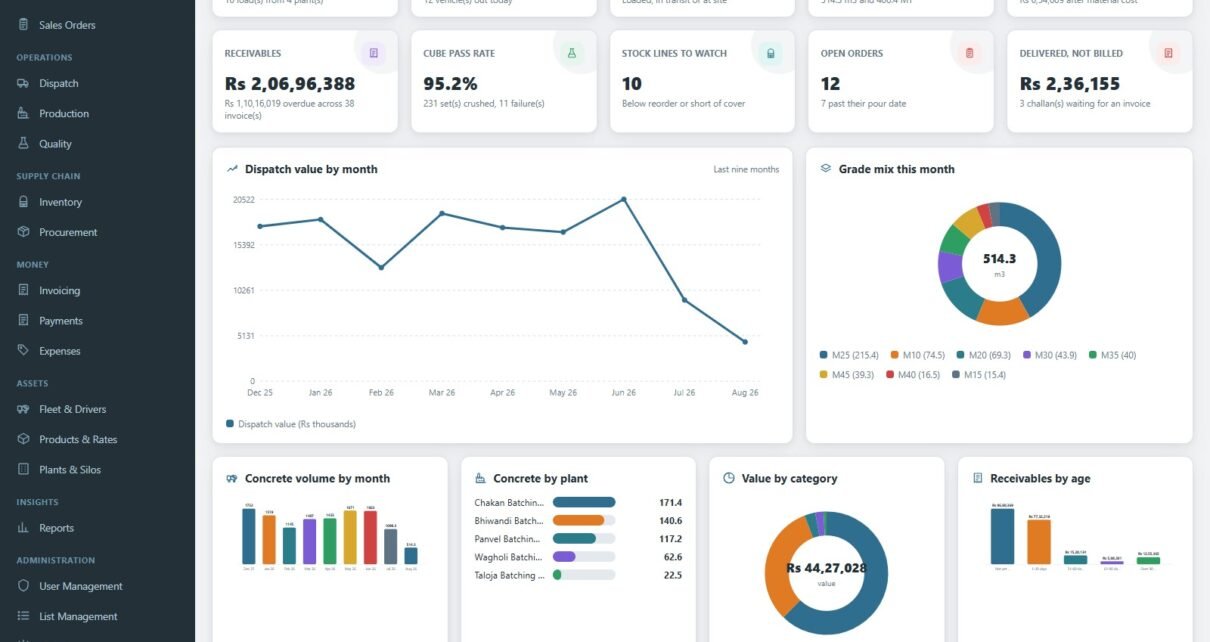
Ten KPI cards answer the five questions a plant manager asks before nine in the morning: Concrete Dispatched Today, Material Dispatched Today, On the Road Now, Dispatch Value This Month, Gross Margin, Receivables, Cube Pass Rate, Stock Lines to Watch, Open Orders and Delivered Not Billed. Below them sit Dispatch value by month, Grade mix this month, Concrete volume by month, Concrete by plant, Value by category and Receivables by age, then a live “Today at the gate” list and a “Silos and bays running thin” table. A month picker and an all-plants filter drive the whole page. Cement & Concrete Supplier Management System Web App
Customers & Credit, Quotations and Sales Orders
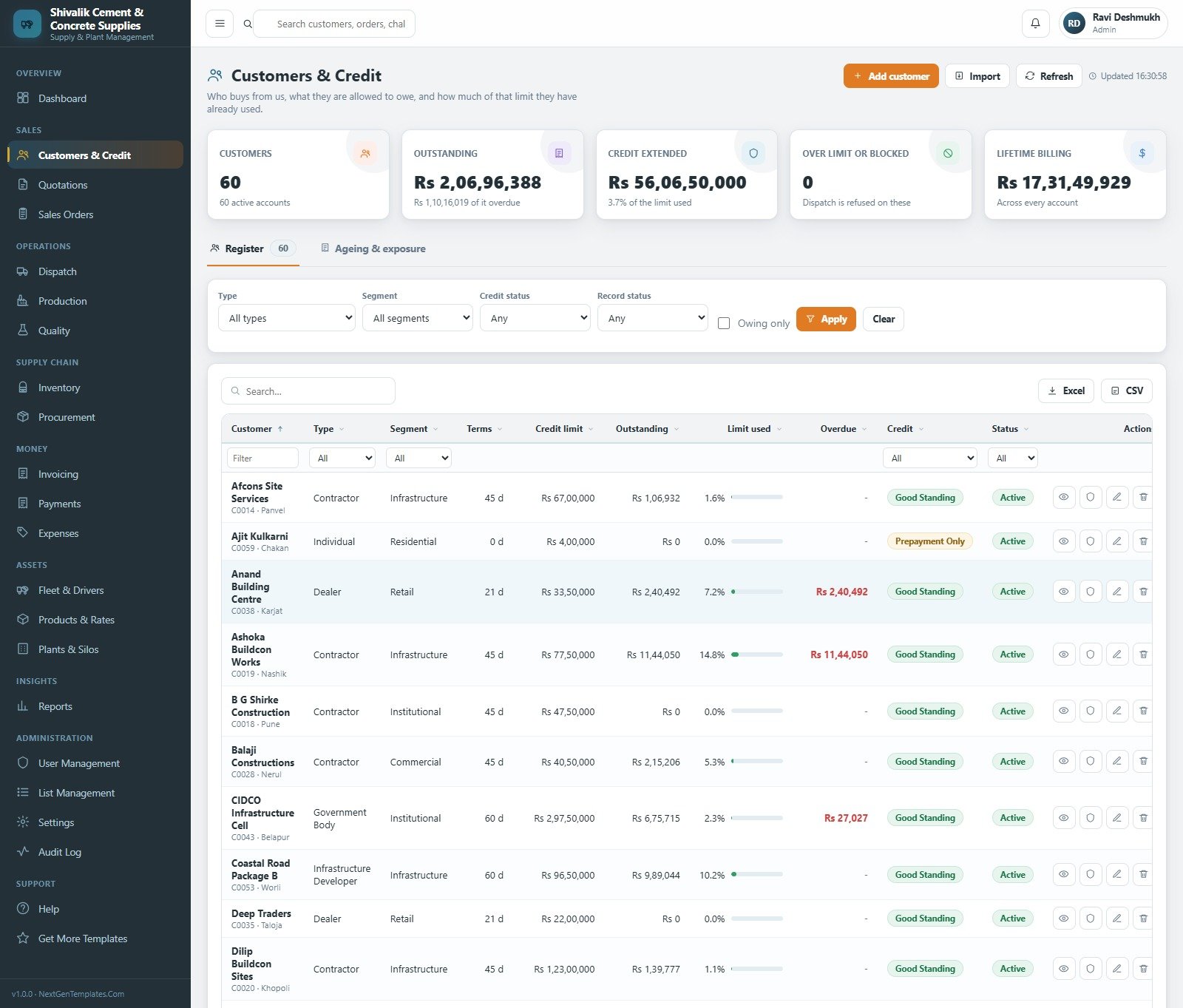
The customer register carries type, segment, terms, credit limit, outstanding, limit used, overdue and a credit status of Good Standing, Prepayment Only or Blocked, with a second tab for ageing and exposure. Quotations track quoted value by status and a “Why we lose them” breakdown — specification mismatch, competitor won, credit not approved, rate too high, project deferred, no plant capacity. Sales Orders show fulfilment against ordered, a seven-day pour calendar and a flag on every order past its pour date. Cement & Concrete Supplier Management System Web App
Dispatch, Production and Quality
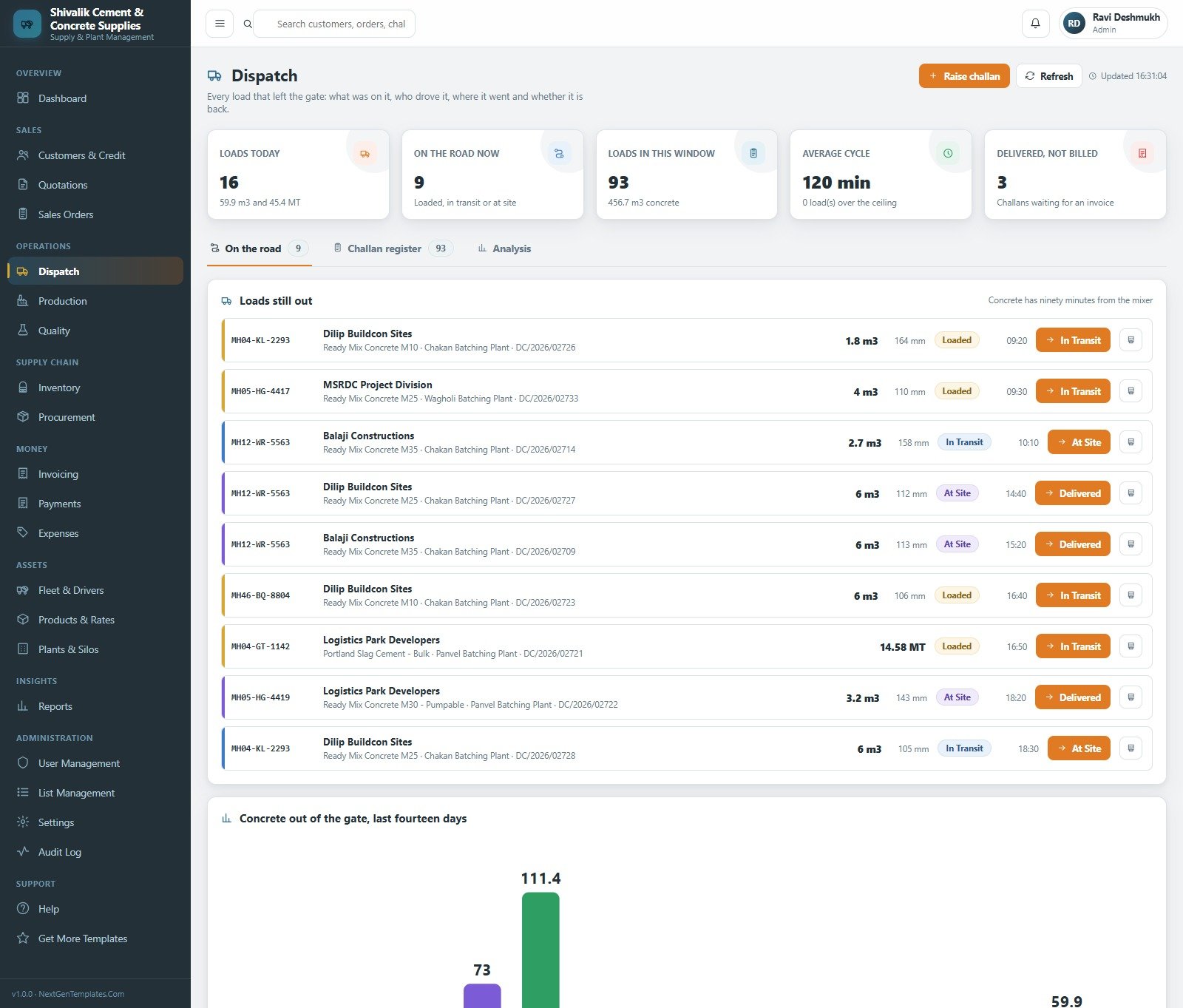
Dispatch follows every load out of the gate — vehicle, grade, volume, slump reading and challan — through Loaded, In Transit, At Site and Delivered, against a ninety-minute-from-the-mixer clock and an average cycle time you set. Production logs every batch against its mix design, showing cement kg/m³ actual against target, the variance, the slump, the operator and the cost per cubic metre, plus tabs for mix designs and plant output. Quality records six-cube sets, their 7-day and 28-day results against the required MPa, the verdict and the tester, with dedicated Failures and Trend tabs. Cement & Concrete Supplier Management System Web App
Inventory, Procurement and the money modules Cement & Concrete Supplier Management System Web App
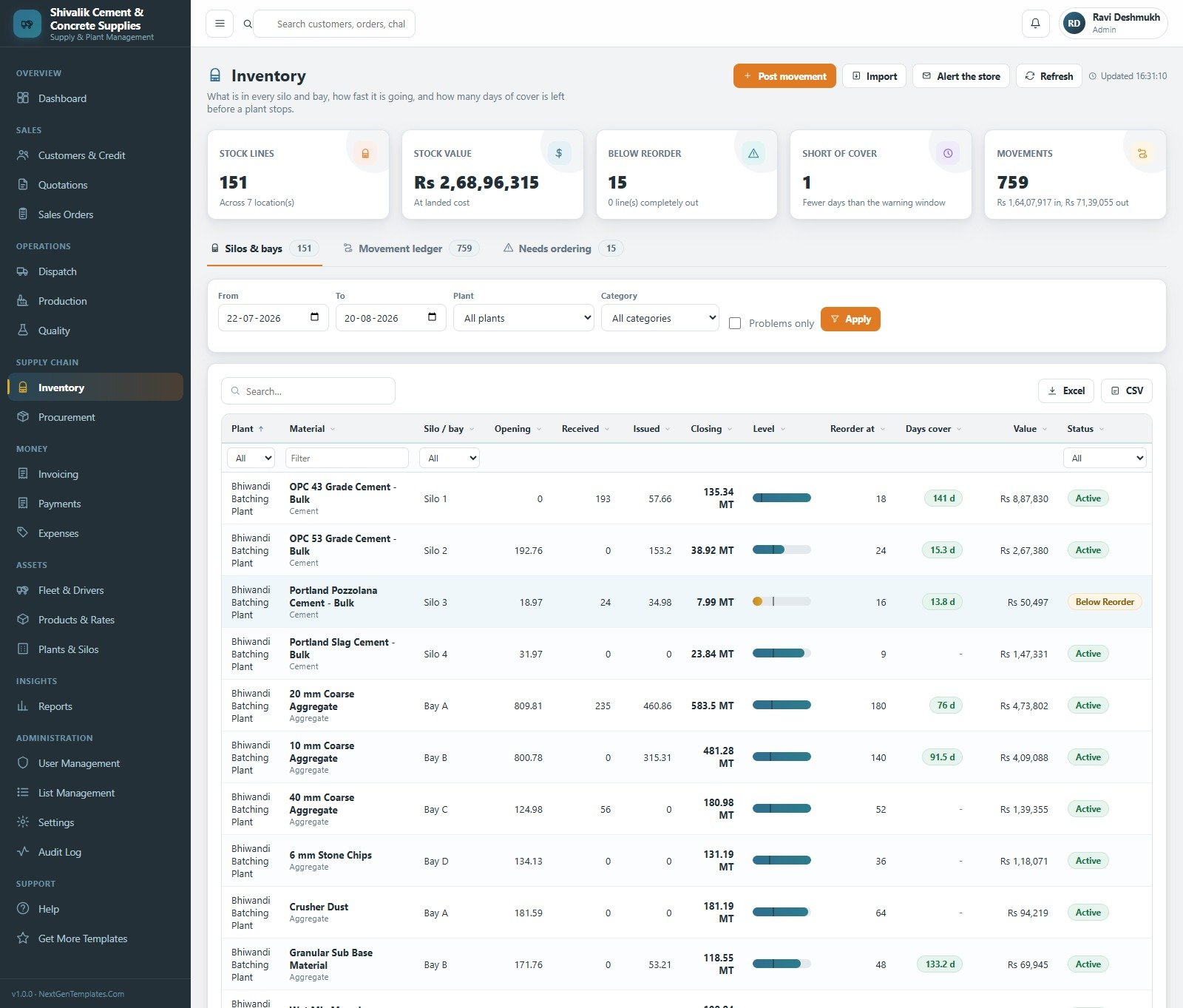
Inventory shows every silo and bay with opening, received, issued and closing quantities, a level bar, reorder point, days of cover and value, plus a movement ledger and a “Needs ordering” list. Procurement covers purchase orders, goods receipts, a rejection rate and supplier performance. Invoicing turns delivered challans into tax invoices with taxable value, tax, total, balance and due date, and keeps credit notes beside them. Payments opens on a collection worklist bucketed by how long each invoice has been overdue, with the oldest at the top. Expenses records diesel, tyres, power, wages, insurance and maintenance against a plant or a vehicle, with an approval step. Cement & Concrete Supplier Management System Web App
Assets, Insights and Administration
Fleet & Drivers holds transit mixers, tippers and bulkers with fitness, insurance and permit expiry — and warns you before those dates pass. Products & Rates carries selling and cost rates, margin, tax and HSN for 46 lines, refusing a cost rate higher than a selling rate. Plants & Silos shows rated output and capacity utilisation per location. Reports lists all 17. Administration adds User Management, 29 configurable dropdown lists, nine groups of settings, a full audit log and a database archive that trims closed business out of the live file. Cement & Concrete Supplier Management System Web App
Cement & Concrete Web App vs. Spreadsheets vs. Paid ERP — Feature Comparison
| This Web App | Spreadsheets / Google Sheets | Paid ERP (Zoho Inventory, NetSuite) | |
|---|---|---|---|
| Cost | One payment, no renewal | Free, but you build it | Per user, per month, forever |
| Platform | Apps Script web app on your Drive | Sheets files | Vendor cloud |
| Setup time | Under 15 minutes, seeded | Weeks of building | Weeks of implementation |
| Real-time collaboration | Yes, with server-side roles | Yes, but everyone sees everything | Yes |
| Mobile access | Yes, responsive browser app | Clumsy on phones | Yes |
| Customisable fields | Yes — you own the source | Yes | Limited to vendor options |
| Share with link | Yes, one deployment URL | Yes, file by file | Login required |
| Year-1 cost at 5 users | The one-off template price | Your time | Typically four figures upward |
| Batch vs. mix-design variance | Built in, per batch | Manual | Add-on module |
| 7 & 28-day cube register | Built in, with trend | Manual | Rarely included |
| Credit block on dispatch | Built in, with approval trail | No | Yes |
Who Should Use This Template
Ready-mix concrete suppliers running one to ten batching plants; cement and building-material dealers who challan and invoice every day; aggregate and crusher operators; precast yards that need batch, cube and dispatch records together. It fits an operation of roughly five to twenty-five users doing a few thousand transactions a month — big enough that a shared spreadsheet has started losing loads, small enough that an ERP implementation is not worth the money or the months. Cement & Concrete Supplier Management System Web App
Real-World Use Cases
The owner with five plants. Instead of phoning each plant for numbers, the dashboard shows concrete dispatched today, dispatch value this month, gross margin after material cost and the loads still on the road, filterable by plant. Capacity utilisation on Plants & Silos shows which plant is carrying the month and which is idle.
The quality engineer across seven locations. Six cubes per set, results entered at seven and twenty-eight days, the Failures tab surfacing anything below characteristic strength, and the Cube Test Compliance report printed for the client’s site engineer.
The accounts officer. The collection worklist sorted by days overdue, receipts recorded against invoices, and a “Delivered, not billed” figure on the dashboard so no challan is ever delivered and then forgotten.
Advantages of the Cement & Concrete Supplier Management System
- One payment and full source, so there is no per-seat fee and nothing to renew.
- The data lives in your own Google Sheet — you can open it, export it and back it up without asking anyone.
- The seeded database means you can evaluate the product properly instead of staring at empty tables.
- Role separation is genuine and server-enforced, which is unusual at this price.
- Everything prints and exports: 17 reports, CSV and Excel on every grid, and thermal or A4 output for gate slips and invoices.
- Optional time-driven triggers rebuild roll-ups daily and send document-expiry warnings weekly, unattended.Cement & Concrete Supplier Management System Web App
Opportunities for Improvement
Be clear about the boundaries before you buy. There is no hardware integration — batches, weights and slump readings are typed by a person, and the system does not read a weighbridge or a batching-plant controller. It is not accounting software and does not file GST returns, e-invoices or e-way bills, even though it stores GSTIN and HSN and prints tax on an invoice. It is not a testing laboratory and does not certify concrete against IS 456, ASTM C39, EN 206 or BS 8500 — it records the results your own engineer produces. Google Sheets also has practical row limits, which is why the archive exists; a very high-volume supplier writing tens of thousands of challans a year should plan to archive annually. Finally, the seeded demo business is Indian, so the sample screens show that currency and number format; Settings changes the symbol, but the artwork you see here does not.
Best Practices
- Raise the challan at the gate, not at the end of the day.
- Enter cube results the day they are crushed, not the week after.
- Read days of cover every morning, not when the plant stops.
- Close the loop — mark loads delivered before you invoice.
- Invoice weekly and work the collection worklist top down.
- Change every seeded password the day you go live, and give each person their own account.
- Take a backup copy before any bulk import, and archive once a year.
Explore Relevant Templates
If you sell materials rather than mix them, the Building Material Supplier Management System Web App covers the dealer side of the same trade. For analysis rather than transactions, see the Cement Mixer Production Dashboard in Excel and the Cement Mixer Production Dashboard in Power BI, or the broader Construction Dashboard in Excel. Every system of this kind lives in the Mini Web Apps category. Cement & Concrete Supplier Management System Web App
New to building spreadsheet-based systems? The NextGenTemplates Academy learning paths give you a structured route from the basics to trackers and management tools, with practice files along the way.
Frequently Asked Questions
Can I try it before buying?
Yes. The live demo above is a fully seeded deployment with eight accounts across seven roles. Open every module, run the reports, print an invoice. The credentials are public because the demo is a shared instance that resets — it is not anyone’s live system. Cement & Concrete Supplier Management System Web App
Does this certify my concrete or replace a testing laboratory?
No. It is a register of cube results your own engineer or laboratory produces. It stores them, charts the pass rate and prints the register. It performs no test, witnesses none, and certifies nothing against IS 456, ASTM C39, EN 206 or BS 8500.
Will it talk to my weighbridge or plant controller?
No. Every batch, weight and slump reading is entered by a person. There is no hardware integration and it does not replace batching-plant control software. Cement & Concrete Supplier Management System Web App
Does it file GST returns or e-way bills?
No. It records GSTIN and HSN and prints tax lines on invoices, but it submits nothing to any tax portal and it is not accounting software. Cement & Concrete Supplier Management System Web App
What do I actually need to deploy it?
A Google account. Create a Sheet, open Extensions → Apps Script, paste the two files, run setup() once, then deploy as a web app. The official Google Apps Script web app documentation covers the deployment settings if you have never done it before.
How many people can use it?
Roughly five to twenty-five, doing a few thousand transactions a month. The archive keeps the live file fast by moving closed business into a dated copy in your Drive. Cement & Concrete Supplier Management System Web App
Can I rebrand it?
Yes. Settings changes the business profile, currency symbol, printing size and five theme colours, and because you get the source you can change anything beyond that. Cement & Concrete Supplier Management System Web App
About the Author
Built by PK – Microsoft Certified Professional with 15+ years of Excel, Google Sheets, and Power BI experience. Founder of NextGenTemplates, reaching 300K+ subscribers across YouTube channels. Every template is hand-built and tested before release. Cement & Concrete Supplier Management System Web App
Conclusion
The value here is not any single screen — it is that the gate, the plant, the laboratory and the office finally write on the same record, and that a dispatch supervisor cannot see a rate while an accounts officer cannot see a batch. Twenty-two modules, seven roles, seventeen reports and a database seeded with nine months of trading, for one payment and with the source in your hands. Open the live demo, sign in as admin, then as dispatch, and decide in ten minutes. When it fits, get it here: Cement & Concrete Supplier Management System Web App.
More walkthroughs on YouTube @NeoTechNavigators.