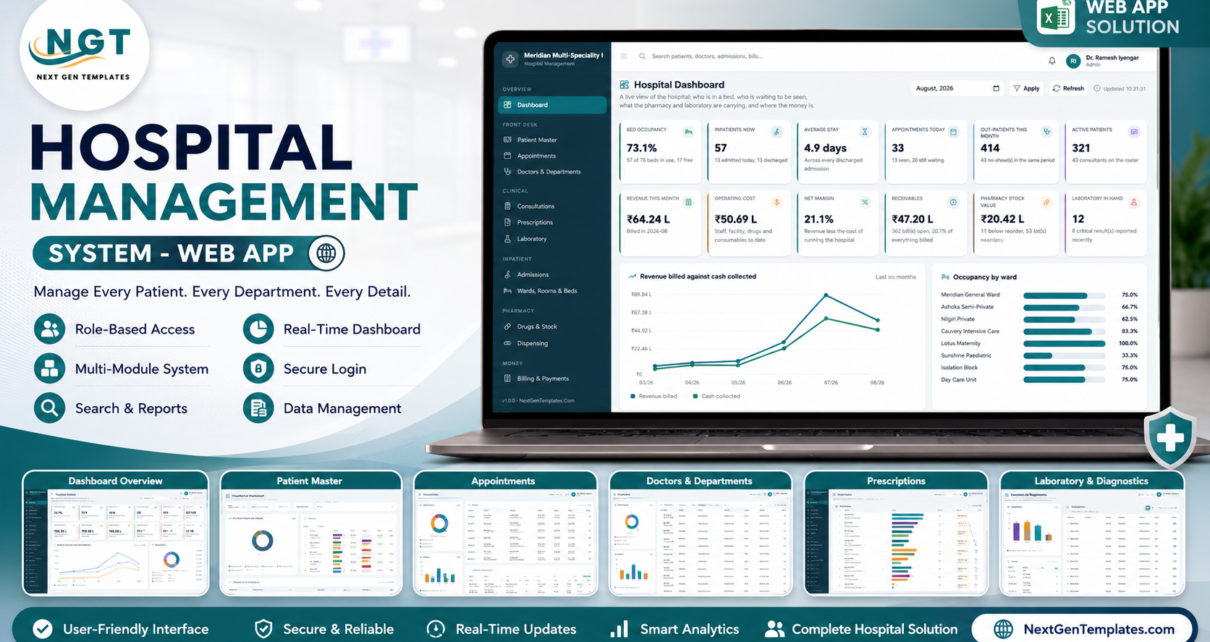
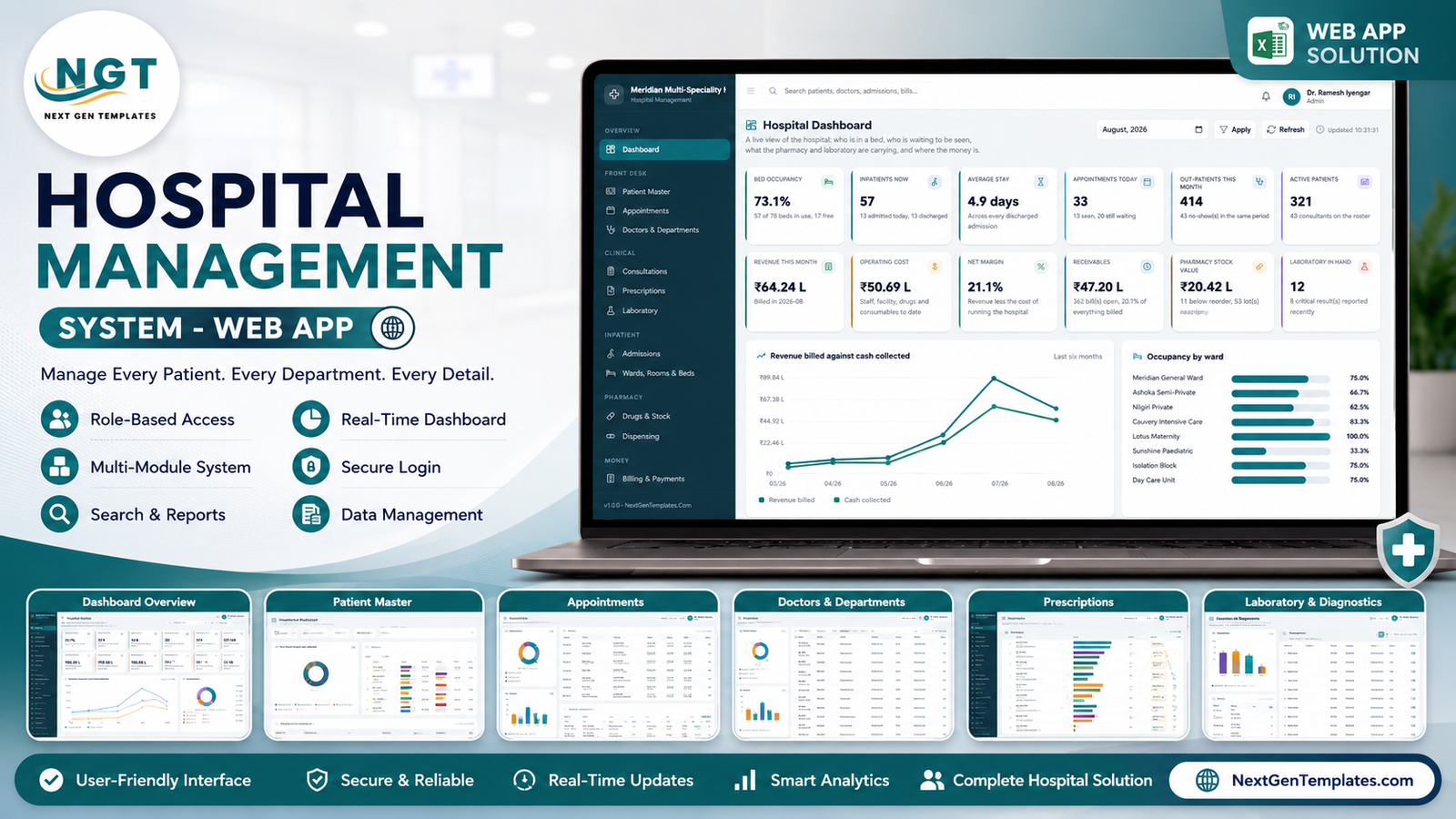
The Hospital Management System Web App is a Google Apps Script application that runs 20 working screens over 33 database sheets, with 8 role-based sign-in accounts guarding them. Its seeded demo hospital carries 340 patients, 45 consultants, 78 beds across 8 wards and 32 rooms, 136 medicines over 285 purchase lots, a 60-test laboratory master and 1,451 bills — 15,370 rows in all. Deployment takes under 15 minutes and one click on Set up the database builds every sheet, account and sample record in a single pass.
Most small hospitals and nursing homes end up running their admissions on a whiteboard, their pharmacy on one spreadsheet and their billing on another — and the three never agree at month-end. This template puts them into one register where the bed board, the dispensing log and the bill are the same record. It is important to be plain about what it is: an administrative record-keeping system for a hospital’s office operations. It stores what your staff type into it and adds up what they enter. It is not clinical software, it is not an electronic health record of record, and it makes no clinical decisions.
Get the Hospital Management System Web App
Sign-In and Role-Based Access
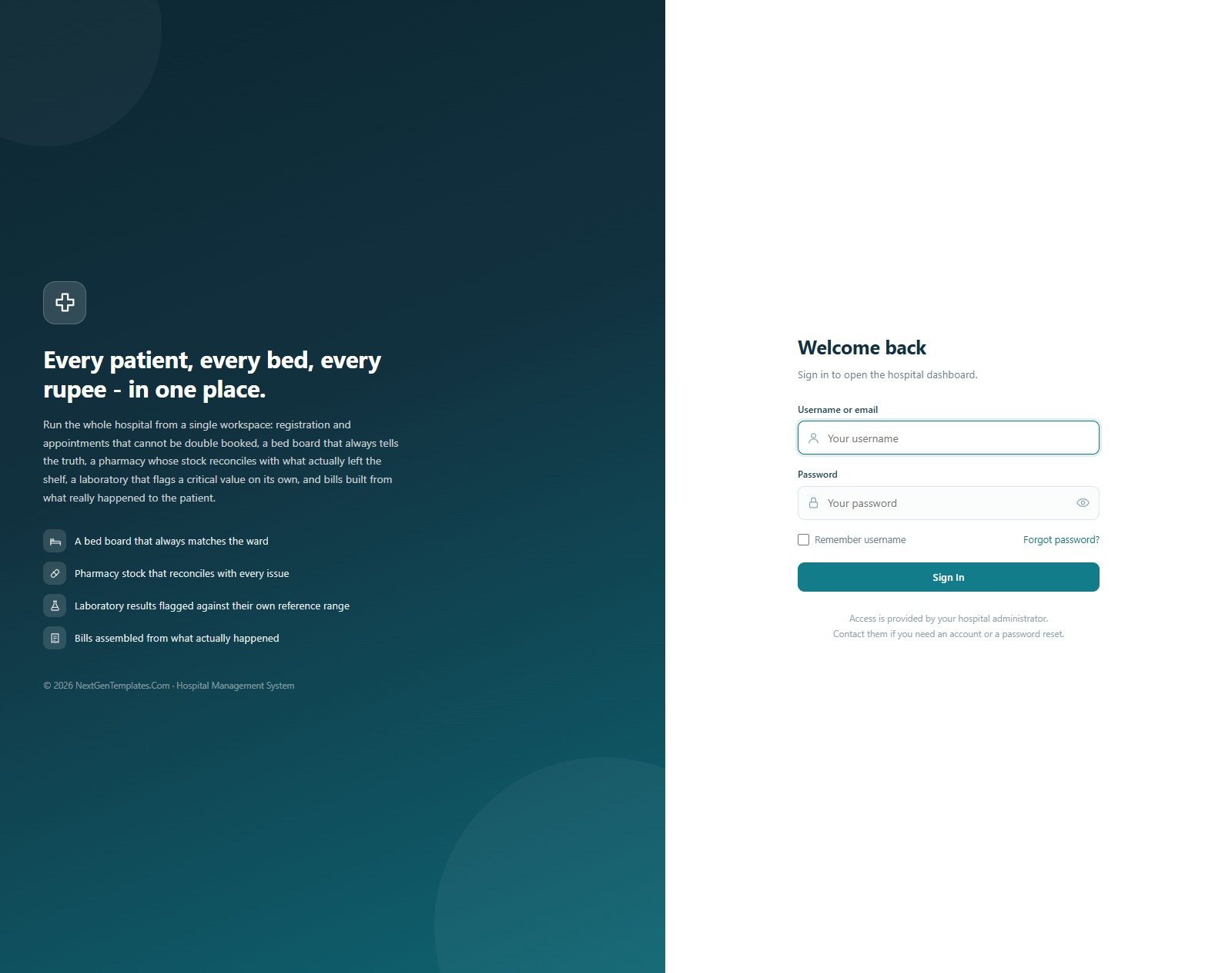
Eight accounts ship with the system — Admin, Hospital Manager, Doctor, Nurse, Receptionist, Pharmacist, Lab Technician and Billing Executive. The role someone signs in with decides both the menu they see and what the server will let them do, so a nurse never reaches billing and a pharmacist never reaches user administration.
🚀 Try the Live Demo Before You Buy
We have deployed this web app in our own Google account so you can test every page and every one of the eight roles — with a full set of sample records — before purchasing. No signup, no email required.
🔑 Test Login Credentials
Sign in as admin to see everything including User Management, Settings and the Audit Log — then sign out and come back as nurse or pharmacy to watch the menu shrink to exactly what that job needs. The role separation is the point of the system, and it takes about ten seconds to see it.
⚠️ About this demo: these are public demo logins on a single shared instance that is reset periodically — not a customer’s deployment. Anyone can sign in and anyone can change what is in it. Every patient, doctor and bill in the demo is fictional sample data generated for the template; none of it relates to a real person. Please do not enter real patient information into the demo.
💡 What you get after purchase: the full source code (Code.gs + Index.html) plus a step-by-step deployment guide, so you can run your own private instance in your own Google account in under 15 minutes.
Key Features of the Hospital Management System Web App
- Eight roles, enforced on the server. The system ships 8 sign-in accounts and a 22-permission matrix across 8 roles. Ticking a module in User Management changes both the sidebar that role sees and the guard on every endpoint behind it, so permissions cannot be bypassed from the browser.
- An appointment book that refuses bad bookings. The server blocks a double booking in the same slot, a booking past a consultant’s daily patient limit, and a booking on a day that consultant does not run OPD.
- A bed board that always matches the ward. A bed holds one active admission at a time, occupied and maintenance beds refuse a new one, discharge releases the bed, and length of stay is computed from the two dates rather than typed.
- Pharmacy stock derived from batches. Every dispense line draws down a real purchase lot, an expired lot is refused, and a lot cannot issue more units than it holds — so stock on hand and the shelf cannot drift apart.
- Bills assembled from the record. A bill’s total is the sum of its line items and its paid amount is the sum of its receipts, and a payment can never exceed the outstanding balance.
- Laboratory results flagged automatically. The abnormal flag is derived from the value against the test master’s own reference range, so a critical value cannot be mislabelled by hand.
- Fourteen built-in reports across money, clinical, pharmacy, laboratory and insurance — each exporting to Excel or CSV and printing at 3 inch, 4 inch or A4.
- 46 dropdown lists and 310 values you edit yourself from List Management, with no code change.
- A complete audit trail of every create, update, delete, admission, discharge, dispense, receipt, permission change and archive.
Module-by-Module Walkthrough
Hospital Dashboard
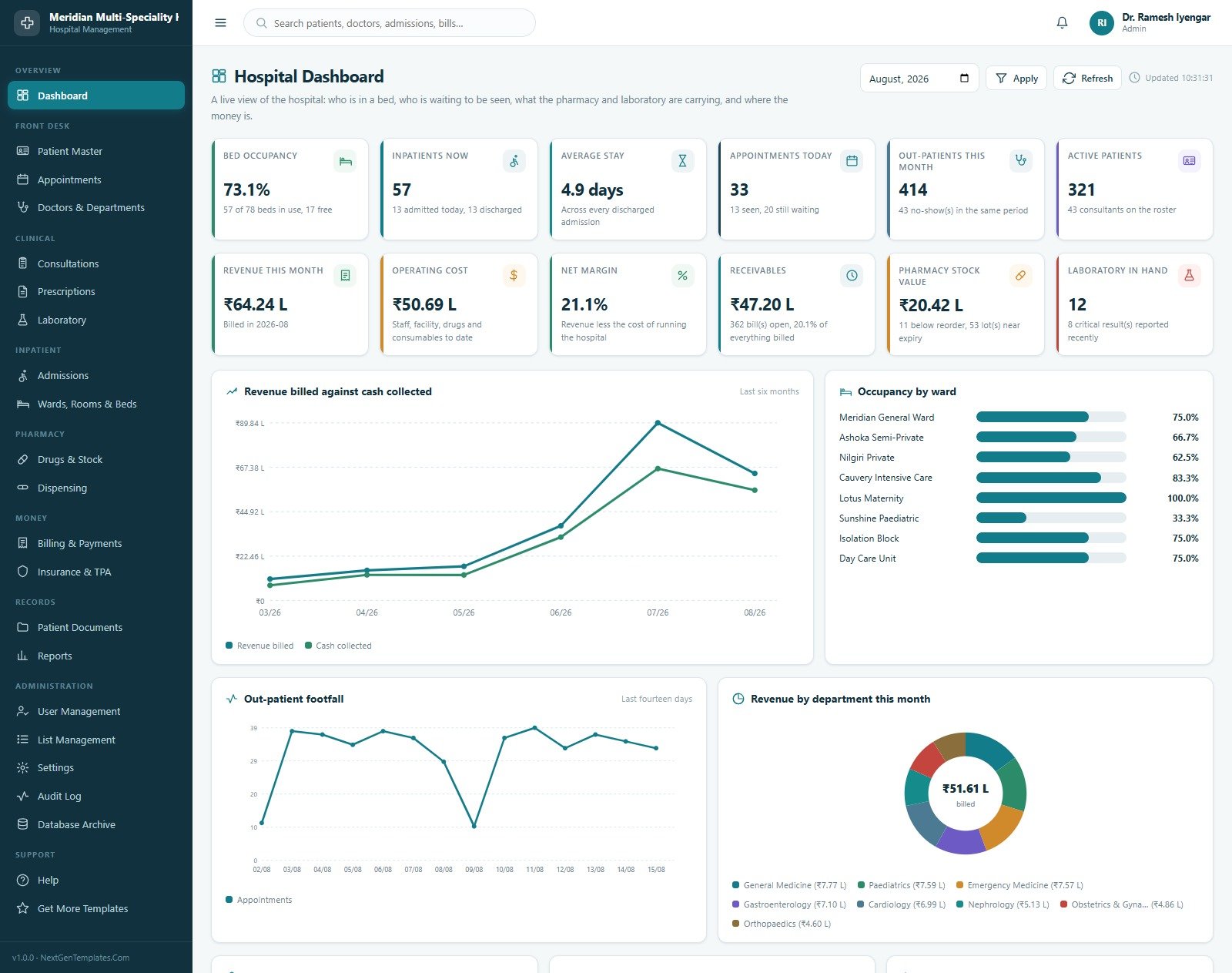
Twelve cards over one screen: Bed Occupancy, Inpatients Now, Average Stay, Appointments Today, Out-Patients This Month, Active Patients, Revenue This Month, Operating Cost, Net Margin, Receivables, Pharmacy Stock Value and Laboratory In Hand. Below them sit Revenue Billed against Cash Collected over six months, Occupancy by Ward, Out-Patient Footfall over fourteen days and Revenue by Department.
Patient Master
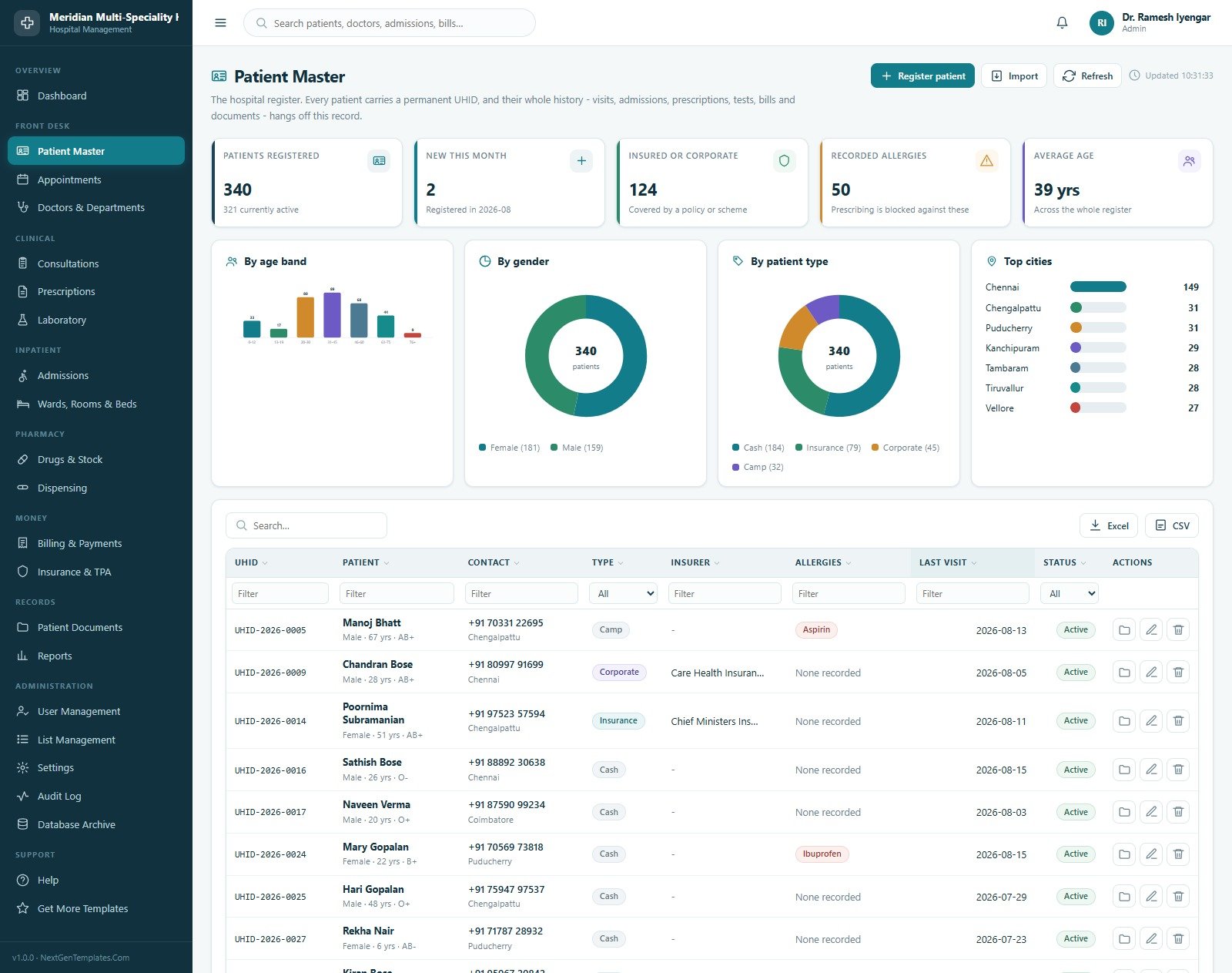
The hospital register. Every patient carries a permanent UHID and their whole history — visits, admissions, prescriptions, tests, bills and documents — hangs off that record. Cards show Patients Registered, New This Month, Insured or Corporate, Recorded Allergies and Average Age, with breakdowns by Age Band, by Gender, by Patient Type and Top Cities, over a filterable table with Excel and CSV export.
Doctors & Departments
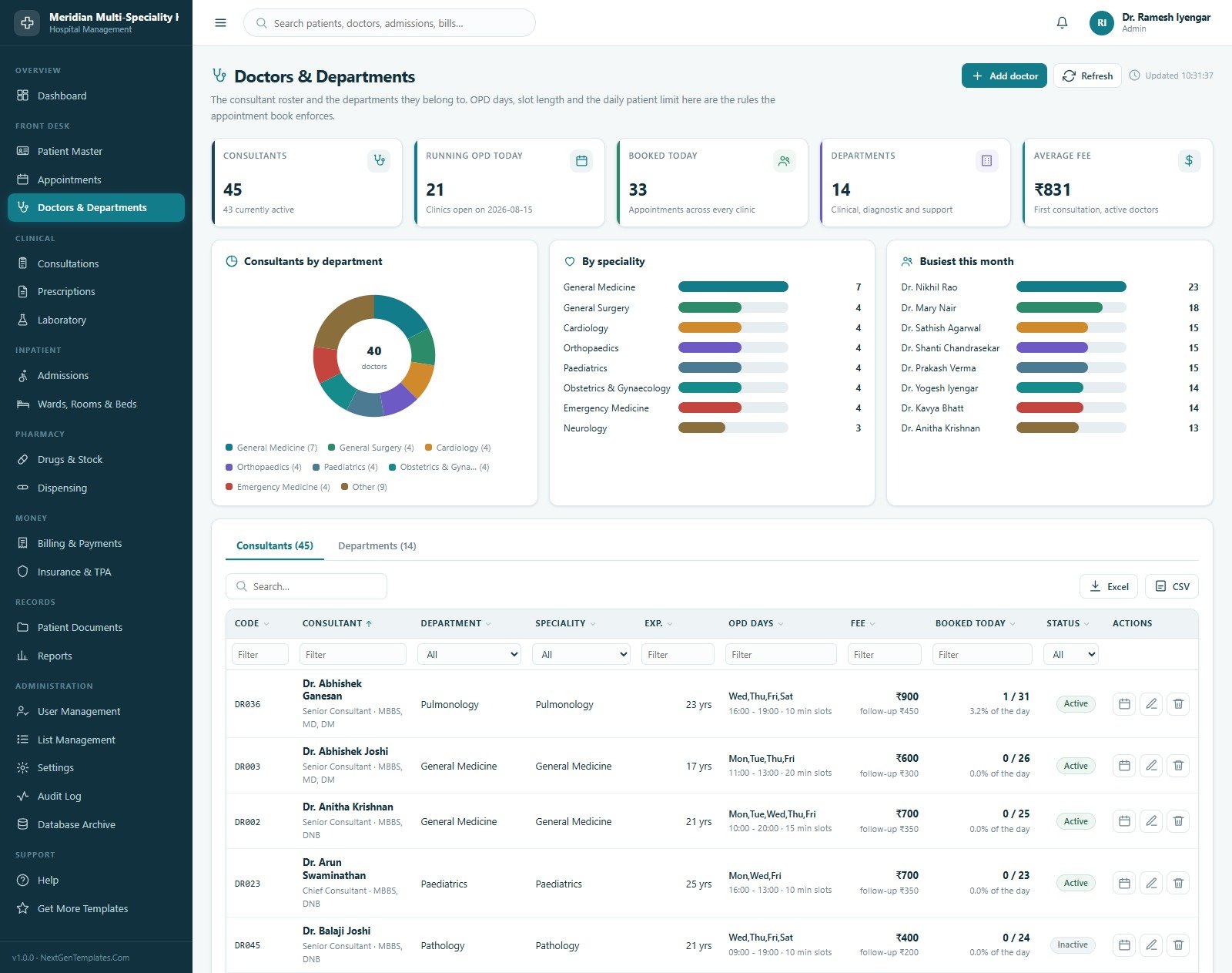
The consultant roster and the 14 departments they belong to, with Consultants, Running OPD Today, Booked Today, Departments and Average Fee across the top and charts for Consultants by Department, Count by Speciality and Busiest This Month. Each consultant row carries OPD days, clinic hours, slot length, daily limit and fees — and those are precisely the rules the appointment book enforces.
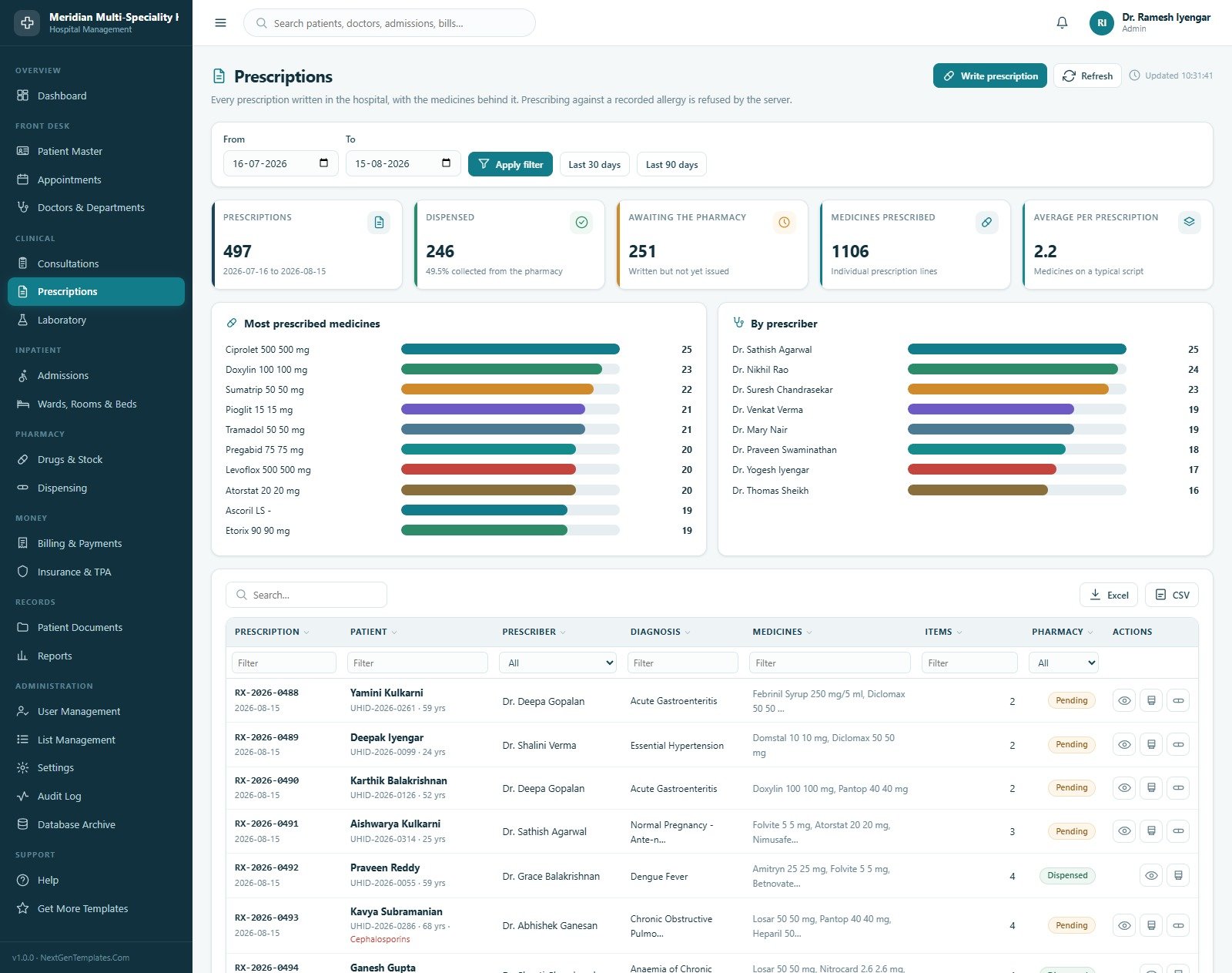
Prescriptions
Every prescription written in the hospital and the medicines behind it, with cards for Prescriptions, Dispensed, Awaiting the Pharmacy, Medicines Prescribed and Average per Prescription, plus Most Prescribed Medicines and a count By Prescriber. A line for a medicine the patient is recorded as allergic to is refused unless the prescriber records an override reason.
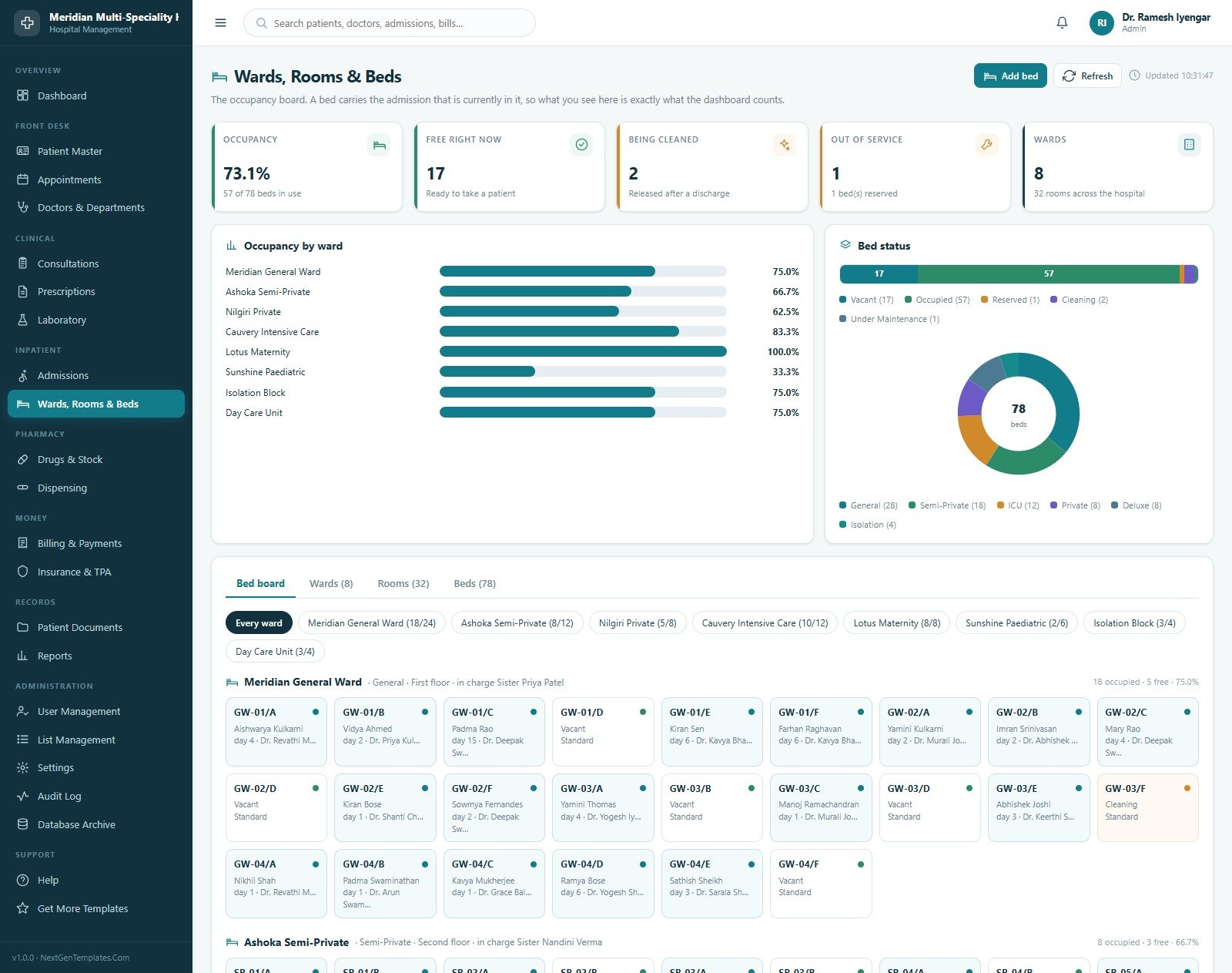
Wards, Rooms & Beds
The occupancy board: Occupancy, Free Right Now, Being Cleaned, Out of Service and Wards, alongside Occupancy by Ward and a Bed Status split of vacant, occupied, reserved, cleaning and under maintenance. Below it, every bed appears as a tile showing its patient, day of stay and consultant, with tabs for the ward, room and bed masters and their daily tariffs.
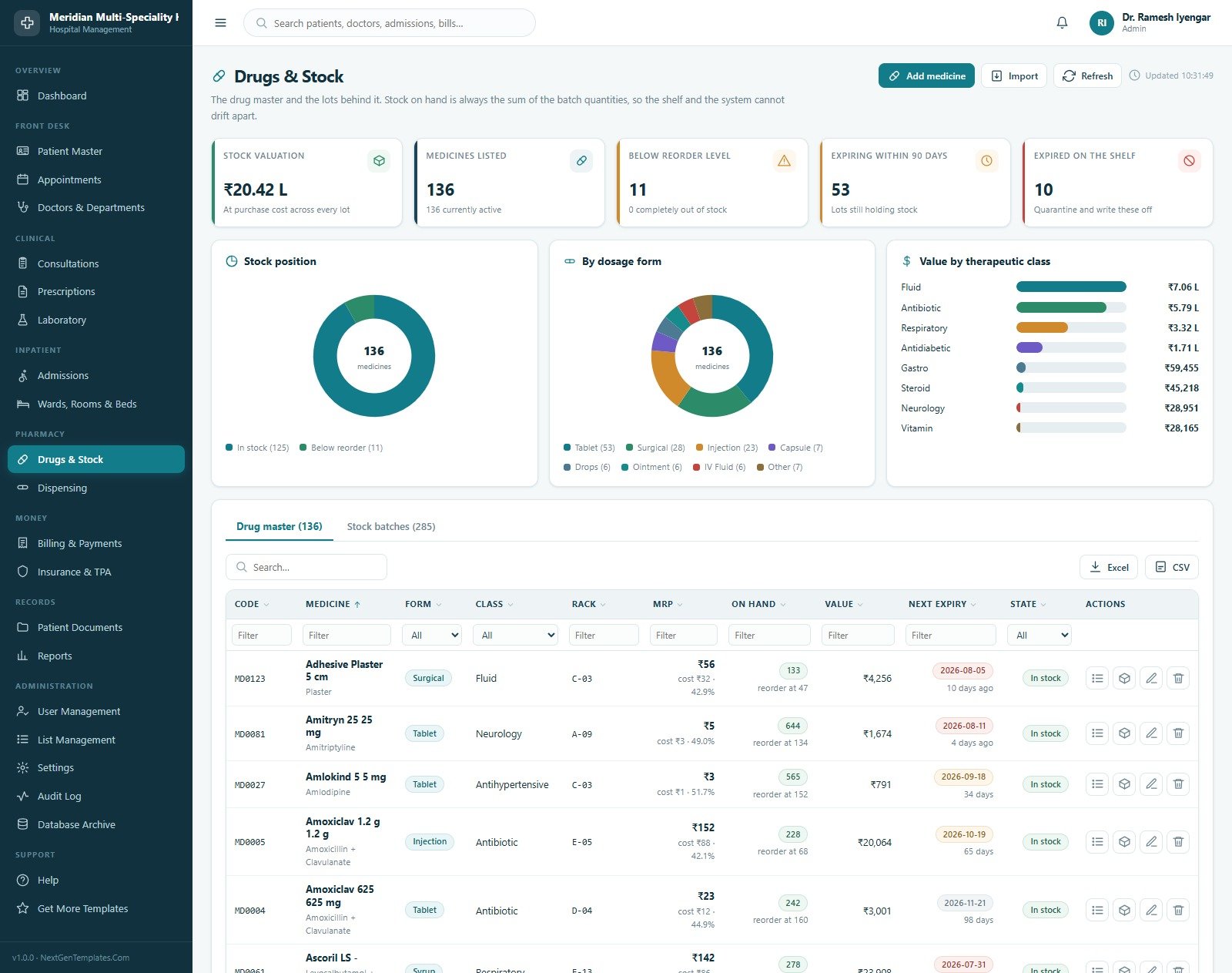
Drugs & Stock
The pharmacy’s drug master and the purchase lots behind it — Stock Valuation, Medicines Listed, Below Reorder Level, Expiring Within 90 Days and Expired on the Shelf, with Stock Position, a split By Dosage Form and Value by Therapeutic Class. Each medicine row carries form, class, rack, MRP, cost, units on hand, reorder point and next expiry, and a Stock Batches tab lists every lot.
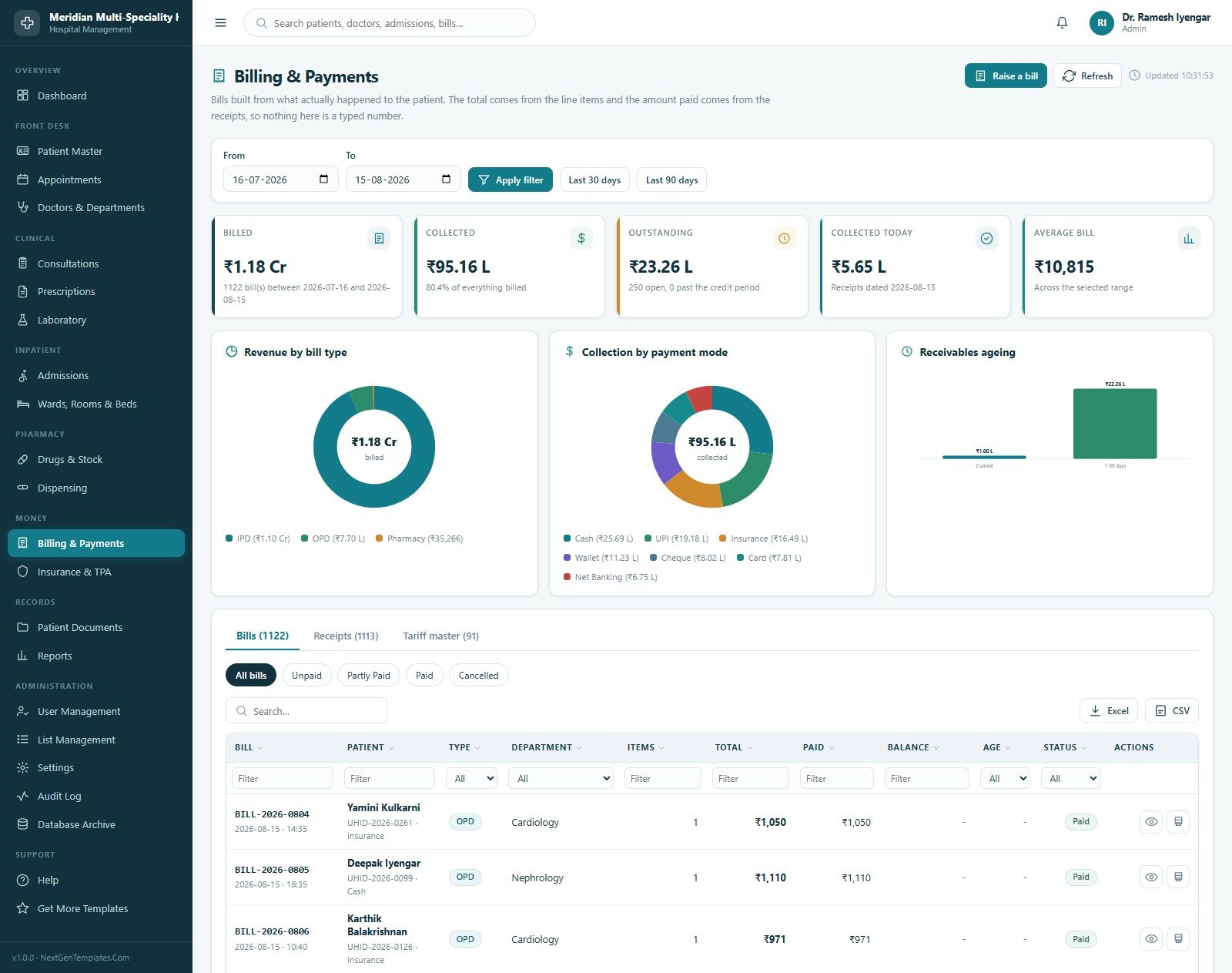
Billing & Payments
Billed, Collected, Outstanding, Collected Today and Average Bill, then Revenue by Bill Type across IPD, OPD and pharmacy, Collection by Payment Mode across cash, UPI, insurance, wallet, cheque, card and net banking, and a Receivables Ageing chart. Tabs hold the bills, the receipts against them, and a 91-line tariff master covering consultations, procedures, surgery, radiology, nursing, ambulance and packages.
Patient Documents
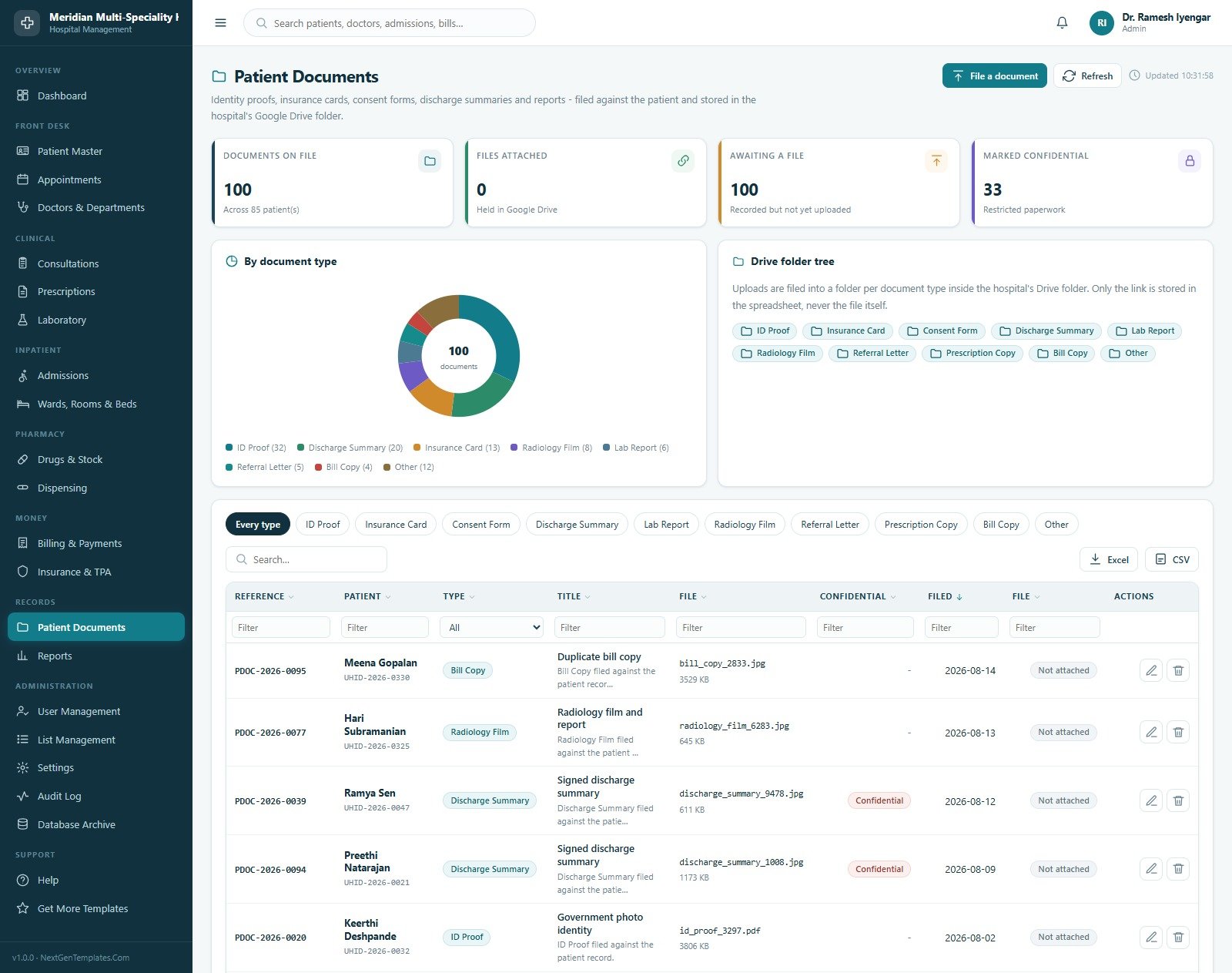
Identity proofs, insurance cards, consent forms, discharge summaries, radiology films and reports, filed against the patient and uploaded into a folder-per-type tree inside the hospital’s own Google Drive folder. Cards track Documents on File, Files Attached, Awaiting a File and Marked Confidential, with a breakdown By Document Type. Only the Drive link is stored in the spreadsheet, never the file itself.
Reports
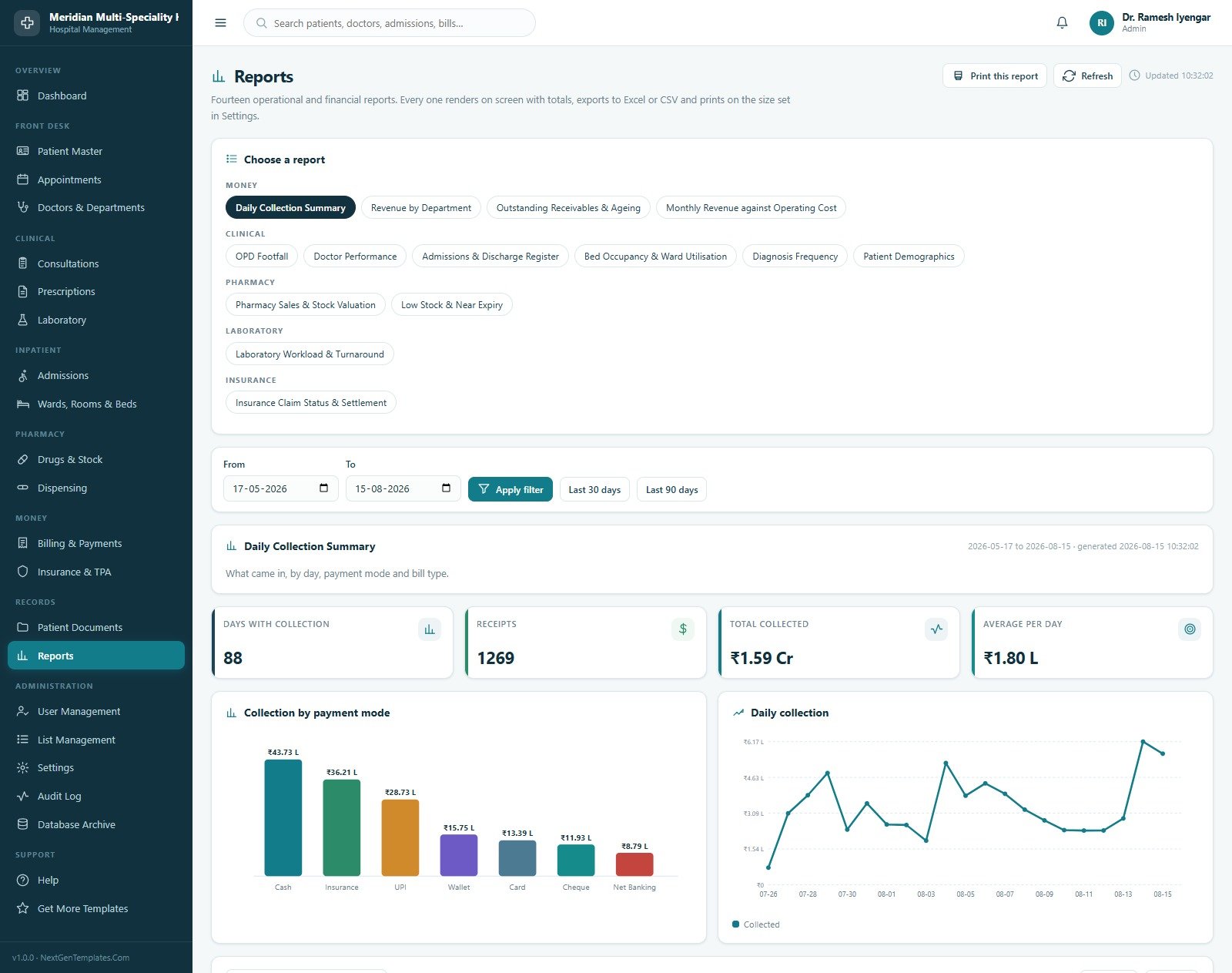
Fourteen operational and financial reports grouped under Money, Clinical, Pharmacy, Laboratory and Insurance — Daily Collection Summary, Revenue by Department, Outstanding Receivables & Ageing, Monthly Revenue against Operating Cost, OPD Footfall, Doctor Performance, Admissions & Discharge Register, Bed Occupancy & Ward Utilisation, Diagnosis Frequency, Patient Demographics, Pharmacy Sales & Stock Valuation, Low Stock & Near Expiry, Laboratory Workload & Turnaround, and Insurance Claim Status & Settlement.
The Remaining Modules
Ten more screens complete the system, and each one is a full module rather than a placeholder:
- Appointments — the clinic book, with Booked Today, In the Selected Range, Upcoming, No-Shows and Consultation Fees, plus By Status, Busiest Clinics and How They Booked across walk-in, phone, online and referral. Free-slot lookup, tokens, check-in and no-show tracking live here.
- Consultations — the encounter record: presenting complaint, vitals, examination note, diagnosis and advice, with charts for encounter type, most common diagnoses and volume by department. A consultation can raise a prescription and a laboratory order in the same flow.
- Laboratory & Diagnostics — orders, samples and results over a 60-test master spanning haematology, biochemistry, microbiology and pathology, with Orders, Still to Report, Critical Results, Average Turnaround and Laboratory Revenue.
- Admissions & Discharge — the inpatient register: Currently Admitted, Admitted Today, Past Their Discharge Date, Average Length of Stay and Room Charges Accrued, with admissions By Type, Inpatients by Ward and a Length of Stay distribution.
- Pharmacy Dispensing — medicines issued against a prescription or over the counter, with Pharmacy Sales, Dispensed Today, Cost of Goods, Gross Margin and Units Issued over Best Selling Medicines and a Prescription against Counter comparison.
- Insurance & TPA — cashless and reimbursement claims against 12 insurers, TPAs, corporates and schemes, each aged against that insurer’s own settlement window.
- User Management — accounts and the permission matrix behind them, with a Roles & permissions tab. The Admin role is locked so a hospital can never lock itself out.
- List Management — 46 dropdown lists and 310 values driving every select box in the application.
- Settings — eight tabs: Hospital letterhead, Finance, Clinical rules, Print size, Email, Theme, Security and Archive.
- Audit Log and Database Archive — the who-did-what trail, and a dated archive that copies closed activity out of the live database once a backup copy has succeeded. Master data, open admissions, bills with a balance and unsettled claims are never archived.
Hospital Management System Web App vs. a Spreadsheet Register vs. Paid Hospital SaaS — Feature Comparison
| Feature | Hospital Management System Web App | Plain spreadsheet / paper register | Cloud hospital SaaS |
|---|---|---|---|
| Cost | $39.99 one-time | Free, but rebuilt by hand | $40–$300 / month, often per bed or per user |
| Platform | Google Apps Script + Google Sheets, in your own account | Excel or Google Sheets | Vendor’s cloud |
| Setup time | Under 15 minutes — paste two files and deploy | Days of column design | Weeks of onboarding |
| Role-based logins | ✅ 8 roles, guarded on the server | ❌ Sheet-level sharing only | ✅ Included |
| Where your data lives | ✅ Your own Google Drive | ✅ Your own file | ❌ Vendor-hosted |
| Source code included | ✅ Yes — Code.gs and Index.html are yours | n/a | ❌ Never |
| Per-user / per-bed fees | ✅ None | None | ❌ The main cost driver |
| Year-1 cost at 8 users | $39.99 | $0 plus a lot of your time | $3,800–$14,000+ |
| Clinical decision support / certified EHR | ❌ No — administrative record only | ❌ No | Varies by vendor and country |
For a clinic or small hospital that wants its admissions, pharmacy and billing in one place without a per-bed subscription — and is happy to keep clinical certification out of scope — the Hospital Management System Web App sits in the sweet spot.
Who Should Use This Template
Perfect for:
- Owners and administrators of small and mid-sized hospitals, nursing homes and day-care centres running their records across several disconnected spreadsheets
- Multi-speciality clinics with an in-house pharmacy and laboratory that want one register instead of three
- Hospital managers who need occupancy, receivables and pharmacy stock on a single screen each morning
- Developers and IT consultants who want a working Apps Script codebase to adapt for a healthcare client
- Teaching and training — a realistic hospital administration system with a full seeded database to demonstrate
Not a fit if you need:
- Clinical decision support, diagnosis assistance or treatment guidance — the system records what staff type and does nothing else with it
- A certified EHR or EMR of record, or a regulated medical device — this carries no FDA, CE, MDR or equivalent clearance of any kind
- HIPAA, GDPR or any other health-data privacy compliance, or a data-security guarantee — none is offered, and compliance depends entirely on how you deploy and administer it
- Pharmacy dispensing safety — there is no drug-interaction checking, no dose checking, no controlled-substance handling and no e-prescribing. The allergy check is a simple text match against the patient record
- Medical coding or insurance-claim regulation compliance — the billing module adds up your own tariff, nothing more
- Accreditation evidence — it produces no JCI, NABH or equivalent artefacts and makes no accreditation claim
- SSO, HL7/FHIR interfaces, PACS integration or 24/7 vendor support
Real-World Use Cases
Dr. Sharma runs a 40-bed nursing home. Admissions were on a whiteboard, the pharmacy on one spreadsheet and bills on another, and the three never agreed at month-end. He now uses the Hospital Management System Web App so the bed board, the dispensing log and the bill are the same record — and reads occupancy and receivables off one dashboard each morning instead of reconciling three files.
Priya manages the front desk of a multi-speciality clinic. She books against real OPD days and daily patient limits, so the system refuses the double bookings that used to cause hour-long waits, and she raises the OPD bill from the same screen she registered the patient on.
Ganesh is an IT consultant serving three small hospitals. He deploys the system into each client’s own Google account, edits Code.gs to match their tariff structure and ward naming, and charges for the customisation — with no licence to renew and nothing hosted on his own servers.
Advantages of the Hospital Management System Web App
The most valuable thing here is not the number of screens — it is that the numbers cannot be argued with. Stock on hand is the sum of the batches, so the shelf and the system cannot drift apart. A bill total is the sum of its items and the amount paid is the sum of its receipts, so nobody can quietly type a figure that suits them. Length of stay is computed from the admission and discharge dates. That removes an entire class of month-end reconciliation work.
The cost picture is the second advantage. A cloud hospital system charged per bed or per user runs into thousands of dollars a year for a small hospital; this is a one-time purchase with no per-seat fee, and it runs inside your own Google Workspace or personal Google account, using infrastructure you already pay for. Because Google Apps Script web apps are served by Google, there is no server to patch and no hosting bill.
Third, you own the source. Code.gs and Index.html ship in the download, so a developer can change the tariff logic, add a ward type, rename a module or translate the interface. That matters more than it sounds — every hospital does something slightly differently, and a system you cannot edit eventually becomes the thing everyone works around.
Opportunities for Improvement
An honest list, because it should shape whether you buy it:
- Google Sheets has practical size limits. A busy hospital will grow the database quickly — the seeded install alone is 15,370 rows. The built-in Database Archive exists precisely to manage that, but it is something you have to remember to run rather than something that happens on its own.
- There is no clinical intelligence at all, and that is by design. No interaction checking, no dose validation, no clinical alerts beyond the simple allergy match.
- Patient documents are stored as Drive links, so file permissions are managed in Drive rather than inside the application. Anyone with the Drive link can open a document regardless of their role in the system — worth planning for before you upload sensitive paperwork.
- No offline mode. The web app needs a live connection; a power or internet outage stops registration and billing, so keep a paper fallback for the front desk.
- Reporting is fixed. Fourteen reports cover the common ground well, but a custom report means editing Code.gs or exporting to Excel and building it there.
- The seeded amounts are in rupees and the demo hospital is Indian. The currency symbol and code are changed in Settings, but you will want to replace the sample tariff and drug master with your own regardless.
Best Practices
- Change all eight passwords on day one. The defaults are published in this article and in the manual, so they are public knowledge.
- Fill in Settings before anyone else signs in. Hospital name, registration number, currency, tax and print size all flow into every printed document.
- Replace the masters before the transactions. Wards, beds, consultants with their real OPD days and limits, drug master, test master with real reference ranges and tariff — these are the rules everything else is validated against.
- Run Reseed Hospital Data once your own masters are in to clear the sample activity without losing your configuration.
- Give each person their own account. Shared logins destroy the value of the audit log.
- Take a backup copy monthly from the Database Archive screen, and archive closed activity once you have a year or two behind you.
- Treat it as an office system. Keep clinical judgement, prescribing safety and legal compliance where they belong — with your clinicians and your own advisers.
Explore Relevant Templates
- Hospital Management System Web App — the template described in this article.
- Eye Care Center Management System Web App — the same role-based architecture applied to an optical practice.
- Physiotherapy Clinic Management System Web App — session packages, therapist scheduling and treatment plans.
- Blood Bank Management System Web App — donors, units and issue registers.
- Therapy Center Management System Web App — a smaller practice system for therapy and counselling centres.
- Prescription Record Data Entry System in Excel and Doctor Duty Roster Data Entry System in Excel — offline Excel alternatives for a single register.
- Also worth a look from the same web-app family: Airport Transfer Management System Web App and App Development Project Management System Web App.
If you want to build registers and trackers like this yourself, the NextGenTemplates Academy learning paths take you through the spreadsheet skills step by step, with practice files.
Frequently Asked Questions
Can I try it before buying?
Yes. A full live demo of the Hospital Management System Web App is linked above, with sign-in details for all eight roles. No signup, no email and no card. It is a shared public instance that resets periodically, so treat anything you enter there as temporary, and note that all of its records are fictional.
Is this HIPAA compliant, or a certified EHR?
No — to both. The Hospital Management System Web App is administrative record-keeping software. It is not an electronic health record of record, it holds no HIPAA, GDPR, FDA, CE, JCI or NABH certification, and no data-security or privacy guarantee is offered. Whether a deployment meets any legal or regulatory obligation depends entirely on how you configure, host and administer it, and you should take your own advice on that.
Does it check drug interactions or dosages?
No. The Hospital Management System Web App does no drug-interaction checking, no dose checking and no controlled-substance handling, and it is not an e-prescribing system. It does refuse a prescription line for a medicine the patient is recorded as allergic to, but that is a simple match against text a member of staff typed into the patient record.
Where is the data stored?
In a Google Sheet inside your own Google account, with uploaded patient documents in your own Google Drive folder. Nothing is sent to NextGenTemplates and no third party hosts it. Access is controlled by your Apps Script deployment settings and the eight role logins inside the system.
How long does setup take?
Under 15 minutes for someone who has used the Apps Script editor before. Paste two files, deploy as a web app, press Set up the database once, and the Hospital Management System Web App builds all 33 sheets and its sample hospital in a single pass.
How does this compare to a paid hospital SaaS?
A cloud hospital system typically costs $40 to $300 a month, often per bed or per user, and gives you no source code. The Hospital Management System Web App is $39.99 once, runs in your own Google account and ships its full source. What you give up is vendor support, clinical certification and interfaces such as HL7 or PACS.
Can I change the modules, fields and branding?
Yes. Settings covers the letterhead, currency, tax, clinical rules, print size, theme and security without touching code, and the 46 dropdown lists are edited from List Management. Beyond that, Code.gs and Index.html are included in full and you are free to modify them.
About the Author
Built by PK — Microsoft Certified Professional with 15+ years of Excel, Google Sheets and Power BI experience. Founder of NextGenTemplates, reaching 300K+ subscribers across YouTube channels. Every template is hand-built and tested before release.
Conclusion
The Hospital Management System Web App gives a small hospital one register instead of six spreadsheets — 20 screens, 8 role-based logins and a set of server-side rules that stop the bed board, the pharmacy shelf and the bill from disagreeing with each other. It is office software for a hospital, sold honestly as that and nothing more: no clinical claims, no compliance claims, no certification.
Before you decide, open the live demo and sign in as a couple of the roles. Ten minutes in the demo will tell you more than any feature list, and it costs nothing.
Get the Hospital Management System Web App
Instant download · One-time payment · No subscription · Full source code included
Last updated: August 2026