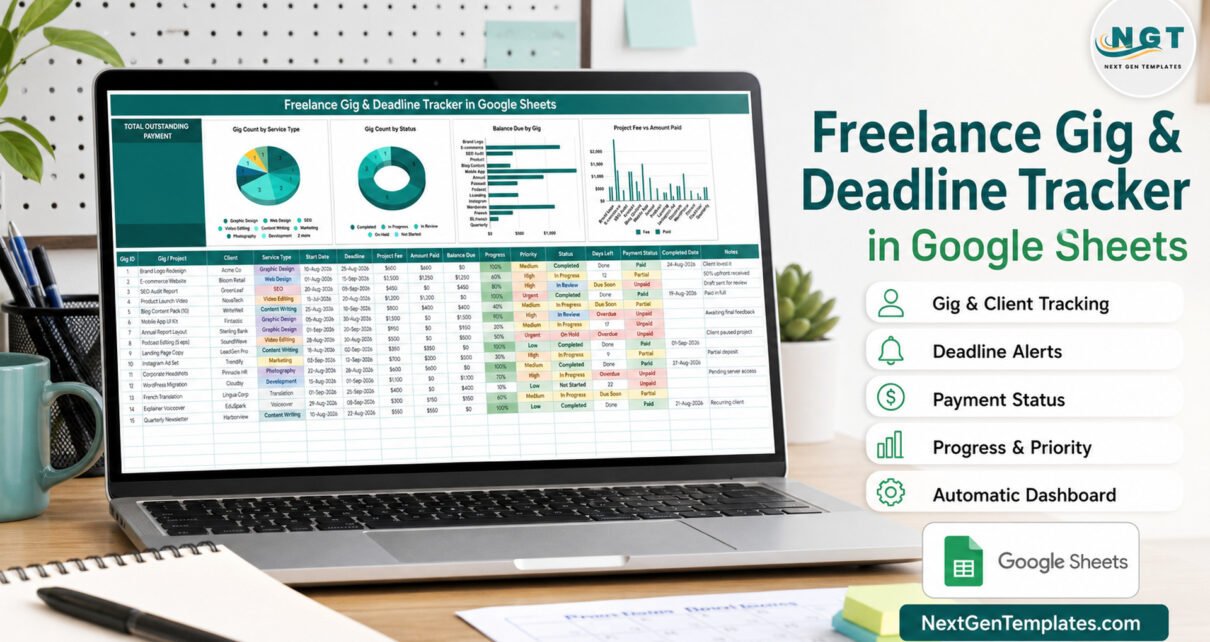
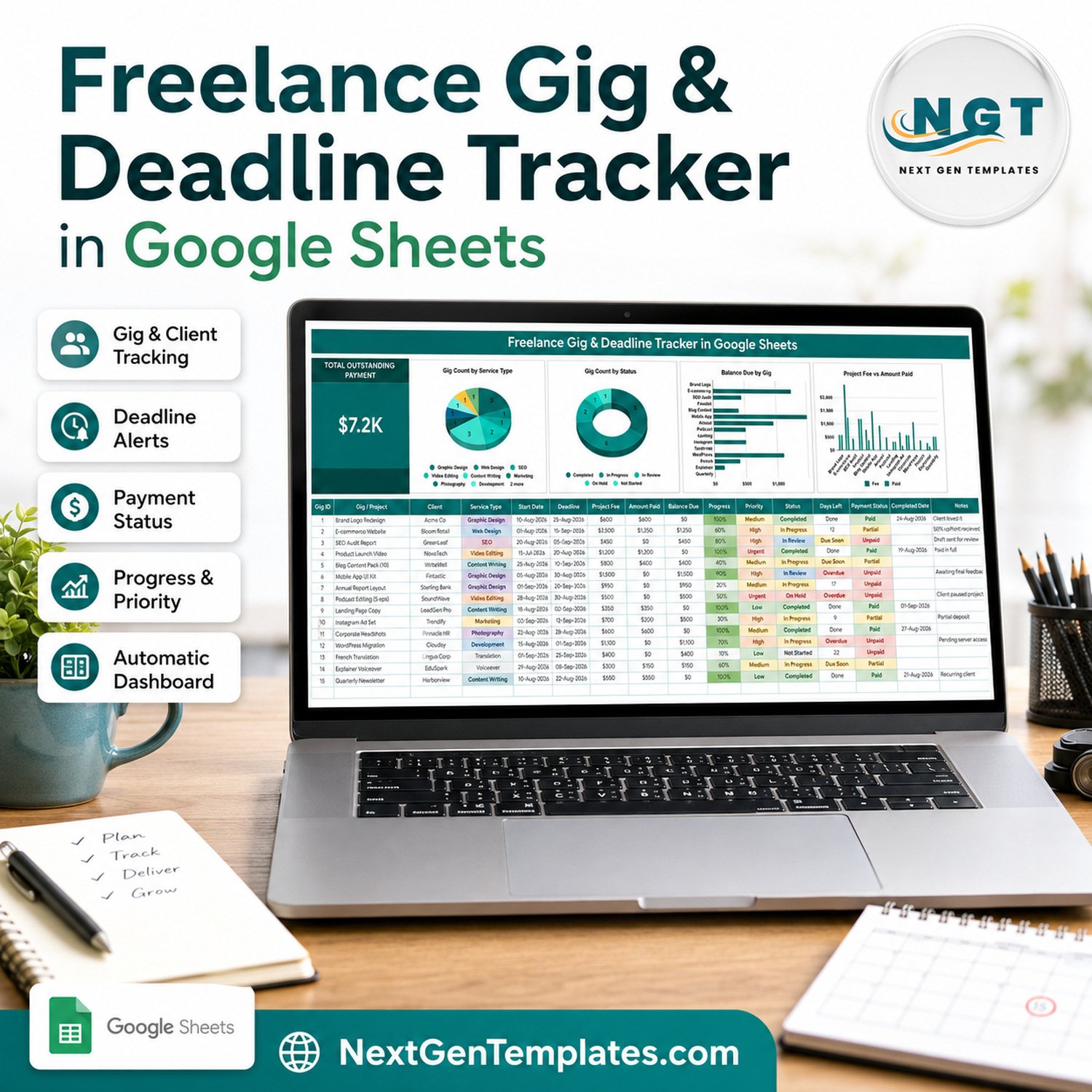
The Freelance Gig Deadline Tracker in Google Sheets keeps 16 columns for every job, works 4 of them out for you, and drives 4 live charts plus one headline card from a single table. The sample file ships with 15 worked gigs: $12,500 in project fees, $5,300 collected and $7,200 still outstanding – the exact number the big card on the left reports as $7.2K.
Most freelancers do not lose money because they cannot design, write or edit. They lose it because a deadline slipped past unnoticed and a 50% deposit was never followed by the other 50%. This tracker exists for those two problems specifically: a Days Left column that changes its own wording when a date goes critical, and a Payment Status column that is calculated from the money rather than from memory.
Key Features of the Freelance Gig and Deadline Tracker
- 16 columns per gig – Gig ID, Gig / Project, Client, Service Type, Start Date, Deadline, Project Fee, Amount Paid, Balance Due, Progress, Priority, Status, Days Left, Payment Status, Completed Date and Notes.
- 4 columns fill themselves – Gig ID, Balance Due (Project Fee minus Amount Paid), Days Left and Payment Status are ordinary formulas. They stay blank until a row has data in it, so a half-filled sheet does not look broken.
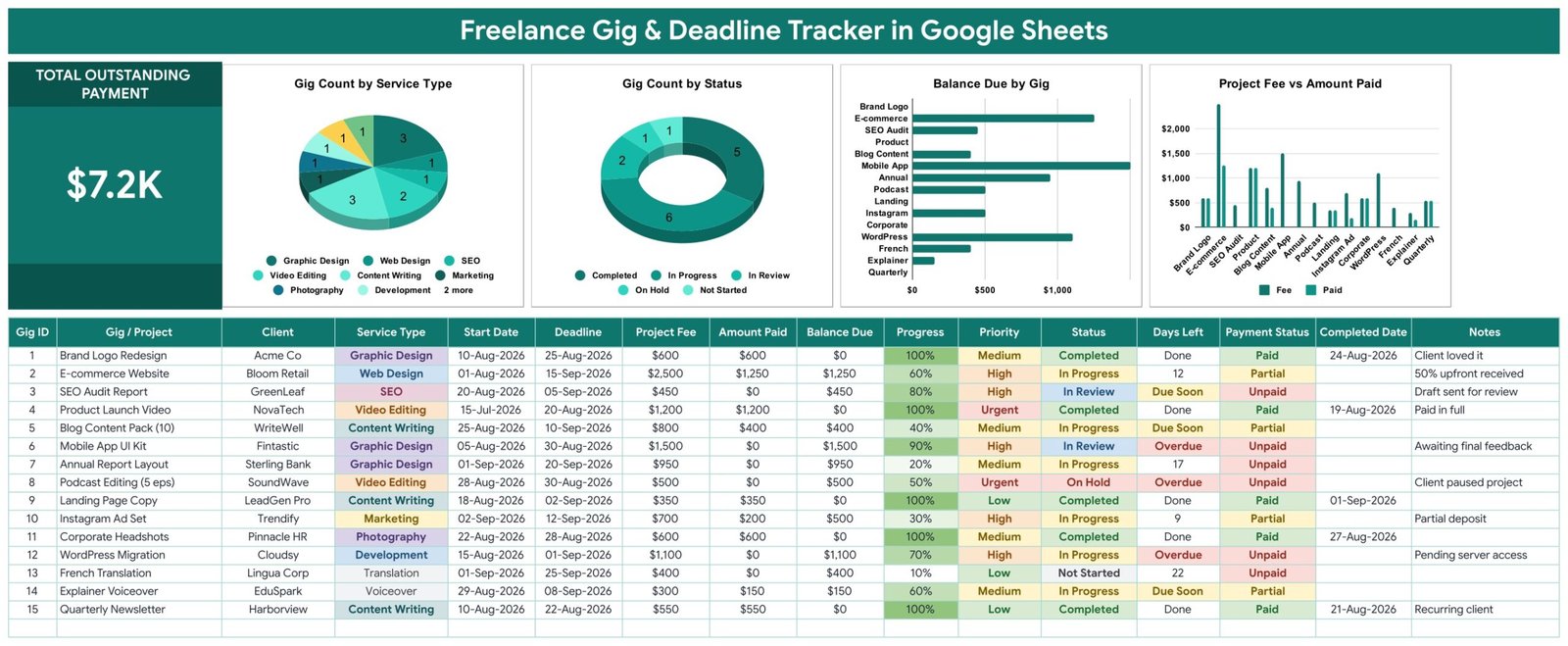
- Days Left is wording, not just arithmetic – more than a week out it shows a number, inside the final week it reads Due Soon, past the date it reads Overdue, and once Status is Completed it reads Done. The 15 sample gigs break down as 3 Overdue, 3 Due Soon, 4 counting down and 5 Done.
- Payment Status is derived, never typed – Paid, Partial or Unpaid comes from comparing Amount Paid with Project Fee, so a deposit shows as Partial from the moment you record it.
- One headline card – TOTAL OUTSTANDING PAYMENT sums every Balance Due into a single figure that moves the instant a client pays.
- 4 live charts – Gig Count by Service Type, Gig Count by Status, Balance Due by Gig, and Project Fee vs Amount Paid. The last one plots the two money columns as paired bars, which makes an underpaid job visible without reading a number.
- 3 dropdowns from one List tab – Service Type, Priority and Status all read rows 2 to 500 of the List tab, so new options appear in the dropdown the moment you add them there.
- No helper tables anywhere – the charts aggregate the data columns directly over rows 16 to 1000, using the built-in Aggregate option rather than a hidden pivot block.
Sheets Explanation
The Tracker Sheet
This is the whole product in one screen. The TOTAL OUTSTANDING PAYMENT card sits on the left, four charts run across the top, and the 16-column table sits underneath with coloured chips on Service Type, Priority, Status and Payment Status. Progress is a green data bar that grows toward 100%, so a row at 20% and a row at 90% are distinguishable at arm’s length.
The How to Use Sheet
Setup instructions written into the file rather than shipped as a separate manual. It names the rows to overwrite (16 to 30), the four automatic columns, the Days Left rules, how the List tab feeds the dropdowns, and the one-time step that turns plain dropdowns into the coloured chips the screenshots show.

The Explore More Templates Sheet
An in-file index of related NextGenTemplates products with categories, formats, prices and a WELCOME15 coupon code. It is the fourth visible tab; the third, List, simply stores the dropdown values.

Freelance Gig Tracker vs. an Excel Sheet vs. Freelance SaaS — Feature Comparison
| Feature | Freelance Gig & Deadline Tracker (Google Sheets) | Excel gig tracker on your laptop | Bonsai / HoneyBook / Dubsado |
|---|---|---|---|
| Cost | $6.99 one-time | $0–$40 one-time, plus your build time | $21–$79 per user / month |
| Platform | Google Sheets, any browser | Desktop Excel | Vendor web app |
| Setup time | Under 10 minutes | Hours if you build the charts yourself | 1–2 days of onboarding |
| Real-time collaboration | Built in – share the sheet | Only through OneDrive co-authoring | Yes, per seat |
| Mobile access | Google Sheets mobile app | Excel mobile, limited charts | Yes |
| Customisable fields | Edit any column or the List tab | Yes, if you know the formulas | Fixed schema; paid tiers unlock more |
| Share with a link | Yes, view or edit | No – you email a file | Client portal on higher plans |
| Due Soon / Overdue / Done wording | Automatic in the Days Left column | You write the formula | Notification-based |
| Year-1 cost at 2 freelancers | $6.99 total | Excel licence plus your time | $504–$1,896 |
For solo freelancers and two-person studios who want deadlines and unpaid balances on one screen without a monthly seat fee, this tracker sits in the sweet spot.
Who Should Use This Template
Perfect for:
- Solo freelancers running 5 to 40 live gigs across design, writing, video, development or translation
- Two- and three-person studios who want one shared sheet instead of three private spreadsheets
- Freelancers whose real pain is chasing balances rather than organising tasks
- Google Workspace users who want the file in Drive, on their phone, and shareable by link
Not a fit if:
- You bill by the hour and need timers, timesheets or an hourly-rate column – this records a flat Project Fee
- You need to issue invoices; this logs what an invoice is worth and whether it was paid, it does not produce one
- You want automated email or SMS deadline reminders rather than an on-screen flag
- You run more than roughly 40 concurrent gigs, where a database-backed project tool will serve you better
Real-World Use Cases
Maya, freelance designer, nine live gigs. Two logos, three social packs, the rest website work. Every Monday she sorts by Days Left, sees the rows reading Overdue, and messages those clients before opening a design file. Previously that reconciliation happened in her head, usually on a Thursday, usually too late.
Ravi, long-form writer for six agencies. His problem was never the writing, it was the 50% deposits. He filters Payment Status to Partial and Unpaid, reads the outstanding card, and sends chase emails on the first of every month with the exact balances in front of him rather than an approximate feeling.
Lena and Tom, two-person video studio. They share one copy of the sheet, tag each job with Priority, and use the Project Fee vs Amount Paid chart to spot the two edits where the second instalment quietly never arrived. Their previous system was a shared note and a lot of guessing.
Advantages of This Tracker
It answers the two questions that cost money. “What is late?” is one sort on Days Left. “Who owes me?” is one glance at the outstanding card and one filter on Payment Status. Neither requires a report to be run or a subscription to be current.
It is cheap in the way that matters. At $6.99 once, the tracker costs less than four days of the cheapest freelance SaaS seat. For a freelancer billing $12,500 a year – the sample file’s own total – a $504 annual tool is 4% of revenue spent on knowing what the revenue is.
It stays yours. The file lives in your Google Drive. You can add a column, delete a chart, change the palette in the script’s colour block, or export the whole thing to Excel. Nothing is locked behind a plan tier, and nothing stops working if you stop paying.
It grows without maintenance. Because the charts read rows 16 to 1000 directly with Google Sheets’ built-in chart aggregation instead of a helper table, adding gig number 60 needs no formula edits and no chart-range changes.
Opportunities for Improvement
Stated honestly, because they will shape whether this is the right file for you:
- Deadline flags are visual, not push. Days Left changes wording on screen. It does not email, text or notify you. If you need to be interrupted rather than to look, add a Google Calendar entry per deadline alongside the sheet.
- There is no time tracking. Project Fee is a flat number. There is no hours column, no rate column and no timer, so an hourly freelancer will need to add those themselves.
- It does not issue invoices. It tracks what is owed; it does not produce a document you can send. Pair it with your existing invoicing tool.
- The coloured chips need one manual step. Google Sheets does not yet let a script set the “Chip” display style on a dropdown, so columns D, K and L need the display style set by hand once through Data → Data validation → Advanced options. The How to Use tab covers it, and it takes about ten seconds a column.
- There is no client rollup or monthly revenue trend. Charts summarise by service type, status and individual gig. Total earned per client, or fees by month, would need a pivot table you add yourself.
- The chart range stops at row 1000. That is roughly 985 gigs, which is far more than the target user will log – but if you pass it, the chart ranges need extending manually.
Best Practices
- Set up the List tab before you type a single gig. Replacing the sample services after 30 rows exist means fixing 30 dropdown values; doing it first costs two minutes.
- Update Amount Paid the day money lands, not at month end. Balance Due, Payment Status and the outstanding card all depend on it, and a stale figure makes the one number you rely on wrong.
- Use Priority honestly. If every gig is Urgent, the column tells you nothing. Reserve Urgent for what would genuinely damage a client relationship.
- Sort by Days Left on a fixed day each week. The tracker only works if you look at it; a recurring Monday slot beats a good intention.
- Fill Completed Date on delivery. It is what separates a finished gig from an abandoned one when you look back at the year, and it flips Days Left to Done.
- Keep the Notes column short and factual – “50% upfront received”, “awaiting final feedback”, “pending server access”. Those three notes from the sample file are exactly the right length.
Explore Relevant Templates
- Freelance Income & Expense Tracker in Google Sheets – the money half of the same job: what came in, what went out, what is left. It pairs directly with this tracker (buy it here).
- Graphic Design Agency Management System Web App – the step up when a spreadsheet stops being enough and you need roles, logins and a client-facing system.
- Content Writing Agency Management System Web App – the same idea for writers running a team rather than a solo practice.
- Translation & Localization Dashboard in Google Sheets – useful if translation is one of the service types you sell.
- Graphic Design Studio Dashboard in Google Sheets and Photography Dashboard in Google Sheets – wider reporting once you are past a handful of gigs a month.
Frequently Asked Questions
What does the Freelance Gig Deadline Tracker in Google Sheets calculate automatically?
Four columns: Gig ID, Balance Due (Project Fee minus Amount Paid), Days Left and Payment Status. It also totals every Balance Due into the TOTAL OUTSTANDING PAYMENT card and feeds four charts. Project, client, dates, fee, progress and priority you type once.
How does the Days Left column decide between Due Soon, Overdue and Done?
It compares today’s date with the Deadline. More than seven days away it shows a number, inside seven days it reads Due Soon, past the date it reads Overdue, and as soon as Status is set to Completed it reads Done regardless of the date.
Can I add my own service types, priorities and statuses?
Yes. All three dropdowns read rows 2 to 500 of the List tab. Type a new value there and it is available immediately in every row of the tracker – you never open the data-validation dialog to add an option.
Does this freelance tracker send deadline reminders?
No. It flags deadlines visually through the Days Left column and chart colours; it does not send email or push notifications. Freelancers who need to be interrupted should add a Google Calendar entry alongside each deadline row.
How does it compare to Bonsai or HoneyBook?
Those platforms issue invoices, take payments and manage contracts for $21 to $79 per user each month. This tracker does none of that. It answers what is due, what is late and who still owes you, for $6.99 once, in a file you own outright.
How long does setup take?
Under 10 minutes. Copy the sheet from the PDF link, swap the List tab values for your own services, delete the 15 sample rows and start typing. The optional chip-display step adds roughly ten seconds per column.
Can I change the currency from US dollars?
Yes. Project Fee, Amount Paid and Balance Due are plain number formats. Select those columns and use Format → Number to switch to rupees, euros, pounds or anything else – no formulas change.
About the Author
Built by PK — Microsoft Certified Professional with 15+ years of Excel, Google Sheets and Power BI experience. Founder of NextGenTemplates, reaching 300K+ subscribers across three YouTube channels. Every template is hand-built and tested before release.
Conclusion
A freelance career rarely fails on craft. It gets ground down by the two administrative facts nobody enjoys tracking: which deadline is closest, and which invoice is still unpaid. This tracker puts both on one screen, calculates four of its sixteen columns for you, and asks for about ten minutes of setup in return.
Click here to purchase the Freelance Gig & Deadline Tracker in Google Sheets
Instant download · One-time payment · No subscription · Lifetime access.
For step-by-step video walkthroughs of Google Sheets templates, visit YouTube.com/@NeoTechNavigators.
Last updated: September 2026