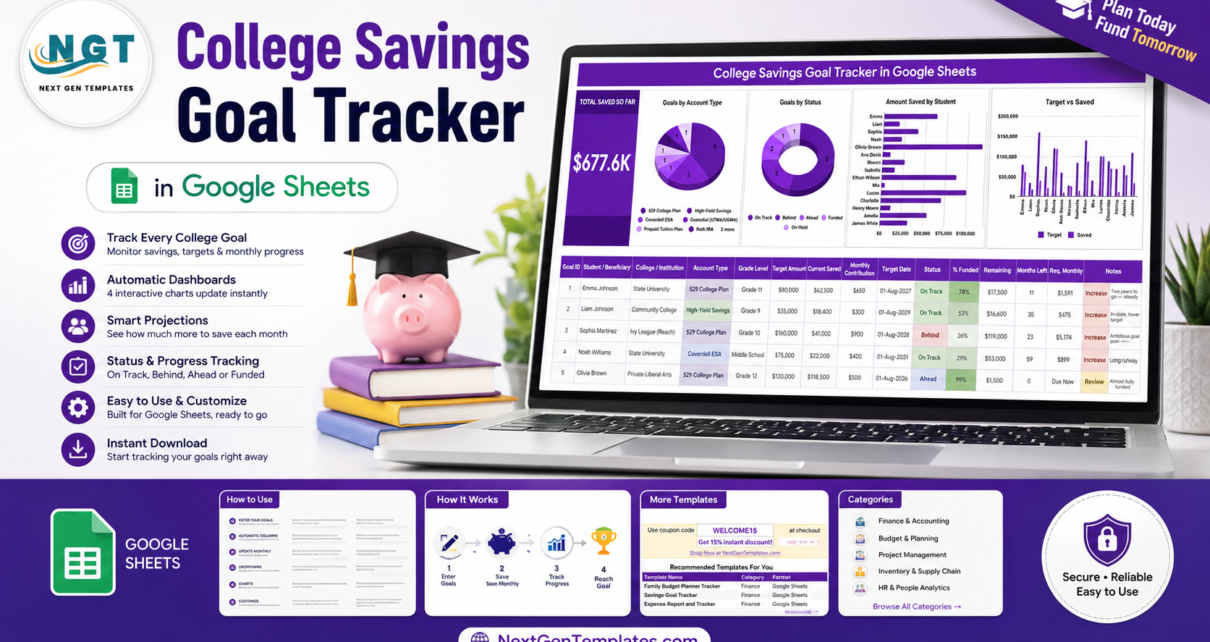
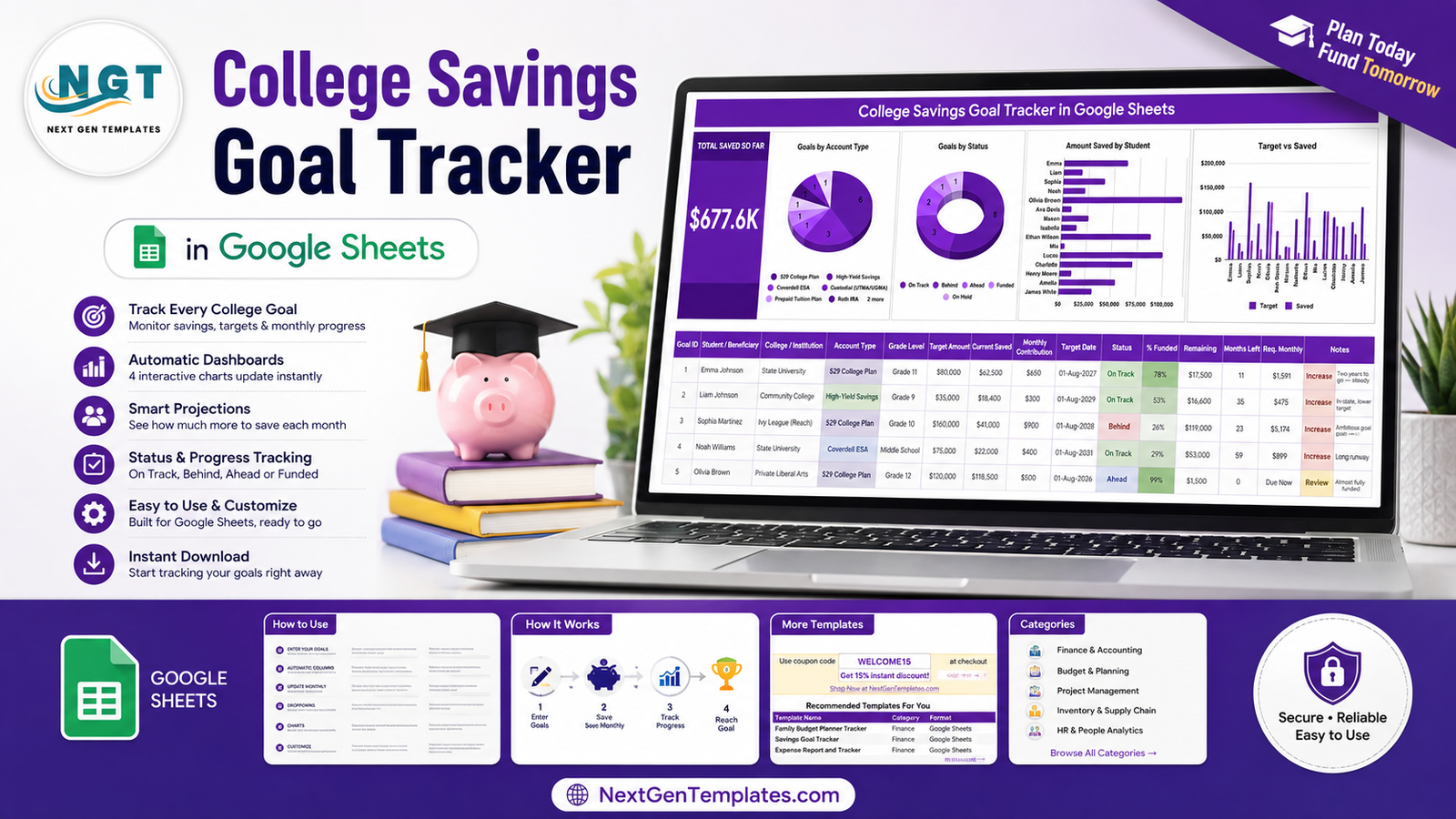
The College Savings Goal Tracker in Google Sheets puts one college fund per child on a single page: 16 columns, 6 of which calculate themselves, 4 charts bound directly to the data, and one headline card. The sample file ships with 15 beneficiaries and shows $677.6K saved so far, across 8 different account types from 529 College Plans to U.S. Savings Bonds.College Savings Goal Tracker in Google Sheets
Most families track college savings in three places at once – a bank app, a 529 provider portal and a note on the fridge. None of them answer the only question that matters: am I savingCollege Savings Goal Tracker in Google Sheets enough each month to hit the number by the time the first tuition bill arrives? This college savings tracker in Google Sheets answers it in one column, for every child, every month.
Get the College Savings Goal Tracker in Google Sheets
Key Features of the College Savings Goal Tracker in Google Sheets
- One KPI card. Total Saved So Far adds the Current Saved column across every beneficiary. It reads $677.6K in the sample data and re-totals the instant you log a deposit.
- Six automatic columns. Goal ID, % Funded, Remaining, Months Left, Req. Monthly and Forecast are formulas. You never type them.
- Nine input columns. Student / Beneficiary, College / Institution, Account Type, Grade Level, Target Amount, Current Saved, Monthly Contribution, Target Date and Status – that is the whole data-entry job.
- Four live charts. Goals by Account Type, Goals by Status, Amount Saved by Student, and Target vs Saved.
- Eight account types. 529 College Plan, Coverdell ESA, Custodial (UTMA/UGMA), Prepaid Tuition Plan, Roth IRA, High-Yield Savings, Brokerage Account and U.S. Savings Bond.
- Five status values. On Track, Behind, Ahead, Funded and On Hold, colour-coded down the Status column.College Savings Goal Tracker in Google Sheets
- Auto-expanding dropdowns. Account Type, Grade Level and Status read the List tab from row 2 to row 500, so adding a new option never means editing a validation rule.
- No helper tables. Every chart reads rows 16 to 1000 of the real data columns using the built-in Aggregate option – there are no hidden pivot sheets in the file.College Savings Goal Tracker in Google Sheets
Sheets Explanation
The workbook is deliberately small: one working page, one guide, one upsell page, plus a List tab that feeds the dropdowns.
Page 1: College Savings Goal Tracker
The whole product lives here. A purple title banner, the Total Saved So Far card on the left, the four charts across the top, and the 16-column goal table underneath starting at row 16. The % Funded column is shaded from pale to deep green as a goal fills up, Status is chipped in colour, and Forecast flags Increase in red wherever the current Monthly Contribution will not get you there in time.
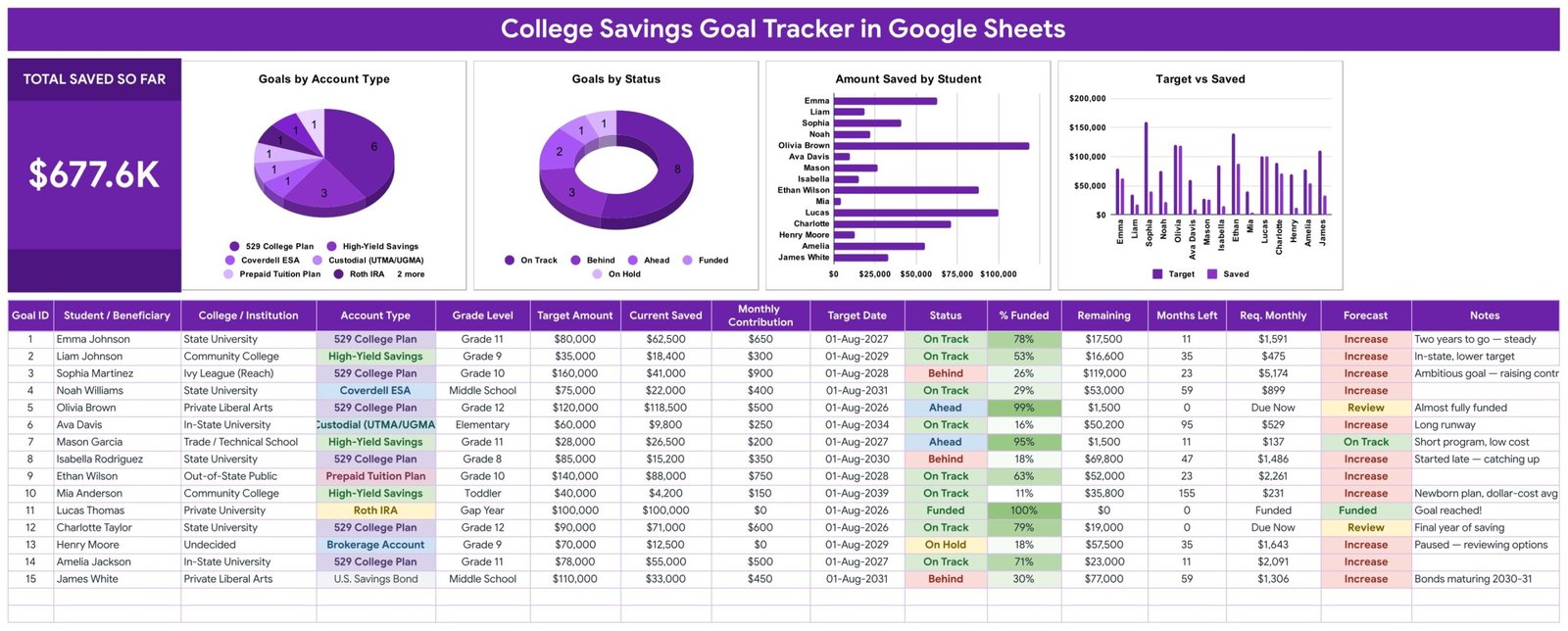
Read one row and you have the whole story. Sophia Martinez is aiming at $160,000 for an Ivy League reach school by August 2028. She has $41,000 saved – 26% funded – with $119,000 remaining and 23 months left, so Req. Monthly comes out at $5,174 against a currentCollege Savings Goal Tracker in Google Sheets contribution of $900. Forecast says Increase, and Status says Behind. Two rows down, Mason Garcia’s $28,000 trade-school goal is 95% funded with $137 a month needed and $200 going in, so his Forecast reads On Track.
Page 2: How to Use
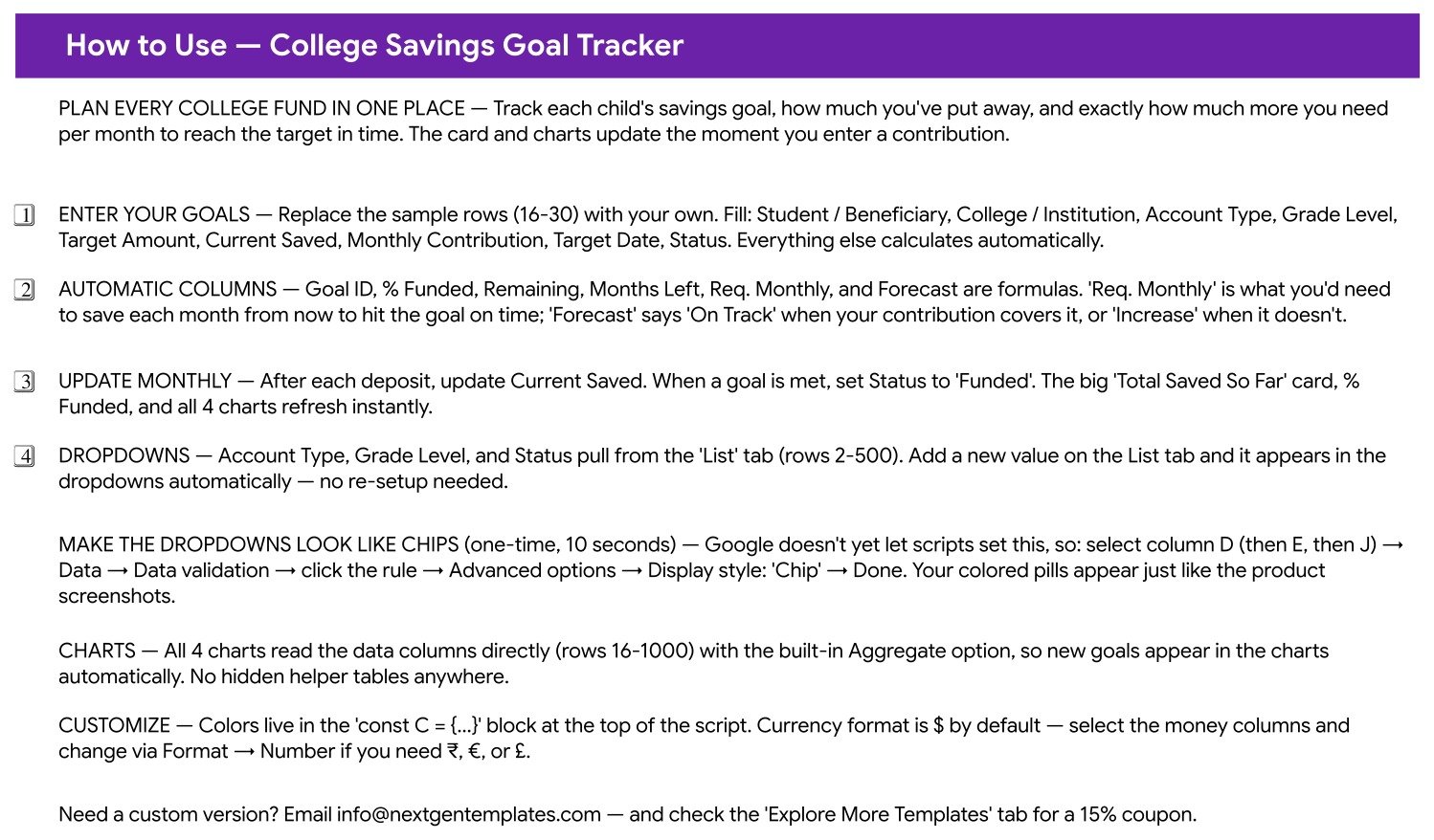
A short in-file guide covering four numbered steps – enter your goals, understand the automatic columns, update monthly, and extend the dropdowns – plus three notes on chips, charts and customisation. It also explains the one manual flourish Google Apps Script cannot set: switching the Account Type, Grade Level and Status data validation rules to Chip display style, which takes about ten seconds per column.
Page 3: Explore More Templates
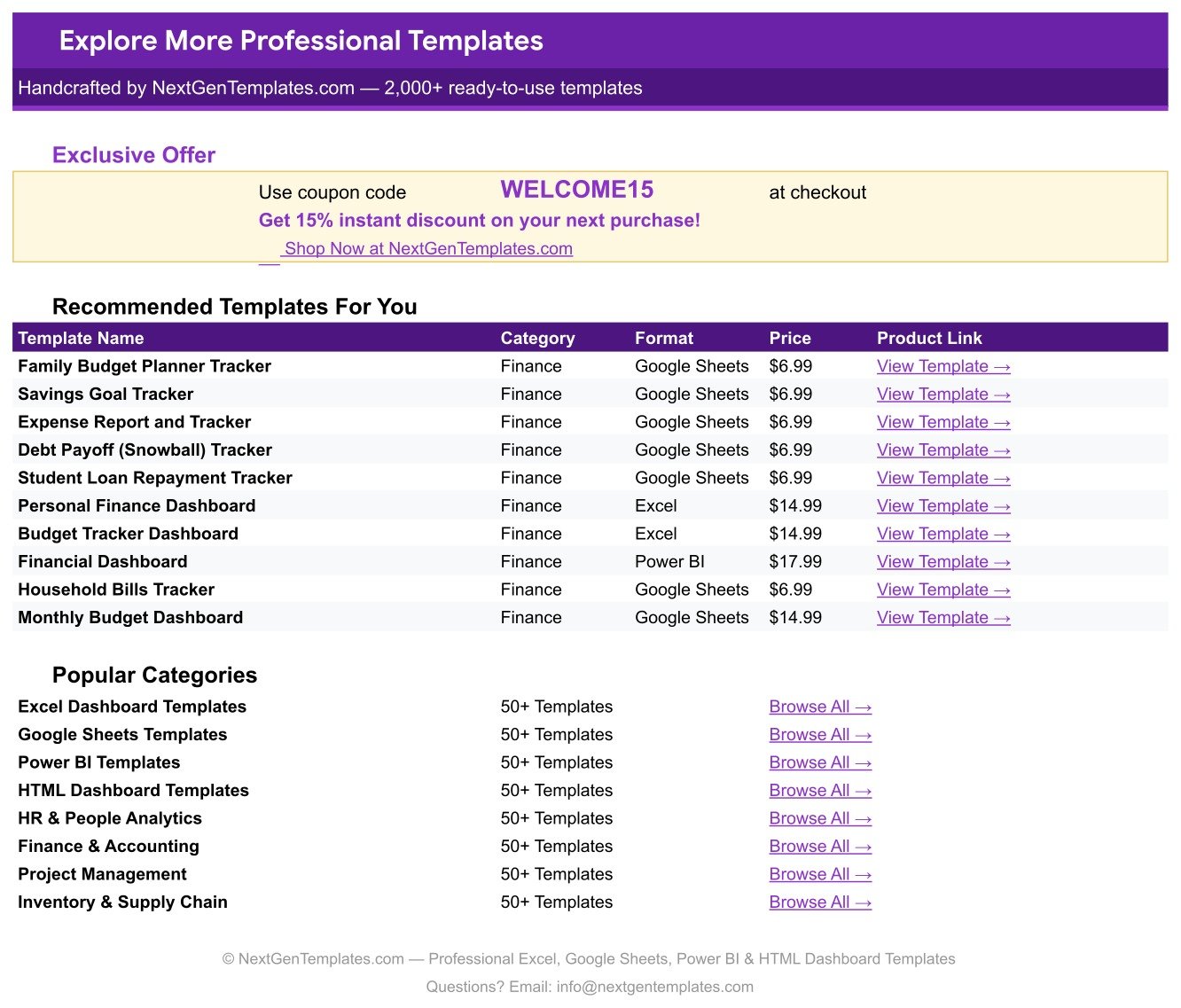
Ten hand-picked finance templates with their categories, formats, prices and direct product links, a set of category shortcuts, and a WELCOME15 coupon for 15% off the next purchase.
College Savings Goal Tracker vs. a Microsoft Excel Workbook vs. Paid Savings Apps – Feature Comparison
| Feature | College Savings Goal Tracker in Google Sheets | Microsoft Excel workbook | Monarch Money / Empower / YNAB |
|---|---|---|---|
| Cost | $6.99 one-time ✅ | $8.25 / user / month for Microsoft 365 | $8.99-$14.99 / month |
| Platform | Google Sheets, browser or mobile app ✅ | Desktop Excel, one file per person | Vendor web app |
| Setup time | Under 10 minutes ✅ | Hours if you build the formulas yourself | 30-60 minutes plus bank linking |
| Real-time collaboration with a partner | Yes, both edit at once ✅ | Only via OneDrive co-authoring | Extra seat or a shared login |
| Mobile access | Free Google Sheets app ✅ | Excel mobile, subscription required | Yes |
| Per-child goal with its own target date | Yes, one row per beneficiary ✅ | Manual to build | Rarely modelled per child |
| 529 / ESA / UTMA account-type breakdown | Built in, 8 account types ✅ | Manual | Aggregated, not goal-level |
| Bank credentials required | None ✅ | None | Yes, account linking |
| Year-1 cost at 5 users | $6.99 total ✅ | $495 | $540-$900 |
For families that want a clear, shareable college-funding plan without handing a budgeting app their bank logins, the College Savings Goal Tracker sits in the sweet spot.
Who Should Use This Template
Perfect for:
- Parents saving for one to ten children across 529 plans, ESAs, custodial accounts or high-yield savings
- Grandparents and guardians who contribute and want to see progress without asking for a statement
- Couples who want one shared sheet instead of two divergent spreadsheets
- Financial coaches and fee-only planners who need a simple client-facing college-funding worksheet
- Anyone mixing account types and needing a single number for total savings across all of them
Not a fit if:
- You want automatic bank or brokerage syncing – balances here are typed in, usually monthly
- You need investment return modelling with growth assumptions, rebalancing or tax-lot tracking
- You are an advisory firm needing audit trails, permissions and compliance archiving at scale
Real-World Use Cases
Priya and Dev, two children eight years apart. Their elder daughter’s $120,000 private-college goal is 99% funded with a 2026 target date; the toddler’s 529 sits at 11% with 155 months left. The Target vs Saved chart makes the imbalance obvious at a glance, so the month the first goal flips to Funded they move that $500 monthly contribution onto the younger child’s row and watch Req. Monthly drop.
Marcus, a grandparent funding a Coverdell ESA. He does not run the family budget, so he holds a view-only link. Twice a year he opens the Amount Saved by Student chart, compares his grandchild’s bar against the others, and decides whether this year’s gift needs to be larger.
Elena, an education-funding coach. She duplicates the tracker for each household she works with, enters the target amount and date, and runs the entire conversation off the Req. Monthly column. No licence, no onboarding, no client seat to pay for.
Advantages of the College Savings Goal Tracker
It converts a vague worry into a monthly number. Req. Monthly is the single most useful output in the file: Remaining divided by Months Left. It turns “we should save more for college” into “we need $1,591 a month for Emma”.
It costs $6.99 once. A budgeting app at $12 a month costs $144 a year, and $2,592 over the eighteen years you would actually be saving for a newborn. This tracker costs less than one month of that, forever.
It scales without maintenance. Because the charts read rows 16 to 1000 directly and the dropdowns read the List tab to row 500, adding a fourth child or a ninth account type takes no configuration at all.
It keeps your data yours. Nothing is linked to a bank. The file lives in your own Google Drive, shared with exactly the people you choose.
Opportunities for Improvement
Honesty helps here. The tracker does not model investment growth – Req. Monthly assumes straight-line saving, so if your 529 is invested in an age-based portfolio the real required contribution will be lower than the sheet suggests. It also has no contribution history: you overwrite Current Saved rather than logging each deposit, so there is no month-by-month trend line. And the chip display style for the three dropdown columns has to be switched on by hand once, because Apps Script cannot set it yet.
None of these break the tracker for its intended job, but if you need growth projections or a deposit ledger you will want to add a second tab of your own.
Best Practices
- Update on payday, not at year end. One pass a month keeps the Forecast column meaningful.
- Set realistic target dates. Use the August of the year the child starts, not their graduation year.
- Use the Notes column. “Ambitious goal – raising contribution” is worth more in six months than a number you cannot explain.
- Add your own statuses. Scholarship Pending or Grandparent Funded on the List tab, and the dropdown picks them up.
- Check the tax rules for your state. Contribution limits and deductions vary; the IRS guidance on 529 plans is the place to start before you set a target.
- Share, do not email. Give your partner edit access from Drive so there is only ever one version.
Explore Relevant Templates
College savings rarely sits alone. The Retirement Savings Tracker in Google Sheets applies the same goal-and-forecast logic to your own retirement, and the Student Loan Repayment Tracker in Google Sheets takes over on the far side of graduation.
To find the monthly contribution in the first place, start with the Annual Family Budget Tracker in Google Sheets or the Cash Envelope Budget Tracker. For the wider picture, the Personal Finance Net Worth Tracker rolls every asset into one figure, and the Kids Allowance and Chores Money Tracker teaches the children the habit while you build the fund.
You may also like our recent write-ups on the Annual Family Budget Tracker, the Bank Account Balance Tracker and the Cash Envelope Budget Tracker.
Want to build skills like this step by step? The NextGenTemplates Academy learning paths walk you through the spreadsheet side of tracking goals, with practice files.
Get the College Savings Goal Tracker in Google Sheets
Frequently Asked QuestionsCollege Savings Goal Tracker in Google Sheets
What does the College Savings Goal Tracker calculate for me?
The College Savings Goal Tracker calculates six values per child: Goal ID, % Funded, Remaining, Months Left, Req. Monthly and Forecast. Req. Monthly is the amount you must save every month from today to reach the Target Amount by the Target Date.
Which college savings account types does it support?
Eight ship in the dropdown: 529 College Plan, Coverdell ESA, Custodial UTMA/UGMA, Prepaid Tuition Plan, Roth IRA, High-Yield Savings, Brokerage Account and U.S. Savings Bond. Add more on the List tab and the College Savings Goal Tracker picks them up automatically.
How long does setup take?
Under 10 minutes. Copy the sheet from the link inside the PDF, delete the 15 sample rows, and enter your own goals. The College Savings Goal Tracker uses no named ranges, no pivot tables and no scripts you need to configure.
How does this compare to Monarch Money or Empower?
Those apps aggregate accounts but seldom model a per-child target date and required monthly contribution. The College Savings Goal Tracker costs $6.99 once rather than $8.99 to $14.99 a month, and no bank credentials ever leave your own Google account.College Savings Goal Tracker in Google Sheets
Do the charts update when I add another child?
Yes. Every chart in the College Savings Goal Tracker reads rows 16 to 1000 of the data columns with the built-in Aggregate option, so a goal typed on row 31 appears in all four charts without any range editing.
Can I use a currency College Savings Goal Tracker in Google Sheetsother than dollars?
Yes. Select the money columns and use Format then Number to switch to rupees, euros or pounds. Every formula in the College Savings Goal Tracker is currency-agnostic.
Can my partner and I edit it at the same time?
Yes. Share the file from Google Drive and you can both edit simultaneously on desktop or in the free mobile app, with no extra seat fee and no merge conflicts.College Savings Goal Tracker in Google Sheets
About the Author
Built by PK – Microsoft Certified Professional with 15+ years of Excel, Google Sheets, and Power BI experience. Founder of NextGenTemplates, reaching 300K+ subscribers across YouTube channels. Every template is hand-built and tested before release.College Savings Goal Tracker in Google Sheets
Conclusion
The College Savings Goal Tracker in Google Sheets does one job properly: it tells you, per child, whether this month’s contribution is enough. Sixteen columns, six of them automatic, four charts that never need a helper table, and a Req. Monthly figure you can act on the same day you read it.
Instant download · One-time payment · No subscription
Last updated: August 2026College Savings Goal Tracker in Google Sheets