Most promoters do not lose money on the show. They lose it in the week afterwards, in the gap between the booking spreadsheet, the door list and the expense file – three documents that never quite agree, argued over with a co-promoter who has their own version. The Concert & Ticketing Management System Web App closes that gap. It is a finished Google Apps Script back office with 24 modules, 16 reports and 6 roles, running on a Google Sheets database inside your own Drive. Run setup once and it opens with a working promoter business already in it: 28 shows, 12 venues, 44 artists, 600 customers, 1,357 orders, 4,334 issued tickets, 2,896 gate scans, 284 cost entries and 18 settled statements – roughly 13,500 rows across 29 sheets. The calendar is anchored on the day you install it, so twenty shows sit behind you, one is playing tonight with the gate half scanned, and seven are ahead in the next ten weeks. Concert & Ticketing Management System Web App
Try the Live Demo before you read another word
This is the real system with the seeded book loaded. Sign in as the most restricted role and you will understand the product in about ten seconds.
| Role | Username | Password | What that sign-in reaches |
|---|---|---|---|
| Admin | admin | Concert@2026 | Everything, including User Management, List Management, Settings, the Audit Log and the database archive |
| Promoter / Owner | promoter | Promote@2026 | Every operational module, approvals, margins and all 16 reports. No database archive |
| Event Manager | events | Events@2026 | Venues, artists, events, lineups, ticket types, campaigns, the crew roster and the gate |
| Box Office | boxoffice | BoxOffice@2026 | Customers, orders, the ticket register, payments, refunds and gate check-in |
| Box Office (second seat) | boxoffice2 | BoxOffice@2026 | The same rights – proves two people can work the window at the same time |
| Gate & Operations | gate | GateOps@2026 | The door only – check-in, ticket register, show list, roster, documents. Money is stripped on the server |
| Gate & Operations (second seat) | gate2 | GateOps@2026 | The same door-only rights – use it to test a second scan terminal |
| Finance | finance | Finance@2026 | Payments, refunds, expenses, settlements, sponsorships, customers and every money report |
Sign in as gate and then as finance. The sidebar changes and every money column disappears – that is the permission map doing its job. These credentials belong to a shared demo copy that is reset periodically; buying the system installs a private copy in your own Google account, with passwords only you know.
Key Features of the Concert & Ticketing Management System Web App
Four rules hold the whole product together, and the Help page states them plainly rather than hiding them in documentation.
- The event is the spine. A venue booking, a lineup, ticket types, orders, tickets, scans, costs, sponsorship, campaigns, the crew roster and the settlement all hang off one show row. Nothing exists on its own, which is exactly why the three-spreadsheet problem cannot come back.
- A ticket needs an order, and an order needs a show that is On Sale. Availability on a ticket type is computed from the zone allocation, never typed, and the server refuses an order that would exceed it. Overselling is not a warning here; it is impossible.
- A ticket scans once. A second scan of the same barcode is written to the gate log as a duplicate and refused. A refunded or cancelled ticket is refused at the door too.
- A show is settled only after it is completed. The statement takes gross ticket revenue minus refunds, adds sponsorship, subtracts artist fees, venue, production, marketing, staff and other cost, then splits the net between the house and the co-promoter at the agreed share.
Around those rules sit a nine-stage event pipeline (Planned, Contracted, Announced, On Sale, Sold Out, Completed, Settled, with Postponed and Cancelled as the exits), six roles enforced twice – once to build the sidebar and again by a guard on every server endpoint – and 36 editable dropdown lists holding 216 values, all changed from List Management without touching code. Every list screen carries column filters, a search box, CSV and Excel export, and a print path: e-tickets on a 3 inch or 4 inch thermal roll, receipts, refund notes, settlement statements, day sheets and reports on A4. Concert & Ticketing Management System Web App
Every Screen in the Concert & Ticketing Management System, Explained
Dashboard
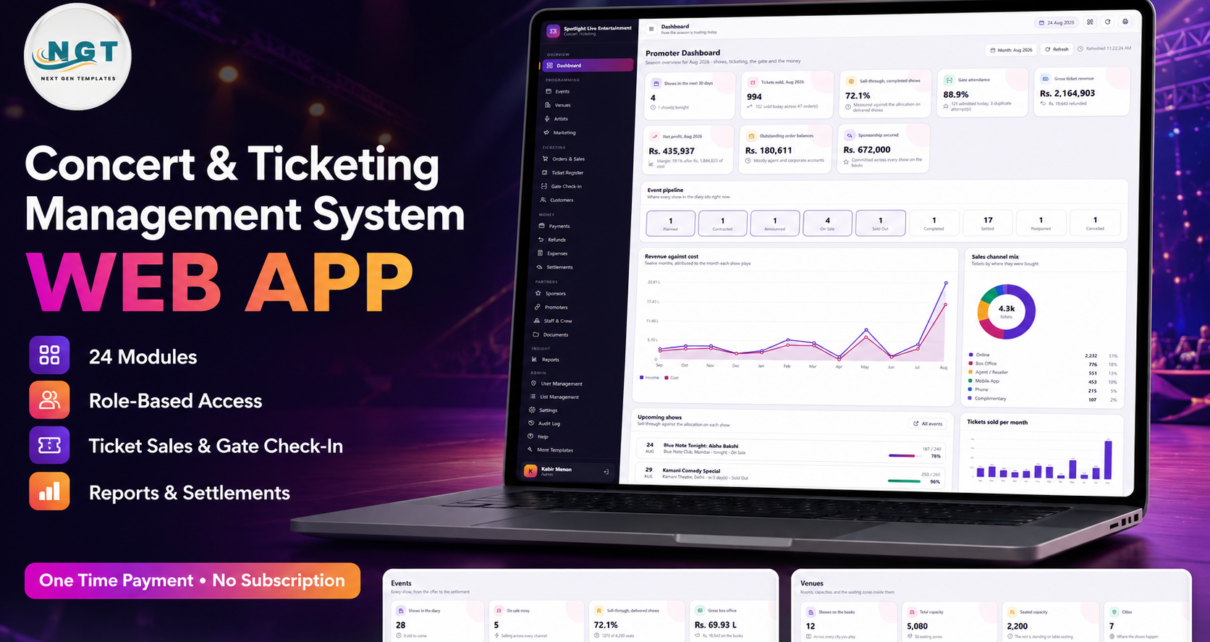
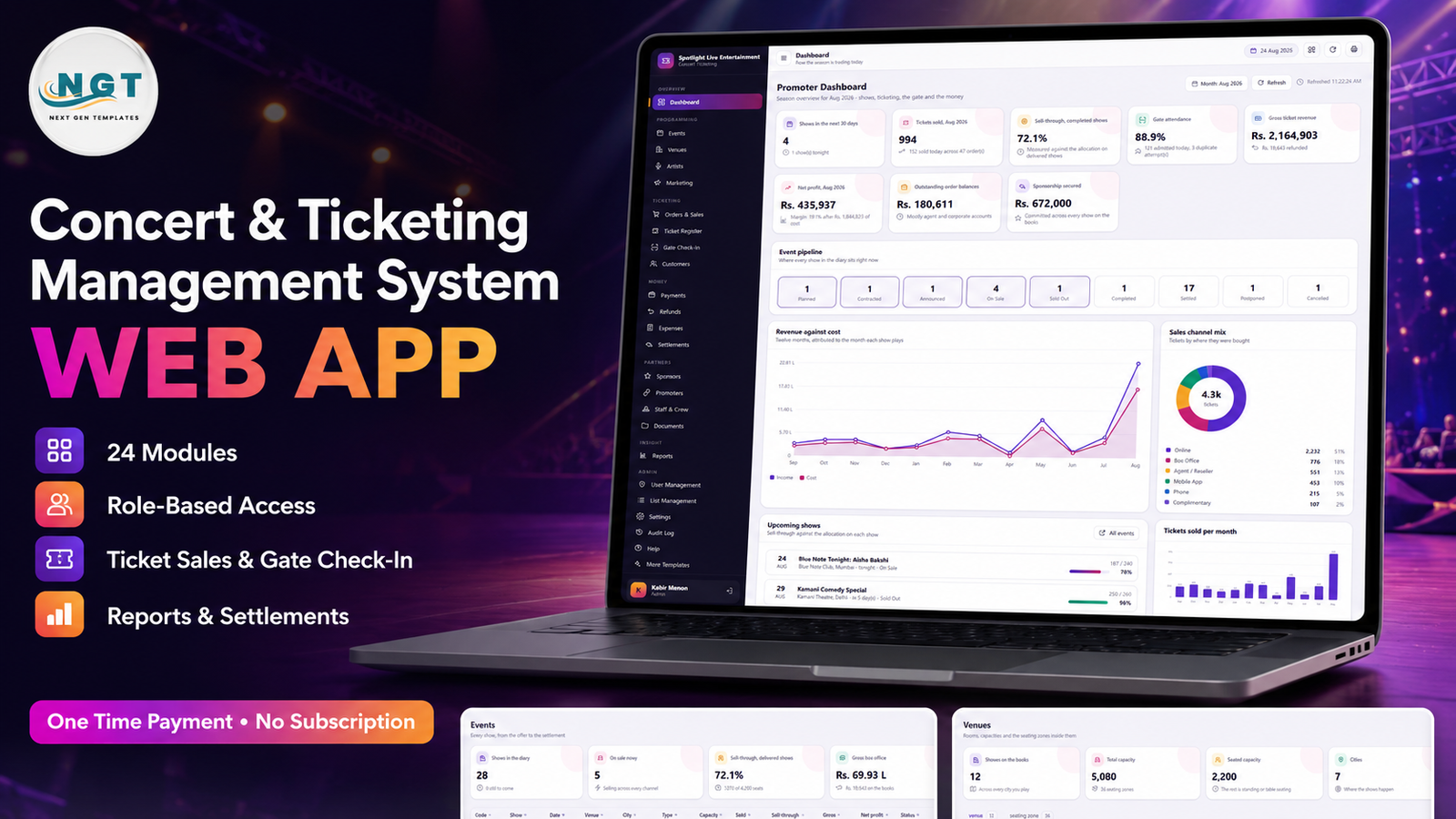
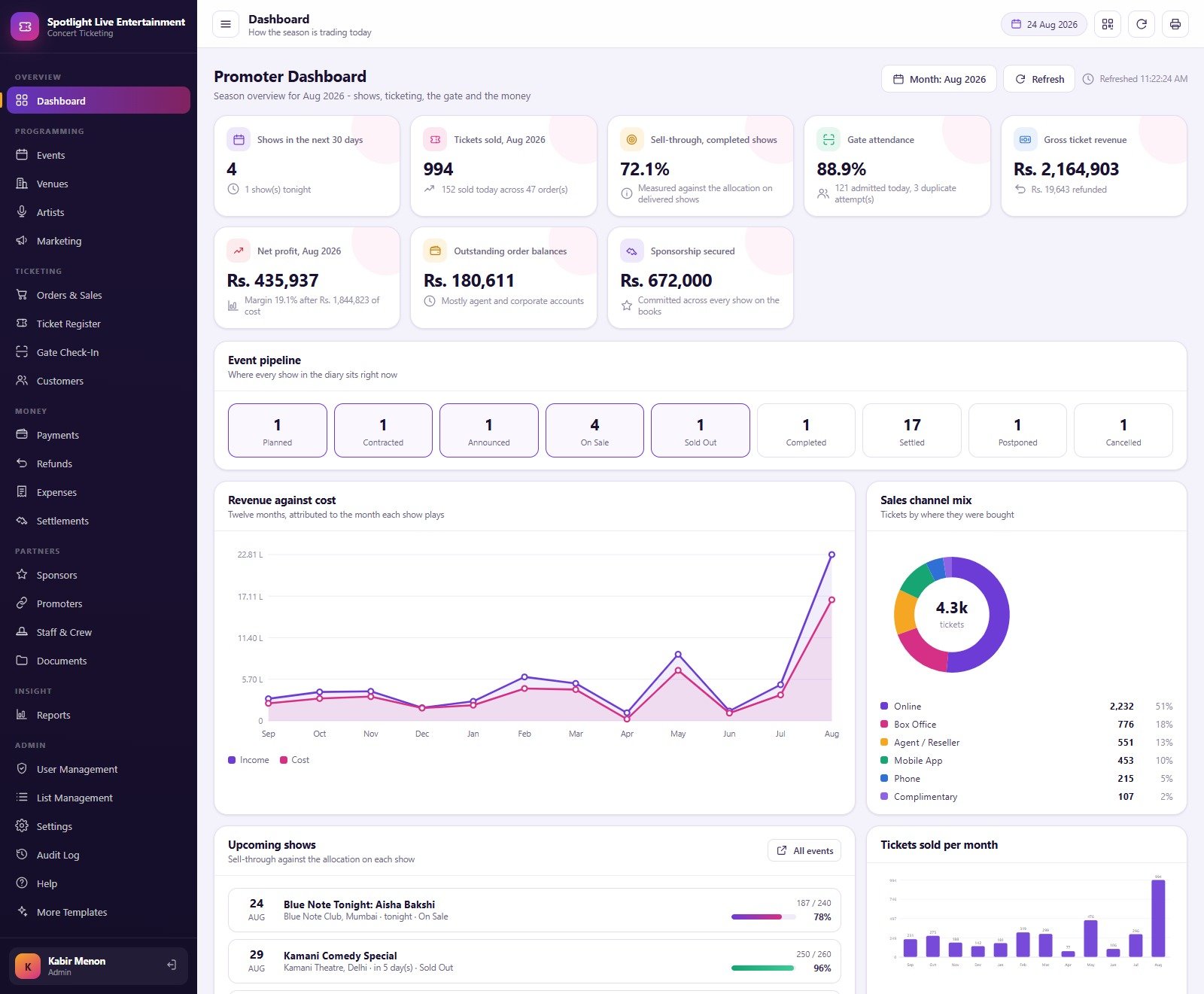
Eight KPI cards read the season: shows in the next 30 days, tickets sold this month, sell-through on completed shows, gate attendance, gross ticket revenue, net profit, outstanding order balances and sponsorship secured. In the seeded book that reads 4 shows ahead, 994 tickets sold, 72.1% sell-through, 88.9% gate attendance and a 19.1% margin. Below them the event pipeline strip counts every show by stage, then four charts: Revenue against cost over twelve months, a Sales channel mix donut (Online 51%, Box Office 18%, Agent/Reseller 13%, Mobile App 10%, Phone 5%, Complimentary 2% of 4.3k tickets), Tickets sold per month, and an Upcoming shows list with a sell-through bar per date.
Events, Venues and Artists
The Events register lists code, show, date, venue, city, type, capacity, sold, sell-through, gross, net profit and status in one row, so a 900-seat arena lawn sitting at 0% and a 240-cap club at 78% are visible in the same glance. Venues carry 12 rooms and 36 seating zones with hire charge and house share per venue. Artists holds 44 acts across 12 genres with act type, standard fee, fee type (flat, revenue share or flat plus percentage), draw rating and last show played.
Orders, Ticket Register and the Gate
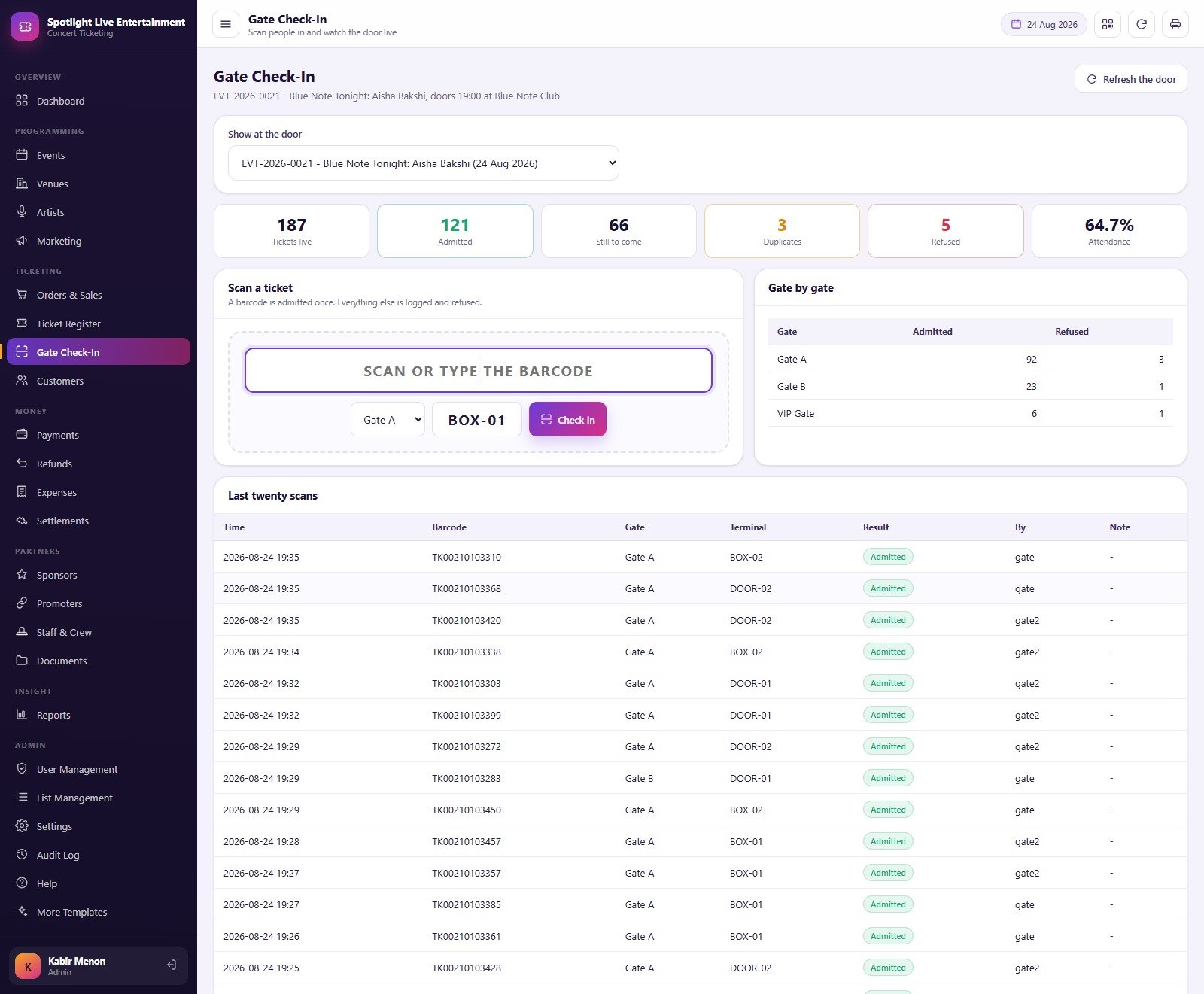
Orders & Sales records face value, discount, booking fee, tax, total, paid and balance per order, tagged by channel. The Ticket Register carries every issued barcode with its show, order, ticket type, zone, seat label, holder, status, when it was scanned and at which gate. Gate Check-In is the screen that earns the product: pick the show at the door, scan into one box, and the counters move – 187 tickets live, 121 admitted, 66 still to come, 3 duplicate attempts, 5 refusals, 64.7% attendance – beside a gate-by-gate table and the last twenty scans with the operator’s name.
Money
Payments logs each receipt with mode, reference, channel and who took it. Refunds & Cancellations records tickets returned to the allocation, the amount, the fee retained and the reason from a controlled list. Expenses spreads 284 cost entries across 14 categories with an approval step, so nothing unapproved reaches a settlement. Settlements produces one statement per completed show with income, cost, net profit, partner share and house share.
Partners, Insight and Admin
Sponsors holds 18 companies and 27 deals with committed and received amounts; Promoters tracks 12 partners, their share percentage and what has actually been paid to them; Staff & Crew carries 40 people across 10 roles and 142 rostered shifts; Documents files 72 contracts, stage plans, licences and insurance certificates in Drive against the record they belong to. Reports offers 16 reports in five groups – Events, Ticketing, Money, Operations and Audience – filterable by date, show, venue, status, channel and cost category. Admin adds User Management with a Roles & Permissions editor, List Management, ten Settings tabs and an Audit Log that had already captured 121 entries by first sign-in.
Concert Ticketing Web App vs. a Spreadsheet vs. Paid Ticketing SaaS – Feature Comparison
| This Web App | Plain spreadsheet | Paid ticketing SaaS | |
|---|---|---|---|
| Cost | One payment, no subscription | Free | Monthly fee, often plus a cut of every ticket |
| Platform | Apps Script web app on your own Google Sheets database | Google Sheets or Excel | Vendor cloud |
| Setup time | About 15 minutes | Days to build, months to patch | Onboarding, then a contract |
| Real-time team collaboration | Yes, with named accounts and roles | Yes, with no permission control | Yes |
| Mobile access | Yes – one URL in any browser | Awkward on a phone | Yes |
| Customisable fields and code | Full source, edit anything | Total freedom, no structure | Only what the vendor exposes |
| Share with a link | Yes – one deployment URL | Yes, but everyone sees everything | Yes |
| Year-1 cost at 5 users | The purchase price, once | Free, plus your own build time | Typically four figures, plus per-ticket fees |
| Overselling protection | Computed from the allocation, refused server-side | None – a typed number drifts | Yes |
| Co-promoter settlement | Built in, with the split on the statement | Hand-built each time | Sometimes, at a higher tier |
| Your data stays in your Drive | Yes | Yes | No |
Who Should Use This Template
Independent promoters running twenty to sixty shows a year; club, theatre and amphitheatre operators who sell their own tickets; comedy and festival producers who co-promote and need a settlement both sides accept; and box-office teams currently reconciling a booking sheet, a door list and an expense file by hand. It suits an operation where staff enter the orders – agents, resellers, the window, the phone – rather than one that needs the public to buy on a website.
It is honestly wrong for you if you need a public-facing ticket store that charges the audience’s card. This is the back office behind that. It records payments; it does not process them, holds no card data and is not a payment gateway or a PCI-DSS environment. It is not a ticketing marketplace, it does not connect to turnstiles, RFID wristbands, printers with SDKs or any access-control hardware, and it confers no entertainment licence, venue-safety certification, crowd-management approval or tax compliance. It files no GST, e-invoice or e-way bill, and it is not accounting software.
Real-World Use Cases
The promoter watching two shows in one month. A 900-capacity arena lawn is Announced at 0% sold; a 240-cap club is On Sale at 78%. Both sit in the same Events row set with gross and net profit beside them, and the Marketing screen – 55 campaigns, 9 channels, Rs. 6.89 L spend, 1,770 tickets attributed, blended ROAS 4.19 – says which channel moved the last hundred seats. Budget shifts on evidence rather than instinct.
The door host on a sold-out comedy night. Signed in as gate on a tablet, they scan into one box. Duplicates and refunded barcodes bounce with a reason and are logged. The gate-by-gate table showing Gate A at 92 admits against Gate B at 23 is enough to move an usher. They see no price on any screen, because the server removed the money before the page ever loaded.
The finance lead closing a co-promoted festival. The show is Completed, so the settlement can be prepared: gross ticket revenue minus refunds, plus committed sponsorship, minus artist fee, venue hire, production, marketing and crew, split with the partner at their agreed percentage. It prints on A4, and the partner’s running total updates on the Promoters screen where they can see it themselves.
Advantages of the Concert & Ticketing Management System Web App
- It arrives working. The seeded book means you are auditing a running business on day one instead of staring at empty tables and wondering whether the design holds.
- The rules are server-side. Availability, the single-scan gate and the money stripping are all enforced on the server, so a curious member of staff with browser dev tools reaches nothing.
- No per-ticket economics. Selling four thousand tickets costs you exactly what selling four hundred costs: nothing beyond the one-time price.
- It is yours to change. Two text files of Apps Script. Add a field, change the settlement formula, rename a module – see Google’s own Apps Script web apps guide if you want to understand the deployment model first.
- The audit trail is real. Every create, change, approval, payment, refund, scan exception, settlement, permission change and sign-in is written to the Audit Log with the user, the role and the record.
Opportunities for Improvement
Two things worth knowing before you buy, found by going through all 25 screens rather than reading the feature list.
- The Ticket Register’s summary cards are scoped to the rows on screen, not the whole book. With the 400 most recent issues loaded they read 0 checked in and 400 still valid, which looks alarming next to a gate screen reporting 121 admitted tonight. Both are correct – the most recent tickets are for shows that have not happened yet – but a “of all 4,334 tickets” line would remove the ambiguity. Filter by show and the numbers behave as expected.
- One cosmetic clip on the More Templates page. The three small feature cards on that upsell screen cut the first character or two off their body text. It is a styling overflow on that card only; no operational screen is affected, and it is a one-line CSS fix if it bothers you.
- There is no public booking page, and the gate takes a barcode typed or scanned into a text field rather than talking to hardware. Reserved seating is by seat label such as ST-07-04, not a graphical seat picker. If any of those are a requirement, this is not the product.
- The seeded demo is an Indian promoter, so the sample figures are in Rupees and lakh. Change the currency symbol, tax percent and booking fee in Settings > Financial and every screen follows; none of the demo money is a forecast of what your shows will earn.
Best Practices
- Change all eight passwords on day one under User Management > Users, and delete the seeded accounts you will not use.
- Set Settings before you load data – Company, Financial, Ticketing, Gate and Printing. Later screens read those values at run time.
- Load venues and their seating zones first. Ticket type availability is computed from the zone allocation, so a venue with no zones cannot sell properly.
- Keep the Gate role money-free. It is the single best demonstration of the permission model, and the reason a casual door host can be given a login at all.
- Approve expenses as they arrive, not at settlement time. Anything left Pending is a statement you cannot close.
- Run one show end to end on the demo data – create, lineup, ticket types, On Sale, orders, scans, costs, Completed, Settled – before you clear the demo transactions and go live.
- Use createBackupCopy() before any bulk edit, and use the archive rather than deleting closed shows. Master tables never move, and customer lifetime spend is carried forward before anything leaves.
Explore Relevant Templates
- Concert & Ticketing Management System Web App – the system described in this post.
- Amusement Park Ticketing Management System Web App – the same gate-and-ticket engine for a gated attraction.
- Bowling Alley Management System Web App – front-desk POS and bookings for a venue that sells time rather than seats.
- Cafeteria and Canteen Management System Web App – if you also run the concessions inside the room.
- Courier & Parcel Delivery Management System Web App – a newer sibling built on the same Apps Script foundation.
- Concert Promoters Dashboard in Power BI and Music and Performing Arts Dashboard in Google Sheets – reporting only, if you already have a ticketing platform.
- Event Success Tracking Dashboard in Google Sheets – a lighter, cheaper starting point.
- Or browse the whole Mini Web Apps catalogue.
Frequently Asked Questions
Can I try it before buying?
Yes – the live demo above is the real system with the seeded book loaded, and every role’s password is listed. Sign in as gate, the most restricted role, and the point of the product is obvious immediately. Those credentials are for a shared demo copy that resets; buying gives you a private deployment in your own Google account.
Does it charge my customers’ cards?
No. It records a payment against an order – amount, mode, reference, channel and who took it – so your books balance. It is not a payment gateway, holds no card data and is not a PCI-DSS environment.
How long does installation take?
About fifteen minutes. Paste two files into a new Apps Script project, run setup once, deploy as a web app with access set to Anyone, and sign in. Setup is staged and resumable, so Google’s six-minute execution limit cannot break it, and running it again is always safe.
Can I change what a role can reach?
Yes, under User Management > Roles & Permissions – each module, the action rights (Create, Edit, Delete, Export, Approve) and a “this role may see money” switch. Admin always holds every permission and cannot be reduced. Every change is written to the Audit Log.
Where is my data stored?
In a Google Sheets file in your own Drive, created by setup. Nothing is sent anywhere else, and passwords are stored only as a salted SHA-256 hash – the plain text never touches the spreadsheet.
What exactly do I download?
A ZIP holding Code.cs.txt, Index.txt and a user manual PDF. Two files to paste, one manual to read. There is a generic Apps Script deployment walkthrough at youtu.be/D26WifFCMm8 if you have never deployed one before.
Can two people work at once?
Yes. The seeded book ships eight accounts across six roles, including two box-office seats and two gate seats, precisely so you can test two people on the same screen before you commit.
About the Author
Built by PK – Microsoft Certified Professional with 15+ years of Excel, Google Sheets, and Power BI experience. Founder of NextGenTemplates, reaching 300K+ subscribers across YouTube channels. Every template is hand-built and tested before release.
Conclusion
The Concert & Ticketing Management System Web App is not a dashboard bolted onto a spreadsheet. It is a back office with rules: availability that cannot be typed over, a gate that admits a barcode once, and a settlement that reconciles gross, refunds, sponsorship and every cost into a number a co-promoter will sign. Twenty-four modules, sixteen reports, six roles, a seeded book of about 13,500 rows, and full source in two files that deploy in a quarter of an hour – for one payment, on a database that stays in your own Drive. Open the live demo, sign in as promoter, and go straight to Settlements. If that is the statement you wish you had after your last show, get the system here.