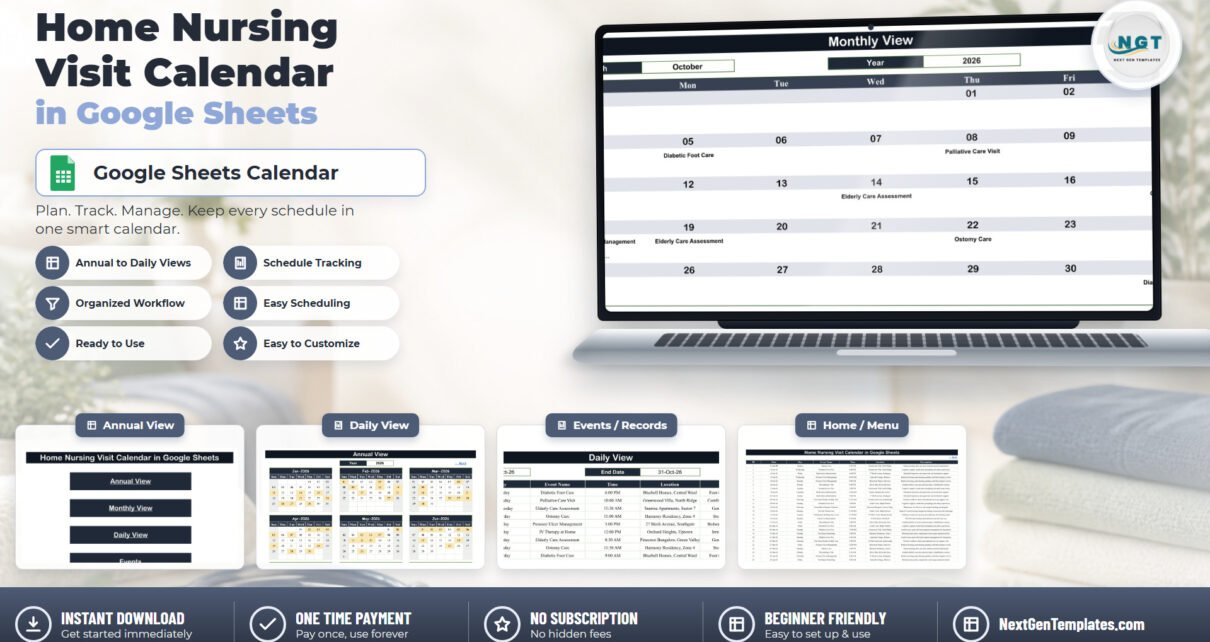
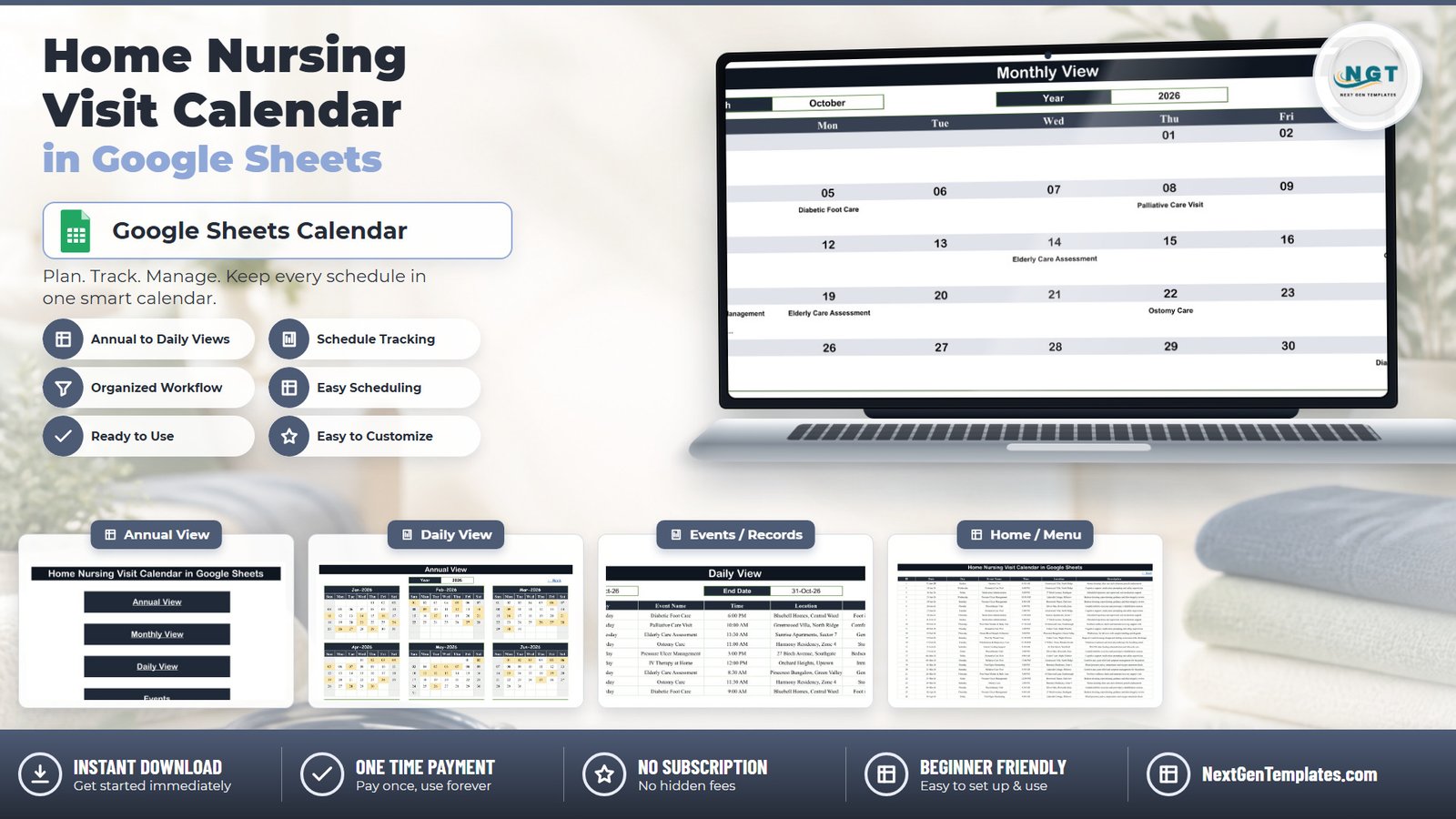
The Home Nursing Visit Calendar in Google Sheets is a ready-to-copy visit-scheduling workbook: six tabs, three linked calendar views, one master visit table, and 100 sample home-nursing visits already loaded across 2026 from 11 January to 27 December. Before release, all 100 rows were audited: every weekday label was recomputed from its date and 0 of the 100 were wrong, the IDs run 1 to 100 with no duplicates, and the dates are in strict ascending order. The sample year carries 8 or 9 visits a month, 16 distinct visit types and 15 locations, in half-hour slots between 7:30 AM and 6:00 PM.
Before anything else, the honest framing: this is a scheduling spreadsheet. It is not a patient record, not an EHR or EMR, not a care-planning or medication-management system, not electronic visit verification (EVV), and not a clinical governance tool. It provides none of those things. It makes no HIPAA, GDPR, CQC or Joint Commission compliance claim and it does not support statutory reporting. If you are looking for an auditable clinical record, close this tab; if you are looking for a shared diary that tells six carers where they are going on Thursday, read on.
Get the Home Nursing Visit Calendar in Google Sheets
Key Features of the Home Nursing Visit Calendar in Google Sheets
- Six tabs. Home, Annual View, Monthly View, Daily View and Events are visible; a sixth hidden tab called List holds the month names and the year list that feed the dropdowns.
- One master table, seven columns. Events holds ID, Date, Day, Event Name, Time, Location and Description. Every other tab is formula-driven from it, so a visit is typed once.
- 100 sample visits across 16 visit types – Ostomy Care (11), Pressure Ulcer Management (10), Post-Natal Mother & Baby Care (10), Medication Administration (9), Physiotherapy Visit (8), Post-Op Wound Care (8), Palliative Care Visit (7), Vital Signs Monitoring (7), Dementia Care Visit (6), IV Therapy at Home (6), Diabetic Foot Care (4), Home Blood Sample Collection (3), Nebulization & Respiratory Care (3), Enteral Feeding Support (3), Elderly Care Assessment (3) and Urinary Catheter Change (2).
- Automatic day shading. Annual View highlights every date that carries a visit, using conditional formatting driven by a hidden FILTER of the Events dates – so it repaints as soon as you add a row.
- Dropdown-driven navigation. A year picker on Annual View, month and year pickers on Monthly View, start and end date pickers on Daily View, and a Back link on each view that returns to the Home menu.
- Room for about 996 visits. Every view formula reads Events rows 4 to 999.
- No macros, no add-ons. A native Google Sheet that opens in any browser and can be shared with the whole team at once.
The Five Tabs, Explained
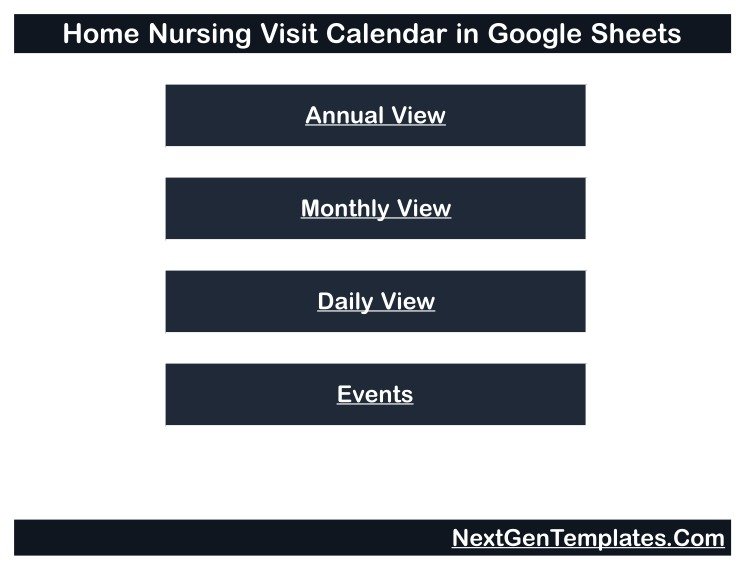
1. Home. A menu page and nothing else: the title bar and four buttons – Annual View, Monthly View, Daily View, Events. It exists so a care coordinator who never opens spreadsheets still knows where to click.
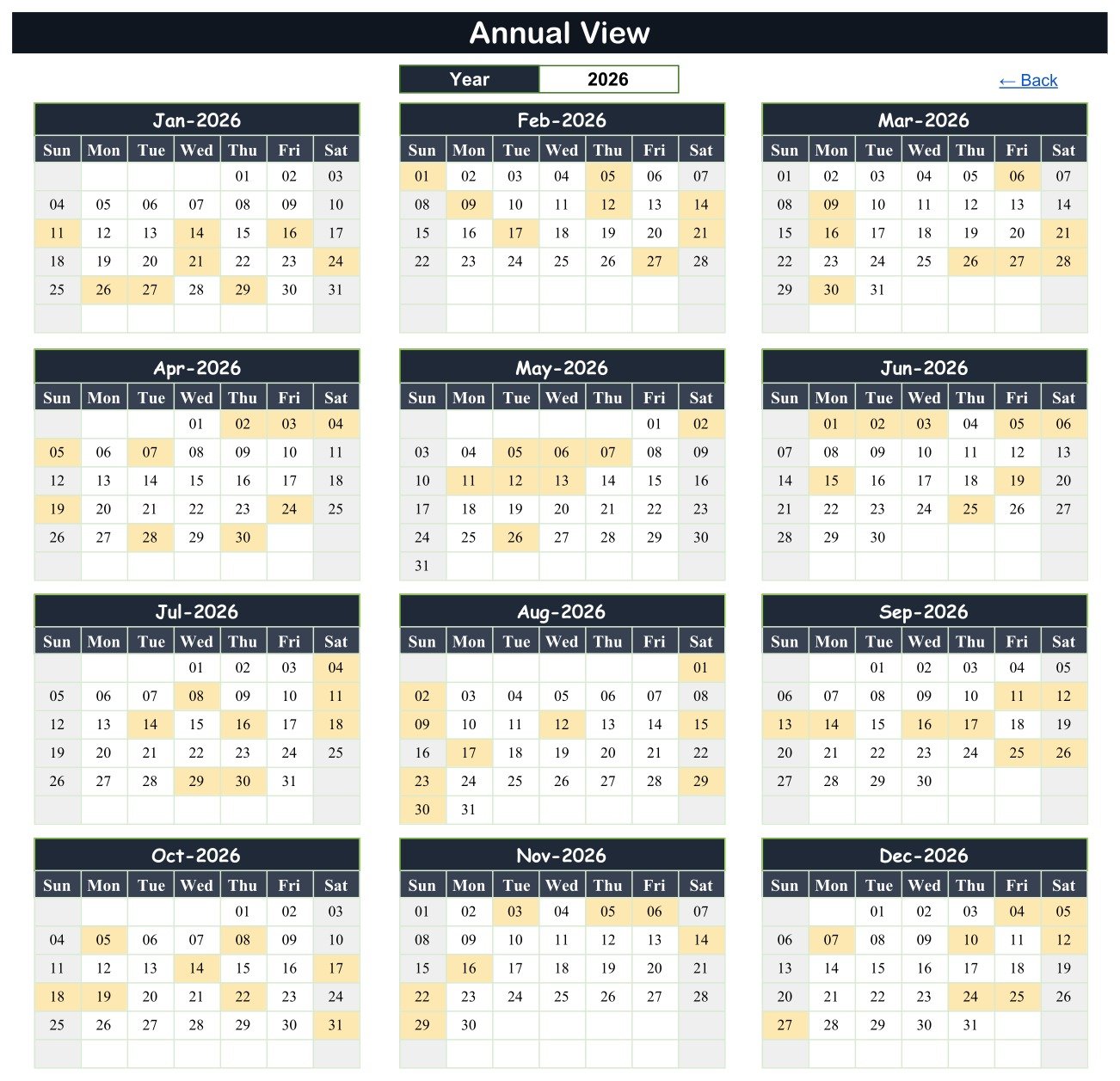
2. Annual View. Twelve month grids on one page, driven by a single year cell. Each grid is built from DATE and EOMONTH formulas rather than typed numbers, so month lengths and leap years look after themselves. In the 2026 sample the shaded days match the visit list exactly – 8 shaded days in January, 8 in February, 8 in March, 9 in April, and so on. This is the page to print for the office wall.
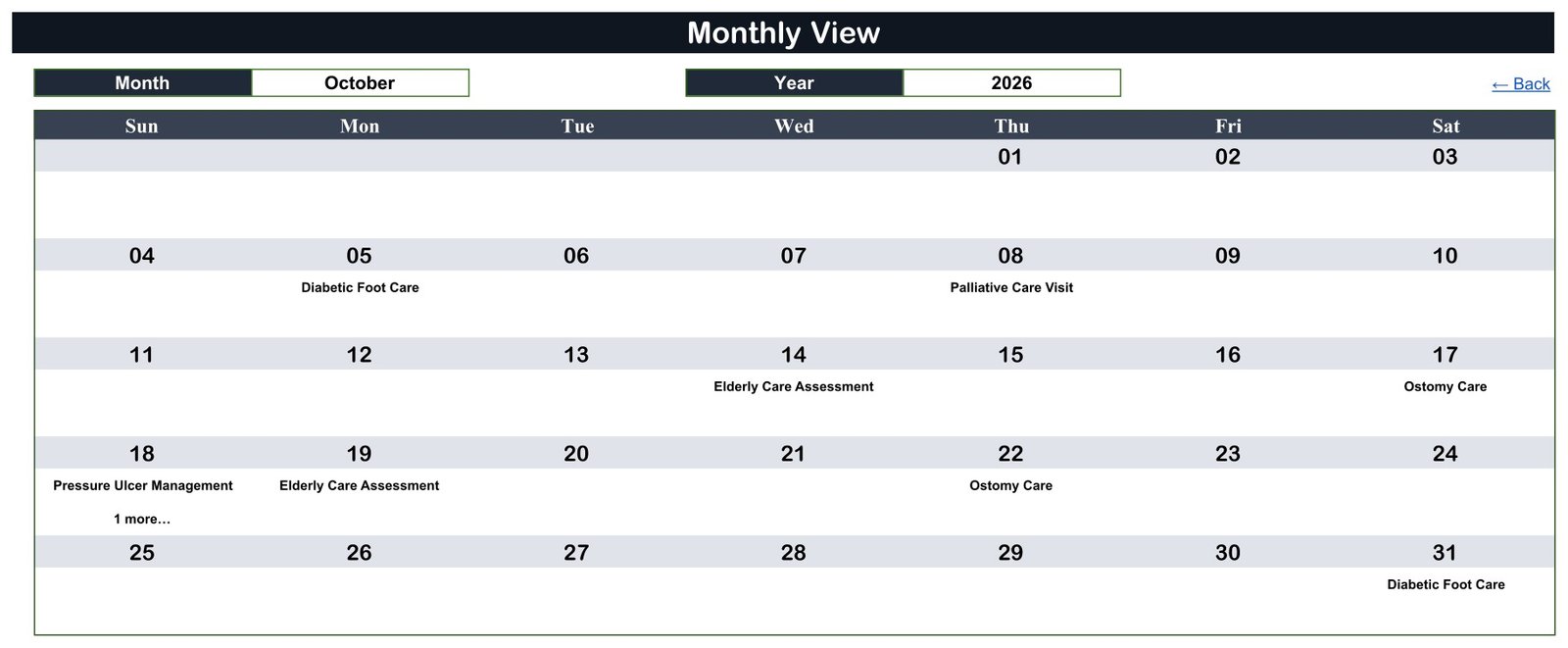
3. Monthly View. Pick a month and a year and the Sunday-to-Saturday grid rebuilds. Each day cell shows the visit title, pulled across with VLOOKUP against the Events dates. In the October 2026 sample you can read Diabetic Foot Care on Monday the 5th, Palliative Care Visit on Thursday the 8th, Elderly Care Assessment on Wednesday the 14th, Ostomy Care on Saturday the 17th, Pressure Ulcer Management plus a “1 more…” marker on Sunday the 18th, Ostomy Care on Thursday the 22nd and Diabetic Foot Care again on Saturday the 31st.
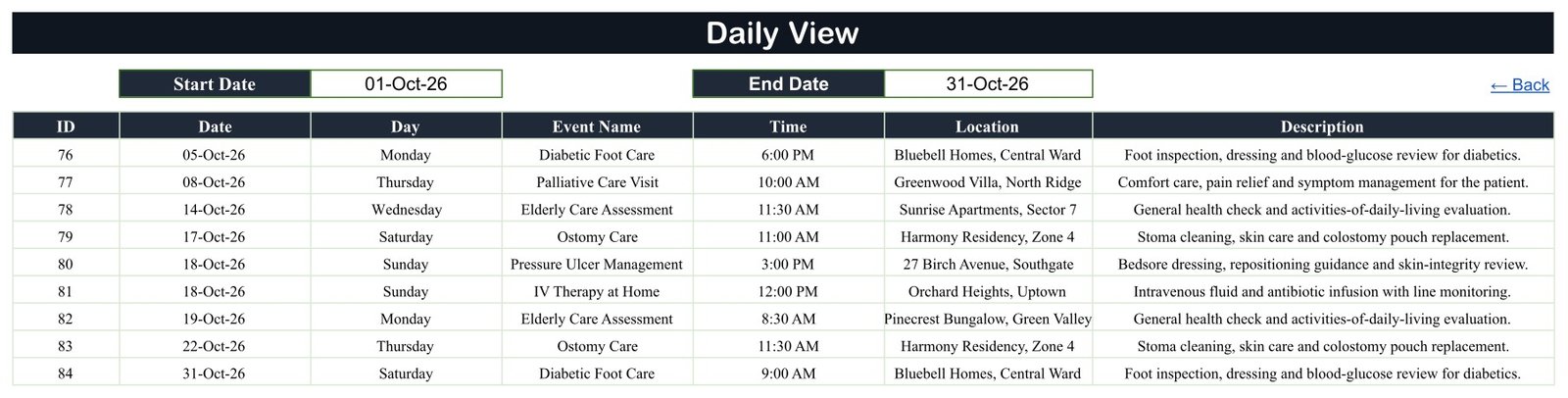
4. Daily View. Two date pickers and one FILTER formula over the Events table. Set 01-Oct-26 to 31-Oct-26 and you get the nine October visits in date order with ID, date, day, visit name, time, location and description. Narrow the range to a single day and it becomes a nurse’s run sheet you can print.
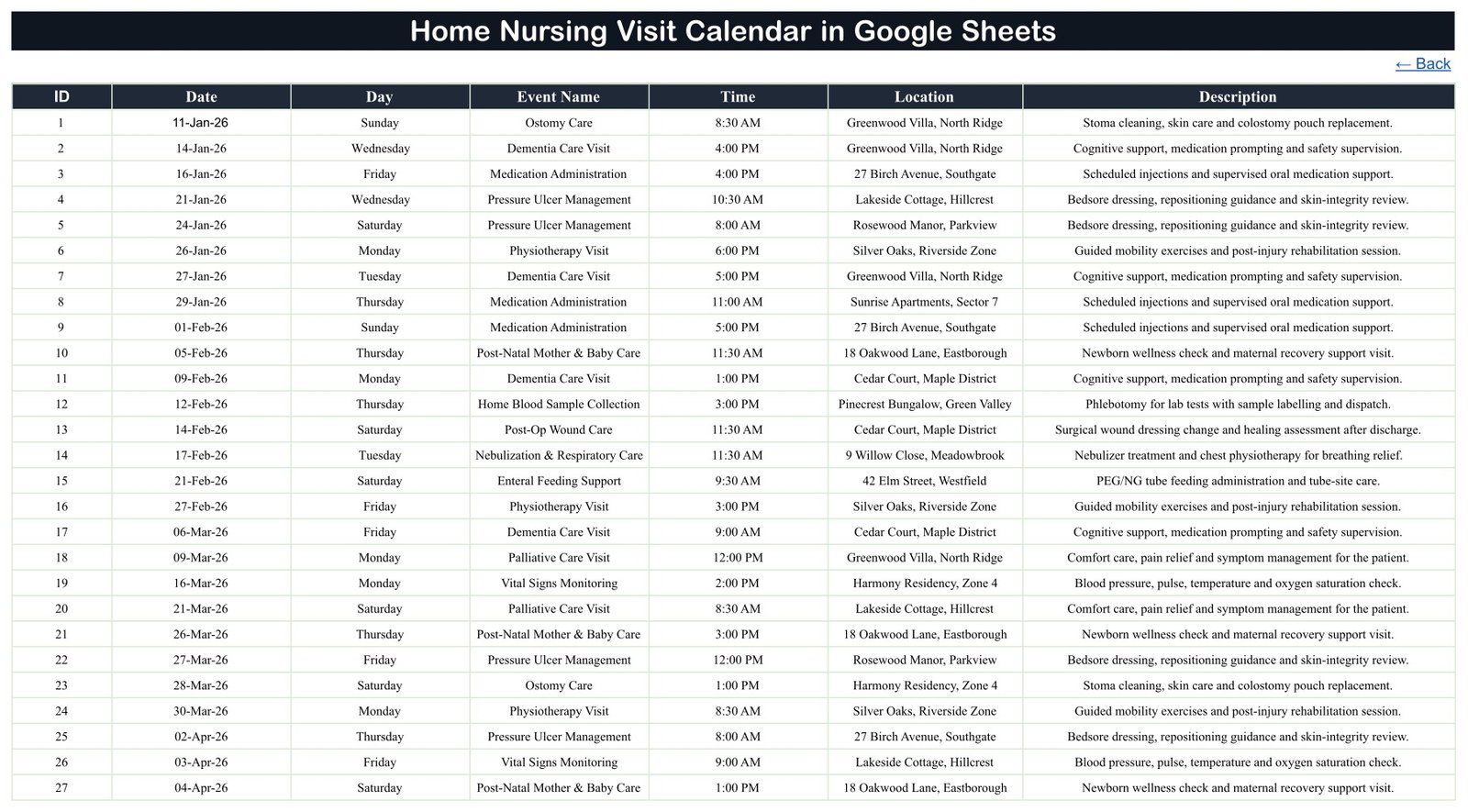
5. Events. The one tab you actually type into. Rows 4 to 103 hold the samples; the formulas reach to row 999.
What Is In the Data – and What Deliberately Is Not
A home-visit schedule deserves more care than most spreadsheets, because it implies two facts about a real person: where they live, and the hours at which somebody who is not well is alone in the house. So it is worth being precise about what this file contains.
There is no patient name column. Column by column, the Events table is ID, Date, Day, Event Name, Time, Location, Description. There is no patient ID, no NHS number or MRN, no phone number, no email address, no next-of-kin field, no diagnosis and no clinical value column anywhere in the workbook. As shipped, it identifies nobody.
The Location column does hold addresses. The samples are invented – “27 Birch Avenue, Southgate”, “9 Willow Close, Meadowbrook”, “42 Elm Street, Westfield” – alongside named residences such as “Greenwood Villa, North Ridge”. But that column is where a real home address will end up the moment you start using the file. Two habits are worth adopting on day one: put a client code in Location and Description rather than a name (HC-014 rather than a person’s name), and keep the address key in a separate, access-controlled document. Then share the sheet with named colleagues through Google’s own sharing controls rather than “anyone with the link” – a link handed to a family member or a contractor is a link to the whole file. Google documents the difference in its Share files from Google Drive help page.
Home Nursing Visit Calendar in Google Sheets vs. the Excel Edition vs. Paid Home-Care Software
| This template (Google Sheets) | Home Nursing Visit Calendar in Excel | Paid home-care software | |
|---|---|---|---|
| Cost | 4.99 once | 4.99 once | Per-carer per-month, quoted |
| Platform | Any browser | Excel on Windows, macros required | Web plus mobile app |
| Setup time | Under 10 minutes | Under 10 minutes | Weeks, with onboarding |
| Real-time collaboration | Yes, native | No | Yes |
| Mobile access | Sheets mobile app; grid is wide | No | Yes, purpose-built |
| Customizable fields | Yes | Yes, within the form | Vendor schema only |
| Share with link | Yes | No | Account-based |
| Data entry | Straight into the Events tab | Pop-up Add / Update / Delete form | Forms and mobile capture |
| Summary counts page | No | Yes – This Month page | Yes, full reporting |
| Colour themes | No | Yes, five one-click themes | Branding options |
| Reminders, EVV, records | None | None | Yes |
| Year-1 cost at 5 users | 4.99 | 4.99 | Typically four figures |
The two NextGenTemplates editions are not the same file twice. The Home Nursing Visit Calendar in Excel ships seven worksheets, an extra This Month page with counts, a pop-up entry form with Add, Update and Delete that fills the Day in for you, and five one-click colour themes – and it needs macros and a Windows desktop. This Google Sheets edition has six tabs, no summary page, no entry form and no themes – and it runs anywhere and can be open on five screens at once. Pick by working style, not by brand.
Who Should Use This Template
It suits a small home-nursing or domiciliary-care agency with roughly one to fifteen carers, a self-employed community nurse, a private-duty nursing practice, a palliative or post-operative home-visit service, and any clinic coordinator whose visit list currently lives in a paper diary or a chat group. It suits anyone who wants the schedule visible to a team without paying a per-seat monthly fee for software they use for one purpose.
It does not suit you if you need reminders, EVV, GPS check-in, mileage, staff assignment, rota rules, route optimisation, billing totals or clinical notes. Those are real requirements, and this template meets none of them.
Real-World Use Cases
A six-carer domiciliary agency. The coordinator keeps Events open in the office and shares the file with two colleagues. Every morning she sets Daily View to today and prints one sheet per round. Because it is one Google Sheet, a visit moved at 8am is visible to everyone without an email.
A self-employed community nurse. He works from Monthly View, sets the month each Monday, and uses the shaded Annual View to see which weeks in the quarter are already heavy before accepting new referrals.
A small private clinic’s discharge coordinator. She books wound-care and ostomy follow-ups into Events under client codes, then exports a date range from Daily View for the visiting nurse, keeping the address key inside the clinic’s own system.
Advantages of the Home Nursing Visit Calendar in Google Sheets
- Everyone sees the same schedule. No file versions, no “which one is current”.
- Nothing to install. No macros, no add-ons, no security prompt, no Windows requirement.
- One table, three views. Type a visit once and it appears on the year page, the month grid and the print list.
- Data-verified samples. The 100 supplied rows are internally consistent – dates, weekdays, IDs and monthly counts all agree – so you are learning from a working example rather than debugging one.
- It stores no patient identifiers, which makes it far easier to use responsibly than a template that invites you to type a name.
- It is cheap and it is yours. One payment, no subscription, and the copy lives in your own Drive.
Opportunities for Improvement
Four things we would change, stated plainly rather than buried:
- The Day column is typed text, not a formula. Change a Date and the Day beside it does not follow. The one-line fix is to put
=TEXT(B4,"dddd")in column C and fill it down. - Monthly View shows only the first visit on a day. A day with two visits reads the first title and then “1 more…”, so the grid stays one page wide. You have to open Daily View or Events to see the rest.
- Validation is thin. Only the Date column and the two Daily View date pickers are validated, plus the month and year dropdowns. Event Name, Time, Location and Description accept any text, so spelling drifts unless you are disciplined or add your own dropdown lists.
- There is no nurse or staff column. If two carers work the same day you cannot tell from the sheet who is going where without adding a column of your own.
Best Practices
- Use a client code in Location and Description, and hold the real address elsewhere.
- Share with named people, never “anyone with the link”, and review the share list monthly.
- Add your own dropdown lists (Data > Data validation) for Event Name and Location so the titles stay consistent across a year.
- Add the
=TEXT(B4,"dddd")Day formula before you enter real data, not after. - If you need a nurse column, insert it at the end of the Events table rather than in the middle, so the existing VLOOKUP and FILTER ranges keep working.
- Keep one file per year. A single sheet holding several years makes Annual View and the shading harder to read.
Explore Relevant Templates
- Home Nursing Visit Calendar in Excel – the companion edition, with the pop-up entry form and the This Month page.
- Nurse Duty Roster Calendar in Google Sheets – who is on shift, rather than which visit happens when.
- Patient Follow-Up Visit Calendar in Google Sheets – clinic-side follow-ups after discharge.
- Physiotherapy Session Calendar in Google Sheets – session scheduling for a rehab caseload.
- Medical Appointment Calendar in Google Sheets – the general-purpose clinic diary.
- Or browse the full Google Sheets Calendar range.
If you would like to get more from spreadsheet scheduling tools, the NextGenTemplates Academy learning paths take you from the basics to building your own with practice files.
Get the Home Nursing Visit Calendar in Google Sheets
Frequently Asked Questions
Is the Home Nursing Visit Calendar in Google Sheets a patient record?
No. It is a visit-scheduling spreadsheet. It is not an EHR or EMR, not a care plan, not a medication chart and not EVV, and it provides no clinical governance, quality or patient-safety function. It makes no HIPAA, GDPR, CQC or Joint Commission claim.
Does it hold patient names, addresses or phone numbers?
There is no name, patient ID, phone or email column at all. The Location column holds invented sample addresses, and it is where a real address would go, so use a client code and keep the address key in a separate controlled document.
Will it remind carers about their visits?
No. There are no reminders, notifications, emails or SMS, and no sync with Google Calendar, Outlook or any clinical system.
Can I change the year?
Yes. The year dropdown covers roughly thirty-six years beginning five years before the current year, and each grid is formula-built, so the weekday layout is correct for whichever year you pick.
How many visits fit?
About 996. The view formulas read Events rows 4 to 999, and 100 of those rows hold the samples you can overwrite.
Does it work on a phone?
It opens in the Google Sheets mobile app, but the Monthly and Daily grids are wide, so a phone is fine for checking and awkward for editing. There is no dedicated mobile app.
What do I actually download?
A PDF. It carries the “Make a copy” link that puts your own editable copy of the calendar in your Google Drive.
About the Author
Built by PK – Microsoft Certified Professional with 15+ years of Excel, Google Sheets, and Power BI experience. Founder of NextGenTemplates, reaching 300K+ subscribers across YouTube channels. Every template is hand-built and tested before release.
Conclusion
If your visit schedule currently lives in a diary, a whiteboard or a chat group, the Home Nursing Visit Calendar in Google Sheets is a ten-minute upgrade: one table, three views, 100 verified sample rows to learn from, and a link your whole team can open. It is 4.99 (regular 8.99), paid once, with no subscription. What it will not do is remind anyone, verify anyone, or record anything clinical – and knowing that in advance is the difference between a tool that helps and a tool that quietly misleads you.