Most independent opticians still run the day on a paper diary or a whiteboard behind the dispensing counter. It works until two people need it at once, until someone wants to know how many Saturday clinics ran last year, or until the practice manager wants tomorrow’s list printed before they lock up. The Optical Store Appointment Calendar in Google Sheets is a small, honest answer to that: a formula-driven booking diary with 6 tabs, 3 linked calendar views and exactly 100 sample appointments already typed in, dated 02 January 2026 to 26 December 2026.
Before anything else, the boundary, because it matters more on an eye-care product than on most: this is a scheduling calendar and nothing else. It is not a patient record, not an EHR or EMR, not a practice-management or dispensing system, and not an online booking engine. It stores no prescriptions, no Rx values and no clinical findings. It sends no reminders and no notifications of any kind. It is not a medical device and it carries no HIPAA, GDPR or optical-board certification. We checked the file column by column and row by row before writing a word of this, and everything below is what is actually in it.
Key Features of the Optical Store Appointment Calendar in Google Sheets
One list, three views. The file holds six tabs — Home, Annual View, Monthly View, Daily View, Events and List. Every booking is typed once on the Events tab, and the three calendar views read from that single table with worksheet formulas. There is no second copy of the data to keep in step and no import step.
Formulas, not automation. We opened the live file and counted what drives it. The Annual View runs on 12 DATE() formulas plus a FILTER that spills the booked dates into a 100-cell helper range, with a COUNTIF conditional-formatting rule shading every date that carries a booking. The Monthly View runs on 35 VLOOKUP formulas — one per date cell in the 5 × 7 grid — plus 35 COUNTIF checks that print the “N more…” note, and a little EOMONTH maths that stops the grid overrunning the month. The Daily View is a single FILTER across a Start Date / End Date pair. There is no Apps Script, no macro, no add-on and no permission prompt.
Seven columns and no more. The Events tab carries ID, Date, Day, Event Name, Time, Location and Description. The 100 sample rows run at 8 or 9 per month across 18 appointment-type labels and 18 in-store locations: Exam Room 1 and 2, Refraction Bay, Contact Lens Fitting Room, Diagnostic Imaging Room, Pediatric Exam Room, Dispensing Counter, Edging Lab, Glazing Workshop, Service Bar, Showroom Floor, Frame Gallery, VIP Styling Lounge, Collection Desk, Consulting Room, Consultation Office, Front Desk and Service Counter.
Real shop hours. The samples use 15 start times from 9:30 AM to 5:30 PM, all on the hour or the half-hour. Every date falls Monday to Saturday — 21 of the 100 are Saturdays, none is a Sunday.
Every date checked. We recomputed the weekday of all 100 sample rows against the real 2026 calendar: 100 matched, 0 mismatched. IDs run 1 to 100 with no duplicates and no gaps. 98 distinct dates are used, and exactly one — 30 June 2026 — carries more than one booking, deliberately, so you can see how a busy day behaves.
A 36-year range. The List tab holds the twelve month names and the years 2021 to 2056, which feed the dropdowns on the Annual and Monthly views. Nothing is hard-coded to 2026, and the view formulas already reach row 999 on the Events tab — room for roughly 896 more bookings without touching a formula.
Every Tab Explained
Home
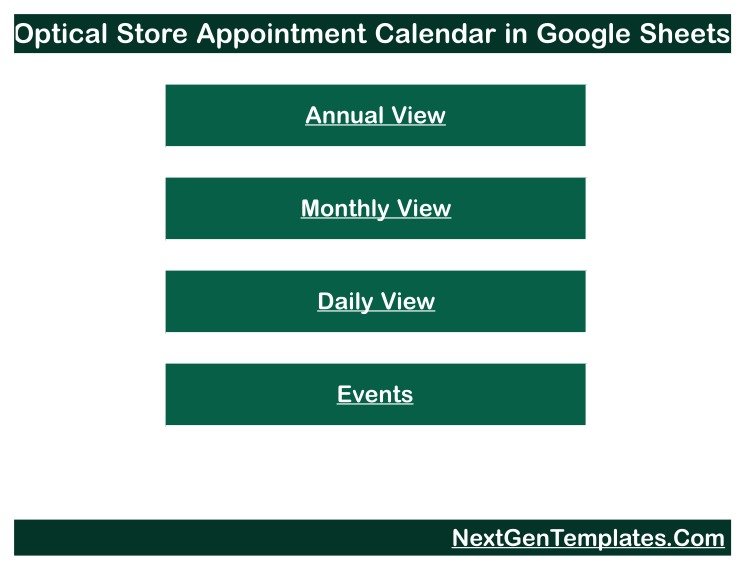
The landing tab: four buttons linking to Annual View, Monthly View, Daily View and Events, with a “Back” link on every other tab to return. It exists so the file is navigable on a phone, where tab strips are fiddly.
Annual View
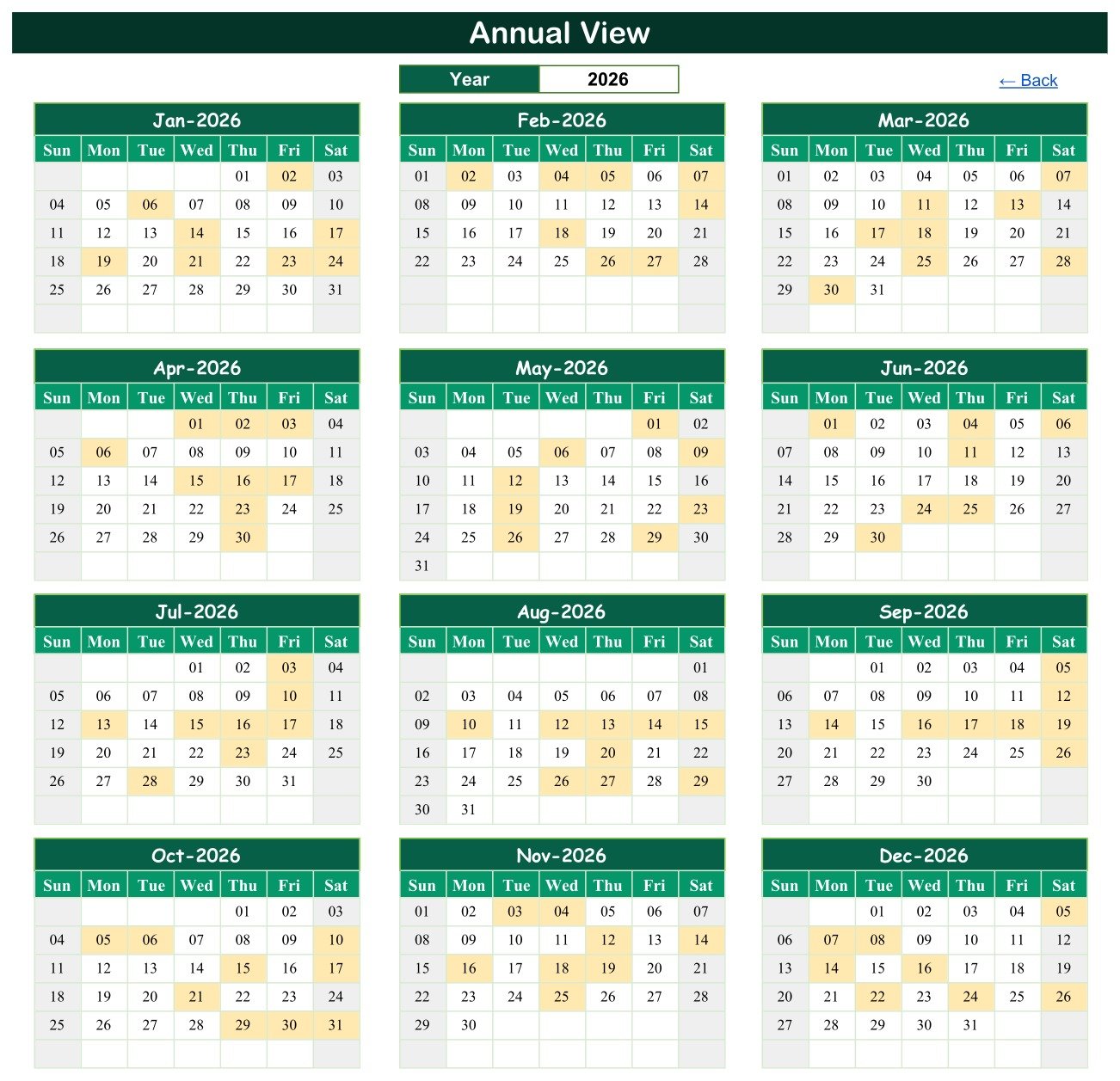
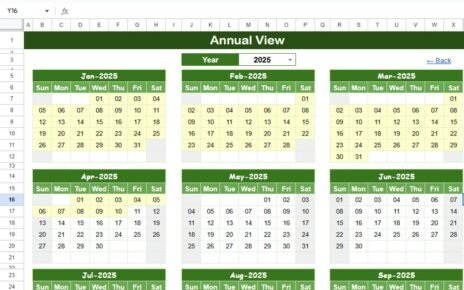
All twelve months of the chosen year on one page, three across and four down, with every booked date shaded amber. In the shipped copy the shading marks 8 days in January, 8 in February, 8 in March, 9 in April, 8 in May, 7 in June, 8 in July, 9 in August, 8 in September, 9 in October, 8 in November and 8 in December. Change the year in the dropdown and the whole page redraws. This is the page that gets printed and pinned up.
Monthly View
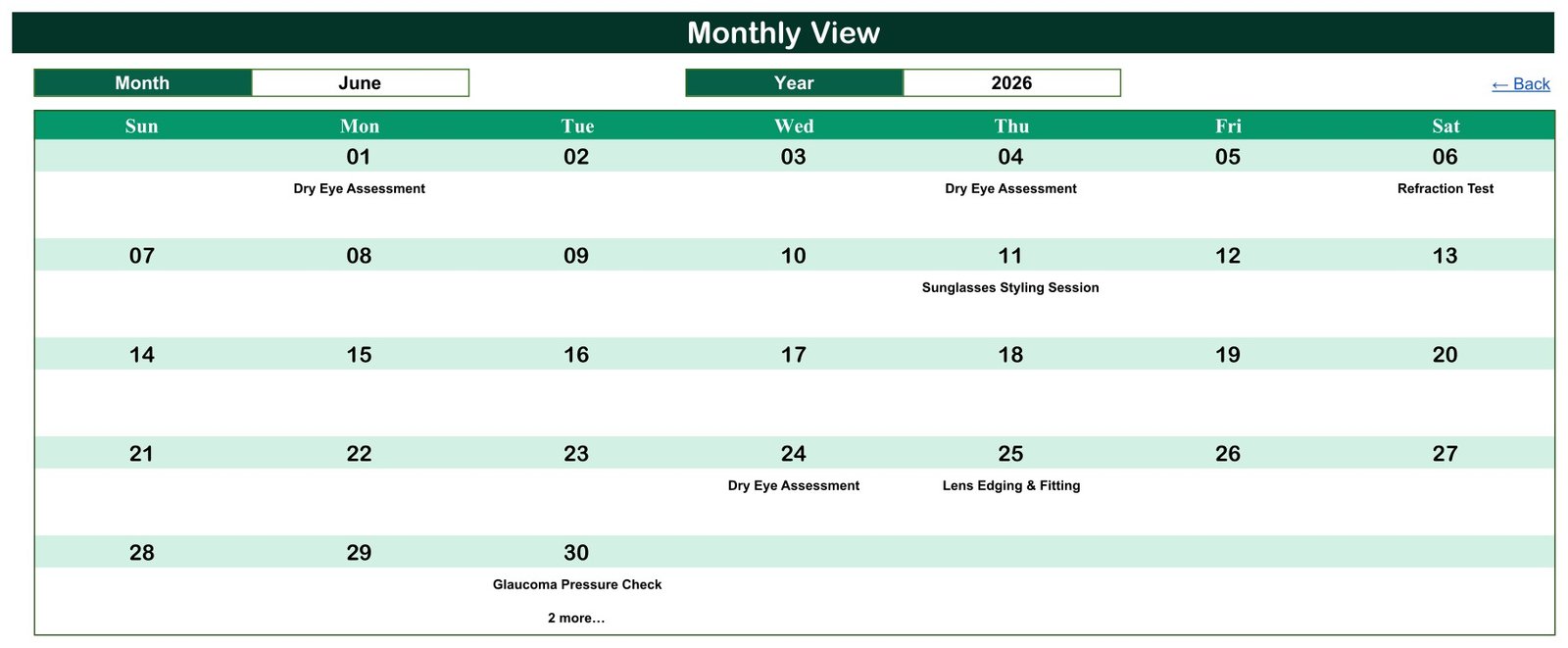
Pick a month and a year from two dropdowns and the calendar rebuilds. Each date cell shows the first booking on that date, with a “N more…” note underneath where several land on the same day. The shipped screenshot is June 2026: Dry Eye Assessment on Monday the 1st and Thursday the 4th, Refraction Test on Saturday the 6th, Sunglasses Styling Session on Thursday the 11th, Dry Eye Assessment on Wednesday the 24th, Lens Edging & Fitting on Thursday the 25th, and Glaucoma Pressure Check with “2 more…” on Tuesday the 30th.
Daily View
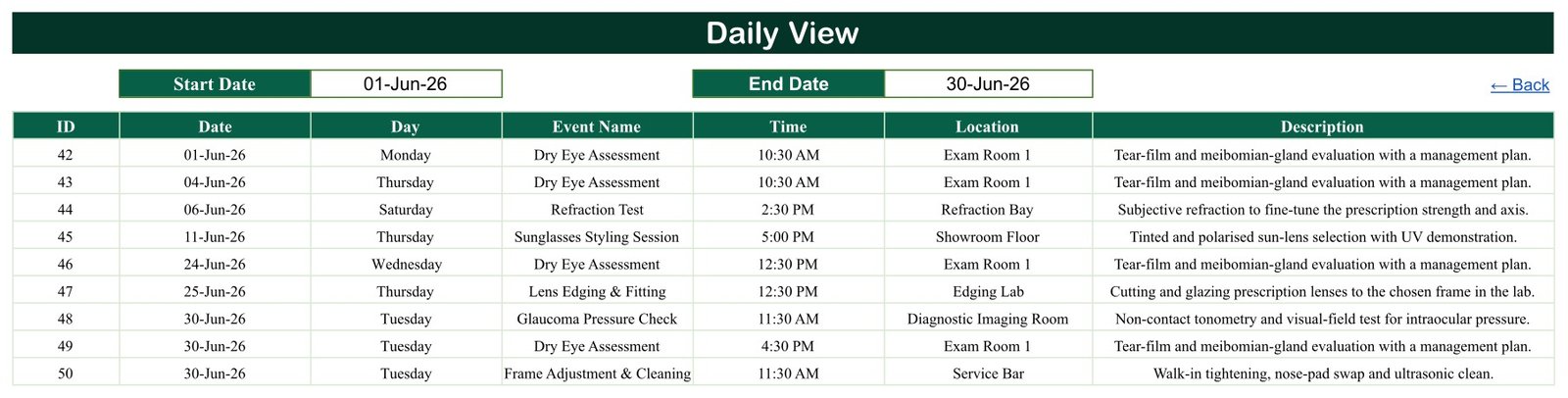
Set a Start Date and an End Date and the tab lists every booking in between, full width, with all seven columns. The shipped screenshot runs 01-Jun-26 to 30-Jun-26 and returns 9 rows, IDs 42 to 50 — including all three of the 30 June bookings that the Monthly View could only summarise. Set both dates to the same day and it becomes a single-day front-desk sheet.
Events
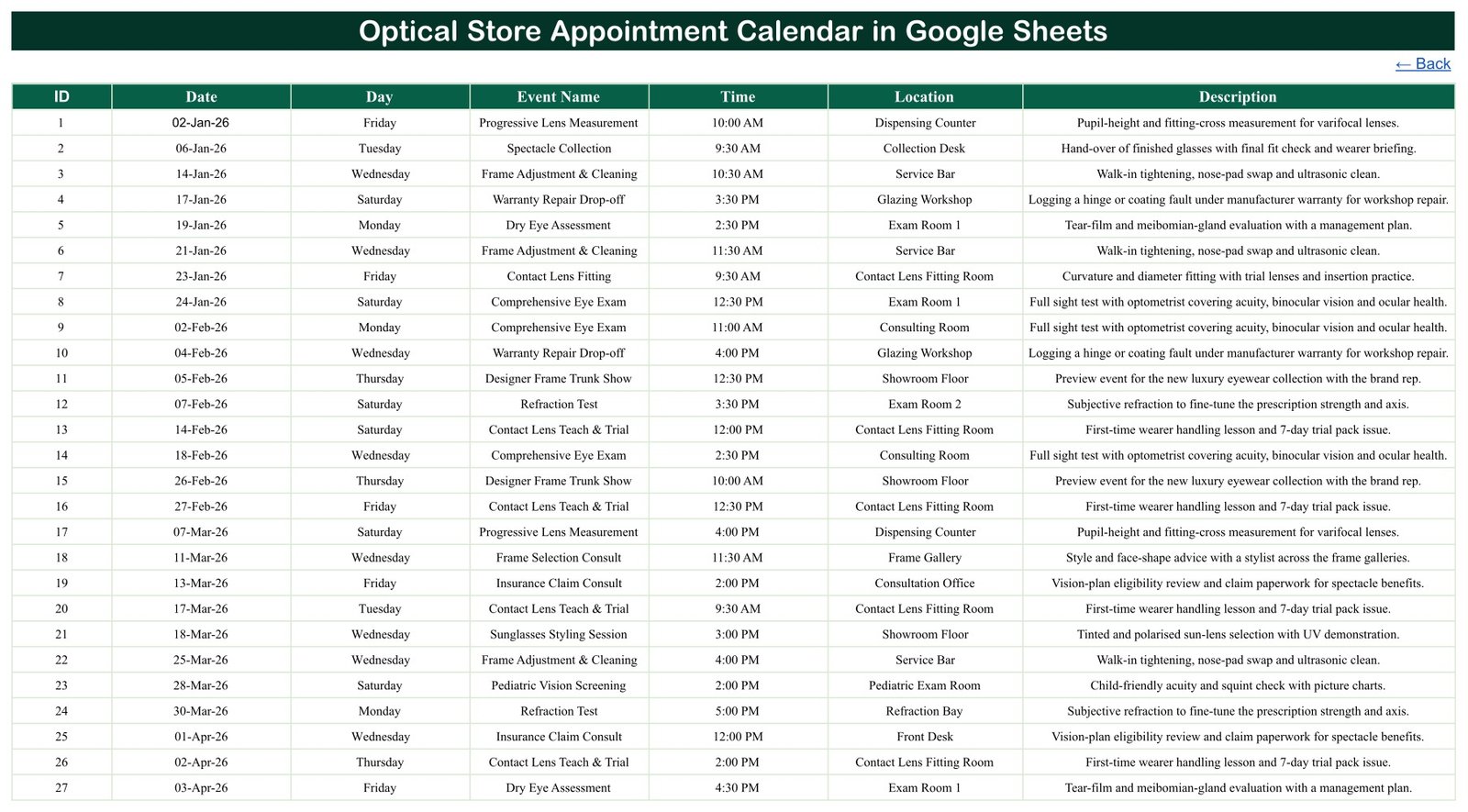
The master log everything else reads from. The Date column carries a date-validation rule; the other columns are free text, so you can rename rooms and appointment types to your own without maintaining a list anywhere.
List
A small helper tab holding the month names and the year range that the two dropdowns read from. Extend the year column and the pickers extend with it.
The Missing Customer Column Is the Point
This is the part of an eye-care scheduling template that deserves a straight answer rather than a hedge, so here it is. We read every column header and all 100 rows. The Events tab has exactly seven columns, and there is no customer name, no patient name, no phone number, no email address, no date of birth, no insurance or vision-plan number, no prescription or Rx field, no sphere, cylinder or axis values and no clinical-notes column anywhere in the file. The 18 sample descriptions describe the type of work — “Subjective refraction to fine-tune the prescription strength and axis”, “Tear-film and meibomian-gland evaluation with a management plan” — and never carry one person’s data. The 18 locations are room names inside a shop, not street addresses.
That is a design decision, not an oversight. A link-shared Google Sheet is not appropriate storage for patient or customer health data. Book the slot here — date, time, room, type — and keep the person’s identity, contact details and clinical record wherever you keep them today. If the two need to line up, put your own booking reference or an internal code in the Description cell instead of a name.
Optical Store Appointment Calendar in Google Sheets vs. Excel vs. Paid Practice Software — Feature Comparison
| What matters | This Google Sheets calendar | Excel calendar workbook | Paid optical practice software |
|---|---|---|---|
| Cost | $8.99 one-time (on sale $4.99) | $8.99 one-time | $70-$300+ per month, per practice |
| Platform | Any browser, free Google account | Desktop Excel for Windows, macros enabled | Vendor cloud or an in-practice server |
| Setup time | Under 10 minutes | Under 10 minutes, plus enabling macros | Days to weeks, usually with paid onboarding |
| Real-time team collaboration | Yes, two staff can edit at once | No, one file one editor | Yes |
| Mobile access | Yes, Google Sheets app | Limited | Yes, often a paid add-on |
| Customizable fields | Yes, it is a spreadsheet | Yes | Vendor-defined, often chargeable |
| Share with a link | Yes | No | No, per-seat logins |
| Year-1 cost at 5 users | $8.99 total | $8.99 total | $840-$3,600+ |
| Stores prescriptions / clinical records | No, by design | No | Yes |
| Sends patient reminders | No | No | Yes, SMS and email |
| Prevents double-booking a room | No | No | Yes |
Who Should Use This Template
Single-site independent opticians and optometry practices coming off a paper day-book. Small optical chains that want the same diary format in every branch so the year-end comparison is trivial. Practice managers who want the year’s clinic load on one printable page. Locum optometrists tracking their own sessions across several practices.
It is the wrong tool if you need automatic reminders, patient self-booking, storage for prescriptions or retinal images, a hard stop on double-booking, an audit trail, or anything a regulator will ask to see. Those are practice-software problems, and a spreadsheet should not pretend to solve them.
Real-World Use Cases
A two-room high-street optician. An optometrist in Exam Room 1, a dispensing optician on the counter. The Monthly View lives on the back-office screen so thin days are obvious a fortnight out; the Daily View gets printed each evening for the next morning. Customer names never enter the sheet.
A three-branch chain. Each branch keeps its own copy with the same seven columns and the same formulas, so a January Annual View from one branch can be laid beside another without reformatting. “How many Saturday clinics did we run last year?” becomes a filter rather than a project.
A locum optometrist. One copy, with the Location column repurposed for the practice name and the Description carrying an agreed rate reference. The Annual View is availability at a glance when a new practice rings.
Advantages of the Optical Store Appointment Calendar in Google Sheets
It is genuinely multi-user, which is the single thing a shared Excel file cannot do. It needs no macros, no add-on and no permission prompt, so it opens on a phone at the front desk as readily as on the back-office PC. It costs $8.99 once rather than a monthly per-practice fee. And every column is yours to rename, because it is a spreadsheet and not a vendor’s data model.
The verification matters too. Templates in this category frequently ship sample data with impossible dates or weekdays that do not match. All 100 rows here were recomputed against the real 2026 calendar and every one is correct, which means the calendar views you see in the screenshots are the calendar views you get.
Opportunities for Improvement
Three, stated plainly, with fixes where there is one.
The Monthly View shows only the first booking on a busy day. Each date cell is a VLOOKUP and a VLOOKUP returns the first match, so a date with several bookings prints one name plus a “N more…” note. You can see it on 30 June 2026: “Glaucoma Pressure Check”, then “2 more…”. Nothing is lost — the Daily View’s FILTER lists all three — but the Monthly View is a spotting tool, not a working list.
Nothing prevents double-booking a room and a time. Only the Date column is validated. There is no check, no warning and no conditional format on Time or Location, so two bookings in Exam Room 1 at 2:30 PM will both save silently. If that risk matters, sort the Events tab by Date then Time each week, or add a COUNTIFS helper column that flags collisions.
The Day column is typed text, not a formula. We checked the cells directly: Day holds plain text rather than =TEXT(B4,"dddd"). It is correct on all 100 sample rows, but edit a Date later and the Day beside it will not follow — it will quietly disagree. The one-minute fix is to put =TEXT(B4,"dddd") in C4 and fill it down. Nothing else in the file reads the Day column, so it is safe to change.
Best Practices
Replace the sample Location values with your own room names first, before you type a single real booking — it takes two minutes and saves a find-and-replace later. Convert the Day column to a formula on day one. Share the file with named colleagues rather than “anyone with the link”; even with no customer data in it, your trading pattern is your own business. Keep one file per site rather than one shared file with a Branch column, so a mistake in one branch cannot affect another. And if you want to know more about how the underlying functions behave, Google’s own documentation for the FILTER function is the reference the views are built on.
Explore Relevant Templates
- Optical Store Appointment Calendar in Google Sheets — the template described in this article.
- Eye Care Center Management System Web App — the step up when a diary is no longer enough: multi-user logins, records and a real booking flow.
- Optical Retail Dashboard in Excel — sales, frames and lens-mix analytics for the retail side of the same shop.
- Optical Retail Dashboard in Power BI — the same analysis with Power BI’s filtering and drill-through.
- Veterinary Clinic Calendar in Google Sheets — the same calendar engine, built for a veterinary practice.
- Home Nursing Visit Calendar in Google Sheets — the same engine again, for home visit scheduling.
If you want to see how the same six-tab engine behaves on a different appointment book, our walkthroughs of the Veterinary Clinic Calendar in Google Sheets and the Home Nursing Visit Calendar in Google Sheets go through the Annual, Monthly and Daily views in the same detail, including how each one handles a day with more than one booking.
Want to build your own scheduling sheets? The NextGenTemplates Academy learning paths take you from spreadsheet basics to calendars and trackers, with practice files along the way.
Frequently Asked Questions
Is the Optical Store Appointment Calendar in Google Sheets a patient record or an EHR?
No. It is a scheduling calendar. There is no patient name, contact detail, date of birth, prescription or clinical-notes field anywhere in it, and you should not add one — a link-shared Google Sheet is not appropriate storage for patient data.
Does it send appointment reminders?
No. It sends nothing at all. There are no reminders, no notifications, no SMS and no email, because there is no macro and no Apps Script in the file.
Can customers book their own appointments through it?
No. There is no public booking page and no form. Staff type bookings onto the Events tab.
Is it HIPAA, GDPR or optical-board compliant?
No, and no spreadsheet template can make you compliant. There is no access control beyond Google’s own sharing, no encryption you control, no audit trail and no certification. How you handle personal data remains your responsibility.
Will it stop me booking two people into the same room at the same time?
No. There is no double-booking check. See the improvements section above for a workaround.
Do I need to install an add-on or enable macros?
No. Everything runs on ordinary worksheet formulas — DATE, FILTER, VLOOKUP, COUNTIF and EOMONTH — plus conditional formatting.
Can I use a year other than 2026?
Yes. The dropdowns cover 2021 to 2056 and both calendar views rebuild when you change them.
Is there an Excel version, and is it the same file?
There is a separate Excel edition, and it is genuinely a different build rather than a converted copy. The Excel workbook is macro-enabled with seven sheets including a “This Month” summary and a Setting sheet, carries a VBA add/update/delete form, and ships 24 appointment-type labels and 7 room names over a 07-Jan-2026 to 31-Dec-2026 sample year. The Google Sheets edition covered here has six tabs, 18 appointment types, 18 locations, no form and no macros, and runs in a browser.
About the Author
Built by PK – Microsoft Certified Professional with 15+ years of Excel, Google Sheets, and Power BI experience. Founder of NextGenTemplates, reaching 300K+ subscribers across YouTube channels. Every template is hand-built and tested before release.
Conclusion
The Optical Store Appointment Calendar in Google Sheets does one job: it turns a paper day-book into something four people can see at once, print from, and read a year of at a glance. Six tabs, three linked views, 100 verified sample bookings, 18 appointment types and 18 rooms, and no customer column — because the slot belongs in the diary and the person belongs in your practice system. It will not remind anyone, it will not stop a double-booking, and it is not a clinical record. Within those limits it is a $8.99 one-time purchase that replaces a whiteboard.
Get the Optical Store Appointment Calendar in Google Sheets — $8.99, currently $4.99, one-time payment and lifetime access. For walkthroughs of this and every other template we build, subscribe at youtube.com/@PKAnExcelExpert.