Parking operations get messy fast when attendants rely on paper tickets, scattered spreadsheets, or one person who knows where every vehicle is supposed to be. The Parking Management System Web App replaces that patchwork with a 15-screen browser-based workspace for login, dashboard cards, live parking map, check-in, check-out, parked vehicle tracking, history, layout setup, tariffs, passes, reports, users, settings, and audit logs. It is a one-time $39.99 template, not a monthly subscription, and it is built for teams that want practical parking control without committing to a full parking SaaS or hardware project.
NextGenTemplates has supported 8,400+ template buyers across 40+ countries, and this parking system follows the same pattern as the other Google Apps Script web apps: a structured web interface, editable source files, and data you control. For technical background on this deployment style, see Google’s official Apps Script web app documentation.
Get the Parking Management System Web App
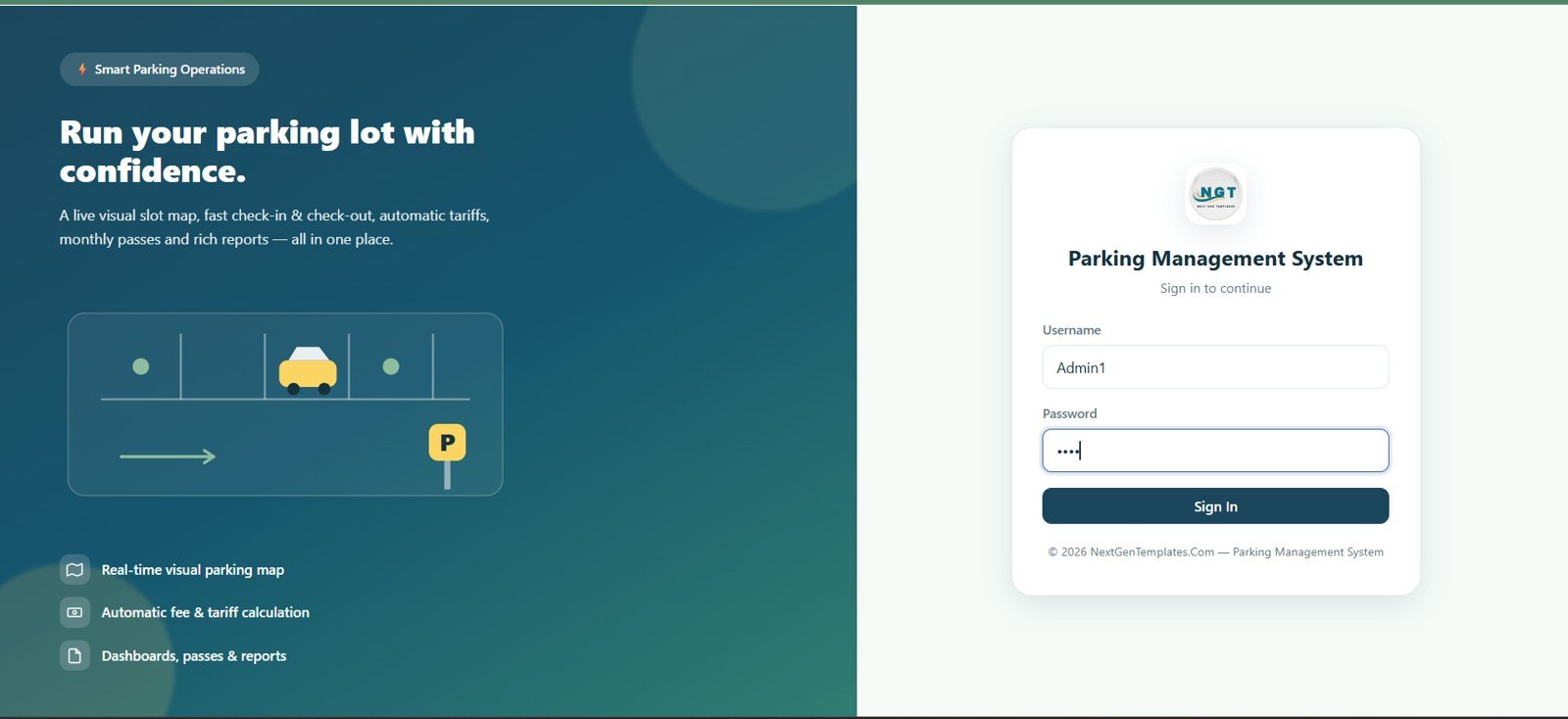
Parking Management System Web App – Login Page
🚀 Try the Live Demo Before You Buy
We have deployed this web app in our own Google account so you can test every page, every role — with real sample data — before purchasing. No signup, no email required.
🔑 Test Login Credentials
Sign in as Admin1 to manage everything — Layout Designer, parking Rates, Passes, full Reports, User & List Management, Settings, Database Archive and the Audit Log — or as User1 to run the attendant desk: check vehicles in and out, view the Live Parking Map, search vehicles, and print tickets & receipts. A second attendant login (User2) is included too, so you can test how the system behaves with multiple operators sharing the same lot in real time.
💡 What you get after purchase: The full source code (Code.gs + Index.html) plus a step-by-step deployment guide so you can deploy your own private instance in your own Google account in under 15 minutes.
Key Features of Parking Management System Web App
- 15 connected screens: login, dashboard, live map, check-in, check-out, currently parked, parking history, layout designer, rates, passes, reports, users, lists, settings, and audit log.
- Live visual slot map: monitor slots by floor, section, status, and vehicle type, including reserved, out-of-service, EV, truck, car, and bike spaces.
- Fast gate workflow: check in a vehicle, assign a slot, track active parking duration, and close the session from a dedicated check-out screen.
- Tariff and pass management: manage vehicle-type rates, grace periods, minimum charges, daily caps, and regular customer passes.
- Operational reporting: track collection, sessions, average duration, pass income, current occupancy, revenue by vehicle type, and daily collection.
- Admin governance: maintain user access, dropdown lists, system settings, and an audit log of important actions.
Dashboard Pages Explanation
The app is designed around a normal parking lot shift: sign in, review occupancy, assign slots, monitor active vehicles, close sessions, reconcile revenue, and review activity. Below is the screen-by-screen breakdown.
1. Login Page
The login page is the secure entry point for the parking workspace. It shows username and password fields, the Parking Management System branding, a smart parking operations message, and highlights for real-time maps, automatic fee calculation, dashboards, passes, and reports.
Login Page
2. Dashboard
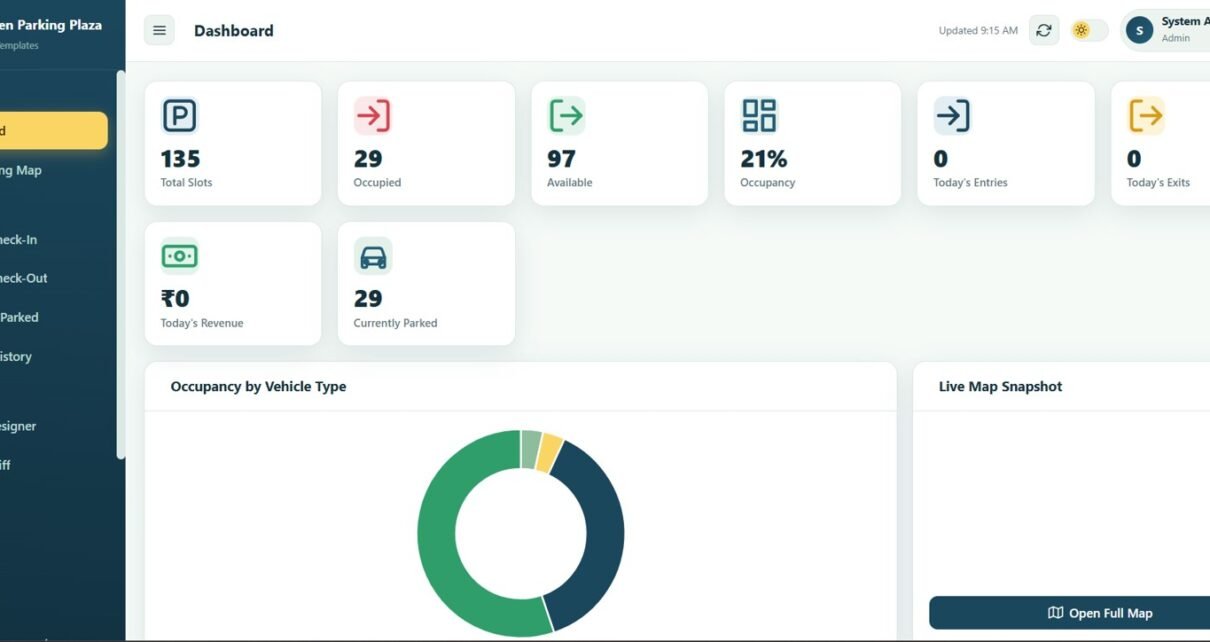
The dashboard gives managers the quickest view of the parking lot: Total Slots, Occupied, Available, Occupancy, Today’s Entries, Today’s Exits, Today’s Revenue, and Currently Parked. Occupancy by Vehicle Type and Live Map Snapshot panels help staff understand the lot position without opening multiple screens.
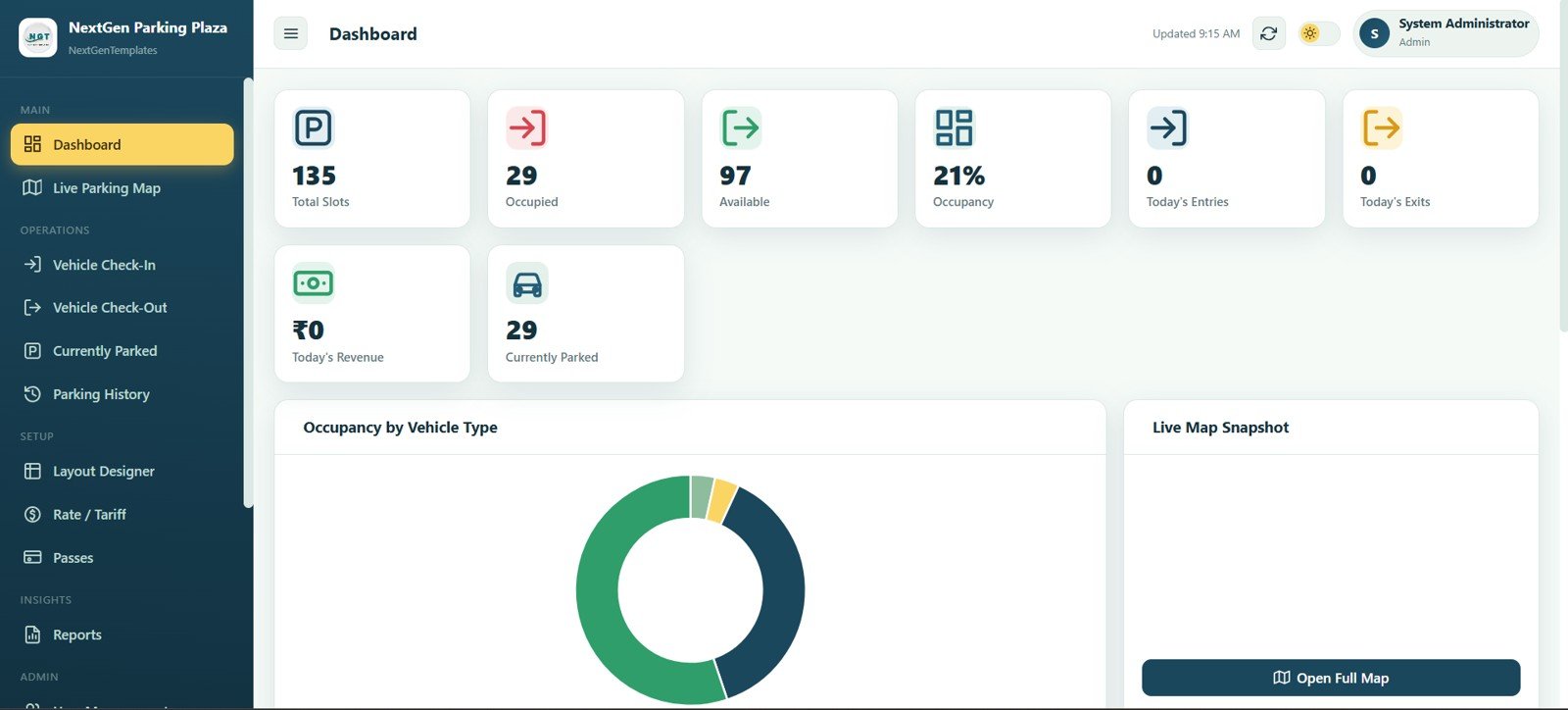
Dashboard
3. Live Parking Map
The live parking map shows the physical slot layout by floor, section, status, and vehicle type. Floor tabs, zoom controls, refresh, occupied count, available count, reserved count, out count, EV count, truck count, car count, bike count, and slot legends make it a visual control room for the lot.
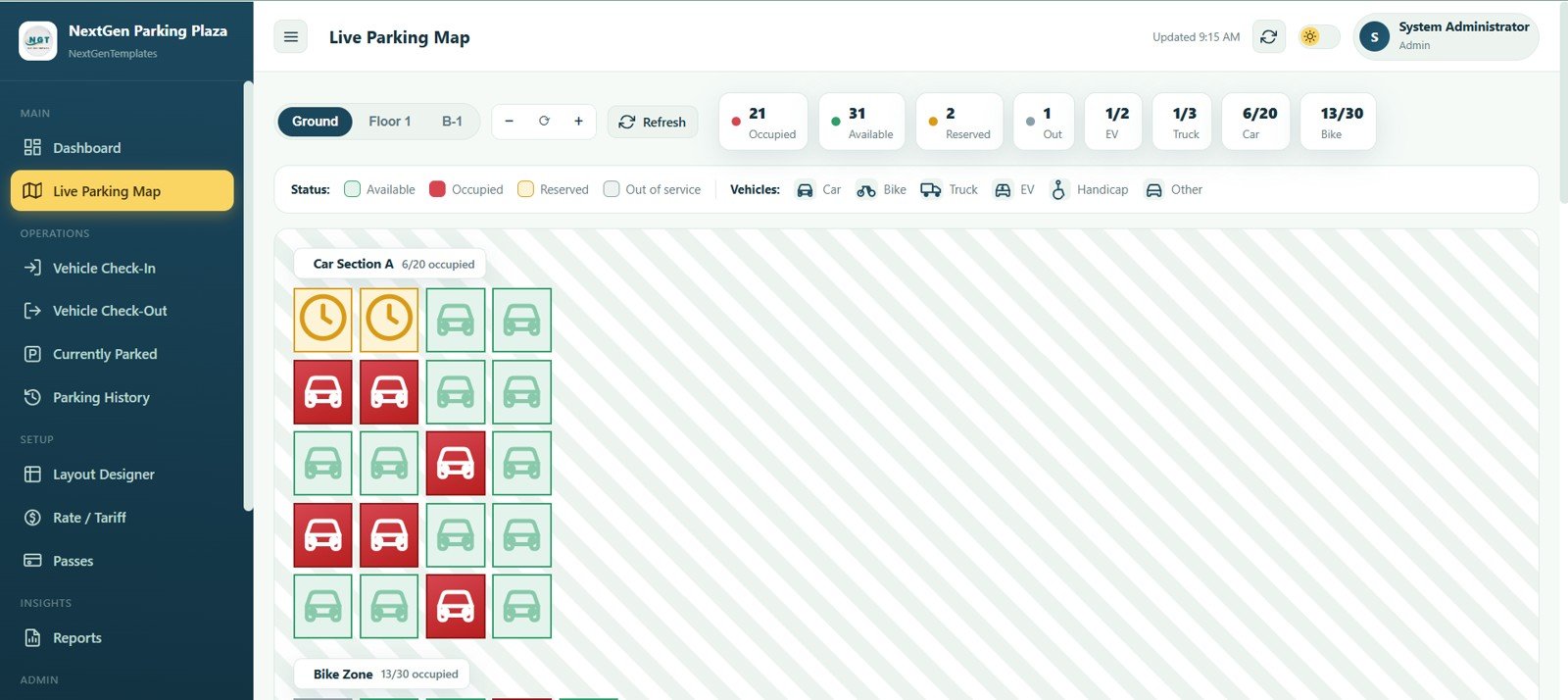
Live Parking Map
4. Vehicle Check-In
The check-in screen captures the vehicle number, vehicle type, floor, slot, owner or driver, phone, email, entry time override, and notes. The Pick on Map option lets the attendant work visually instead of typing every slot assignment manually.
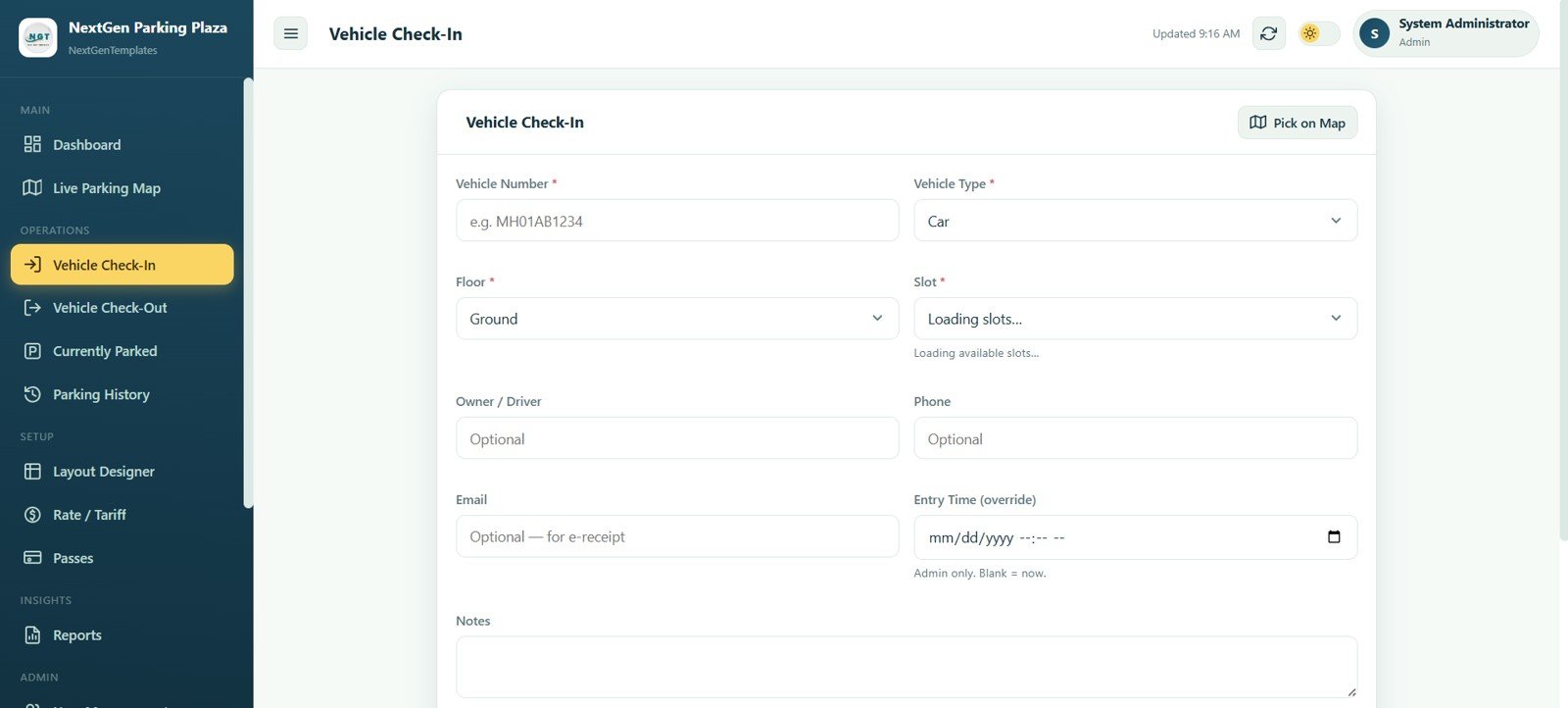
Vehicle Check-In
5. Vehicle Check-Out
The check-out workflow is built to find a parked vehicle and close the parking session quickly. The table shows Vehicle, Type, Slot, Section, Entry, Parked duration, and Action, so staff can verify the record before clicking Check-Out.
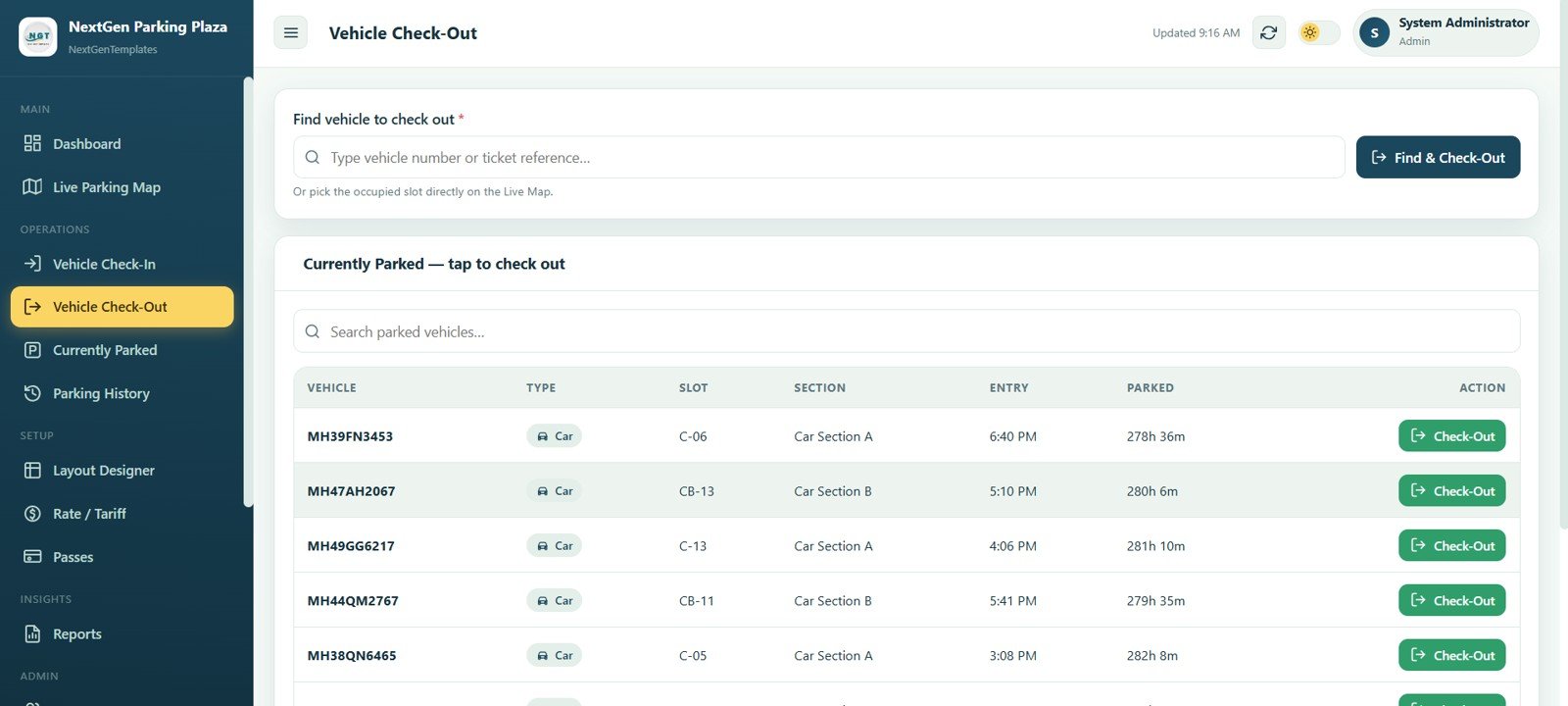
Vehicle Check-Out
6. Currently Parked
The currently parked screen is the live active-session register. Users can filter, search, export, and open quick actions while reviewing Slot, Vehicle, Type, Owner, Section, Floor, Entry, Parked time, Running Fee, Attendant, and Actions.
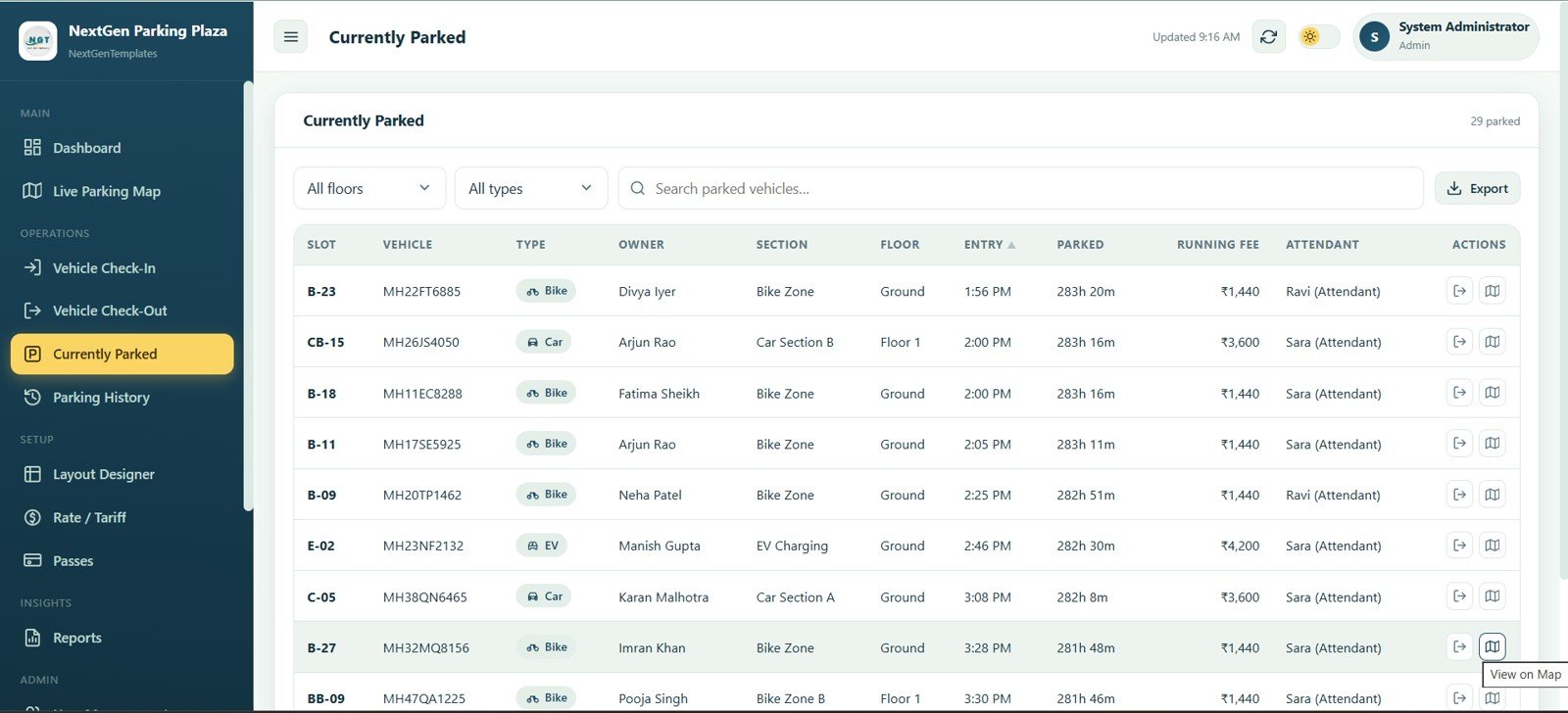
Currently Parked
7. Parking History
The parking history table stores completed sessions for review by date range, vehicle type, and payment mode. Ticket, Vehicle, Type, Slot, Section, Entry, Exit, Duration, Amount, Pay, and Attendant columns make it useful for disputes, reconciliation, and audit checks.
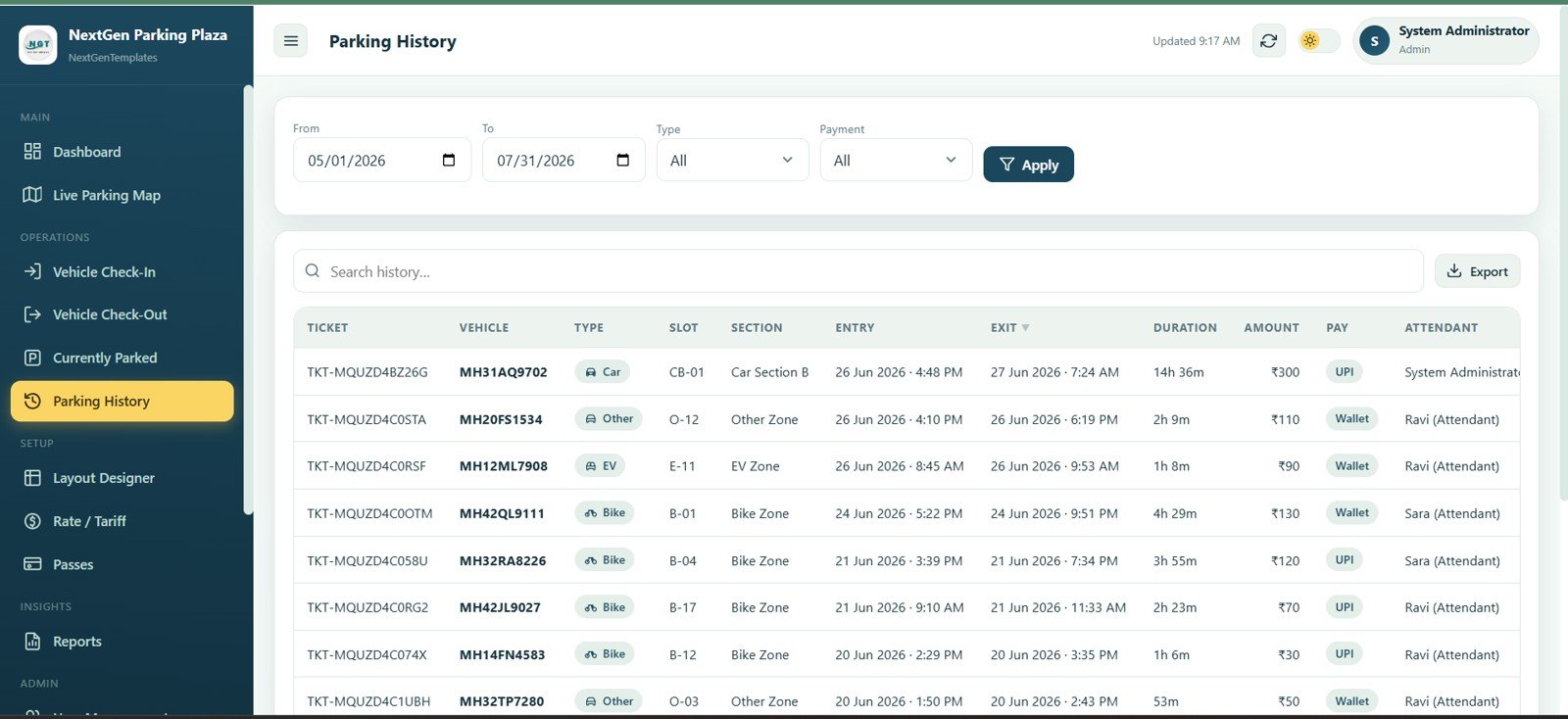
Parking History
8. Layout Designer
The layout designer lets admins build floors, sections, and slots visually. Ground, Floor 1, B-1, Add Floor, Delete Floor, Rows, Cols, Generate Grid, Driveway, Car, Bike, Truck, EV, Handicap, Other, Reserved, Out of Service, Section, Auto-name slots, and Save Layout controls make the map configurable for each location.
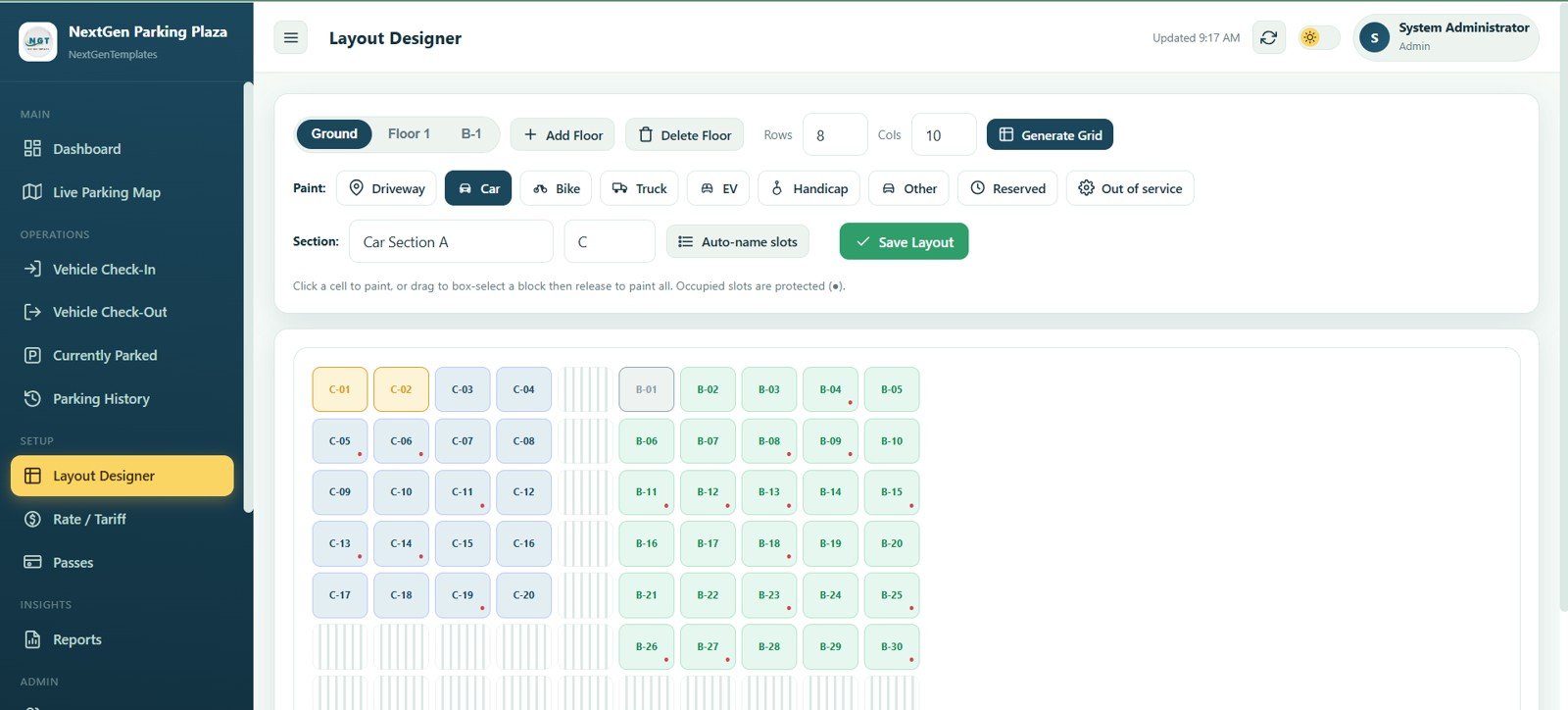
Layout Designer
9. Rate / Tariff
The rate and tariff module defines fee rules for each vehicle type. Vehicle Type, Model, Amount, Grace, Min, Daily Cap, Status, Actions, Import, Add Rate, and Export controls help managers update pricing without touching the rest of the system.
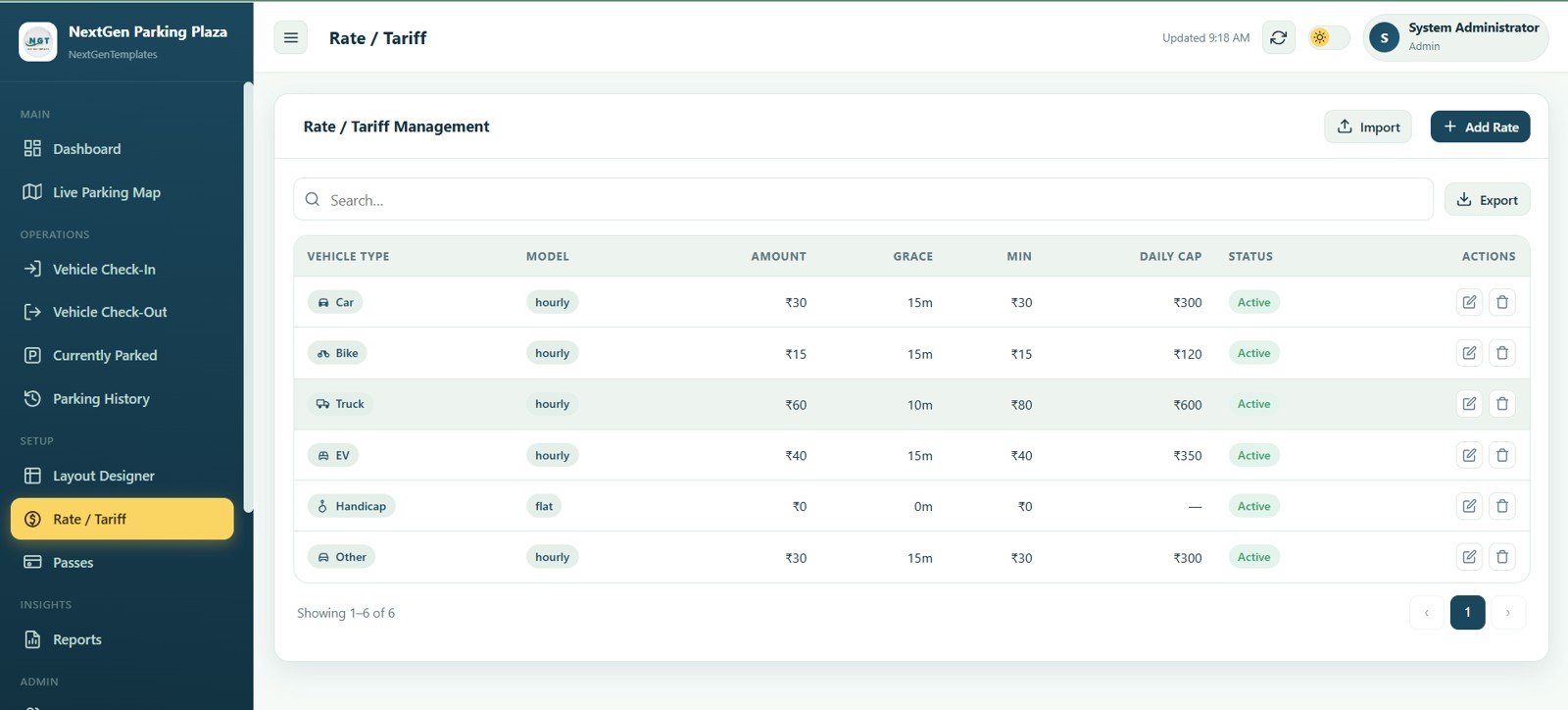
Rate / Tariff
10. Passes
The passes screen manages subscriptions and regular parking customers. Holder, Vehicle, Type, Start, End, Amount, Status, Actions, Import, Add Pass, and Export fields support staff parking, monthly customer parking, and recurring access workflows.
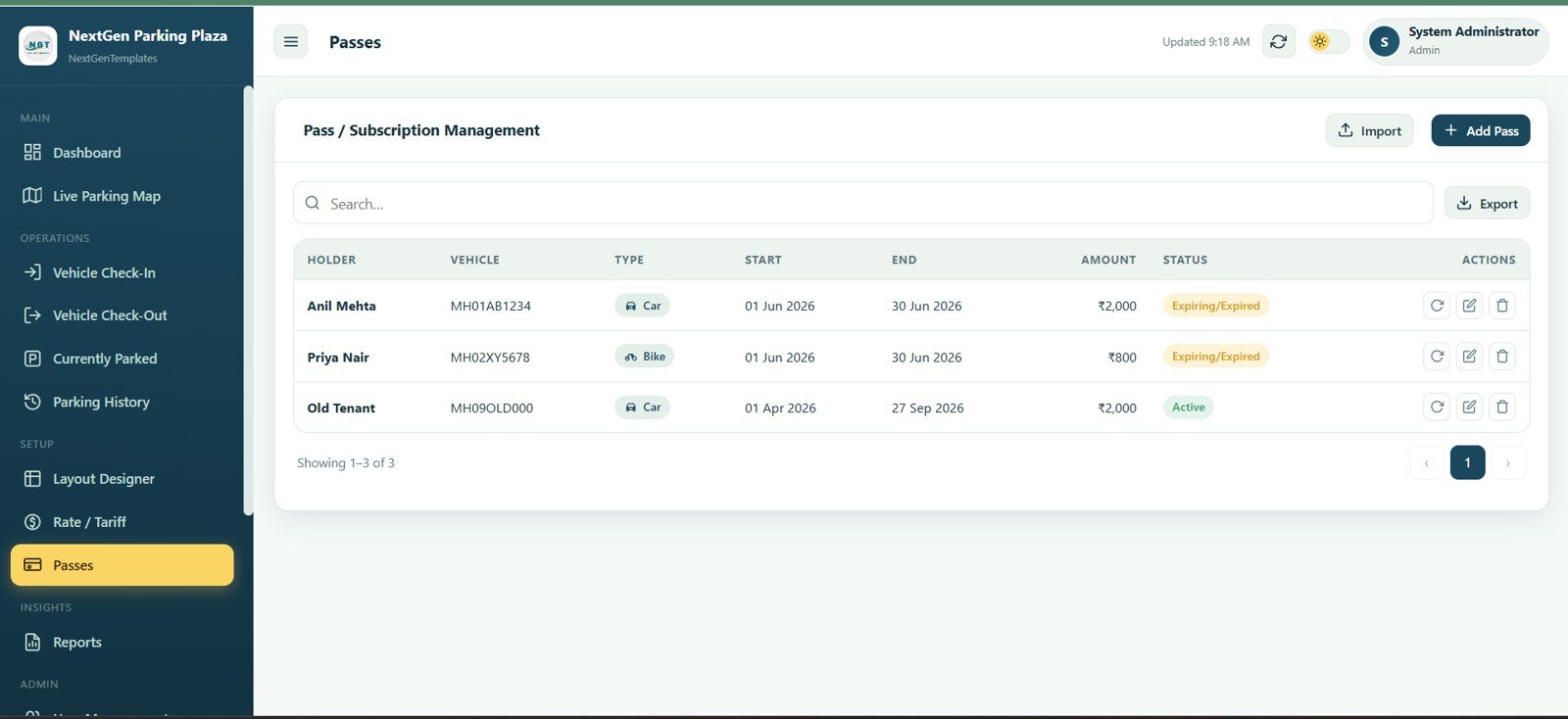
Passes
11. Reports
The reports page turns operational data into a management view for a selected date range. From Date, To Date, Apply, Print A4, Export, Total Collection, Sessions, Avg Duration, Pass Income, Occupancy Now, Revenue by Vehicle Type, and Daily Collection are all available from one screen.
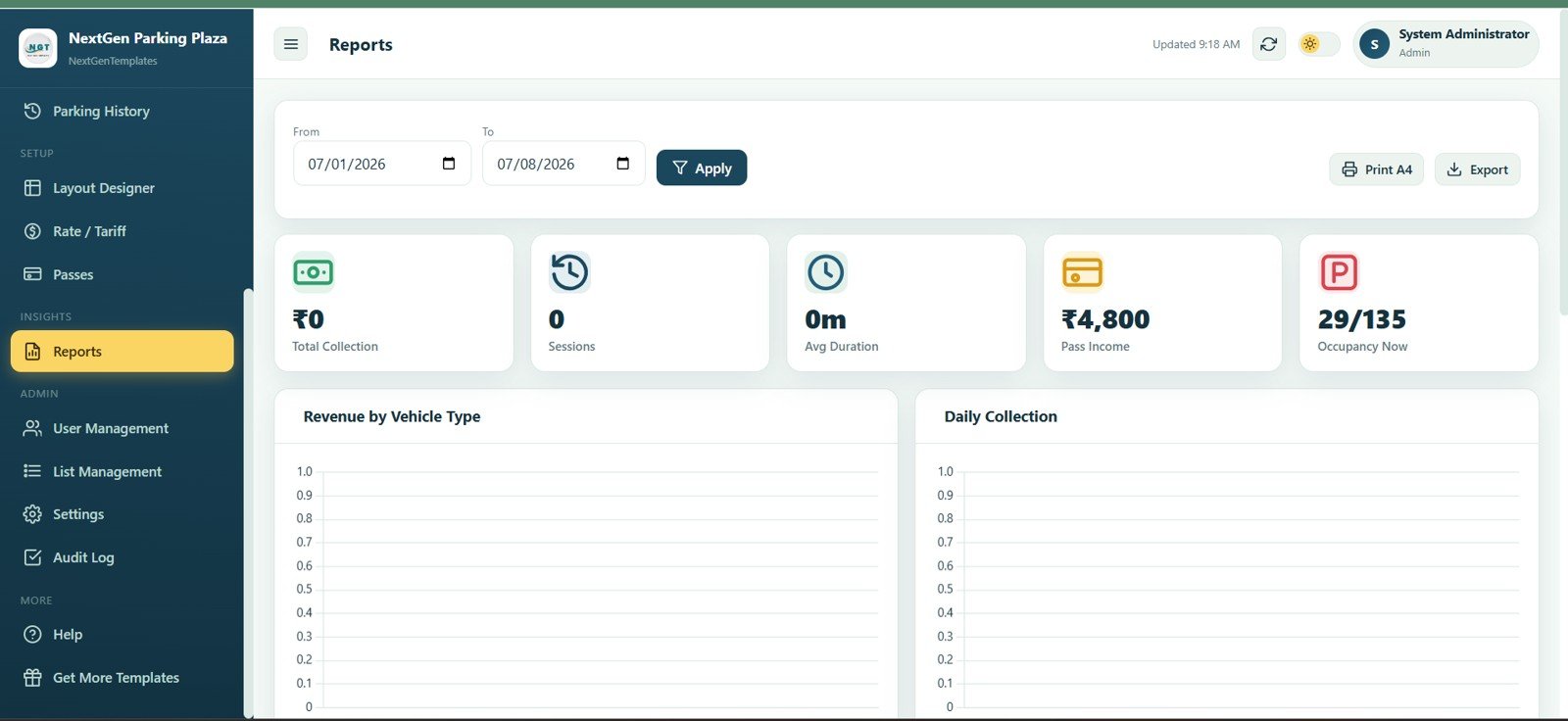
Reports
12. User Management
User Management maintains admin and attendant access. Name, Username, Role, Status, Email, Phone, Last Login, Actions, and Add User fields help the owner decide who can operate the system and who should only have limited access.
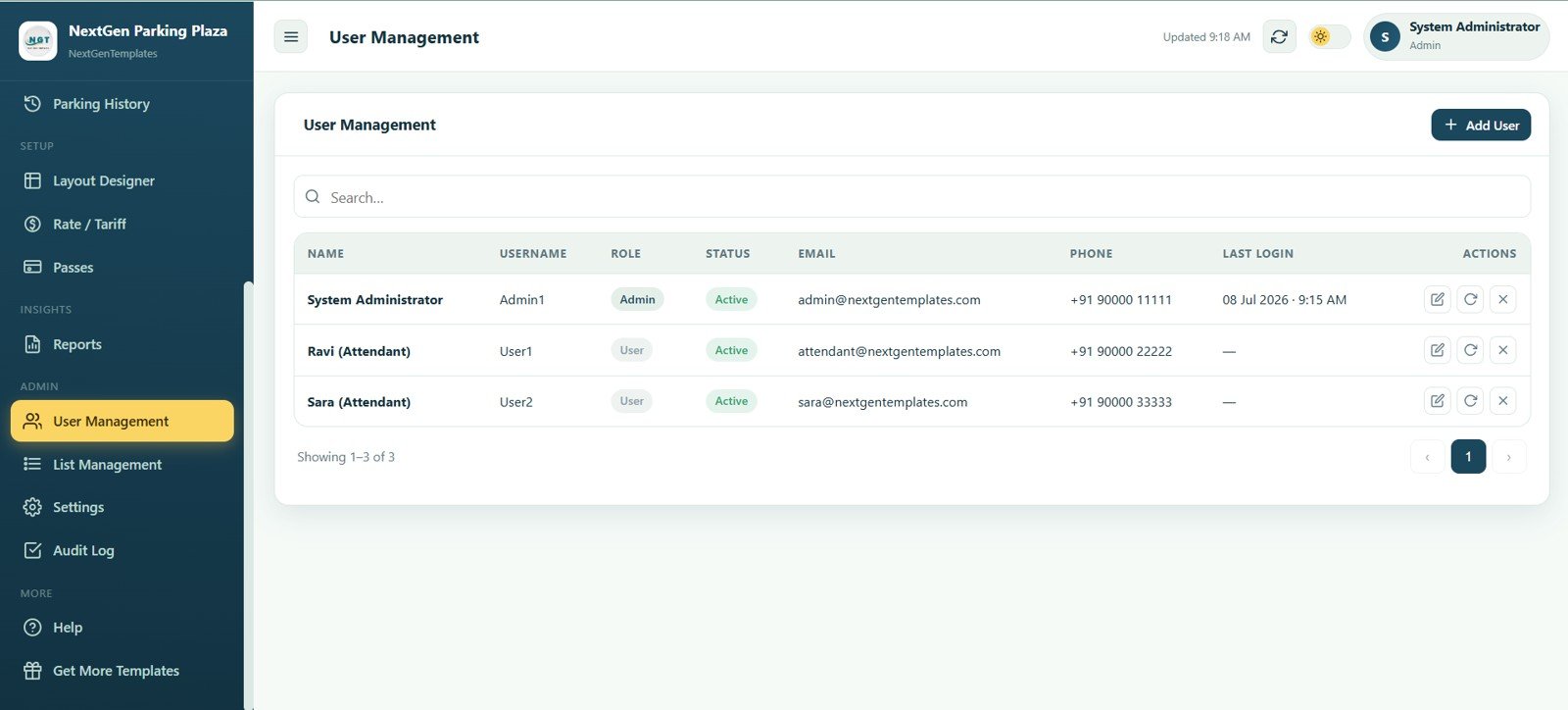
User Management
13. List Management
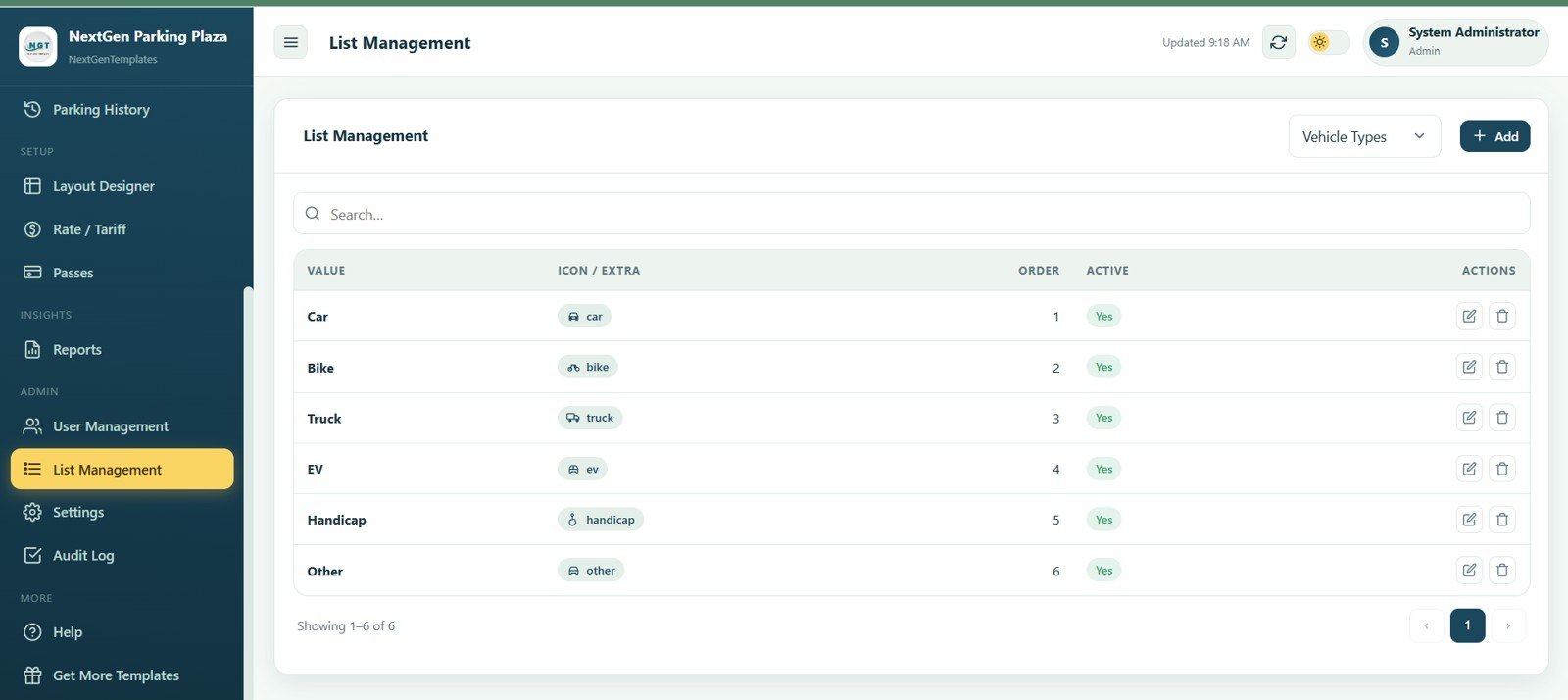
List Management keeps dropdown values clean, especially vehicle types. Admins can add, search, order, activate, or edit values such as Car, Bike, Truck, EV, Handicap, and Other, which keeps reports and filters consistent.
List Management
14. Settings
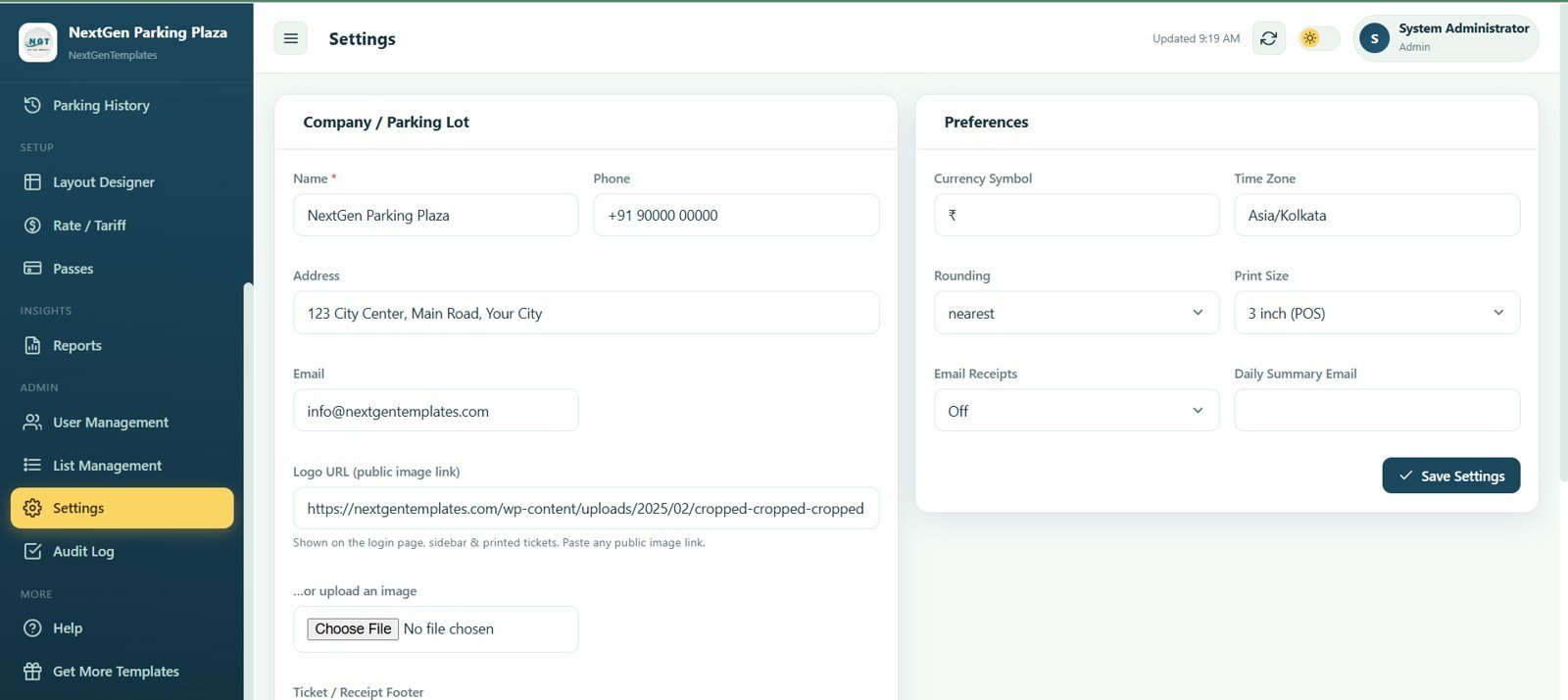
The settings screen stores company and parking lot details, including name, phone, address, email, logo URL, currency symbol, time zone, rounding, print size, email receipts, daily summary email, and Save Settings. These values help the system match the operating rules of the parking lot.
Settings
15. Audit Log
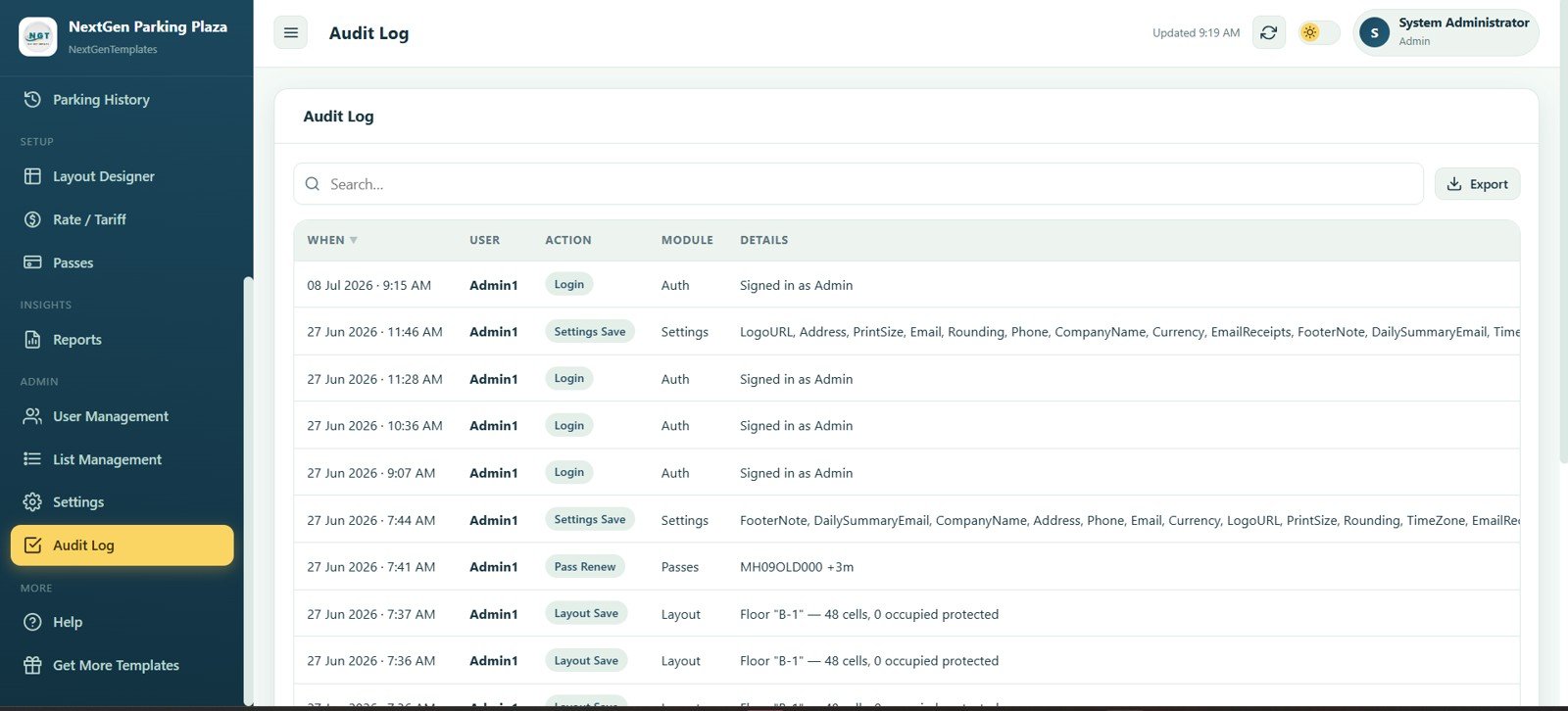
The audit log records important user activity and system changes. When, User, Action, Module, Details, Search, Export, Login, Settings Save, Pass Renew, and Layout Save records give admins visibility into who changed what and when.
Audit Log
Parking Management System Web App vs. Google Sheets Tracker vs. Paid CRM/SaaS – Feature Comparison
| Feature | Parking Management System Web App | Google Sheets Tracker | Paid Parking SaaS |
|---|---|---|---|
| Cost | $39.99 one-time | Low cash cost, high manual setup | Monthly subscription, often with add-ons |
| Platform | Browser-based web app | Spreadsheet tabs | Vendor-hosted cloud platform |
| Setup time | Deploy, configure layout, add rates and users | Build tables, formulas, and views yourself | Vendor onboarding and configuration |
| Live visual map | Included | Manual drawing or custom formulas | Usually available, sometimes hardware-linked |
| Check-in/check-out | Dedicated workflows | Manual row entry | Included by plan |
| Pass management | Included | Separate sheet or manual log | Included by plan |
| Reports and export | Built in | Manual pivots/charts | Included, sometimes restricted by plan |
| Data ownership | You control the template and data | You control the file | Vendor-hosted |
| Year-1 cost at 5 users | $39.99 total | Low cost but more manual effort | Can become hundreds or thousands depending on plan and site count |
Who Should Use This Template
Perfect for:
- Parking lot owners managing hourly, daily, or monthly parking.
- Facility managers in offices, malls, hospitals, schools, hotels, event venues, and residential complexes.
- Teams that need a live slot map, active parked list, and fee workflow without expensive hardware integration.
- Operators replacing paper tickets, WhatsApp updates, or disconnected spreadsheets.
Not a fit if:
- You need automatic number plate recognition, gate barrier integration, or payment terminal integration.
- You need a public consumer mobile app for booking and paying for spaces.
- You need government enforcement features such as citation issuing, permit enforcement, or municipal integrations.
Real-World Use Cases
Ravi manages a 180-slot office building. He uses the live map to separate visitor parking, employee pass parking, and reserved spaces. The dashboard tells him how many slots are open before morning peak traffic starts.
Maria runs parking for a small hospital. Her attendants check in vehicles at the entry point, use vehicle type to apply the right tariff, and review reports at the end of each shift for total collection and session count.
Arjun operates paid parking near an event venue. He updates tariff rules for high-demand days, issues passes to nearby shop owners, and exports parking history for weekly reconciliation.
Advantages of Parking Management System Web App
- Faster front-gate work: attendants can check vehicles in, assign slots, and close sessions from dedicated screens.
- Visual control: the live map makes occupancy easier to understand than a flat list of vehicle numbers.
- One-time purchase: useful for small and mid-size operators that do not want recurring software fees.
- Configurable layout: floors, sections, slot types, reserved spaces, and out-of-service slots can be built visually.
- Cleaner records: history, reports, pass records, and audit logs reduce end-of-shift guesswork.
Opportunities for Improvement
This template is built for parking operations management, not hardware automation. It does not connect automatically to gates, cameras, payment terminals, ANPR systems, or municipal enforcement platforms. Operators that need those integrations should use a dedicated parking hardware and SaaS provider. For smaller lots, private facilities, and early-stage parking businesses, the trade-off is attractive: a structured web app with no recurring fee and a much faster setup path.
Best Practices
- Build the parking layout first, including floors, sections, reserved spaces, EV spaces, and out-of-service slots.
- Standardize vehicle types in List Management before attendants start entering data.
- Review tariff rules carefully, especially grace period, minimum charge, and daily cap.
- Use the Passes page for monthly customers instead of manually overriding charges each day.
- Export Parking History and Reports at the end of each shift or day for reconciliation.
- Review Audit Log weekly to check changes to settings, passes, and layout.
Explore Relevant Templates
- Logistics Management System Web App – useful for transport operations with dispatch, POD, fleet, and billing.
- Web App Based: Hotel Booking Management System – useful for property and hospitality operations.
- Salon and Spa Management System Web App – another full Google Apps Script operations app.
- Browse all Mini Web Apps on NextGenTemplates.
- Logistics Management System Web App on NextGenTemplates – related operational system product.
Curious how the spreadsheet side of systems like this is built? The NextGenTemplates Academy learning paths cover tracker and template building with practice files.
Get the Parking Management System Web App
Frequently Asked Questions
What is included in the Parking Management System Web App?
It includes 15 screens: login, dashboard, live parking map, vehicle check-in, vehicle check-out, currently parked, parking history, layout designer, rate/tariff, passes, reports, user management, list management, settings, and audit log.
Does it include a live parking map?
Yes. The Live Parking Map screen shows parking slots by floor, section, status, and vehicle type, with counts and legends for occupied, available, reserved, out-of-service, EV, truck, car, and bike slots.
Can it manage check-in and check-out?
Yes. The app has separate Vehicle Check-In and Vehicle Check-Out workflows so attendants can assign slots, capture driver details, track parked duration, and close sessions.
Can I manage parking rates and passes?
Yes. The Rate / Tariff screen manages fee rules by vehicle type, while the Passes screen manages regular parking customers and subscriptions.
Does this replace gate barriers, ANPR cameras, or payment terminals?
No. It is a parking operations web app, not a hardware automation platform. It helps teams manage records, slots, tariffs, passes, and reports manually through a structured interface.
Where is the data stored?
The product is designed as a web app template. After purchase, follow the included setup guide and deploy it in your own environment or account, depending on the package instructions.
Is this a one-time payment?
Yes. The template is sold as a one-time digital download on NextGenTemplates. There is no monthly subscription charged by NextGenTemplates.
About the Author
Built by PK – Microsoft Certified Professional with 15+ years of Excel, Google Sheets, and Power BI experience. Founder of NextGenTemplates, reaching 300K+ subscribers across YouTube channels. Every template is hand-built and tested before release.
Conclusion
The Parking Management System Web App is a practical middle ground between simple spreadsheets and expensive parking SaaS. It gives operators a live map, active parked list, check-in/check-out workflows, tariff control, passes, reports, settings, users, and audit tracking in one structured workspace.
Instant download. One-time payment. No subscription. Lifetime access.
Last updated: July 8, 2026.