The Eye Care Center Management System Web App runs 21 modules across 22 screens, enforces 5 user roles on the server as well as in the menu, ships 20 built-in reports, and stores everything in a 26-tab Google Sheet inside your own Google account. Setup is a copy-paste job that takes about ten minutes, and the app then seeds 73 settings and 64 editable master lists on its own.
Get the Eye Care Center Management System Web App
🚀 Try the Live Demo Before You Buy
We have deployed this web app in our own Google account so you can test every page, every role — with real sample data — before purchasing. No signup, no email required.
🔑 Test Login Credentials
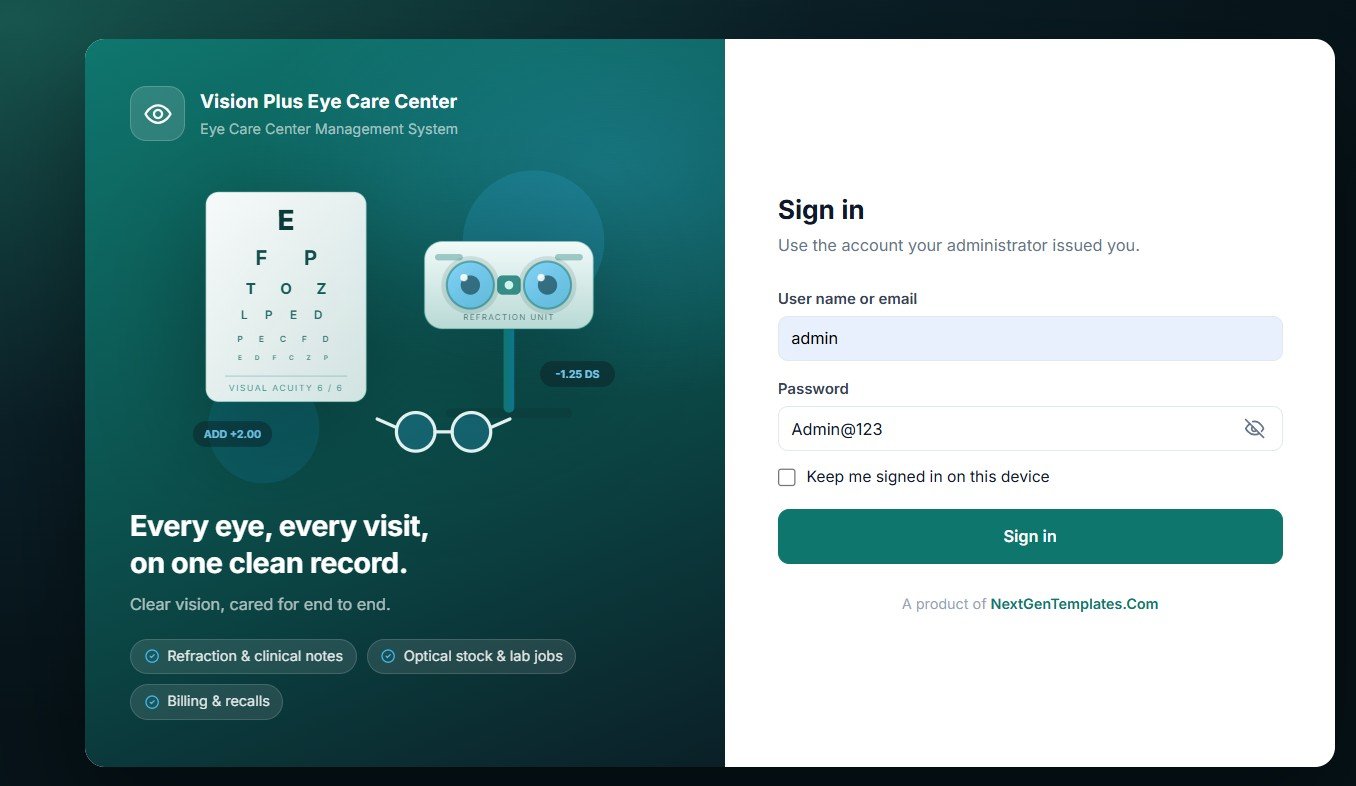
Sign in as admin to manage the whole system, as dr.anil to record eye exams and prescriptions, as reception to handle appointments and patient registration, as optician to manage eyewear inventory and sales, or as accounts to manage billing and payments.
| Role | Username | Password |
|---|---|---|
| 🧑💼 Admin | admin | Admin@123 |
| 👨⚕️ Doctor / Optometrist | dr.anil | Doctor@123 |
| 💁♀️ Receptionist | reception | Front@123 |
| 🕶️ Optician / Store | optician | Optic@123 |
| 🧾 Accountant | accounts | Accts@123 |
💡 What you get after purchase: The full source code (Code.gs + Index.html) plus a step-by-step deployment guide so you can deploy your own private instance in your own Google account in under 15 minutes.
Most eye clinics end up running three disconnected things at once: a paper case sheet for the refraction, a spreadsheet for frame and lens stock, and a receipt book for billing. The powers get re-typed on the way to the lab, the recall register goes stale, and nobody can say how much capital is sitting in slow-moving frames. This system puts the whole patient journey – registration, appointment, examination, prescription, optical sale, lab job order, invoice, payment and recall – behind one login Eye Care Center Management System Web App .
Key Features of the Eye Care Center Management System Web App
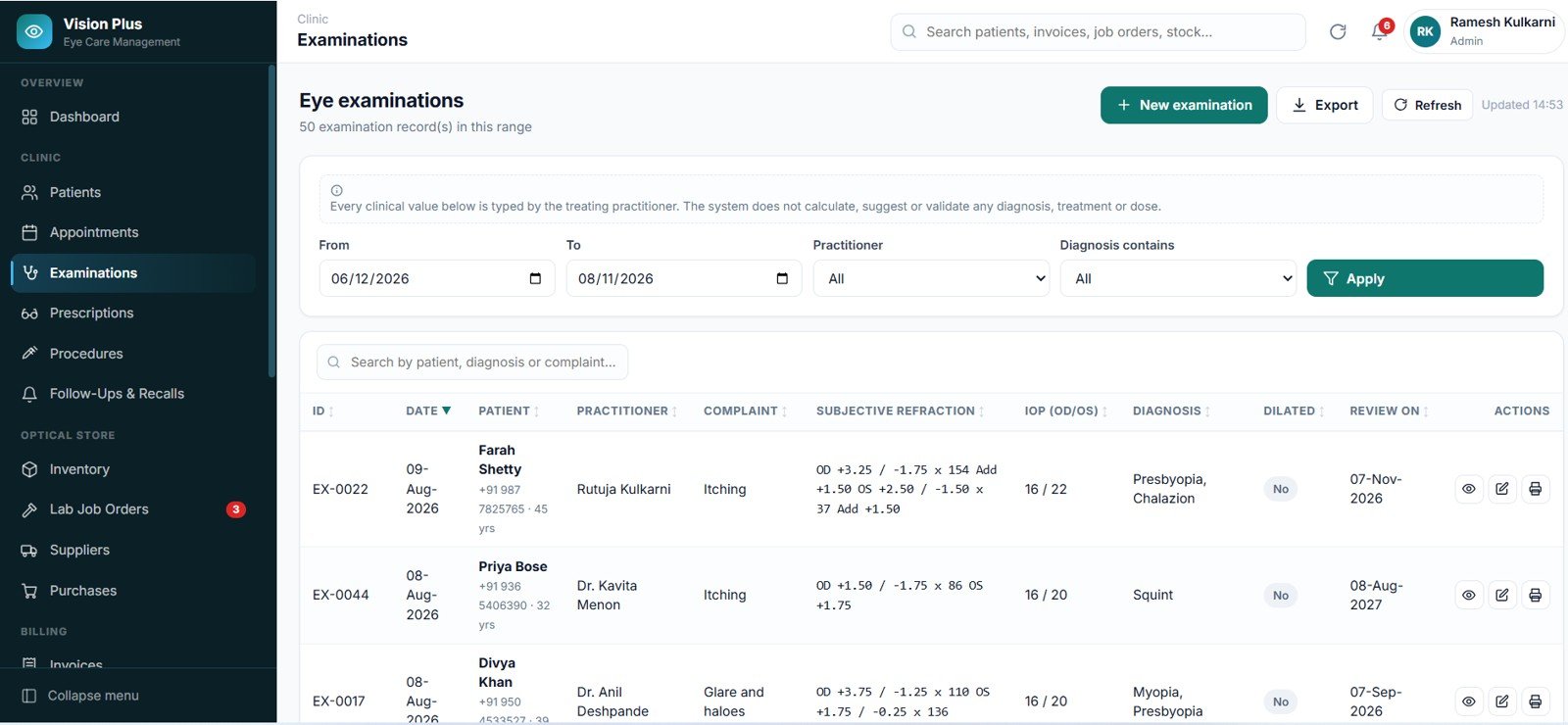
- A full refraction record. Each examination stores distance and near visual acuity, auto-refraction, subjective refraction with sphere, cylinder, axis and add, intraocular pressure for both eyes, anterior and posterior segment findings, assessment and plan.
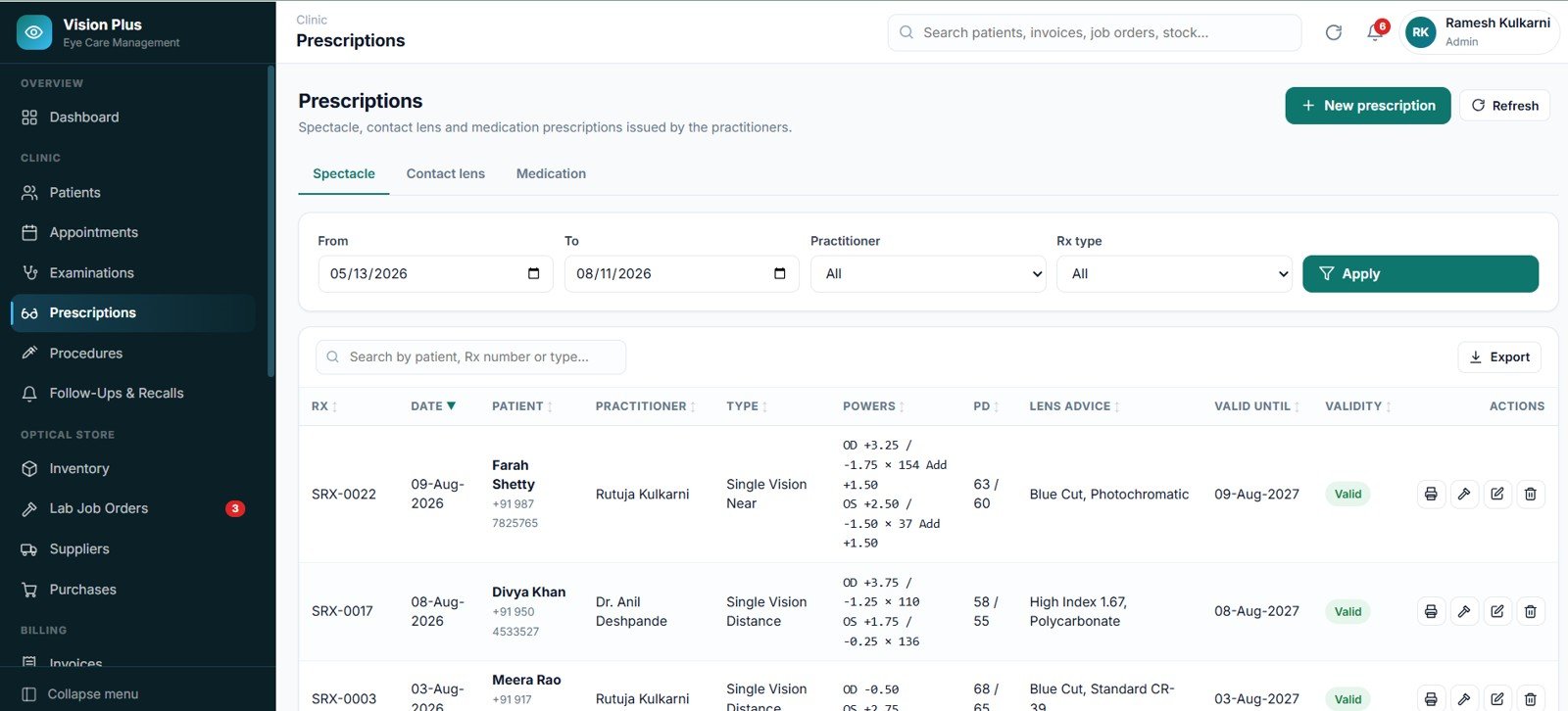
- Three prescription types. Spectacle, contact lens and medication prescriptions each get their own numbering series, powers grid, validity date and print layout.
- An optical store, not an add-on. Frames, spectacle lenses, contact lenses, solutions and accessories carry cost, MRP, selling price, shelf and reorder level, and every movement writes a row to the stock ledger.
- Lab job orders with a seven-step status trail. Pending, Sent to Lab, In Progress, Fitted, Quality Check, Ready and Delivered, with expected dates and overdue highlighting.
- Billing that reconciles. Line discounts, bill-level discount as amount or percent, tax, round-off, part payments, receivables ageing and an insurance claim register.
- Five roles enforced twice. Admin, Doctor/Optometrist, Receptionist, Optician/Store and Accountant – checked in the menu and again on the server before any data is read or written.
- Ten printable documents at three sizes. A4, 4-inch and 3-inch, set separately per document type.
- No clinical automation. The system never generates, suggests or calculates a diagnosis, treatment or medication dose. Every clinical field is free entry or list-driven.
Screen-by-Screen Walkthrough
Sign In
A split sign-in screen carrying your clinic name and logo. Users sign in with a user name or their email address, and Keep me signed in holds the session on trusted machines.
Dashboard
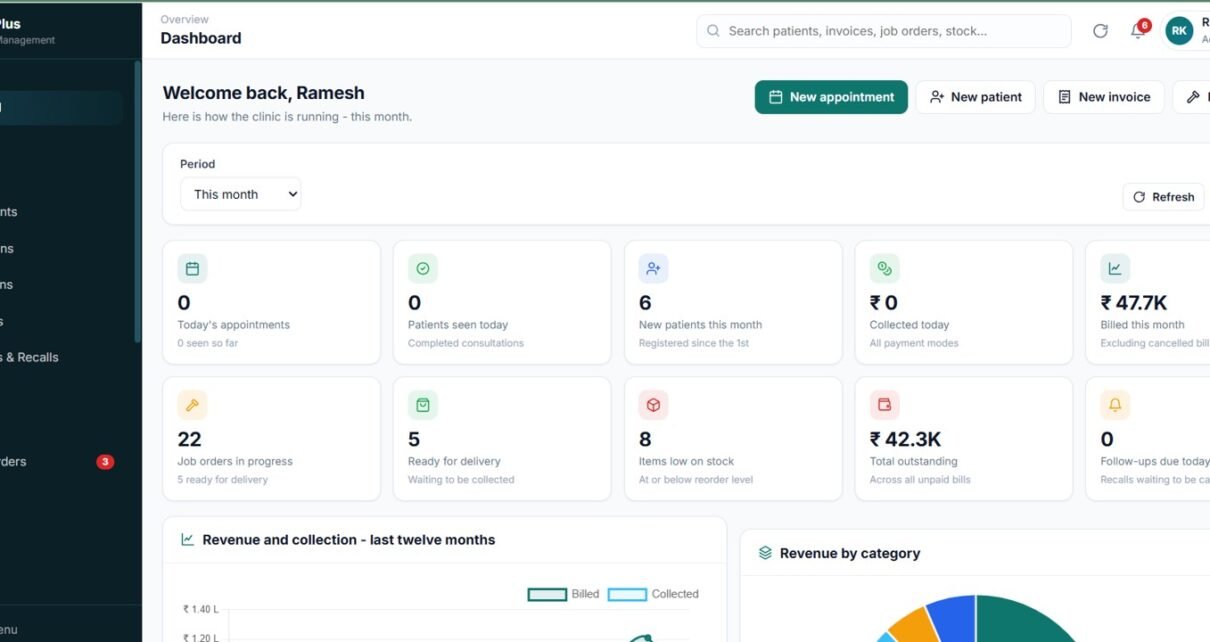
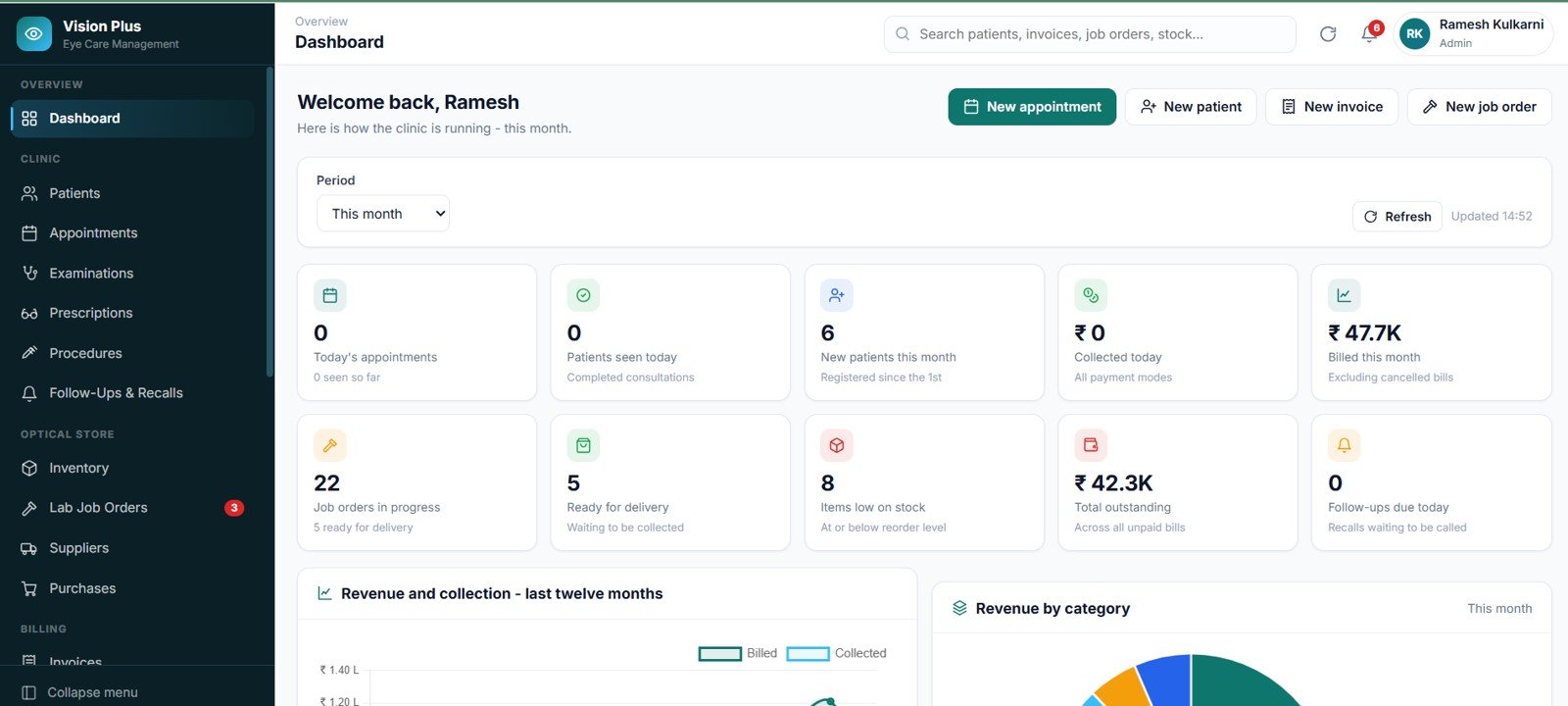
Ten live figures – today’s appointments, patients seen today, new patients this month, collected today, billed this month, job orders in progress, ready for delivery, items low on stock, total outstanding and follow-ups due today – plus Revenue and collection last twelve months and Revenue by category.
Patients
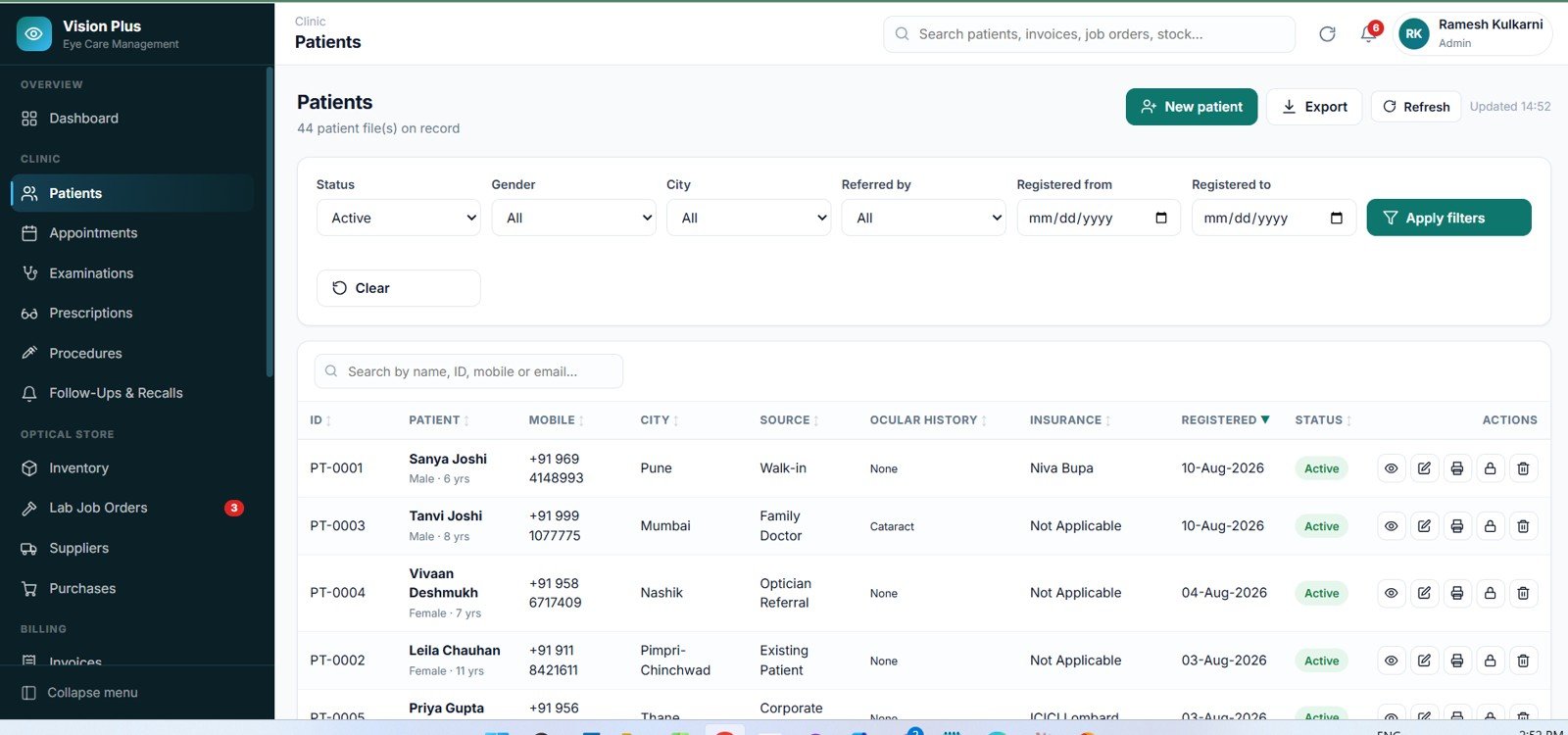
The register shows mobile, city, source, ocular history, insurance, registration date and status, with a nine-tab patient profile behind every row and duplicate checking on new registrations.
Appointments
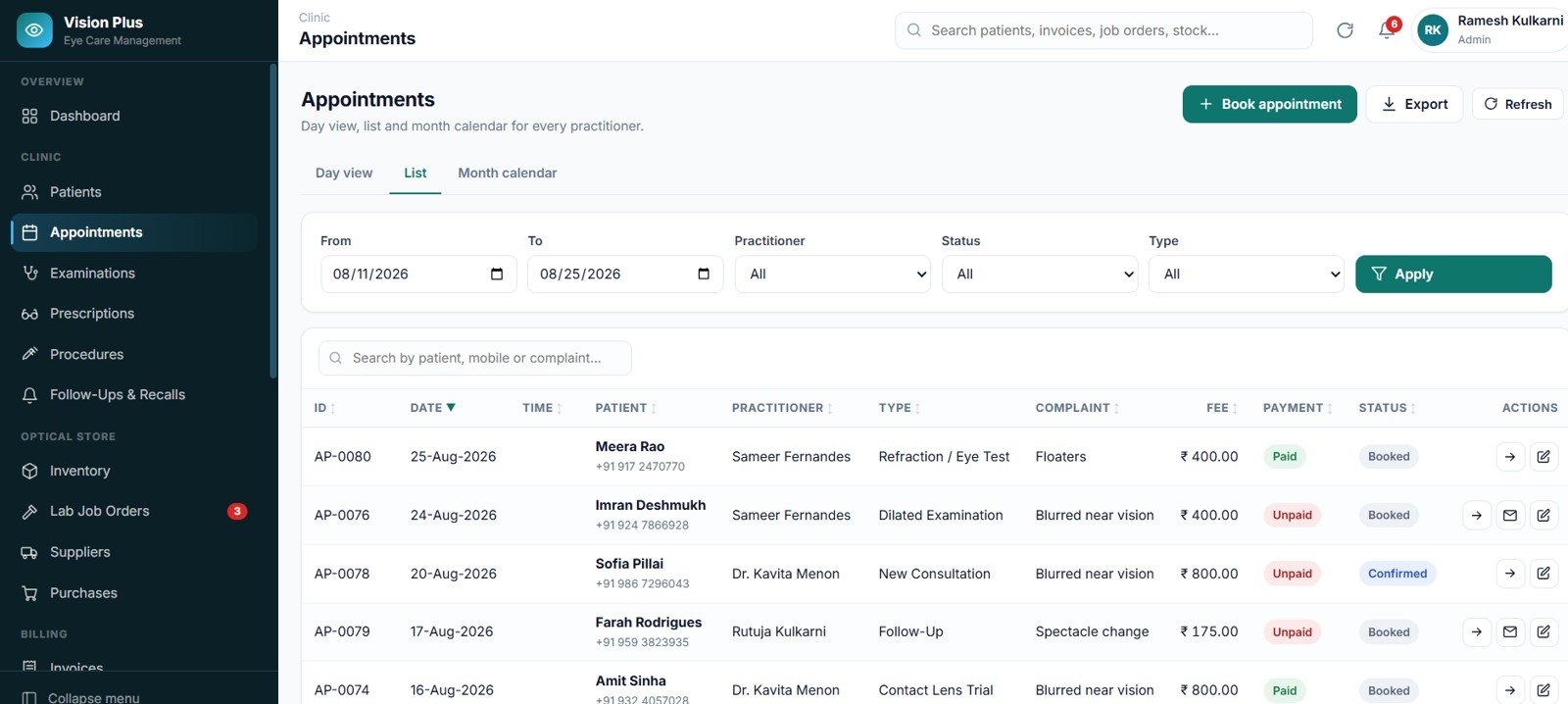
Three views of one diary – a doctor-wise day view with time slots, a filterable list and a month calendar – each booking carrying practitioner, type, chief complaint, fee and payment status. Eye Care Center Management System Web App .
Eye Examinations
The consulting-room record: complaint, subjective refraction, IOP for both eyes, diagnosis, dilation status and review date, filterable by date, practitioner and diagnosis text.
Prescriptions
Spectacle, contact lens and medication prescriptions on three tabs, each with powers, PD, lens advice, validity and a dedicated print layout.
Procedures
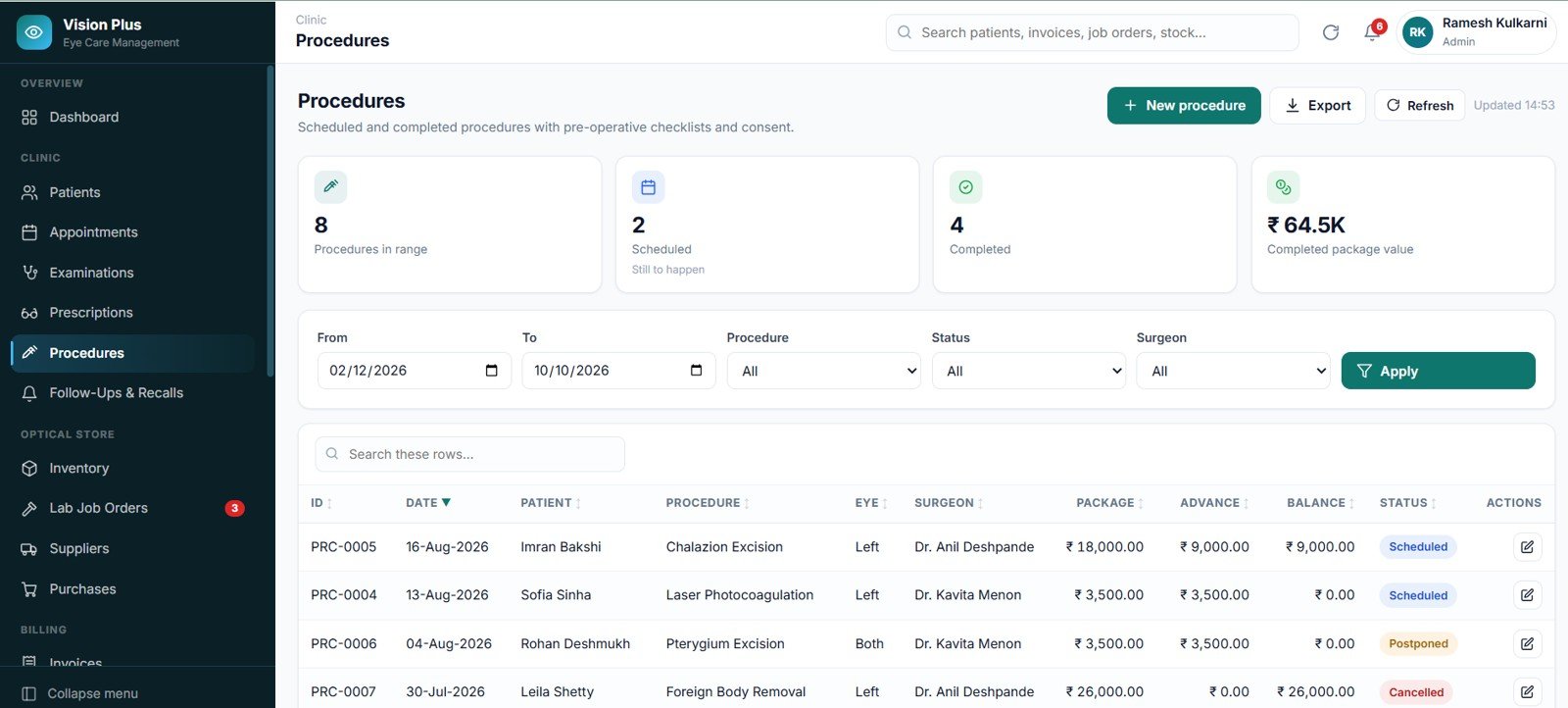
Procedures in range, scheduled, completed and completed package value across the top, then each case with eye, surgeon, package amount, advance, balance and status.
Follow-Ups and Recalls
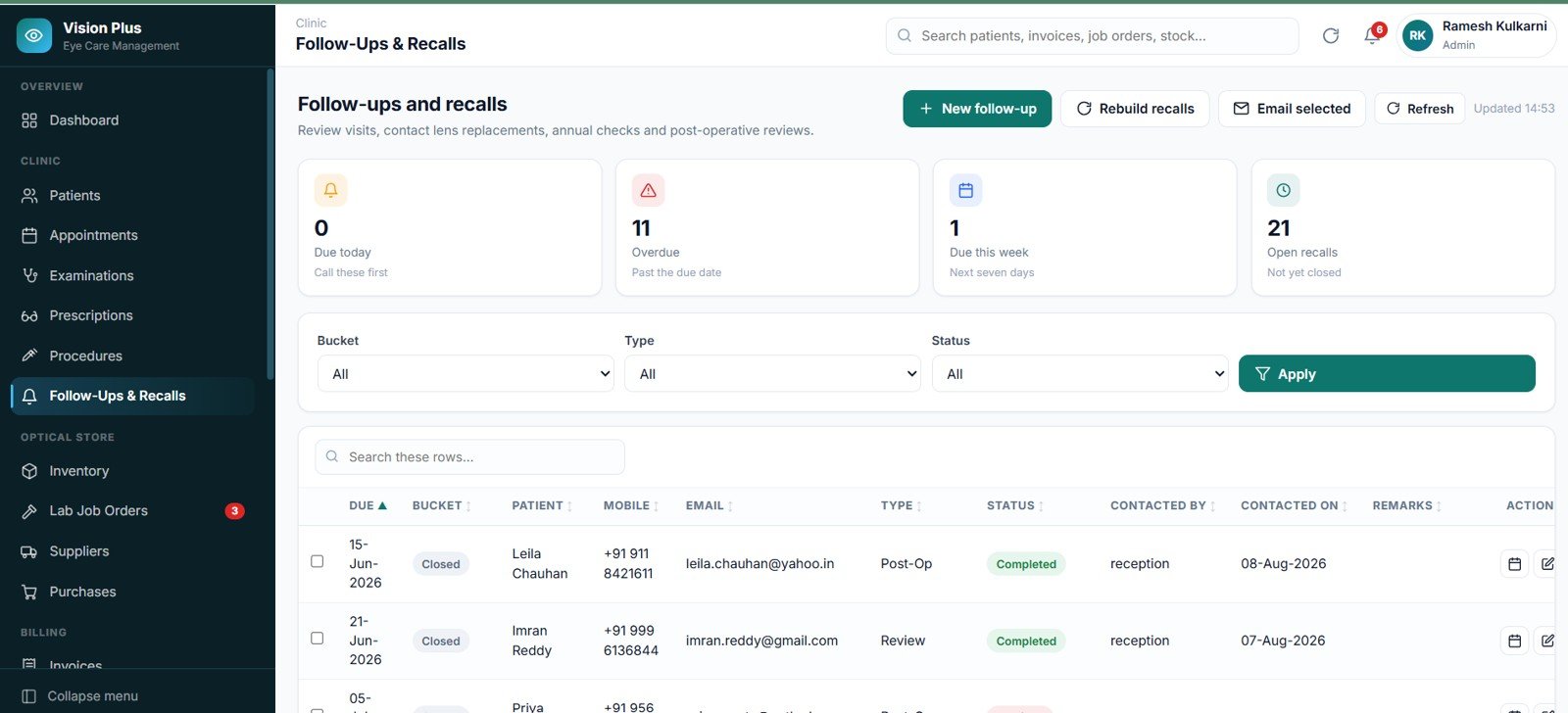
Due today, overdue, due this week and open recalls as counters, with a Rebuild recalls button that regenerates the list from your own clinical records and an Email selected batch action.
Optical Inventory
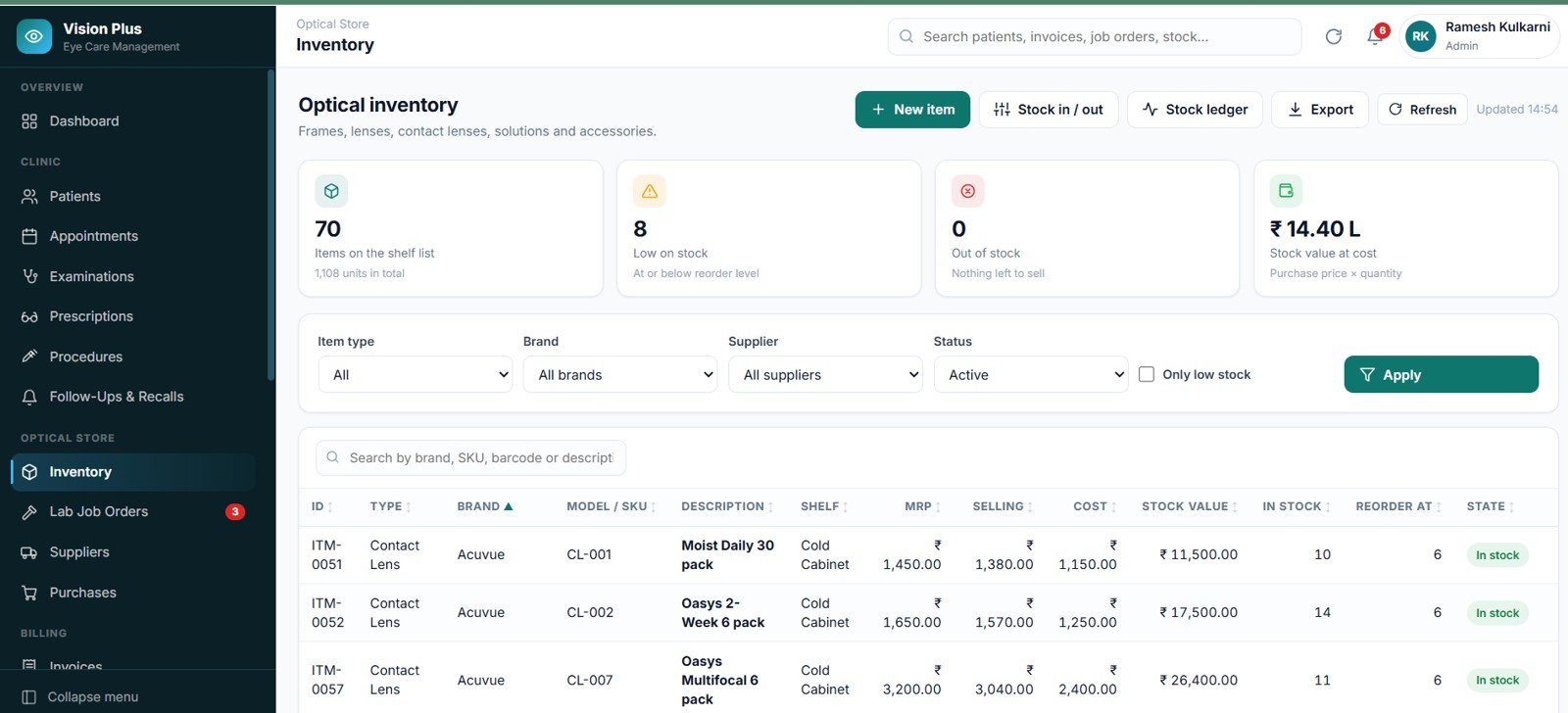
Items on the shelf list, low on stock, out of stock and stock value at cost, then every item with type, brand, model, shelf, MRP, selling price, cost, stock value, quantity and reorder level.
Lab Job Orders
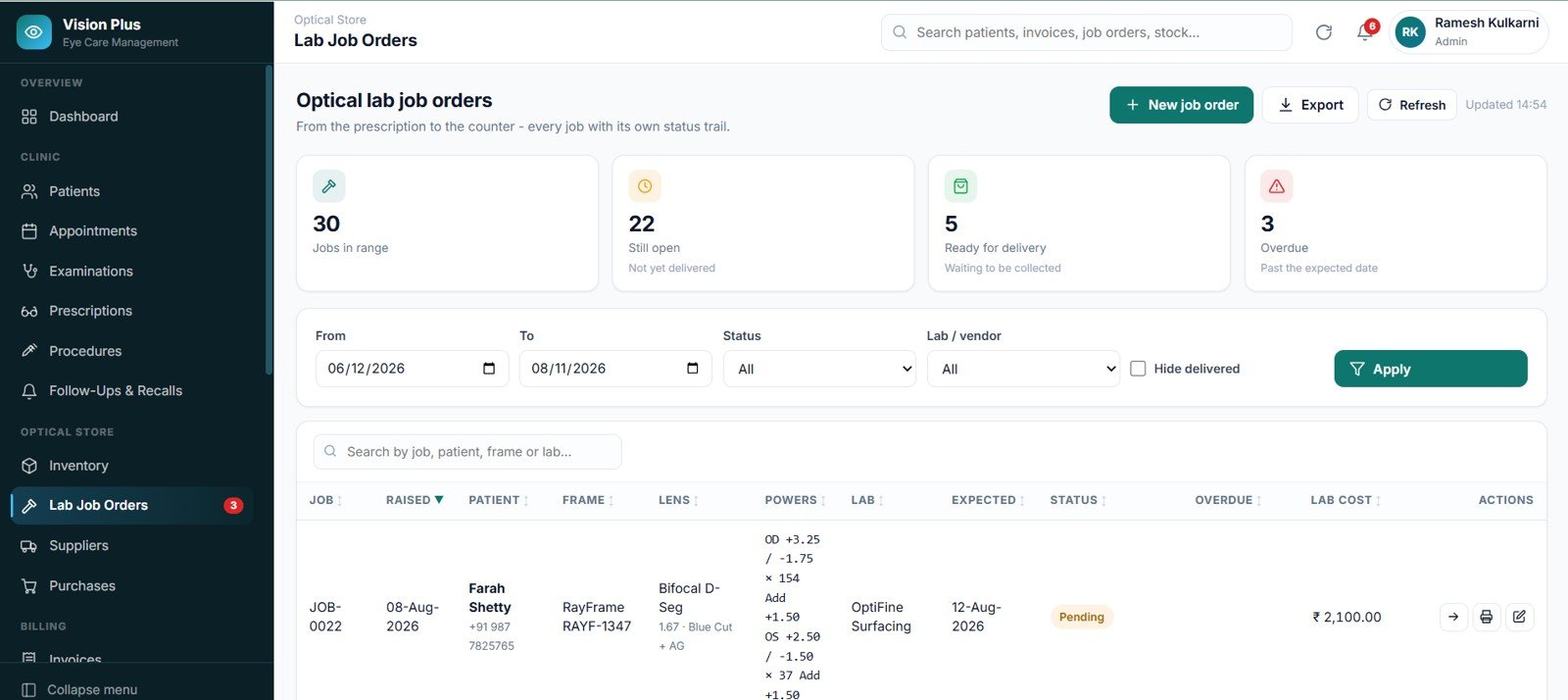
Jobs in range, still open, ready for delivery and overdue as live counters, with frame, lens, powers, lab, expected date, status and lab cost on every row.
Suppliers
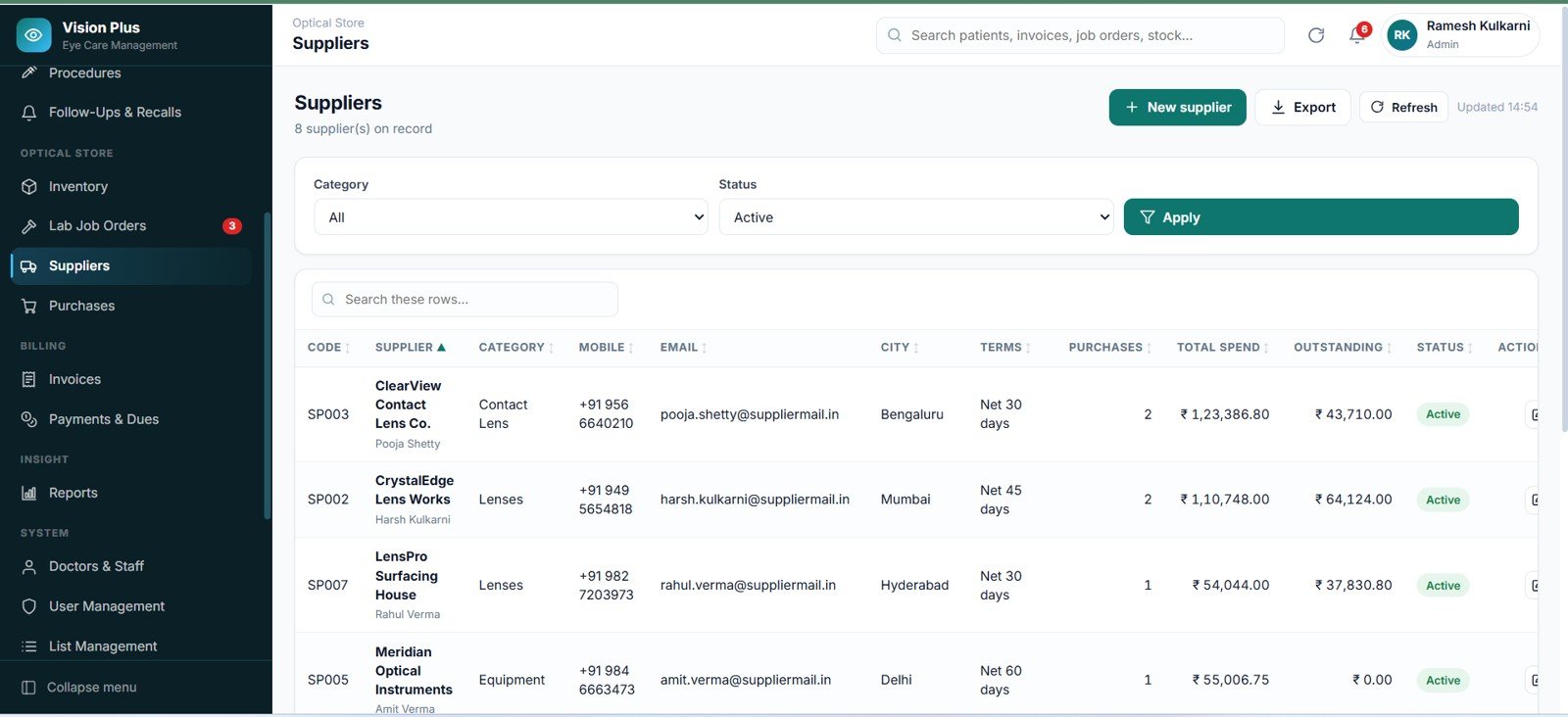
Every vendor with category, contact, city, payment terms, purchase count, total spend and outstanding balance in one line.
Purchases
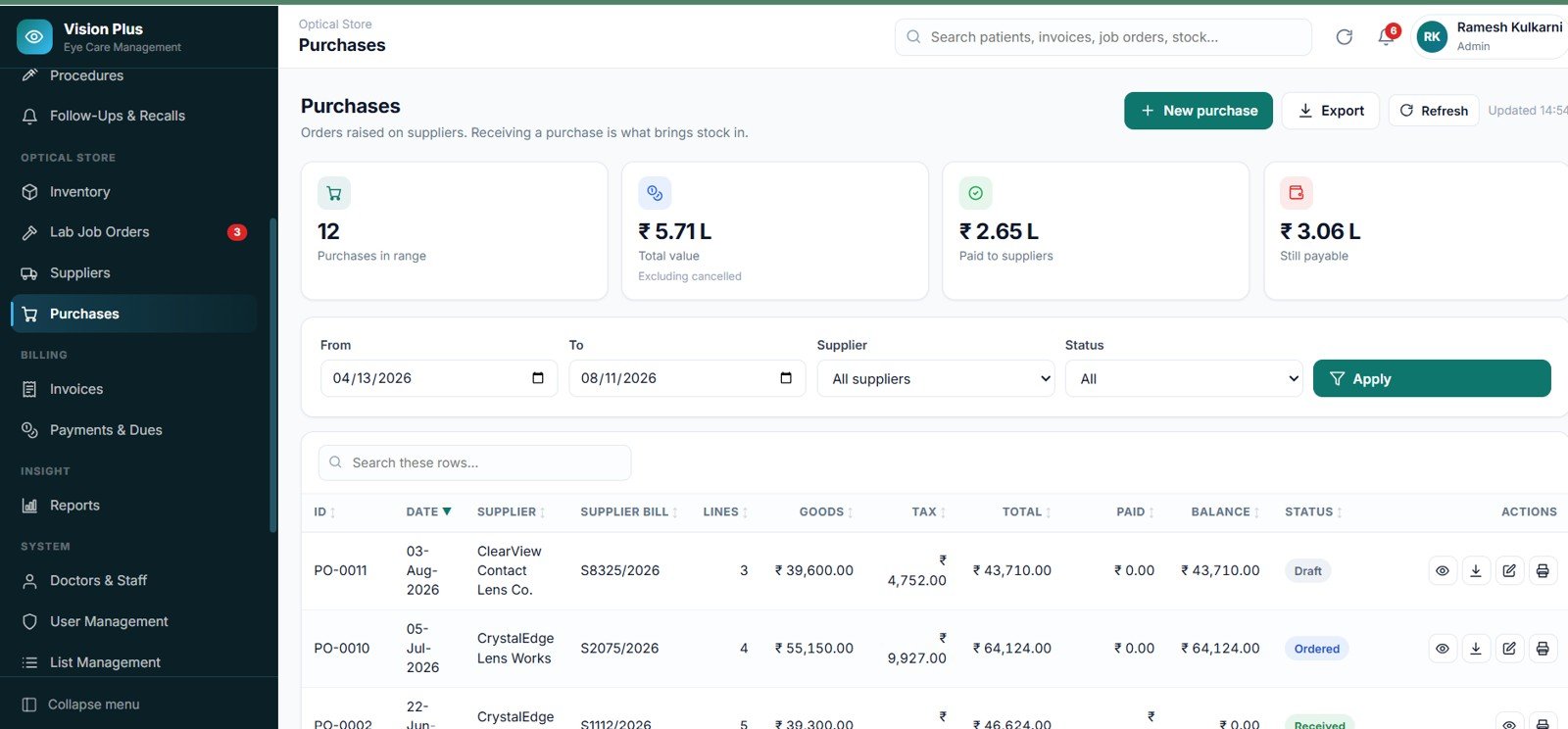
Purchases in range, total value, paid to suppliers and still payable, with a Received action that is what actually brings goods into stock.
Invoices
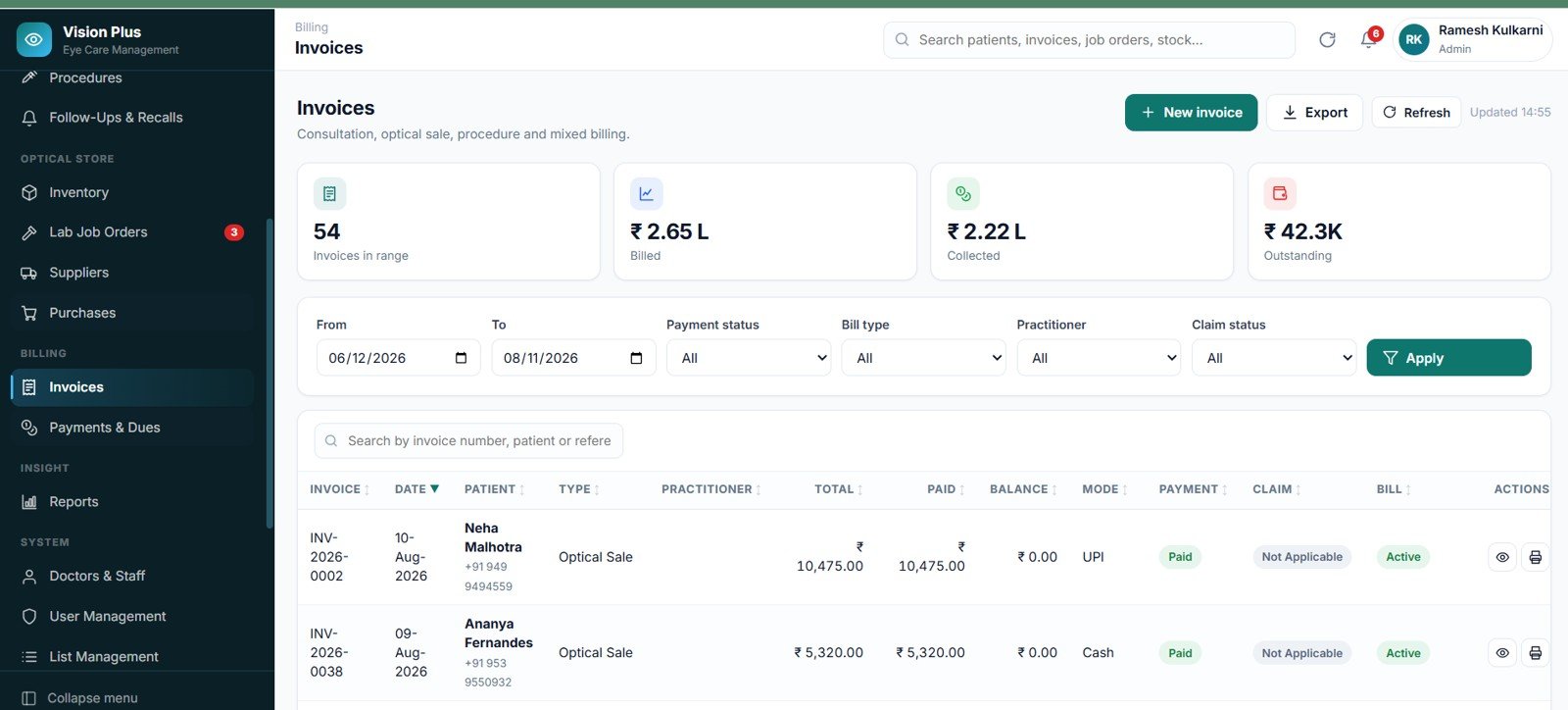
Invoices in range, billed, collected and outstanding at the top, then every bill with type, practitioner, total, paid, balance, mode, payment status and insurance claim status.
Payments and Dues
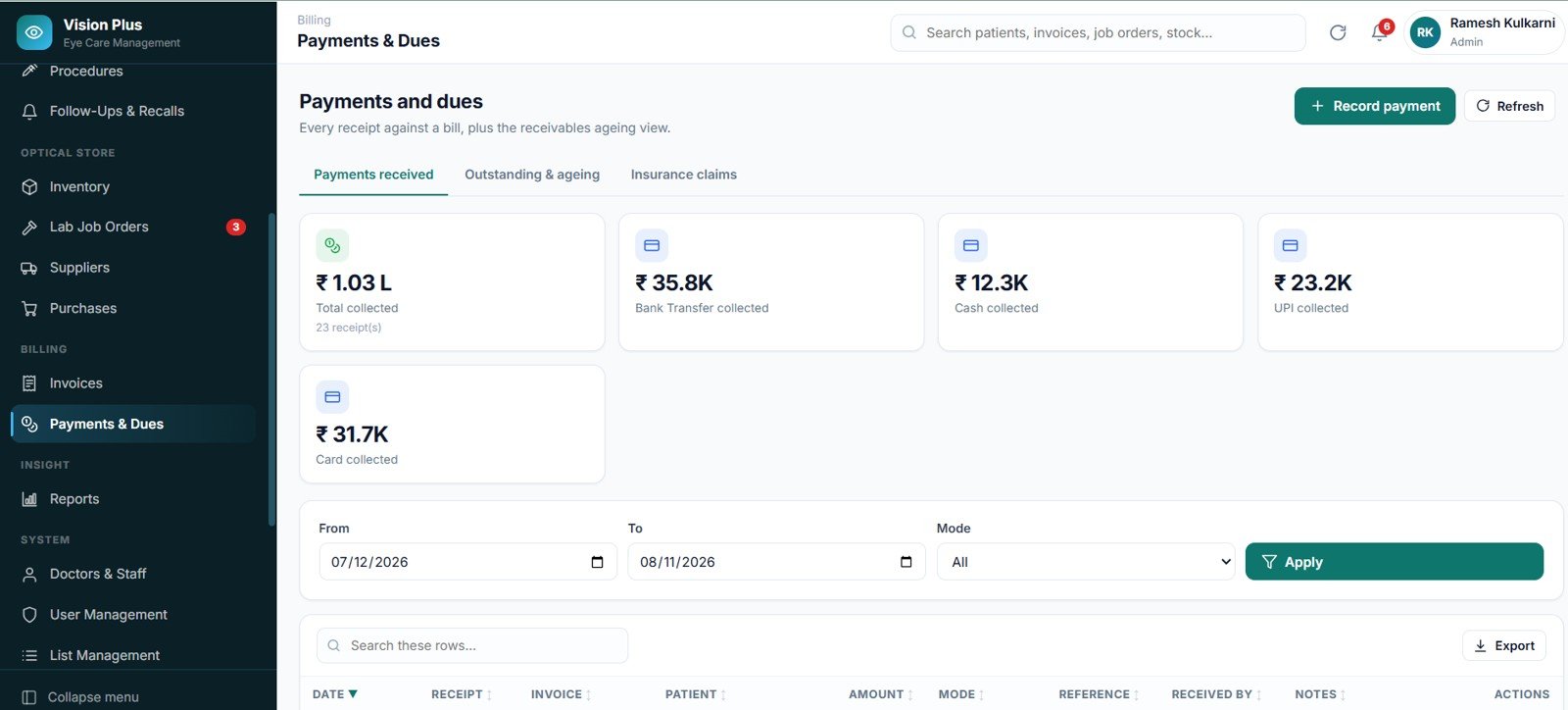
Collections split by mode – cash, card, UPI and bank transfer – across three tabs: Payments received, Outstanding and ageing, and Insurance claims.
Reports
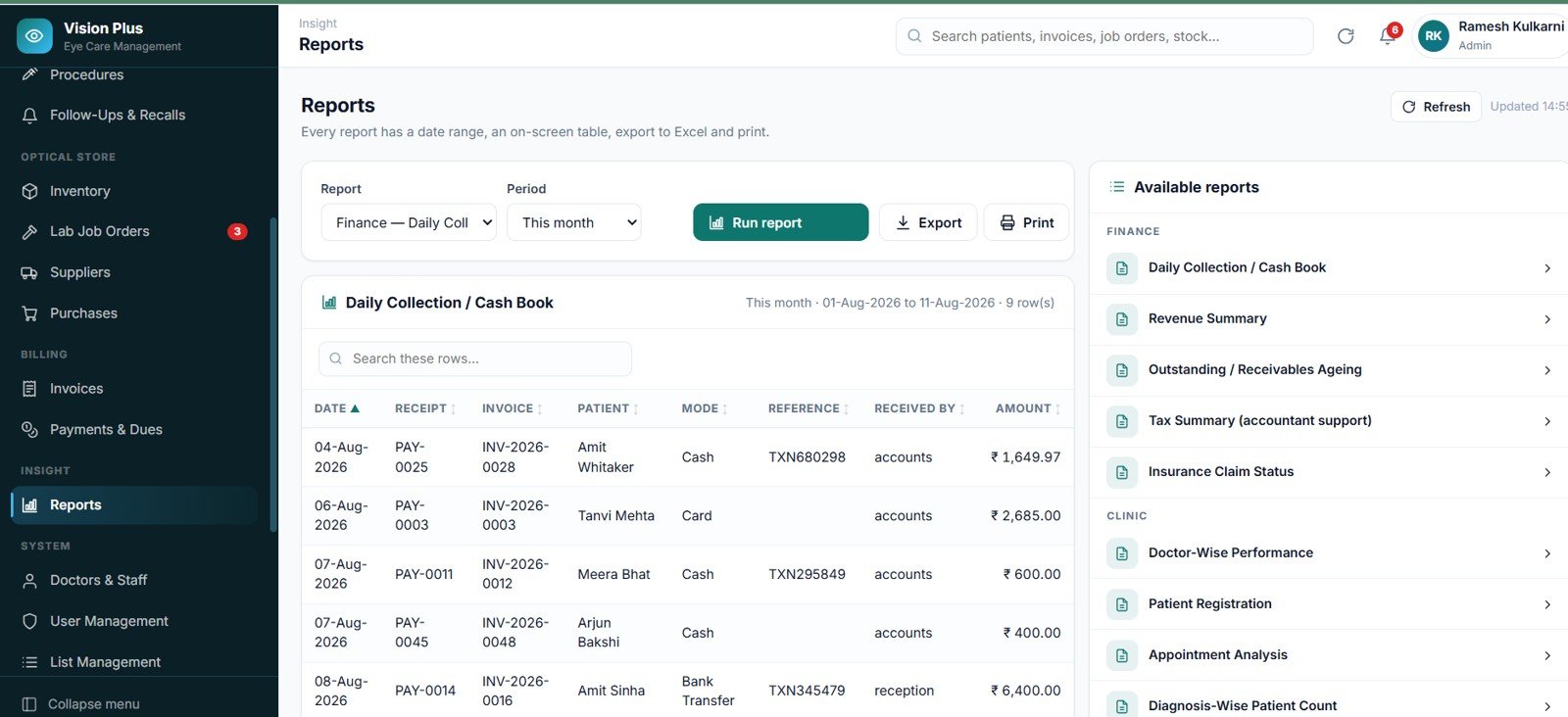
Twenty reports in five groups with a period picker, on-screen result, Excel export and print: Finance (Daily Collection / Cash Book, Revenue Summary, Outstanding / Receivables Ageing, Tax Summary, Insurance Claim Status), Clinic (Doctor-Wise Performance, Patient Registration, Appointment Analysis, Diagnosis-Wise Patient Count, Follow-Up Due), Optical (Optical Sales, Current Stock, Low Stock, Stock Movement Ledger, Stock Valuation, Fast and Slow Moving Items, Job Order Status and Turnaround), Purchasing (Purchase Summary, Supplier Payables) and System (Audit Log).
Doctors and Staff
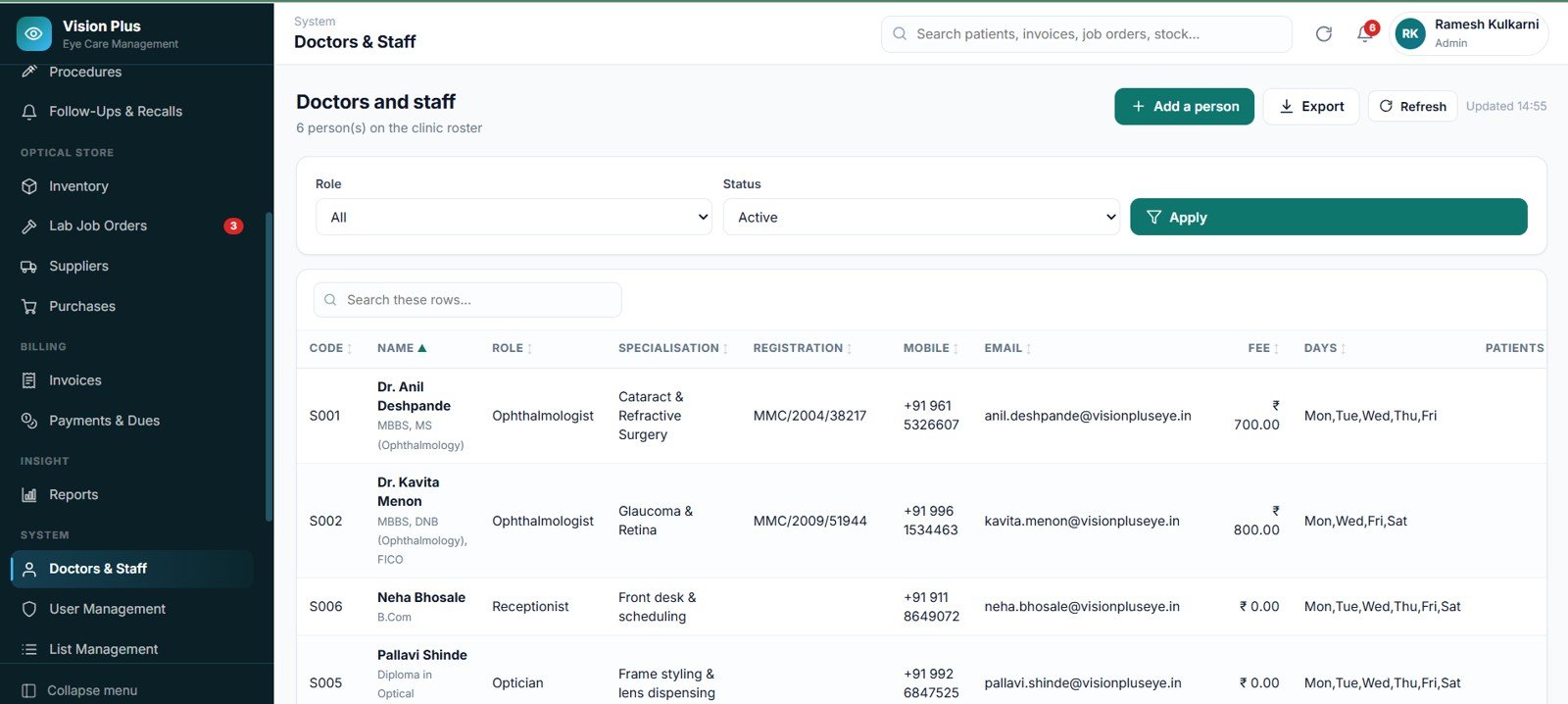
The clinic roster with role, specialisation, registration number, consultation fee, working days and patients seen.
User Management
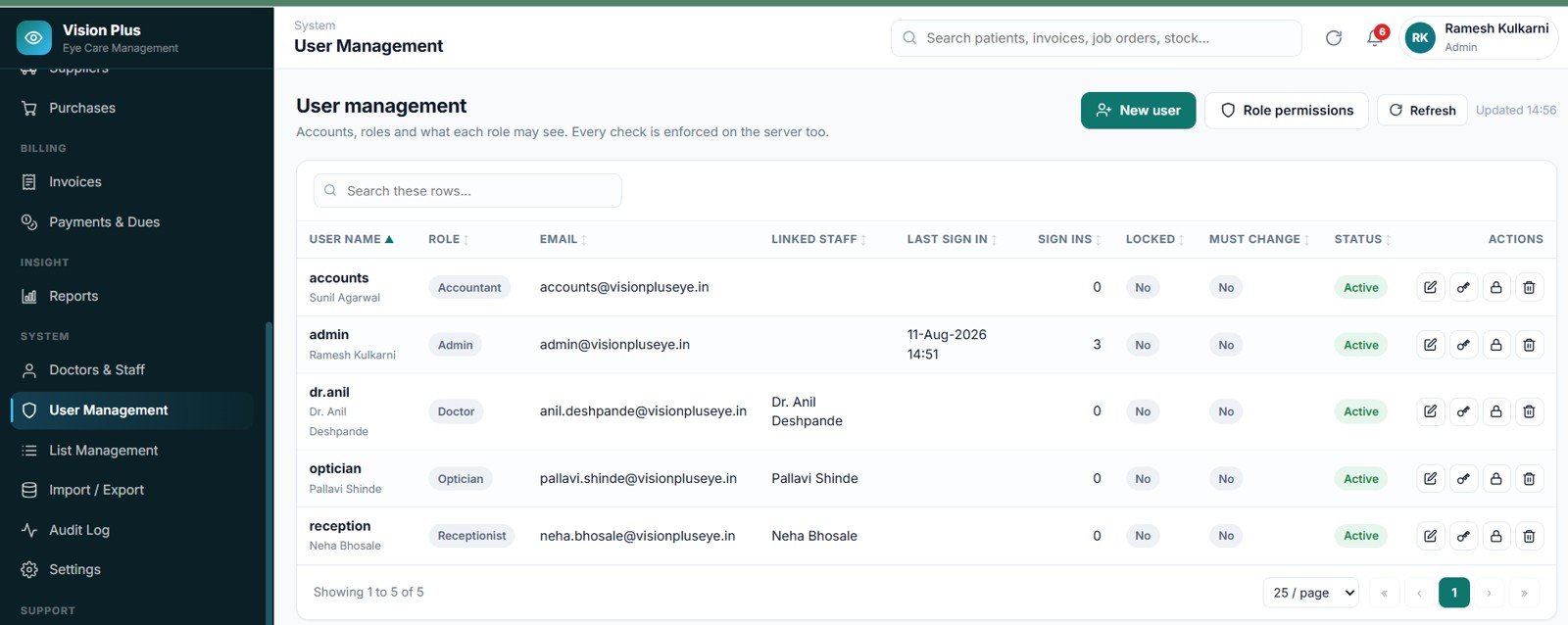
Accounts with role, linked staff member, last sign-in, sign-in count, lock state and must-change-password flag, plus a Role permissions matrix.
Import and Export
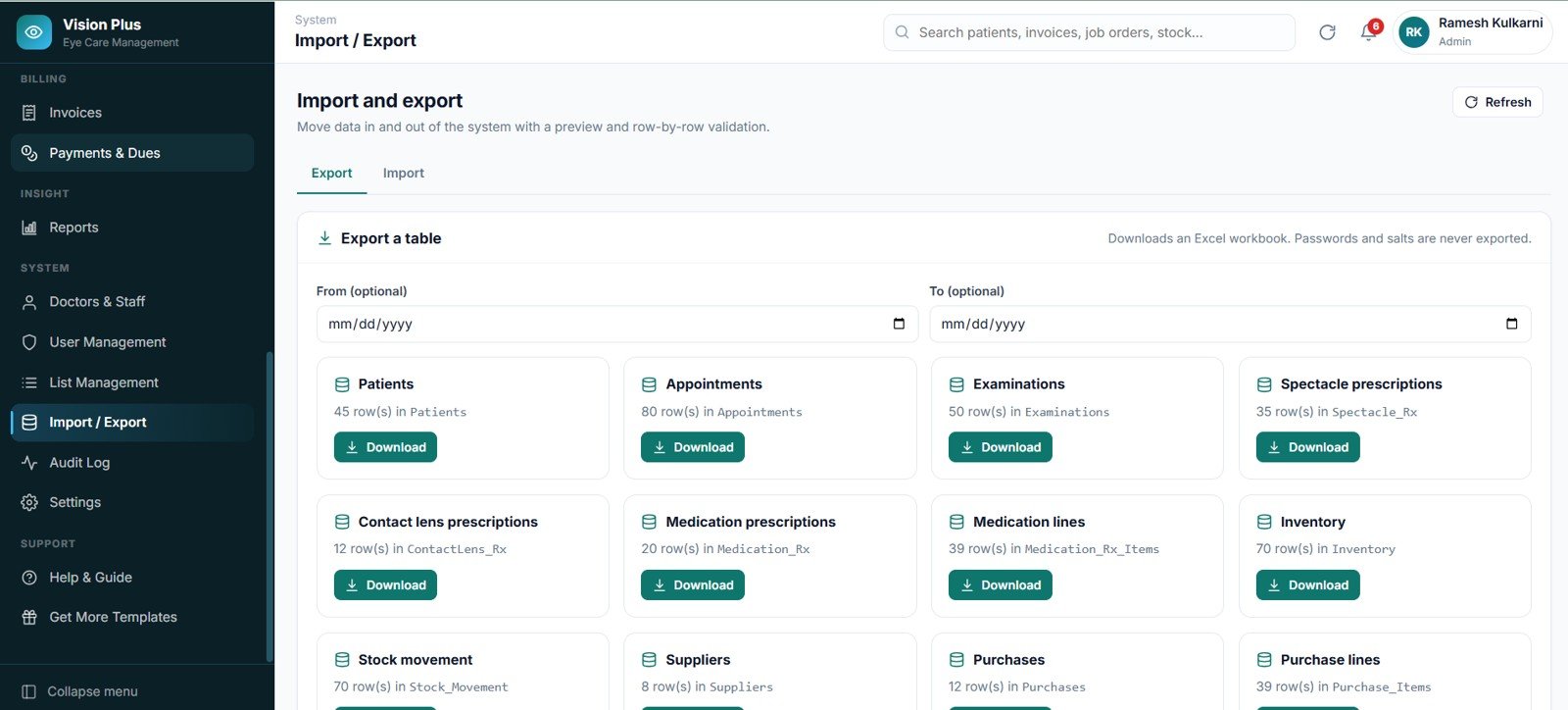
Twelve tables can be exported with an optional date range and five can be imported from a downloadable template. Passwords and salts are never exported.
Audit Log
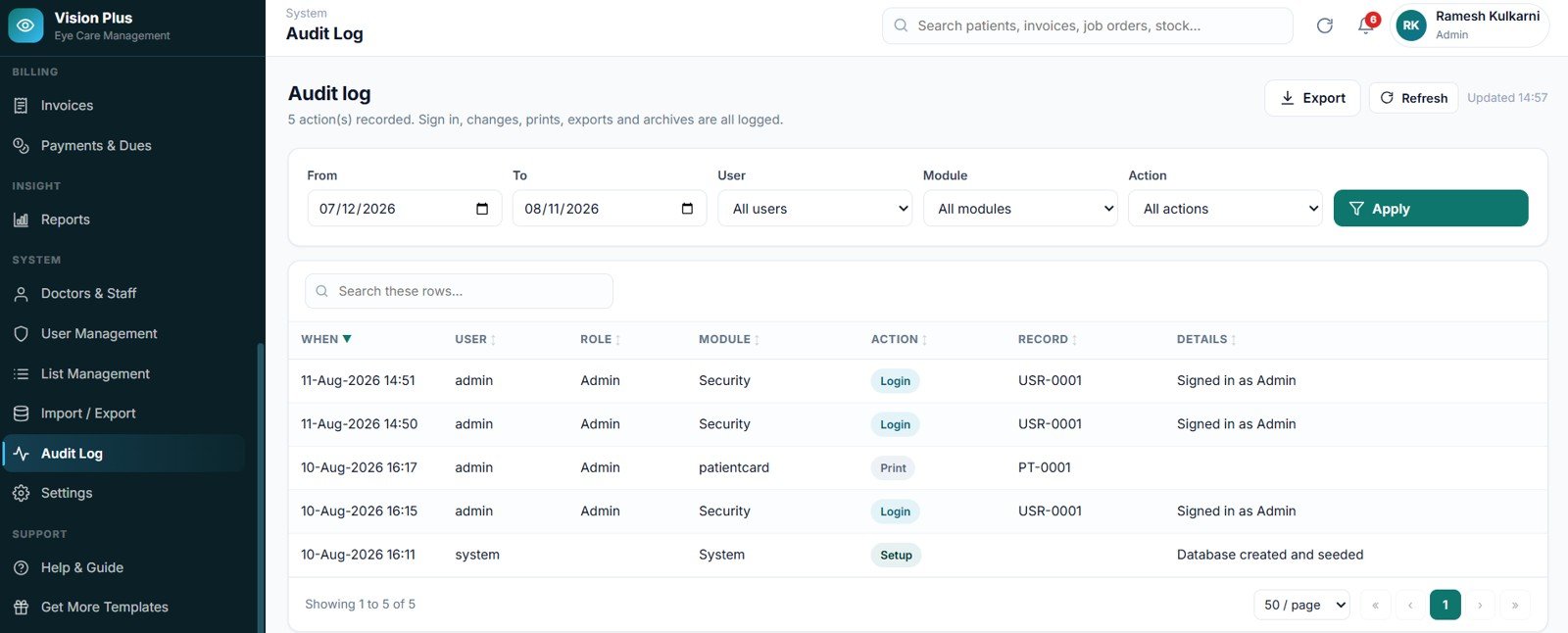
Sign-ins, changes, prints, exports and archives with the user, role, module, action, record and timestamp – filterable by date, user, module and action.
Settings
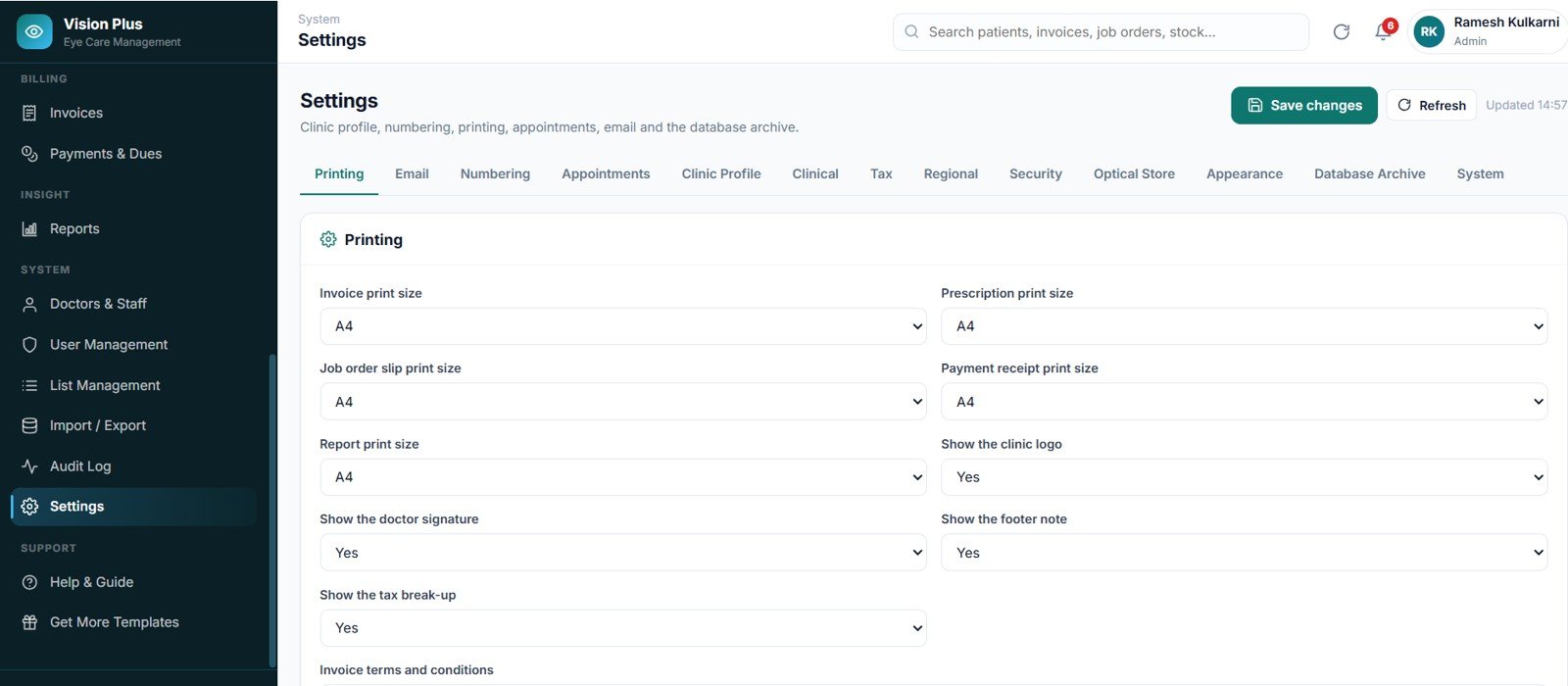
73 settings across 11 groups on 13 tabs – Clinic Profile, Printing, Email, Numbering, Appointments, Clinical, Tax, Regional, Security, Optical Store, Appearance, Database Archive and System.
Help and Guide
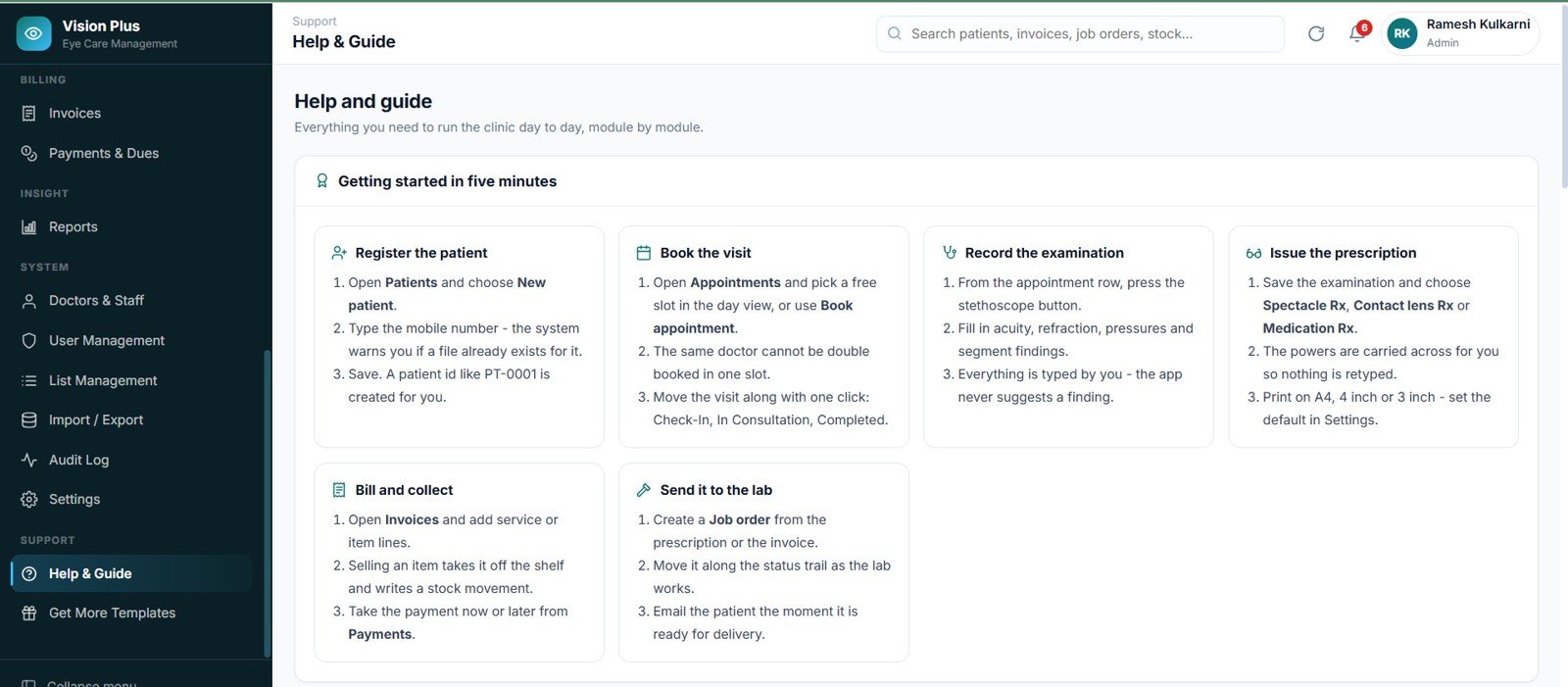
A built-in Getting started in five minutes page with six how-to cards: register the patient, book the visit, record the examination, issue the prescription, bill and collect, send it to the lab.
Eye Care Center Management System vs. an Excel/VBA Clinic Tool vs. Paid Optometry SaaS – Feature Comparison
| Feature | Eye Care Center Management System Web App | Excel / VBA Clinic Tool | RevolutionEHR / Practo Ray / Cliniko |
|---|---|---|---|
| Cost | $39.99 one-time | $50-150 one-time | $50-150 per user / month |
| Platform | Any browser – Google Sheets + Apps Script | Windows Excel with macros enabled | Vendor cloud |
| Setup time | About 10 minutes | 15-30 minutes | Days – onboarding call and data migration |
| Real-time team collaboration | Yes – unlimited users, 5 roles | No – one file, one user at a time | Yes – per seat, billed monthly |
| Mobile access | Yes – responsive to 390px | No – macros do not run on mobile | Yes |
| Customisable fields and dropdowns | Yes – 64 editable master lists, no code | Needs VBA edits | Limited to vendor fields |
| Optical stock and lab job orders in the same system | Yes – built in | Rarely | Often a paid add-on module |
| Own your database | Yes – a Google Sheet in your account | Yes – a file on your PC | No – vendor-hosted, export on request |
| Year-1 cost at 5 users | $39.99 | $50-150 | $3,000-9,000 |
For an eye clinic that wants a real multi-user system with an optical store and a lab bench attached, without a per-seat monthly bill, the Eye Care Center Management System Web App sits in the sweet spot.
Who Should Use This Template
Perfect for:
- Independent eye clinics and optometry practices with 1-10 practitioners that also run a dispensing counter.
- Optical showrooms needing prescriptions, frame and lens stock, lab job orders and billing in one place.
- Vision centres and small eye hospitals replacing paper case sheets or a shared spreadsheet.
- Owners who want the database to live in their own Google Drive rather than a vendor’s cloud.
Not a fit if:
- You need a HIPAA Business Associate Agreement, SOC 2 certification or single sign-on. This is an Apps Script app, not a certified EHR.
- You need to file electronic insurance claims to a payer clearinghouse – the system tracks claim status but does not submit claims.
- You are a multi-hospital group generating tens of thousands of rows a month; Apps Script quotas and Sheets row limits become the ceiling.
Real-World Use Cases
Dr. Anita runs a two-chair optometry practice with a dispensing counter. Her receptionist books the slot, Anita records the refraction and issues the spectacle prescription, and the optician raises the lab job order straight from that prescription – so the powers can never be re-typed wrong on the way to the lab.
Ravi manages a three-branch optical chain. He signs in as Accountant, opens Outstanding and ageing to see which bills have crossed 60 days, then runs Stock Valuation to check how much capital is tied up in slow-moving frames – without ever seeing a patient’s clinical notes.
A small eye hospital retired its paper recall register. Follow-ups are rebuilt from the clinical records themselves, so annual eye checks, contact-lens replacements and post-operative reviews surface on their due date and go out as a batch email.
Advantages of the Eye Care Center Management System Web App
- No monthly bill. A five-person practice on a $60-per-user SaaS plan spends about $3,600 a year. This is $39.99 once.
- Nothing to install. It runs as a Google Apps Script web app, so any browser on a desktop, tablet or phone works.
- Configured, not re-coded. 64 master lists mean an administrator can add a diagnosis, a lens coating or an insurance panel without touching code.
- Every figure reconciles. Taxable value plus tax plus round-off equals the grand total on every invoice, and the stock ledger nets exactly to the item balance.
- A real audit trail. Every sign-in, edit, print, export and archive is logged with user, role and timestamp.
Opportunities for Improvement
Being straight about the limits: Apps Script has daily execution quotas, so very high-volume clinics will feel a ceiling. There is no offline mode – if the internet is down, the app is down. Insurance claims are tracked, not electronically filed. There is no built-in SMS gateway, so recall reminders go by email unless you wire in a provider. And because the database is a Google Sheet, anyone with edit access to that Sheet can bypass the app’s role checks – keep the Sheet shared with the script owner only.
Best Practices
- Change all five default passwords in User Management before the first real patient is registered.
- Fill in Settings first – clinic name, address, tax number, logo and numbering prefixes appear on every printed document.
- Trim the master lists to what your clinic actually uses; short dropdowns are faster than long ones.
- Receive purchases as soon as goods arrive – that action, not the purchase order, is what brings stock in.
- Run Rebuild recalls weekly so the follow-up list stays honest.
- Use Database Archive once the transaction sheets get large; masters are never archived.
Explore Relevant Templates
- Dental Clinic Management System Web App – the same architecture for a dental practice.
- Physiotherapy Clinic Management System Web App – sessions, packages and therapist scheduling.
- Pathology Lab Management System Web App – sample tracking, test panels and report release.
- Medical Practice Dashboard in Google Sheets – a lighter, reporting-only alternative.
- Healthcare Administrator Toolkit – 9 Premium Templates – the reporting side of a healthcare practice in one bundle.
You can also browse every multi-user Web App template we build on Google Apps Script.
To build the spreadsheet skills behind management systems like this one, take a look at the NextGenTemplates Academy learning paths, which come with practice files.
Get the Eye Care Center Management System Web App
Frequently Asked Questions
What do I get when I buy the Eye Care Center Management System Web App?
You get a ZIP with Code.cs.txt (the backend), Index.txt (the frontend), Login_Details.txt containing the five default accounts, and a 43-page Word user manual covering deployment, roles, every module and an FAQ.
How long does installation take?
About ten minutes. Paste two files into Google Apps Script, deploy as a web app, then click Run setup now. The Eye Care Center Management System Web App builds all 26 sheets, 73 settings, 64 master lists and a full working data set by itself.
How does this compare to RevolutionEHR or Practo Ray?
Those are certified cloud EHRs billed per user per month. The Eye Care Center Management System Web App is a one-time purchase running in your own Google account with unlimited users. It has no EHR certification and does not file insurance claims, so pick it for practice management rather than regulated clinical certification.
Does it suggest a diagnosis or calculate lens powers?
No. The Eye Care Center Management System Web App never generates, suggests or calculates a diagnosis, treatment or medication dose. Every clinical field is free entry or driven by a master list the clinic maintains itself.
Can several staff use it at once?
Yes. Five roles – Admin, Doctor/Optometrist, Receptionist, Optician/Store and Accountant – and any number of accounts. Every permission is re-checked on the server before data is read or written.
Can I print on a 3-inch thermal printer?
Yes. Ten document types print at A4, 4-inch or 3-inch, set separately for invoices, prescriptions, job order slips, payment receipts and reports.
Where does my data live?
In one Google Sheet with 26 tabs inside your own Google Drive. Nothing is sent to NextGenTemplates, and the Users export always drops the password hash and salt.
About the Author
Built by PK – Microsoft Certified Professional with 15+ years of Excel, Google Sheets and Power BI experience. Founder of NextGenTemplates, reaching 300K+ subscribers across YouTube channels. Every template is hand-built and tested before release.
Conclusion
If your clinic is stitching together a case sheet, a stock spreadsheet and a receipt book, the Eye Care Center Management System Web App collapses all three into one browser tab – with the refraction, the frame, the lab job and the bill all pointing at the same patient record.
Instant download · One-time payment · No subscription
Last updated: August 2026