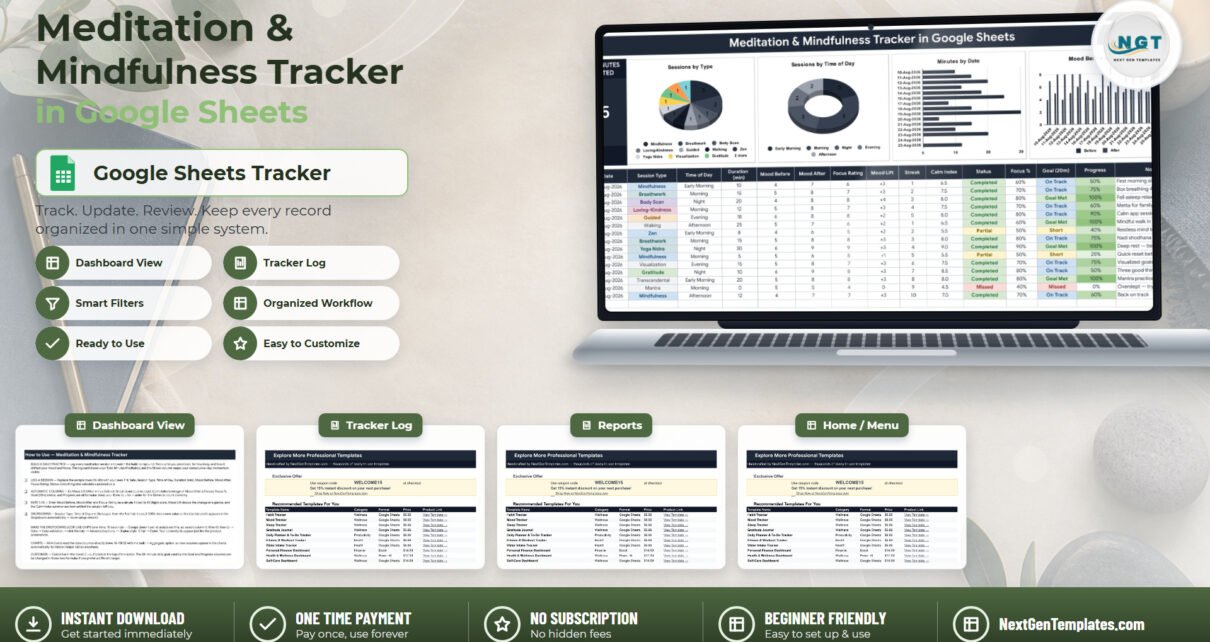
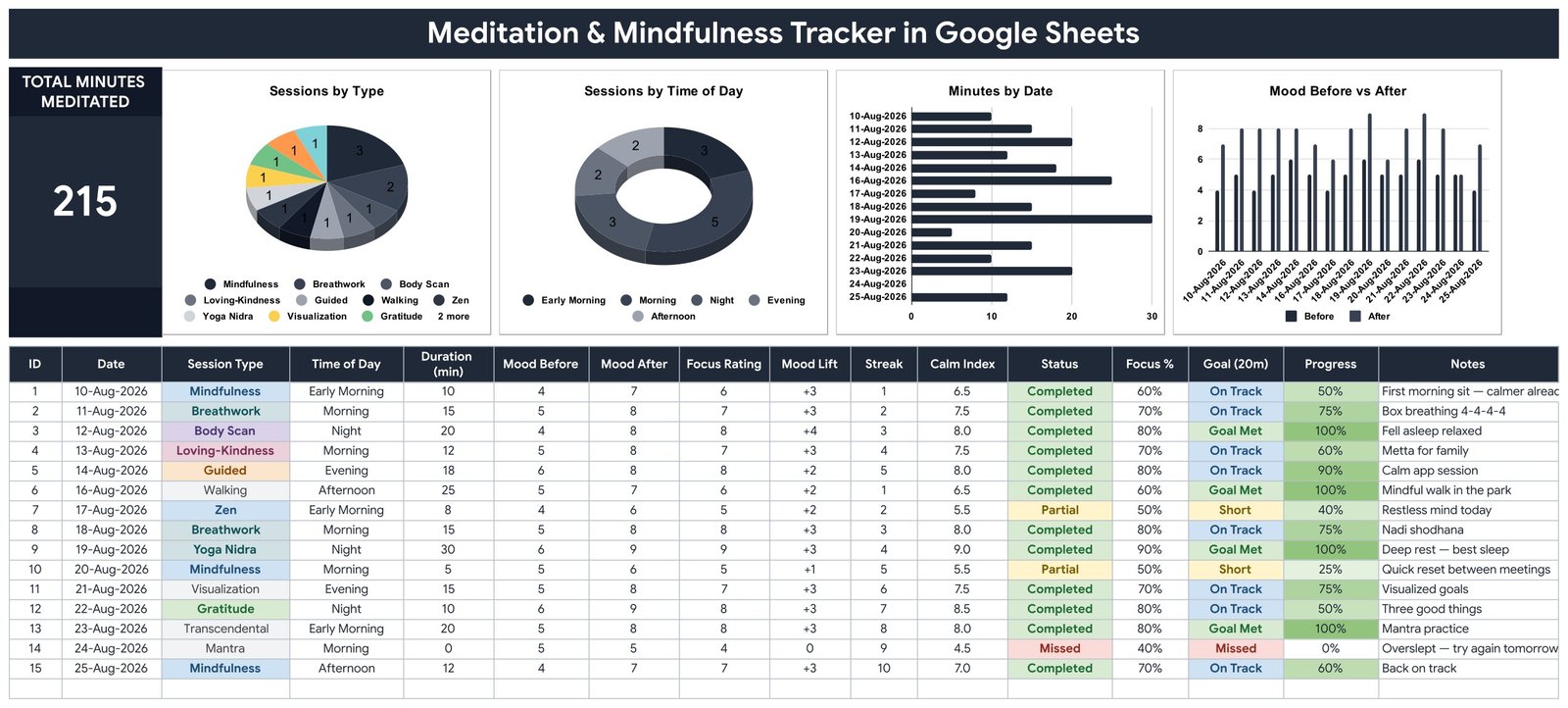
Most meditation habits do not fail loudly. They fade – three sessions one week, one the next, then a fortnight where you would honestly have to guess. The Meditation & Mindfulness Tracker in Google Sheets exists to remove the guessing. It is a four-tab Google Sheet built around a 16-column session log where you type nine values and seven columns work themselves out, one Total Minutes Meditated card, and four charts that redraw the moment you add a row. The log, the formulas, the dropdowns and the charts are pre-built from row 16 to row 1000, so there is space for 985 sessions – roughly two years and eight months of daily practice – before anything needs extending. It arrives with 15 filled sample rows, and it costs $6.99 once instead of about $70 a year.
Key Features of the Meditation & Mindfulness Tracker in Google Sheets
One number that answers the only question you actually ask
The Total Minutes Meditated card sums the Duration column from row 16 to row 1000. In the sample data it reads 215. It is the number people reach for after a month – not an average, not a score, just how much you actually sat.
Four charts, no helper tables
The tracker carries four charts, and each one reads the data columns directly using the built-in Aggregate option rather than a hidden summary range:
- Sessions by Type – a pie of how your practice splits across Mindfulness, Breathwork, Body Scan, Loving-Kindness and the rest.
- Sessions by Time of Day – a donut across Early Morning, Morning, Afternoon, Evening and Night.
- Minutes by Date – a horizontal bar per logged day, so gaps and long sits are equally obvious.
- Mood Before vs After – two columns per session, Before against After, which is the chart that shows whether sitting is doing anything at all.
Because nothing is precomputed, a new row appears in all four charts as soon as you type it. There is no refresh step and nothing to re-point when the log grows.
Seven columns you never type
Of the 16 columns, seven are formulas: ID, Mood Lift, Streak, Calm Index, Focus %, Goal (20m) and Progress.
- Mood Lift is Mood After minus Mood Before, displayed as +3, +1 or 0.
- Streak compares each row’s date to the one above it and only continues the count when the days are consecutive – so a skipped day resets it rather than quietly rolling on.
- Calm Index is the average of Mood After and Focus Rating, rounded to one decimal.
- Focus % converts your 1-10 Focus Rating into a percentage.
- Goal (20m) reads the duration and returns Missed at 0 minutes, Short under 10, On Track from 10, and Goal Met from 20.
- Progress is the same idea as a percentage of the 20-minute target, capped at 100%.
Dropdowns that grow with your practice
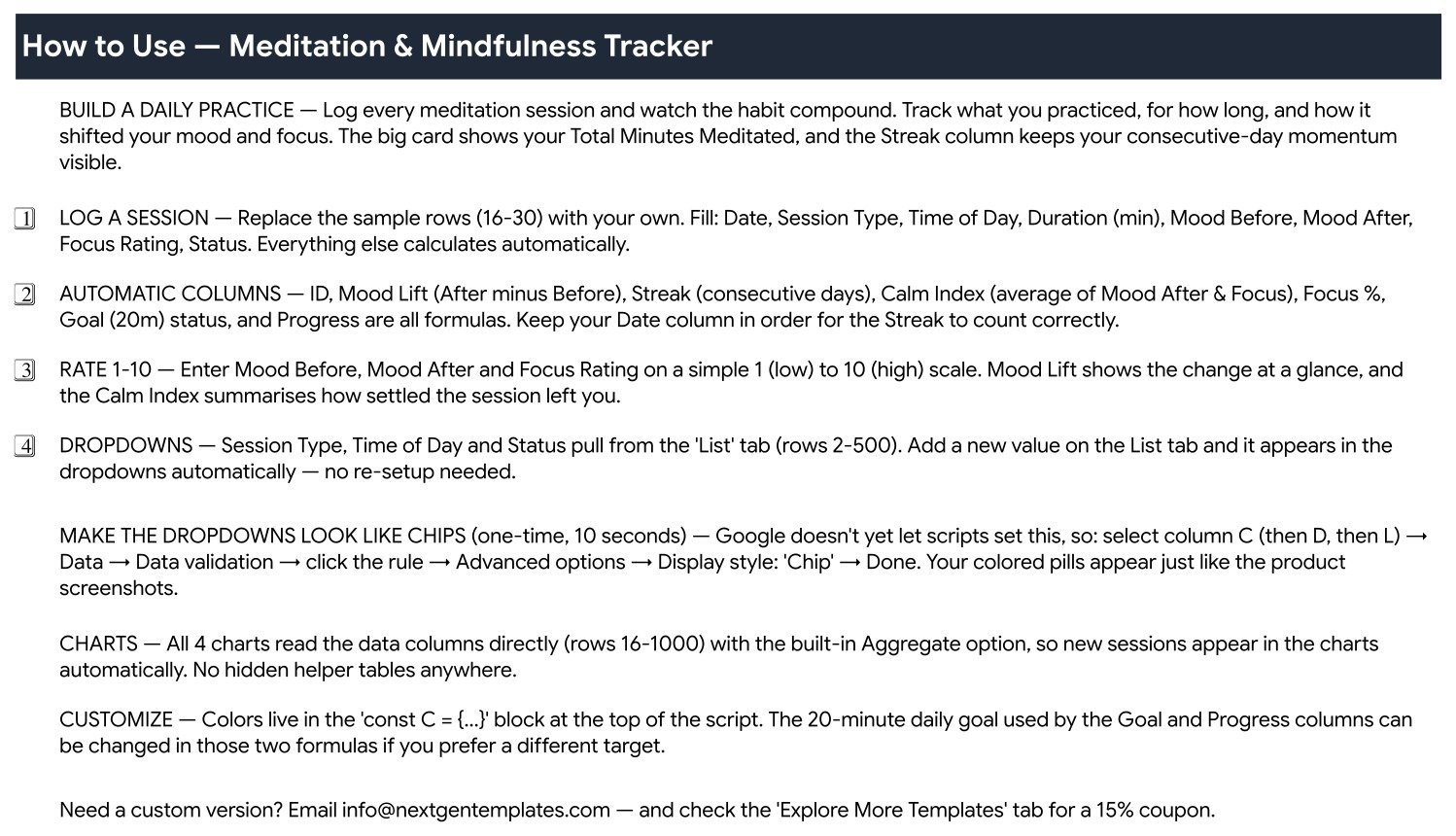
Session Type, Time of Day and Status are all dropdown columns fed from the List tab, reading rows 2 to 500. Twelve session types ship in the box – Mindfulness, Breathwork, Body Scan, Loving-Kindness, Guided, Walking, Yoga Nidra, Visualization, Zen, Transcendental, Mantra and Gratitude – alongside five times of day and three statuses. Add Qigong or Sound Bath to the List tab and it appears in the dropdown immediately, with no re-setup. If you want the coloured pill look from the screenshots, that is a one-time toggle in Google’s own data validation settings: Data → Data validation → the rule → Advanced options → Display style: Chip. Apps Script cannot set it, which is why it is left to you.
Inside the Tracker – Every Tab Explained
1. Meditation Tracker
The working page, and the only one you use daily. A dark title banner runs across the top, the Total Minutes Meditated card sits at the left, the four charts run across the rest of the width, and the log starts underneath. The columns, in order, are: ID, Date, Session Type, Time of Day, Duration (min), Mood Before, Mood After, Focus Rating, Mood Lift, Streak, Calm Index, Status, Focus %, Goal (20m), Progress and Notes. Fifteen sample sessions dated 10-Aug-2026 to 25-Aug-2026 are already filled in, including a deliberately missed day – 24-Aug-2026, 0 minutes, “Overslept – try again tomorrow” – so you can see what a lapse looks like before you have one.
2. List
Three columns – Session Type, Time of Day, Status – each read down to row 500 by the validation rules. This is the single place you edit to change what the dropdowns offer, and a note at the top of the tab says exactly that.
3. Instructions
A written walkthrough covering what to fill and what calculates, the 1-10 scale, how to keep the Streak honest, the chip display toggle, where the colour palette lives in the script’s const C = {...} block, and how to change the 20-minute goal.
4. Explore More Templates
A directory of related NextGenTemplates products with a WELCOME15 coupon for 15% off a future purchase.
Meditation & Mindfulness Tracker in Google Sheets vs. Excel vs. a Paid Meditation App – Feature Comparison
| This Google Sheets tracker | A Microsoft Excel tracker | Calm / Headspace-style subscription | |
|---|---|---|---|
| Cost | $6.99 one time | Typically $10-$20 one time, plus Office | About $70 per year, per person |
| Platform | Google Sheets, browser or free mobile app | Excel desktop; formulas can misbehave on mobile | Closed mobile app |
| Setup time | About 2 minutes – open the PDF, click Make a copy | Download, unzip, open, enable editing | Sign up, choose a plan, add a card |
| Real-time collaboration | Yes, native to Sheets | Only via OneDrive co-authoring | No – single personal account |
| Mobile access | Yes | Limited | Yes |
| Customizable fields | Yes – add columns, rename, edit formulas | Yes | No |
| Share with a link | Yes | File attachment only | No |
| Year-1 cost at 5 users | $6.99 total | $10-$20 plus five Office licences | About $350 |
| Mood captured before AND after each sit | Yes, plus the Mood Lift difference | Only if you build it | Rarely, and not as exportable data |
| You own and can export the raw data | Yes – it is your spreadsheet | Yes | No, or on request only |
| Guided audio, timer, reminders | No | No | Yes – that is what you are paying for |
The honest reading of that table: a subscription app and this tracker are not really competitors. The app runs the session; the spreadsheet remembers it. Plenty of people will keep both – and the tracker is the half you still own when the subscription lapses.
Who Should Use This Template
It suits anyone with an existing personal practice who wants a record instead of an impression. That includes people rebuilding a habit after it lapsed, anyone working through a 30- or 60-day commitment, meditation teachers keeping a private log of their own sitting separate from their classes, and long-time app users who want their history in a file they control rather than inside somebody’s account.
It is a poor fit if you want the tool to run the session. There is no timer, no bell, no guided audio, no reminders and no phone sync – every row is typed by hand. It is also not clinical software. Calm Index, Mood Lift and Focus % are ordinary arithmetic on numbers you chose; they are not an assessment, not diagnostic, and not a replacement for professional care. And if you need user roles, permissions or an audit trail, a spreadsheet is simply the wrong shape.
Real-World Use Cases
Restarting after a lapse. Priya sits five minutes a day for a fortnight after three months off. Because Goal (20m) reports “Short” rather than “Missed” at five minutes, the sheet records the effort without scolding her, and the Streak column quietly reaches 14 while the Total Minutes card passes 200.
A teacher auditing their own practice. Daniel logs his personal sitting separately from the classes he leads. Two months in, Sessions by Type shows Breathwork at fourteen sessions and Body Scan at one – a drift he had not noticed and would not have noticed without the chart.
A four-person workplace pilot. Each participant copies the sheet, logs eight weeks, and the coordinator compares the Mood Before vs After charts at the end. Total software spend: one $6.99 template. Nobody’s mood data left the person who produced it.
Advantages of the Meditation & Mindfulness Tracker in Google Sheets
- Nothing to install or subscribe to. A free Google account and a browser is the whole requirement.
- Low friction per entry. Three of the eight fields you fill are dropdowns, so most of a session is logged by picking, not typing.
- Before-and-after is built in. Very few habit trackers capture a state on both sides of the activity; that pairing is what makes the Mood Before vs After chart worth looking at.
- Fully editable. Every formula is visible, the colour palette sits in one block at the top of the script, and the 20-minute target is just a number in two formulas.
- Your data stays yours. It is a spreadsheet in your Drive – exportable, shareable, deletable, on your terms.
- Room to run. 985 pre-built rows means years of daily practice without touching the plumbing.
Opportunities for Improvement
An honest list, because a template that claims to do everything is a template nobody trusts:
- Entry is entirely manual. No integration with Apple Health, Google Fit, Insight Timer or anything else – if you want automatic capture, this is not it.
- The chip styling is a manual step. Google does not expose the display style to scripts, so the coloured pills in the screenshots need a ten-second toggle on three columns.
- The streak depends on date order. Log rows out of sequence and the Streak column will count wrongly – it is comparing to the row above, not scanning the sheet.
- The 20-minute goal is fixed in two formulas. Editable, but not a settings cell you can point a beginner at.
- One page, not a page per view. The card and charts live above the log rather than on a separate dashboard tab, which is fast to use but means less room for future charts.
Best Practices
- Log immediately after the sit, while Mood After is still real. A rating recalled at bedtime is a different measurement.
- Keep the 1-10 scale consistent. Decide once what a 7 means to you. The Calm Index is only as meaningful as that decision.
- Enter dates in order. The Streak column depends on it.Meditation & Mindfulness Tracker in Google Sheets
- Log the missed days too. A 0-minute row with a note is more useful than a gap – the sample data does exactly this on 24-Aug-2026.Meditation & Mindfulness Tracker in Google Sheets
- Trim the list to what you practise. Twelve session types is a starting menu; deleting the nine you never use makes the dropdown faster and Sessions by Type readable.
- Set a goal you will actually hit. If 20 minutes is aspirational, change it to 10 in the two formulas so the column reports reality.Meditation & Mindfulness Tracker in Google Sheets
- Use Notes. “Restless mind today” explains a dip that no number ever will.
Explore Relevant Templates
- Mood & Mental Health Tracker in Google Sheets – daily mood logging beside your practice.
- Anxiety & Trigger Journal Tracker in Google Sheets – for the situations that send you back to the cushion.Meditation & Mindfulness Tracker in Google Sheets
- Yoga & Stretching Practice Tracker in Google Sheets – the same structure, movement instead of stillness.
- 30-Day Fitness Challenge Tracker in Google Sheets – if the streak idea works on you.
- Symptom & Pain Diary Tracker in Google Sheets – when the practice is part of managing something physical.Meditation & Mindfulness Tracker in Google Sheets
Frequently Asked Questions
Do I need a paid Google account?
No. Any free Google account can open the link in the PDF, make a copy and use the sheet.
How many sessions can I record?
985 – the formulas, dropdowns and charts run from row 16 to row 1000. At one session a day that is about two years and eight months.Meditation & Mindfulness Tracker in Google Sheets
Does it include a timer or guided meditations?
No. It is a log, not a meditation app. You sit however you already sit and record what happened afterwards.Meditation & Mindfulness Tracker in Google Sheets
Why are my dropdowns plain text and not coloured chips?
Google Sheets does not let a script set the chip display style. Select column C (then D, then L) and choose Data → Data validation → the rule → Advanced options → Display style: Chip. Ten seconds per column, once.
Can I change the 20-minute daily goal?
Yes. The target is written into the Goal (20m) and Progress formulas; change it there and every row recalculates.Meditation & Mindfulness Tracker in Google Sheets
Can I add session types the template does not include?
Yes. Add them to the Session Type column on the List tab and they appear in the dropdown straight away – the validation reads to row 500.Meditation & Mindfulness Tracker in Google Sheets
Is this a mental-health or medical tool?
No. It is a personal logging spreadsheet. It is not diagnostic, it sends no alerts, it stores nothing securely, and it is not a substitute for professional care. If you are struggling, speak to someone qualified.
About the Author
Built by PK – Microsoft Certified Professional with 15+ years of Excel, Google Sheets, and Power BI experience. Founder of NextGenTemplates, reaching 300K+ subscribers across YouTube channels. Every template is hand-built and tested before release.Meditation & Mindfulness Tracker in Google Sheets
Conclusion
A meditation log only survives if logging costs less effort than the sitting did. This one gets there by doing less than it could: three dropdowns so most of a row is picked rather than typed, seven formula columns so nothing is arithmetic, one number and four charts so a month has a visible shape, and four tabs so there is nowhere to get lost. It will not remind you, time you, or talk you through a body scan. What it will do is make sure that in March you can answer “how has your practice actually been going?” with a number instead of a shrug.Meditation & Mindfulness Tracker in Google Sheets
Get the Meditation & Mindfulness Tracker in Google Sheets for $6.99 (regular $12.99), and see more Google Sheets walkthroughs on NeoTechNavigators on YouTube.