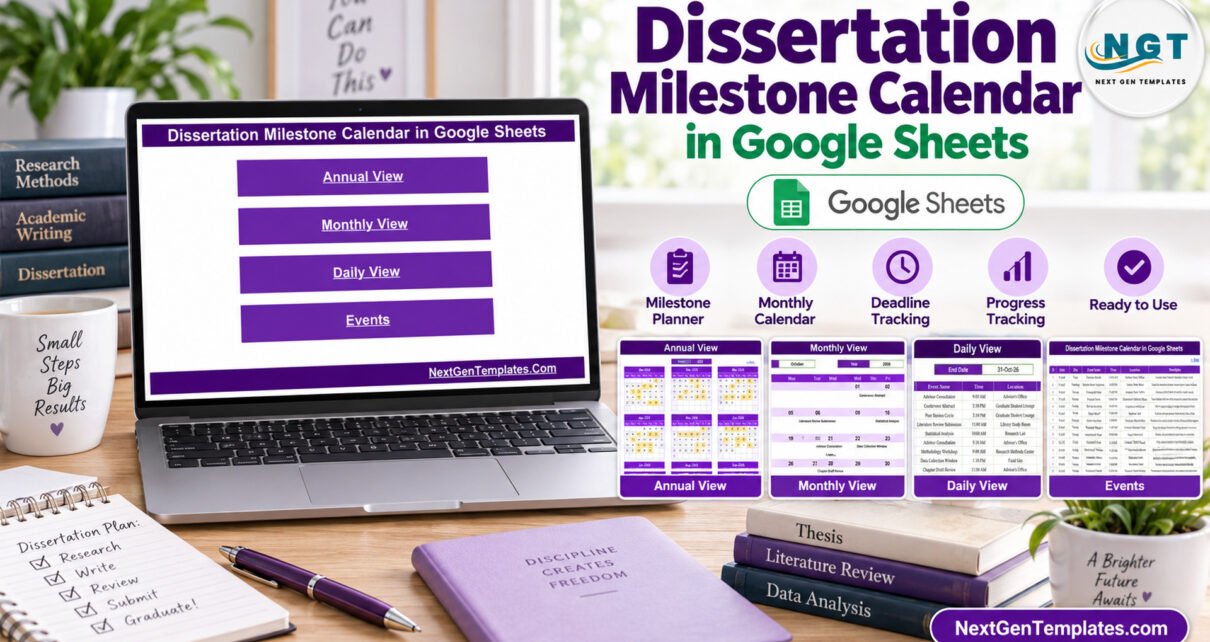
The Dissertation Milestone Calendar in Google Sheets helps doctoral and master’s researchers record every key date of a dissertation and review it in annual, monthly, daily and full event-list views. It is a focused planning template for proposal defenses, IRB approval deadlines, literature review submissions, data collection windows, chapter draft reviews, committee meetings, graduate school submissions and the final defense.
Get the Dissertation Milestone Calendar in Google Sheets
Dissertation Milestone Calendar in Google Sheets Overview
The file has five pages: a Home page with navigation buttons, an Annual View, a Monthly View, a Daily View and the Events table. Every calendar view is driven by formulas that read the Events table, so you only type your milestones once. Each Events row holds an ID, date, written weekday, milestone name, time, location and description. There are no macros and no add-ons, and it runs in any browser with a Google account.
If you also plan funding deadlines, the Grant Proposal Submission Calendar in Google Sheets uses the same layout.
Why a Dissertation Milestone Calendar Helps
A dissertation runs for years, and its deadlines live in many places: the graduate handbook, advisor emails, committee invitations, ethics office letters and conference calls for papers. It is easy to lose sight of how close two milestones really are until one of them slips.
A single dissertation milestone calendar puts those dates side by side. You can see a busy spring of IRB approval, data collection and a conference abstract at a glance, and you can show your advisor the same view instead of forwarding a chain of messages.
Four Views for Different Planning Questions
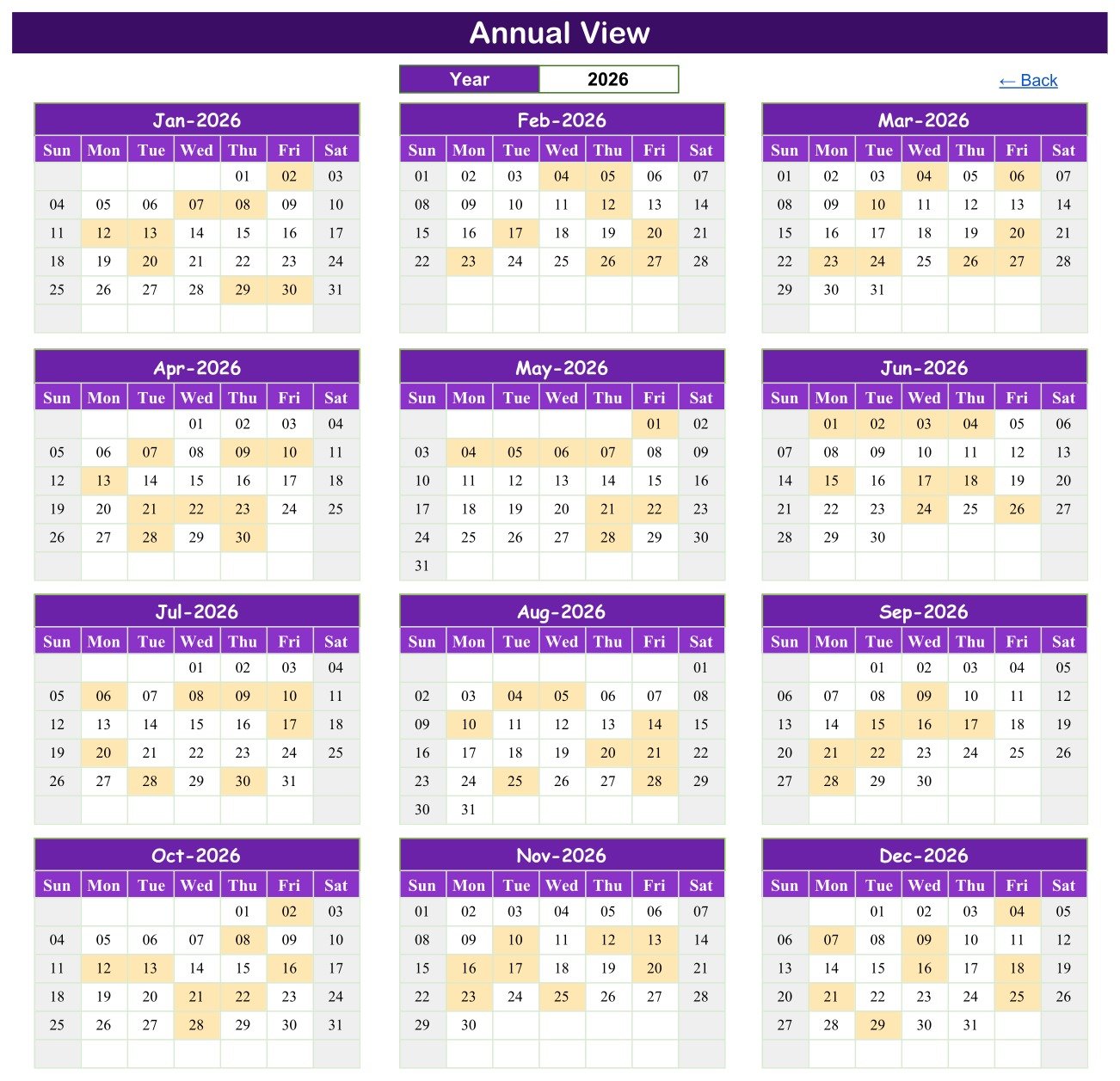
Annual View
All twelve months of the selected year appear on one page, and every date with a milestone is highlighted. This is the fastest way to spot crowded months and long gaps in a thesis timeline planner.
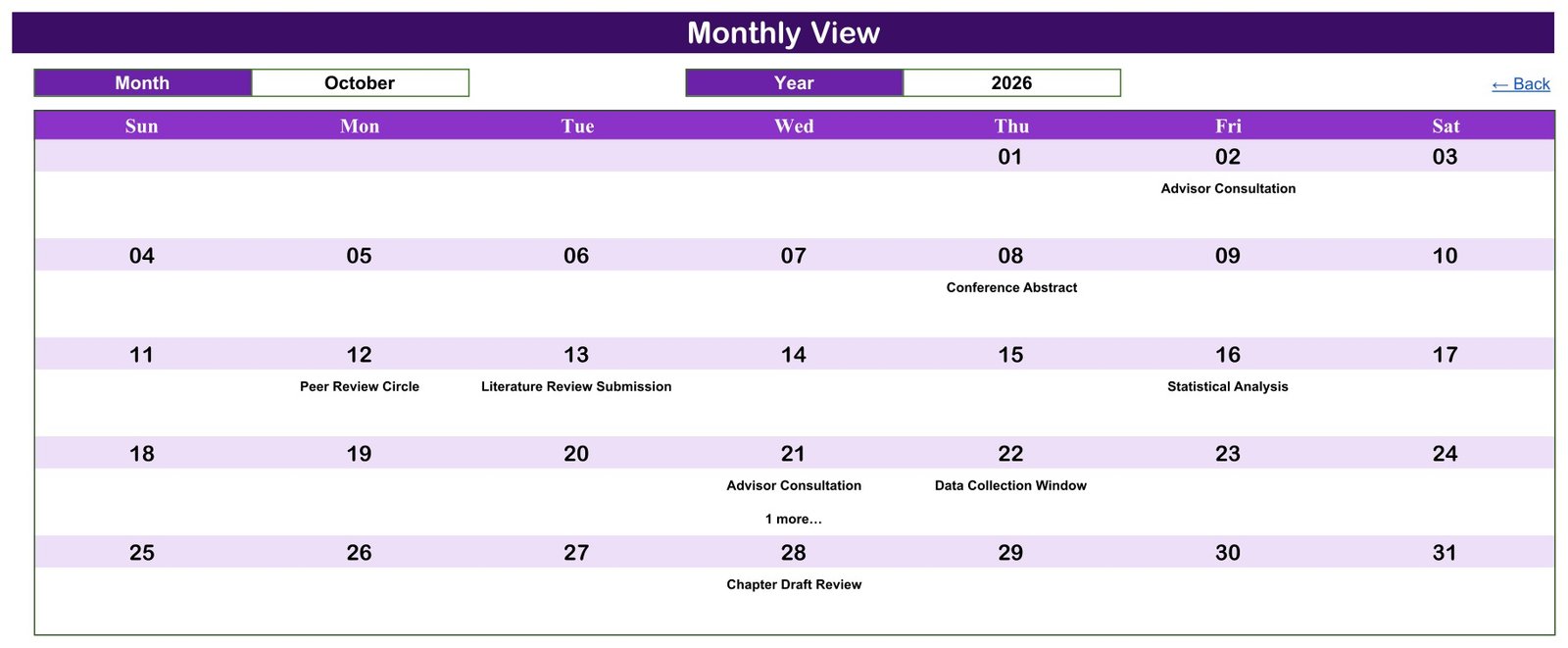
Monthly View
Pick a month and a year from the dropdowns and the milestones drop into a Sunday-to-Saturday grid. When a date has more than one entry, the grid shows the first milestone and a counter such as “1 more…”, so you know to check the detail views.
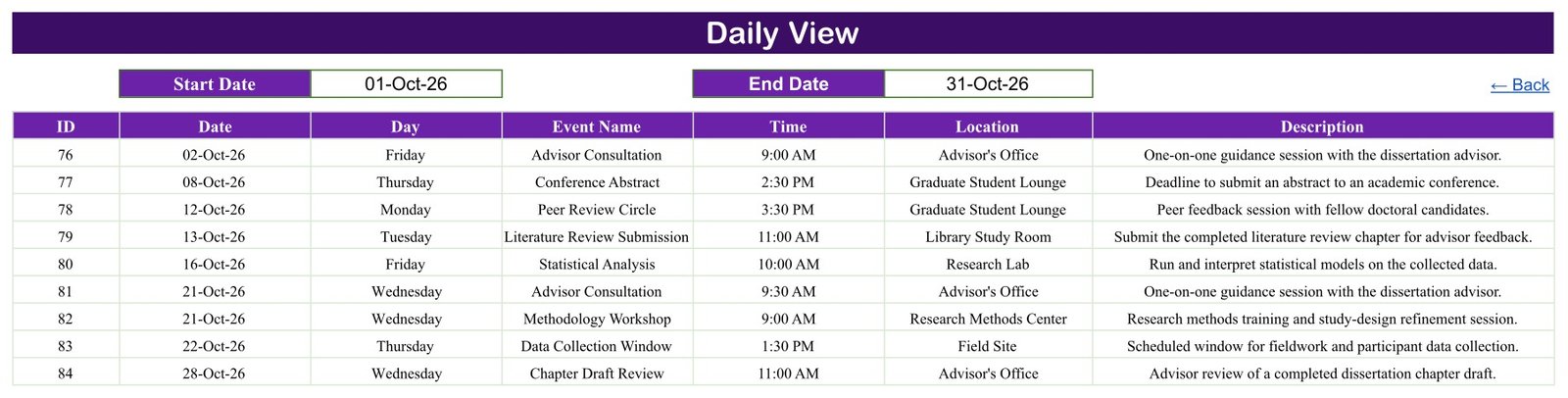
Daily View
Enter a start date and an end date and the view lists every milestone in that range with its time, location and description. It works well as a short-range phd milestone tracker for the next week or month.
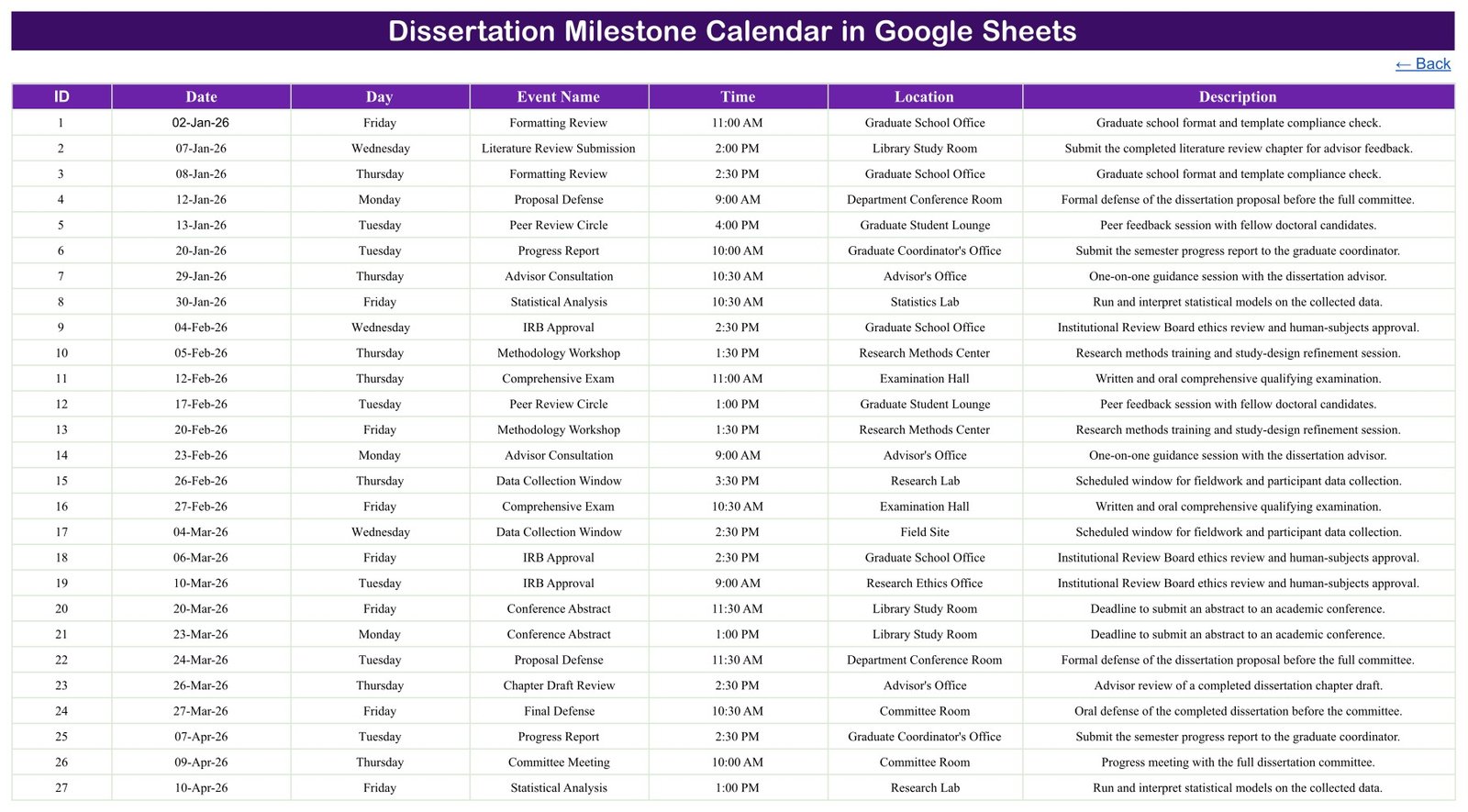
Events
The source table keeps every row visible and editable. This is where you add, correct and sort your milestones.
What the Sample Data Shows
The live demonstration sheet was checked before this post was written. It holds exactly 100 records from 2 January to 29 December 2026, with 8 or 9 entries each month, 17 milestone types and 13 locations. All 100 written weekdays match their dates, and every entry falls on a weekday. Three dates carry two milestones each, which shows the Monthly View counter at work.
Milestone types include Formatting Review, Literature Review Submission, Proposal Defense, Peer Review Circle, Progress Report, Advisor Consultation, Statistical Analysis, IRB Approval, Methodology Workshop, Comprehensive Exam, Data Collection Window, Conference Abstract, Chapter Draft Review, Final Defense, Committee Meeting, Graduate School Submission and Writing Retreat. The sample spreads these across the whole year so every view has content; it is not a suggested order for a real programme.
How to Set Up Your Google Sheets Academic Calendar
- Download the product PDF and open its Make-a-copy link.
- Save your own copy in Google Drive and keep one untouched backup.
- Replace the sample rows with your milestones, dates, weekdays, times, locations and descriptions.
- Type the correct weekday for each date. The Day column is plain text and does not change when you edit a date.
- Set the year on the Annual and Monthly views to turn the file into your own Google Sheets academic calendar.
- Use the Daily View before each busy stretch to see exactly what is due.
- Share the file only with your advisor or the people who need it.
What This Template Does Not Do
This is a planning calendar, not a project-management system. It has no progress percentages, Gantt chart, task dependencies or charts. It does not send reminders, stop two milestones landing on the same date, or connect to a university portal.
It also does not manage ethics or IRB applications or confirm that a deadline meets your institution’s rules. Always check official dates with your graduate school and advisor. The Events table has no student name, student ID or contact field. If a supervisor uses one copy for several students, use short codes instead of names and keep sharing restricted.
Template vs Scattered Reminders
| Planning Need | This Template | Scattered Reminders |
|---|---|---|
| Whole-year scan | Annual calendar view | Manual review of emails |
| Month layout | Calendar grid | Date-sorted notes |
| Date-range detail | Daily View | Repeated searching |
| Consistent fields | Seven-column Events table | Different every time |
| Sharing with an advisor | Google Sheets sharing | Forwarded messages |
Related Academic Planning Templates
- Scholarship Deadline Calendar in Google Sheets for funding applications.
- Exam Timetable Calendar in Google Sheets for examination schedules.
- Research Institutions Dashboard in Google Sheets for research performance reporting.
- Colleges and Universities Dashboard in Google Sheets for institution-level analysis.
Planning to build your own planners and trackers? The NextGenTemplates Academy learning paths on NextGenTemplates Academy walk you through the spreadsheet skills with practice files.
Get the Dissertation Milestone Calendar in Google Sheets
Frequently Asked Questions
Is this a project-management tool?
No. The thesis timeline planner records dated milestones and shows them in calendar views. It does not track task progress or dependencies.
Can I use a different year?
Yes. Change the year selectors and replace the Events data. Check the weekday text after any date change.
How are two milestones on one date shown?
Every row stays visible in the Events page and Daily View. The Monthly View shows the first milestone and a counter.
Does it send reminders?
No. There are no email, SMS or push alerts.
Do I need Excel?
No. The product runs in Google Sheets. The PDF download carries the Make-a-copy link.
Can I rename the milestone types?
Yes. Type your own milestone names and locations into the Events table and the views update.
Keep Your Dissertation on Track
If you want a light, visual schedule instead of a complex project tool, the Dissertation Milestone Calendar in Google Sheets is a clear place to start. Review the screenshots, note the limitations, and see the product details on NextGenTemplates.