The Car Rental Management System Web App runs an entire rental business across 26 screens, with 12 live KPI cards, 16 built-in reports, 20 controlled dropdown lists and 28 Google Sheets tabs. It handles hourly, daily, weekly and monthly hire for self-drive and chauffeur-driven cars, and it calculates every late fee, extra-kilometre charge, damage recovery, traffic challan and security-deposit movement automatically. Setup takes about 10 minutes.
🚀 Try the Live Demo Before You Buy
We have deployed this Car Rental Management System in our own Google account so you can test every page, every module and every role — with real sample data — before purchasing. No signup, no email required.
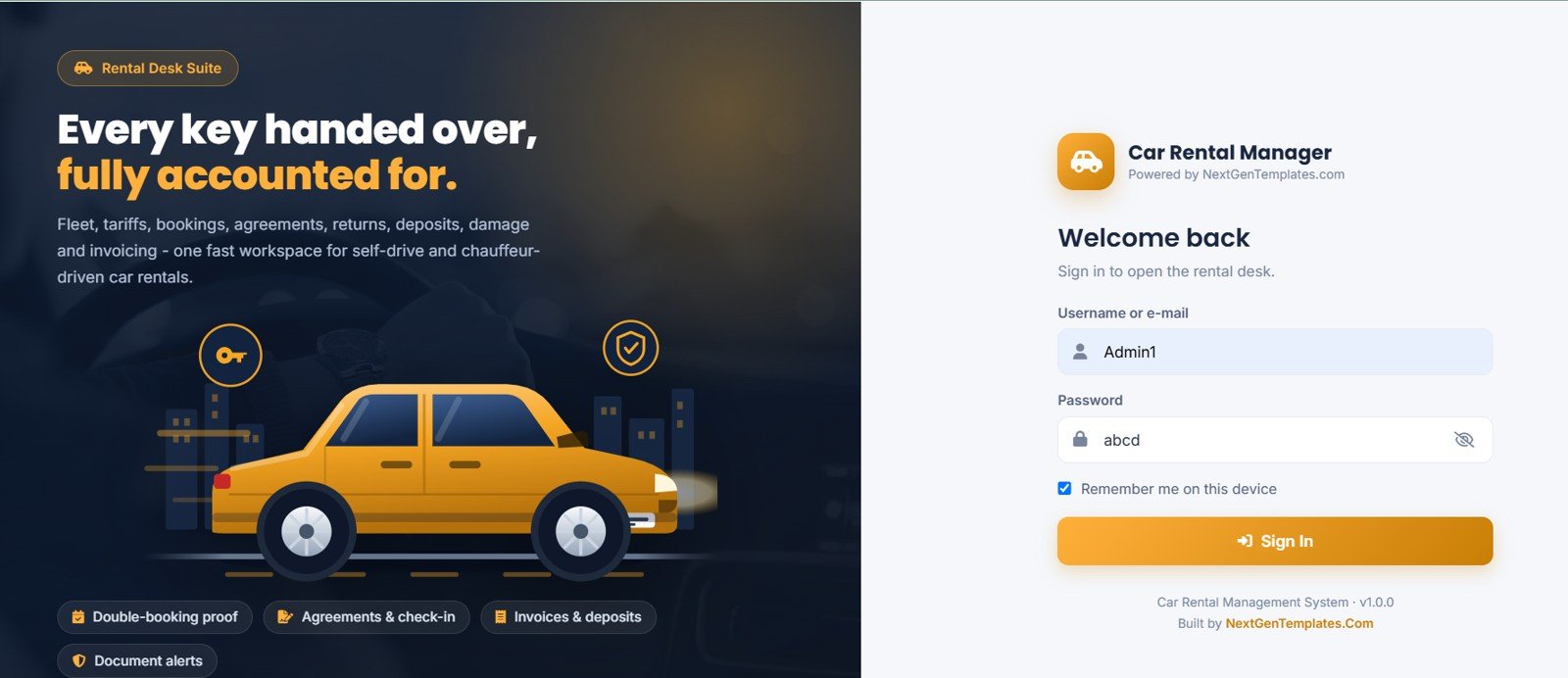
🔑 Test Login Credentials
Sign in as Admin1 to explore the full system — vehicle fleet, bookings and reservations, customers, rental agreements, payments, maintenance records, reports and user management. Feel free to add, edit and delete records; the demo data resets periodically.
| Role | Username | Password |
|---|---|---|
| 👨💼 Admin | Admin1 | abcd |
💡 What you get after purchase: The full source code (Code.gs + Index.html) plus a step-by-step deployment guide so you can deploy your own private instance in your own Google account in under 15 minutes.
Most small rental operators still run on a diary, a WhatsApp group and a spreadsheet. That works until two counter staff promise the same SUV to two customers on the same weekend, or a car returns 400 km over its allowance and nobody can prove what the odometer read when it left. This system fixes exactly those problems: a server-side double-booking refusal that names the clashing booking, odometer and fuel evidence at both ends of the hire, and a final bill that computes itself.
Key Features of the Car Rental Management System
- A fleet record built for rental. Registration, make, model, category, transmission, fuel, colour, seats, branch, ownership type, odometer, deposit and seven expiry dates — insurance, RC, fitness, permit, PUC, next service date and next service kilometres.
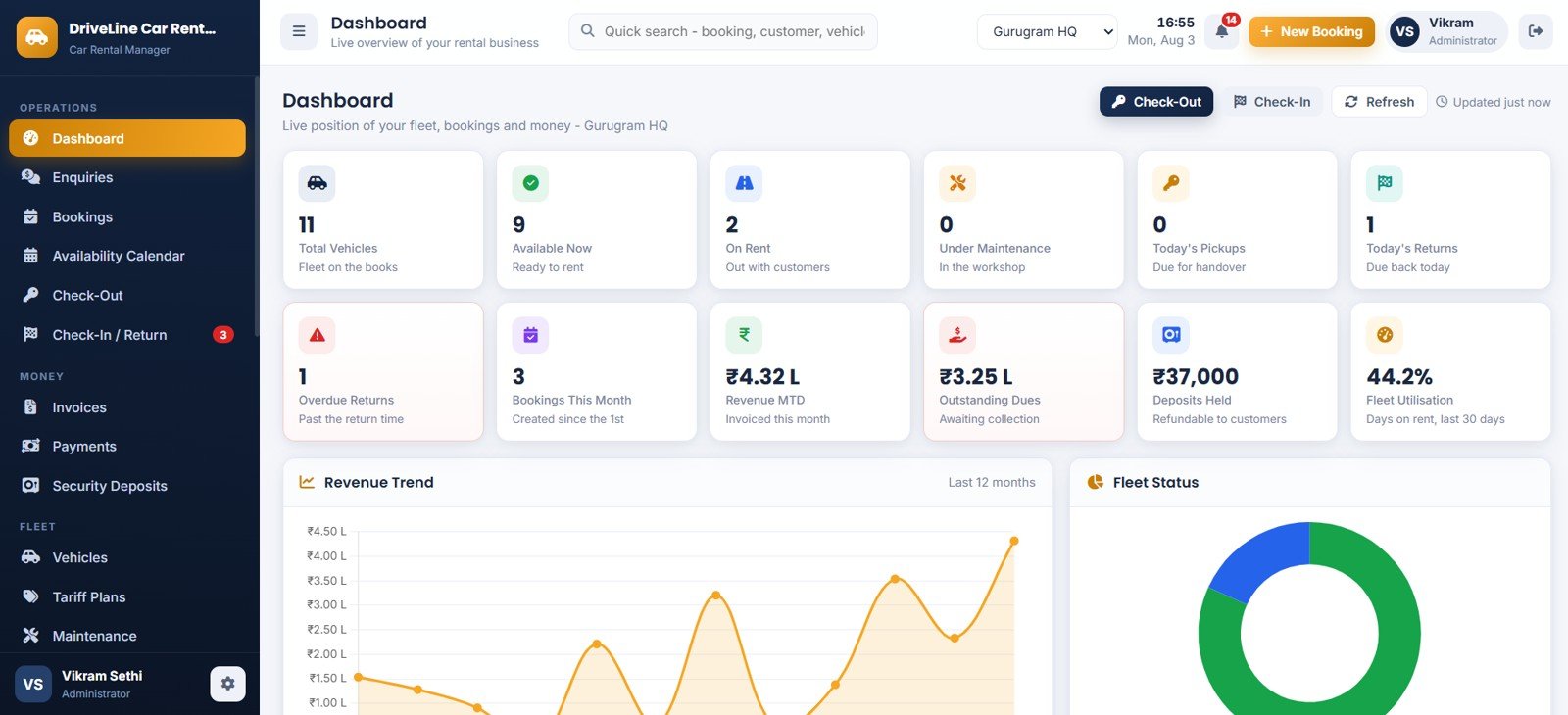
- Six colour-coded vehicle statuses. Available, On Rent, Reserved, Maintenance, Inactive and Sold. Only genuinely free cars appear in the booking picker, and everything else is excluded automatically with the reason shown.
- Double-booking blocked on the server. An overlap test runs inside a script lock against every Reserved, Confirmed and Checked-Out hire on that vehicle, and all ID allocation for bookings, agreements, invoices, receipts and challans happens inside the same lock.
- One charge engine, used twice. Base rental + extra hours + extra kilometres + add-ons + driver allowance + fuel + cleaning + damage + fines + late fee + other, less discount, then tax, then less advance and deposit adjustment. The live preview at the counter and the saved invoice use identical arithmetic.
- Four roles, enforced server-side. Administrator, Manager, Counter Staff and Fleet / Maintenance, with every write re-checked on the server rather than merely hidden in the menu.
- Compliance alerts as a first-class module. Insurance, RC, fitness, permit, PUC, service due and driving-licence expiry across vehicles, drivers and customers, bucketed into Expired, Due in 7 Days, Due in 30 Days and Valid.
- Deposits treated as a liability. Collected, deducted and refunded amounts sit in their own ledger with a reason on every movement, never mixed into revenue.
- Documents that print properly. Rental agreement, tax invoice and payment receipts at 3 inch, 4 inch or A4, defaulting to A4.
Dashboard Pages Explanation
Page 1: Login Page
A branded split-screen sign-in — the rental illustration on one half, the sign-in card on the other. Default credentials are deliberately never displayed here, and the session token expires after 12 hours.
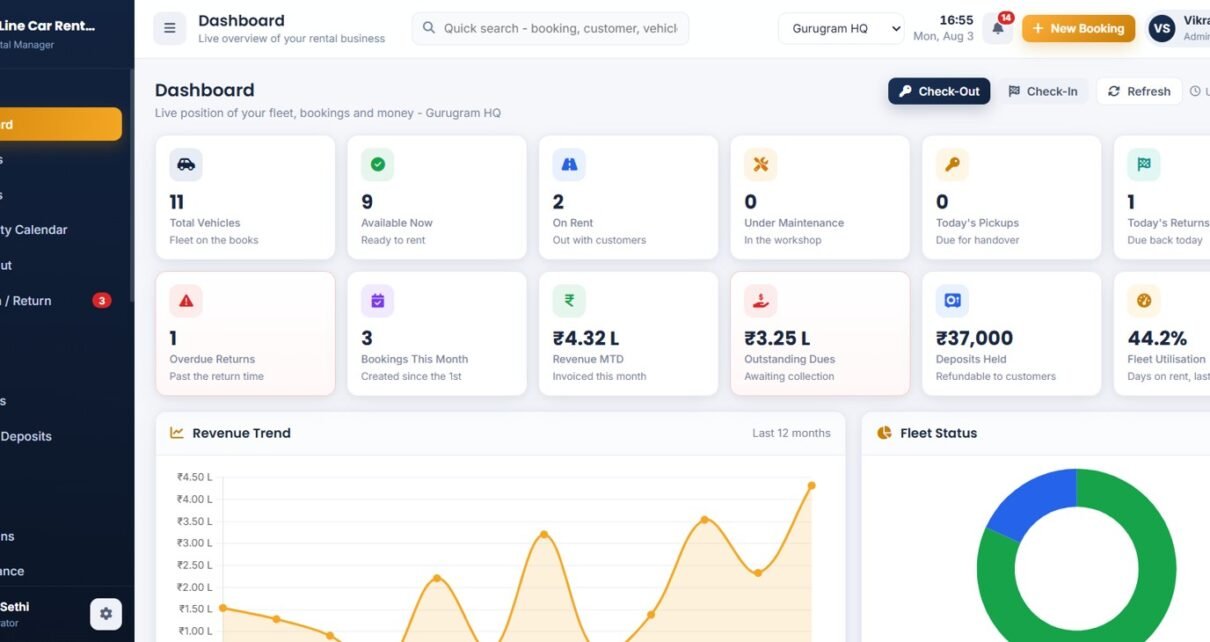
Page 2: Dashboard
Twelve KPI cards — Total Vehicles, Available Now, On Rent, Under Maintenance, Today’s Pickups, Today’s Returns, Overdue Returns, Bookings This Month, Revenue MTD, Outstanding Dues, Deposits Held and Fleet Utilisation — sit above Revenue Trend by Month and Fleet Status by Vehicle Status, with Check-Out and Check-In shortcuts and a branch selector in the top bar.
Page 3: Enquiries
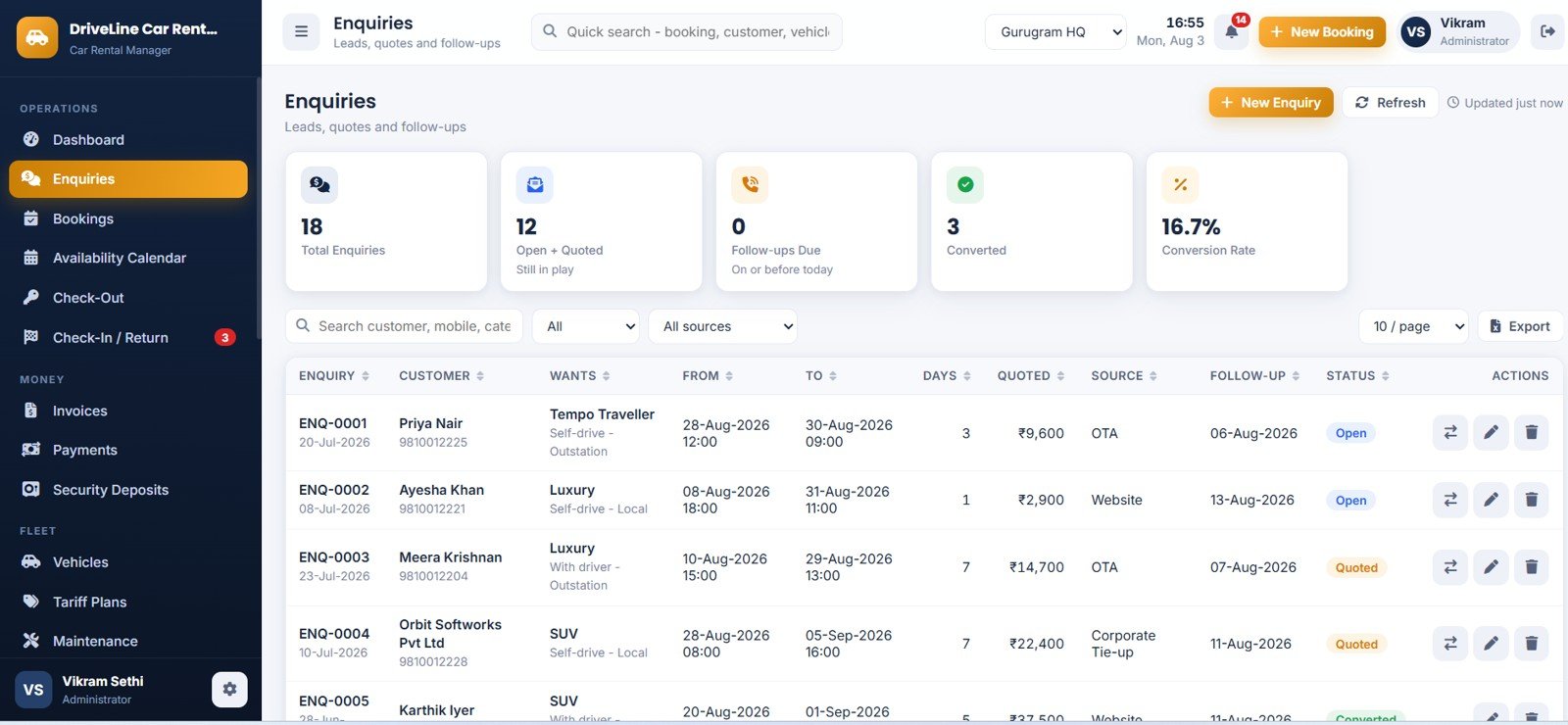
The lead pipeline, showing Total Enquiries, Open + Quoted, Follow-ups Due, Converted and Conversion Rate. Each enquiry records the wanted category, self-drive or with-driver, dates, quoted value, source and follow-up date, and converts straight into a booking.
Page 4: Bookings
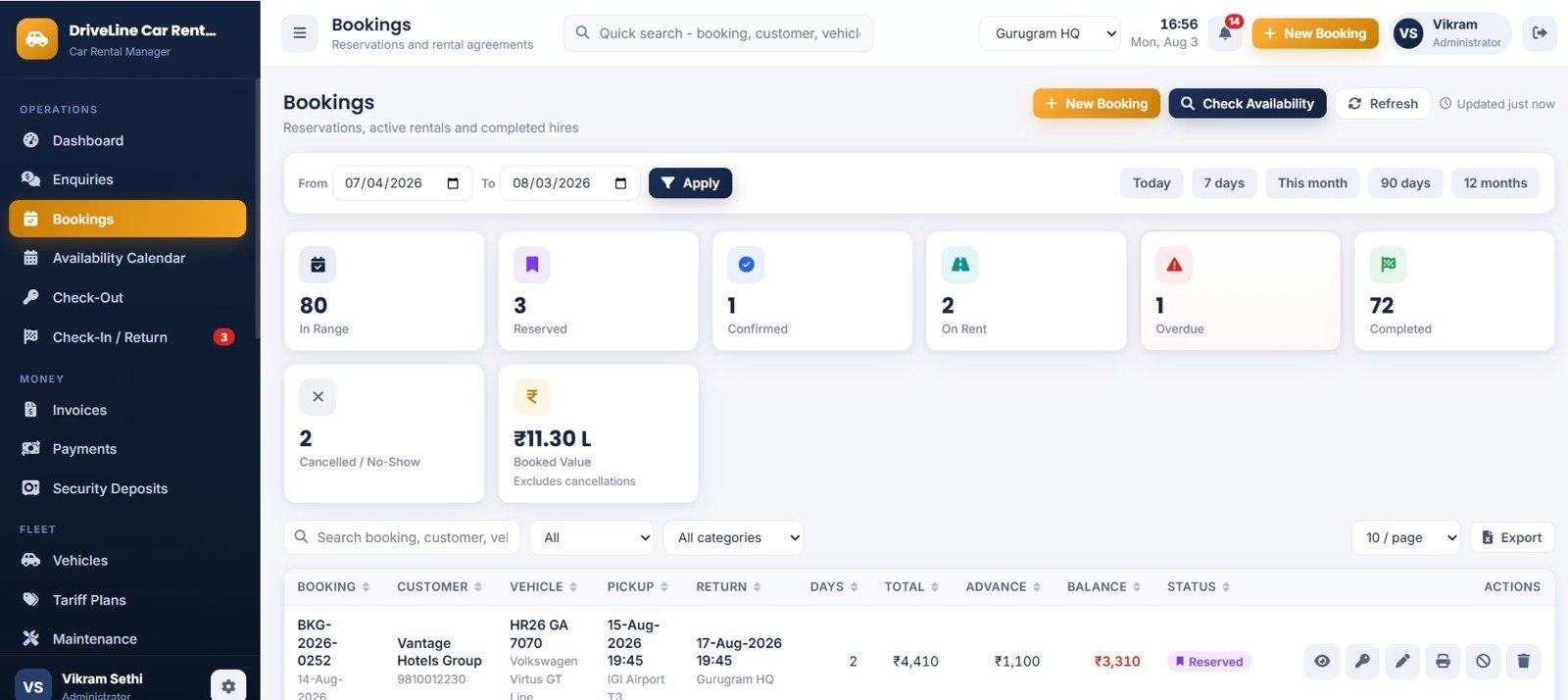
The reservation register, counted by In Range, Reserved, Confirmed, On Rent, Overdue, Completed, Cancelled / No-Show and Booked Value. Every row shows vehicle, pickup, return, days, total, advance and balance, and Check Availability finds free cars for any window.
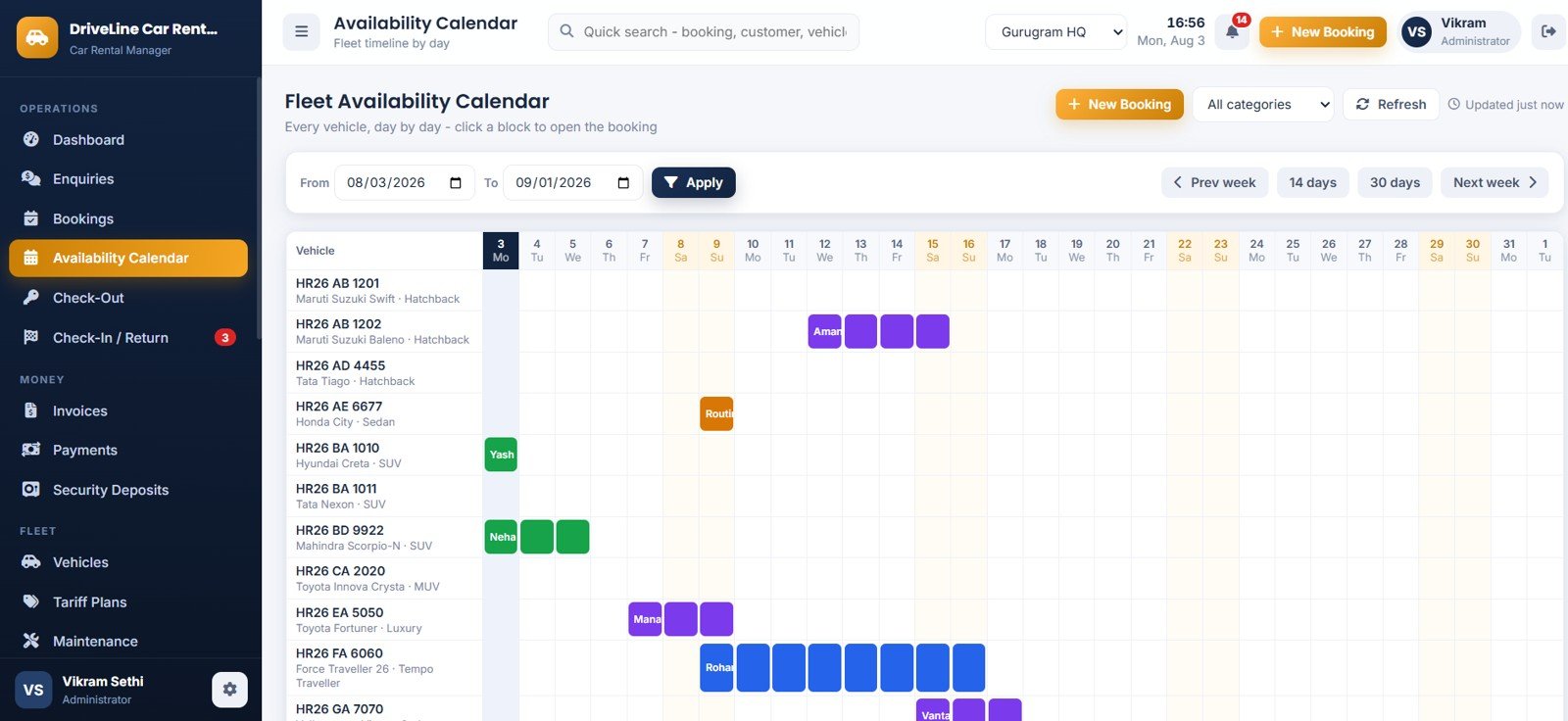
Page 5: Fleet Availability Calendar
Every vehicle down the side, days across the top, one colour-coded block per booking. Filter by category, step week by week, or switch to a 14-day or 30-day view, and click any block to open that hire.
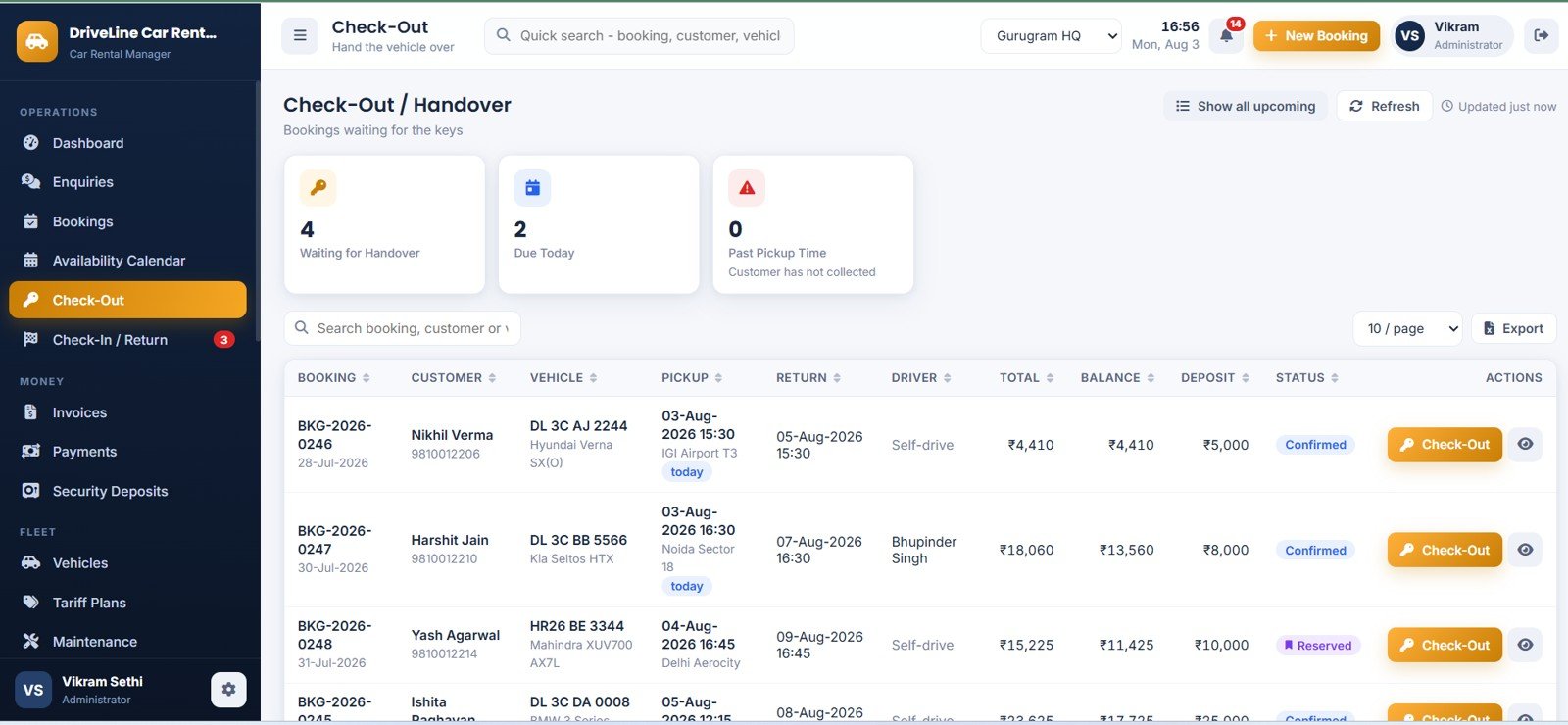
Page 6: Check-Out / Handover
Bookings waiting for the keys, counted by Waiting for Handover, Due Today and Past Pickup Time. The handover captures actual start time, odometer out, fuel level, assigned driver, security deposit and mode, the condition checklist and photographs, then prints the rental agreement.
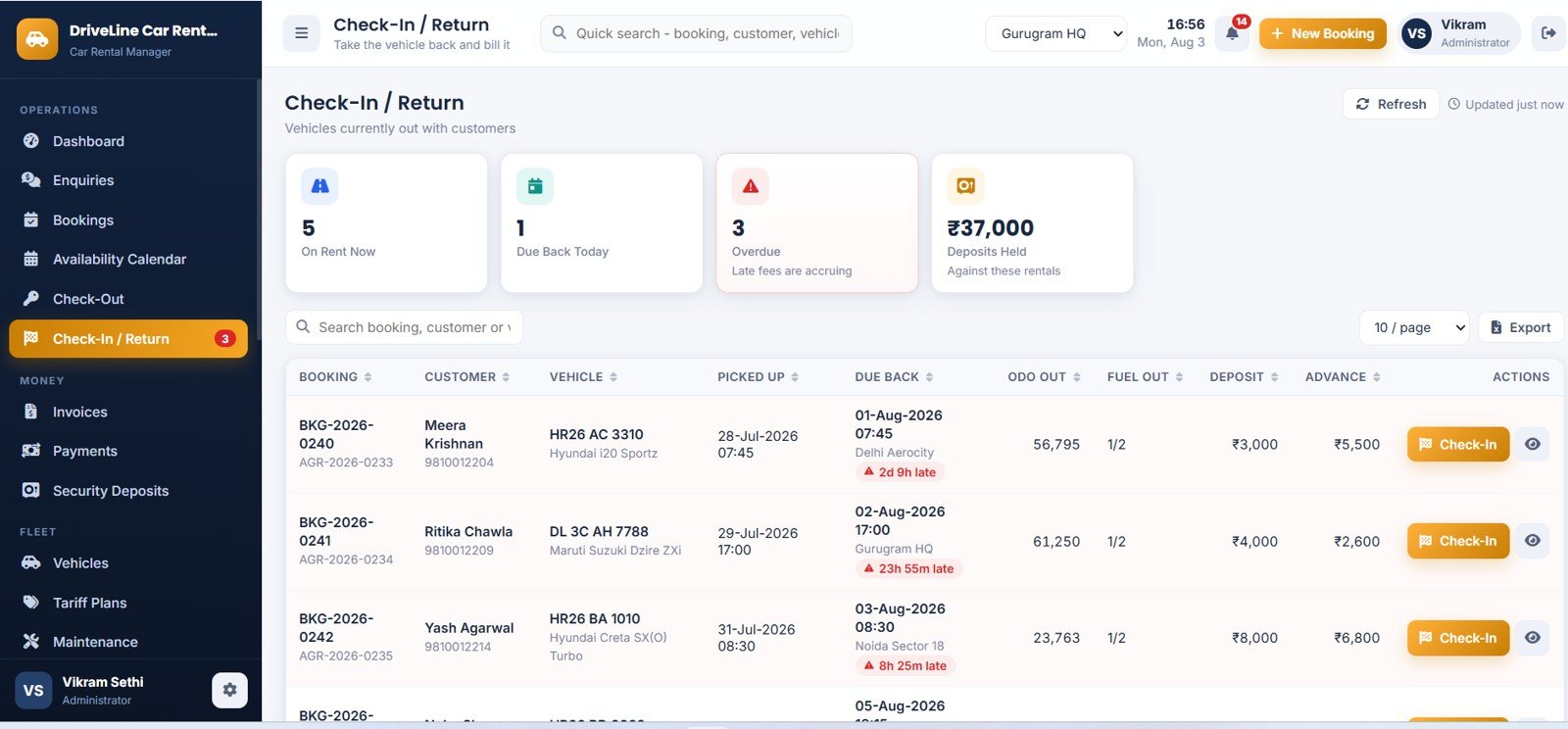
Page 7: Check-In / Return
Vehicles currently out, counted by On Rent Now, Due Back Today, Overdue and Deposits Held, with late rows in red and the exact overdue duration shown. A live bill panel recalculates as the operator types, so the customer sees the final figure before anything is saved.
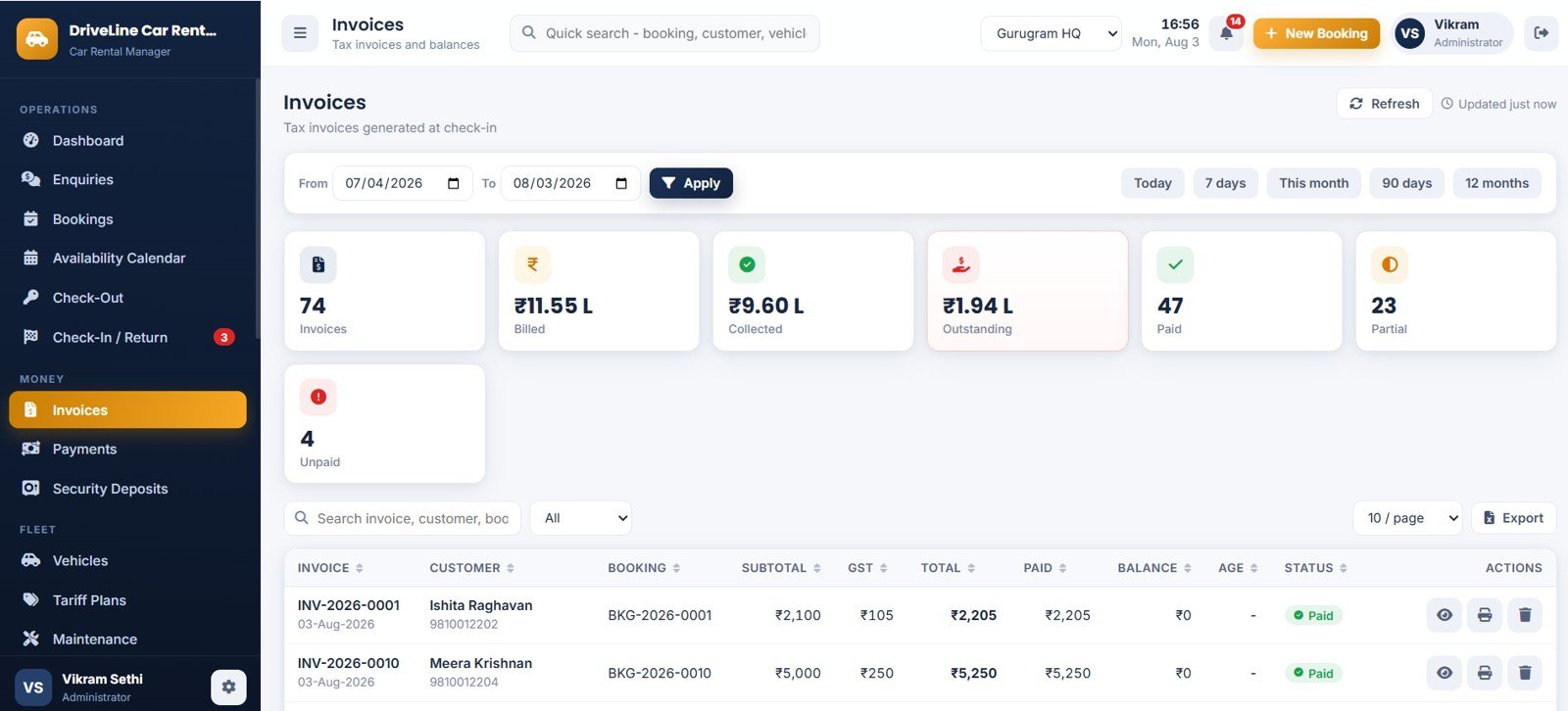
Page 8: Invoices
Every tax invoice generated at check-in, with Invoices, Billed, Collected, Outstanding, Paid, Partial and Unpaid. Each line carries subtotal, tax, total, paid, balance, ageing bucket and status, and prints at your configured size.
Page 9: Payments
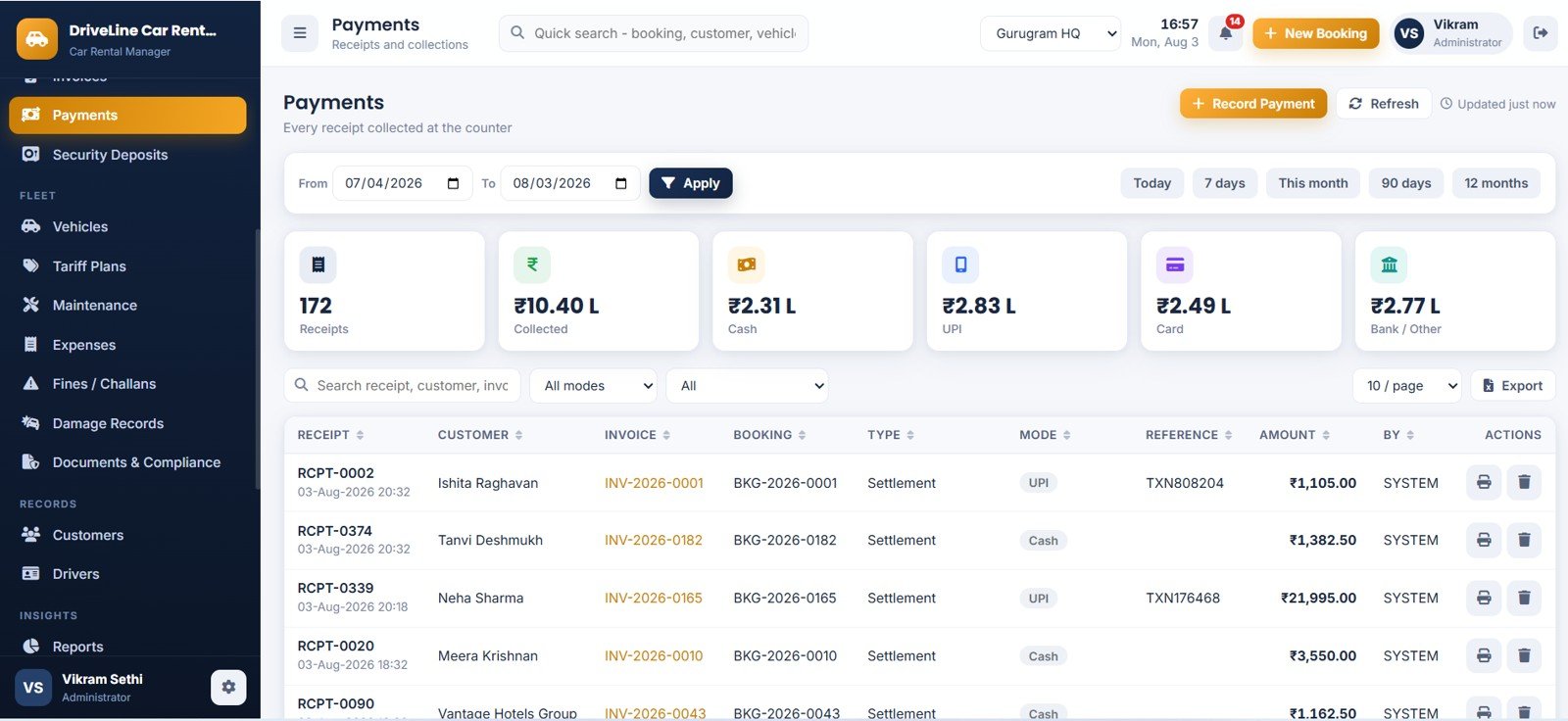
Every receipt collected at the counter, split by Receipts, Collected, Cash, UPI, Card and Bank / Other. Advances, settlements and refunds all land against their invoice and booking, and each receipt prints.
Page 10: Security Deposits
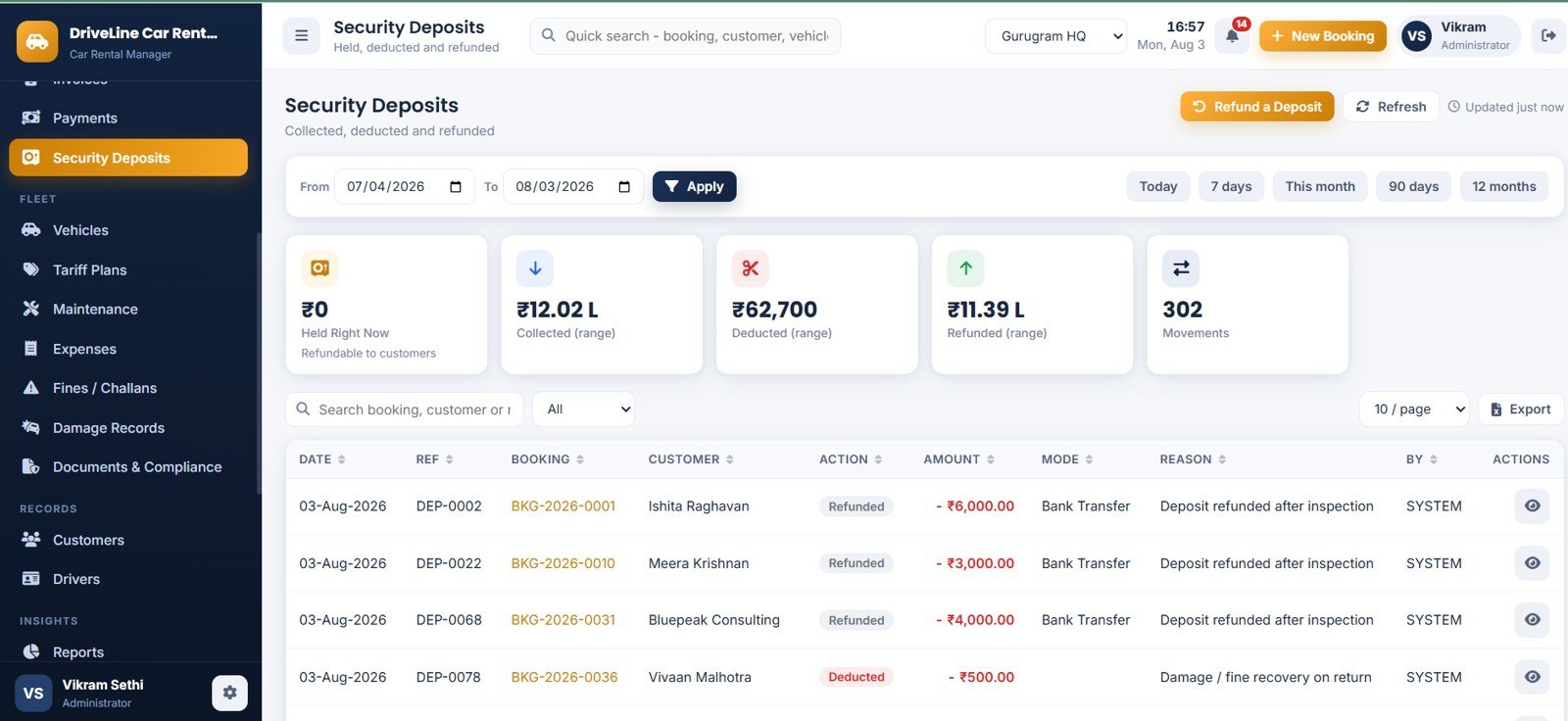
The deposit ledger, showing Held Right Now, Collected, Deducted, Refunded and total Movements. Deposits are a customer liability rather than income, and every collection, deduction and refund carries a written reason.
Page 11: Fleet / Vehicles
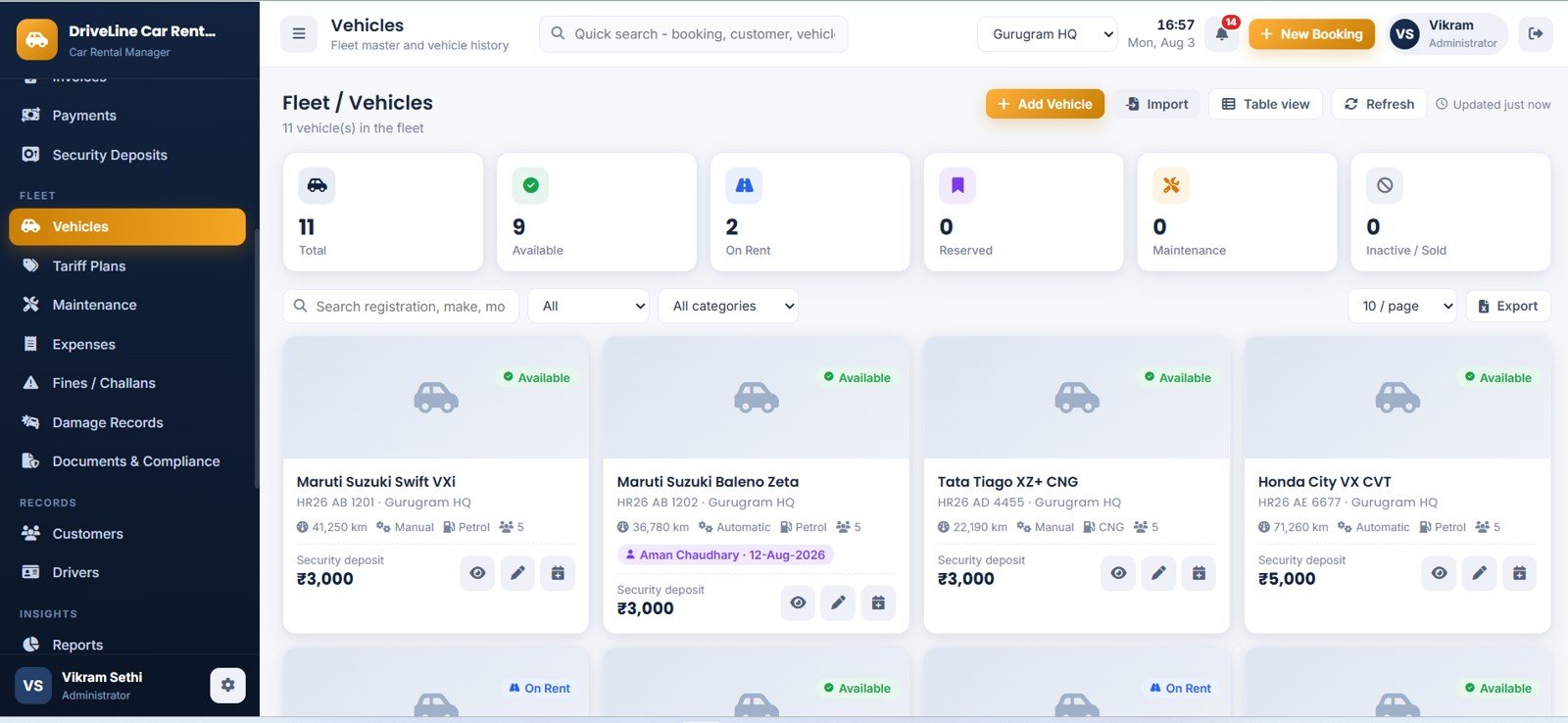
The fleet master in card or table view, counted by Total, Available, On Rent, Reserved, Maintenance and Inactive / Sold. Each card shows odometer, transmission, fuel, seats and deposit, and opens a history of revenue, kilometres run and workshop cost.
Page 12: Tariff Plans
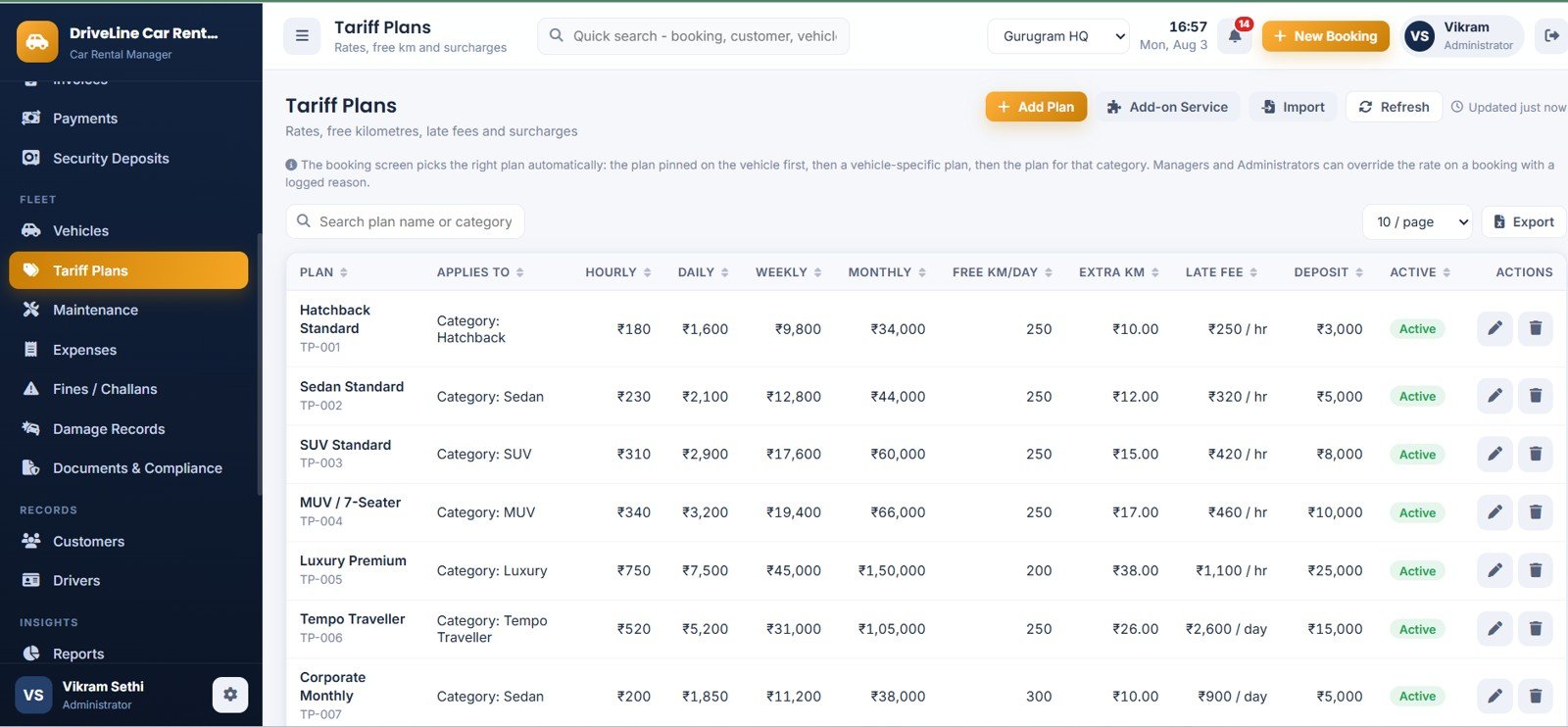
Rate cards by category with hourly, daily, weekly and monthly rates, free km per day, extra km rate, late fee and deposit. The booking screen resolves the plan automatically — the plan pinned to the vehicle first, then any vehicle-specific plan, then the category plan — and Managers can override the rate with a logged reason.
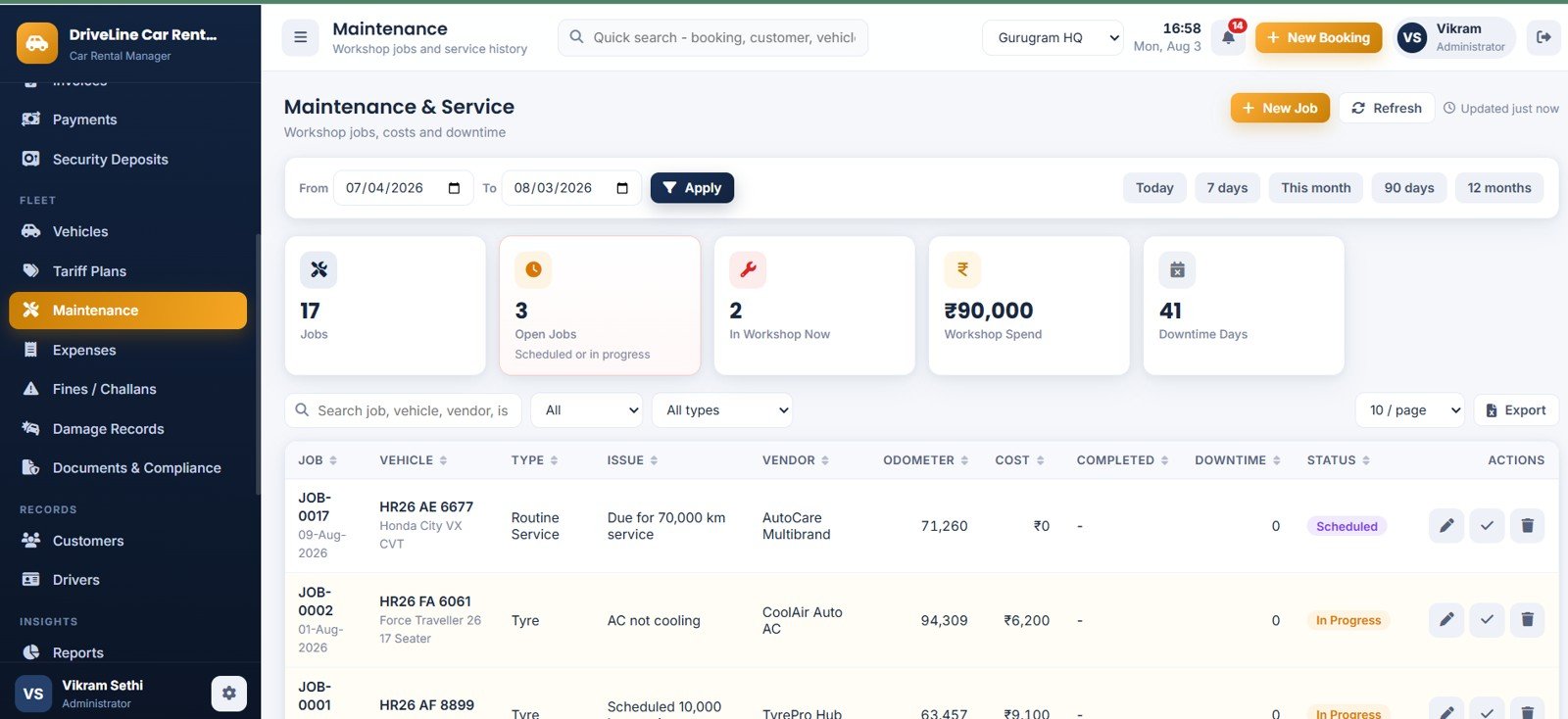
Page 13: Maintenance & Service
Workshop jobs counted by Jobs, Open Jobs, In Workshop Now, Workshop Spend and Downtime Days. Opening a job removes the car from availability; completing a service rolls the next service date and kilometre reading forward on its own.
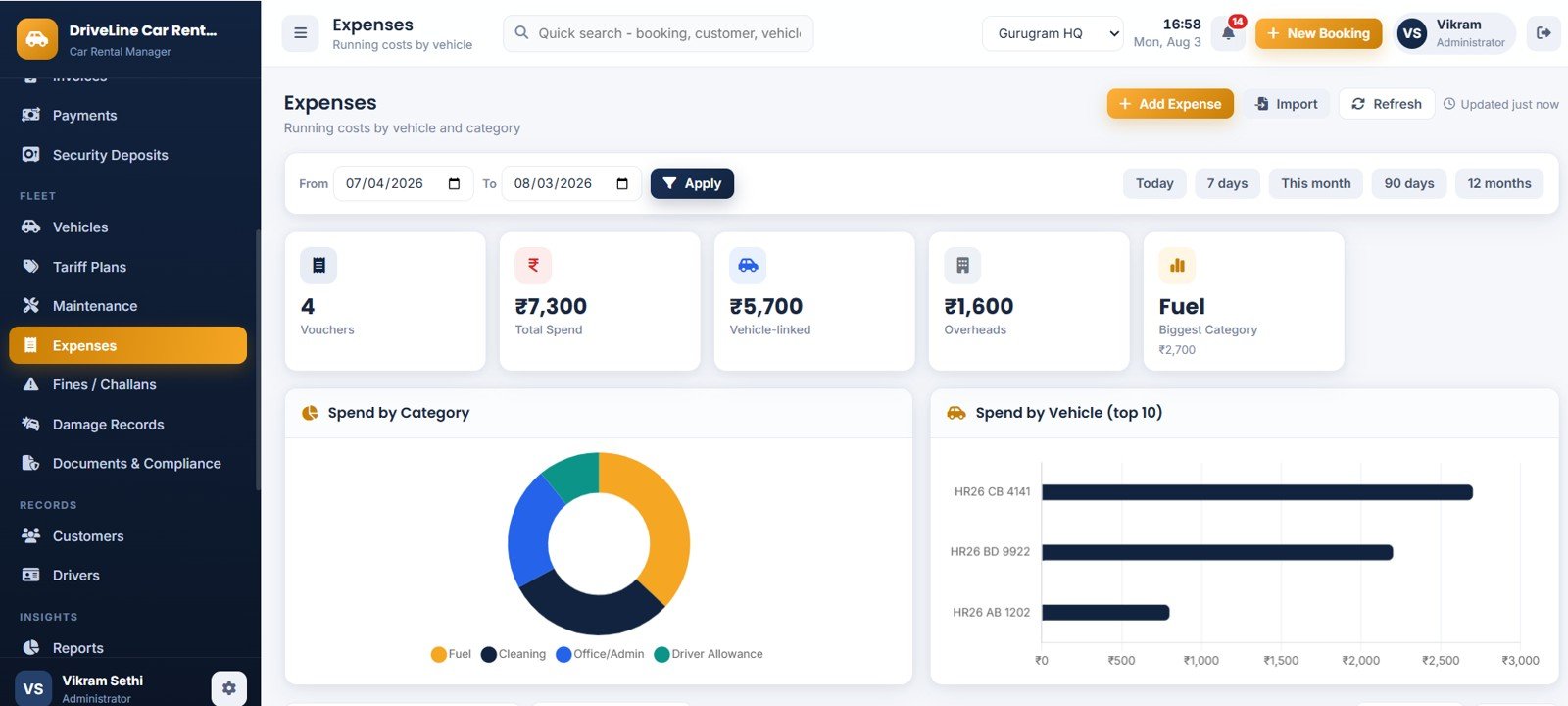
Page 14: Expenses
Running costs by Vouchers, Total Spend, Vehicle-linked, Overheads and Biggest Category, with Spend by Category and Spend by Vehicle charts. Vehicle-linked spend flows directly into the Vehicle Profitability report.
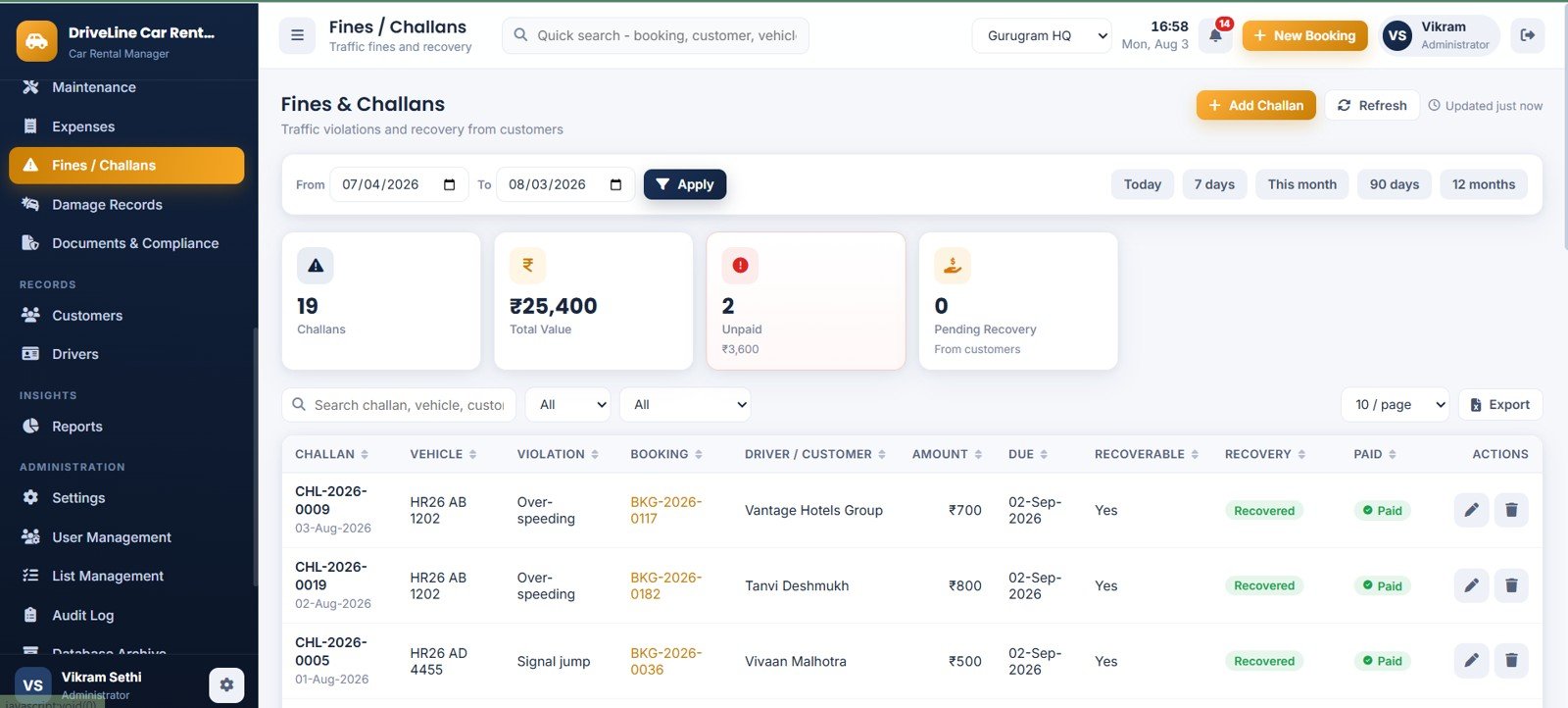
Page 15: Fines & Challans
Traffic violations tied to the vehicle, the booking and whoever was holding the car, tracked by Challans, Total Value, Unpaid and Pending Recovery. Recoverable challans can be pushed onto the customer’s final bill.
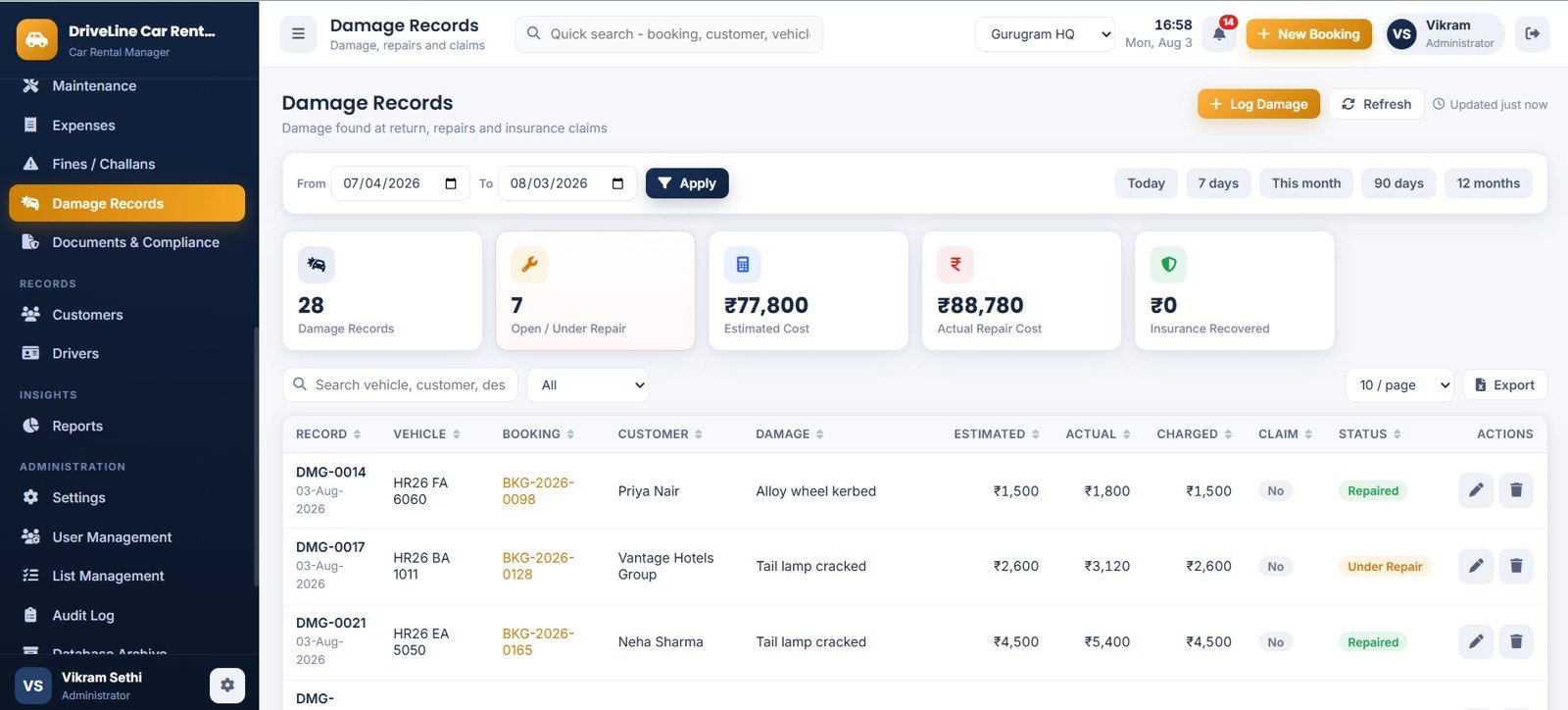
Page 16: Damage Records
Damage found at return, tracked by Damage Records, Open / Under Repair, Estimated Cost, Actual Repair Cost and Insurance Recovered, with each record linked back to the booking and the customer charged.
Page 17: Documents & Compliance
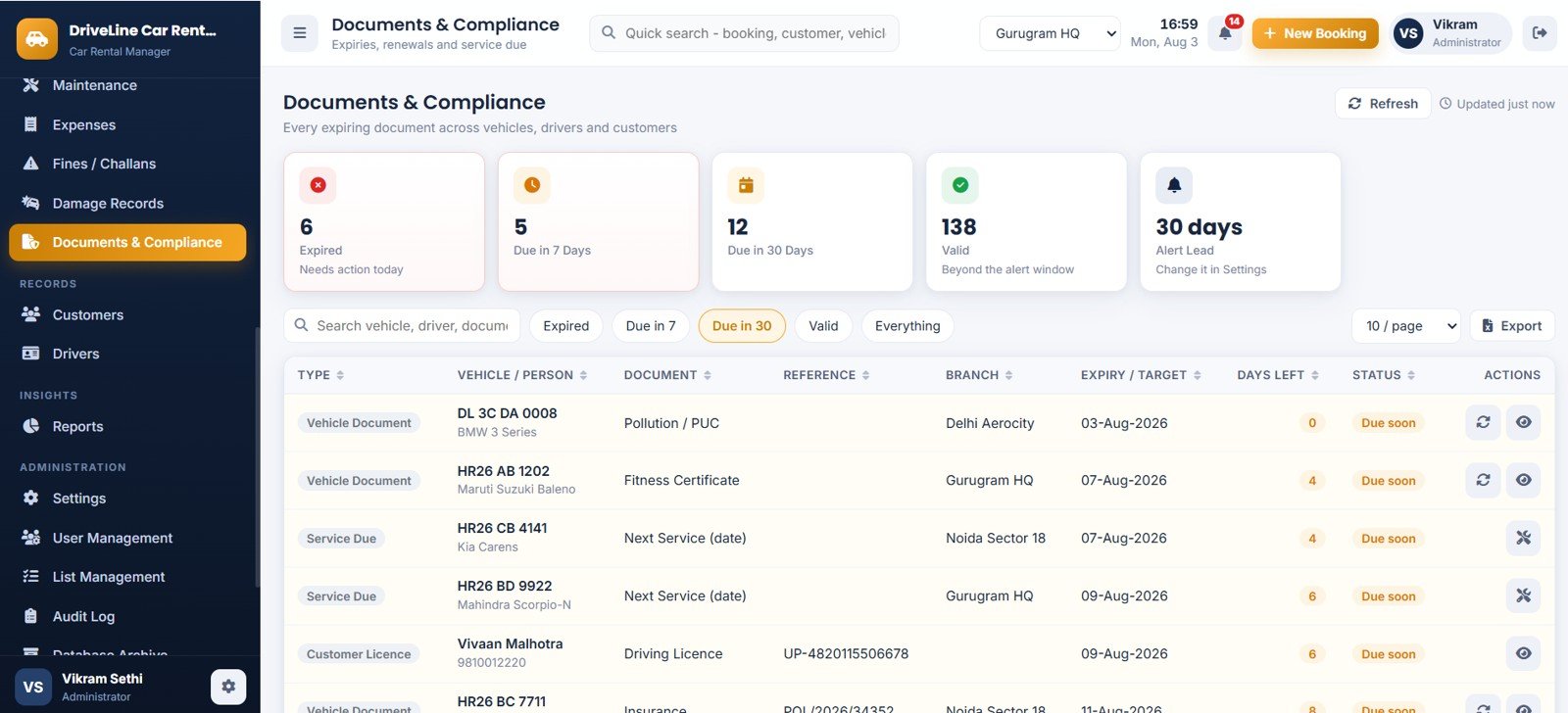
Every expiring document across vehicles, drivers and customers in one place — Expired, Due in 7 Days, Due in 30 Days and Valid — covering insurance, RC, fitness, permit, PUC, service due and driving licences, using your own alert lead days.
Page 18: Customers
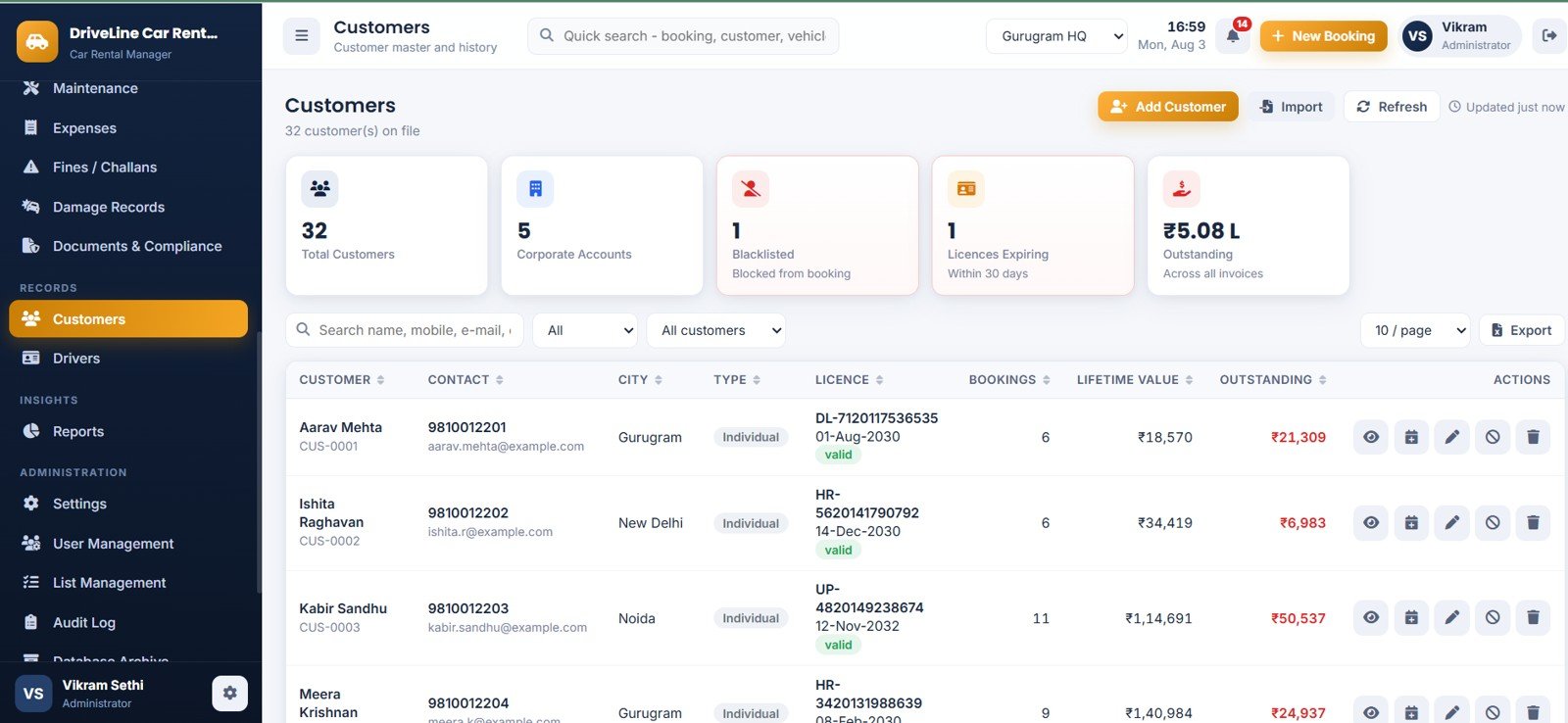
The customer master with Total Customers, Corporate Accounts, Blacklisted, Licences Expiring and Outstanding. Each row shows licence number and validity, bookings, lifetime value and dues, and blacklisting blocks new hires outright unless an Administrator overrides it — which is itself logged.
Page 19: Drivers
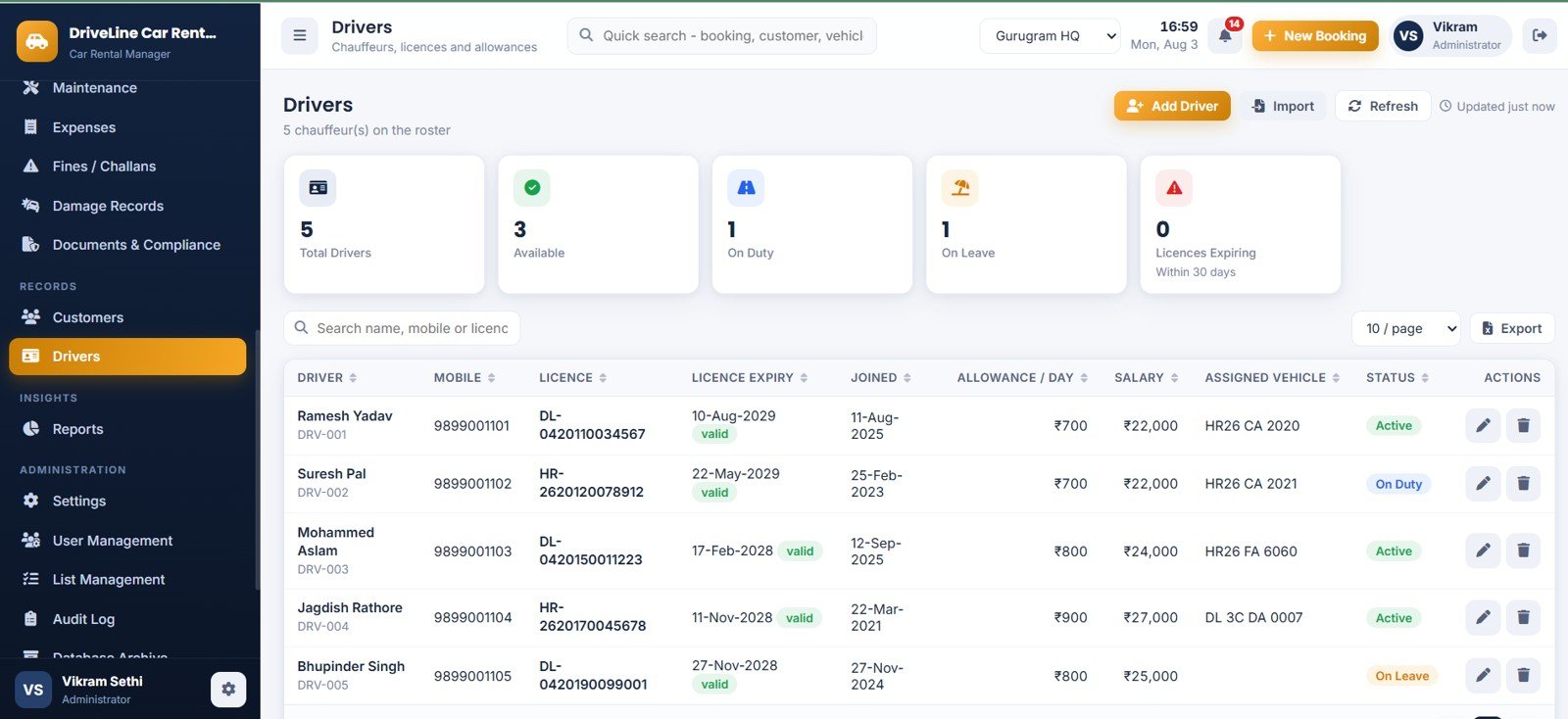
The chauffeur roster with Total Drivers, Available, On Duty, On Leave and Licences Expiring. Each driver carries licence expiry, joining date, daily allowance, salary and assigned vehicle, and feeds the Driver Report.
Page 20: Reports
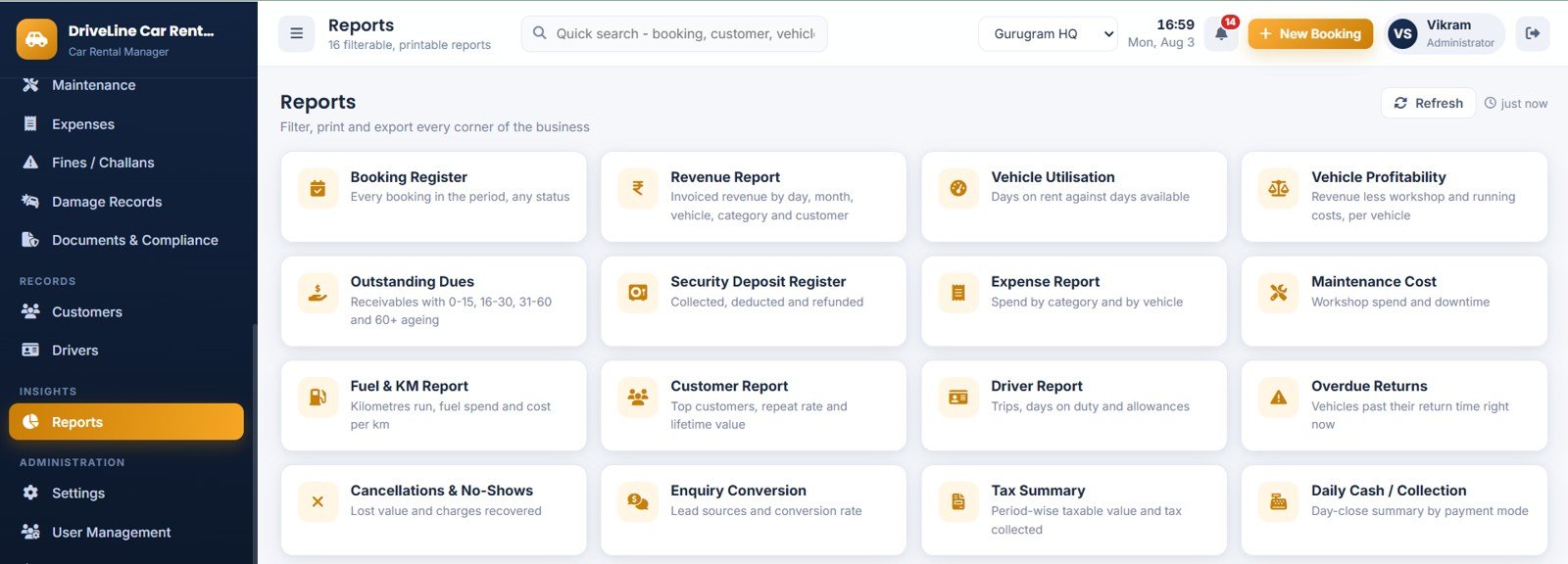
Sixteen filterable, printable reports: Booking Register, Revenue Report, Vehicle Utilisation, Vehicle Profitability, Outstanding Dues, Security Deposit Register, Expense Report, Maintenance Cost, Fuel & KM Report, Customer Report, Driver Report, Overdue Returns, Cancellations & No-Shows, Enquiry Conversion, Tax Summary and Daily Cash / Collection. Each exports to CSV.
Page 21: Settings
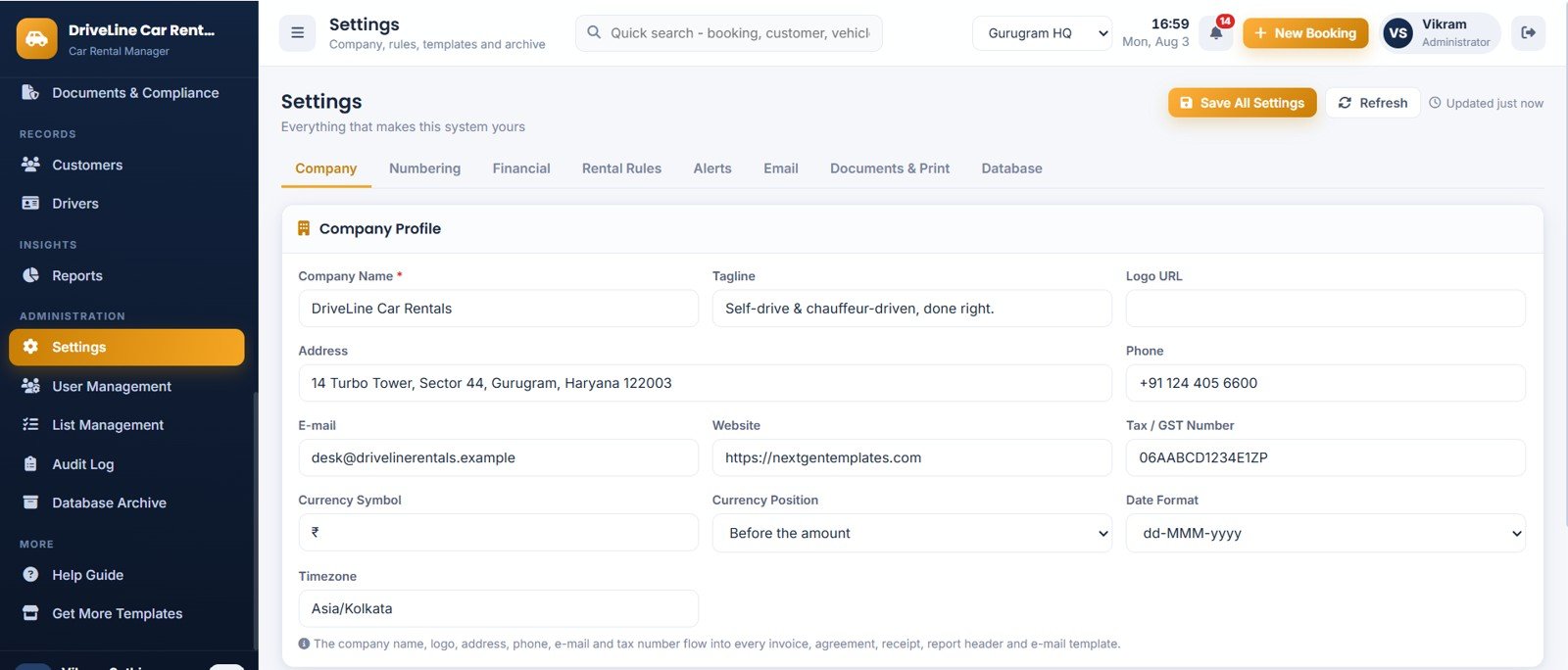
Eight tabs — Company, Numbering, Financial, Rental Rules, Alerts, Email, Documents & Print and Database. Rental Rules drive every automatic charge: grace hours, late-fee basis, free km, extra km rate, minimum hire hours, cancellation percentage, no-show charge and deposit rule.
Page 22: User Management
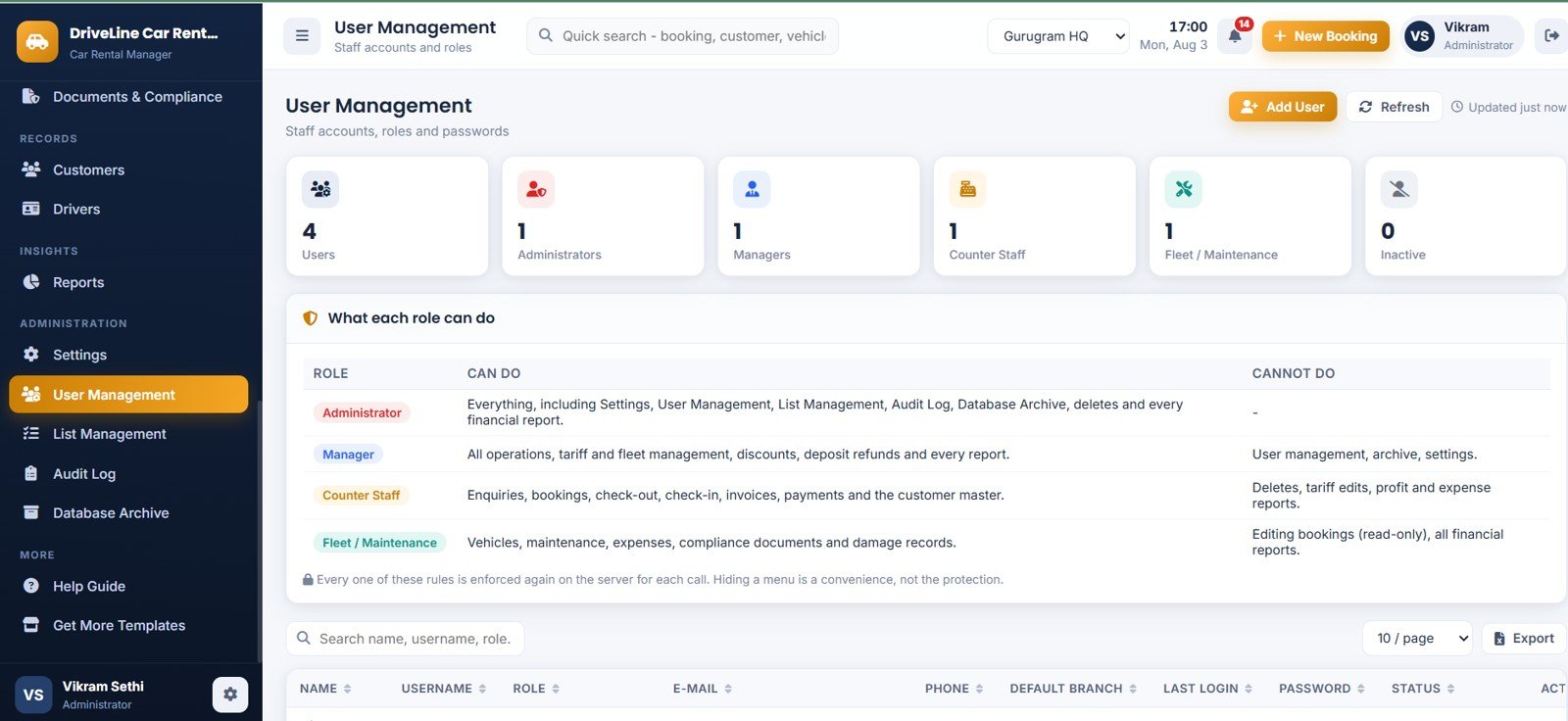
Staff accounts by Users, Administrators, Managers, Counter Staff, Fleet / Maintenance and Inactive, with a plain-language matrix of what each role can and cannot do. Passwords are stored only as salted SHA-256 hashes, new accounts must set their own password at first sign-in, and the system always keeps at least one active Administrator.
Page 23: List Management
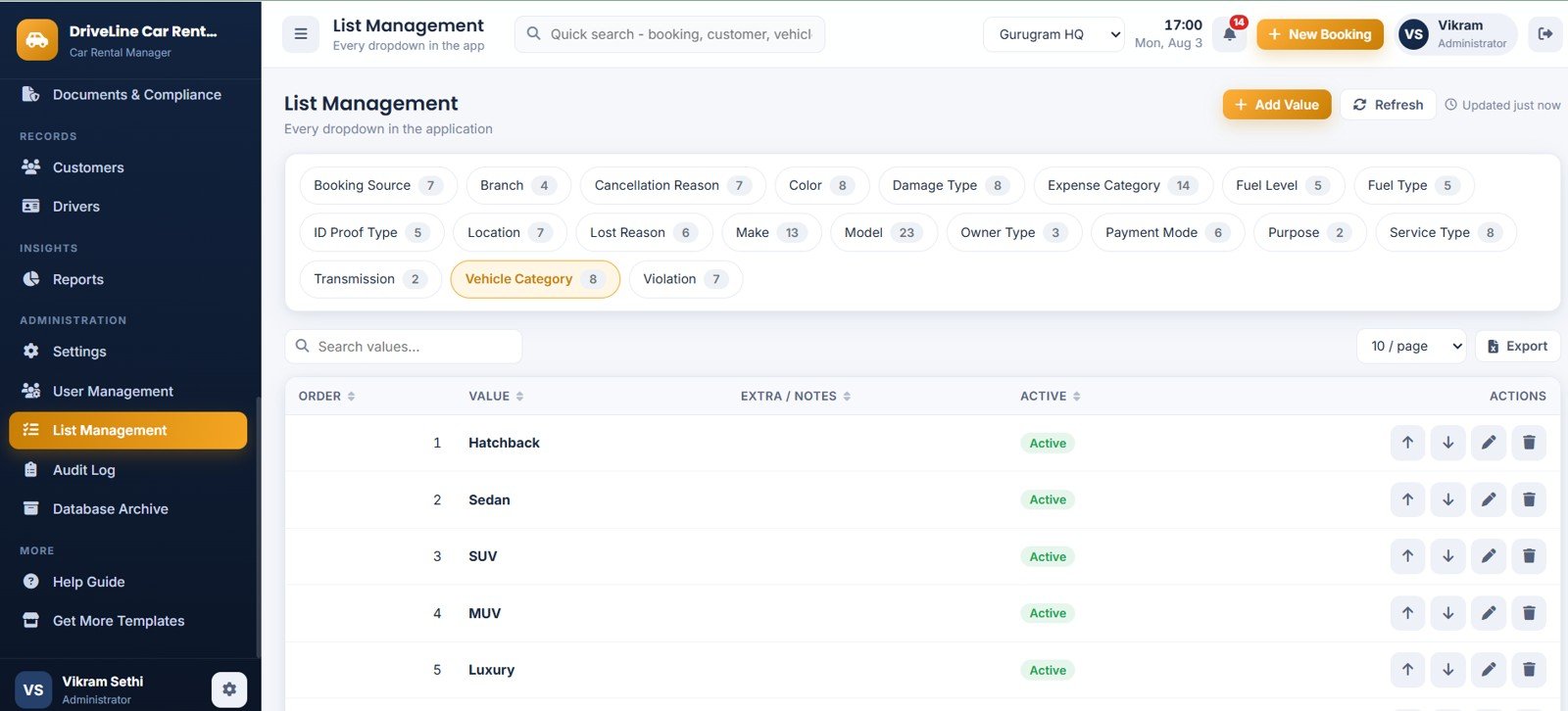
Twenty controlled dropdown lists — booking source, branch, cancellation reason, colour, damage type, expense category, fuel level, fuel type, ID proof, location, lost reason, make, model, owner type, payment mode, purpose, service type, transmission, vehicle category and violation.
Page 24: Audit Log
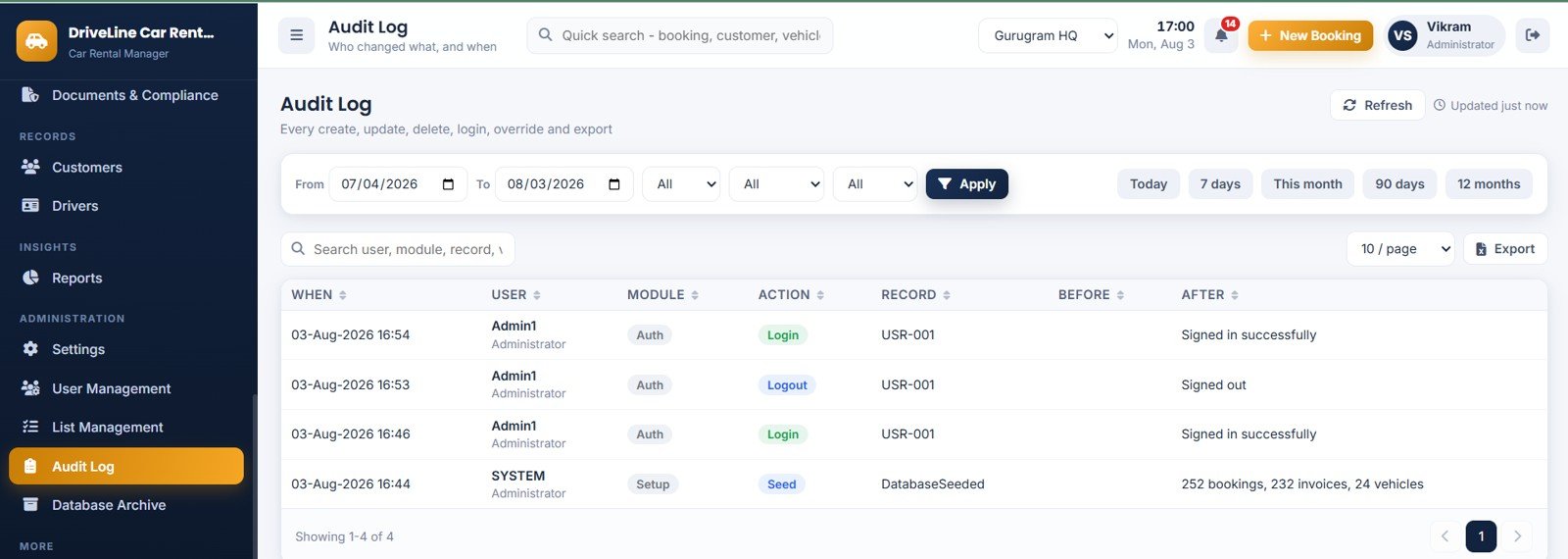
Who changed what and when, filterable by date, user, module and action, with a before-and-after summary on every create, update, delete, sign-in, blacklist override, rate override, discount, import, export and archive run.
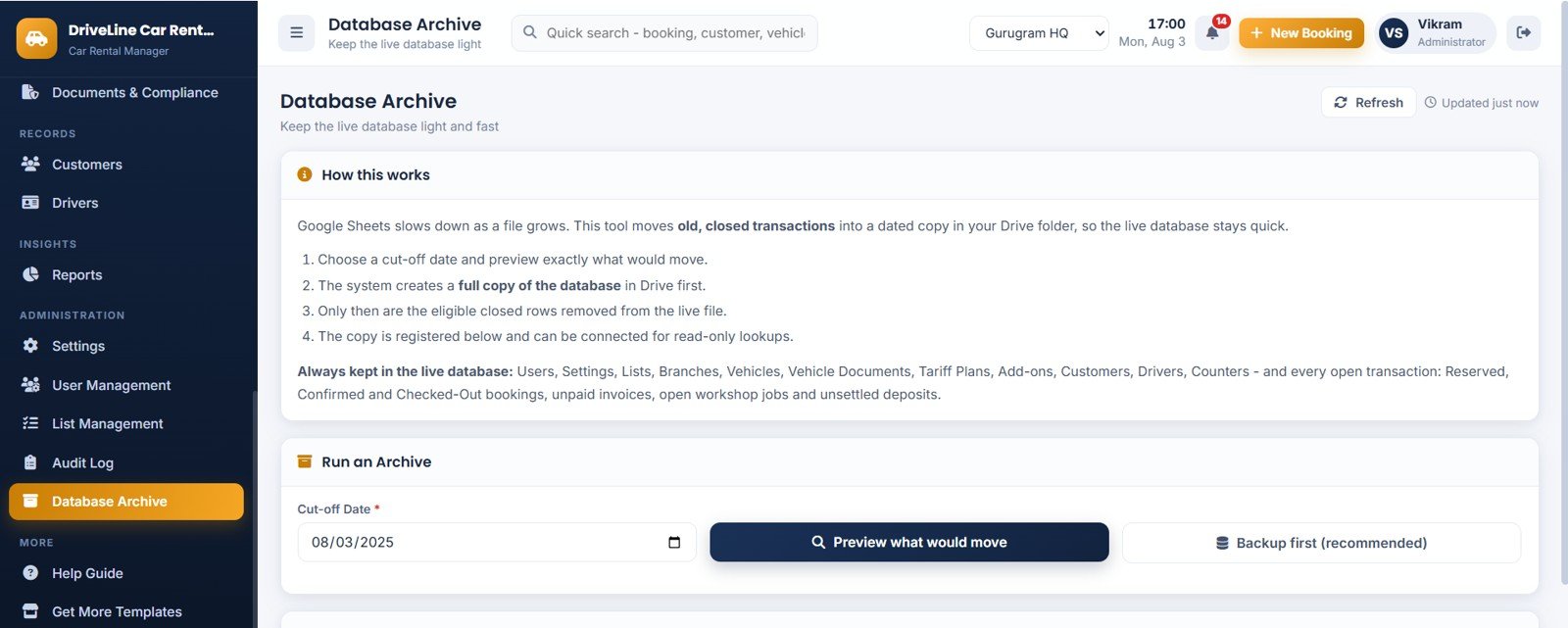
Page 25: Database Archive
Keeps the live spreadsheet fast. Choose a cut-off date, preview exactly what would move, take a full Drive copy first, and only then remove eligible closed rows. Master data and every open transaction always stay in the live file, and archives stay connectable read-only.
Car Rental Management System vs. Excel Rental Workbook vs. HQ Rental Software / Booqable
| Feature | Car Rental Management System Web App | Excel / VBA Rental Workbook | HQ Rental Software / Booqable / RentSyst |
|---|---|---|---|
| Cost | $39.99 one-time | $6-$30 one-time | ~$29-$400 / month |
| Platform | Browser web app on Google Sheets | Desktop Excel only | Vendor cloud |
| Setup time | About 10 minutes | Minutes | Days, usually with onboarding calls |
| Multi-user login with roles | 4 roles, server-enforced | Rarely, file-level only | Yes, priced per user |
| Double-booking prevention | Server-side overlap test inside a lock | Manual checking | Yes |
| Deposit, damage, challan and late-fee automation | All four built in | Manual formulas | Partly, on higher plans |
| Built-in reports | 16, date-filtered and printable | Whatever you build | Yes, plan-dependent |
| Document expiry alerts | Built in with your own lead days | Manual | Sometimes |
| Data ownership | Your own Google Sheet and Drive | Your file | Vendor-hosted |
| Year-1 cost at 5 users | $39.99 total | $6-$30 | ~$350-$4,800+ |
For rental operators who want real multi-user booking control, deposit handling and reporting without a monthly per-seat fee, this sits in the sweet spot between a spreadsheet and a subscription platform.
Who Should Use This Template
Perfect for:
- Self-drive car rental companies running 5-150 vehicles across one or several branches.
- Chauffeur-driven and airport-transfer operators who need driver allowances and duty tracking alongside the hire.
- Hotel, resort and travel-desk fleets hiring cars to guests.
- Corporate tie-up operators billing monthly against a tariff plan.
- Mixed fleets of hatchbacks, sedans, SUVs, MUVs, luxury cars and tempo travellers.
Not a fit if:
- You need customer-facing online booking with card payment capture. This is a staff-side desk system — payments are recorded, not processed.
- You need live GPS or IoT telematics feeds from your vehicles.
- You require SOC 2, SSO or a signed data-processing agreement.
Real-World Use Cases
A 30-car self-drive operator at an airport counter. Every morning starts on the dashboard: today’s pickups, today’s returns and anything overdue on one screen. When a car comes back four hours late having run 320 km over its free allowance, the late fee and the extra-kilometre charge are already on the bill before the conversation starts.
A travel company with a corporate tie-up. Enquiries arrive from the website and the corporate desk, get quoted, and convert into bookings without anything being re-typed. The Outstanding Dues report, with 0-15, 16-30, 31-60 and 60+ ageing buckets, drives the monthly collection call, and the Tax Summary goes straight to the accountant.
A two-branch operator with its own workshop. The fleet supervisor signs in on a Fleet / Maintenance account: he can open workshop jobs, log expenses, record challans and damage and update compliance documents, but bookings are read-only and the financial reports are simply not reachable from his login.
Advantages of the Car Rental Management System
- No recurring cost. One payment of $39.99 against roughly $350 to $4,800 a year for a comparable subscription platform at five users.
- Disputes end quickly. Odometer readings, fuel levels, a condition checklist and photographs at both ends of every hire mean there is always evidence.
- Nothing is calculated twice. Set grace hours, late-fee rule, free kilometres, tax percentage and deposit defaults once, and every return follows them.
- Compliance stops being a surprise. Expiring insurance, permits, PUC certificates and driving licences surface before they lapse, not after a fine.
- Your data stays yours. Everything lives in your own Google Sheet and Drive. Read it, back it up or export it whenever you like.
- It stays fast. Modules load once and are then served from browser memory, and the archive keeps the live spreadsheet small as the years pass.
- Deployment is genuinely simple. Paste two files, run one function, deploy. See the official Google Apps Script web apps documentation for how the deployment model works.
Opportunities for Improvement
It is a staff-side system, so there is no customer-facing booking portal and no online card capture — payments are recorded, not processed. There is no GPS or telematics integration, so live vehicle location is out of scope. Google’s own Sheets size limits apply, which is precisely why the Database Archive exists, though very high-volume operators running thousands of hires a month should plan to archive regularly. E-mail uses the daily MailApp quota of the Google account that owns the script, which is modest on a free Gmail account. And the tariff structure is shaped for cars — an operator renting heavy commercial vehicles would want the rate card reworked.
Best Practices
- Change every default password before you go live, and give each staff member their own account so the audit log actually means something.
- Photograph the car at handover and at return, every single time. It takes fifteen seconds and settles arguments permanently.
- Enter the odometer accurately. Extra-kilometre billing, service scheduling and the Fuel & KM report all depend on it.
- Write your real terms and conditions into Settings before printing your first agreement — that is the text the customer signs.
- Open a maintenance job the moment a car is off the road, so nobody can book it by accident.
- Check the Documents & Compliance page weekly. An expired permit costs far more than a missed rental.
- Run the Daily Cash / Collection report at close of business and the Revenue and Tax Summary reports monthly, and take a spreadsheet copy before any large change.
Explore Relevant Templates
- Bike and Two-Wheeler Rental Management System Web App — the same rental workflow shaped for scooters, motorcycles and e-bikes.
- Rental Equipment Management System Web App — for tools, equipment and event gear.
- Vehicle Movement Register Management System Web App — for fleets that move vehicles rather than rent them.
- Car Rental KPI Dashboard in Google Sheets — a reporting-only view if you already have a booking process.
- Vehicle Reservation Tracker in Excel — a lightweight Excel starting point.
You can also read our walkthroughs of the Bike and Two-Wheeler Rental Management System, the Rental Equipment Management System and the Fleet Utilization KPI Dashboard in Google Sheets, plus the Car Rental KPI Dashboard in Google Sheets — all built on the same Google Sheets foundation.
Frequently Asked Questions
What does the Car Rental Management System actually track?
The Car Rental Management System tracks 12 live KPIs — total vehicles, available now, on rent, under maintenance, today’s pickups, today’s returns, overdue returns, bookings this month, revenue month-to-date, outstanding dues, deposits held and fleet utilisation — across 26 screens, 16 reports and 28 Google Sheets tabs.
How long does setup take?
About 10 minutes. You paste two files into a new Apps Script project, name the HTML file exactly Index, run Setup Database once from the sheet menu, then deploy as a web app. It arrives seeded with 24 vehicles, 32 customers, 5 drivers and 252 bookings so you can test every feature immediately.
How does this compare to HQ Rental Software or Booqable?
Those are subscription platforms costing roughly $29 to $400 a month, and they add customer-facing online booking and payment capture. The Car Rental Management System is a one-time $39.99 staff-side desk system that keeps your data in your own Google account with no recurring fee and no per-user charge.
Can two staff members double-book the same car?
No. The Car Rental Management System runs an overlap test on the server, inside a script lock, against every Reserved, Confirmed and Checked-Out booking on that vehicle. The save is refused and the clashing booking number is named, so two people saving at the same instant still cannot hire it twice.
How are late fees, extra kilometres and challans calculated?
Late fees start only after your grace hours, then follow a flat amount per late hour, a flat amount per late day, or a percentage of the daily rate per late day. Extra kilometres are anything beyond the free allowance per hire day at your per-kilometre rate. Recoverable traffic challans are pushed onto the customer’s bill as their own line.
What happens to the security deposit?
You choose at return: refund it in full, deduct dues or damage from it and refund the balance, or hold it. The choice is written to the deposit ledger with a reason, printed on the invoice and reported in the Security Deposit Register.
Will the Google Sheet slow down over time?
No. An Admin-only Database Archive copies the spreadsheet to Drive, registers it, and then removes only old closed transactions. Master data and every open booking always remain in the live database, and archives can be reconnected read-only.
About the Author
Built by PK — Microsoft Certified Professional with 15+ years of Excel, Google Sheets and Power BI experience. Founder of NextGenTemplates, reaching 300K+ subscribers across YouTube channels. Every template is hand-built and tested against real transaction data before release.
Conclusion
If you hire out cars — self-drive or with a chauffeur — the Car Rental Management System Web App gives you the three things a diary and a spreadsheet never can: it stops double-bookings before they happen, it produces a correct final bill without arithmetic, and it leaves an audit trail behind every action. It runs entirely on your own Google account, so there is nothing to host and nothing to renew.
Click here to Purchase the Car Rental Management System Web App
Instant download · One-time payment · No subscription · Lifetime access
For step-by-step walkthroughs of this and other Google Apps Script web apps, visit Youtube.com/@NeoTechNavigators.
Last updated: August 2026