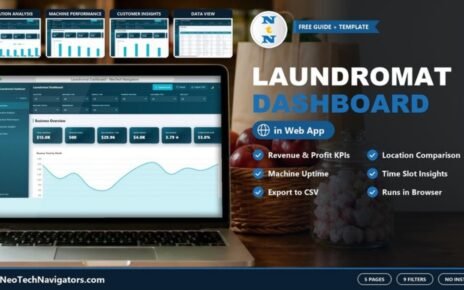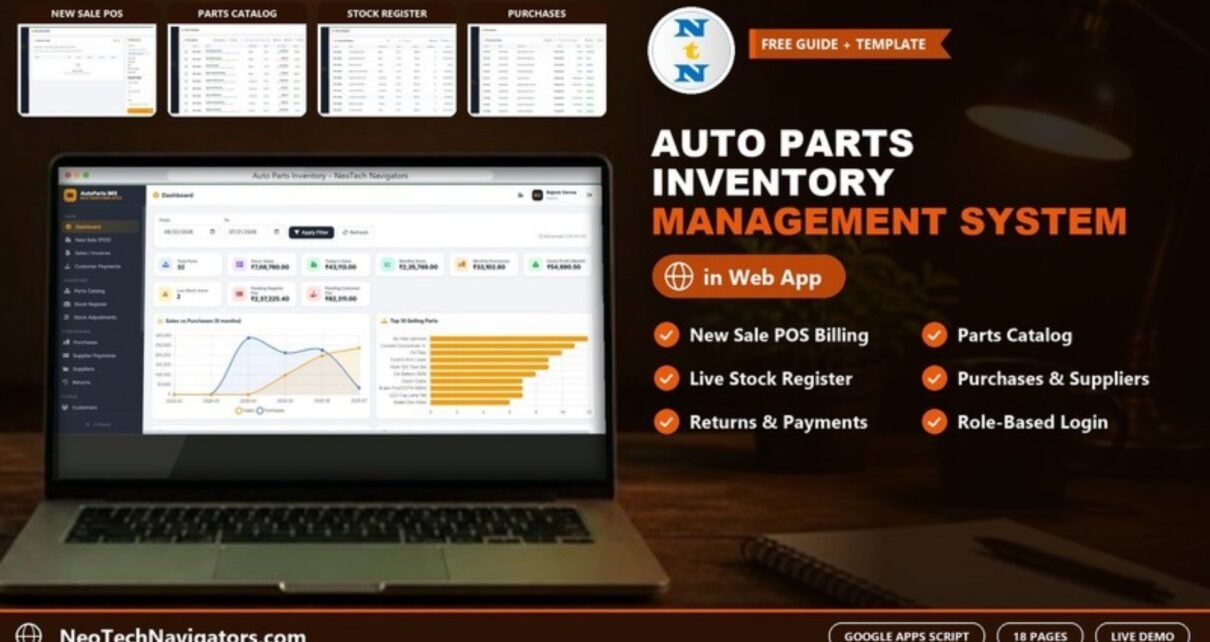
The Auto Parts Inventory Management System Web App gives auto parts shops an 18-page browser workflow for parts catalog management, New Sale POS billing, purchases, supplier payments, customer payments, stock register, stock adjustments, returns, reports, user management, settings and audit logs. Inventory mistakes quickly become lost sales, dead stock, supplier disputes and wrong customer dues, so a prepared operating system matters even for a small counter business.
This template is built for teams that want a downloadable web app instead of starting from blank spreadsheets or committing straight away to a paid inventory SaaS. It runs on Google Apps Script; the official Google Apps Script web app documentation explains how this kind of browser-based app is deployed.
🎥 Watch the Video Tutorial
Get the Auto Parts Inventory Web App
🚀 Try the Live Demo Before You Buy
We have deployed this web app in our own Google account so you can test every page and every role with sample data before purchasing. No signup or email is required: open the live demo.
🔑 Demo Login Credentials
Sign in as admin for full access (every operational module plus Settings, User Management, List Management, Database Archive and the Audit Log); as manager to run day-to-day operations (parts, stock, adjustments, purchases, supplier and customer payments, POS billing, returns and all reports); or as sales1 for counter billing (POS, own invoices, customer payments and parts lookup).
💡 What you get after purchase: the full source code (Code.gs + Index.html) plus a step-by-step deployment guide so you can deploy your own private instance in your own Google account in under 15 minutes.
Key Features of the Auto Parts Inventory Management System Web App
- 18-page workflow: login, dashboard, billing, invoices, payments, parts, stock, purchases, suppliers, returns, reports, users, settings and audit tracking.
- POS billing: search parts, add invoice items, calculate subtotal, discount, tax, charges, payment mode, received amount and invoice total.
- Parts master: maintain part code, part name, OEM reference, vehicle reference, category, rack location, sell price and stock status.
- Stock control: monitor live stock, inventory value, reorder levels, stock status, rack location and adjustment history.
- Purchase management: track purchase orders, suppliers, purchase totals, paid amounts, payment references and payable status.
- Customer and supplier payments: customer receipts are kept separate from supplier payment transactions for cleaner cash follow-up.
- Admin visibility: manage users, roles, dropdown lists, invoice numbering, purchase numbering, settings, stock behaviour and audit history.
Dashboard Pages Explained
1. Login Page
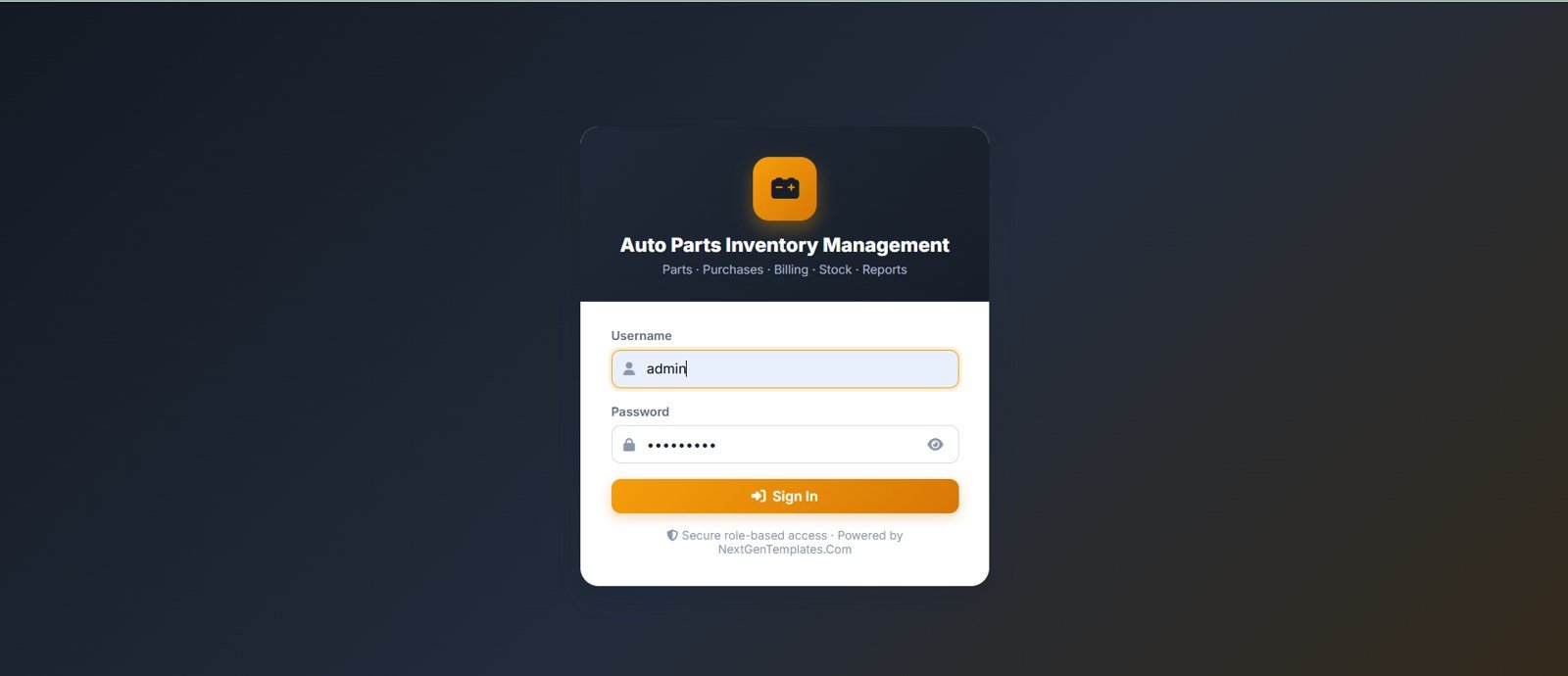
The login page is the access point for the system. It shows the Auto Parts Inventory Management title, the module subtitle (Parts, Purchases, Billing, Stock, Reports), username and password fields, the Sign In button and a secure role-based access note.
2. Dashboard
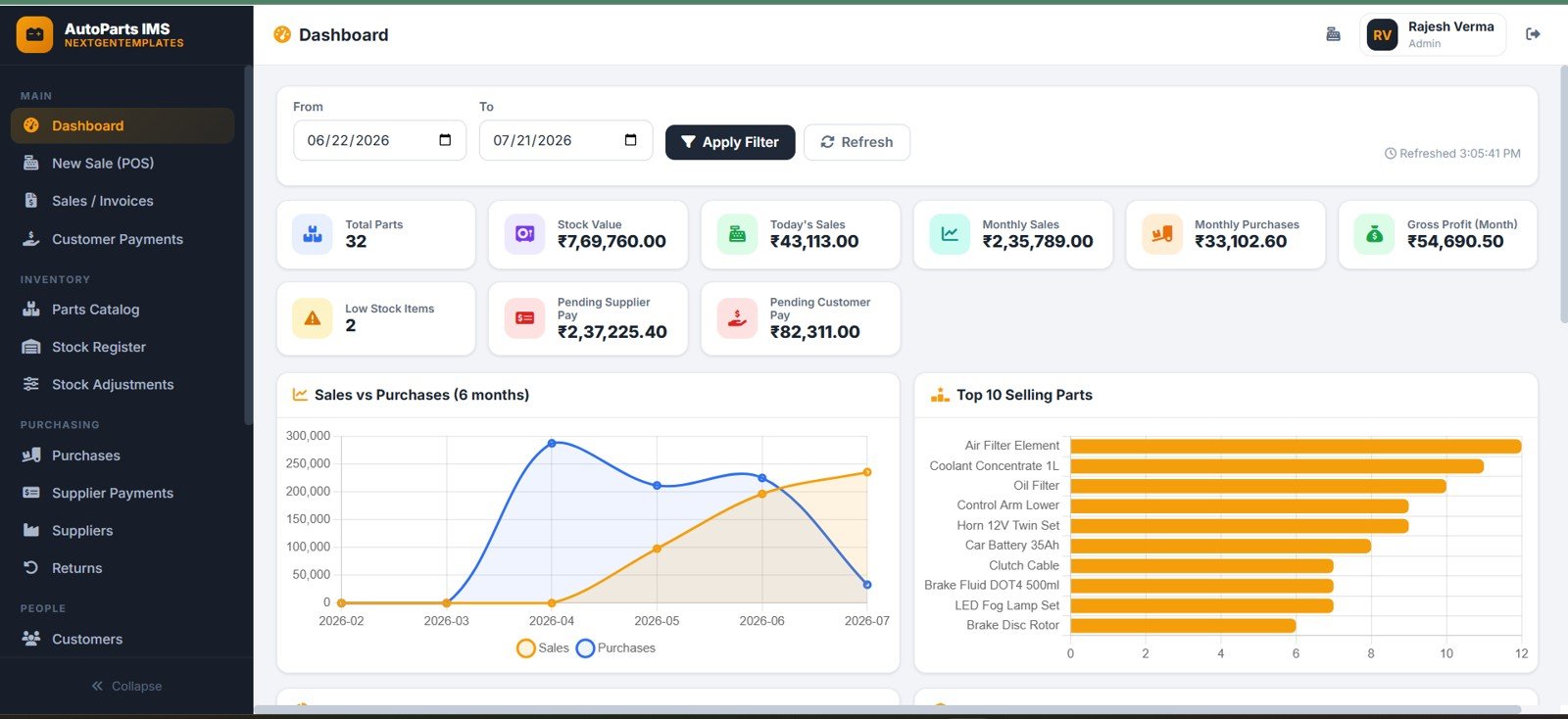
The dashboard brings sales, purchases, inventory, gross profit and payables into one page, with a From/To date filter. Its cards show Total Parts, Stock Value, Today’s Sales, Monthly Sales, Monthly Purchases, Gross Profit (Month), Low Stock Items, Pending Supplier Pay and Pending Customer Pay, followed by a Sales vs Purchases (6 months) chart and Top 10 Selling Parts by quantity.
3. New Sale POS
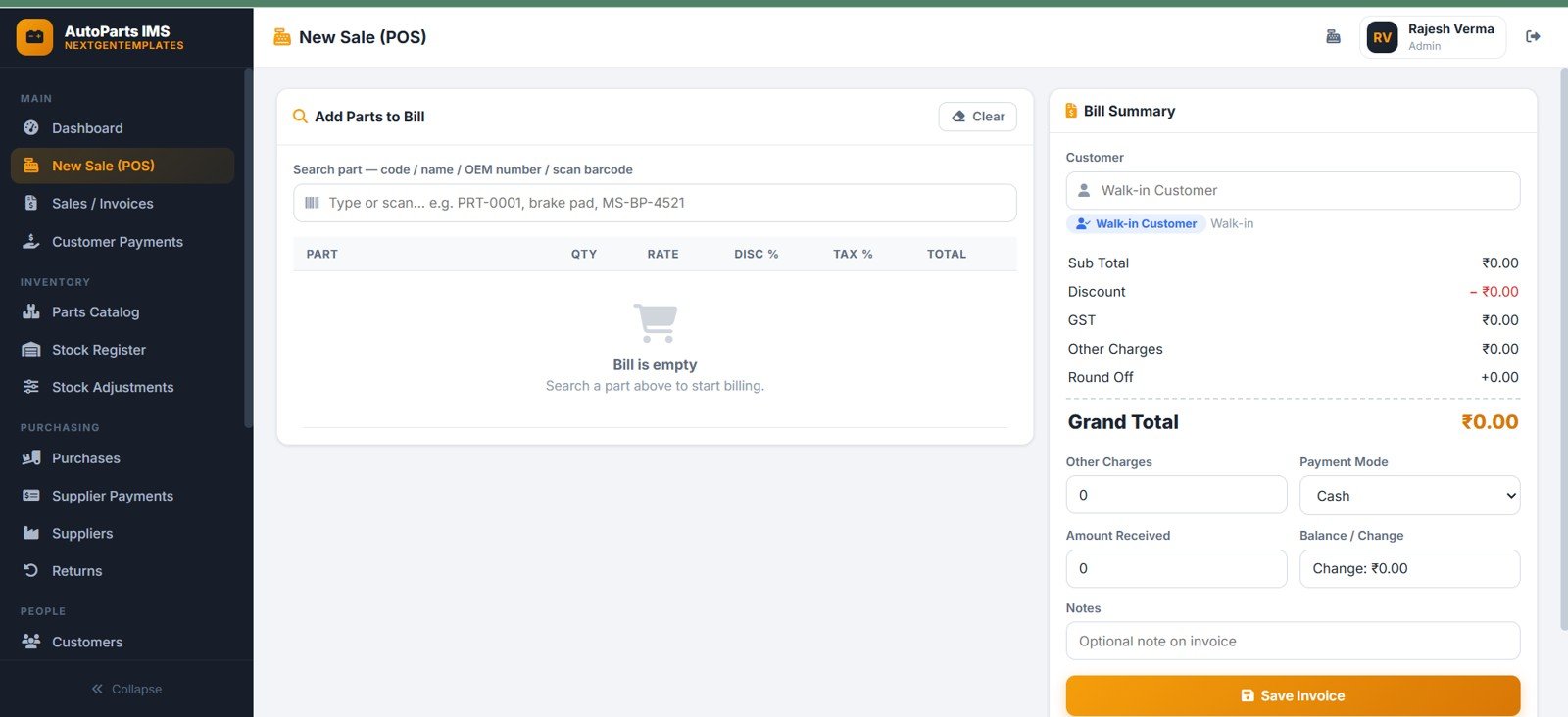
The New Sale POS page supports front-counter billing. Staff can search parts, add billing items, review subtotal, discount, tax, charges, invoice total, payment mode, amount received and customer selection.
4. Sales and Invoices
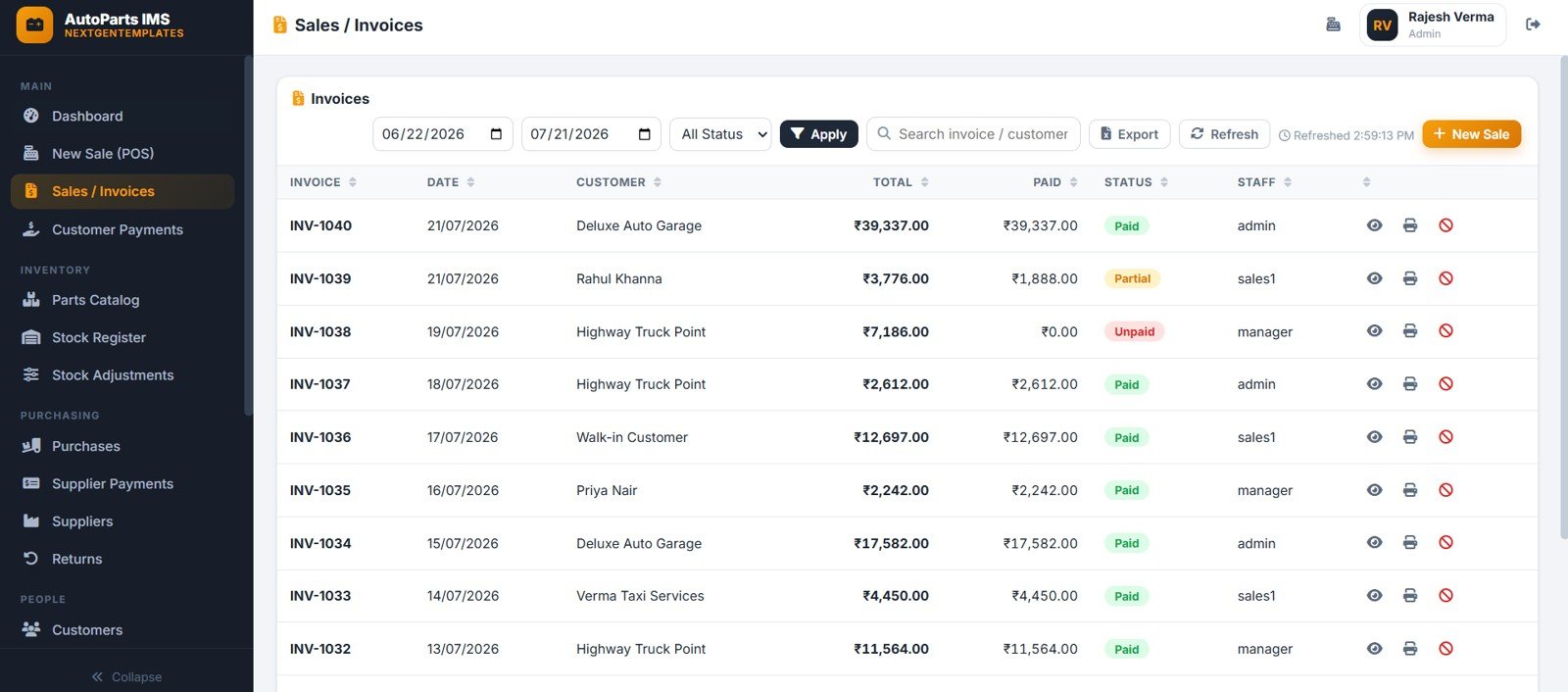
Sales and Invoices keeps invoice records searchable by date, customer, invoice number, staff, total, paid amount and status. It helps owners review daily sales and identify invoices that still need payment follow-up.
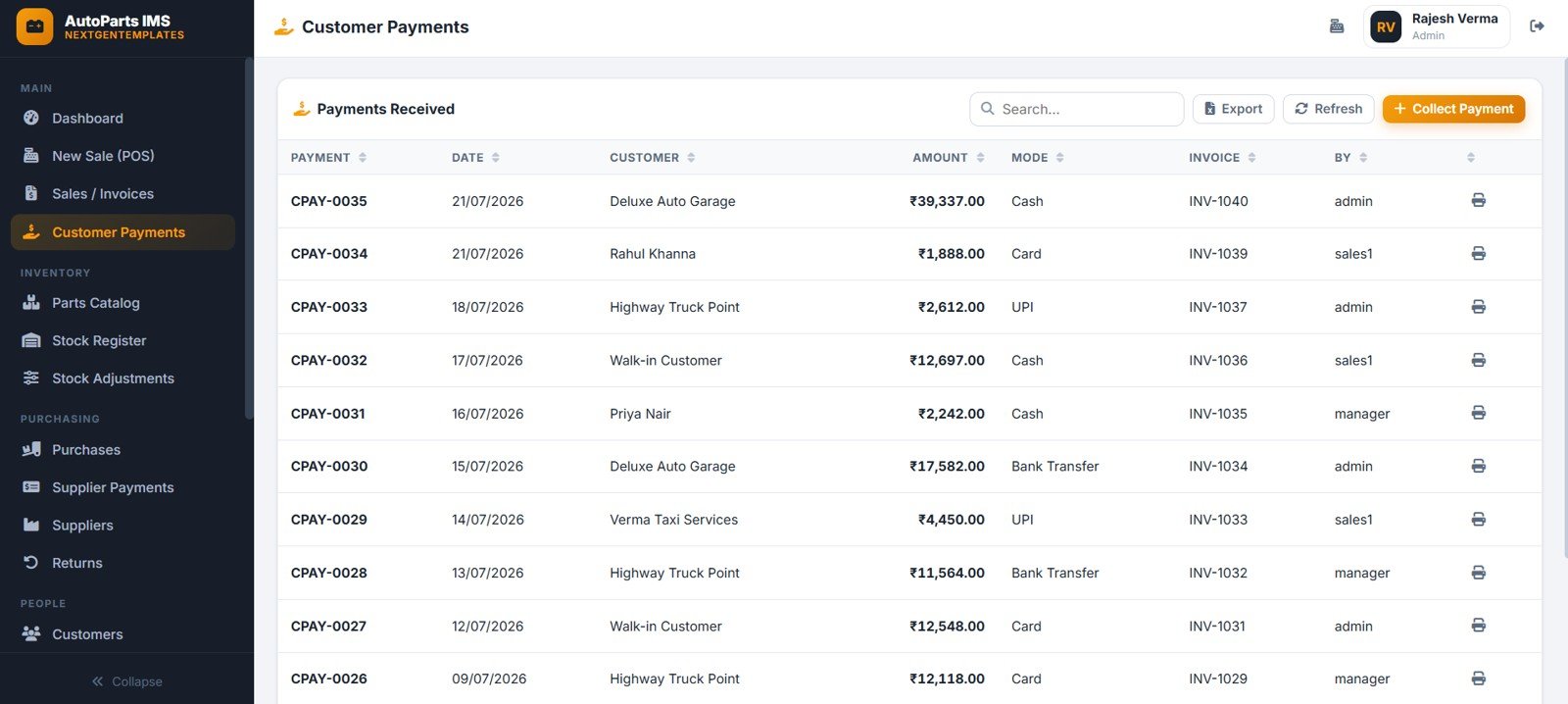
5. Customer Payments
The Customer Payments page records payments received by customer and invoice. Amount, payment mode, collecting staff member and payment date make it easier to separate collected cash from unpaid balances.
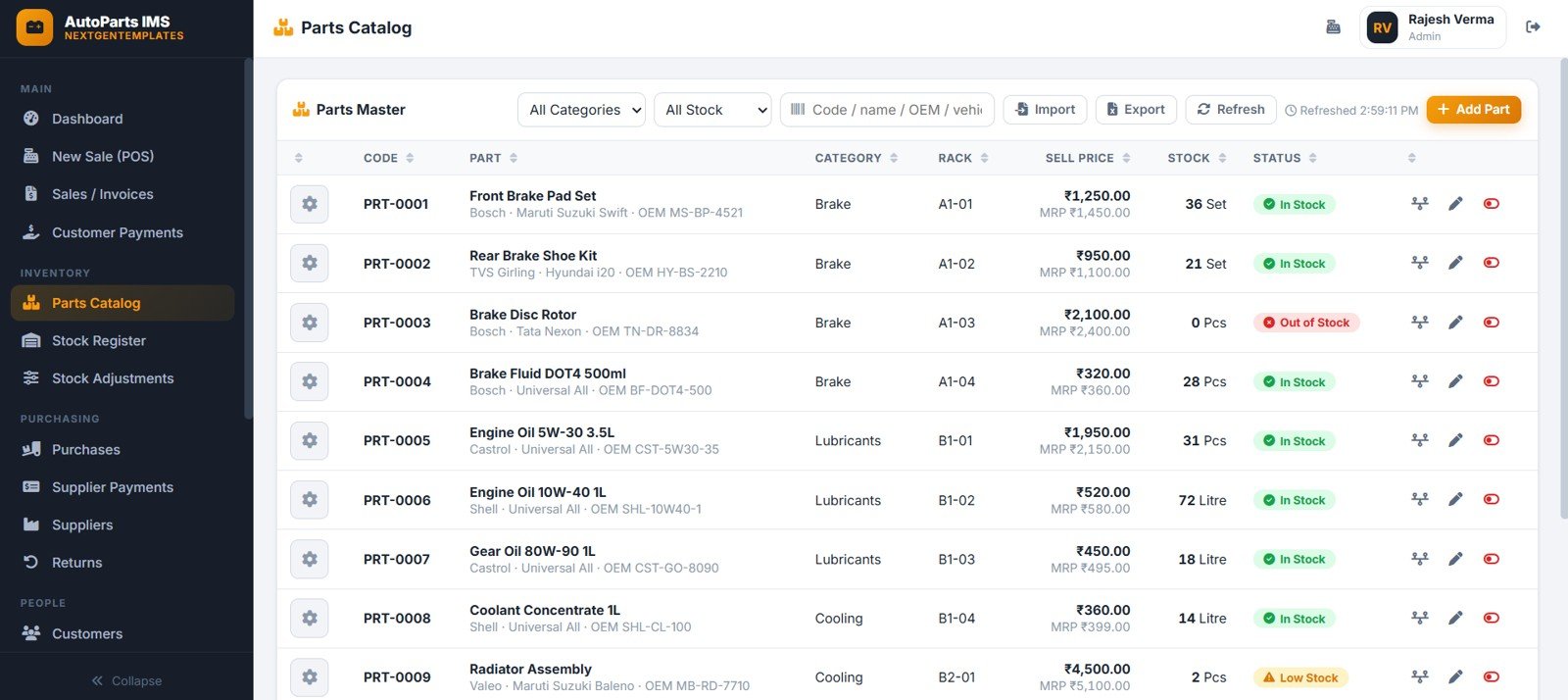
6. Parts Catalog
Parts Catalog is the product master for the business. It holds part code, part name, category, rack location, sell price and stock status, with OEM and vehicle search for quick part lookup.
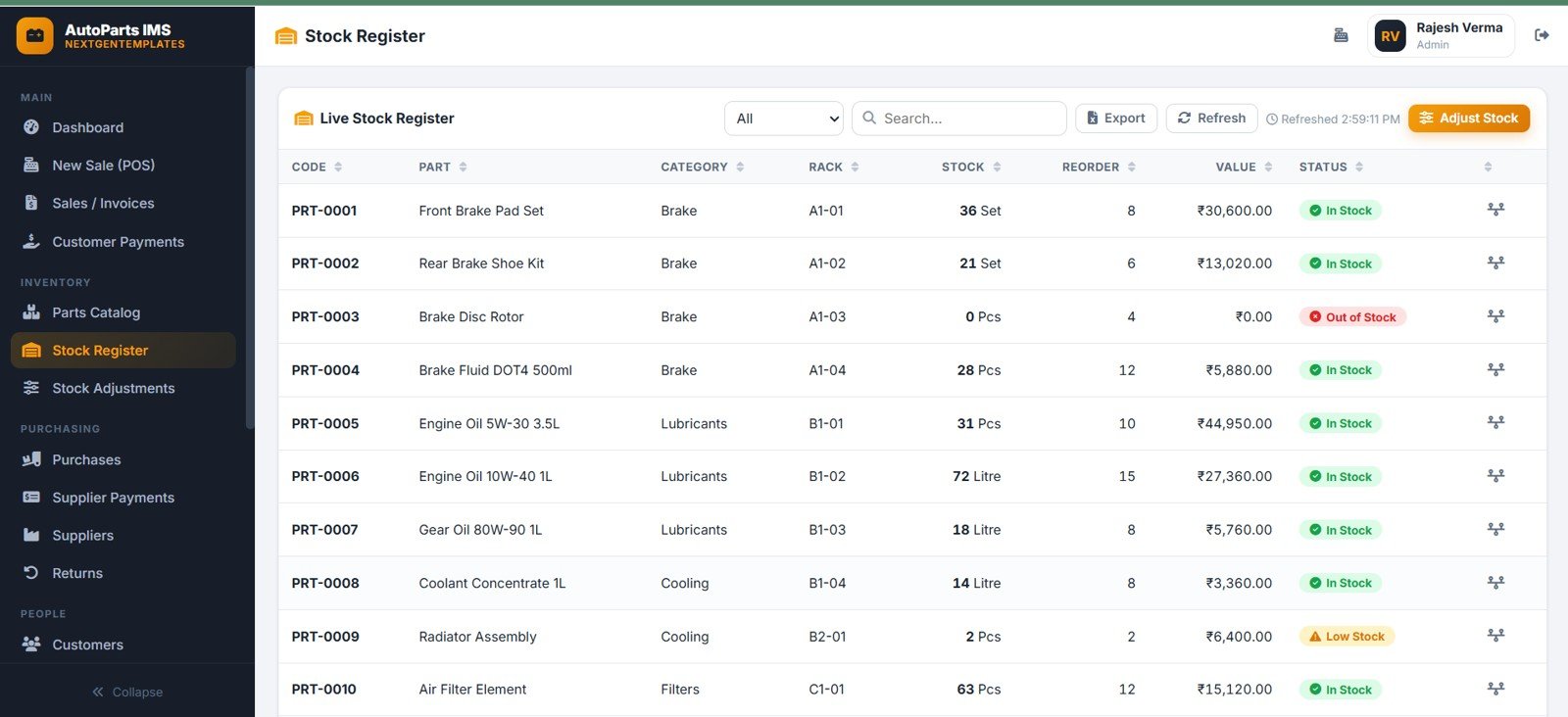
7. Stock Register
The Stock Register page shows live stock by part, inventory value by part, reorder level, stock status by category and rack location by part code. It is built for daily stock review and reorder conversations.
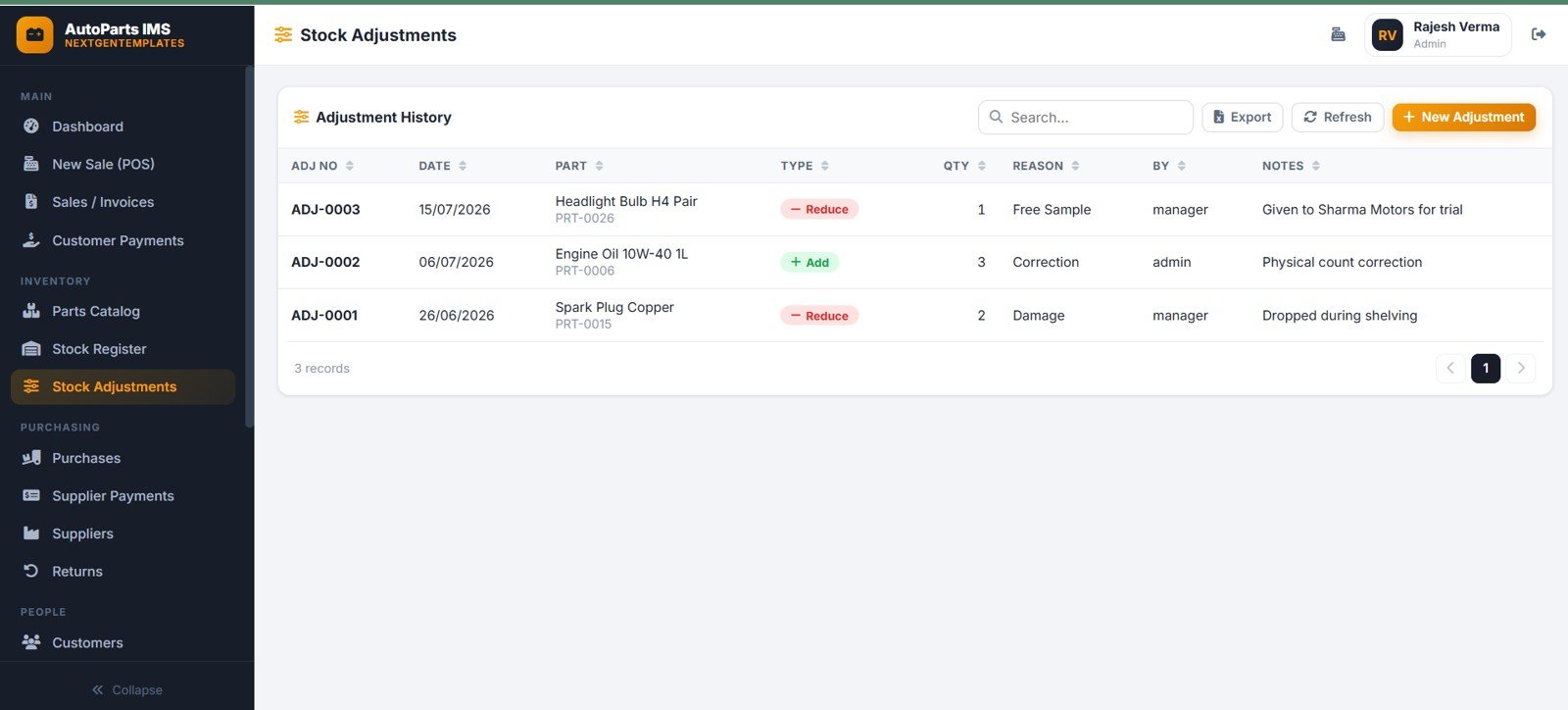
8. Stock Adjustments
Stock Adjustments records inventory corrections by part, adjustment quantity, adjustment type, reason, date, staff and notes. Use it after physical counts or for damaged stock, missing items and manual corrections.
9. Purchases
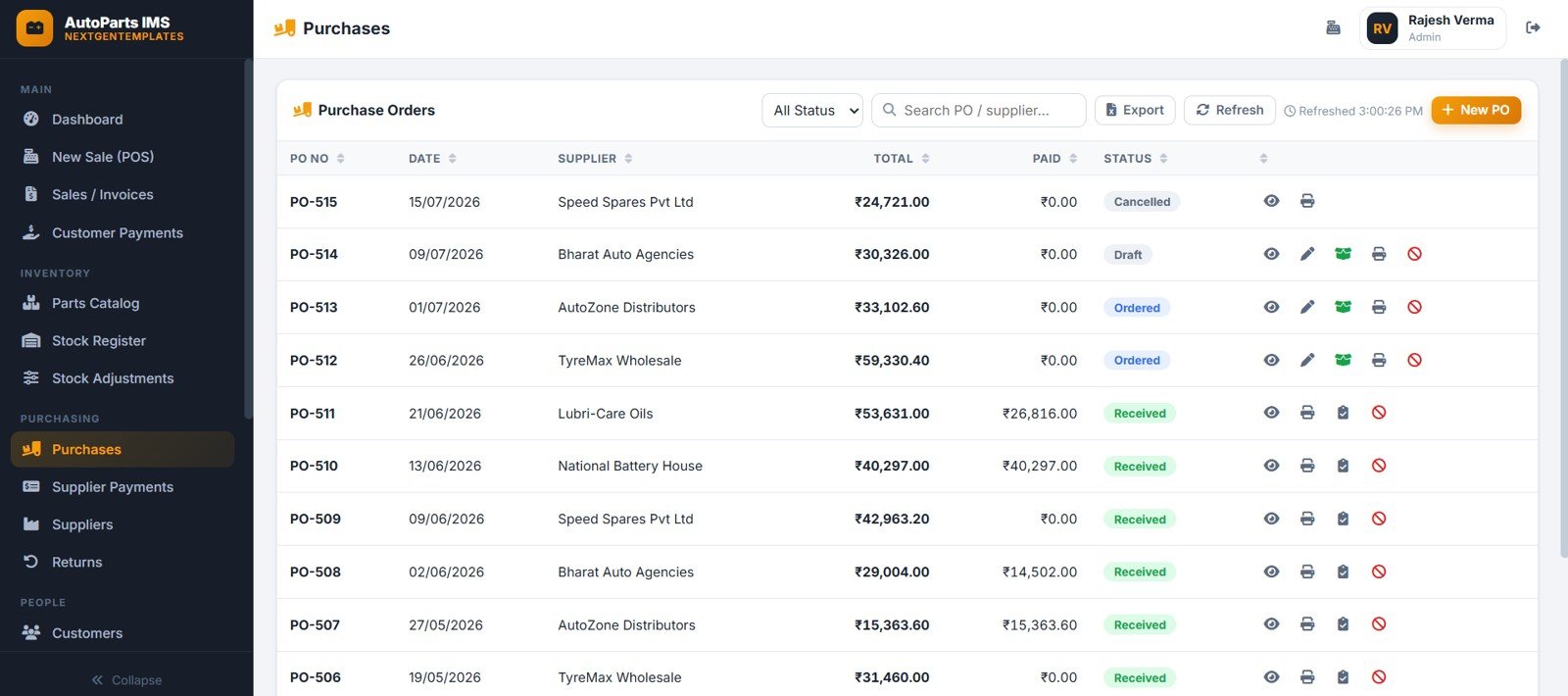
The Purchases page tracks purchase orders by supplier, PO number, total, paid amount, status and date, with a status filter. It gives the purchasing team one place to monitor incoming stock and purchase balances.
10. Supplier Payments
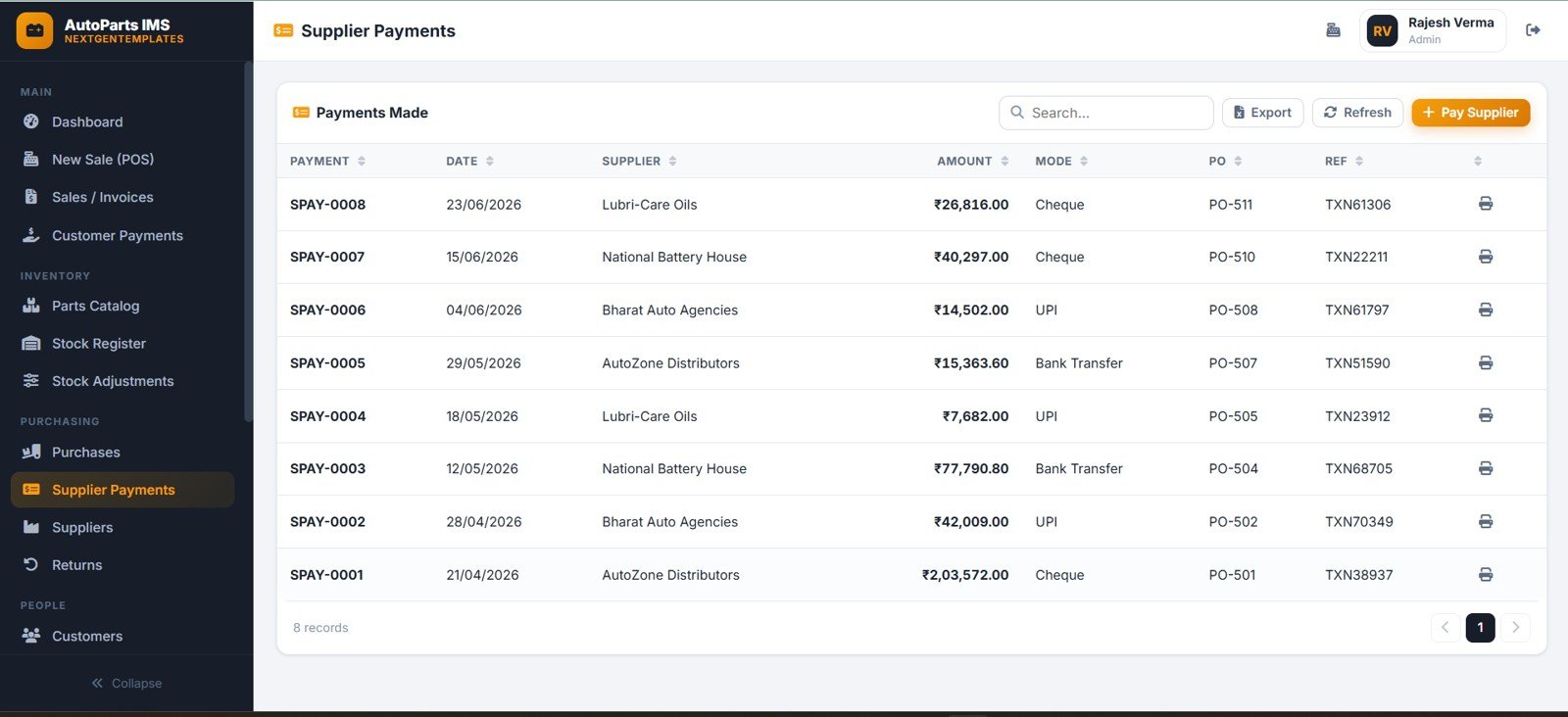
Supplier Payments records payments made by supplier and purchase order. Payment amount, payment mode, reference and date help owners review payables without mixing supplier payments with customer receipts.
11. Suppliers
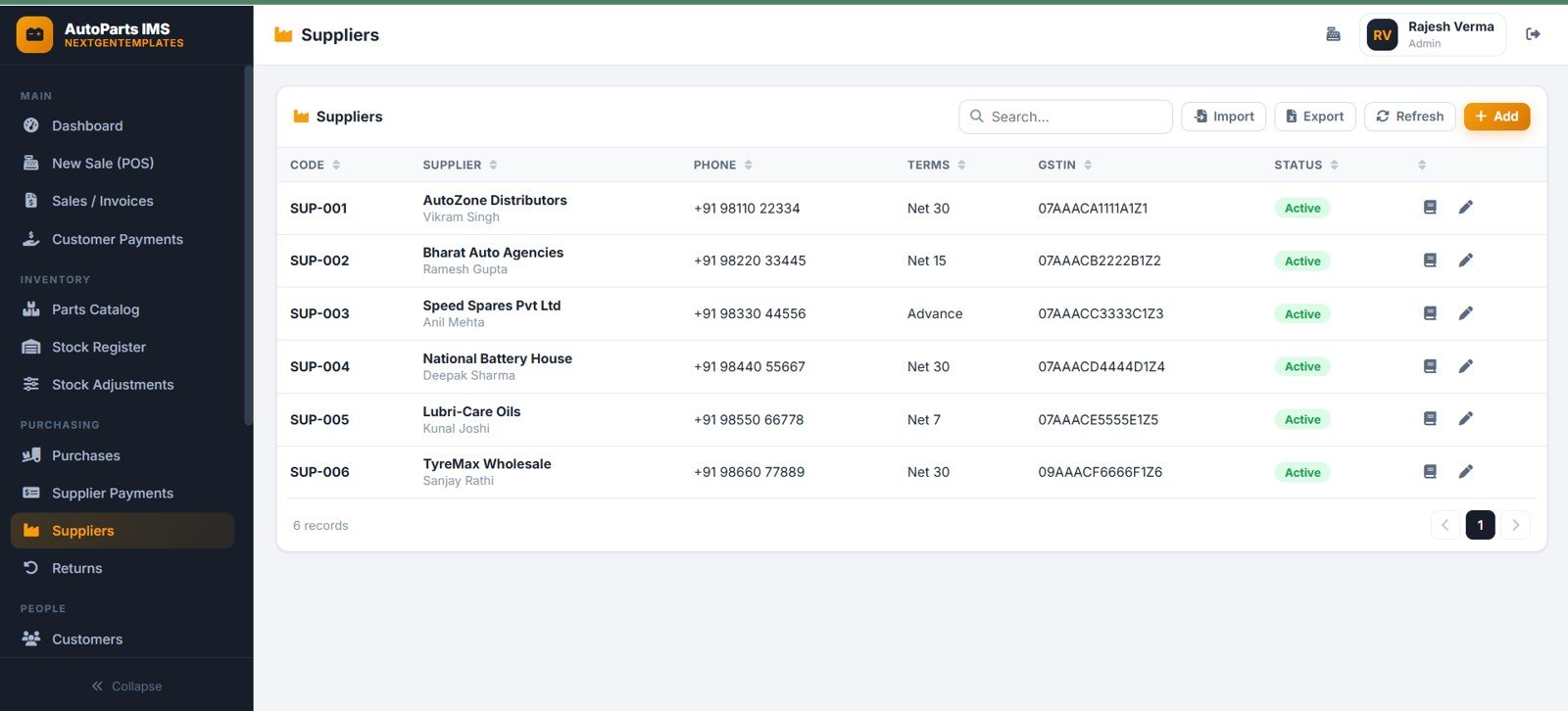
The Suppliers page maintains supplier code, contact details, phone number, payment terms, GSTIN and record status. Clean supplier data improves purchase orders, payments and payable reporting.
12. Returns
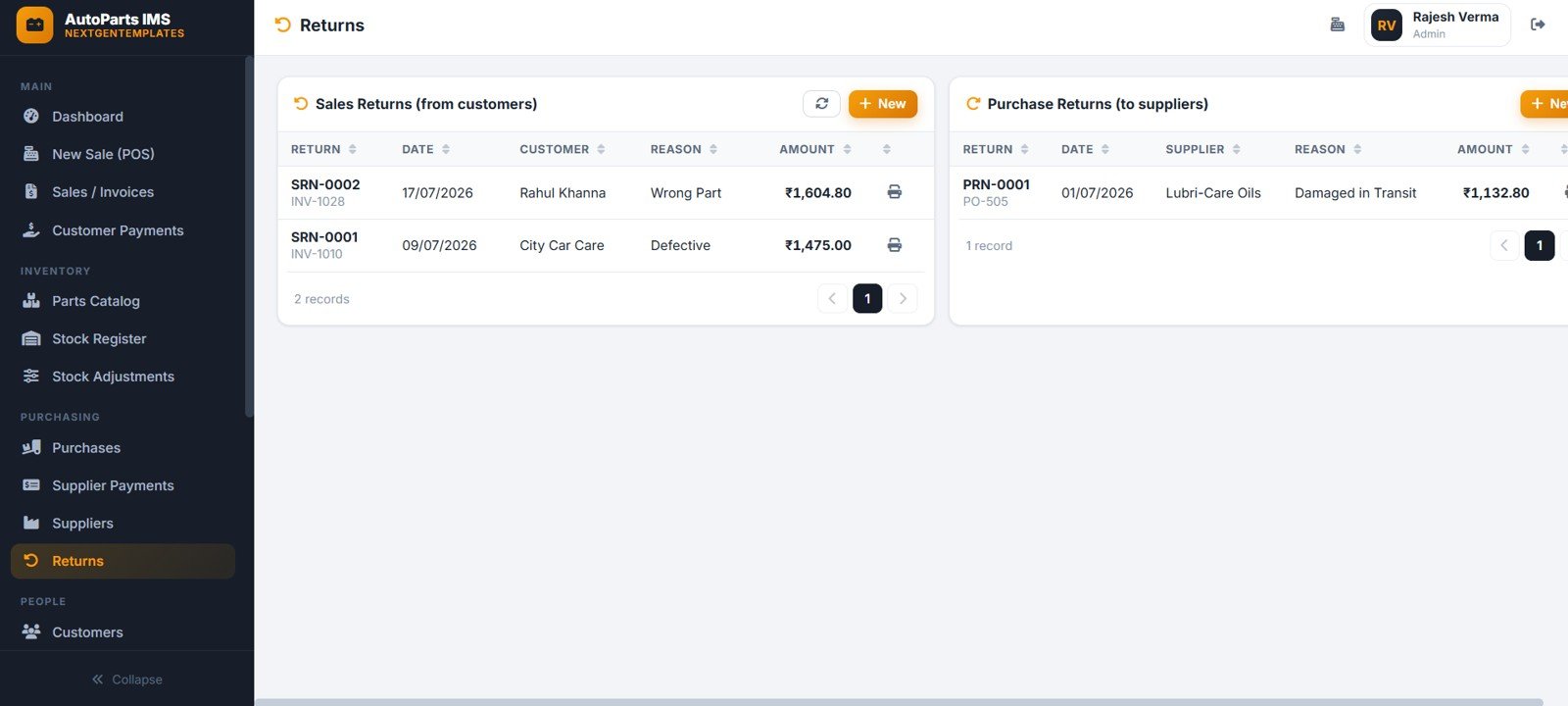
The Returns page covers sales returns by customer and purchase returns by supplier. It keeps return amount, reason, date, sales invoice and purchase order references visible for review.
13. Customers
Customers stores customer codes, customer type, phone number and status for workshops, walk-in customers and dealers. This supports repeat sales, invoice history and payment follow-up.

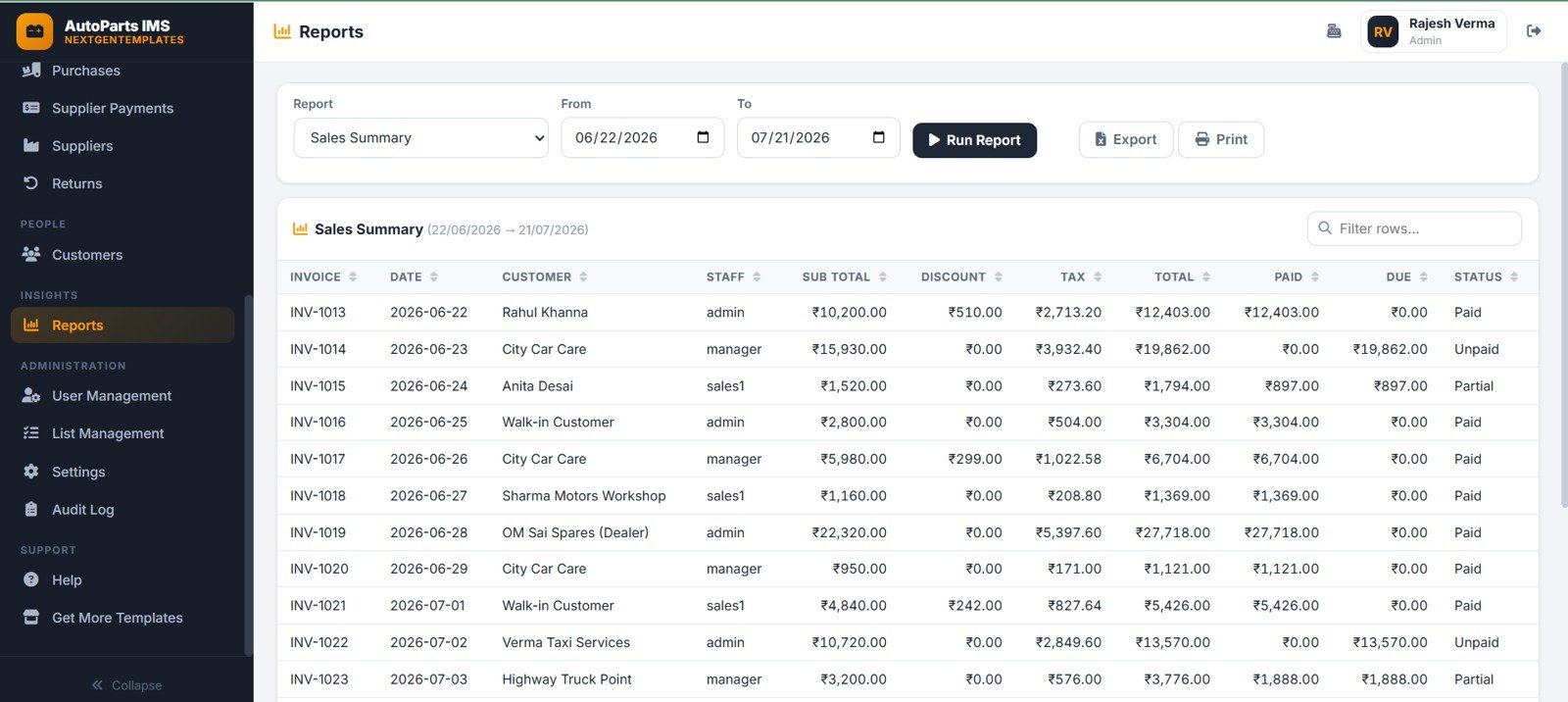
14. Reports
The Reports page gives sales summaries by invoice, customer, date, paid amount, due amount, tax and discount for any date range. It helps a shop owner review performance without building a report from scratch each week.
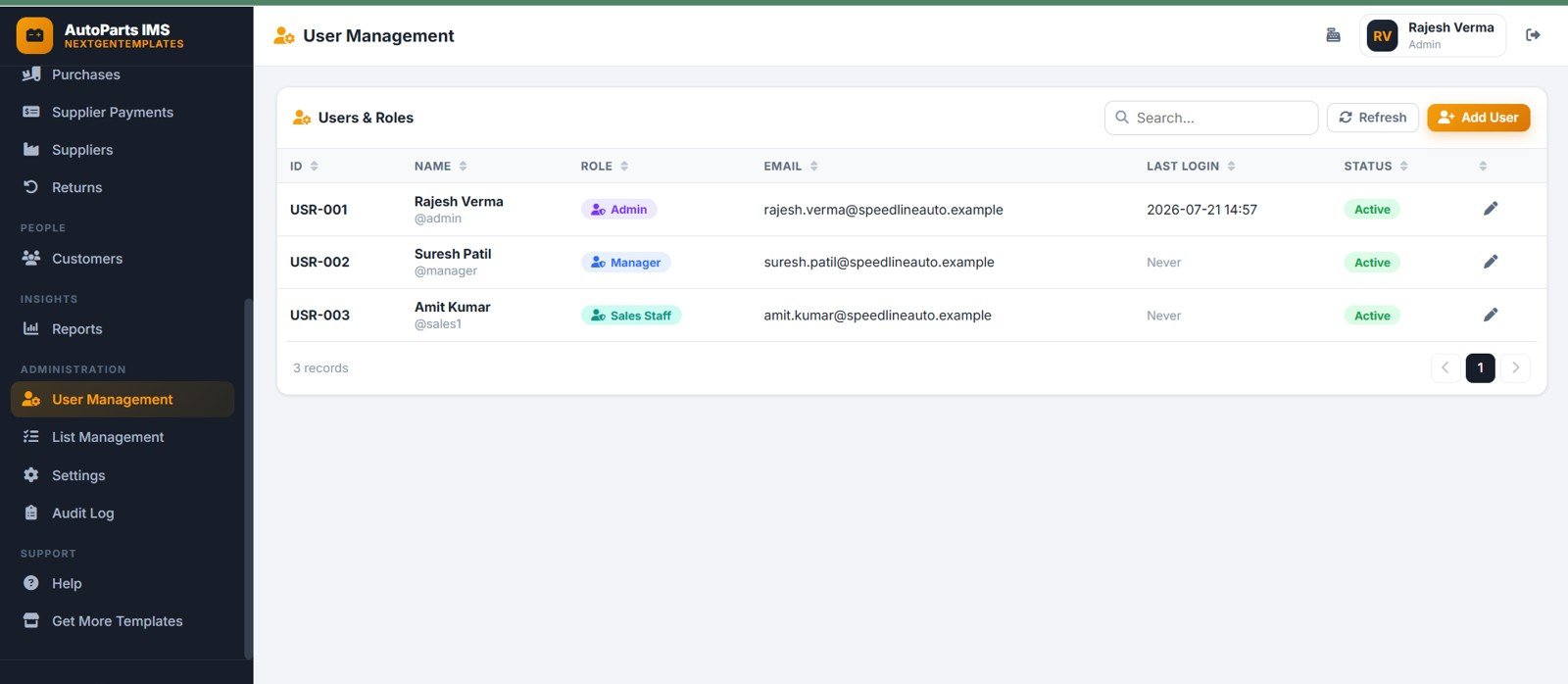
15. User Management
User Management controls users by role, login access, status, last login and email. Admin, manager and sales staff roles can be separated for cleaner access control.
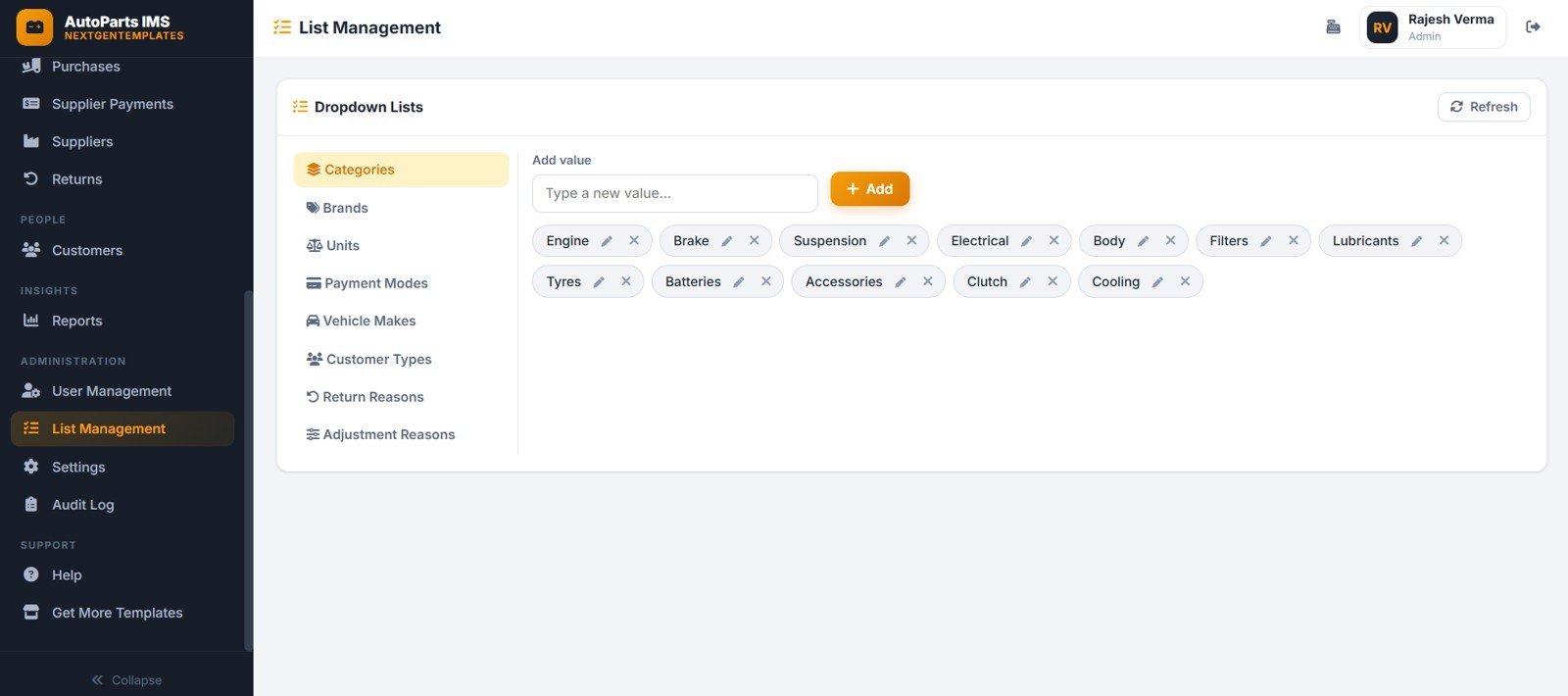
16. List Management
List Management controls the dropdown values used across the app: Categories, Brands, Units, Payment Modes, Vehicle Makes, Customer Types, Return Reasons and Adjustment Reasons. Consistent lists prevent messy reporting labels later.
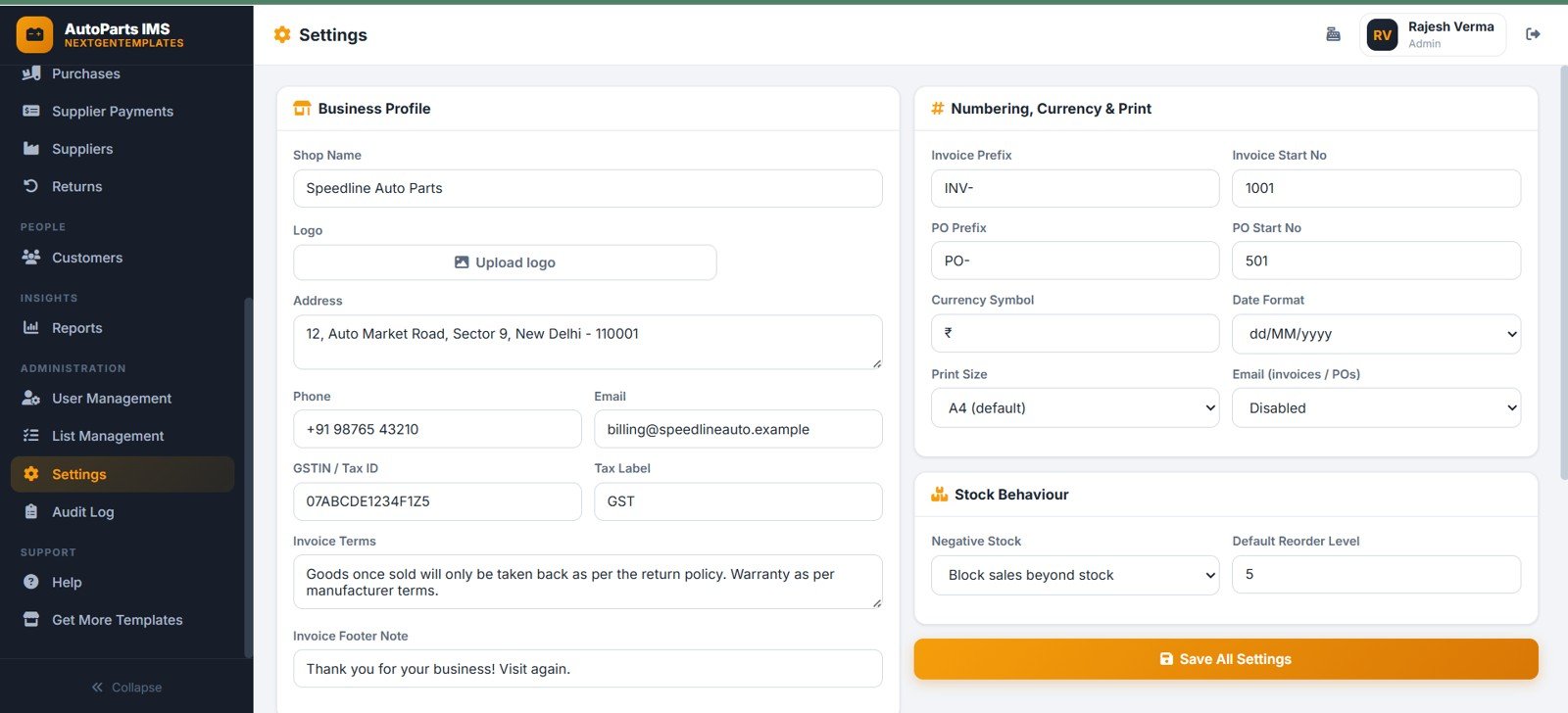
17. Settings
Settings contains the business profile (shop name, logo, address, phone, email, GSTIN / tax ID, tax label, invoice terms and invoice footer note), the invoice prefix and start number, the PO prefix and start number, currency symbol, date format, print size, the email option for invoices and POs, and the stock behaviour rules: negative stock handling and the default reorder level.
18. Audit Log
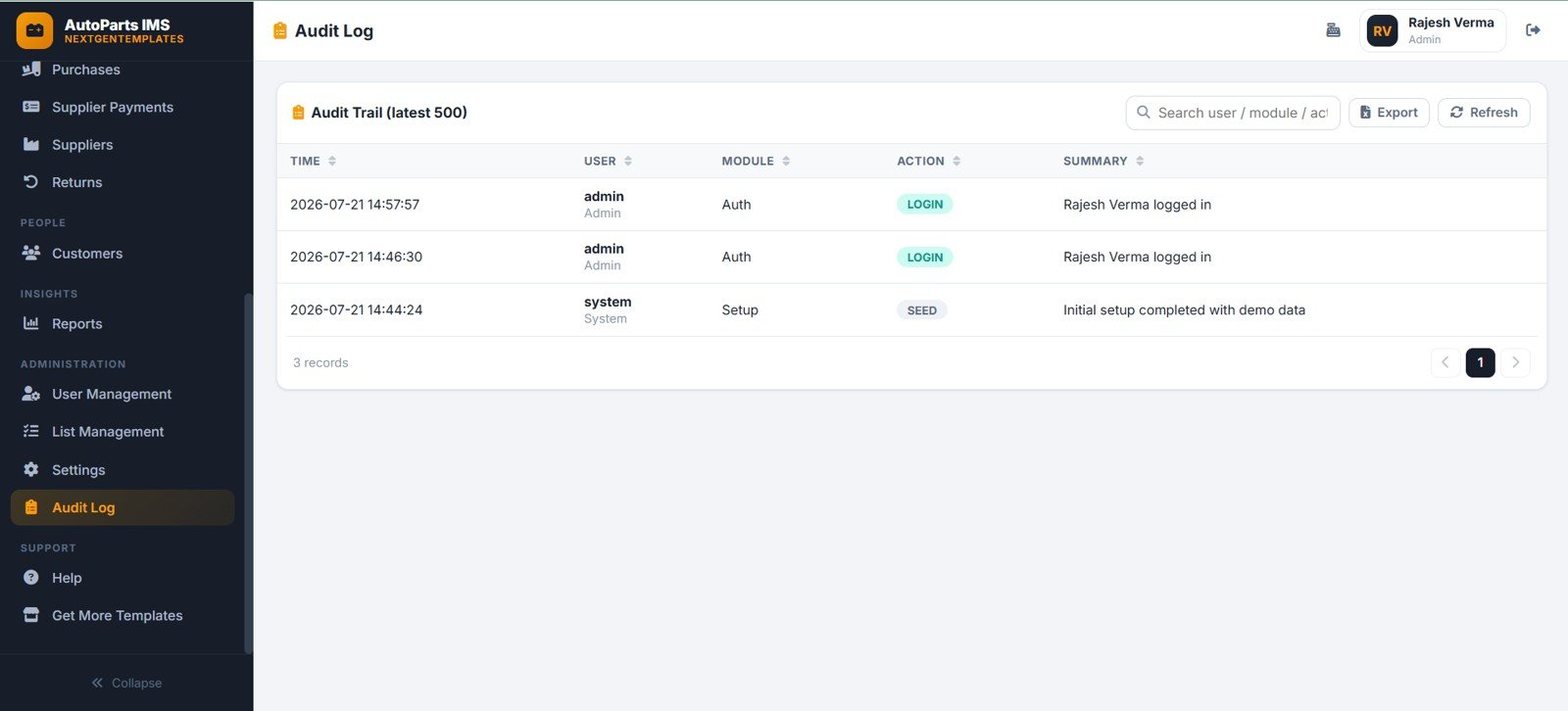
The Audit Log records time, user, module, action summary, login events and setup events. It helps the owner investigate operational changes and access events.
Web App vs. Spreadsheet Tracker vs. Paid Inventory SaaS
| Feature | This web app | Spreadsheet tracker | Paid inventory SaaS |
|---|---|---|---|
| Cost | One-time $39.99 sale price | Low tool cost but more build time | Recurring subscription or per-user fees |
| Platform | Browser-based web app template | Spreadsheet workbook or sheet file | Vendor-hosted cloud platform |
| Setup time | Start from 18 prepared pages | Build tables, formulas and forms manually | Configure imports, users, plans and permissions |
| Real-time team collaboration | Possible after web app deployment | Depends on shared-file discipline | Usually included by plan |
| Mobile access | Browser access on modern devices | Spreadsheet mobile app or browser | Usually included |
| Customizable fields | Editable lists, settings and source code | Editable columns and formulas | Limited by vendor configuration |
| Year-1 cost at 5 users | $39.99 template cost before any workspace costs | Template plus internal build time | Can increase with seats and add-ons |
| Parts POS workflow | Included as New Sale POS | Needs custom setup | Depends on retail plan |
| Supplier payments and returns | Included as dedicated pages | Needs linked sheets | Depends on inventory module |
Who Should Use This Template
This template fits auto parts stores, spare parts retailers, motorcycle parts shops, repair-shop counters, wholesalers and small automotive distributors that need one place for sales, purchases, supplier payables, customer dues, returns, stock adjustments and reports.
It is especially useful when the business has outgrown a simple stock spreadsheet but does not want a long SaaS onboarding project. You still need to follow the included deployment guide, update settings and test the workflow with your own sample data before going live. If you run a workshop rather than a parts counter, the Auto Garage Job Card Management System Web App or the Service Center and Repair Shop Management System may suit you better.
Real-World Use Cases
Independent auto parts retailer: the owner reviews dashboard sales, pending payables, stock value and low stock items before calling suppliers.
Repair shop counter desk: staff use the New Sale POS page to bill parts sold to walk-in customers or workshop customers.
Wholesale spare parts distributor: the admin team records purchases, supplier payments, sales invoices, customer payments and returns so balances are easier to review.
Inventory audit day: a supervisor records stock adjustments with quantity, type, reason, date, staff member and notes after a physical count.
Advantages
The biggest advantage is that operational pages are already separated by workflow. Staff do not have to search one huge sheet for sales, purchases, customers, suppliers, adjustments and reports.
The second advantage is visibility. The dashboard summarises sales vs purchases, top-selling parts, stock value, gross profit and pending payables in a format that is faster to scan than raw rows.
The third advantage is control. Role-based login, user management, list management, settings and the audit log give structure around who can access the app and which values appear in forms.
Limitations to Consider
This is a downloadable web app template, not a hosted enterprise ERP. Businesses that need barcode scanners, accounting sync, payment gateway settlement, GST return filing, EDI supplier ordering, VIN decoding or multi-warehouse branch automation may need extra customisation.
It also needs careful setup. Before live use, update business settings, load starting inventory, test invoice and purchase order numbering, confirm tax behaviour and verify stock adjustment rules with sample data.
Best Practices
- Clean part codes, OEM values, vehicle references and categories before importing them.
- Use consistent supplier and customer names so reports do not split the same party across several spellings.
- Review reorder levels weekly, especially for fast-moving parts.
- Record stock adjustments with a clear reason and staff name.
- Close customer and supplier payment entries daily so balances stay current.
- Limit admin settings access to trained users only.
- Check the audit log after major setup changes.
Explore Related Templates and Guides
On NeoTech Navigators you can also read about the Car Wash Management System Web App, the Pharmacy Inventory and Billing Management System (a similar stock-plus-billing workflow for another retail trade) and the Auto Repair Dashboard in Google Sheets for workshop reporting.
Related NextGenTemplates web apps for automotive and service businesses:
- Auto Garage Job Card Management System Web App
- Service Center and Repair Shop Management System Web App
- Appliance Repair Service Management System Web App
- Car Wash Management System Web App
- Vehicle Movement Register Management System Web App
If you also want to strengthen the spreadsheet side of stock and billing records, the NextGenTemplates Academy learning paths cover tracker and reporting skills with downloadable practice files.
Frequently Asked Questions
What is the Auto Parts Inventory Management System Web App?
It is a downloadable web app template for managing auto parts inventory, sales billing, purchases, customer payments, supplier payments, stock adjustments, returns, reports, users, settings and audit logs.
How many pages are included?
The app includes 18 pages: Login, Dashboard, New Sale POS, Sales and Invoices, Customer Payments, Parts Catalog, Stock Register, Stock Adjustments, Purchases, Supplier Payments, Suppliers, Returns, Customers, Reports, User Management, List Management, Settings and Audit Log.
Can it manage POS billing?
Yes. The New Sale POS page includes part search, billing items, invoice totals, discount, tax, charges, payment mode, amount received and customer selection.
Can it track purchases and supplier payments?
Yes. Purchase orders, supplier records, supplier payment amounts, payment modes, references, paid amounts, purchase totals and status fields are included.
Can it track returns?
Yes. It includes sales returns, purchase returns, return amount, return reason, date, invoice reference and purchase order reference.
Is it a replacement for enterprise inventory software?
No. It is best for small and mid-size parts operations that want an editable web app template. Enterprise needs such as accounting API sync, barcode hardware or multi-branch ERP controls may need additional software or customisation.
About the Author
Built by PK, Microsoft Certified Professional with 15+ years of Excel, Google Sheets and Power BI experience and founder of NextGenTemplates. Every template is hand-built and tested before release.
Wrapping Up
The Auto Parts Inventory Management System Web App gives auto parts businesses a structured way to manage daily sales, purchases, stock, payments, suppliers, customers, reports, settings, users and audit history. Try the live demo with the manager or sales1 login first, map the 18 pages to how your counter actually works, and then deploy your own copy with the included guide.
Get the Auto Parts Inventory Management System Web App
📅 Last updated: October 2026