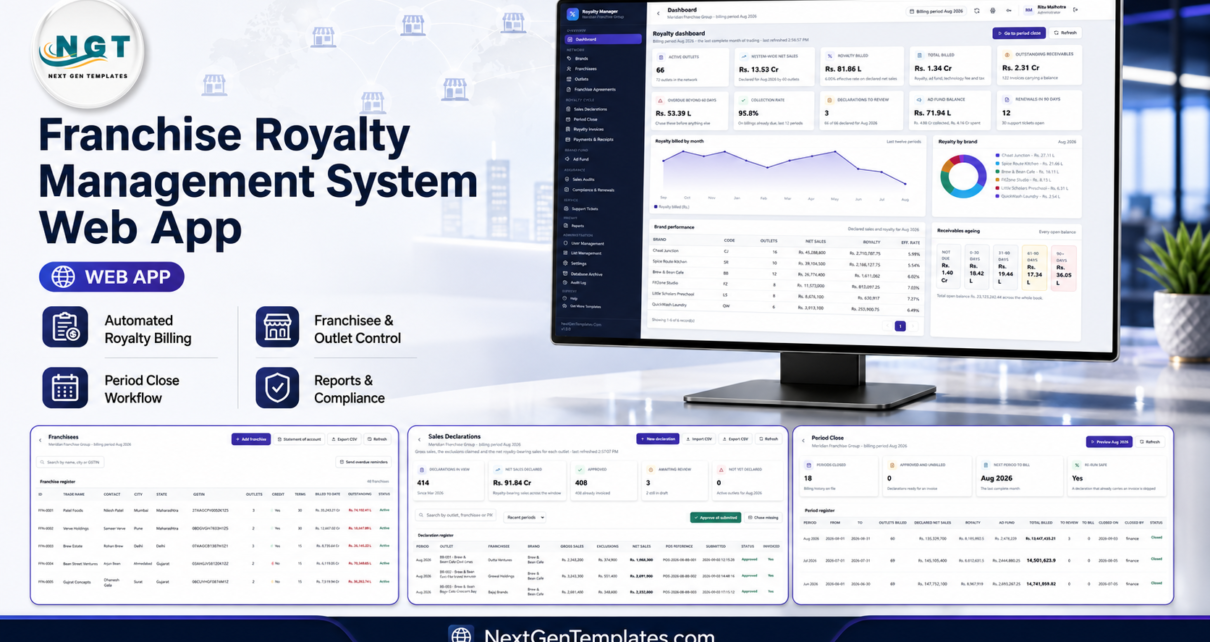
The Franchise Royalty Management System Web App is a Google Apps Script web app that runs 21 modules on a 21-table Google Sheets database, bills royalty from each outlet’s own franchise agreement on either a flat percentage or a banded rate table, and arrives seeded with 11,028 rows across a six-brand, 72-outlet demonstration network carrying 18 closed monthly billing cycles. It ships with five server-enforced roles, twelve standard reports and a franchisee self-service portal.
Most franchisors do not lose royalty because their rates are wrong. They lose it because the monthly cycle lives in a spreadsheet: declarations arrive by email, someone retypes them, the tiered brands get calculated by hand, the minimum monthly floor is forgotten on a slow month, and nobody can say what the collection rate actually is. The Franchise Royalty Management System Web App replaces that cycle with a single system that computes the invoice from the agreement, ages the receivable from the due date, and lets the franchisee declare their own sales.
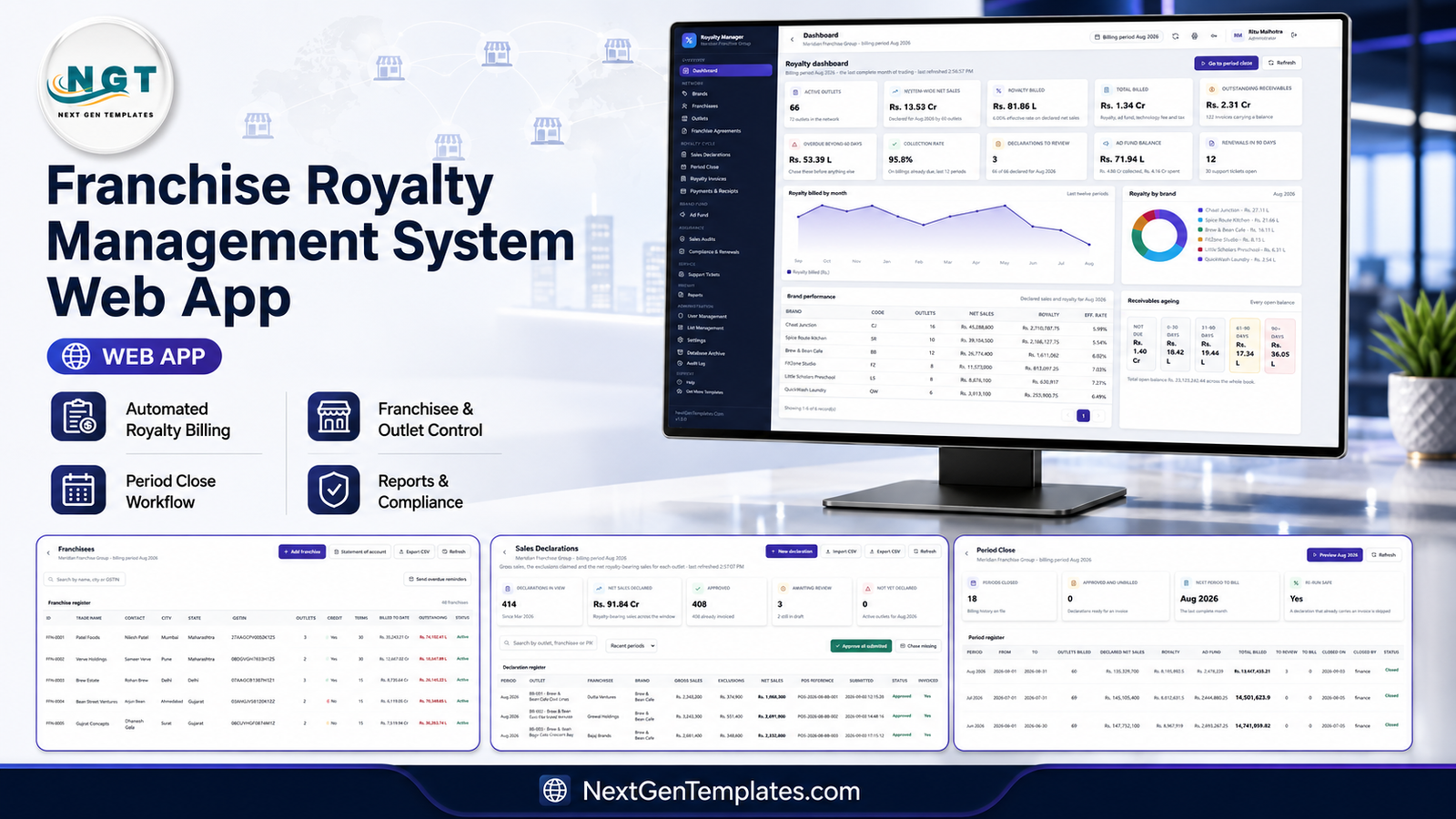
Get the Franchise Royalty Management System Web App
🚀 Try the Live Demo Before You Buy
We have deployed this web app in our own Google account so you can test every module and every one of the five roles — against a full 18-month royalty history — before purchasing. No signup, no email required.
🔑 Test Login Credentials
Sign in as admin to see the whole franchisor, then sign back in as partner to see the same system filtered down to one franchisee’s own outlets. That contrast explains the product faster than any feature list.
The demo also carries seven further named staff accounts on the same three head-office roles — for example rkulkarni / Network@2026 (Franchise Manager), nsharma / Accounts@2026 (Finance Officer) and pverma / Review@2026 (Compliance Auditor) — plus a second franchisee login, jshah / Outlet@2026, so you can see two people working the same role side by side and two franchisees seeing entirely different data.
💡 These credentials are public by design. They are the seeded starter logins of a shared demonstration instance that is reset from time to time — not a customer deployment, and not the passwords your own copy will run on. Your own instance seeds the same accounts and prompts you to change every password at first sign-in.
Key Features of the Franchise Royalty Management System Web App
Royalty computed from the agreement, not from a formula someone maintains. Each outlet has a franchise agreement, and each agreement carries a rate type. A flat agreement bills net royalty-bearing sales at one percentage. A tiered agreement runs the month’s sales through a banded rate table, summing the marginal amount in each slab. Whatever the calculation produces is then compared with that agreement’s minimum monthly royalty floor, and the higher figure is billed — with the top-up written as its own line on the invoice so nobody has to work out why the number moved.
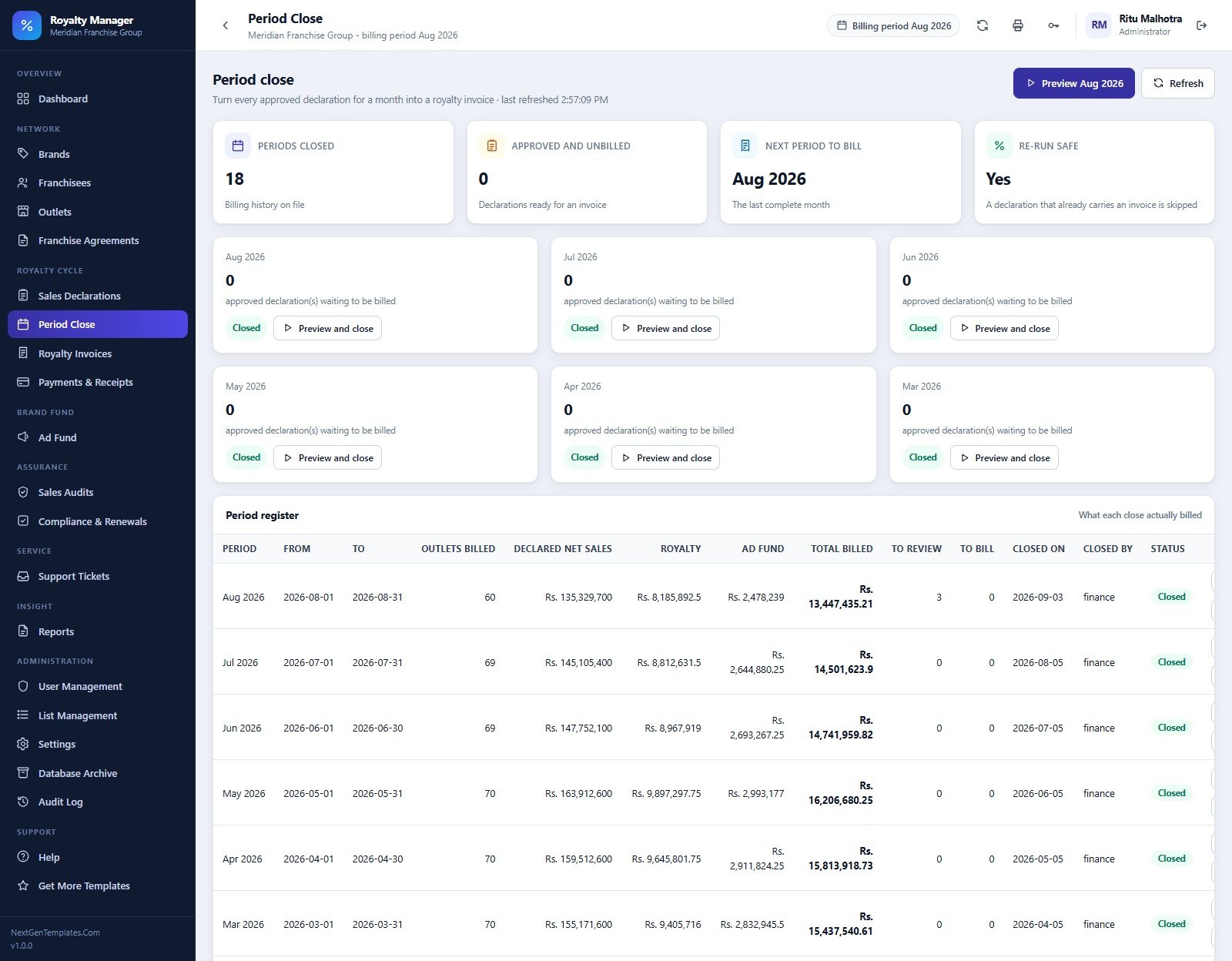
A monthly period close that is safe to re-run. Period Close converts every approved sales declaration for a month into a royalty invoice, complete with the ad fund levy, the monthly technology fee and tax. A declaration that already carries an invoice is skipped, so an interrupted run can simply be repeated. The period register then records what each close actually billed: outlets billed, declared net sales, royalty, ad fund, total billed, who closed it and when.
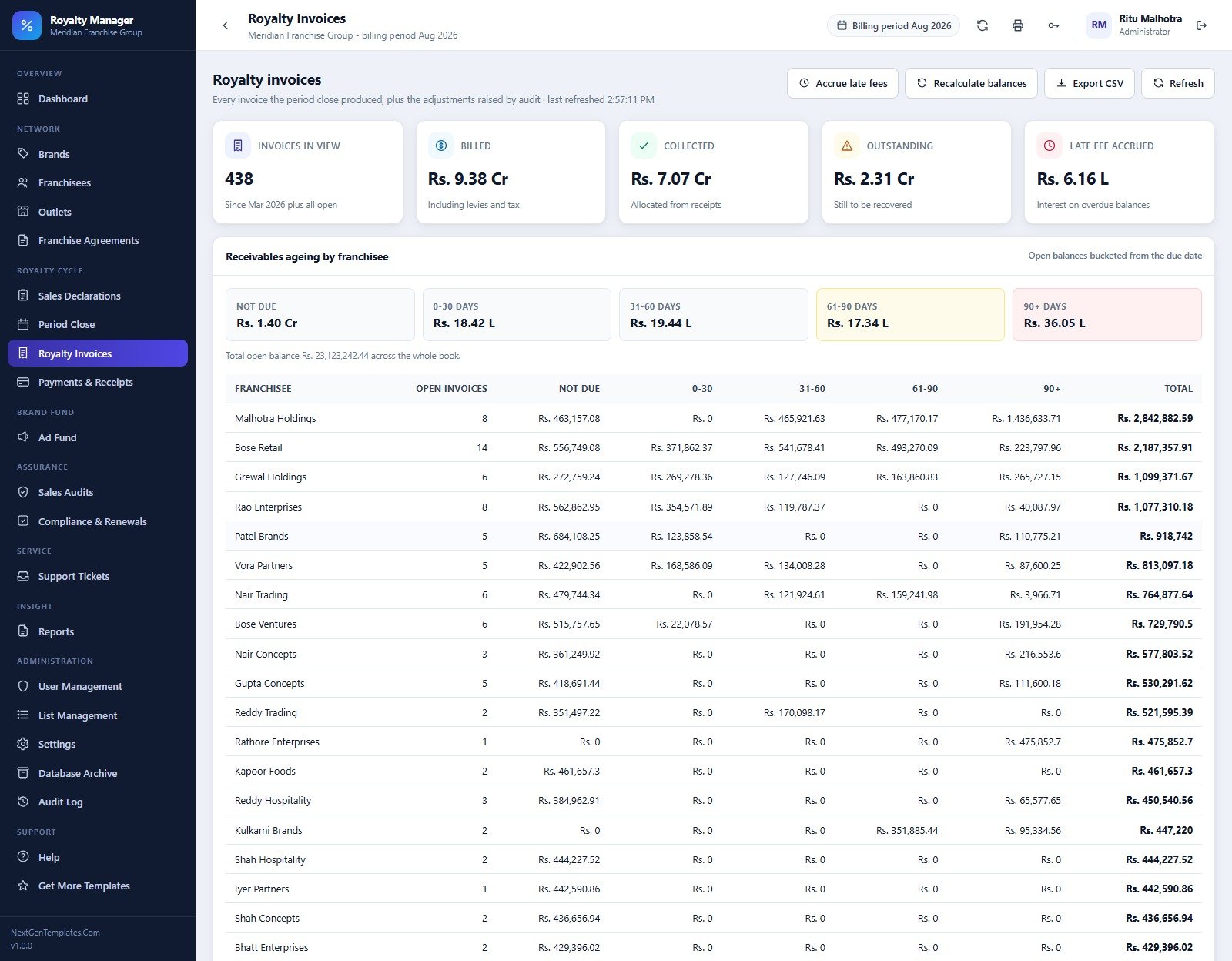
Receivables that age themselves. Every open balance is bucketed Not due / 0-30 / 31-60 / 61-90 / 90+ from its due date, both per franchisee and across the whole book. Late-fee interest accrues on overdue invoices at the monthly rate set in Settings, and the dashboard carries a collection rate calculated only on billings that have actually fallen due — a run raised three days ago is not counted as a collection failure.
Sales audits that raise the back charge for you. Record an audit against an outlet with the declared and the audited figure. If the variance clears the tolerance in Settings — 1.5% by default — the system prices the shortfall at that agreement’s own royalty rate, adds the ad fund levy and tax, and raises an Adjustment invoice against the outlet, referencing the audit number in the invoice number and in the audit log.
An ad fund ledger that balances per brand. The marketing levy billed on every royalty invoice is posted against campaign spend brand by brand, so contributions, spend, utilisation and closing balance are visible for each brand separately instead of pooled into one number nobody trusts.
Five roles enforced on the server. The permission map hides menu items and guards every API entry point before it touches data. Passwords are stored only as salted SHA-256 hashes, so nobody — including an administrator — can read an existing password back.
Module Walkthrough
The 21 modules are grouped into Overview, Network, Royalty cycle, Brand fund, Assurance, Service, Insight, Administration and Support. Every register carries search, pagination, CSV export and browser printing; declarations, the ad fund and compliance also accept a CSV import.
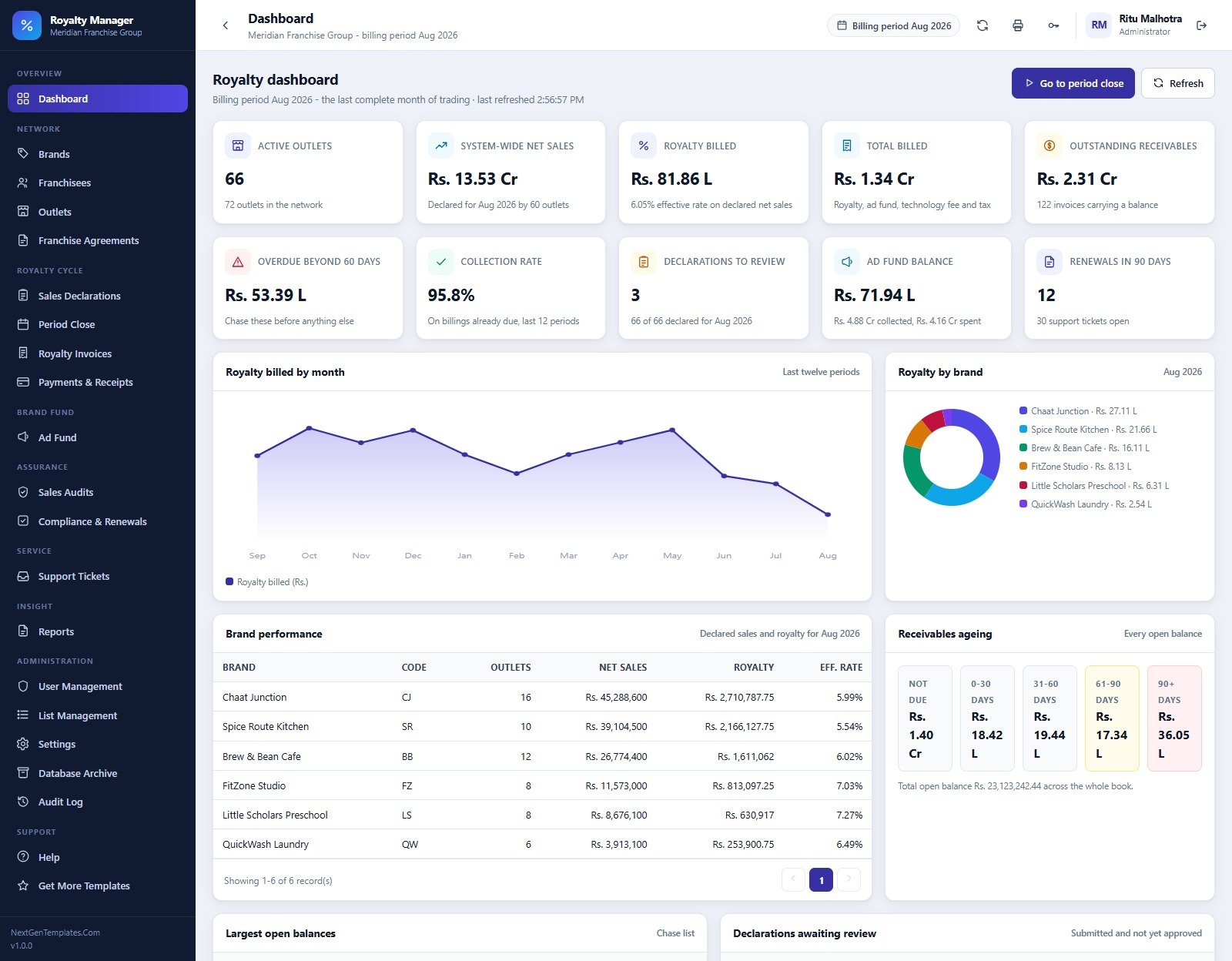
Dashboard
Ten headline tiles for the last complete trading month — Active Outlets, System-wide Net Sales, Royalty Billed, Total Billed, Outstanding Receivables, Overdue Beyond 60 Days, Collection Rate, Declarations to Review, Ad Fund Balance and Renewals in 90 Days — over royalty billed by month, royalty by brand, a brand performance table with effective rates, receivables ageing, the largest open balances and the declarations still awaiting review.
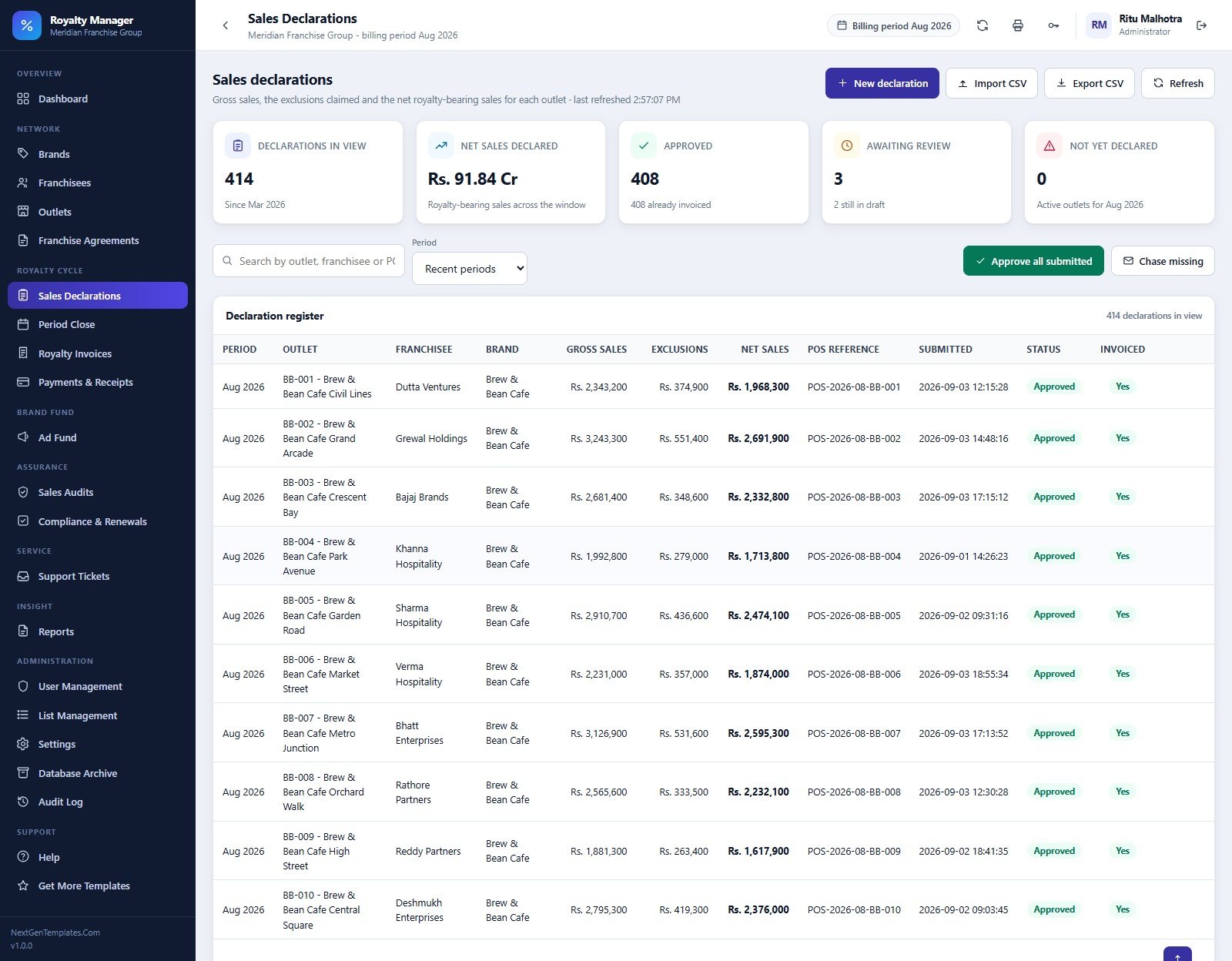
Sales Declarations
Gross sales, the exclusions claimed and the resulting net royalty-bearing sales for every outlet, with the POS reference, the submission timestamp, the approval state and whether an invoice has already been raised. Approve one declaration, approve everything submitted in a single action, or chase the outlets that have not declared for the period at all.
Period Close
A card for each recent month showing how many approved declarations are still waiting to be billed, a preview before you commit, and the period register beneath it. Everything the close produces is traceable back to the declaration it came from.
Royalty Invoices and Receipts
Every invoice the close produced plus the adjustments raised by audit, with billed, collected, outstanding and accrued late fee on top, and ageing broken out franchisee by franchisee. Receipts are captured by mode, bank and transaction reference and allocated against invoices; anything received but not yet matched stays visible as an on-account balance rather than disappearing into a total.
Reports
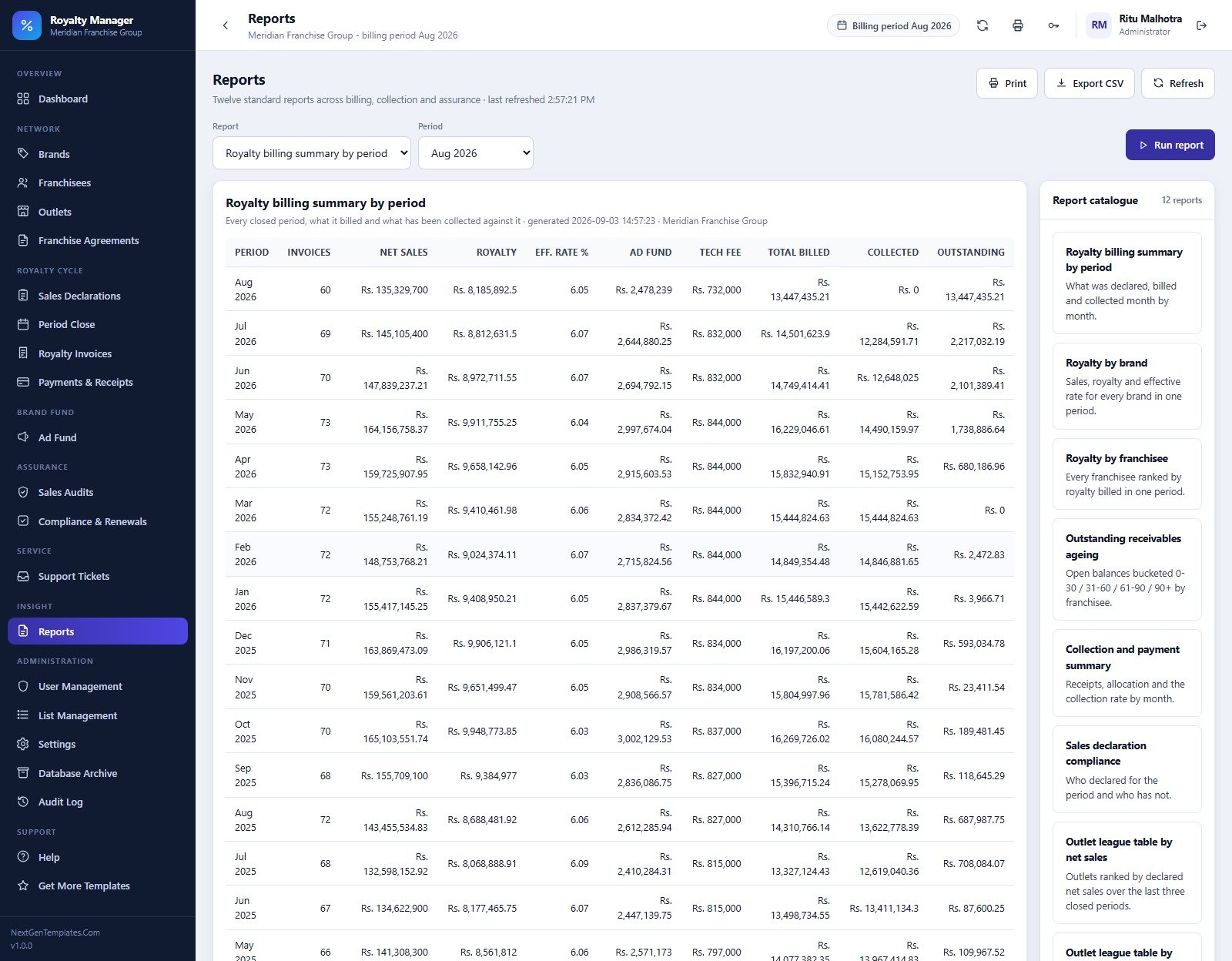
Twelve standard reports: royalty billing summary by period, royalty by brand, royalty by franchisee, outstanding receivables ageing, collection and payment summary, sales declaration compliance, outlet league table by net sales, outlet league table by royalty, ad fund statement by brand, sales audit variance summary, agreement renewal pipeline, and minimum royalty floor invocations. Each one prints and exports to CSV.
Administration
User Management with role assignment and password resets, List Management driving 21 dropdown lists from 103 values, 34 settings spanning organisation identity, financial defaults, royalty behaviour and assurance thresholds, a Database Archive for ageing transaction rows out of the live sheets, and an Audit Log recording every change, approval, close, allocation and sign-in with the user, the role and the record.
Franchise Royalty Management System Web App vs. a Spreadsheet Tracker vs. Paid Franchise SaaS — Feature Comparison
| Feature | Franchise Royalty Management System Web App | Spreadsheet royalty tracker (Excel / Sheets) | Paid franchise SaaS (FranConnect, Naranga, ClientTether) |
|---|---|---|---|
| Cost | $39.99 one-time, lifetime | $0-$30 one-time | Subscription quoted per location, renewed every year |
| Platform | Google Apps Script web app in your own Google account | A workbook on somebody’s laptop | Vendor-hosted; your data lives with them |
| Setup time | About 15 minutes, staged and resumable | Minutes | Onboarding project, often weeks |
| Banded (tiered) royalty with a minimum floor | ✅ Marginal slab calculation plus a floor top-up line | Hand-built nested formulas that break silently | ✅ Usually included |
| Franchisee self-service portal | ✅ Built in, scoped to that franchisee only | ❌ Spreadsheets emailed back and forth | ✅ Usually included |
| Audit back charge on under-declared sales | ✅ Priced automatically at the agreement rate | ❌ Manual recalculation | ✅ In the higher tiers |
| Role-based access enforced server-side | ✅ Five roles, guarded on every API call | ❌ Sheet protection at best | ✅ Included |
| Per-user fees as your team grows | ✅ None | None | Priced per seat or per location |
| You own and can modify the source | ✅ Full Code.gs + Index.html supplied | ✅ Yes | ❌ No |
For franchisors who want banded royalty, a period close and a franchisee portal without signing a per-location subscription, the Franchise Royalty Management System Web App sits in the sweet spot.
Who Should Use This Template
Perfect for:
- Franchisors with roughly 10-300 outlets still billing royalty out of a spreadsheet
- Multi-brand groups where different brands bill on different rate structures
- Area developers and master franchisees invoicing sub-franchisees monthly
- Finance teams that need ageing, late-fee accrual and a defensible collection rate
- Consultants and resellers who want deployable Apps Script source they can rebrand
Not a fit if:
- You need an accounting system of record — this bills royalty, it is not a general ledger and it does not replace your accounting software
- You need card processing, auto-debit or a payment gateway — receipts are recorded here, not collected here
- You have SOC 2, SSO or data-residency obligations
- You expect a system to discharge franchise-disclosure, tax or audit obligations — those stay with you and your professional advisers
- You run a single outlet with no franchisees to bill
Real-World Use Cases
Meera runs finance for a six-brand food and fitness franchisor with 72 outlets. Two brands bill on banded rates and four on a flat percentage, every one with a monthly floor. She replaced a stack of monthly workbooks with one Period Close run and now reads the collection rate and the 90+ day bucket off the dashboard instead of rebuilding them each month.
Arjun is an area developer with eleven sub-franchisees. Each of them has a Franchisee Portal login, enters and submits their own declarations, and sees their own invoices and receipts — which ended the monthly email chase without giving anyone visibility of another franchisee’s numbers.
Pooja audits declared sales for a preschool network. When a POS data pull shows audited sales above the declaration by more than tolerance, she records the audit and the system prices the shortfall at that agreement’s own rate and raises the adjustment invoice, with the audit number carried through to the invoice and the audit log.
Advantages of the Franchise Royalty Management System Web App
The obvious saving is the subscription. A per-location franchise platform renews every year for as long as you use it; this is one payment for source code you keep. The less obvious saving is the month-end itself: declarations, approval, close, invoicing and allocation happen in one place, so the reconciliation that usually eats two or three days at the start of every month largely disappears.
Because it is a Google Apps Script web app, everything runs inside your own Google account. The database is a Google Sheet in your own Drive, the permissions are yours, and there is no third party holding your franchise network’s sales data. Adding a user costs nothing, which matters when the finance team, the audit team and forty franchisees all need access.
Opportunities for Improvement
It is worth being honest about the edges. There is no payment gateway: receipts are recorded once the money arrives, not collected by the system. There is no mobile app — the interface is responsive, but a field auditor working offline will not find one here. Google Sheets is a fine database for tens of thousands of rows and the Database Archive module exists precisely so the live sheets stay quick, but a network well past a few hundred outlets with several years of history will eventually want a real database behind it. And there is no automatic POS integration: declarations are entered or imported by CSV, so if you want a nightly sales feed you will need to build it.
Best Practices
- Change every seeded password before the first franchisee is given access, then disable the demonstration accounts entirely.
- Get Settings right before you load real data — tax rate, invoice prefixes, payment terms, late fee and audit tolerance all feed the invoices you are about to raise.
- Enter brands and their rate bands first, then franchisees, then outlets, then agreements. The agreement is what the invoice is computed from, so it is the record worth being careful with.
- Close each period as soon as declarations are approved. The ageing, the collection rate and the renewal pipeline are only as current as the last close.
- Give franchisees the Portal login rather than emailing statements. It removes a whole category of dispute.
- Take a dated backup from the Administrator menu before any bulk change, and run the Database Archive once a year.
Explore Relevant Templates
If you want the analytics rather than the billing engine, the Franchise Management Dashboard in Excel and the Franchise Management Dashboard in Power BI read network performance without touching invoicing, while the Regional Franchise Performance Dashboard in Google Sheets and the Franchise Network Analytics Dashboard in Google Sheets do the same job territory by territory.
For neighbouring Apps Script systems, see the Multi-Branch Shop Accounting Management System Web App for branch-level books and the Cloud Kitchen Management System Web App for multi-outlet food operations. We have also written up the Courier & Parcel Delivery Management System Web App and the Appliance Repair Service Management System Web App, both built on the same Apps Script foundation.
If the spreadsheet side of a system like this is what you want to understand better, the NextGenTemplates Academy learning paths build the underlying Sheets and Excel skills step by step, with practice files.
Get the Franchise Royalty Management System Web App
Frequently Asked Questions
Can I try it before buying?
Yes. The Franchise Royalty Management System Web App has a live demo linked near the top of this article, with logins for all five roles. It runs on a shared demonstration instance seeded with 11,028 rows and 18 closed billing periods, so you can run reports and open real invoices before spending anything.
How does the Franchise Royalty Management System Web App calculate royalty?
From each outlet’s franchise agreement. Flat agreements bill net royalty-bearing sales at one percentage; tiered agreements sum the marginal amount in each sales band. The result is compared with the agreement’s minimum monthly royalty floor and the higher figure is billed, alongside the ad fund levy, technology fee and tax.
How long does setup take?
About fifteen minutes. Paste the two files into a new Apps Script project, deploy it as a web app, and run the first-time setup from the sign-in card. Setup is staged and resumable and every stage is idempotent, so an interrupted run continues where it stopped rather than duplicating data.
Where is my data stored?
In a Google Sheets database the Franchise Royalty Management System Web App creates inside your own Google Drive, on your own Google account. Nothing is sent to NextGenTemplates, and the Administrator role can take a dated backup copy to Drive whenever you want one.
How does this compare to paid franchise management software?
Paid franchise platforms are quoted per location and renew annually; this is a one-time purchase with no per-user fee and the full source code included. It does not attempt to replace their CRM, lead-development or field-audit mobile suites — it does royalty billing, receivables, audits and compliance well.
Is this an accounting system?
No. The Franchise Royalty Management System Web App bills royalty and tracks what franchisees owe and have paid. It is not a general ledger, it does not process card payments or direct debits, and it makes no franchise-disclosure, tax, legal or regulatory compliance claim.
Can I change the modules or the branding?
Yes. You receive Code.gs and Index.html in full, so it can be renamed, re-coloured, extended with new fields or trimmed down. Write to info@NextGenTemplates.Com if you would rather we tailor it for you.
About the Author
Built by PK — Microsoft Certified Professional with 15+ years of Excel, Google Sheets and Power BI experience. Founder of NextGenTemplates, reaching 300K+ subscribers across YouTube channels. Every template is hand-built and tested before release.
Conclusion
Franchise royalty is not complicated arithmetic, but it is unforgiving bookkeeping: one missed floor, one un-chased 90-day balance or one under-declared month per outlet adds up quickly across a network. The Franchise Royalty Management System Web App puts the agreement, the declaration, the invoice, the receipt and the audit in one place, and hands the franchisee their own window into it.
Open the live demo first — sign in as admin, then as partner, run a report and open an invoice — and only buy once you have seen your own month-end in it.
Instant download · One-time payment · No subscription · Full source code included
Last updated: September 2026