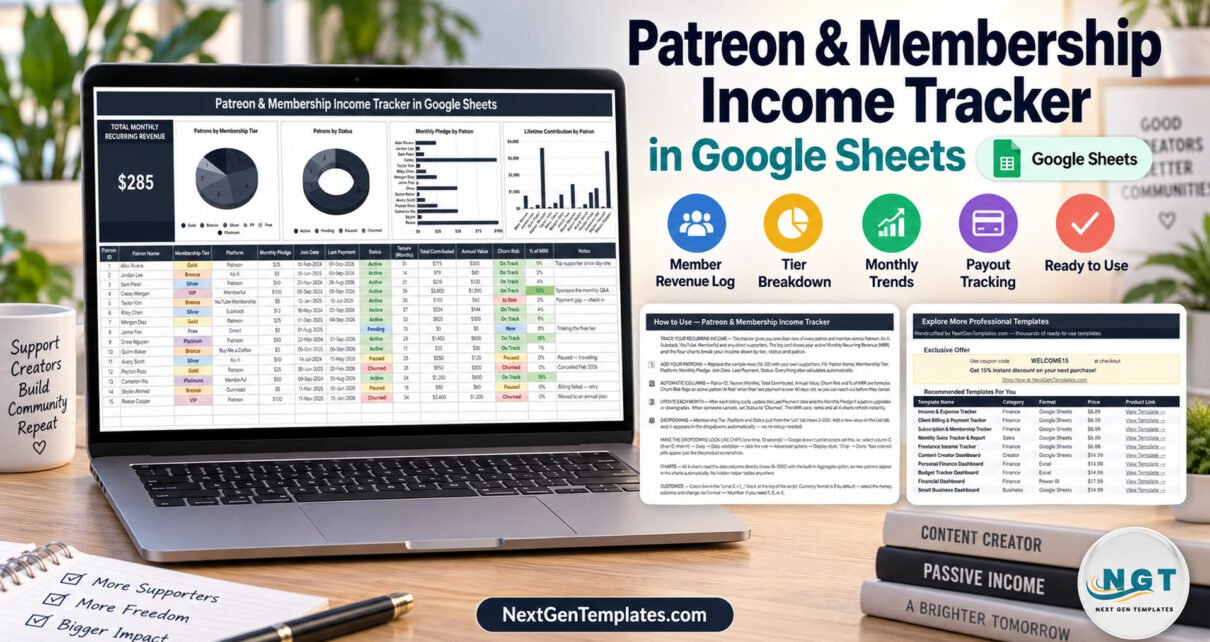
The Patreon and Membership Income Tracker in Google Sheets puts every paying supporter you have into a single 14-column table, calculates 6 of those columns automatically, and feeds 1 live MRR card plus 4 charts straight from the rows you type. The sample file ships with 15 patrons spread across 8 platforms, 6 membership tiers and 4 statuses, and the whole thing opens in a browser tab.
Most creators do not have a membership income problem — they have a membership visibility problem. The pledges arrive from Patreon, the tips from Ko-fi, the paid subscriptions from Substack, the channel memberships from YouTube, and each one has its own dashboard with its own definition of a month. This tracker fixes that by ignoring the platforms entirely and letting you own the numbers.
Get the Patreon & Membership Income Tracker
Key Features of the Patreon and Membership Income Tracker
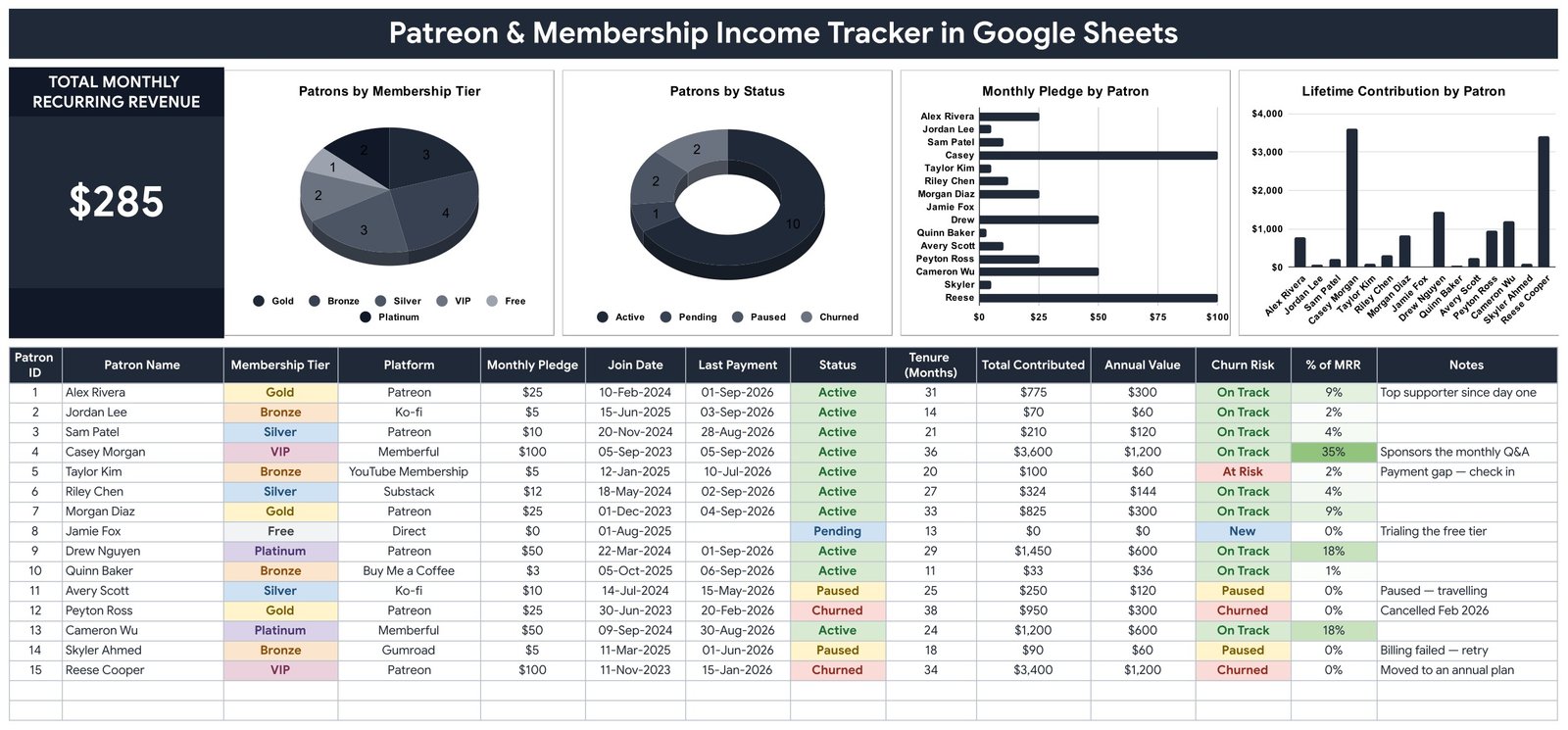
- A live Monthly Recurring Revenue card. It totals the Monthly Pledge of patrons whose Status is Active only. Paused, Pending and Churned supporters never inflate the figure.
- Six self-calculating columns. Patron ID, Tenure (Months), Total Contributed, Annual Value, Churn Risk and % of MRR are formulas. You fill seven fields; the sheet does the rest.
- A 40-day churn rule. Any active patron whose Last Payment is more than 40 days old is flagged “At Risk” automatically, which turns retention into a two-minute weekly job instead of a guess.
- Four charts with no helper tables. Patrons by Membership Tier, Patrons by Status, Monthly Pledge by Patron and Lifetime Contribution by Patron read the data columns directly across rows 16 to 1000 using the built-in Aggregate option.
- Dropdowns that expand. Membership Tier, Platform and Status pull from the List tab, rows 2 to 500. Add a value there and it appears everywhere instantly.
- Eight platforms in the sample data. Patreon, Ko-fi, Substack, YouTube Membership, Memberful, Gumroad, Buy Me a Coffee and Direct.
One thing this template deliberately does not do: connect to anything. There is no Patreon API, no OAuth, no sync. It is an independent spreadsheet and is not affiliated with or endorsed by Patreon or any other membership platform. You enter or paste your own figures — which is precisely why it keeps working when a platform changes its export format or you move your community somewhere new.
Sheets Explanation
Page 1: Patron Tracker
The page you actually work on. The Total Monthly Recurring Revenue card sits at the far left, then four charts — Patrons by Membership Tier, Patrons by Status, Monthly Pledge by Patron and Lifetime Contribution by Patron. Underneath runs the patron table with Patron ID, Patron Name, Membership Tier, Platform, Monthly Pledge, Join Date, Last Payment, Status, Tenure (Months), Total Contributed, Annual Value, Churn Risk, % of MRR and Notes. Tier, Status and Churn Risk are colour-coded so a problem row is visible without reading a single number.
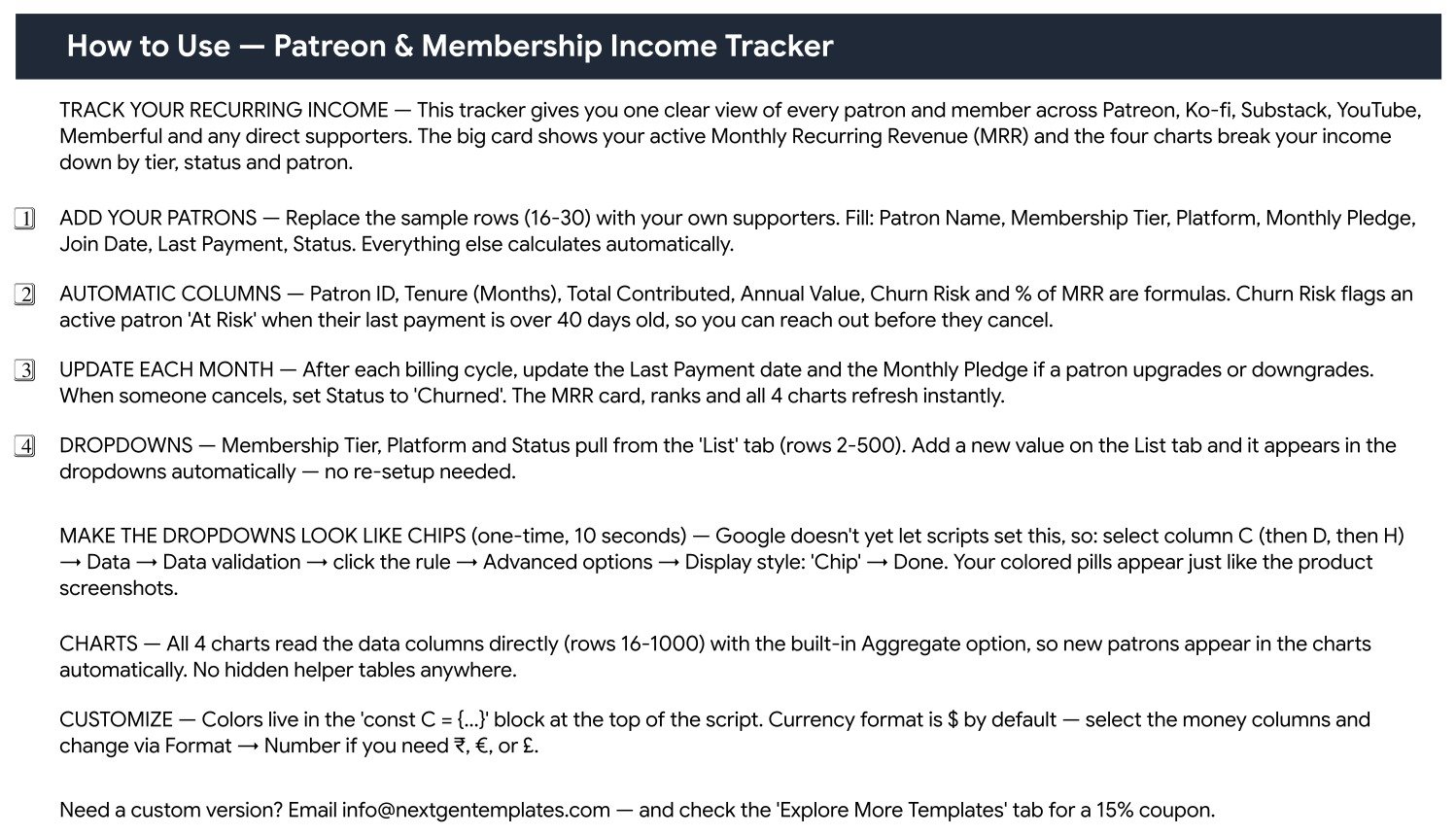
Page 2: How to Use
The instructions live inside the file, not in a separate manual. This page covers replacing the sample rows, which columns are formulas and must be left alone, how the 40-day Churn Risk rule behaves, and the one-time 10-second steps for switching the Tier, Platform and Status dropdowns to chip display through Data > Data validation > Advanced options. It also points at the colour block in the script and explains how to move the currency format from $ to ₹, € or £.
Page 3: Explore More Templates
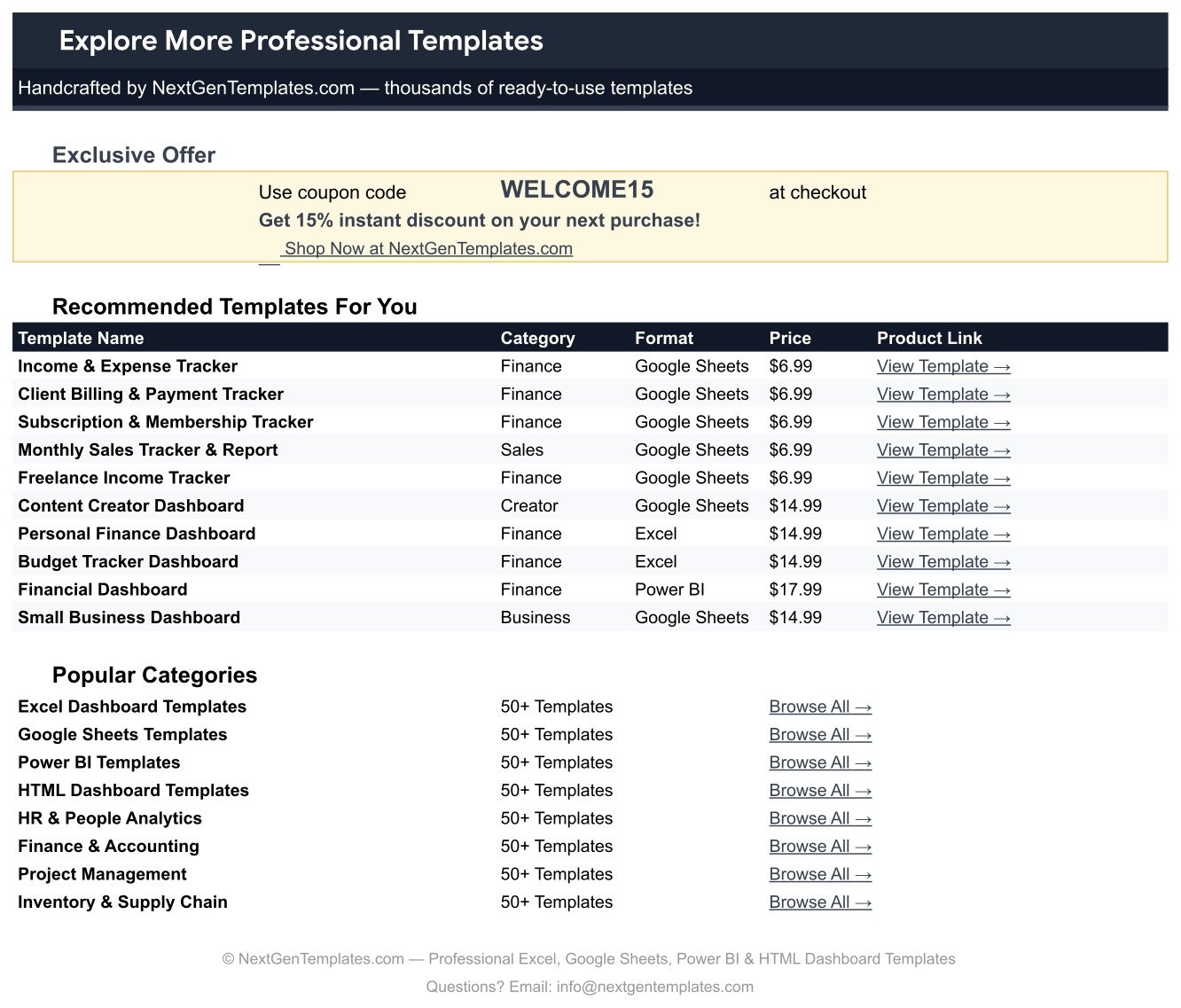
A reference page listing recommended NextGenTemplates spreadsheets with their category, format and price, plus popular category links and a WELCOME15 coupon for 15% off a future purchase.
A fourth tab named List stores the dropdown values. It is the only tab you need to edit before you start.
Patreon and Membership Income Tracker vs. an Excel Membership Sheet vs. ChartMogul / Baremetrics — Feature Comparison
| Feature | Patreon & Membership Income Tracker in Google Sheets | Excel membership spreadsheet | ChartMogul / Baremetrics |
|---|---|---|---|
| Cost | One-time purchase | One-time, but you build it yourself | Monthly subscription that scales with revenue |
| Platform | Google Sheets in any browser | Desktop Excel | Vendor web app |
| Setup time | ✅ Under 10 minutes | Hours of formula building | Days, plus billing integration |
| Real-time collaboration | ✅ Share the sheet with your team | Only via OneDrive co-authoring | ✅ Yes, per seat |
| Mobile access | ✅ Google Sheets mobile app | Limited | ✅ Yes |
| Custom tiers and platforms | ✅ Add a row to the List tab | Manual named-range edits | Restricted to supported billing systems |
| Share with a link | ✅ Yes | Needs a cloud drive | ✅ Yes, inside the paid plan |
| Year-1 cost at 5 users | ✅ One purchase, no per-user fee | Office licences | Hundreds to thousands per year |
| Every platform in one table | ✅ Patreon, Ko-fi, Substack, YouTube, Memberful, Gumroad and more | Whatever you build | Only integrated processors |
| Automatic API import | ❌ No — you enter or paste the figures | ❌ No | ✅ Yes, for supported processors |
For creators who want one honest view of membership income across every platform without paying a monthly analytics subscription, the Patreon and Membership Income Tracker sits in the sweet spot.
Who Should Use This Template
Perfect for:
- Creators with 10 to 500 paying members across Patreon, Ko-fi, Substack, YouTube Memberships or Buy Me a Coffee
- Newsletter writers and podcasters who want a patron tracker spreadsheet showing tier mix and churn side by side
- Bands, studios and community organisers invoicing supporters directly
- Anyone who needs a recurring revenue tracker for creators that outlives any single platform
Not a fit if:
- You expect pledges to import themselves — there is no connection to Patreon and no sync of any kind
- You need SaaS-grade cohort analysis, MRR movement waterfalls or revenue recognition
- You want the sheet to issue invoices, take payments or file your taxes
- You cannot use Google Sheets; a free Google account and a browser are required
Real-World Use Cases
Maya writes an illustration newsletter. Substack handles her paid subscriptions, Ko-fi takes one-off tips that several readers have turned into monthly habits, and three long-standing supporters pay by bank transfer. All three land in the same membership income tracker Google Sheets file. On Monday morning she reads one card instead of three dashboards.
Devon produces a weekly history podcast with 180 patrons. Every second Friday he sorts by Churn Risk, pulls the handful of active patrons whose last payment slipped past 40 days, and sends a short personal note. Expired cards, not lost interest, turn out to be the most common cause.
The Harrow Street Collective is a six-person music co-op. The sheet is shared with the whole band. The % of MRR column showed them that one VIP supporter was funding roughly a third of their monthly income — concentration risk they decided to reduce by building out the middle tier rather than chasing another large patron.
Advantages of the Patreon and Membership Income Tracker
The obvious saving is the subscription you do not pay. The bigger one is time: a creator reconciling four platform dashboards by hand at month-end typically loses an hour or two, and the result is a spreadsheet anyway. Here the spreadsheet is the system, and it takes a couple of minutes a week.
Because nothing is locked to a vendor, your history is portable. Move your community from Patreon to Memberful and the table does not care; you change the Platform value and keep every month of history you have already recorded. And because it is Google Sheets, sharing with a manager, a bandmate or an accountant is a link, not an export.
Opportunities for Improvement
An honest list. There is no automatic import, so someone has to type or paste the monthly figures — for a few hundred patrons that is a manageable habit, for several thousand it would not be. There is no month-by-month trend chart: the four charts show the current mix and per-patron totals rather than growth over time, so if you want a 12-month MRR line you will need to log a monthly snapshot yourself. Payout timing, platform fees and taxes are out of scope; the tracker records pledges, not what actually lands in your bank account after Patreon’s cut. And the coloured chip dropdowns need a one-time manual step because Google does not yet let a script set that display style.
Best Practices
- Update Last Payment straight after each billing cycle — the entire Churn Risk column depends on that one date being current.
- Never overtype a formula column. If a value looks wrong, fix the input field that feeds it.
- Set Status to Churned rather than deleting the row. A deleted patron takes their Total Contributed history with them.
- Keep the List tab tidy. Three spellings of “Ko-fi” become three slices in the Patrons by Membership Tier and status charts.
- Watch % of MRR. Any single supporter above roughly 20% is a concentration risk worth planning around.
Explore Relevant Templates
Membership income is usually one stream among several. The Sponsorship & Brand Deal Tracker in Google Sheets covers paid partnerships, the Affiliate Marketing Income Tracker in Google Sheets handles commissions, and the Online Course Sales & Student Tracker in Google Sheets is the one to pair with if you teach. Selling files too? Look at the Digital Product Sales Tracker in Google Sheets and the Print-on-Demand Sales Tracker in Google Sheets.
We have written up several of these in detail already: the Affiliate Marketing Income Tracker walkthrough, the Sponsorship & Brand Deal Tracker guide, the Side Hustle Income Tracker post, and the Multiple Income Streams Tracker article for anyone juggling more than two sources at once.
Want to build skills like this step by step? The NextGenTemplates Academy learning paths walk you through tracker-building with practice files.
Get the Patreon & Membership Income Tracker
Frequently Asked Questions
Does the Patreon and Membership Income Tracker connect to Patreon?
No. The Patreon and Membership Income Tracker is an independent Google Sheets template with no API, no integration and no automatic import. You enter or paste your patron figures yourself. It is not affiliated with, endorsed by or connected to Patreon or any other membership platform.
What exactly does the MRR card count?
It adds up the Monthly Pledge of every patron whose Status is Active. Paused, Pending and Churned supporters are excluded, so the Patreon and Membership Income Tracker shows the recurring income you can rely on this month rather than a lifetime total.
How does the Churn Risk column decide who is at risk?
It is a formula. An active patron whose Last Payment date is more than 40 days old is marked “At Risk”; other rows show Paused, Churned, New or On Track. Sorting by that column gives you a ready-made outreach list.
Can I add my own tiers and platforms?
Yes. Membership Tier, Platform and Status read the List tab, rows 2 to 500. Type a new value and it shows up in every dropdown in the patron tracker spreadsheet immediately, with no script editing required.
How long does setup take?
Under 10 minutes. Copy the sheet, edit the List tab, clear the 15 sample rows and start entering your supporters. The only optional step is the 10-second chip-display tweak explained on the How to Use page.
How does this compare to ChartMogul or Baremetrics?
Those tools read your billing system automatically and charge a monthly fee tied to revenue. This recurring revenue tracker for creators is a single purchase, covers every platform at once because you supply the numbers, and keeps your history in a file you own.
Which currency does it use?
Dollars by default. Select the money columns and use Format > Number to switch to ₹, € or £. The steps are written on the How to Use page inside the file.
About the Author
Built by PK — Microsoft Certified Professional with 15+ years of Excel, Google Sheets and Power BI experience. Founder of NextGenTemplates, reaching 300K+ subscribers across YouTube channels. Every template is hand-built and tested before release.
If you are new to the underlying Google Sheets features, Google’s own documentation on data validation and dropdown lists and on adding and editing charts is the best place to start, and the Patreon Help Center remains the right source for questions about payout schedules and platform fees.
Conclusion
If your membership income arrives from more than one place, you are already keeping a mental version of this table. The Patreon and Membership Income Tracker in Google Sheets just makes it visible, keeps it current and flags the supporters about to slip away while you can still do something about it.
Instant download · One-time payment · No subscription
Last updated: September 2026