The Bike and Two-Wheeler Rental Management System Web App runs an entire rental desk across 17 screens, with 9 live KPI cards, 4 dashboard charts and 7 built-in reports, storing everything in 14 Google Sheets tabs. It supports hourly, daily and weekly hire for bikes, scooters, motorcycles and e-bikes, and it calculates every late fee, extra-kilometre charge, damage charge and security-deposit refund automatically. Setup takes about 10 minutes.
🚀 Try the Live Demo Before You Buy
We have deployed this web app in our own Google account so you can test every page, every role — with real sample data — before purchasing. No signup, no email required.
🔑 Test Login Credentials
Sign in as Admin1 to manage the full system — bookings, fleet, payments, all reports, Settings, User Management and Database Archive — or as Manager1 to handle daily operations — bookings, check-out, check-in/return, payments, fleet, customers and reports. Manager access is intentionally restricted from Settings, User Management, List Management, Audit Log and Database Archive to protect sensitive controls.
| Role | Username | Password |
|---|---|---|
| 👨💼 Administrator | Admin1 | abcd |
| 👤 Manager | Manager1 | abcd |
💡 What you get after purchase: The full source code (Code.gs + Index.html) plus a step-by-step deployment guide so you can deploy your own private instance in your own Google account in under 15 minutes.
Most small rental shops still run on a paper register and a WhatsApp group. That works until two staff promise the same scooter to two customers, or a bike comes back 400 km over the allowance and nobody can prove what the odometer read when it left. This system fixes exactly those problems: server-side double-booking prevention, photographic condition evidence at both ends of the rental, and a final bill that computes itself.
Key Features of the Bike and Two-Wheeler Rental Management System
- Fleet built for two-wheelers. Every vehicle carries a three-tier rate card (hourly, daily, weekly), a security-deposit amount, odometer reading, insurance and permit expiry dates, and a service-due date and kilometre reading.
- Five colour-coded vehicle statuses. Available, Rented, Under Maintenance, Damaged and Retired. Only Available vehicles can be booked, and the other four are excluded from availability automatically.
- Double-booking blocked on the server. An overlap test runs inside a script lock against every confirmed, active and overdue booking on that vehicle, so simultaneous saves still cannot hire the same bike twice.
- Automatic final billing. Base rental for the actual duration, late fee after the grace period, extra kilometres beyond the free allowance, damage and accessories, less the advance and any deposit adjustment.
- Three deposit outcomes. Refund in full, adjust dues from the deposit and refund the balance, or forfeit it. Each is printed on the invoice and rolled into the Deposit Register.
- Six-point condition checklist. Brakes, lights, tyres, horn, mirrors and body, recorded at hand-over and again at return, with photographs stored in organised Google Drive folders.
- Three roles, enforced server-side. Administrator, Manager and Rental Desk Operator, with every write re-checked on the server rather than merely hidden in the menu.
- Documents that print properly. Rental agreement, final invoice and payment receipts at 3 inch, 4 inch or A4.
Dashboard Pages Explanation
Page 1: Login and Welcome Page
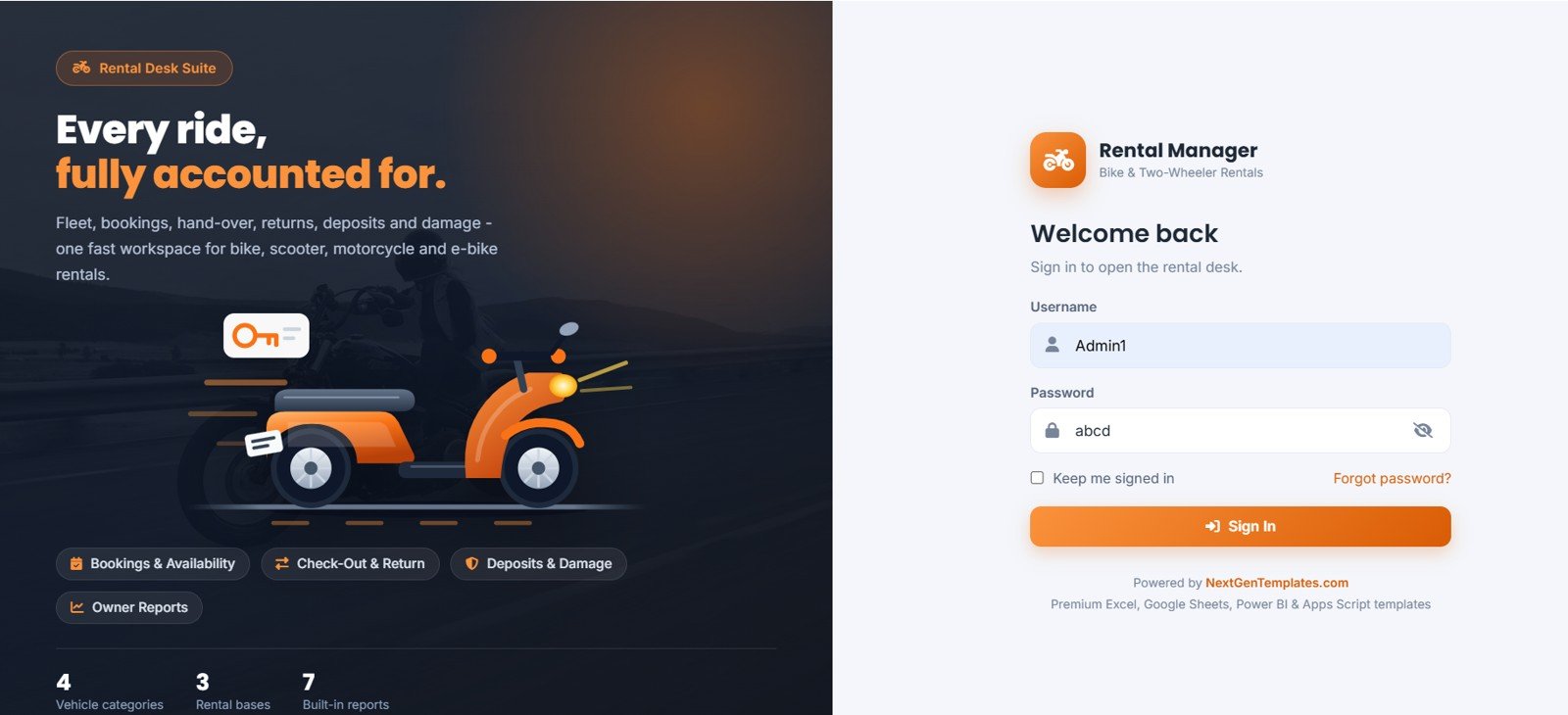
A branded sign-in screen that introduces the system before anyone signs in. It highlights Rental Workflow by Bookings and Availability, Check-Out and Return by Rental Desk Activity, Deposits and Damage by Customer Rental Control, Owner Reports by Business Performance, Vehicle Categories by Rental Type, and Built-In Reports by Management Insight. Default credentials are deliberately never displayed here.
Page 2: Dashboard Overview
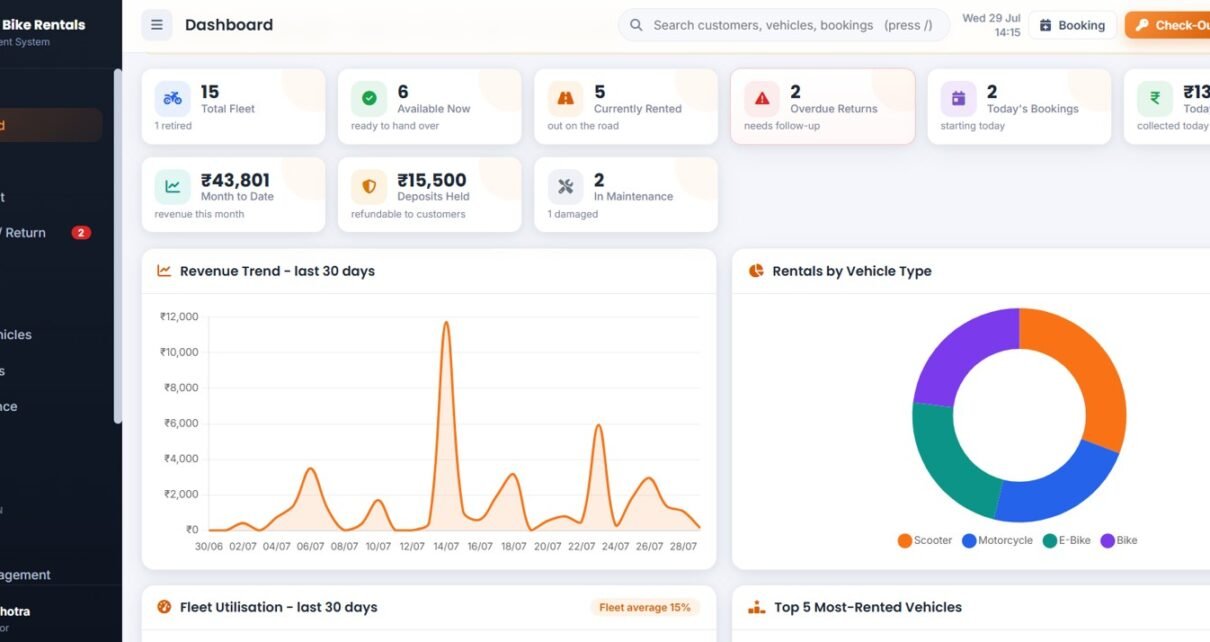
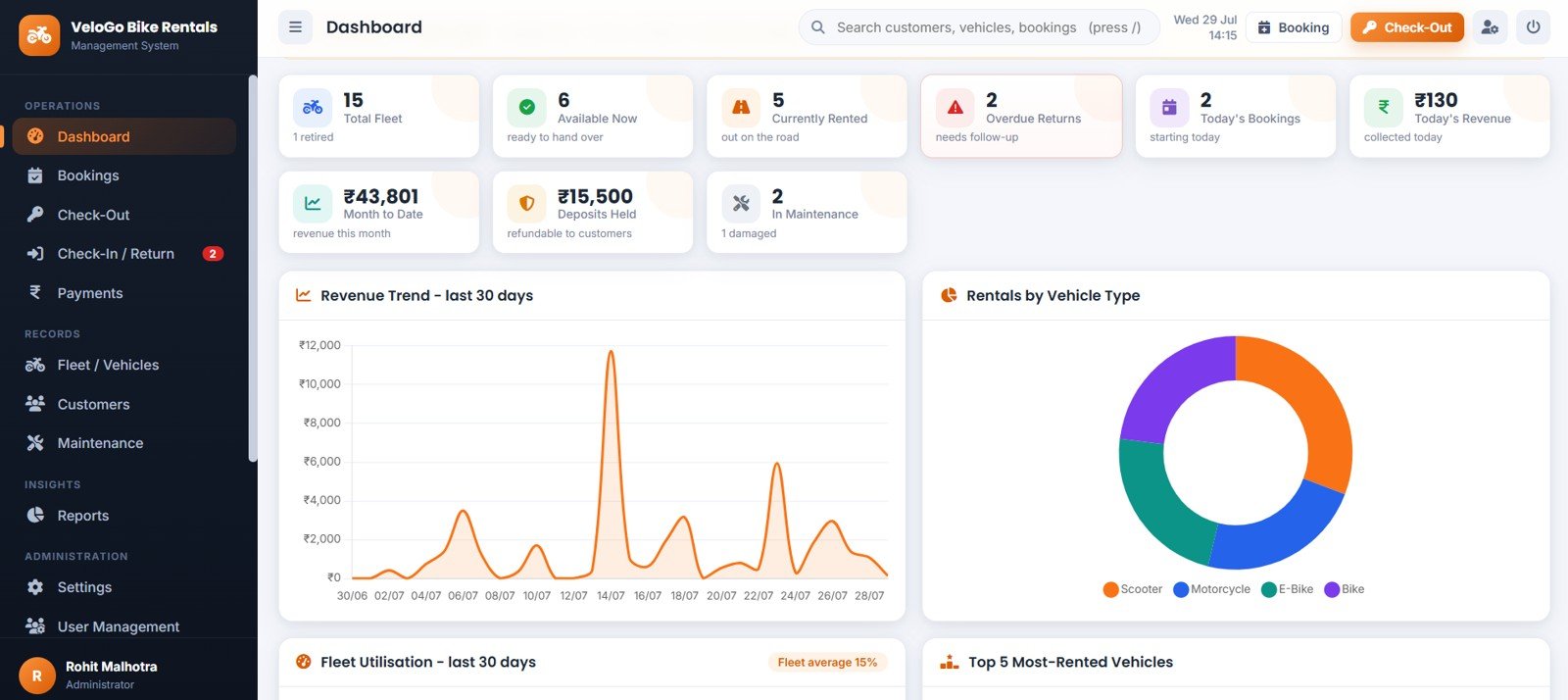
Nine KPI cards sit across the top: Total Fleet, Available Now, Currently Rented, Overdue Returns, Today’s Bookings, Today’s Revenue, Month to Date, Deposits Held and In Maintenance. Below them are Revenue Trend by Last 30 Days, Rentals by Vehicle Type, Fleet Utilisation by Last 30 Days, Most Rented Vehicles by Rental Count, Upcoming Pickups by Customer and Vehicle, Due Back Rentals by Customer and Vehicle, Open Maintenance by Vehicle, and Overdue Rentals by Expected Return.
Page 3: Bookings
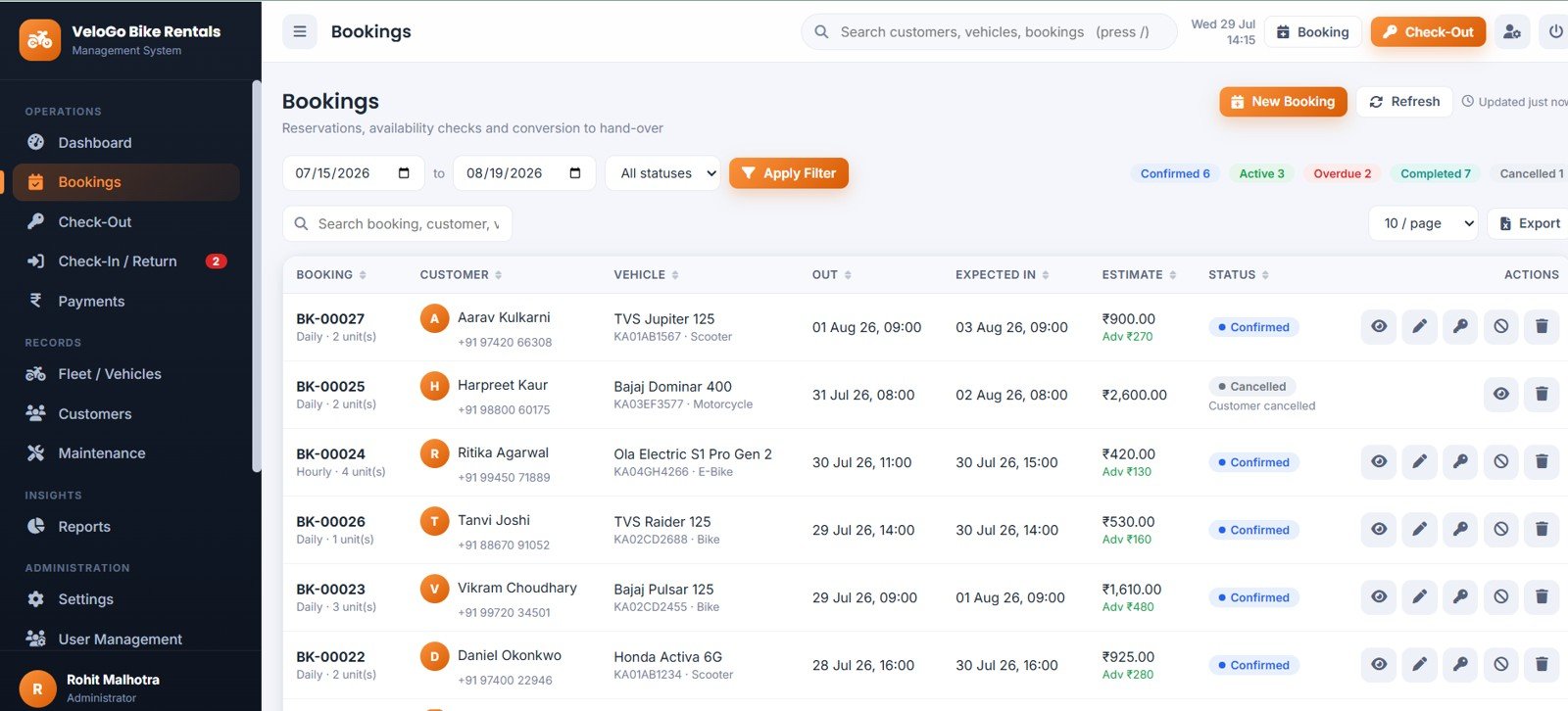
The reservation register showing Reservations by Booking Status, Bookings by Customer, Bookings by Vehicle, Estimate by Reservation and Booking Actions by Workflow Stage. The vehicle picker only offers bikes genuinely free for the chosen window, and greys out anything booked, damaged, retired or in the workshop with the reason shown.
Page 4: Check-Out and Hand-Over
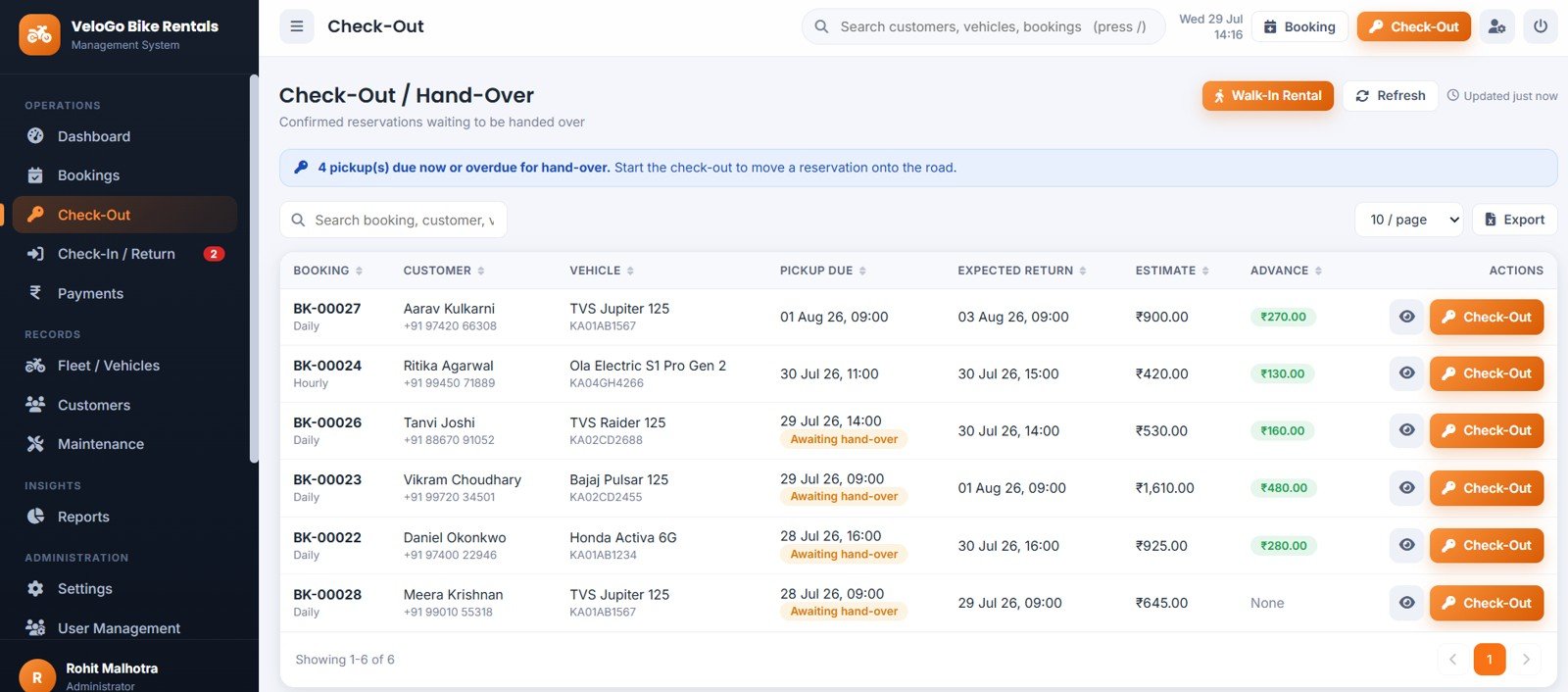
The hand-over desk, covering Confirmed Reservations by Pickup Due, Expected Returns by Booking, Advance Amount by Customer and Hand-Over Actions by Reservation. It captures the actual start time, odometer out, fuel or charge level, the security deposit and its mode, the condition checklist, photographs and the signed agreement acknowledgement.
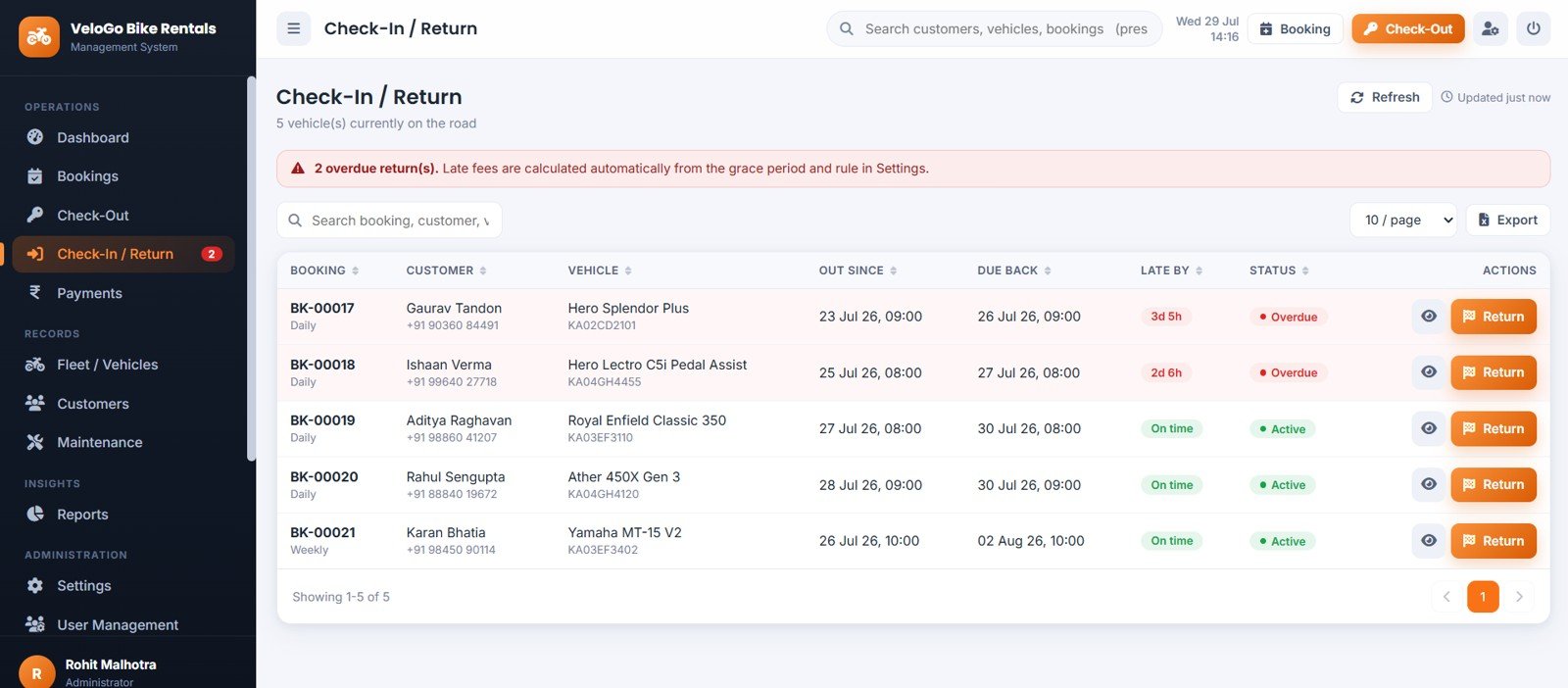
Page 5: Check-In and Return
Shows Vehicles on Road by Customer, Due Back Date by Booking, Late Return by Customer and Return Actions by Active Rental, with overdue rows highlighted in red. A live bill panel beside the form recalculates as the operator types, so the customer sees the final figure before anything is saved.
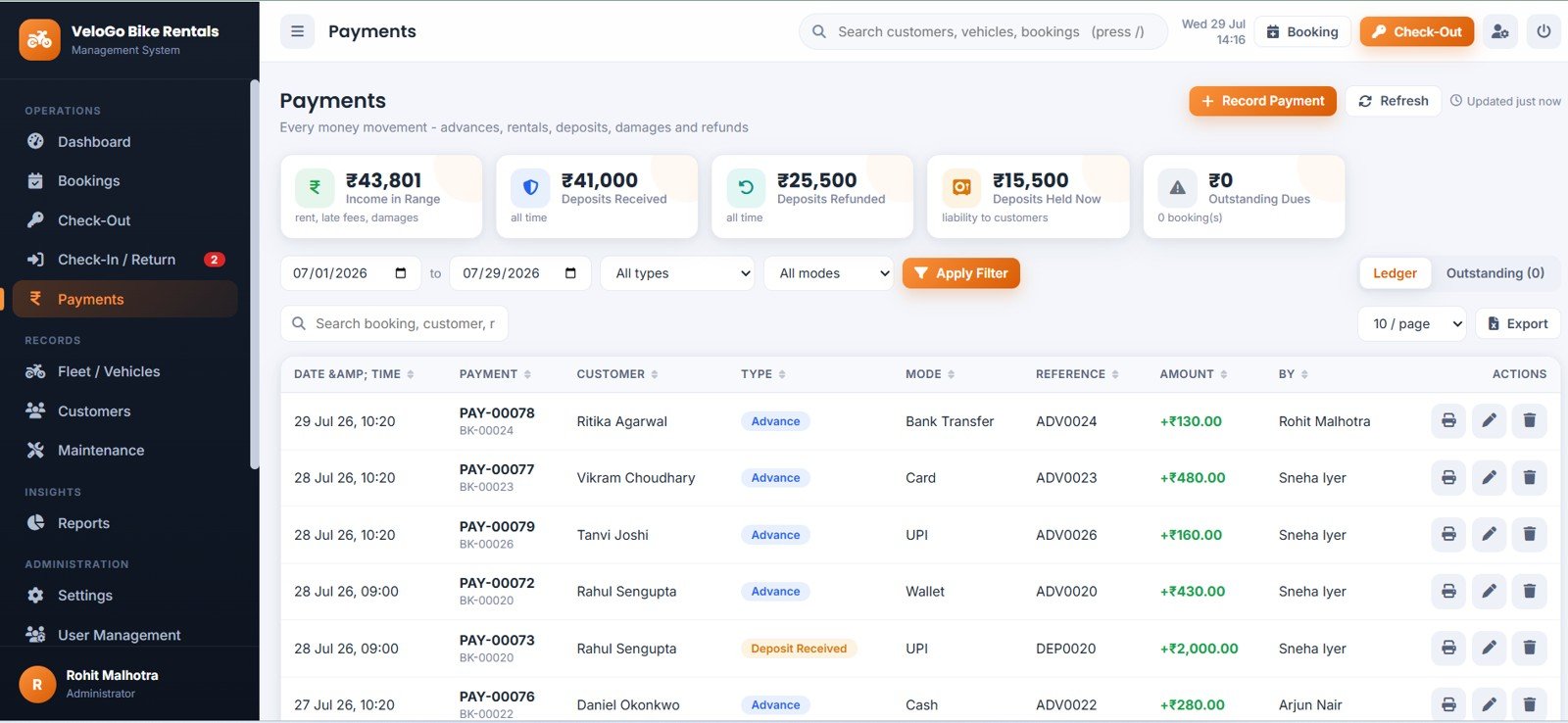
Page 6: Payments
A single ledger for every money movement, showing Income in Range by Payment Ledger, Deposits Received by Booking, Deposits Refunded by Booking, Deposits Held Now by Customer Liability, Outstanding Dues by Booking and Payment Amount by Payment Mode. Seven payment types are supported, and deposits are correctly treated as a liability rather than income.
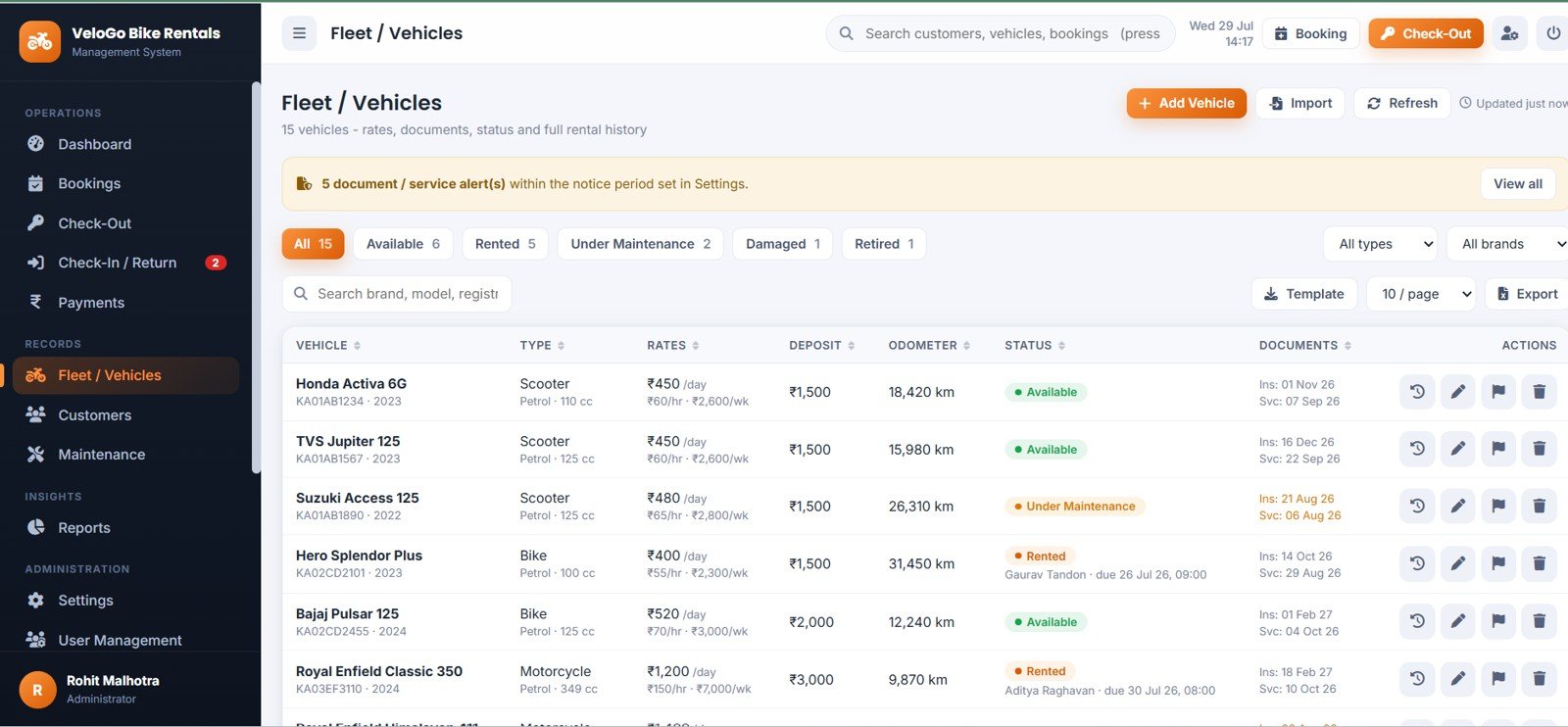
Page 7: Fleet and Vehicles
The fleet master, presenting Vehicles by Status, Vehicles by Type, Rental Rates by Vehicle, Deposits by Vehicle, Odometer Reading by Vehicle and Document Alerts by Vehicle. Each vehicle opens a history view with its rental revenue, kilometres run, maintenance cost and net contribution.
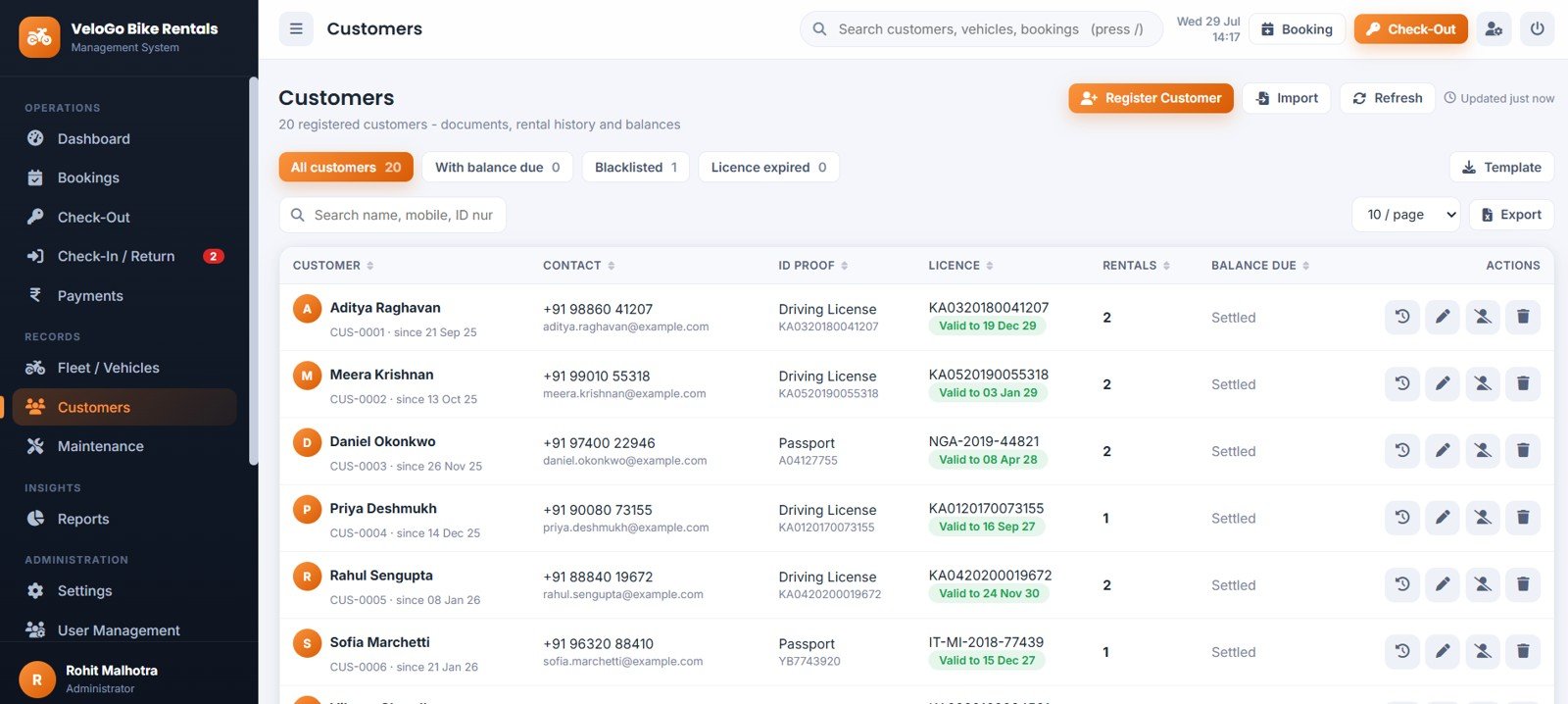
Page 8: Customers
Displays Customers by Account Status, Customers with Balance by Rental Account, Licence Expiry by Customer, Rental Count by Customer and Balance Due by Customer. Blacklisting blocks new bookings outright with the reason shown, and a booking is also refused when the driving licence expired before the rental start date.
Page 9: Maintenance
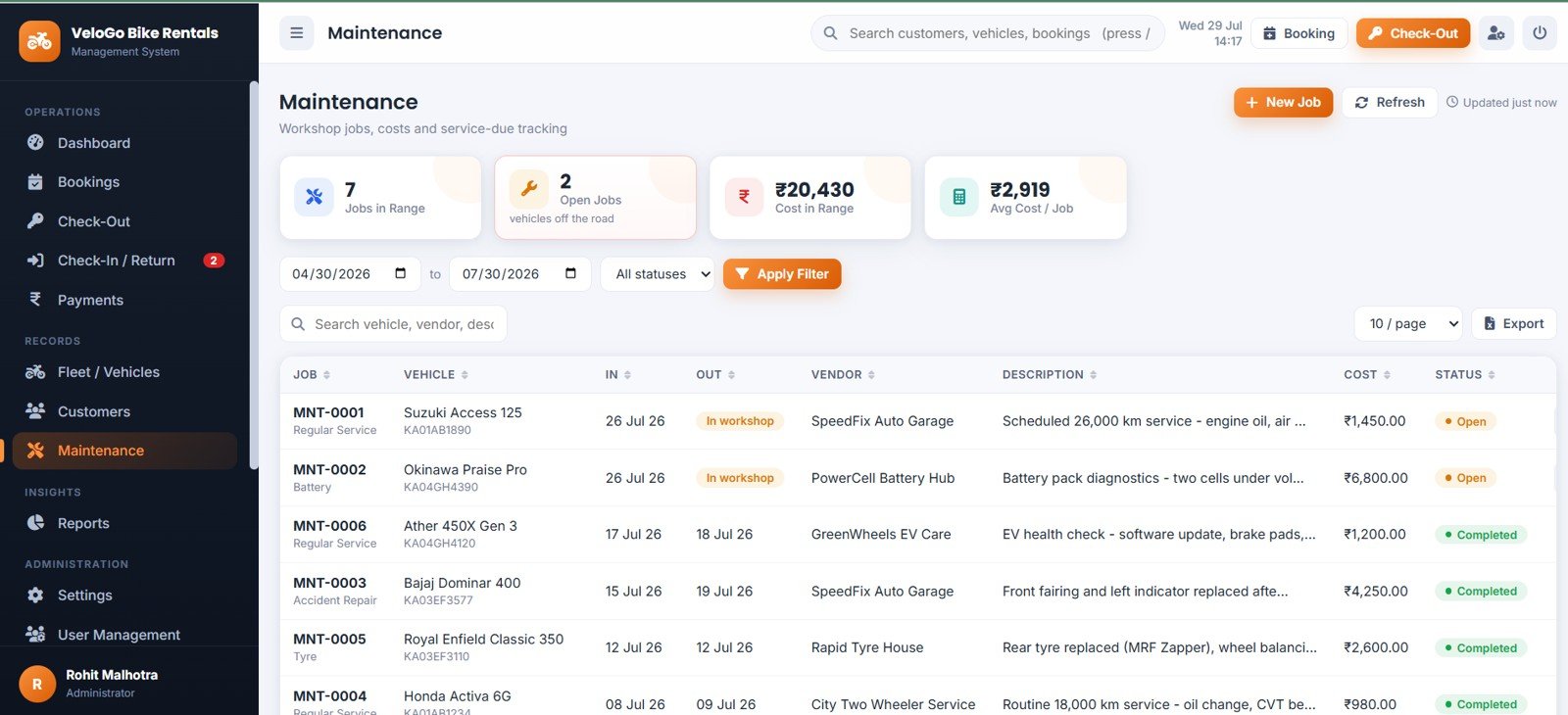
Covers Jobs in Range by Maintenance Record, Open Jobs by Vehicle, Cost in Range by Workshop Job, Average Cost by Job and Maintenance Status by Vehicle. While a job is open the vehicle is set to Under Maintenance and disappears from booking availability; completing a regular service sets the next service due date and kilometres automatically.
Page 10: Reports
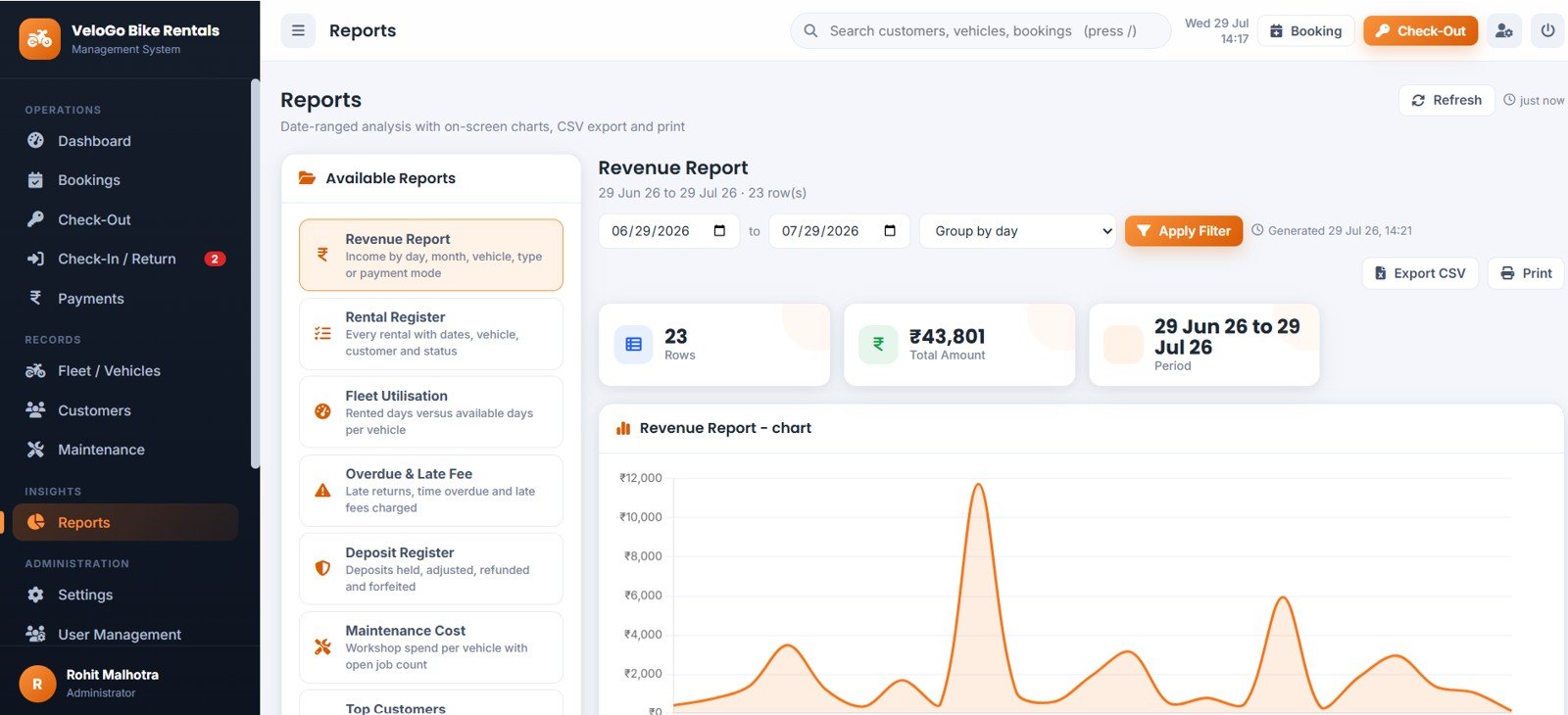
Seven date-ranged reports: Revenue Report by Date Range, Rental Register by Booking, Fleet Utilisation by Vehicle, Overdue and Late Fee by Rental, Deposit Register by Booking, Maintenance Cost by Vehicle, and Top Customers by Revenue and Rentals. Each shows a table and a chart, exports to CSV and prints at the configured size.
Page 11: Settings
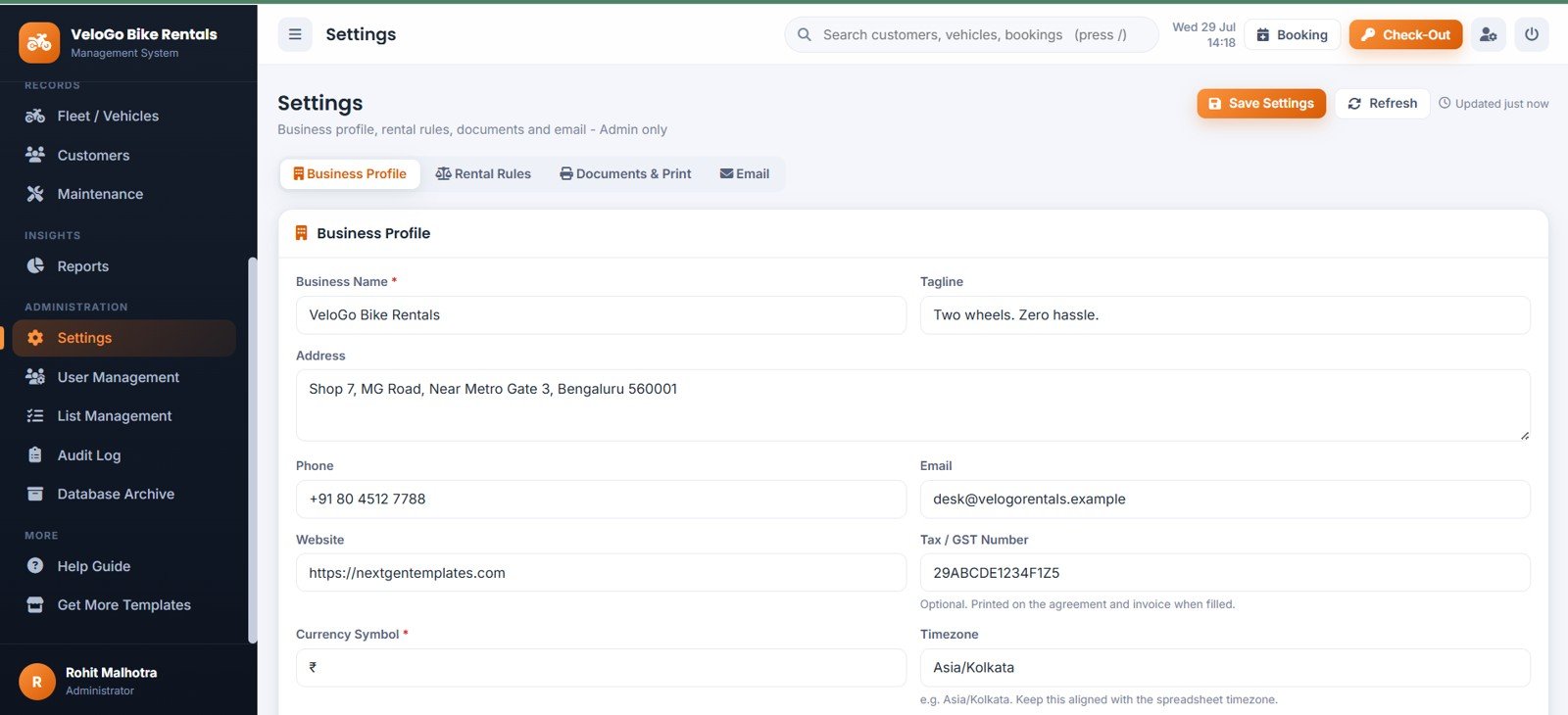
Four tabs covering Business Profile by Company Details, Rental Rules by Operating Policy, Documents and Print by Invoice Setup, and Email Settings by Notification Setup. The rental rules drive every automatic calculation: grace period, late-fee rule and value, free kilometres per day, extra-kilometre rate, minimum rental hours and default deposits per vehicle type.
Page 12: User Management
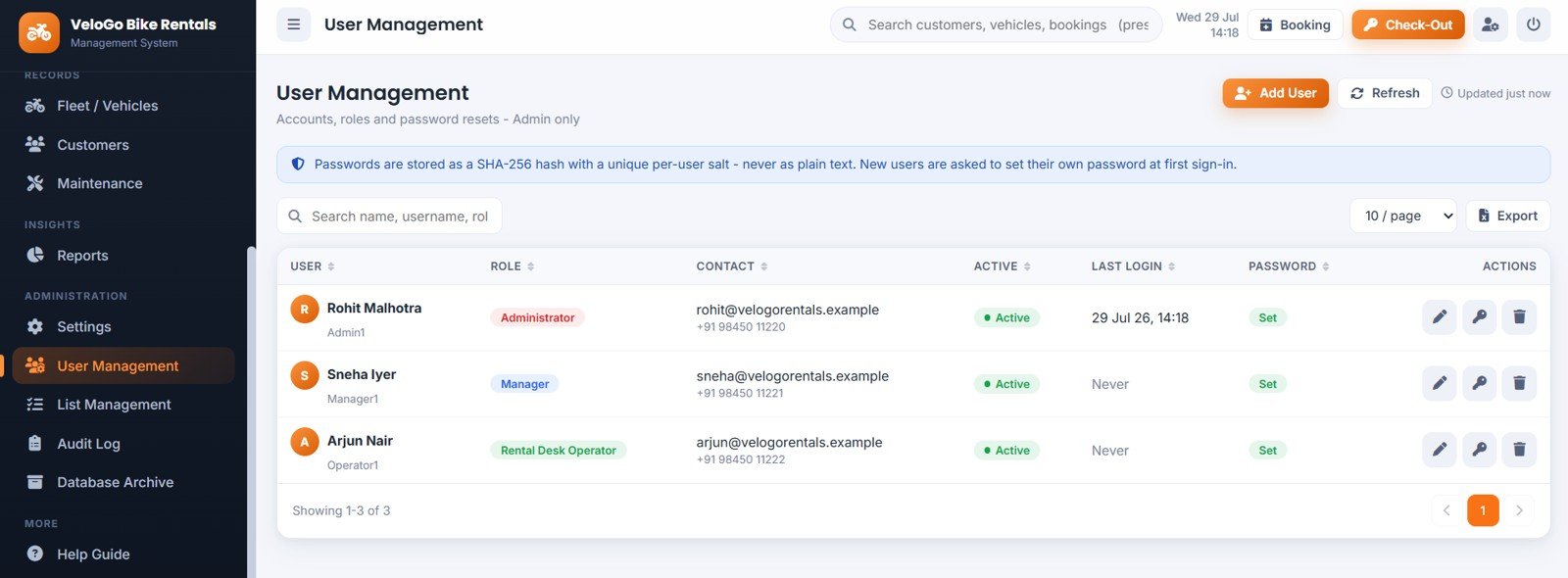
Shows Users by Role, Active Users by Account Status, Last Login by User and Password Status by User. Passwords are stored only as salted SHA-256 hashes, new accounts are prompted to set their own password at first sign-in, and the system always keeps at least one active Administrator.
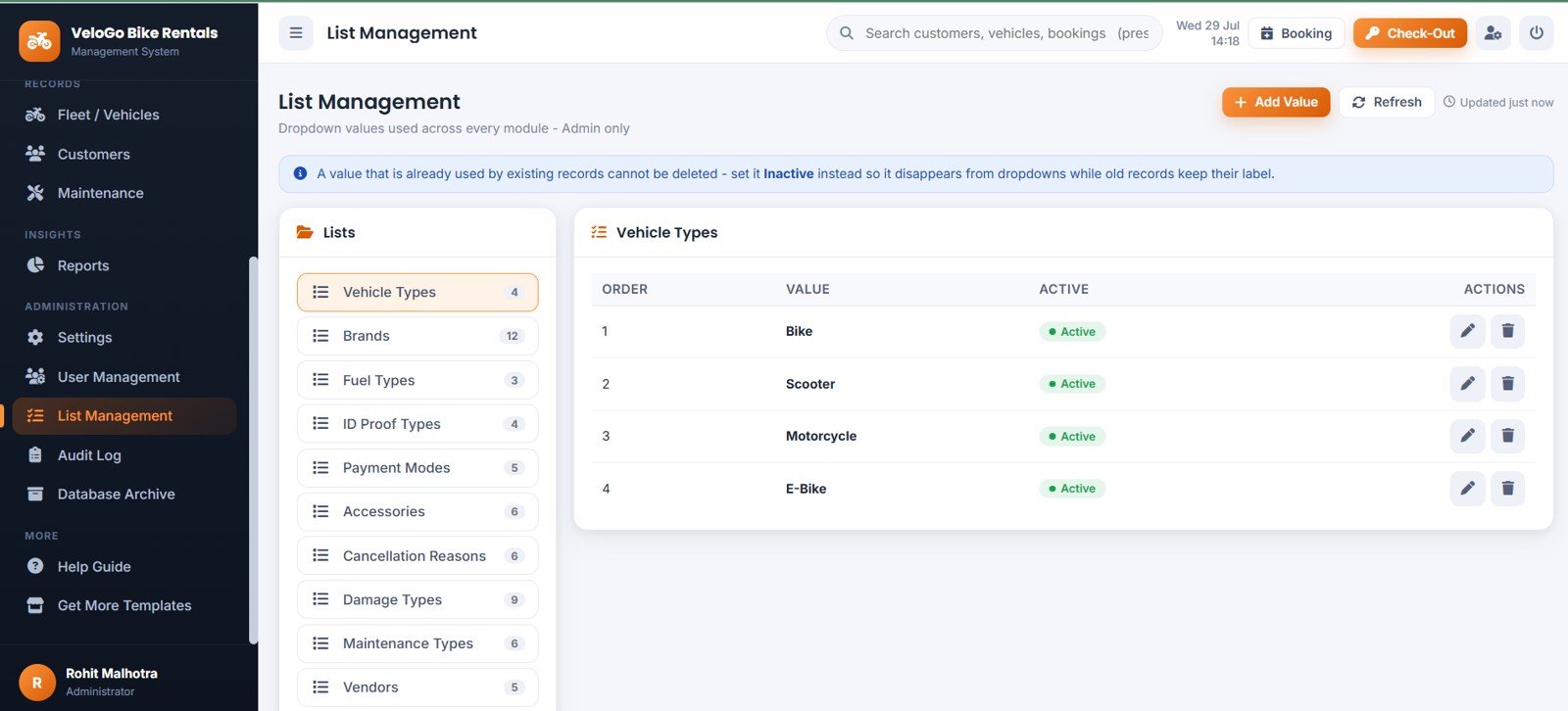
Page 13: List Management
Ten controlled dropdown lists: Vehicle Types by List Value, Brands by Master List, Fuel Types by Master List, Payment Modes by Master List, Maintenance Types by Master List and Vendors by Master List, plus ID proof types, accessories, cancellation reasons and damage types. A value already used by records is protected from deletion.
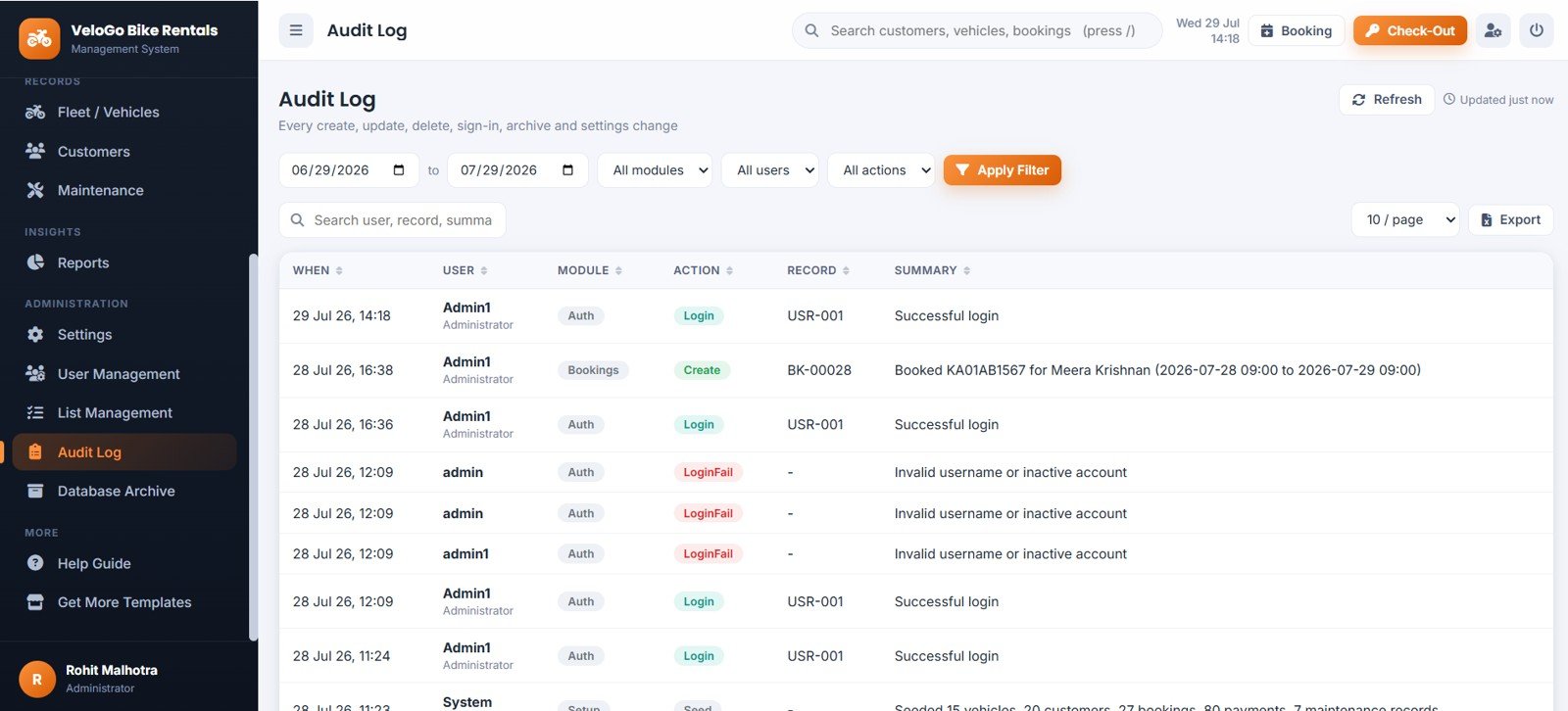
Page 14: Audit Log
Records Audit Events by Date and Time, Activity by User, Activity by Module, Activity by Action and Record Changes by Summary. Every create, update, delete, sign-in, failed sign-in, hand-over, return, archive run and settings change is captured with a plain-language summary.
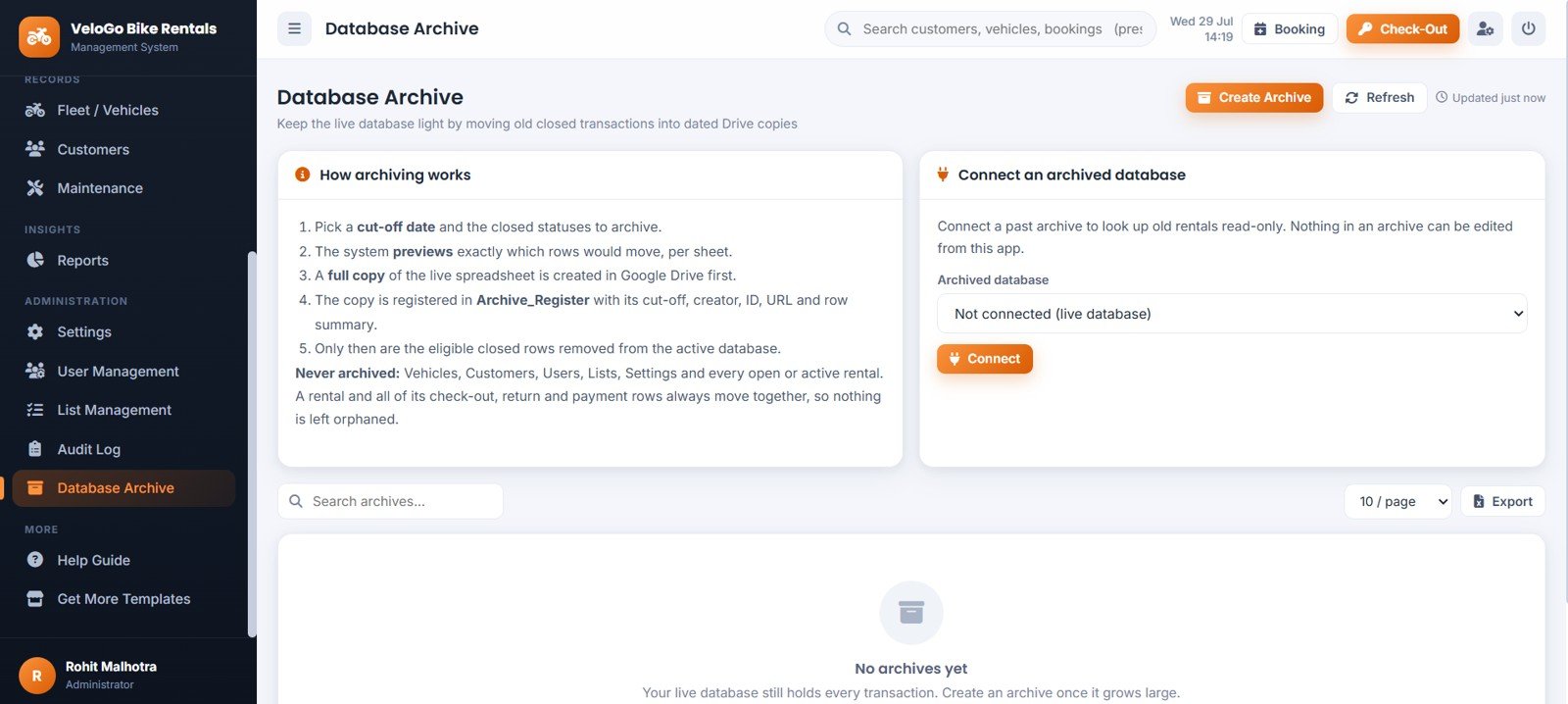
Page 15: Database Archive
Handles Archive Workflow by Closed Transactions, Archived Database by Connection Status and Old Records by Archive Search. A full copy of the spreadsheet is saved to Drive and registered before a single row is removed, and master data plus every open rental always stay in the live database.
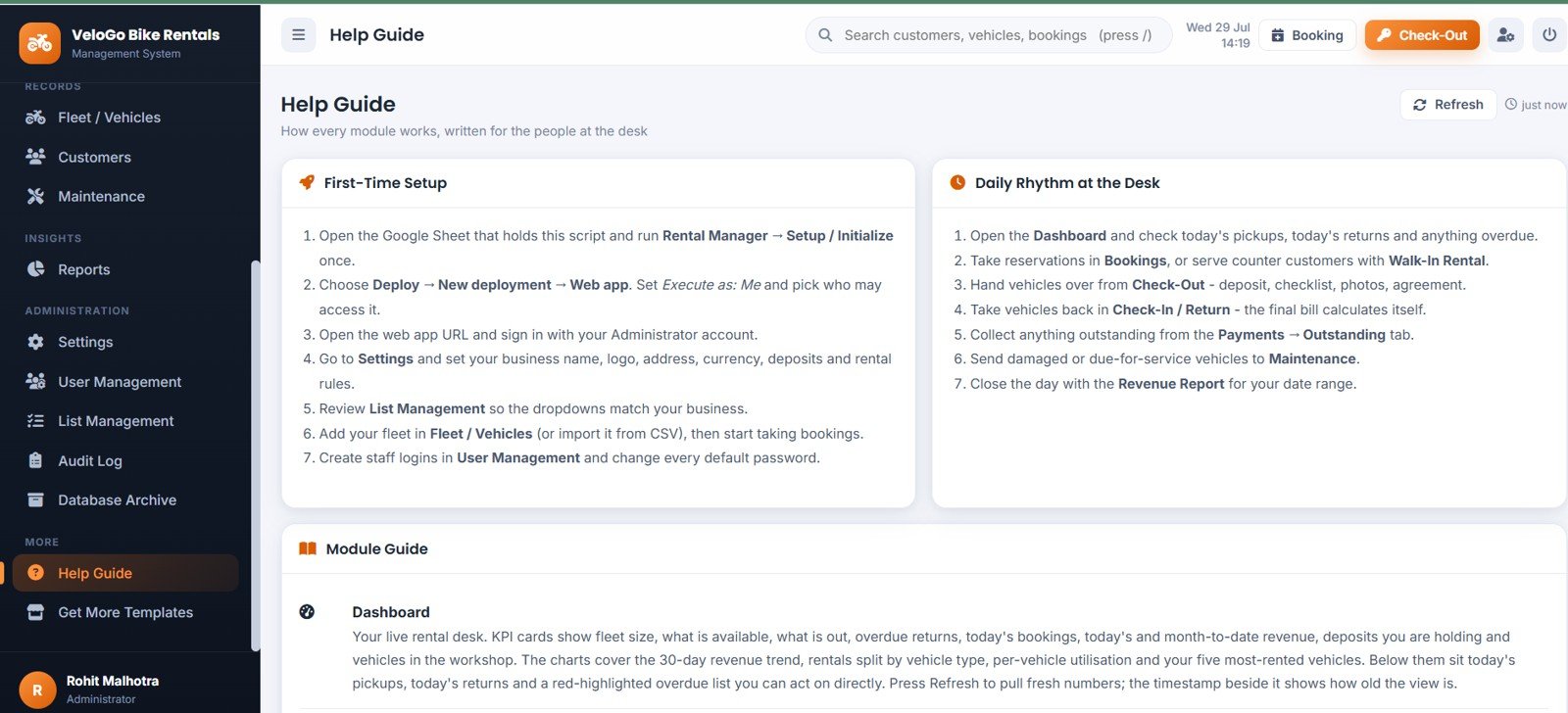
Page 16: Help Guide
Built-in documentation covering First-Time Setup by Implementation Step, Daily Rhythm by Rental Desk Task and Module Guide by App Section, written for counter staff rather than developers.
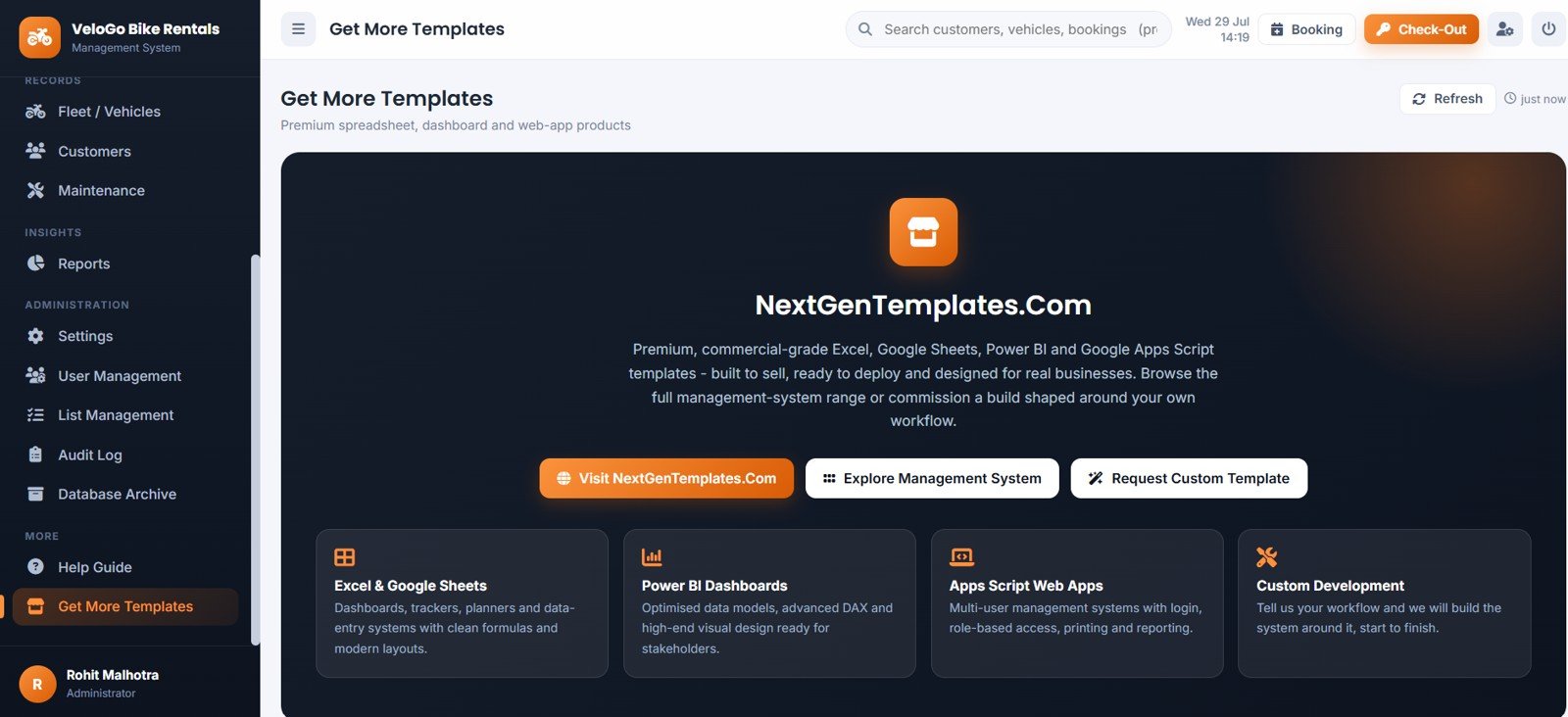
Page 17: Get More Templates
A promotional page presenting Template Categories by Product Type, Management Systems by Business Need and Custom Development by Project Request, linking to the wider NextGenTemplates catalogue.
Bike and Two-Wheeler Rental Management System vs. Excel Rental Workbook vs. Booqable / HQ Rental Software
| Feature | Bike and Two-Wheeler Rental Management System | Excel / VBA Rental Workbook | Booqable / HQ Rental Software |
|---|---|---|---|
| Cost | $39.99 one-time | $6-$30 one-time | ~$29-$300 / month |
| Platform | Browser web app on Google Sheets | Desktop Excel only | Vendor cloud |
| Setup time | About 10 minutes | Minutes | Days, often with onboarding calls |
| Multi-user login with roles | 3 roles, server-enforced | Rarely, and file-level only | Yes, priced per user |
| Double-booking prevention | Server-side overlap lock | Manual checking | Yes |
| Deposit, damage and late-fee automation | Built in, all three | Manual formulas | Yes, on higher plans |
| Mobile access | Responsive on any phone | Poor | Yes |
| Data ownership | Your own Google Sheet and Drive | Your file | Vendor-hosted |
| Year-1 cost at 5 users | $39.99 total | $6-$30 | ~$350-$3,600+ |
For rental shops that want proper multi-user booking control, deposit handling and reporting without paying a monthly per-user fee, the Bike and Two-Wheeler Rental Management System sits in the sweet spot.
Who Should Use This Template
Perfect for:
- City bike and scooter rental shops running 5-100 vehicles with 1-5 counter staff.
- Tourist rental outlets in hill stations, coastal towns and heritage cities.
- Hostel, hotel and guest-house rental desks hiring vehicles to guests.
- Delivery-fleet renters supplying two-wheelers to gig and courier riders.
- Operators running mixed petrol, electric and pedal-assist fleets.
Not a fit if:
- You need customer-facing online booking with card payment capture. This is a staff-side desk system.
- You need live GPS or IoT telematics feeds from your vehicles.
- You require SOC 2, SSO or a signed data-processing agreement.
- You rent cars or trucks. The rate card and condition checklist are shaped for two-wheelers.
Real-World Use Cases
Ravi runs a 40-scooter rental shop near a metro station. Every morning he opens the dashboard and sees today’s pickups, today’s returns and anything overdue in one screen. When a customer returns a scooter three hours late having ridden 380 km on a 100 km-per-day allowance, the late fee and the extra-kilometre charge are already on the bill before the conversation starts.
Meera manages a hostel rental desk in a tourist town. Her two front-desk staff hold Operator logins, so they can register guests, take bookings, hand vehicles over and process returns, but they cannot delete records or open the owner reports. She reviews the Fleet Utilisation report monthly to decide which bikes to add and which are sitting idle.
Anand supplies e-bikes to delivery riders on weekly hire. He uses the weekly rental basis, holds a deposit against every rider, and runs the Deposit Register and the Outstanding Dues tab each Friday. Riders who leave dues unpaid get blacklisted with a written reason, which blocks them from booking again.
Advantages of the Bike and Two-Wheeler Rental Management System
- No recurring cost. One payment of $39.99 against roughly $350 to $3,600 a year for a comparable subscription platform at five users.
- Disputes end quickly. Odometer readings, fuel levels, a six-point checklist and photographs at both ends of every rental mean there is always evidence.
- Nothing is calculated twice. Set your grace period, late-fee rule, free kilometres and deposit defaults once, and every return follows them.
- Your data stays yours. Everything lives in your own Google Sheet and Drive. Read it, back it up or export it whenever you like.
- It stays fast. Modules load once and are then served from browser memory, and the archive keeps the live spreadsheet small as the years pass.
- Deployment is genuinely simple. Paste two files, run one function, deploy. See the official Google Apps Script web apps documentation for how the deployment model works.
Opportunities for Improvement
It is a staff-side system, so there is no customer-facing booking portal and no online card capture. Payments are recorded, not processed. There is no GPS or telematics integration, so live vehicle location is out of scope. Google’s own Sheets size limits apply, which is precisely why the Database Archive exists, though very high-volume operators running thousands of rentals a month should plan to archive regularly. Email uses the daily MailApp quota of the Google account that owns the script, which is modest on a free Gmail account. Finally, the rate card and checklist are tuned for two-wheelers, so a car rental business would want the fields reworked.
Best Practices
- Change every default password before you go live, and give each staff member their own account so the audit log means something.
- Photograph the vehicle at hand-over and at return, every single time. It takes fifteen seconds and settles arguments permanently.
- Enter the odometer accurately. Extra-kilometre billing and service scheduling both depend on it.
- Write your real terms and conditions into Settings before printing your first agreement, since that is the text the customer signs.
- Open a maintenance job the moment a vehicle is off the road, so nobody can book it by accident.
- Check the insurance, permit and service alerts weekly. An expired permit costs far more than a missed rental.
- Export the Revenue Report monthly and keep it with your accounts, and take a spreadsheet copy before any large change.
Explore Relevant Templates
- Rental Equipment Management System Web App – the same rental workflow shaped for tools, equipment and event gear.
- Barbershop Management System Web App – appointments, walk-in queue and counter billing on the same Apps Script architecture.
- Payroll and Salary Management System Web App – run staff salaries alongside your rental desk.
- Car Rental KPI Dashboard in Google Sheets – reporting-only view if you already have a booking process.
- Vehicle Reservation Tracker in Excel – a lightweight Excel starting point.
You can also read our walkthroughs of the Rental Equipment Management System and the Ambulance Fleet and Dispatch Management Web App, both built on the same Google Apps Script foundation.
Frequently Asked Questions
What does the Bike and Two-Wheeler Rental Management System actually track?
The Bike and Two-Wheeler Rental Management System tracks 9 live KPIs – total fleet, available now, currently rented, overdue returns, today’s bookings, today’s revenue, month-to-date revenue, deposits held and vehicles in maintenance – across 17 screens and 14 Google Sheets tabs.
How long does setup take?
About 10 minutes. You paste two files into a new Apps Script project, name the HTML file exactly Index, run Setup / Initialize once and deploy as a web app. It arrives seeded with 15 vehicles, 20 customers and 27 bookings so you can test every feature immediately.
How does this compare to Booqable or HQ Rental Software?
Those are subscription platforms costing roughly $29 to $300 a month, and they add customer-facing online booking and payment capture. The Bike and Two-Wheeler Rental Management System is a one-time $39.99 staff-side desk system that keeps your data in your own Google account with no recurring fee.
Can two staff members double-book the same bike?
No. The Bike and Two-Wheeler Rental Management System runs an overlap test on the server inside a script lock, against every confirmed, active and overdue booking on that vehicle. Two people saving at the same instant still cannot hire it twice.
How are late fees and extra kilometres calculated?
Late fees start only after your grace period, then follow one of three rules: a flat amount per late hour, a flat amount per late day, or a percentage of the daily rate per late day. Extra kilometres are anything beyond the free allowance per rental day, charged at your per-kilometre rate.
What happens to the security deposit?
You choose at return: refund it in full, adjust dues from it and refund the balance, or forfeit it. The Bike and Two-Wheeler Rental Management System records the choice on the printed invoice, writes it to the payments ledger and reports it in the Deposit Register.
Will the Google Sheet slow down over time?
No. An Admin-only Database Archive copies the spreadsheet to Drive, registers it, and then removes only old closed rentals. Master data and every open rental always remain in the live database, and archives can be reconnected read-only.
About the Author
Built by PK – Microsoft Certified Professional with 15+ years of Excel, Google Sheets and Power BI experience. Founder of NextGenTemplates, reaching 300K+ subscribers across YouTube channels. Every template is hand-built and tested before release.
Conclusion
If you hire out bikes, scooters, motorcycles or e-bikes, the Bike and Two-Wheeler Rental Management System Web App gives you the three things a paper register never can: it stops double-bookings before they happen, it produces a correct final bill without arithmetic, and it leaves an audit trail behind every action. It runs entirely on your own Google account, so there is nothing to host and nothing to renew.
Click here to Purchase the Bike and Two-Wheeler Rental Management System Web App
Instant download · One-time payment · No subscription · Lifetime access
For step-by-step video walkthroughs of this and other Google Apps Script web apps, visit Youtube.com/@NeoTechNavigators.
Last updated: July 2026