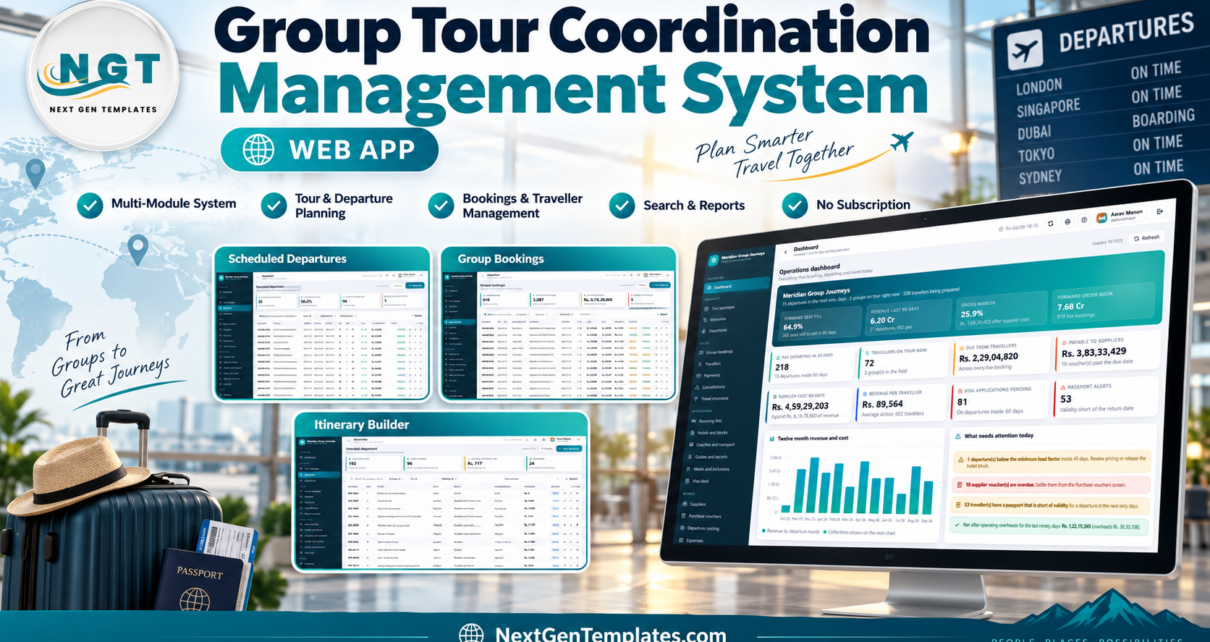
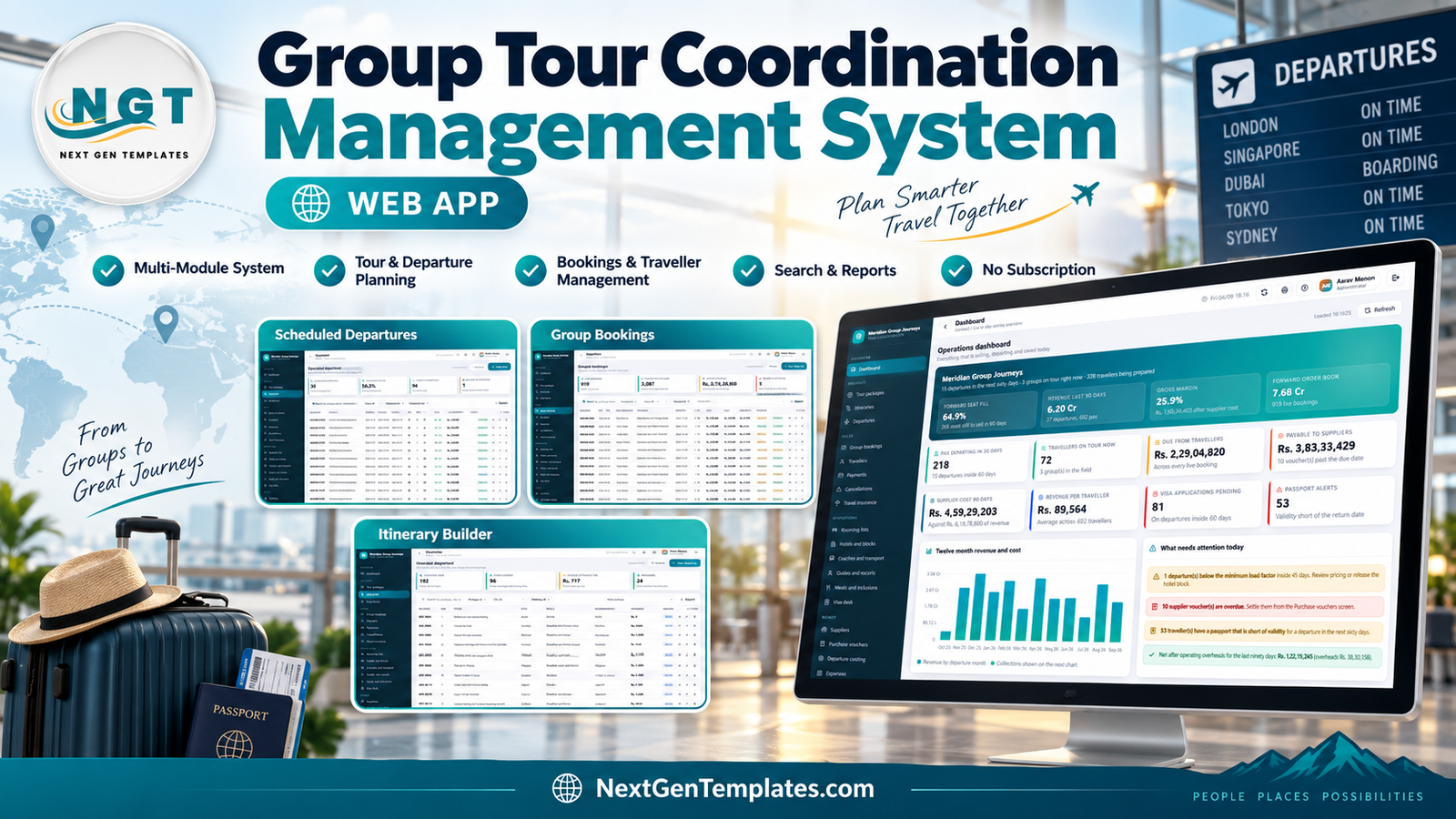
One escorted departure is not one record. It is a package, an itinerary, a seat count, a rooming list, a hotel block with a release date, a coach per leg, a guide, a meal plan, a visa file per passport and a supplier voucher — and if any one of them is late the coach still leaves without it. The Group Tour Coordination Management System web app collapses that spread into a single Google Apps Script console: 27 screens over 28 database tables, 17 built-in reports, 6 roles across 52 server-checked permissions, and a seeded demo database of 14,176 rows so nothing is empty the first time you open it. It runs in your own Google account, stores everything in a Google Sheet in your own Drive, and ships as source you own outright.
Get the Group Tour Coordination Management System Web App
Try the Live Demo
The system is deployed and running. Open it, sign in and click through the modules before you decide anything.
Demo sign-in details
| Role | Username | Password |
|---|---|---|
| Administrator | admin | Tours@2024 |
| Operations Manager | manager | Manager@2024 |
| Reservations Officer | reservations | Reserve@2024 |
| Reservations Officer | reservations2 | Booking@2024 |
| Tour Coordinator | coordinator | Coord@2024 |
| Tour Coordinator | coordinator2 | Journey@2024 |
| Accounts Officer | accounts | Accounts@2024 |
| Visa Officer | visa | Visadesk@2024 |
Sign in as visa or accounts rather than admin — the sidebar shrinks to that role’s screens and the server refuses the writes the role is not allowed to make. These credentials are public by design: they belong to a shared demo instance that resets, not to anybody’s live deployment. Your own copy builds its own database in your own Drive.
Key Features of the Group Tour Coordination Management System
The build is organised around the way a tour desk actually moves work, not around a database diagram.
- Tour packages — the sellable catalogue, with code, destination, category, duration, twin price and status. The demo carries 24 active packages averaging 8 days.
- Itineraries — 192 day rows across 96 overnight and touring cities, each with meals, overnight city, entrance fee and a walking grade of Easy, Moderate or Active.
- Departures — scheduled dates with capacity, sold, free and a load factor that recalculates itself, plus a counter for departures inside 45 days that are under target.
- Group bookings and travellers — 1,011 bookings and 3,087 traveller rows carrying passport number, expiry, validity flag, visa state, sharing type and meal preference.
- Payments, cancellations and insurance — deposits, instalments, balances, charge bands and refunds, with 524 policies issued against international travellers.
- Ground operations — rooming lists, hotel blocks with confirmation numbers and release dates, coach allocation per leg, guide assignments and meal covers.
- Visa desk — 500 applications with appointment dates, decisions, visa numbers and a passport validity watch against the return date.
- Money out — 38 suppliers, 919 purchase vouchers, departure costing with margin percent, and an operating-expense register that sits outside the departure cost sheet.
- 17 reports — date filtered, printable at A4, 4 inch or 3 inch, and exportable to CSV.
- Administration — users and roles, 29 dropdown lists holding 191 values, 38 settings, an audit log and a dated database archive.
Screen-by-Screen Walkthrough
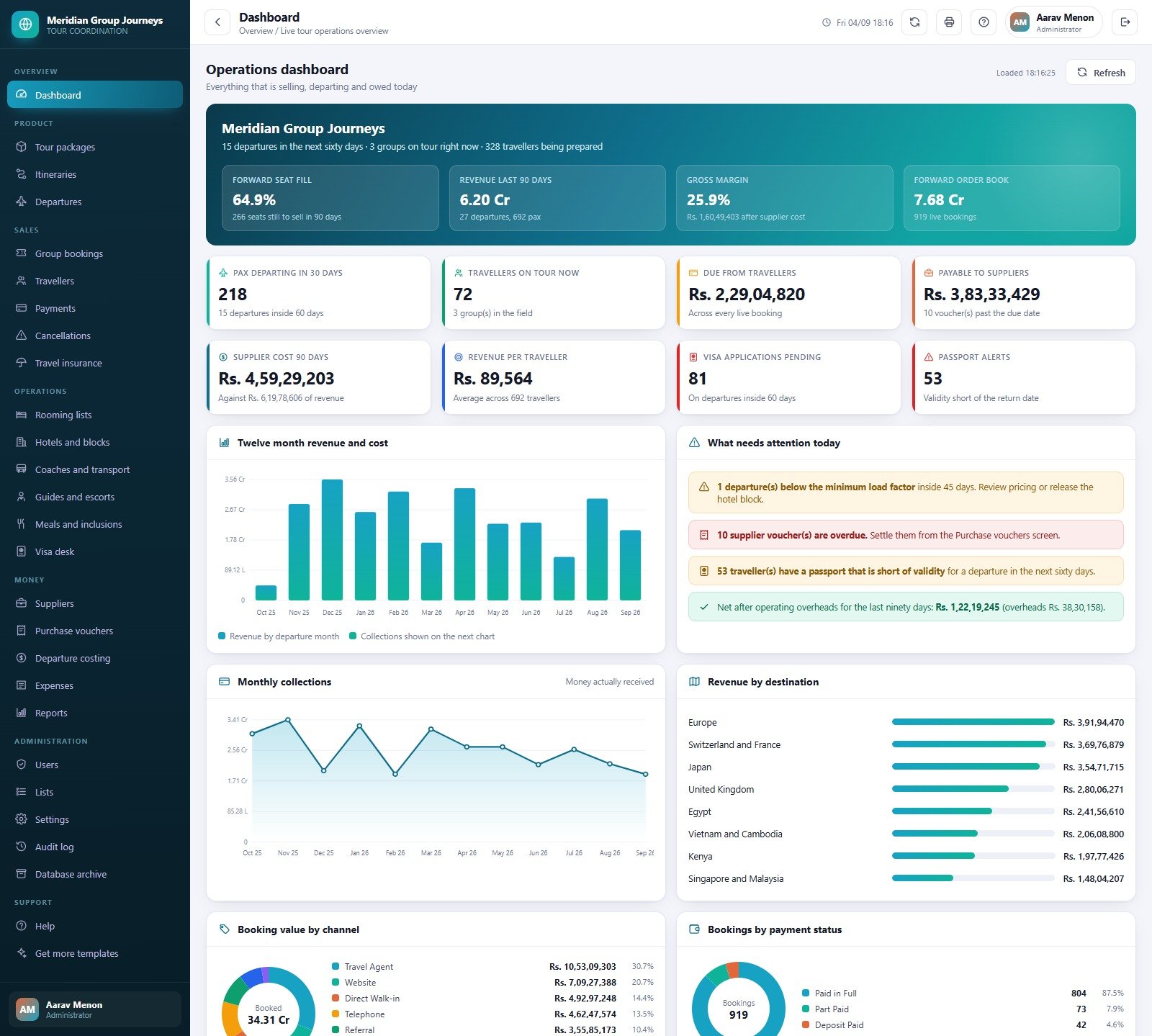
Operations dashboard
Eight KPI tiles plus a banner: forward seat fill, revenue over the last 90 days, gross margin, forward order book, pax departing in 30 days, travellers on tour now, due from travellers, payable to suppliers, supplier cost, revenue per traveller, visa applications pending and passport alerts. Underneath sit a twelve-month revenue and cost column chart, a monthly collections line, revenue by destination, booking value by channel and bookings by payment status. The right-hand column is the useful part: four plain-English alert lines covering departures below the minimum load factor, overdue supplier vouchers, travellers whose passport is short of validity, and net margin after overheads for the last ninety days.
Tour packages and the itinerary builder
Packages list with revenue and seat fill charts above the grid. The itinerary builder is a flat day table filtered by package, city and walking grade, so a coordinator can compare Day 4 of two Rajasthan circuits without opening two documents.
Scheduled departures
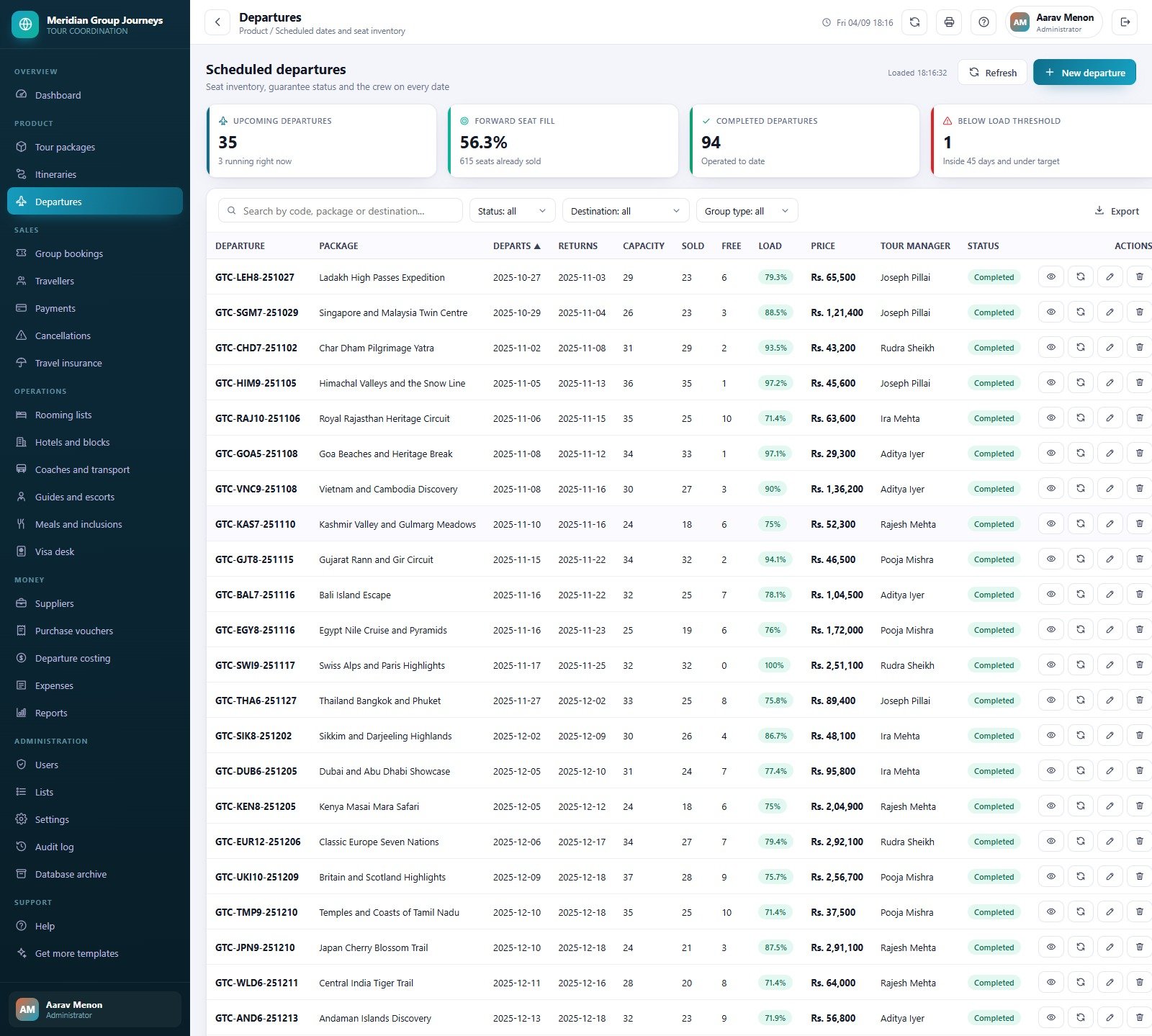
Departure code, package, depart and return dates, capacity, sold, free, load percent, price, tour manager and status. Sorting by load is how you find the departure that needs a price move or a released hotel block.
Group bookings, travellers and payments
Bookings carry pax, value, paid, balance, payment state and booking state. Travellers hang off the booking with the passport and visa detail that becomes the manifest. Payments open with a “balances falling due first” panel above the receipt register, which is the screen a reservations officer works from on a Monday.
Rooming, hotels, coaches, guides and meals
Rooming lists are rebuilt per departure from the room split on every confirmed booking, so a change request never disturbs another group. Hotel blocks track rooms held against rooms used with a release date; the demo runs at 92.5% block utilisation with 19 blocks inside the release window. Coach allocation is per leg with a seats-versus-capacity flag, guides carry a day rate and a fee, and meal services record covers, vegetarian share and cost per cover.
Visa desk and compliance
Applications by country, a pipeline donut of approved, in progress and refused, and a row per traveller with the appointment date, decision date and visa number. The passport validity watch is the companion report.
Money and reports
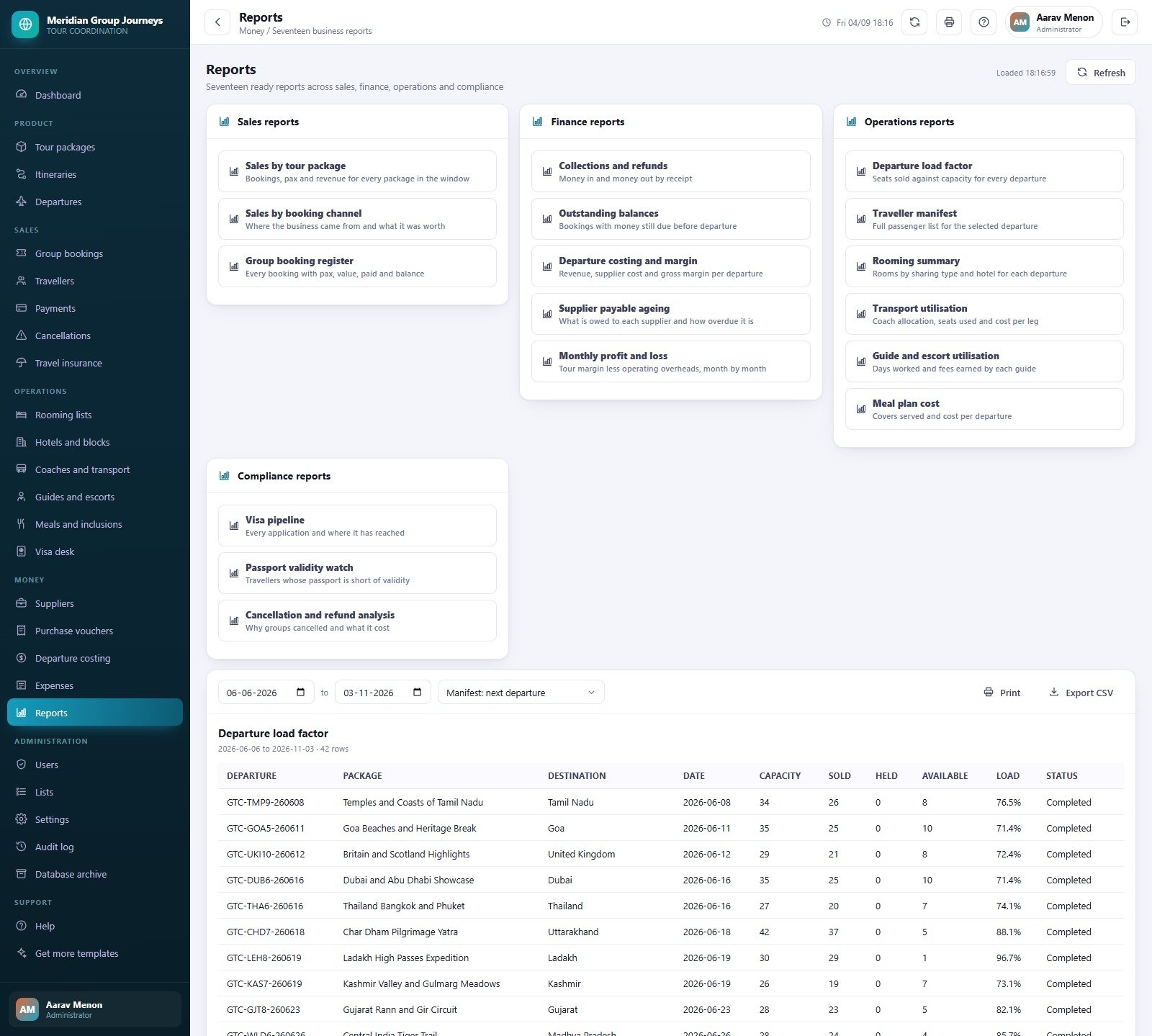
Suppliers, purchase vouchers by service type, departure costing with margin per departure, and the expense register. The Reports screen groups all seventeen: three sales, five finance, six operations and three compliance.
Group Tour Coordination Management System vs. a Spreadsheet vs. Paid Tour Operator SaaS
| This web app | Spreadsheet tracker | Paid tour operator SaaS | |
|---|---|---|---|
| Cost | One payment, yours to keep | Free | Roughly $60-$200 per user per month |
| Platform | Google Apps Script + Google Sheets | Excel or Google Sheets | Vendor cloud |
| Setup time | About 15 minutes | Immediate, then weeks of formulas | Days of onboarding |
| Real-time team collaboration | Yes, 8 seeded accounts | Partial, file locking and versions | Yes |
| Mobile access | Yes, browser based | Clumsy | Yes |
| Customizable fields | Yes, you hold the source | Yes | Only what the vendor exposes |
| Share with link | Yes, one deployment URL | Yes, the whole file | Yes |
| Year-1 cost at 5 users | One payment | Free plus your time | Roughly $3,600-$12,000 |
| Seat inventory and load factor | Calculated per departure | Manual formulas | Yes |
| Role permissions | 6 roles, 52 permissions, server enforced | None worth the name | Yes |
| Who owns the data | You, in your own Drive | You | The vendor |
Who Should Use This Template
It suits outbound and inbound operators running fixed escorted departures, pilgrimage and yatra organisers, school and college tour desks, corporate offsite planners, and destination management companies with a few coordinators who currently share three spreadsheets and a WhatsApp group. It is a poor fit if you sell only single FIT bookings with no fixed departure, if you need live GDS or airline inventory, if you want a public booking engine taking card payments, or if you need accounting-grade ledgers — this records money against bookings and vouchers, it does not replace your books.
Real-World Use Cases
An outbound desk with fourteen coordinators. The operations manager opens the dashboard alerts first: departures under the minimum load factor inside 45 days, overdue supplier vouchers, passports short of validity for a departure inside sixty days. Three items that used to be a Monday phone call.
A pilgrimage organiser. Most travellers are seniors, so age band, meal preference and sharing type matter more than headline price. The traveller manifest and rooming summary print at A4 for the tour manager, and the rooming list emails straight to the hotel.
A visa officer at a mid-size operator. Signs in with a scoped account, works applications from documents pending to approved, and lets the passport validity watch decide which files to chase before the embassy window closes.
Advantages of the Group Tour Coordination Management System
- Deployment is honest about free accounts. Setup is staged and resumable, so a free Gmail account that hits the six-minute Apps Script execution limit queues a trigger and finishes on its own rather than leaving a half-built database.
- Permissions are enforced on the server. The permission map drives the sidebar and the guard on every write, so a hidden screen cannot be reached by editing the page.
- The seed is dated relative to install. Roughly 340 days of history behind today and 130 days of forward inventory ahead, so every screen and report has something to show and a few departures are always in progress.
- Print sizes are configured, not hard-coded. Invoices, reports and receipts each take A4, 4 inch or 3 inch from Settings.
- Housekeeping is included. Salted SHA-256 passwords, 12-hour server-issued sessions, a full audit log, one-click backup, and an archive that moves old rows to a dated Drive copy you can reconnect read-only.
Opportunities for Improvement
Stated plainly, because a listing that only praises is not much use:
- The permissions table on the Users screen shows a count only for Administrator (52). The other five roles read “A scoped subset covering the screens that role uses” with a dash in the permissions column, so you have to sign in as the role to see exactly what it can do.
- There is no public booking engine and no payment gateway. Money is recorded, not collected; card capture stays wherever you take it today.
- No live airline or GDS inventory. Seat counts are your own, entered against the departure.
- Email rides on your Google quota. MailApp limits apply, which matters on a large manifest send.
- Currency and tax are single-value settings. A multi-currency operator will need to extend the source, which is included but is still work.
- The sample business identifiers are placeholders. The demo GSTIN, IATA number, insurer names and hotel names are invented sample data, not real registrations.
Best Practices
- Change all eight seeded passwords before anyone else signs in, then delete the accounts you do not need.
- Give coordinators the narrowest role that lets them work — the separation is the product.
- Set the deposit percent, tax percent and cancellation charge bands in Settings before the first live booking, not after.
- Build the itinerary before the first departure; the itinerary is what operations works to and what the traveller is sold.
- Run the passport validity watch weekly rather than at 45 days out. Renewals take longer than visas.
- Raise purchase vouchers as services are confirmed, so departure costing and margin percent stay honest.
- Take a backup before any structural edit to the source, and run the archive once the live file passes roughly fifty thousand rows.
For the platform limits behind all of this — execution quotas, triggers and MailApp allowances — the official Google Apps Script quotas documentation is the reference worth bookmarking.
Explore Relevant Templates
- Adventure Sports Booking Management System Web App — the same architecture for activity operators selling sessions rather than departures.
- Airport Transfer Management System Web App — pairs with this one for the arrival and departure transfer legs.
- Backpacker Hostel Management System Web App — bed-level inventory on the accommodation side.
- Car Rental Management System Web App — fleet, contracts and damage for self-drive.
- Travel and Tourism Dashboard in Google Sheets — a lighter, reporting-only view if a full system is more than you need.
- Escape Room Booking Management System Web App — another booking-led build from the same family.
If you would rather learn the spreadsheet craft behind systems like this, the NextGenTemplates Academy learning paths take you through it step by step, with practice files included.
Get the Group Tour Coordination Management System Web App
Frequently Asked Questions
Can I try it before buying?
Yes. The live demo above is the real system with all eight seeded accounts. Create a booking, run a report, print a manifest. Nothing you do there touches your own copy.
Do I need a paid Google Workspace plan?
No. It runs on a free Gmail account; setup is staged specifically so it survives the six-minute execution limit that free accounts impose.
Where does the data live?
In a Google Sheet that setup creates in your own Drive, under your own account, with a Drive folder tree alongside it for passport copies, contracts and bills.
How long does deployment take?
About fifteen minutes: new Apps Script project, paste two files, deploy as a web app, run setup once, sign in and change the passwords.
Can I change fields, roles and branding?
Yes — the full Apps Script source is included. Operator name, address, GSTIN, currency, tax percent, deposit percent and print sizes are already editable from Settings without touching code.
How many people can use it?
As many as you create. The demo ships 8 accounts across 6 roles, and each role’s permission set is checked on the server rather than only in the browser.
What happens when the database grows?
The Database archive screen moves rows older than a cutoff into a dated Drive copy and removes them from the live file; the copy reconnects and is searchable read-only from the same screen.
About the Author
Built by PK – Microsoft Certified Professional with 15+ years of Excel, Google Sheets, and Power BI experience. Founder of NextGenTemplates, reaching 300K+ subscribers across YouTube channels. Every template is hand-built and tested before release.
Conclusion
Group tour work fails in the gaps between systems: the seat that was sold twice, the block that released on Friday, the passport nobody checked. The Group Tour Coordination Management System closes those gaps by keeping the package, the departure, the traveller, the room, the coach, the visa and the voucher on one console with one audit trail. Open the live demo, sign in as the Visa Officer and then as the Accounts Officer, and see how much of a Monday morning it removes — then take the source and run your own copy.