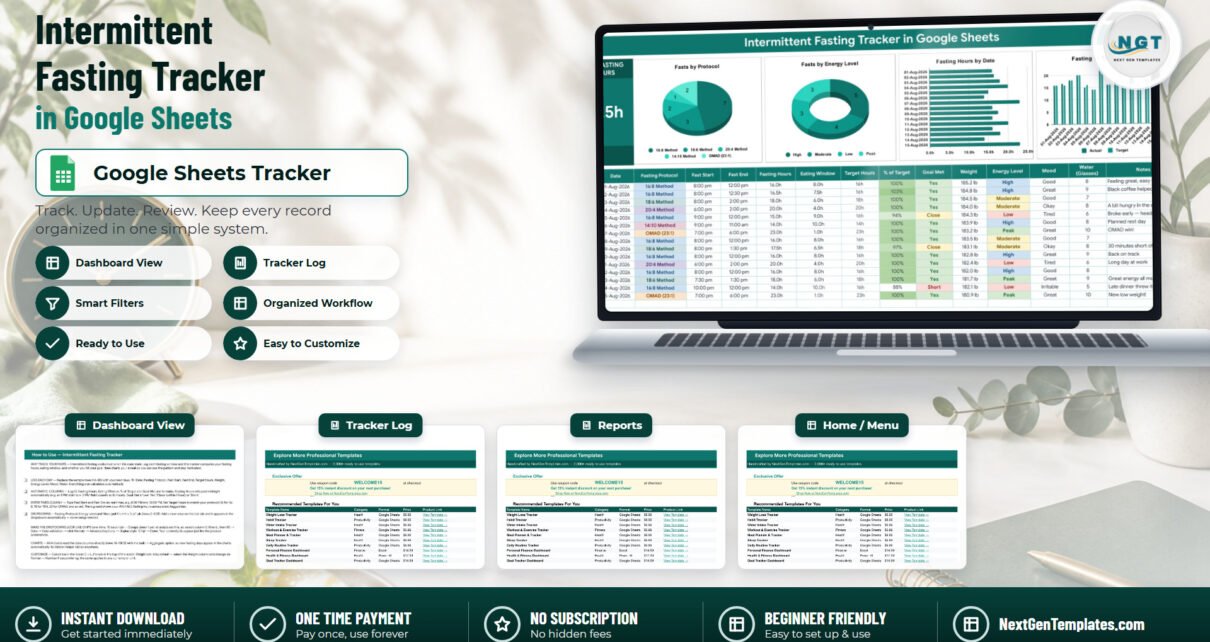
Most people who fast do not actually know their numbers. They know they “usually do 16:8” and they have a feeling about how the last month went. The Intermittent Fasting Tracker in Google Sheets replaces the feeling with a record: one row per fasting day, 15 columns of which 5 fill themselves in, 4 charts that update as you type, and a single KPI card holding your average fasting hours. It is 4 tabs, 18 pre-seeded dropdown values, and a data range wired to 1,000 rows, which is about two and a half years of daily logging.Intermittent Fasting Tracker in Google Sheets
Before anything else, what this is and what it is not. This is a personal logging and charting spreadsheet. It is not a medical device, it is not diagnostic, and it gives no dietary or medical advice. It does not recommend a fasting protocol, does not set a target for you, and does not count calories. It sends no reminders, alerts or notifications of any kind – it is a record, not an alarm. Every number in it is a number you typed. Decisions about whether and how to fast, especially if you are pregnant, diabetic, on medication, or have a history of disordered eating, belong with a qualified doctor or dietitian.
Get the Intermittent Fasting Tracker in Google Sheets
Key Features of the Intermittent Fasting Tracker in Google Sheets
Fasting hours that survive midnight. This is the calculation that breaks most home-made fasting spreadsheets. You type Fast Start 8:00 PM and Fast End 12:00 PM and the sheet returns 16.0h, not a negative number and not an error. You never enter a second date.Intermittent Fasting Tracker in Google Sheets
Eating Window, derived. The complement of the fast within 24 hours, sitting right beside it, so a 16:8 day reads 16.0h against 8.0h and an OMAD day reads 23.0h against 1.0h.Intermittent Fasting Tracker in Google Sheets
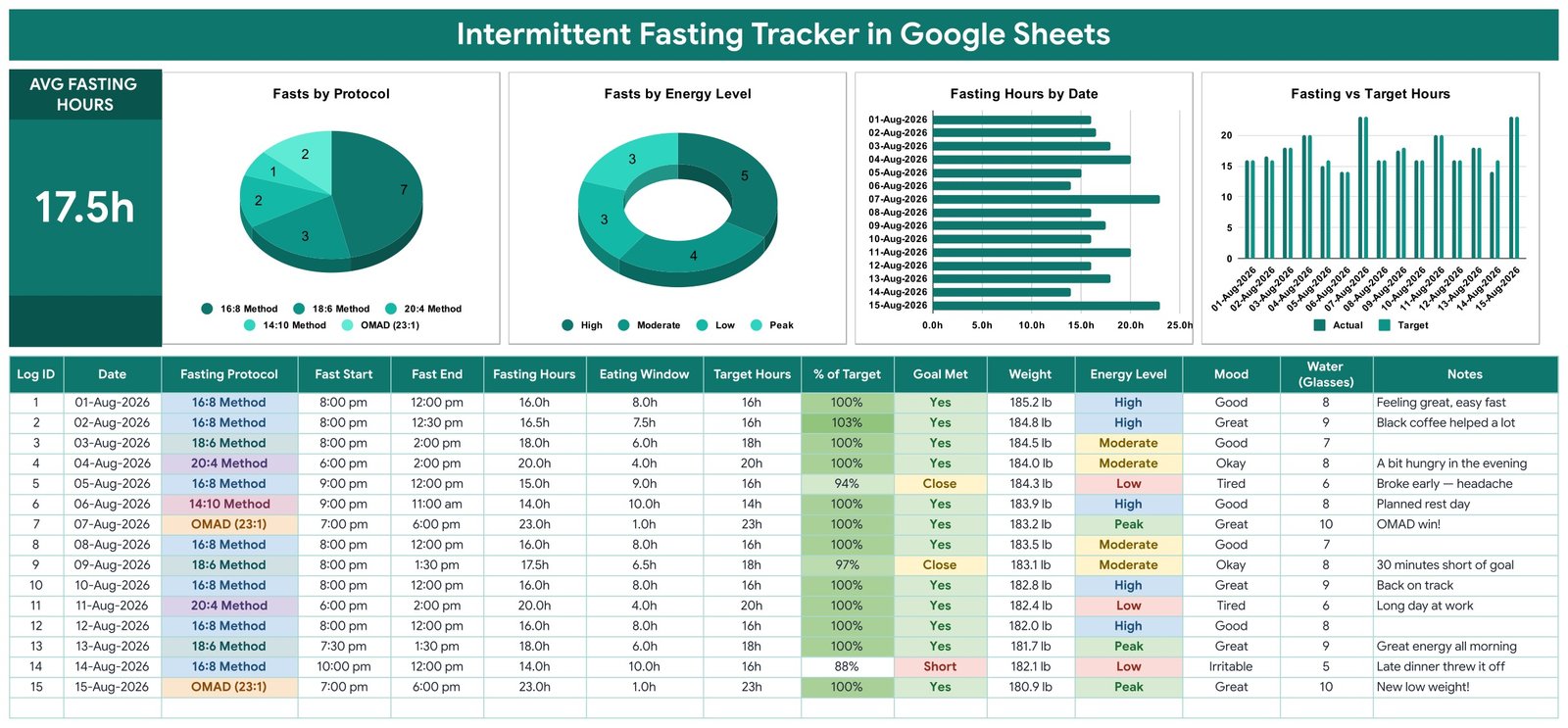
% of Target and Goal Met. You type the Target Hours for that day – 16 for 16:8, 18 for 18:6, 23 for OMAD – and the sheet returns the percentage plus a plain verdict. Yes at or over target, Close within one hour of it, Short beyond that. In the shipped demo data a 15.0h fast against a 16h target reads 94% and Close; a 14.0h fast against the same target reads 88% and Short.
One KPI card, no vanity metrics. AVG FASTING HOURS is an ordinary mean across every row you have logged. On the fifteen demo rows it reads 17.5h, which is exactly the average of those fifteen values – the card is not decorative.
Four charts, all reading the log directly. Fasts by Protocol, Fasts by Energy Level, Fasting Hours by Date, and Fasting vs Target Hours with actual and target side by side. They use the built-in Aggregate option over rows 16 to 1000, so there are no hidden helper tables anywhere in the file and a new day appears the moment you type it.Intermittent Fasting Tracker in Google Sheets
Dropdowns you control. Fasting Protocol, Energy Level and Mood read a plain List tab. Nine protocols ship seeded – 16:8, 18:6, 20:4, 14:10, 12:12, OMAD (23:1), 5:2 (Weekly), Alternate Day and Custom – alongside four energy levels and five moods. Add your own anywhere in rows 2 to 500 and it appears in the dropdown, no re-setup required.
Template Structure – the four tabs explained
1. Fasting Tracker
The product, on one screen. Title banner, the average fasting hours card on the left, the four charts across the top, and the log underneath: Log ID, Date, Fasting Protocol, Fast Start, Fast End, Fasting Hours, Eating Window, Target Hours, % of Target, Goal Met, Weight, Energy Level, Mood, Water (Glasses) and Notes. Fifteen worked demo rows occupy rows 16 to 30. Delete them once you have watched the formulas behave.Intermittent Fasting Tracker in Google Sheets
2. List
Three columns – Fasting Protocol, Energy Level, Mood – and a note reminding you that the dropdowns read rows 2 to 500. That is the whole tab, and that is the point: nothing is hard-coded into the data-validation rules, so you can rename or extend anything.Intermittent Fasting Tracker in Google Sheets
3. Instructions
A written walkthrough of the same ground: which columns are automatic, how to enter times cleanly, how to switch Weight from lb to kg through Format > Number, and how to recolour the whole sheet from one constants block at the top of the script. It also covers the one manual step in the whole product – Google does not yet let a script set the Chip display style on data validation, so if you want the coloured pills you see in the screenshots you select column C, then L, then M, and set Data > Data validation > Advanced options > Display style to Chip. Ten seconds, once.
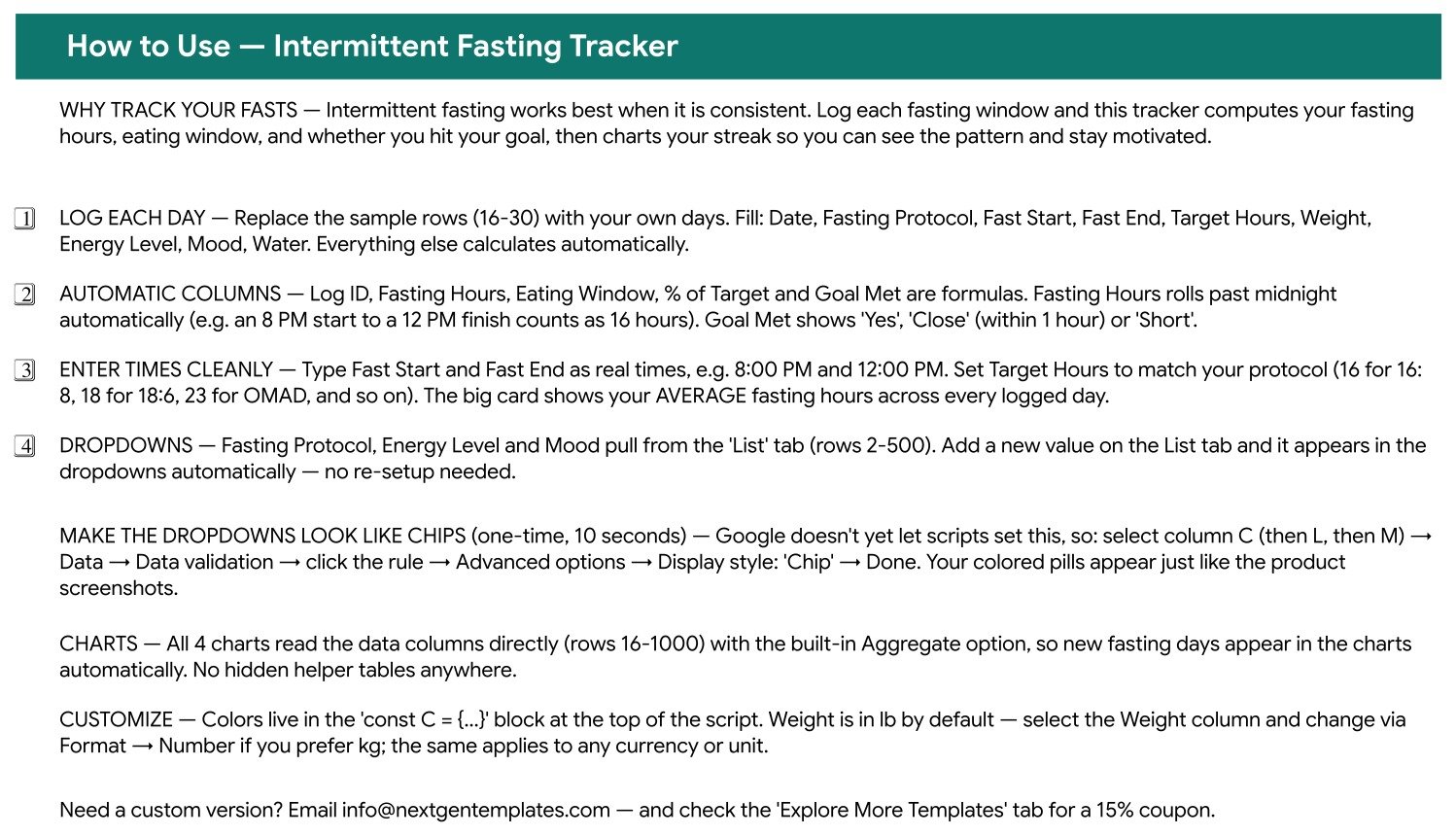
4. Explore More Templates
A directory of related NextGenTemplates products, with a coupon code for your next purchase.
Intermittent Fasting Tracker vs. a Microsoft Excel Sheet vs. a Paid Fasting App – Feature Comparison
| This tracker (Google Sheets) | A DIY Excel fasting sheet | A paid fasting app subscription | |
|---|---|---|---|
| Cost | One payment, no renewal | Free, but you build every formula | Recurring, billed monthly or yearly |
| Platform | Google Sheets, any browser | Desktop Excel | The vendor’s phone app |
| Setup time | Minutes: open the PDF, click Make a Copy | Hours, and the midnight rollover is the fiddly part | Minutes, after creating an account |
| Real-time collaboration | Yes, native Google Sheets sharing | Only through OneDrive co-authoring | Usually single-user |
| Mobile access | Google Sheets mobile app | Excel mobile app | Yes, that is what it is built for |
| Customisable fields | Every column, dropdown and colour | Yes, if you build it | Rarely: you get the vendor’s fields |
| Share with a link | Yes | File attachment or cloud link | Screenshots |
| Year-1 cost at 5 users | One purchase, share the copy | Free, plus your build time | Five subscriptions, renewing |
| Who owns the raw data | You. A sheet in your own Drive, exportable to CSV or XLSX | You | The vendor, until you export it |
| Reminders and notifications | None at all | None | Yes, usually the headline feature |
Who Should Use This Template
It suits people who already fast and want the record rather than the encouragement. If you rotate protocols – 16:8 on work days, OMAD at the weekend – the Fasts by Protocol chart tells you which one you actually finish rather than which one you intended. If you suspect your energy dips on longer fasts, Energy Level and Mood sit on the same row as the hours, which is the only way that question gets answered honestly.
It also suits people who simply do not want another account. The sheet lands in your own Google Drive, exports to CSV or XLSX, and no third party sees it.
It does not suit you if you want push notifications when a fast ends, if you want calorie or macro counting, or if you want the template to tell you what protocol to follow. It does none of those things by design.
Real-World Use Cases
Alternating protocols. Maya rotates 16:8 and 18:6 and suspected the longer days were flattening her afternoons. Six weeks of rows, and the Energy Level breakdown was clear enough to move 18:6 onto her non-training days.
Weekend OMAD. Daniel fasts long twice a week and logs from his phone in the Google Sheets app. The Fasting vs Target Hours chart shows him at a glance which weeks drifted under the window he set, without him having to read a single number.
Restarting after a break. Priya cares less about the numbers than the Notes column – “late dinner threw it off”, “black coffee helped” – and uses Goal Met to stay honest without turning the sheet into something she dreads opening.
Advantages of the Intermittent Fasting Tracker in Google Sheets
- The hard formula is already solved. Cross-midnight duration is the one thing a beginner spreadsheet gets wrong, and it is done here.
- No helper tables. Every chart points at the data columns, so there is nothing hidden to break when you insert a row.
- Objective and subjective on one row. Hours, weight and water beside energy, mood and free text.
- Honest defaults. The demo rows include a failed fast and two near-misses, not fifteen perfect days.
- Fully editable. Columns, dropdown values, number formats and the colour palette are all yours; the palette is a single constants block.
- Owned, not rented. One purchase, your Drive, exportable at any time.
Opportunities for Improvement
Honest limits, so nobody is surprised after buying:
- There is no streak counter. The Instructions tab uses the word “streak” in its opening paragraph, but no column or chart in the file computes consecutive successful days. The charts show per-day hours and the protocol and energy distributions. Worth knowing before you buy for that reason.
- Fasts by Protocol and Fasts by Energy Level are counts, not averages. They tell you how often you used 16:8, not your mean hours on 16:8.
- No weekly or monthly rollup, and no filters or slicers. One KPI card and four charts over the whole log; if you want last-month-only views you will add a filter view yourself.
- The chip styling is a manual step. Google’s API cannot set it, so the coloured pills need a ten-second click-through described on the Instructions tab.
- Weight is a single lb column. No body-fat, waist or other measurements – the Body Measurements Tracker handles those.
Best Practices
- Log the fast you actually did, not the one you planned. A Short row is more useful than a missing one.
- Set Target Hours per day, not once. It is a column, not a setting, precisely so a 14:10 recovery day is scored against 14 and not against your usual 16.
- Use Notes ruthlessly. “Late dinner threw it off” explains a Short row six weeks later when the number alone will not.
- Delete the demo rows before you start so your average is yours.
- Add your own protocol names on the List tab rather than typing free text into the log, so the Fasts by Protocol chart stays clean.
- Keep the sheet private. Google Sheets sharing is link-based; see the Google Docs Editors Help guide to sharing files before you share anything you would rather keep to yourself.
Explore Relevant Templates
The same one-page tracker pattern across the rest of the health range:
- Weight Loss Tracker in Google Sheets – the longer-run weight record.
- Calorie & Macro Tracker in Google Sheets – the food side of the routine this one does not cover.
- Water Intake Tracker in Google Sheets – hydration on its own sheet.
- Sleep Tracker in Google Sheets – the other half of the energy story.
- Workout Log Tracker in Google Sheets – training volume alongside your windows.
- Daily Steps Tracker in Google Sheets – the low-effort daily-activity companion.
Want to build skills like this step by step? The NextGenTemplates Academy learning paths walk you through spreadsheet tracker building with practice files.
Get the Intermittent Fasting Tracker in Google Sheets
Frequently Asked Questions
Does it handle a fast that runs past midnight?
Yes, and it is the core calculation. An 8:00 PM start with a 12:00 PM finish the next day is counted as 16.0 hours. You enter only the two times.
Will it notify me when my fast ends?
No. The sheet sends no notifications, alerts, emails or push messages of any kind. If you want reminders, set them on your phone separately.
What does “Close” mean in the Goal Met column?
Within one hour of the Target Hours you set for that day. At or over target reads Yes; more than an hour under reads Short.
Can I add my own fasting protocol?
Yes. Nine are seeded and the dropdown reads rows 2 to 500 of the List tab, so anything you add appears automatically.Intermittent Fasting Tracker in Google Sheets
Does it count calories or macros?
No. There is no food or nutrition database in this template. Pair it with the Calorie & Macro Tracker in Google Sheets for that.
Can I record weight in kilograms?
Yes. Weight is formatted in lb by default; select the column and change it through Format > Number.
Do I need Google Workspace or a paid account?
No. A free Google account is enough. Open the PDF in your download, click the Make a Copy link, and the sheet is created in your own Drive.Intermittent Fasting Tracker in Google Sheets
Is any of this medical advice?
No. It is a personal record-keeping template with no dietary or medical guidance, no targets set for you, and no clinical function of any kind. A Google Sheet is also not appropriate storage for medical records. Talk to a qualified professional about fasting itself.Intermittent Fasting Tracker in Google Sheets
About the Author
Built by PK – Microsoft Certified Professional with 15+ years of Excel, Google Sheets, and Power BI experience. Founder of NextGenTemplates, reaching 300K+ subscribers across YouTube channels. Every template is hand-built and tested before release.Intermittent Fasting Tracker in Google Sheets
Conclusion
The Intermittent Fasting Tracker in Google Sheets does one job properly: it turns two typed times into fasting hours, an eating window, a percentage of your own target and a verdict, then charts the pattern. No reminders, no coaching, no subscription, and no food database – just an honest record you own, in a file you can export, edit and recolour. If you want the record rather than the encouragement, that is the trade it makes.Intermittent Fasting Tracker in Google Sheets
Get the Intermittent Fasting Tracker in Google Sheets – instant download, one-time payment, yours to keep.
For more Google Sheets walkthroughs and template tutorials, subscribe to NeoTechNavigators on YouTube.Intermittent Fasting Tracker in Google Sheets