Aquarium and Fish Store Management System Web App is a 20-screen browser-based system built for fish shops, aquarium retailers and aquarium service businesses that need livestock, tanks, water quality, sales, purchases, service jobs and reporting in one place. Instead of tracking fish batches in one sheet, water tests in another, and invoices somewhere else, this web app connects the daily workflow around one login-based workspace.
The system includes 12 dashboard KPI cards, 6 dashboard charts, 20 operational screens, 218 dropdown values across 36 lists, built-in reports and a full audit log. For teams replacing paper registers or disconnected spreadsheets, that structure matters because aquarium retail has inventory risks that ordinary retail software often ignores: quarantine, tank capacity, water chemistry, species loss, dry goods stock and service visits.
This type of web app is especially useful when a business wants an editable Google Apps Script style system rather than a locked monthly SaaS tool. You can learn more about the platform behind this style of deployment in the official Google Apps Script overview.
Get the Aquarium and Fish Store Management System Web App
🚀 Try the Live Demo Before You Buy
We have deployed this web app in our own Google account so you can test every page, every module and all six user roles — with real sample data — before purchasing. No signup, no email required.
🔑 Test Login Credentials
Sign in as admin to unlock every module, setting and report, or use any of the five staff logins below to see exactly what each role can and cannot access. Each login is linked to a sample staff member, so dashboards, records and reports change depending on who signs in.
💡 What you get after purchase: The full source code (Code.gs + Index.html) plus a step-by-step deployment guide so you can deploy your own private instance in your own Google account in under 15 minutes.
Key Features of Aquarium and Fish Store Management System Web App
- Livestock and species tracking: Manage live animals, batches, water type, tank, quantity in, sold, lost, live count, retail value and status.
- Tank and system occupancy: Review capacity, animals held, batch count, fill percentage, tested date and safety status.
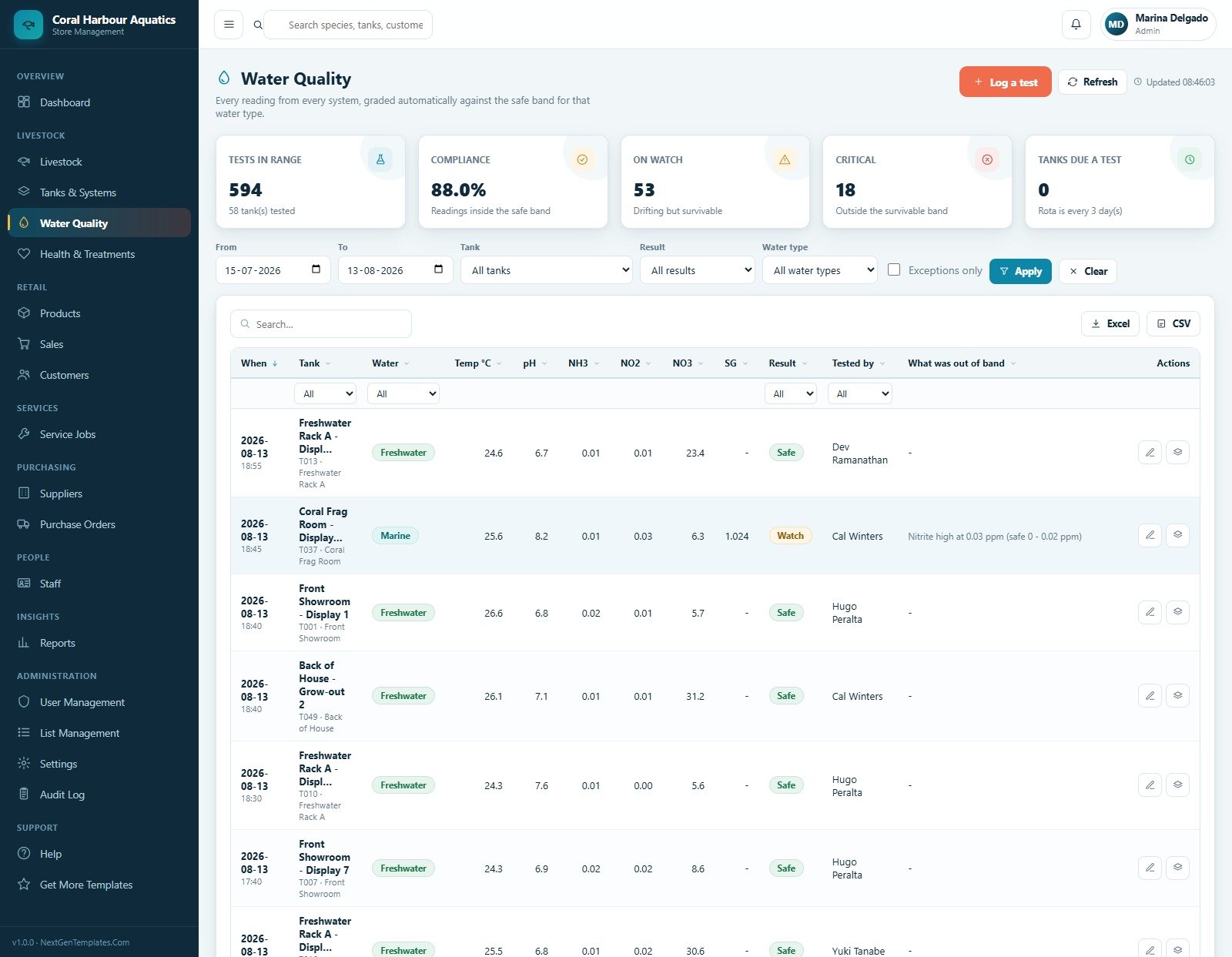
- Water test log: Record temperature, pH, NH3, NO2, NO3, SG and automatic test result grading.
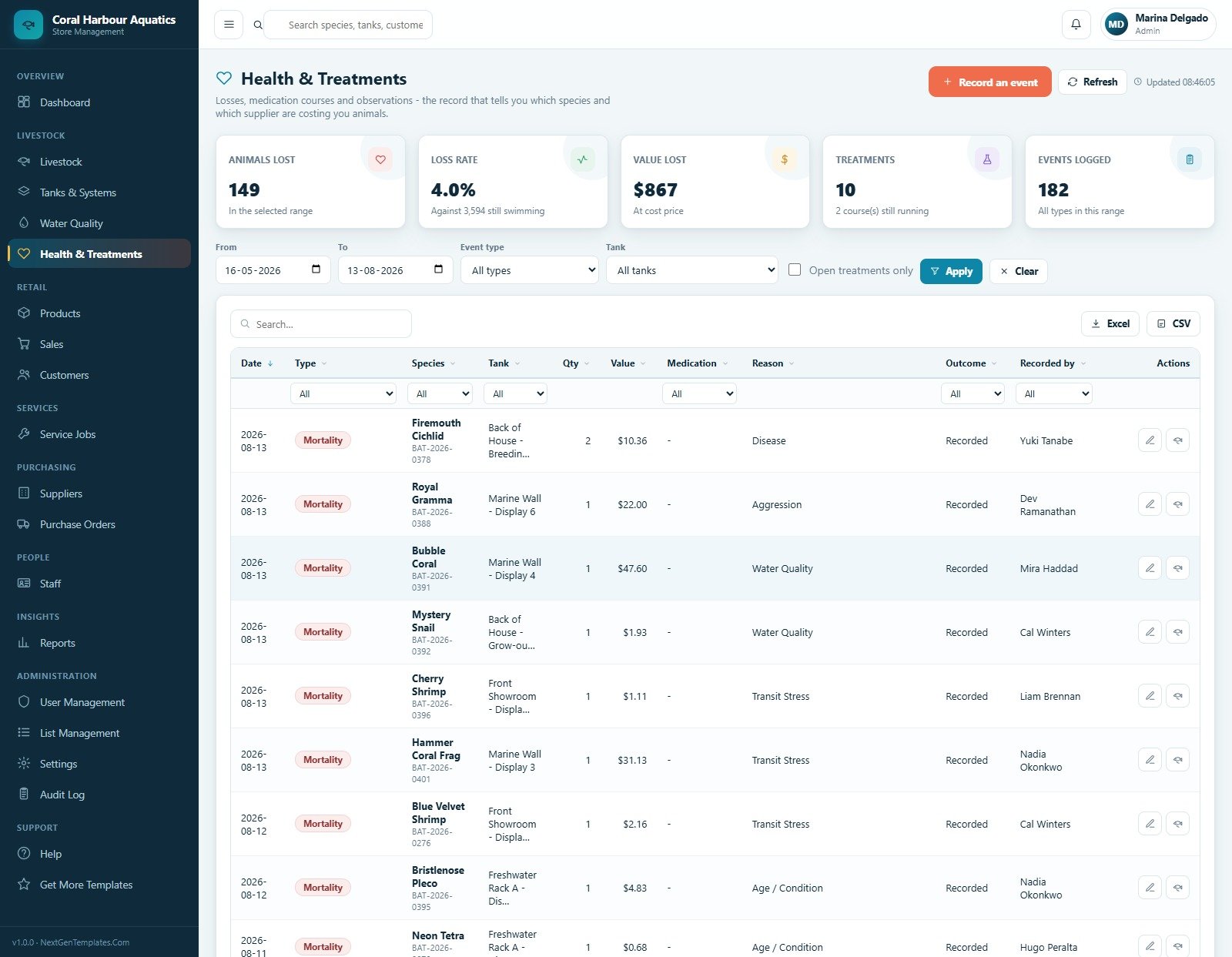
- Health and treatment events: Capture losses, medication, reasons, outcomes, open treatments and value lost.
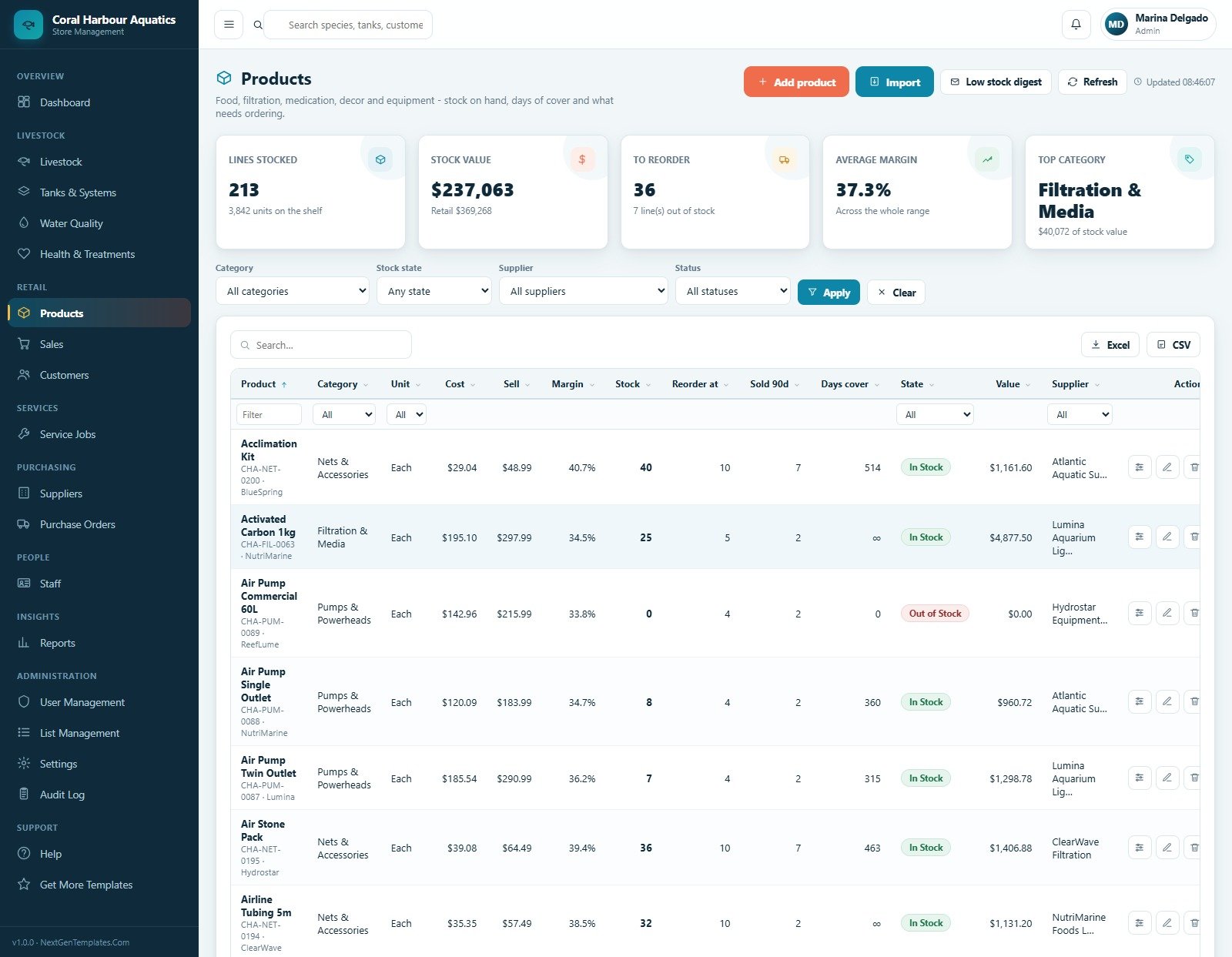
- Dry goods inventory: Track product categories, suppliers, cost, sell price, margin, reorder level and days cover.
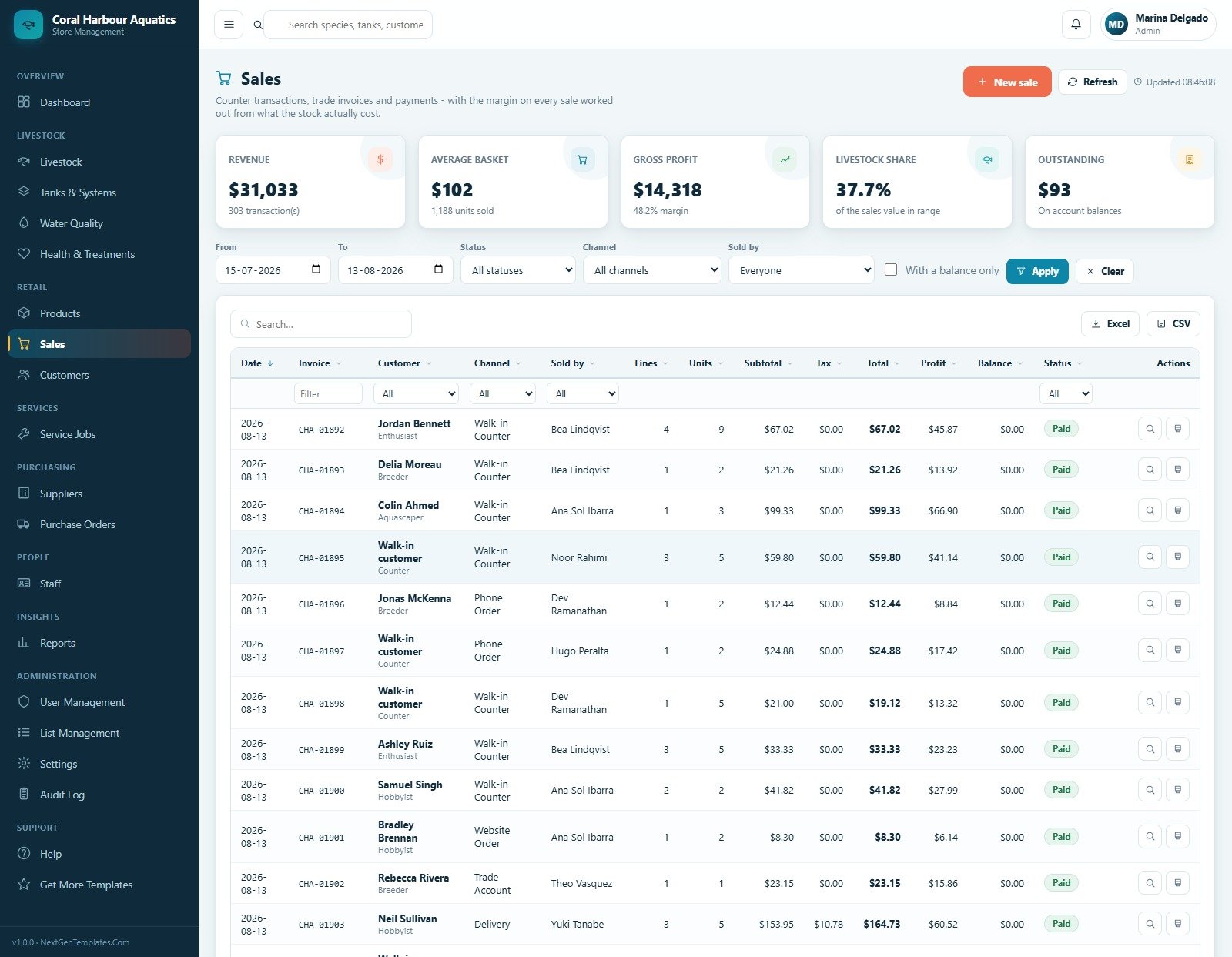
- Counter sales and receivables: Manage invoices, customers, taxes, profit, balances and receipt actions.
- Service job scheduling: Book aquarium maintenance visits, assign technicians, track labour, parts and overdue work.
- Supplier and purchase order control: Compare spend, loss rate, lead time, open orders and owed balances.
- Reports and audit trail: Use filtered reports and user activity logs to review operations and accountability.
Dashboard Pages Explanation
1. Login Page
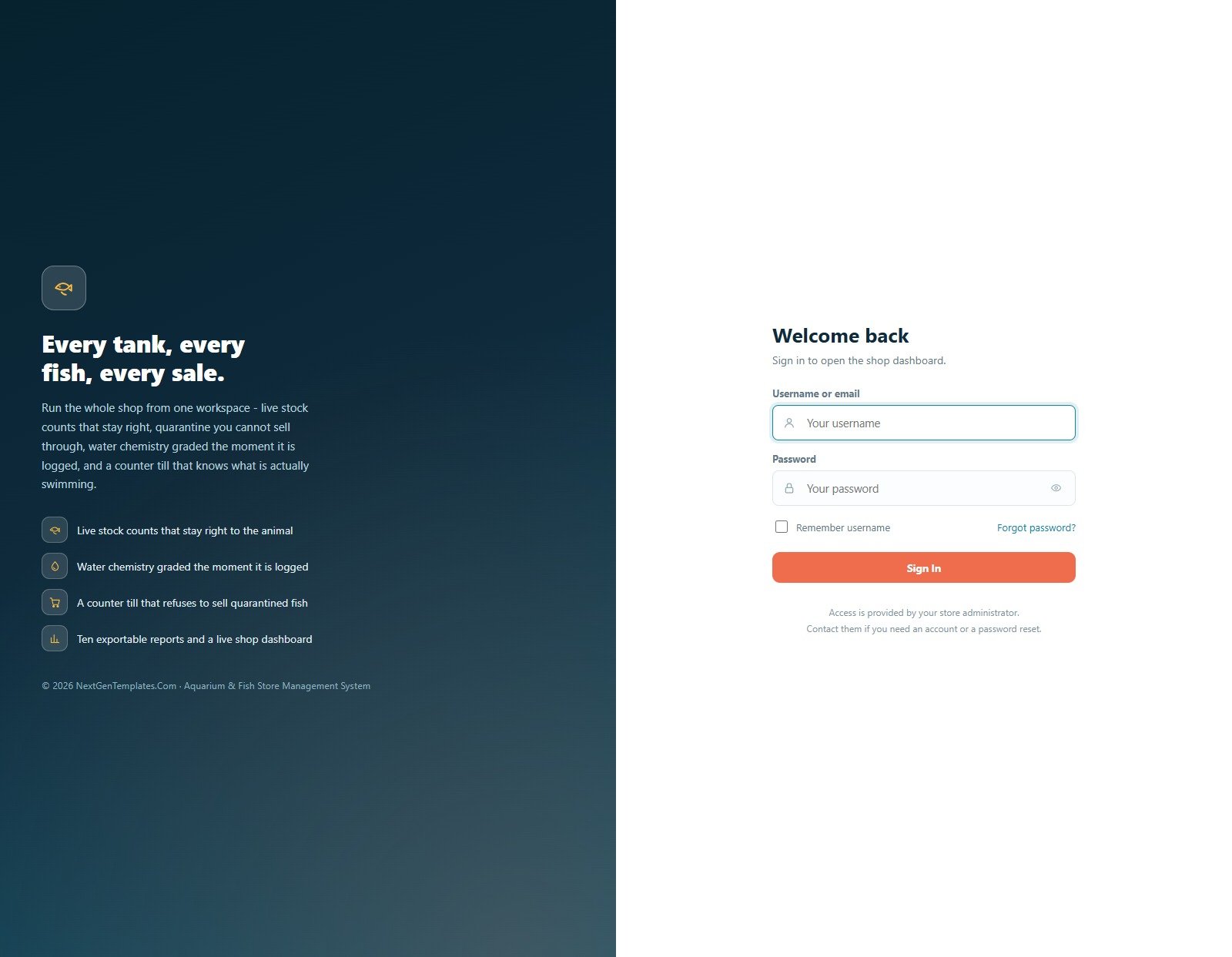
The login screen gives staff a secure entry point with username, password, remember username and forgot password options. It presents the Aquarium and Fish Store Management System branding and sets the context for live stock counts, water chemistry, quarantine controls, counter sales and exportable reports.
2. Store Dashboard
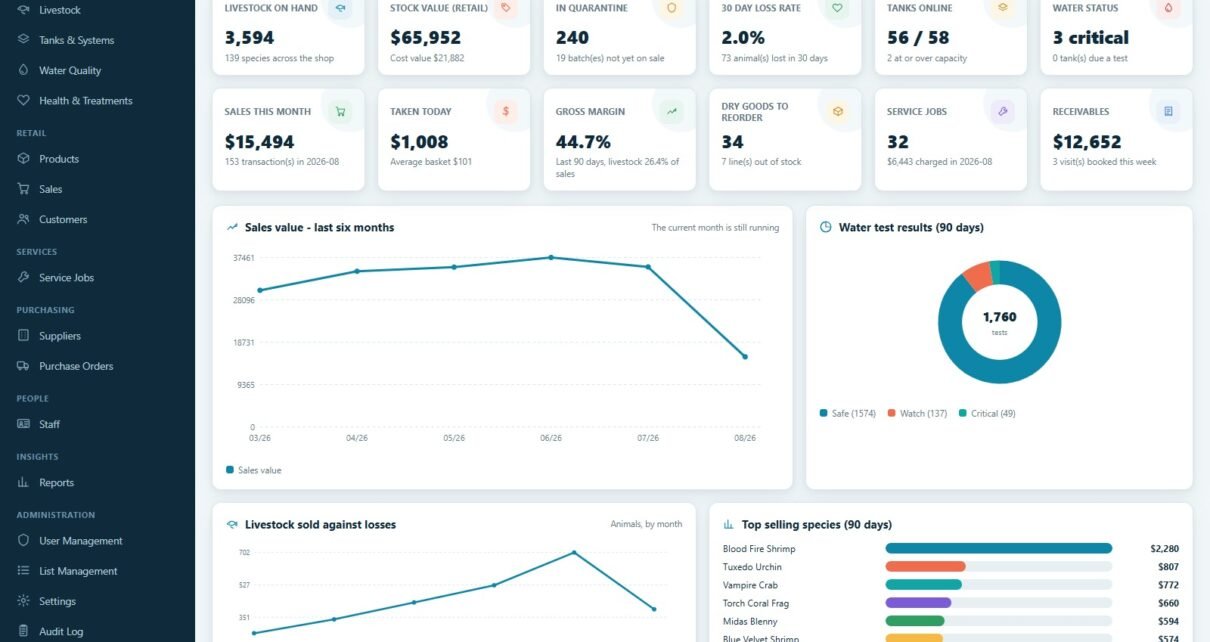
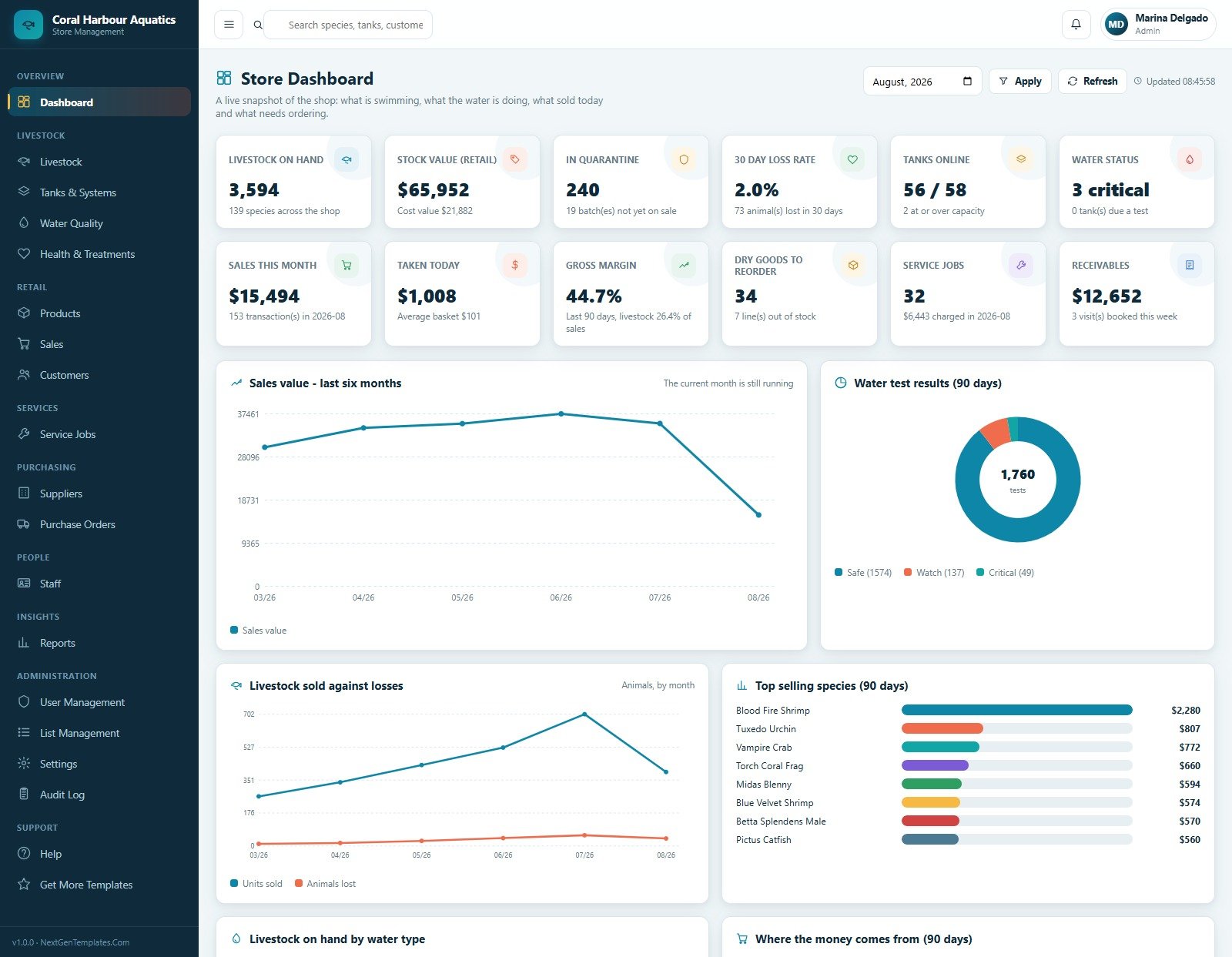
The dashboard gives owners a high-level view of livestock on hand, stock value, quarantine, 30-day loss rate, tanks online, water status, sales, gross margin, reorders, service jobs and receivables. The charts cover sales by month, water test status, livestock sold versus losses, top species, stock by water type and revenue categories.
3. Livestock
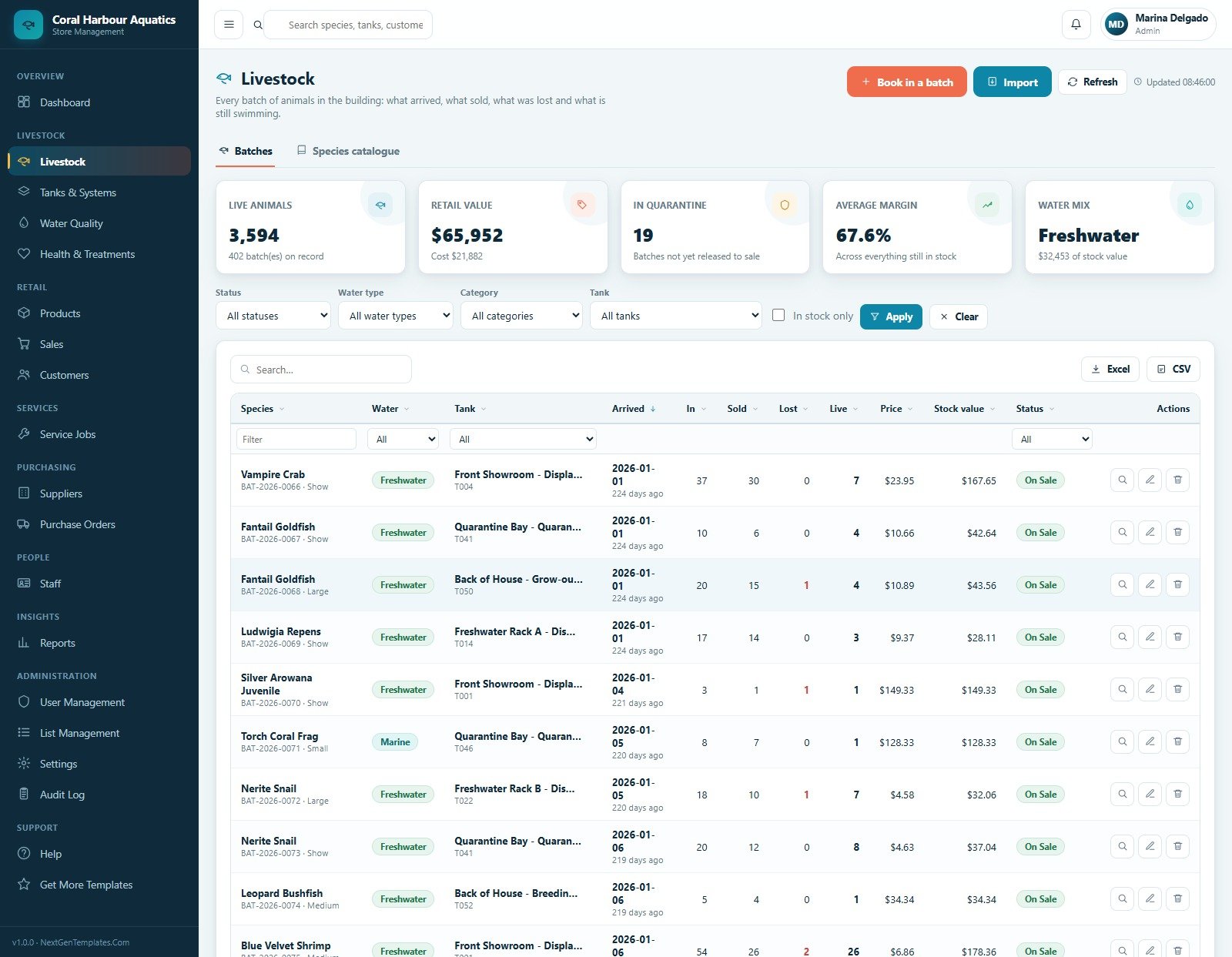
The Livestock page is the batch and species register. It tracks live animals, retail value, quarantine, margin, water mix and stock status, with filters for status, water type, category, tank and in-stock-only records.
4. Tanks and Systems
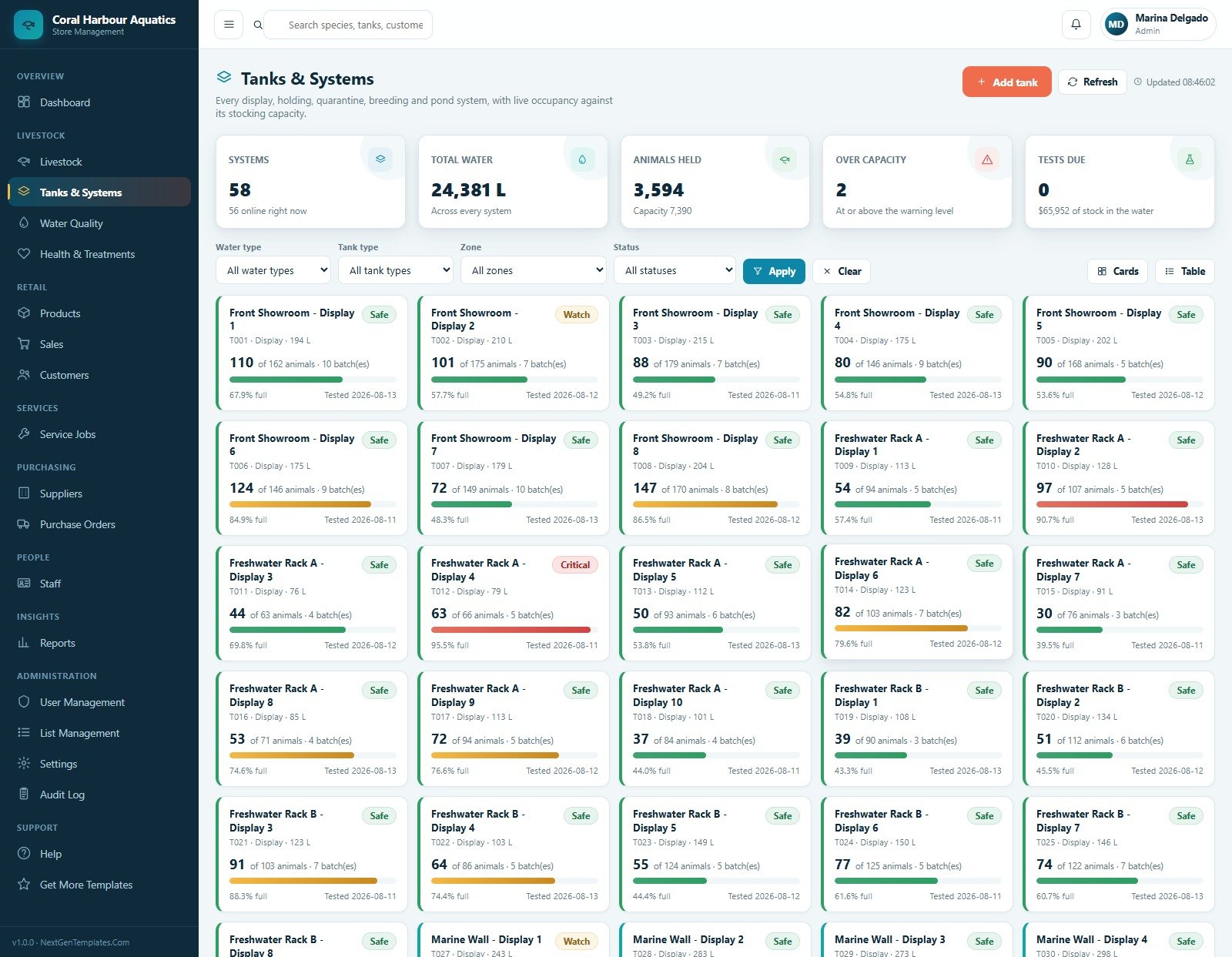
This screen helps the team monitor aquarium systems, total water, animals held, over-capacity tanks and tests due. Card and table views make it easy to review tank name, code, type, capacity, animal count, batch count, fill percentage, tested date and safety status.
5. Water Quality
The Water Quality page records water test results and grades them automatically. Filters for date range, tank, result, water type and exceptions help staff focus on out-of-band readings before livestock is affected.
6. Health and Treatments
Health and Treatments records animal losses, loss rate, value lost, treatment count and event history. The event register includes date, type, species, tank, quantity, medication, reason, outcome and recorder.
7. Products
The Products page is the dry goods inventory register. It tracks stocked lines, stock value, reorder items, margin, category, cost, selling price, stock state, supplier and days cover, with stock adjustment and low-stock digest actions.
8. Sales
The Sales screen tracks counter sales and invoice history with revenue, average basket, gross profit, livestock share and outstanding balances. Filters by date range, status, channel, seller and balance-only records make daily review faster.
9. Customers
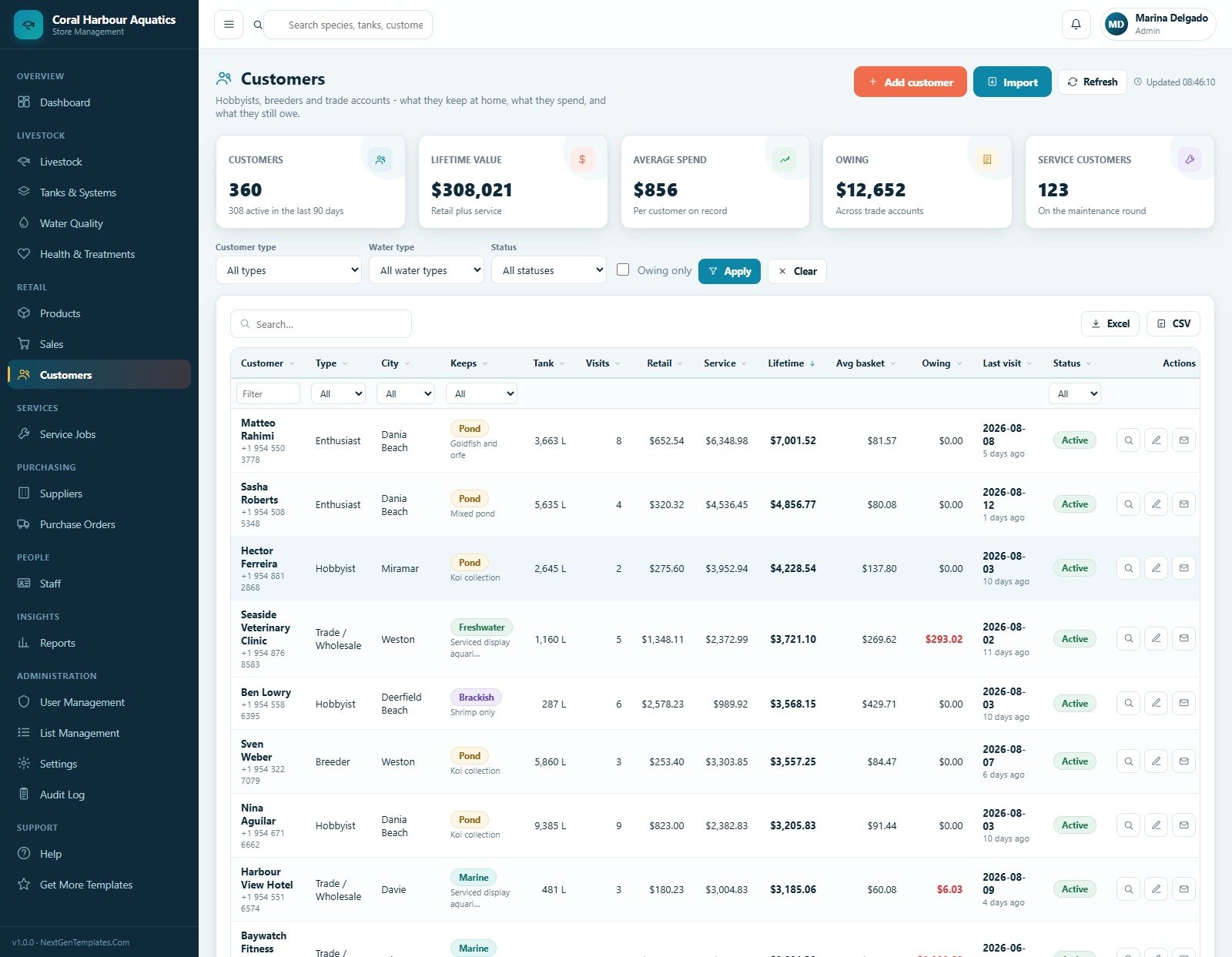
The Customers page stores customer type, city, water type kept, tank details, visits, retail spend, service spend, lifetime value, average basket, owing amount, last visit and status. It is useful for separating walk-in buyers from ongoing service customers.
10. Service Jobs
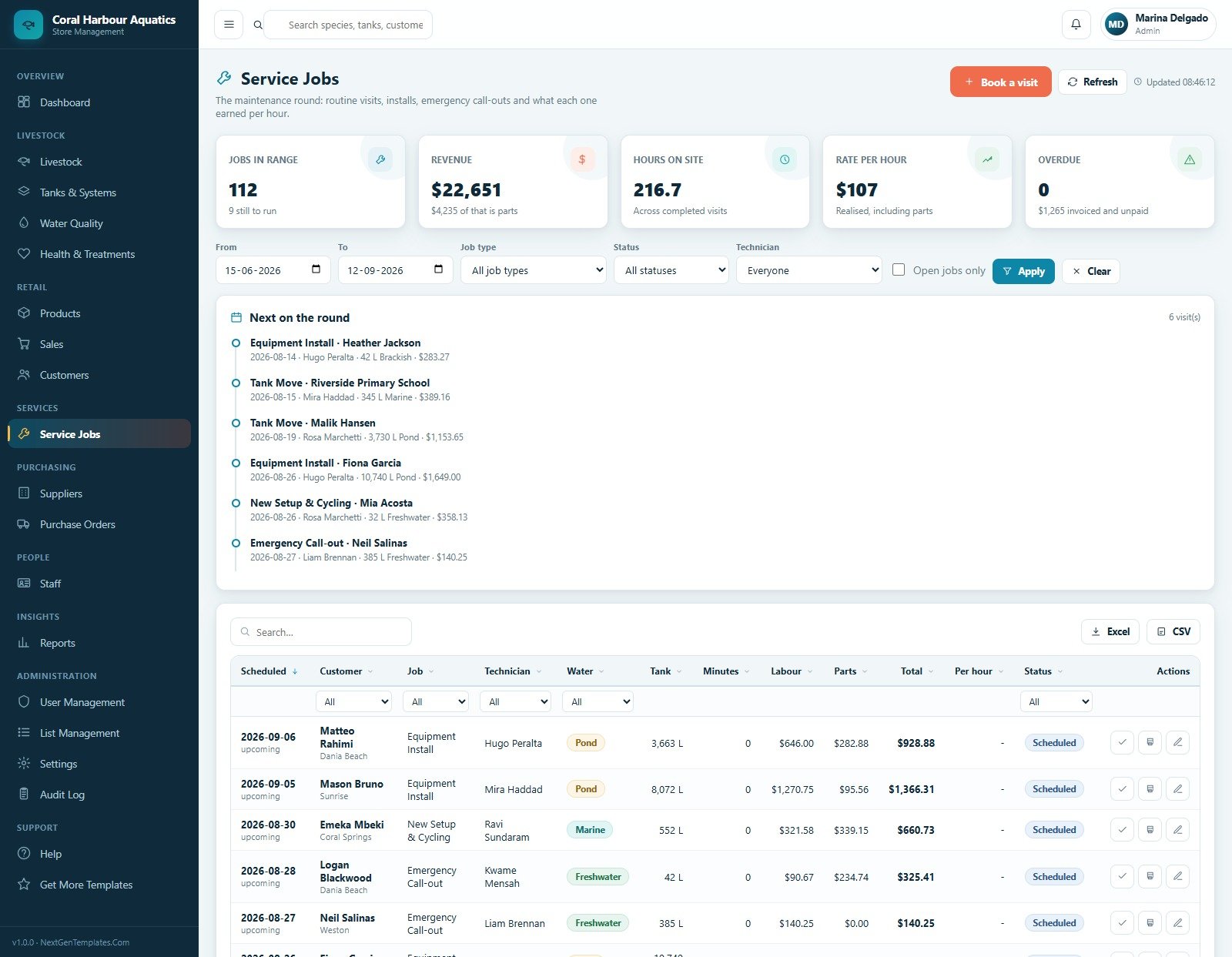
Service Jobs manages aquarium maintenance visits, upcoming visits, labour, parts, technician assignment and overdue status. The job table shows scheduled date, customer, job, technician, water, tank, minutes, labour, parts, total, hourly rate and status.
11. Suppliers
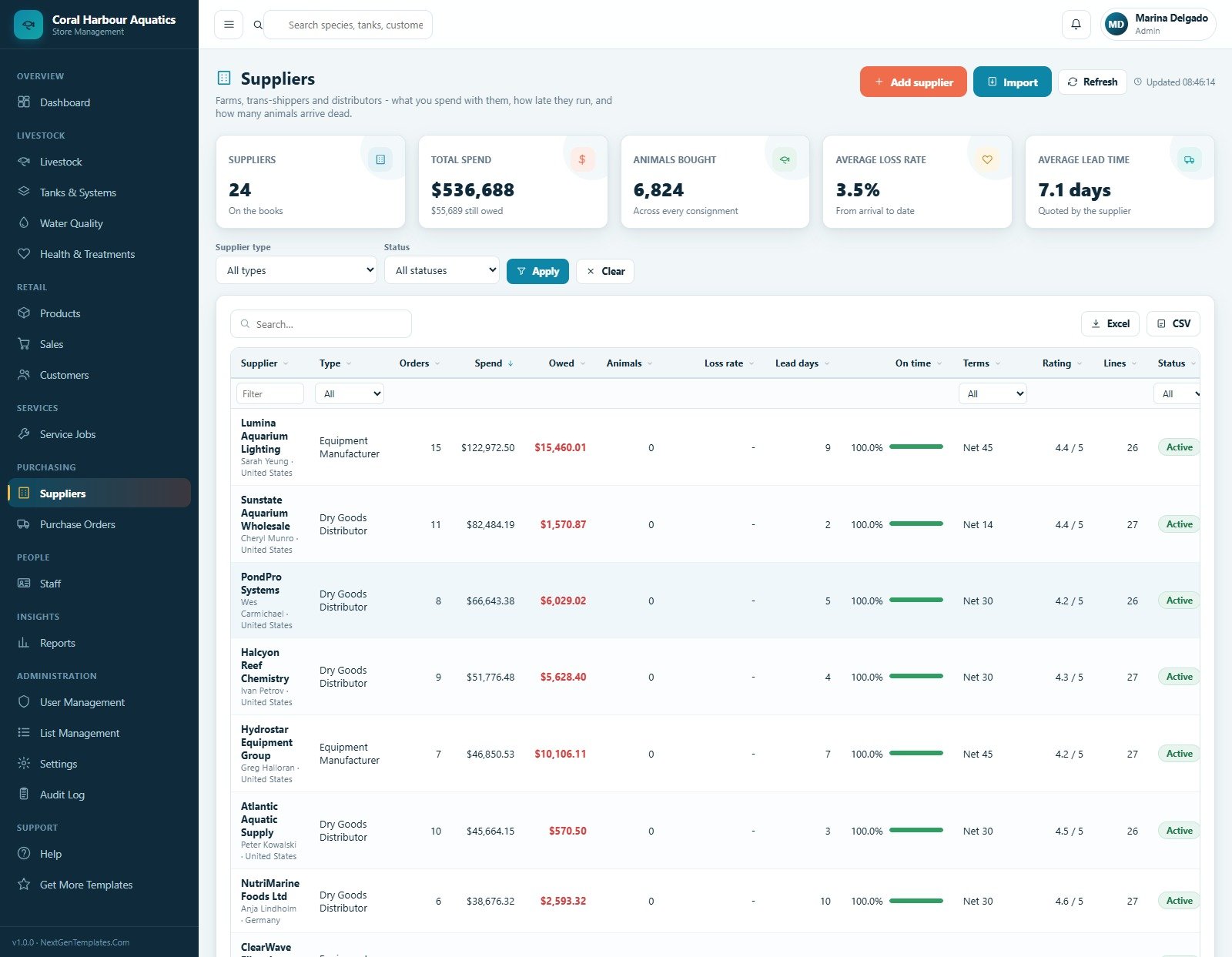
The Suppliers page compares suppliers by type, order count, spend, owed amount, animals bought, loss rate, lead days, on-time percentage, terms, rating, lines and status. This helps owners decide which suppliers are reliable for livestock and dry goods.
12. Purchase Orders
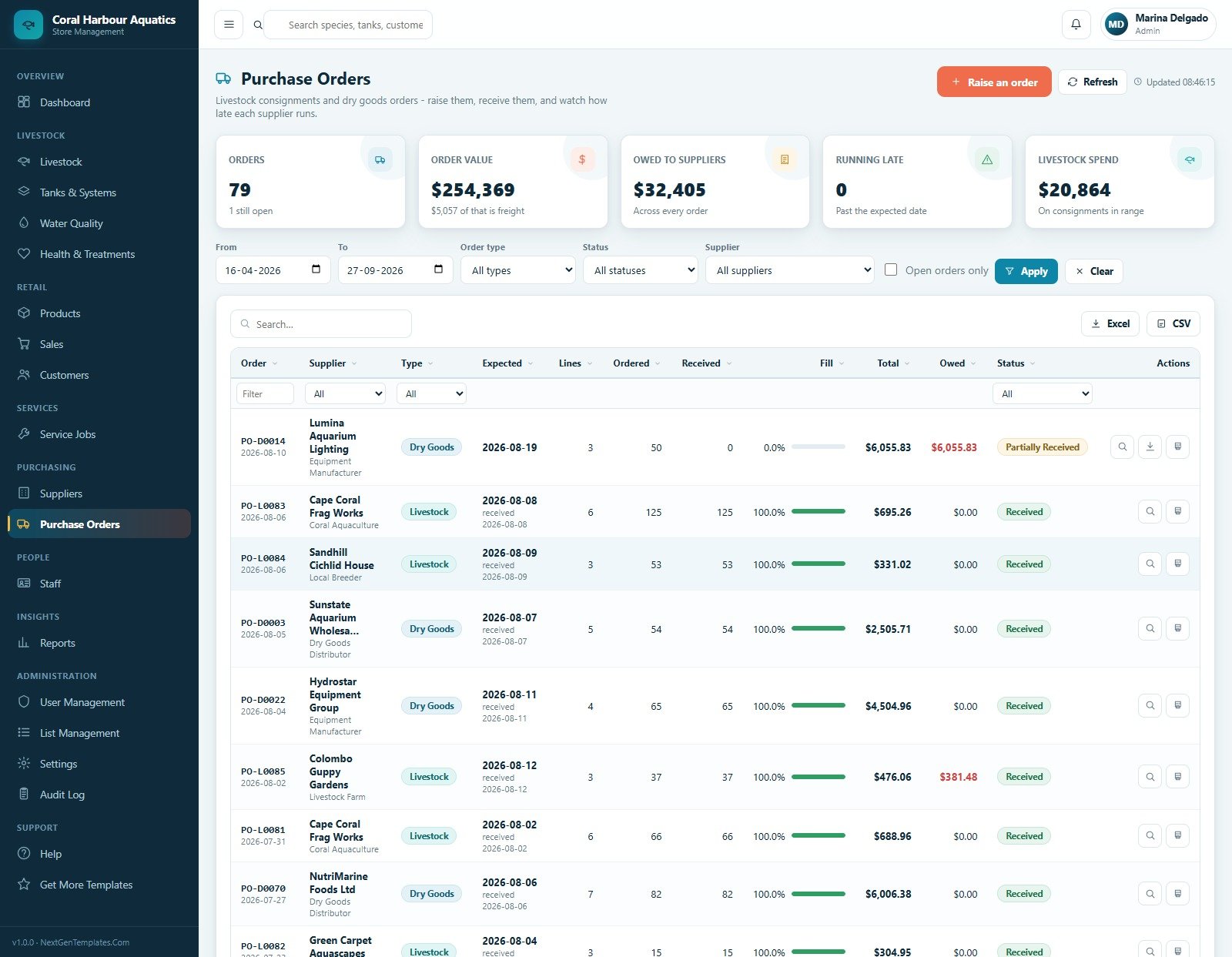
Purchase Orders tracks livestock consignments and dry goods orders with order value, supplier balance, running late orders and livestock spend. The table shows supplier, order type, expected date, lines, ordered, received, fill percentage, total, owed and status.
13. Staff
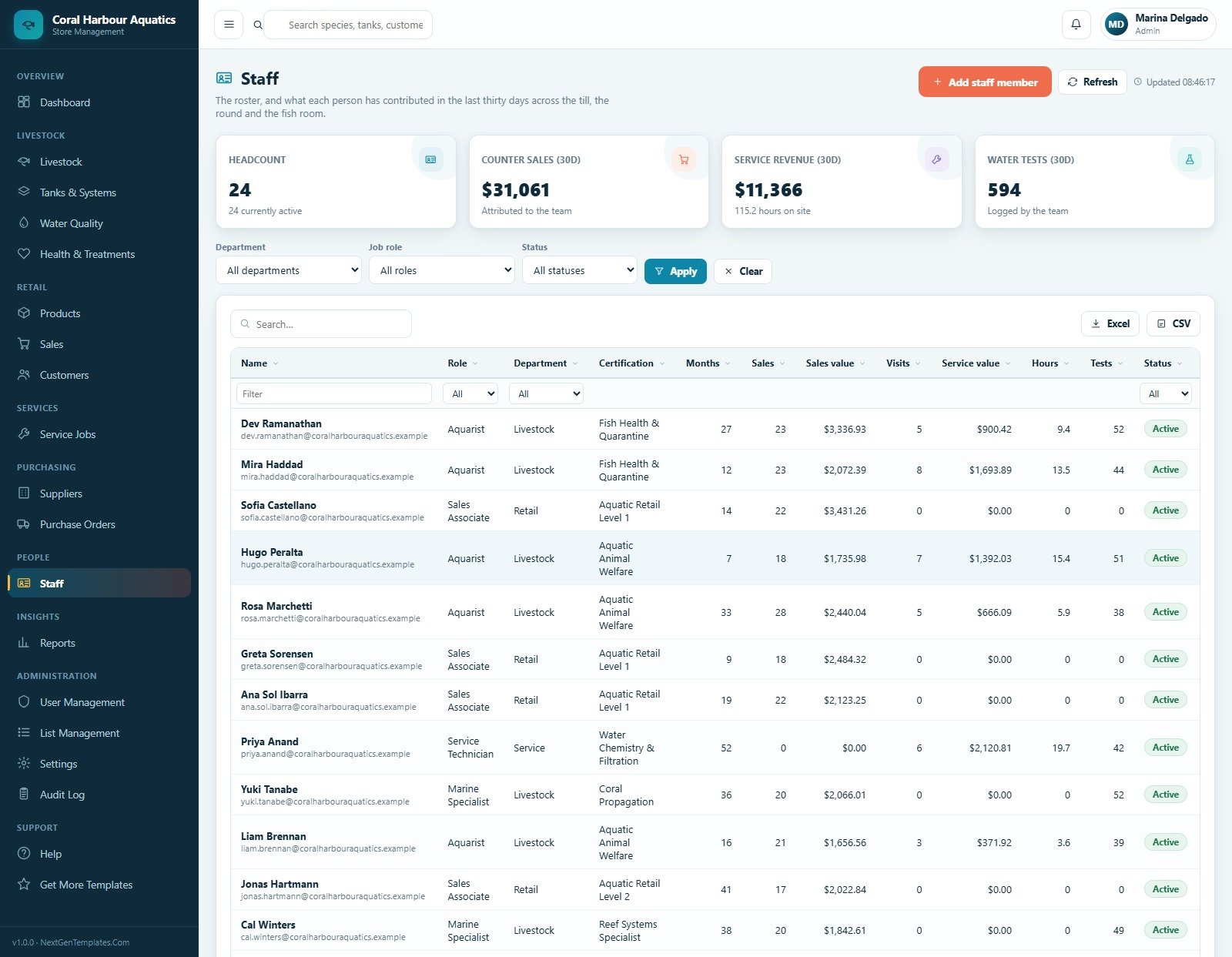
The Staff page gives a team roster and contribution register. It tracks headcount, counter sales, service revenue, water tests, certification, months, sales, visits, hours, tests and status.
14. Reports
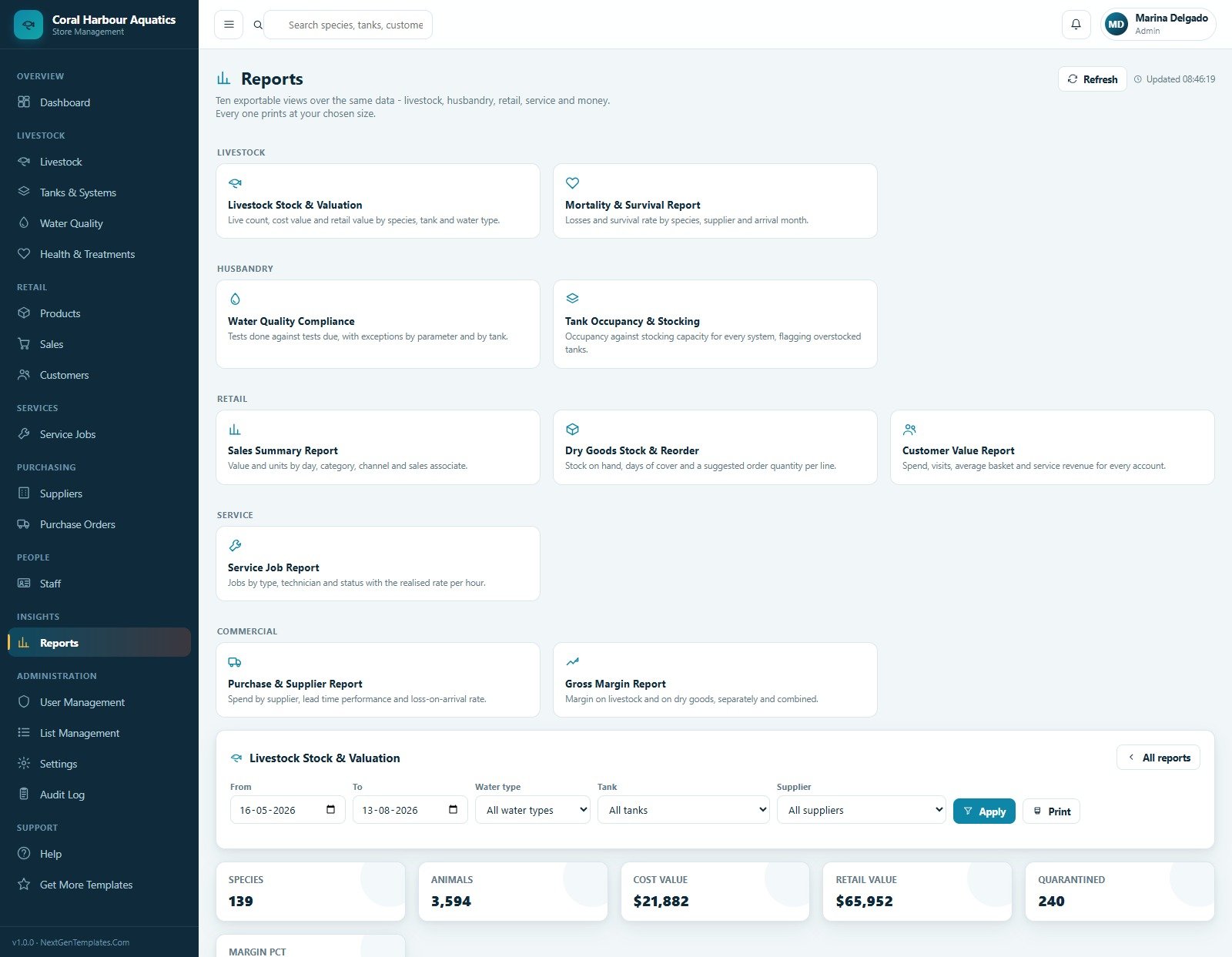
The Reports page includes livestock valuation, mortality, water compliance, tank occupancy, sales summary, dry goods reorder, customer value, service job, purchase, supplier and gross margin report views. Report filters cover date range, water type, tank and supplier.
15. User Management
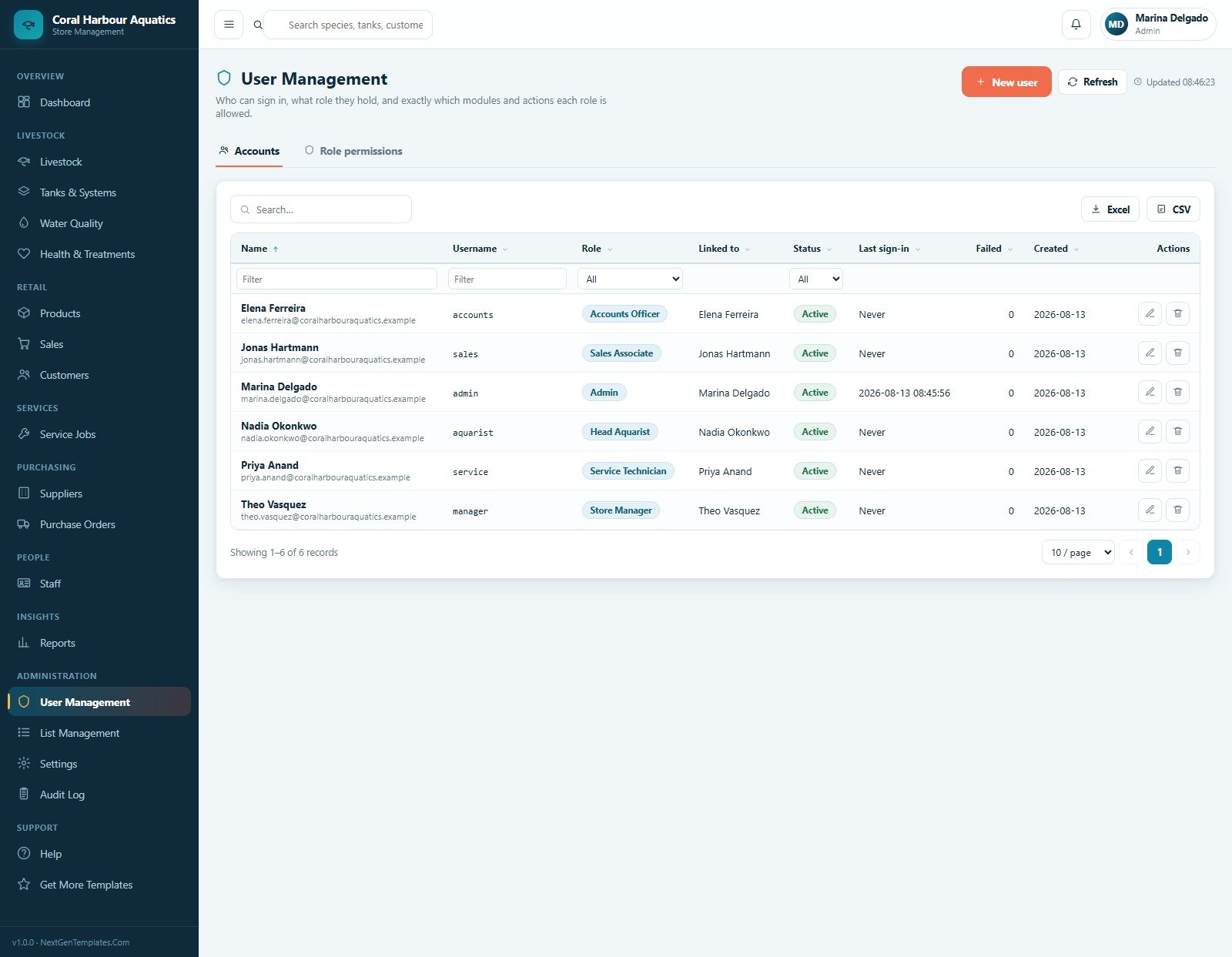
User Management controls accounts and role permissions. Roles include Accounts Officer, Sales Associate, Admin, Head Aquarist, Service Technician and Store Manager, with search, role filter, status filter, export, new user, edit and delete actions.
16. List Management
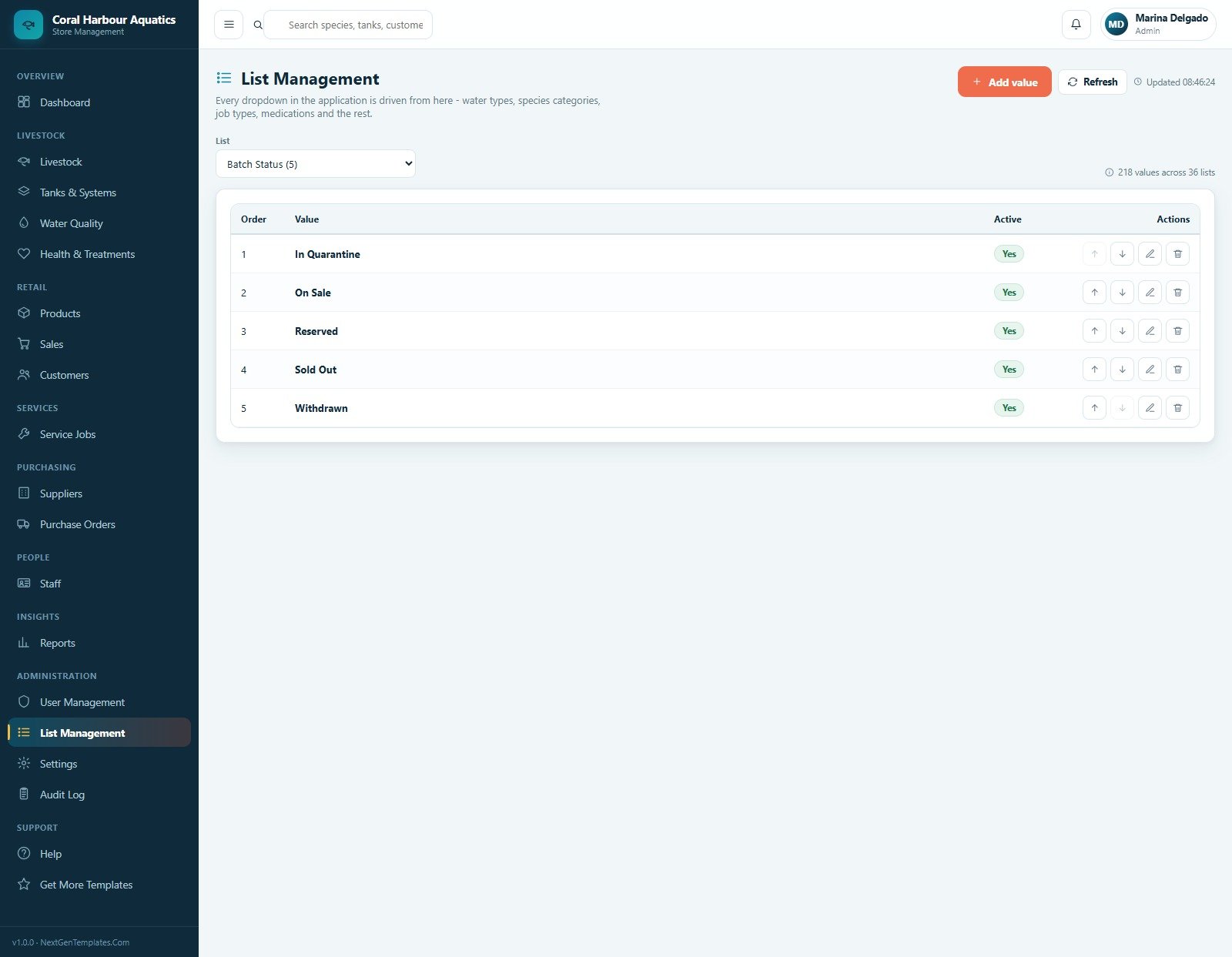
List Management controls dropdown values used across the app. The Batch Status list includes values such as In Quarantine, On Sale, Reserved, Sold Out and Withdrawn, with 218 values across 36 lists.
17. Settings
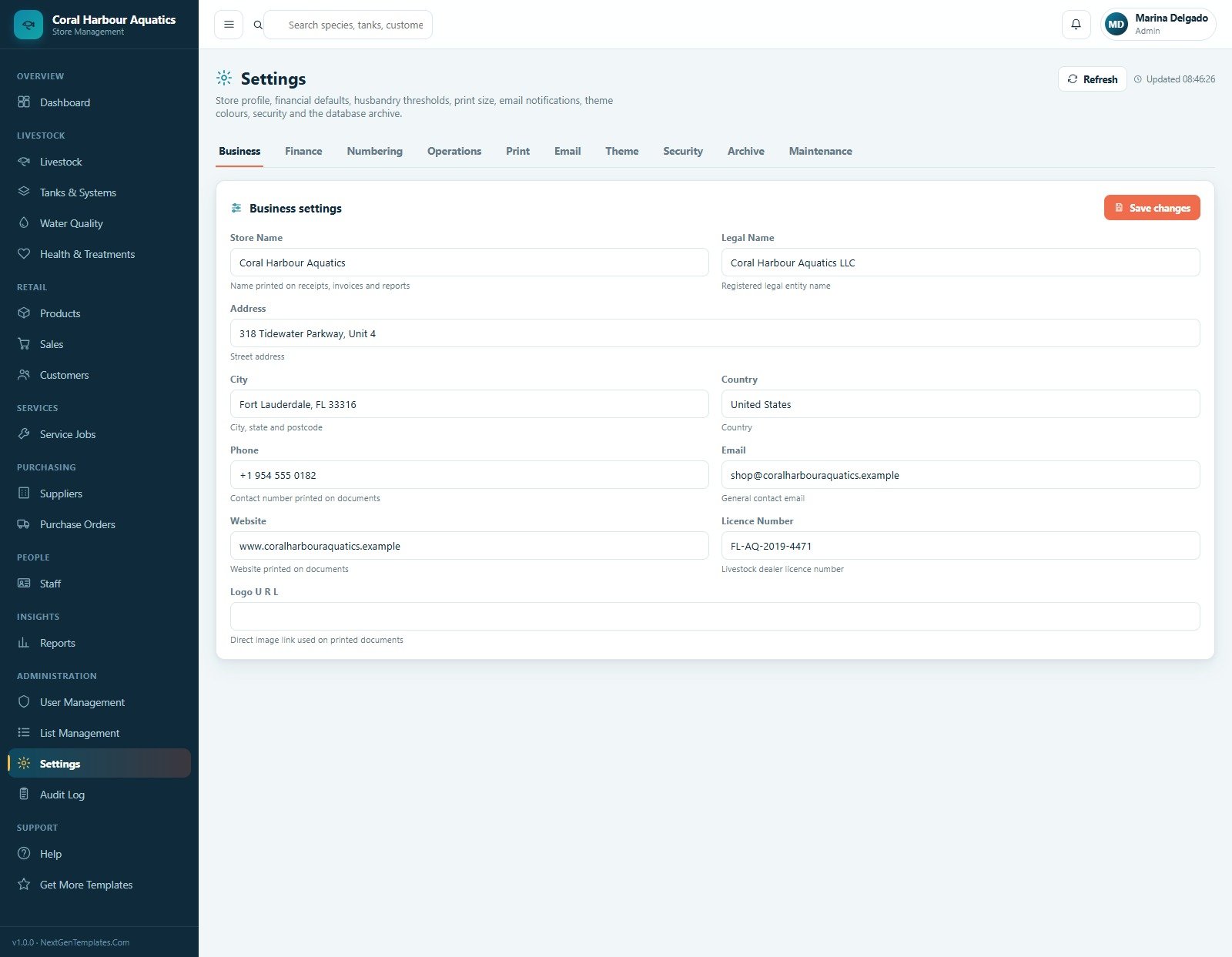
Settings manages store profile and configuration across Business, Finance, Numbering, Operations, Print, Email, Theme, Security, Archive and Maintenance. Store name, legal name, address, city, country, phone, email, website, licence number and logo URL can be maintained here.
18. Audit Log
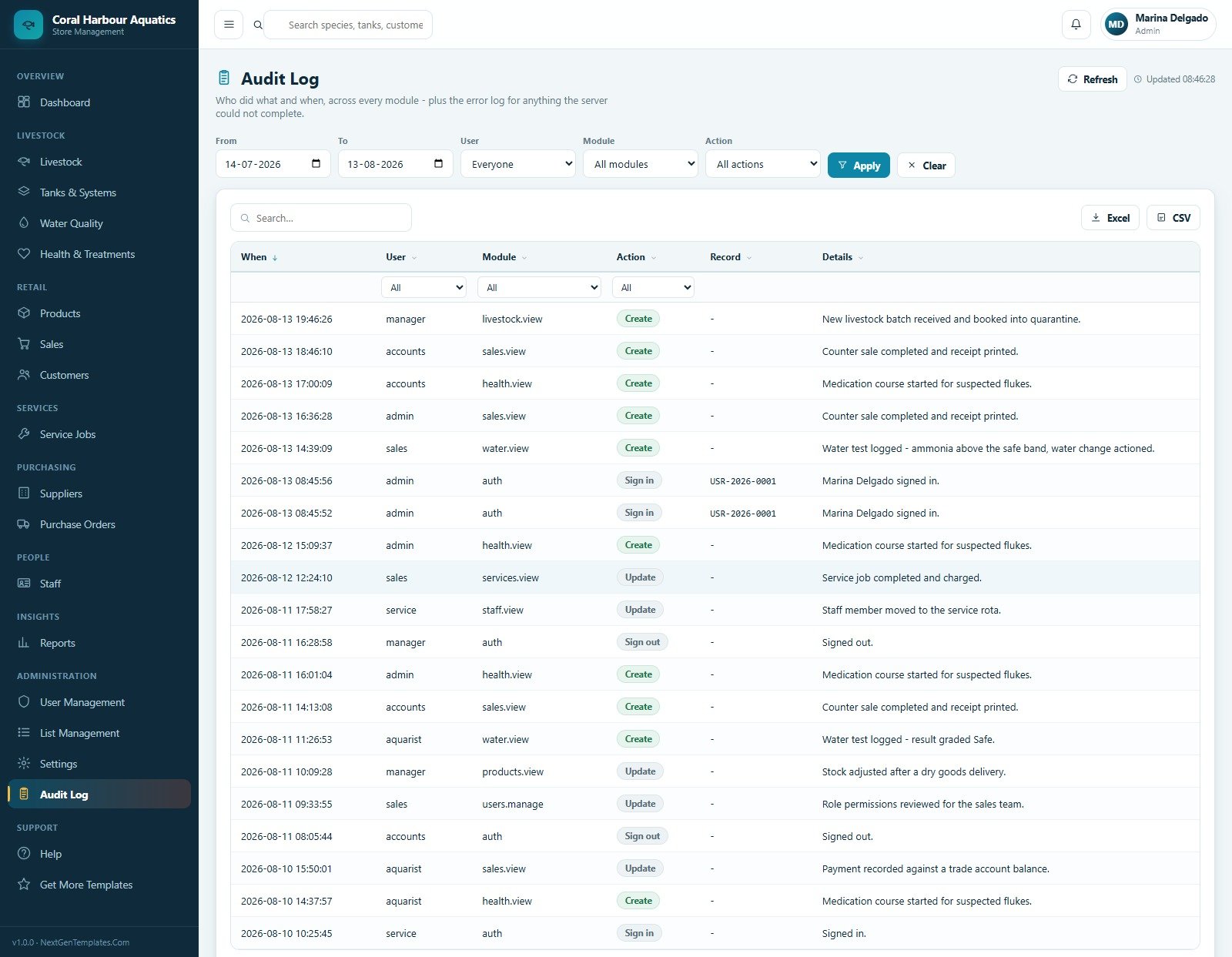
The Audit Log captures filtered activity by date range, user, module and action. It records create, update, sign-in and sign-out activity across livestock, sales, health, water, services, staff, users and authentication modules.
19. Help
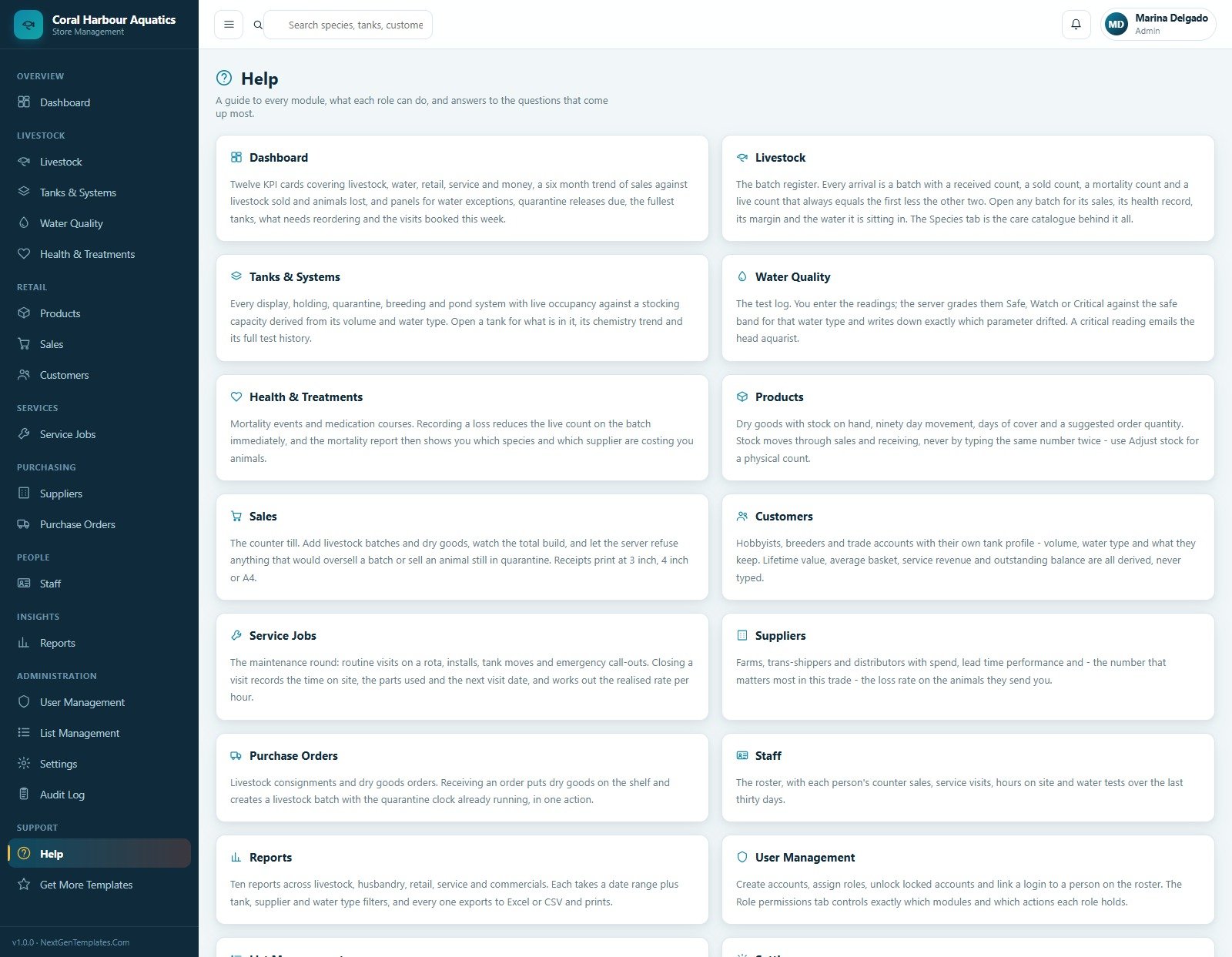
The Help page gives built-in module guidance for Dashboard, Livestock, Tanks and Systems, Water Quality, Health and Treatments, Products, Sales, Customers, Service Jobs, Suppliers, Purchase Orders, Staff, Reports and User Management.
20. Get More Templates
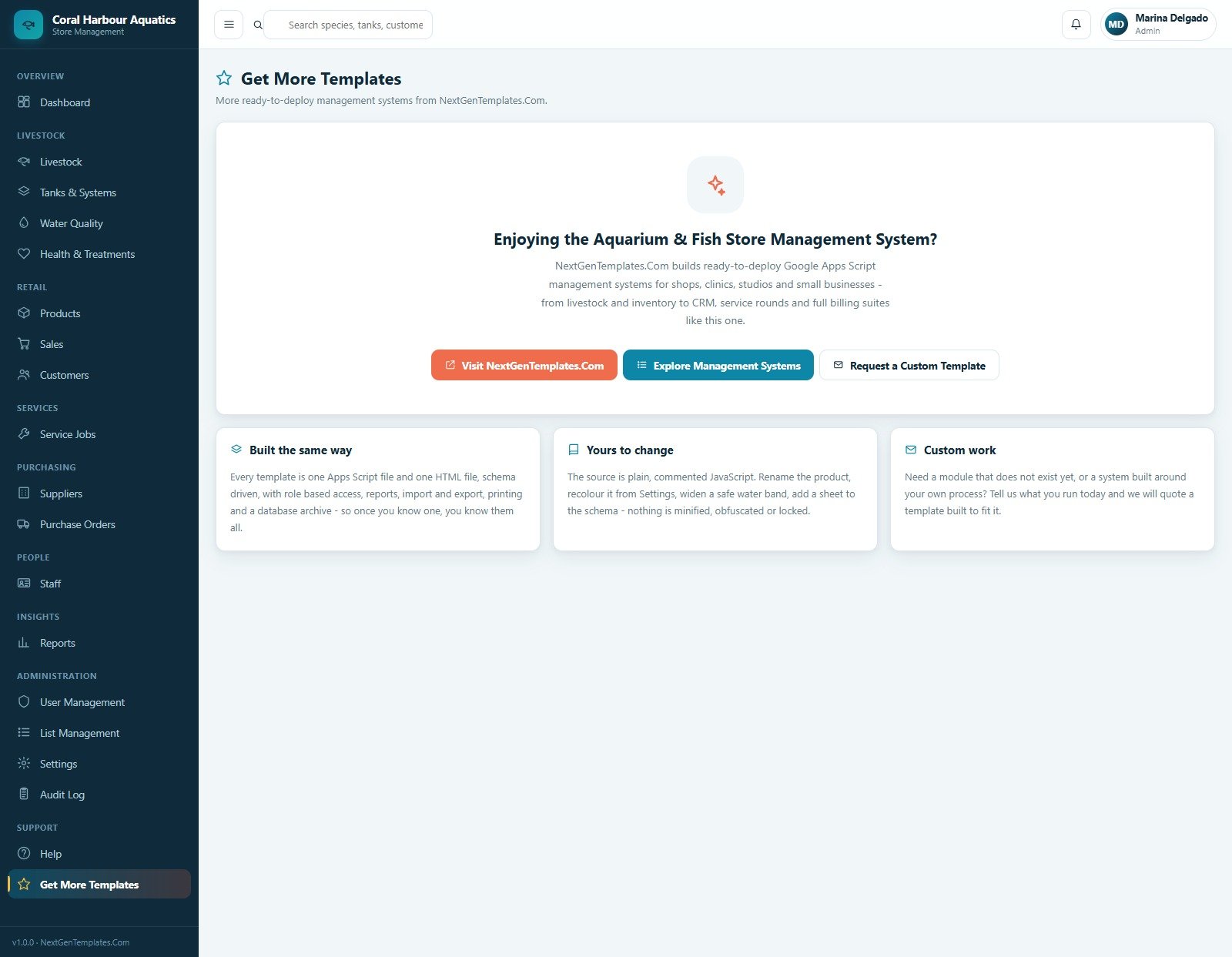
The final screen connects users to NextGenTemplates for more management systems, with buttons to visit the site, explore management systems and request a custom template. It also explains that the system is built in the same editable style.
Aquarium and Fish Store Management System Web App vs. Spreadsheet Tracker vs. Paid CRM/SaaS – Feature Comparison
| Feature | Aquarium and Fish Store Management System Web App | Spreadsheet tracker | Paid retail SaaS |
|---|---|---|---|
| Cost | One-time template purchase | Low software cost but high build time | Monthly or annual subscription |
| Platform | Browser-based web app style system | Workbook or shared sheet | Vendor-hosted platform |
| Setup time | Start from 20 prepared screens | Build tabs, formulas, forms and charts yourself | Plan setup, imports and onboarding |
| Real-time team collaboration | Role-based workflow after deployment | Limited by file permissions | Usually supported by plan |
| Mobile access | Modern browser access after deployment | Depends on spreadsheet layout | Usually available |
| Customizable fields | Dropdown lists, settings and source structure can be edited | Highly editable but fragile | Limited by vendor configuration |
| Share with link | Possible through the deployed web app | Possible through file sharing | Usually account based |
| Year-1 cost at 5 users | Template cost before any workspace or deployment costs | Template plus internal build time | Can increase with seats and add-ons |
| Aquarium livestock workflow | Included with quarantine, tanks, losses and treatments | Requires custom design | Often not included in generic retail plans |
| Water quality control | Included with test log and result grading | Requires custom table and rules | Usually requires a specialized add-on |
Who Should Use This Template
This template is a strong fit for aquarium shop owners, fish store managers, aquatic pet retailers, pond supply shops and aquarium maintenance providers that need a practical operational system without starting from a blank spreadsheet.
It is also useful for teams that sell both live animals and dry goods, because it separates livestock risk from standard retail stock. A shop can manage quarantine, tank testing and treatment events while still tracking product margin, purchase orders, invoices and receivables.
It is less suitable for businesses that need integrated payment gateways, barcode hardware, accounting API sync, branch-level ERP workflows, vendor-hosted infrastructure or enterprise compliance controls from day one.
Real-World Use Cases
Independent Aquarium Retailer
An owner reviews dashboard KPIs each morning, checks tanks due for water tests, identifies dry goods to reorder and follows receivables before the store opens.
Head Aquarist
The aquarist logs arrivals, quarantines new stock, monitors pH and ammonia readings, records losses and treatments, and uses the reports to understand which tanks or species need closer attention.
Aquarium Service Business
A service coordinator schedules maintenance visits, assigns technicians, invoices service jobs and tracks customer tank details alongside retail purchases and customer balances.
Advantages of Aquarium and Fish Store Management System Web App
- It reflects aquarium-specific work instead of only generic retail sales.
- It keeps livestock, water quality, treatments, service jobs and dry goods in one connected structure.
- It gives owners a fast dashboard for daily decisions.
- It supports role-based access for store managers, head aquarists, service technicians, sales staff and accounts users.
- It includes exportable reports and an audit log, which makes reviews easier.
- It avoids a recurring software subscription for businesses that prefer a one-time template purchase.
Opportunities for Improvement
The template is a prepared management system, but every business has local rules. A store may want to connect barcode scanners, automate payment collection, add accounting software sync, create custom print formats, or change the treatment workflow for local operating standards. Those are sensible customizations after the base process is stable.
Teams should also review user permissions before live use. Any app that includes sales, supplier balances, staff records and audit trails should have clean roles from the beginning.
Best Practices
- Set up tanks, species, products, suppliers and dropdown lists before entering daily transactions.
- Use consistent species naming so livestock reports stay clean.
- Log water tests on a fixed schedule and review exception filters daily.
- Record livestock losses and treatment events immediately, not at month-end.
- Review low-stock dry goods and purchase orders weekly.
- Keep user roles tight, especially for settings, list management and audit access.
- Export reports regularly for management review and backup discipline.
Explore Relevant Templates
You can view the product page here: Aquarium and Fish Store Management System Web App.
Related templates include the General Store POS Web App, Service Center and Repair Shop Management System Web App, Auto Parts Inventory Management System Web App and Aquatic Pet Stores Dashboard in Power BI.
Planning to move your shop records out of paper registers? The NextGenTemplates Academy learning paths cover the spreadsheet and data skills behind systems like this, with practice files.
Get the Aquarium and Fish Store Management System Web App
Frequently Asked Questions
What is the Aquarium and Fish Store Management System Web App?
It is a 20-screen web app template for aquarium and fish store operations, covering livestock, tanks, water quality, treatments, products, sales, customers, service jobs, suppliers, purchase orders, staff, reports, users, settings and audit logs.
Does it track aquarium livestock?
Yes. The Livestock page tracks species, water type, tank, arrival date, quantity in, sold, lost, live count, price, stock value and status.
Can it help with water testing?
Yes. The Water Quality module records tank test results, grades readings, and allows filters for date range, tank, result, water type and exceptions.
Does it include sales and invoices?
Yes. The Sales page tracks invoices, customers, channels, sellers, items, tax, total, profit, balance and status, with new sale, view, receipt, export and refresh actions.
Can it manage aquarium service visits?
Yes. The Service Jobs page tracks scheduled visits, customer, job type, technician, water type, tank, minutes, labour, parts, total, hourly rate and status.
Is it suitable for a large retail chain?
It is better suited to small and mid-sized aquarium retailers and service businesses. Large chains may need custom integrations, accounting sync, payment gateway automation, multi-branch controls and formal vendor compliance.
Is this a subscription product?
No. It is positioned as a one-time downloadable template product. You may still have your own deployment, Google account, customization or workspace costs.
About the Author
Built by PK – Microsoft Certified Professional with 15+ years of Excel, Google Sheets, and Power BI experience. Founder of NextGenTemplates, reaching 300K+ subscribers across YouTube channels. Every template is hand-built and tested before release.
Conclusion
The Aquarium and Fish Store Management System Web App brings the special workflow of an aquarium business into one prepared system: live stock, quarantine, tank safety, water chemistry, treatments, retail products, sales, service jobs and reports. For a business that has outgrown paper registers or disconnected spreadsheets, it gives a much clearer starting point than building every screen from scratch.