The Chiropractic Clinic Management System Web App brings 20 connected modules into a single Google Apps Script application backed by your own Google Sheet. It surfaces 8 dashboard KPIs, records SOAP visit notes with before-and-after pain scores, and automatically deducts visit credits from patient packages when an invoice is raised. Setup takes roughly 10 minutes and needs no coding.
Most small chiropractic practices run on a mix of a paper diary, a shared spreadsheet and a receipt book. That works until two practitioners double-book the same slot, a patient’s 10-visit package quietly runs out, or a month-end collection figure has to be rebuilt by hand. This chiropractic clinic software in Google Sheets closes those gaps by keeping scheduling, clinical notes, packages and money in one place — without a per-seat monthly subscription.
Get the Chiropractic Clinic Management System Web App
🚀 Try the Live Demo Before You Buy
We have deployed this web app in our own Google account so you can test every page, every role — with real sample data — before purchasing. No signup, no email required.
🔑 Test Login Credentials
Sign in as admin to explore full system access, or try any of the role-specific logins below — Doctor, Receptionist, Therapist, or Accountant — to see exactly what each staff role sees and can do.
💡 What you get after purchase: The full source code (Code.gs + Index.html) plus a step-by-step deployment guide so you can deploy your own private instance in your own Google account in under 15 minutes.
Key Features of the Chiropractic Clinic Management System Web App
- 20 modules in one app — login, dashboard, patients, appointments, intake and assessment, visit notes, treatment plans, packages and visit credits, services and fee schedule, products and inventory, billing, payments, insurance, staff, expenses, reports, users, lists, settings and audit log.
- Three scheduling views — Day, Week and List, each with conflict checking, a waitlist, and seven booking statuses from Scheduled through to No-Show.
- SOAP notes with measurable outcomes — techniques applied, spinal regions treated, and a before score, after score and change on every visit.
- Package credits that deduct themselves — sell a package once, and each billed visit reduces the balance, with alerts at 2 credits or fewer and 30 days to expiry.
- One invoice for three revenue types — services, retail products and package redemptions can sit on the same bill with discount, tax and running balance.
- Insurance ageing at a glance — claim amount, approved amount, patient payable and days outstanding on every claim record.
- Role-based access plus a read-only audit log — every sign-in, edit, deletion and settings change is stored with its old and new value.
- Runs on your own Google account — the data never leaves a Google Sheet you own, and the app opens in any browser on desktop, tablet or phone.
Screens Explanation
Login Page
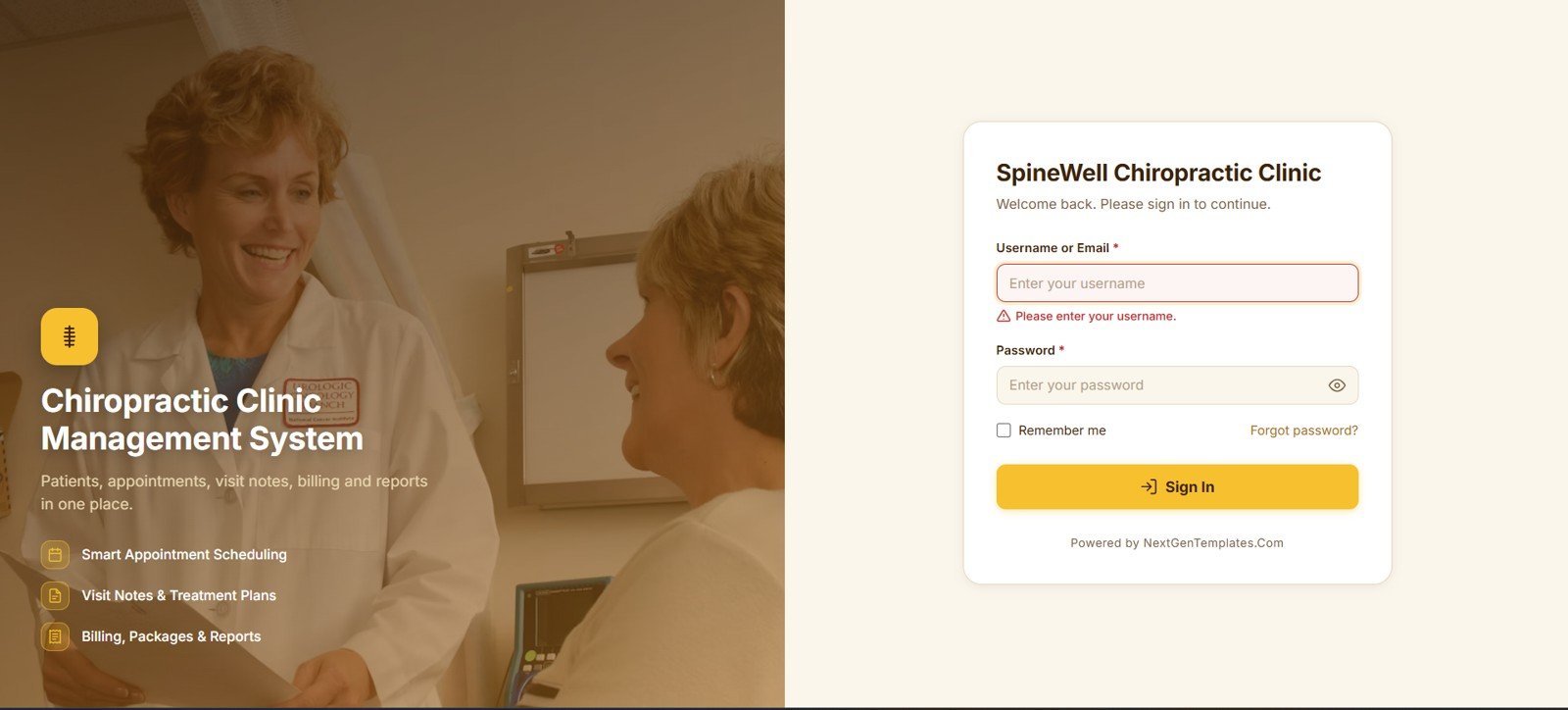
Staff sign in with a username or email and password, with Remember Me and Forgot Password options. The panel alongside sets out the three things the app is built around: smart appointment scheduling, visit notes and treatment plans, and billing, packages and reports.
Dashboard
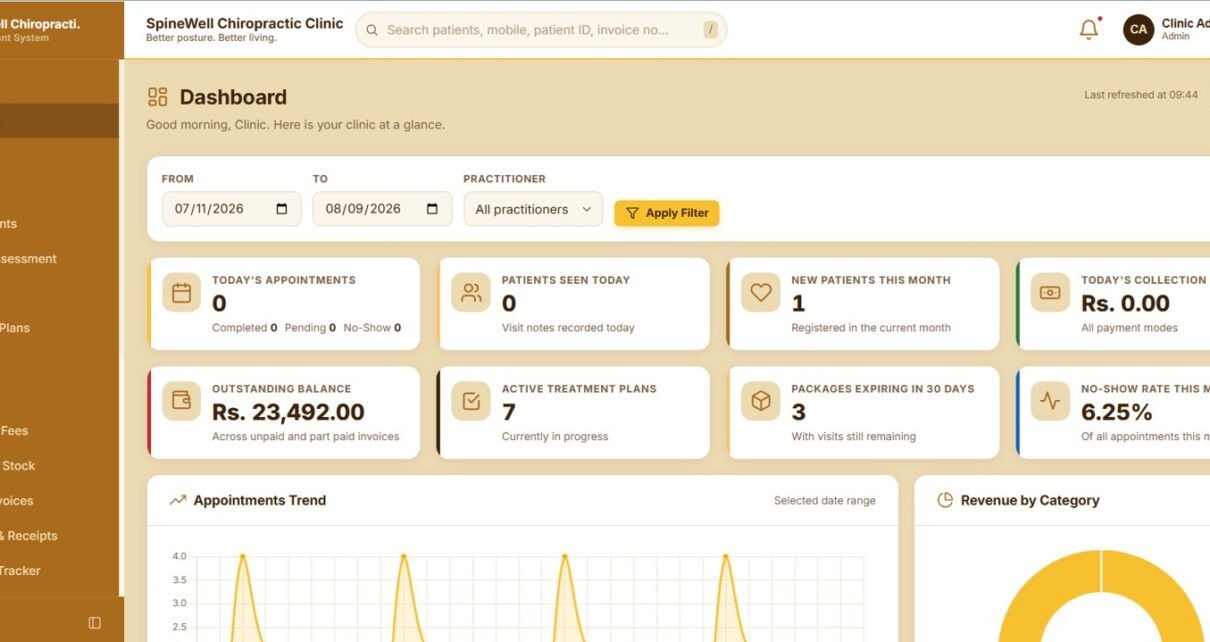
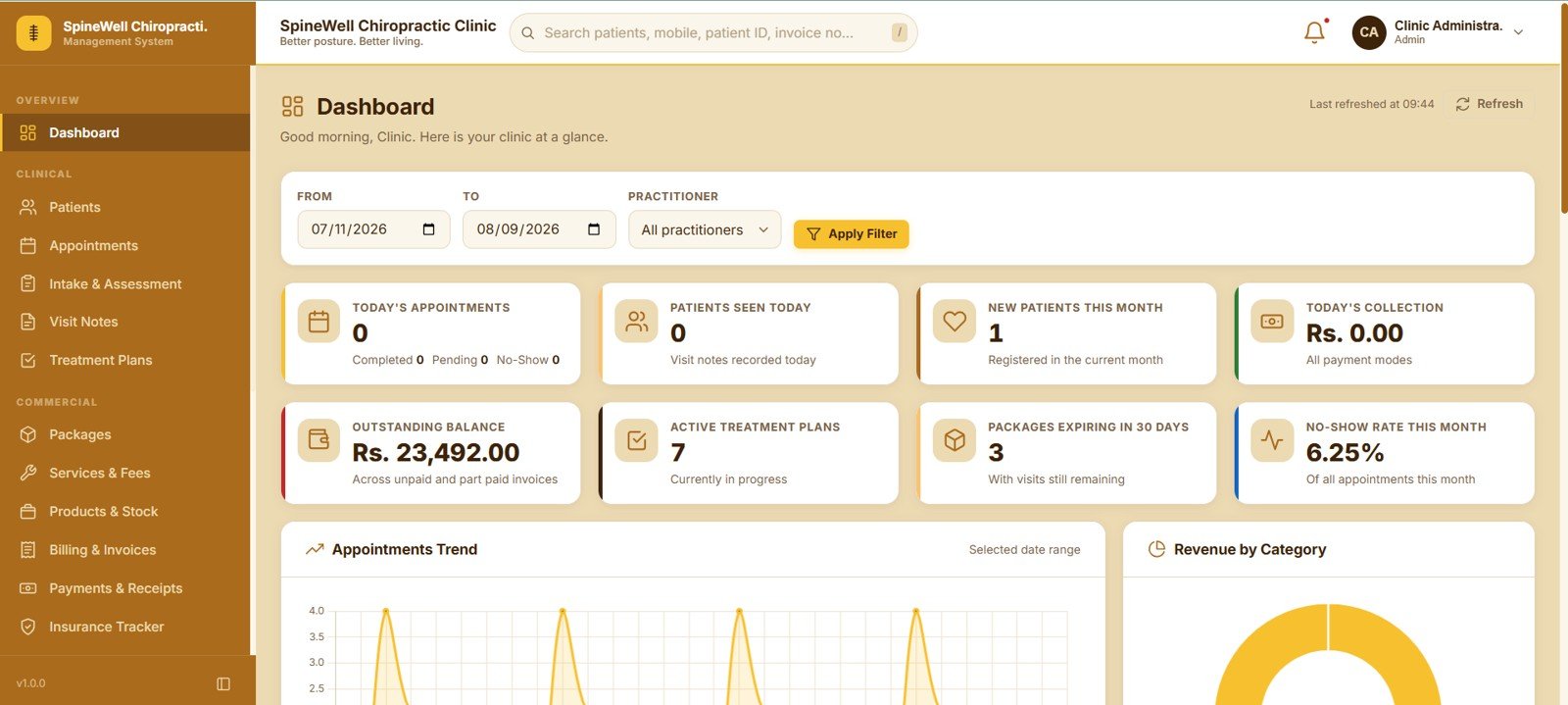
Eight cards summarise the clinic day: Today’s Appointments, Patients Seen Today, New Patients This Month, Today’s Collection, Outstanding Balance, Active Treatment Plans, Packages Expiring in 30 Days and No-Show Rate This Month. An Appointments Trend chart and a Revenue by Category chart sit below, driven by From Date, To Date and Practitioner filters.
Patients
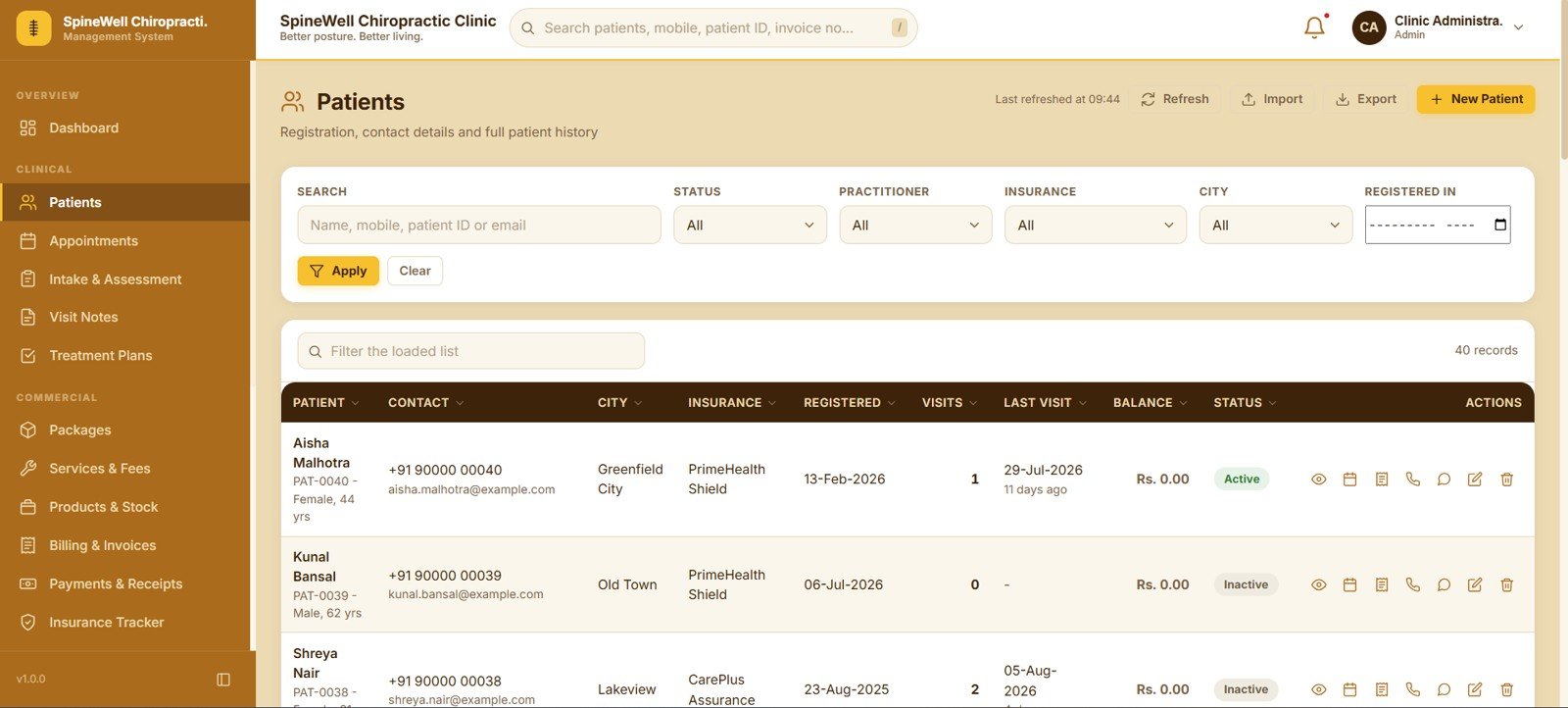
Every patient record carries contact details, city, insurance provider, registration date, visit count, last visit, outstanding balance and status. Six filters plus Import, Export and New Patient handle everything from a quick lookup at reception to a bulk migration from an old spreadsheet.
Appointments
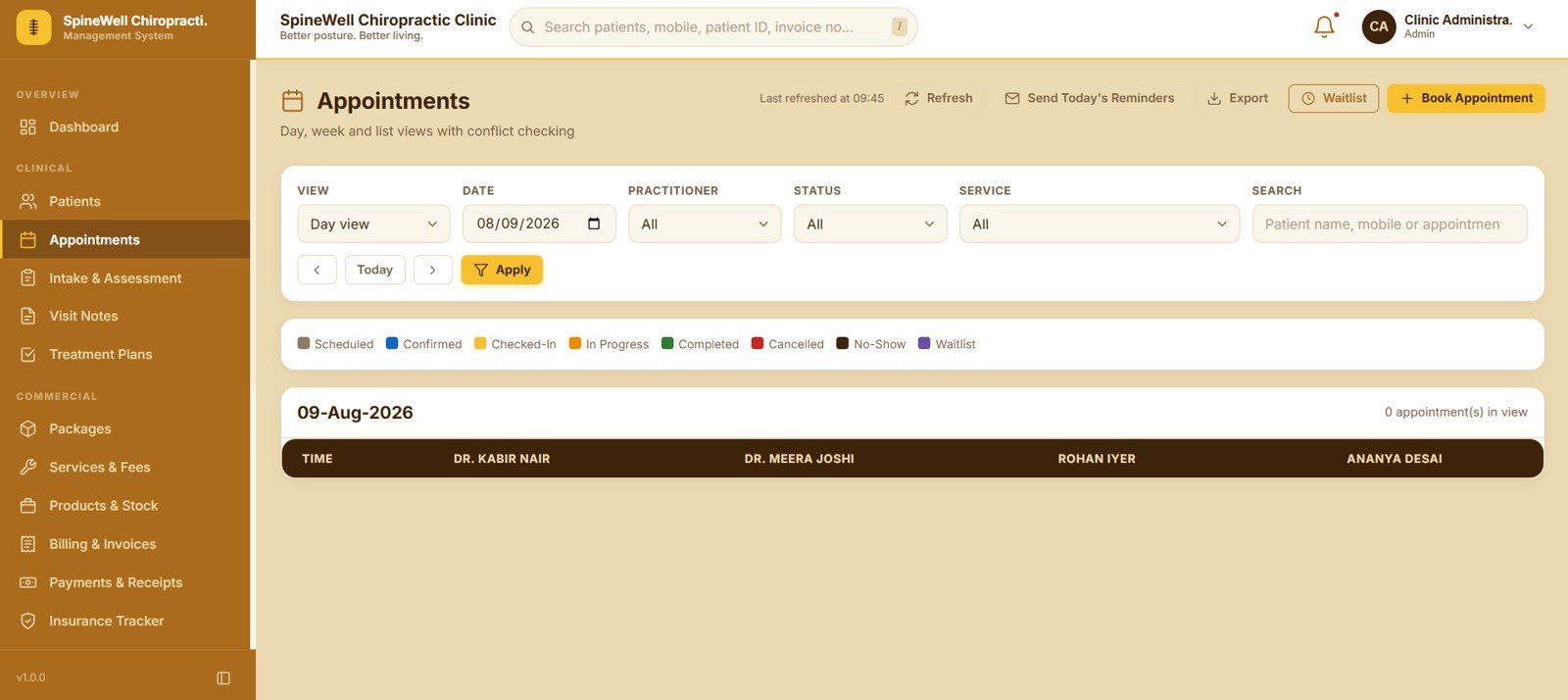
The booking grid puts each practitioner in a column with time slots down the side, and the app warns before a slot is double-booked. Send Today’s Reminders pushes the whole day’s list in one action, and overflow patients go to the waitlist rather than being turned away.
Intake & Assessment
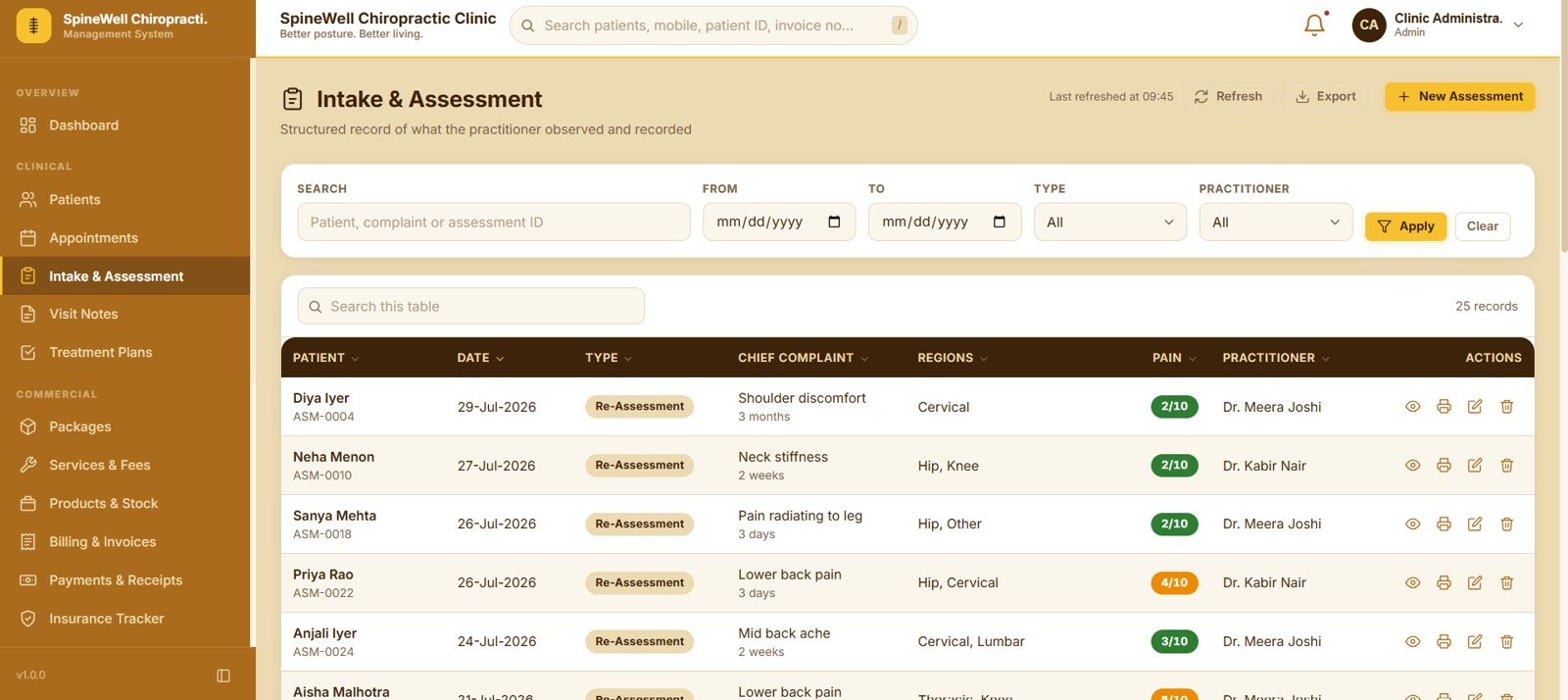
Initial and follow-up assessments record the chief complaint, affected regions, pain score, assessment type and practitioner against a date. Filtering by patient and date range pulls a full assessment history before a re-examination.
Visit Notes
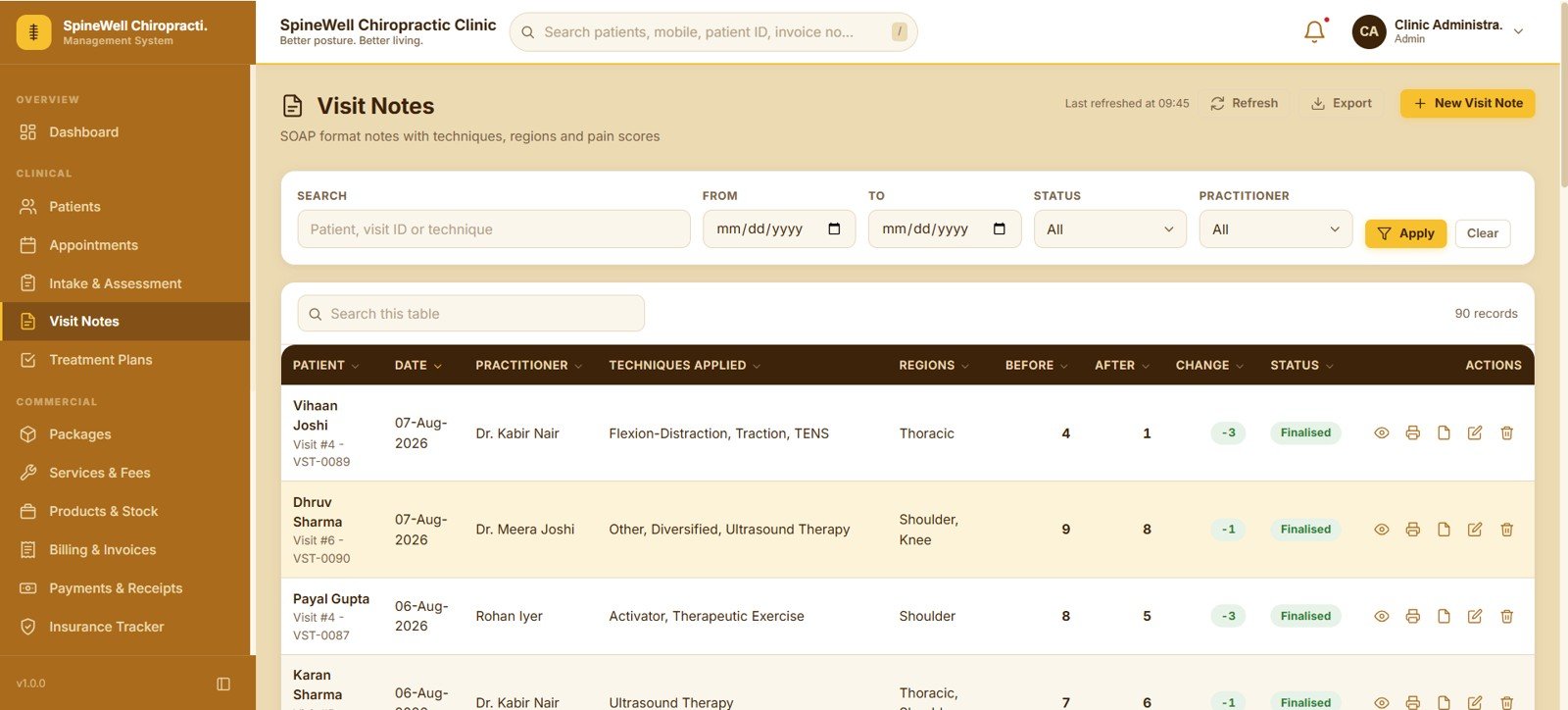
Notes follow SOAP structure and capture techniques applied, regions treated, and the before, after and change pain figures. Because the change column is stored per visit, showing a patient their own progress over eight sessions takes seconds.
Treatment Plans
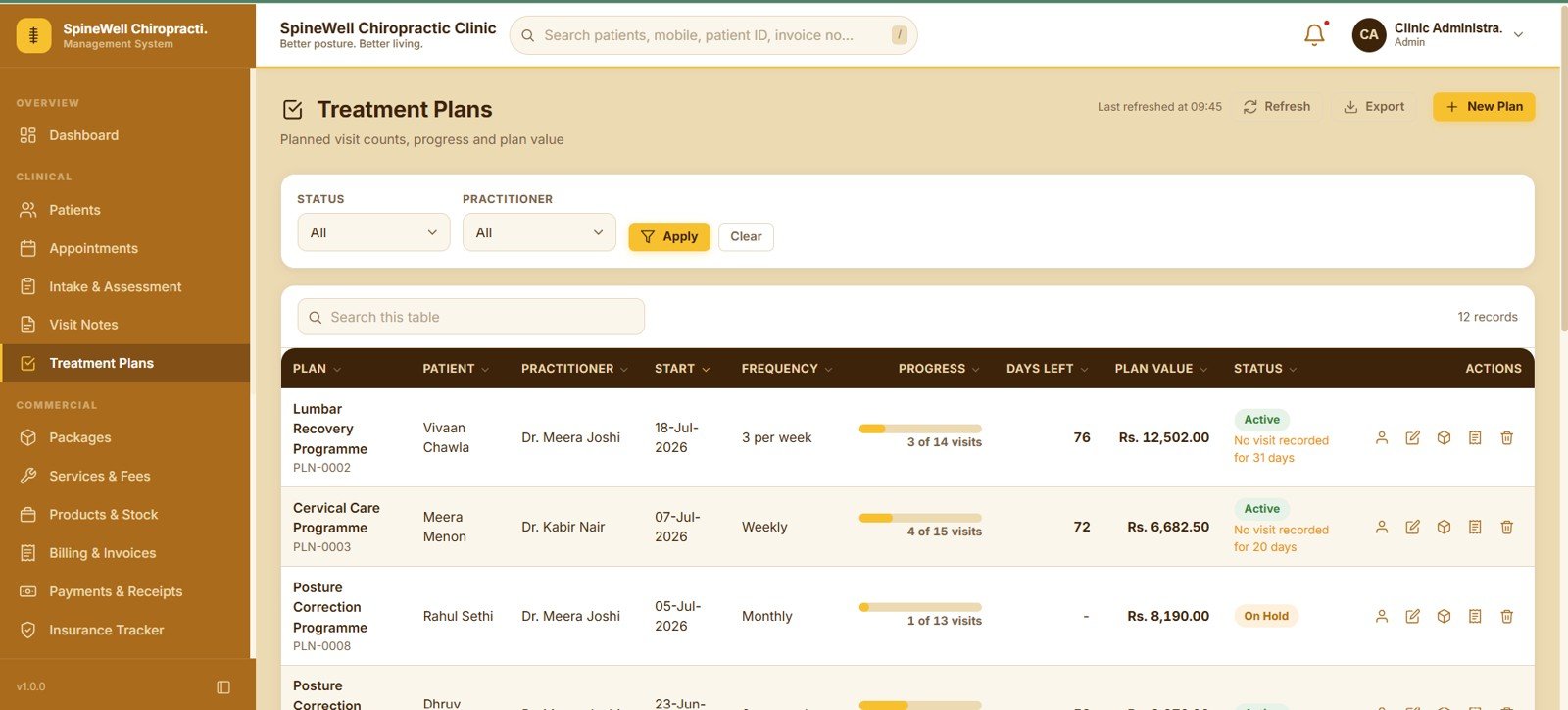
A plan records the practitioner, start date, visit frequency, planned visit count and plan value, then reports progress and days remaining. Status and practitioner filters isolate the plans that are behind schedule and need a follow-up call.
Packages & Visit Credits
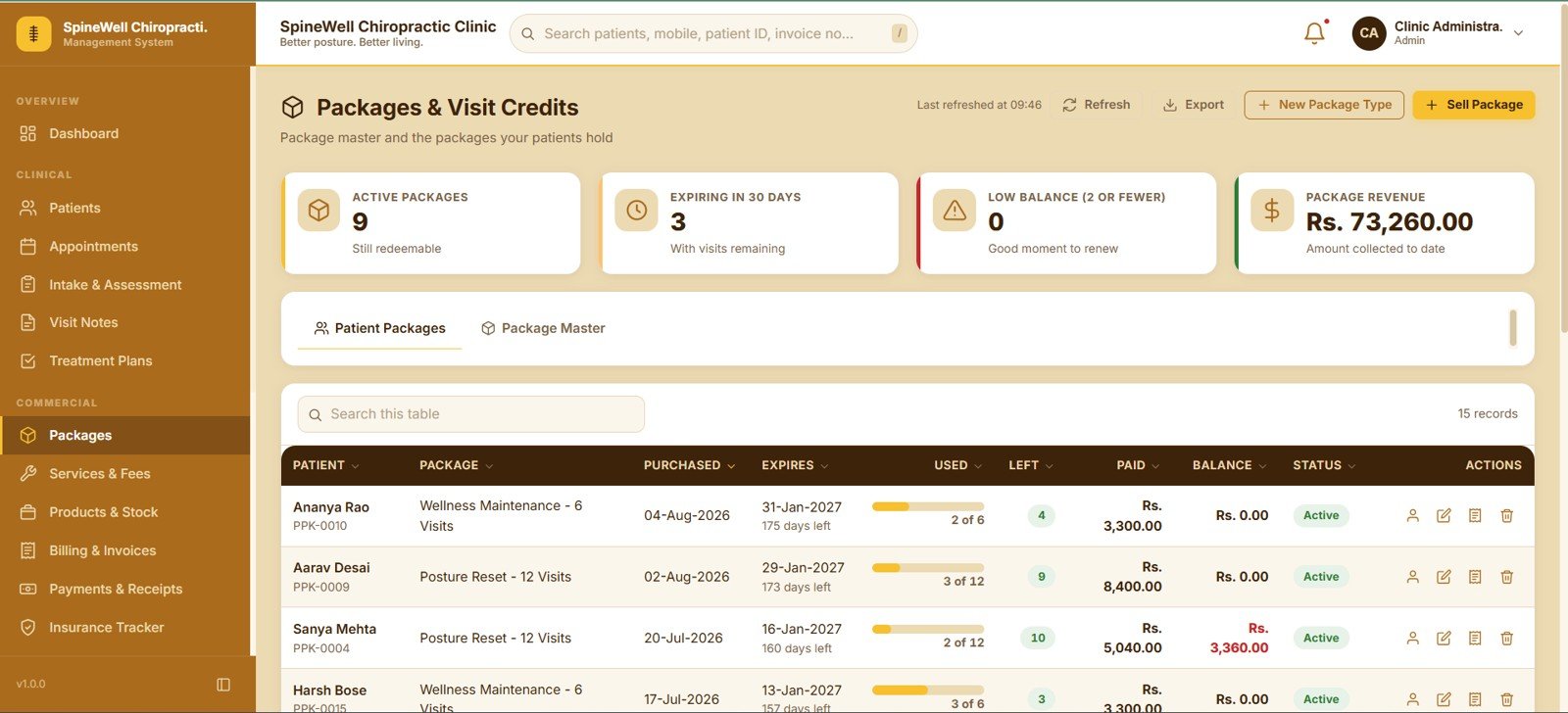
The Package Master defines each package type once; Patient Packages then shows purchase date, expiry, used credits, credits left, amount paid and balance per patient. Cards flag Active Packages, Expiring in 30 Days, Low Balance and Package Revenue.
Services & Fee Schedule
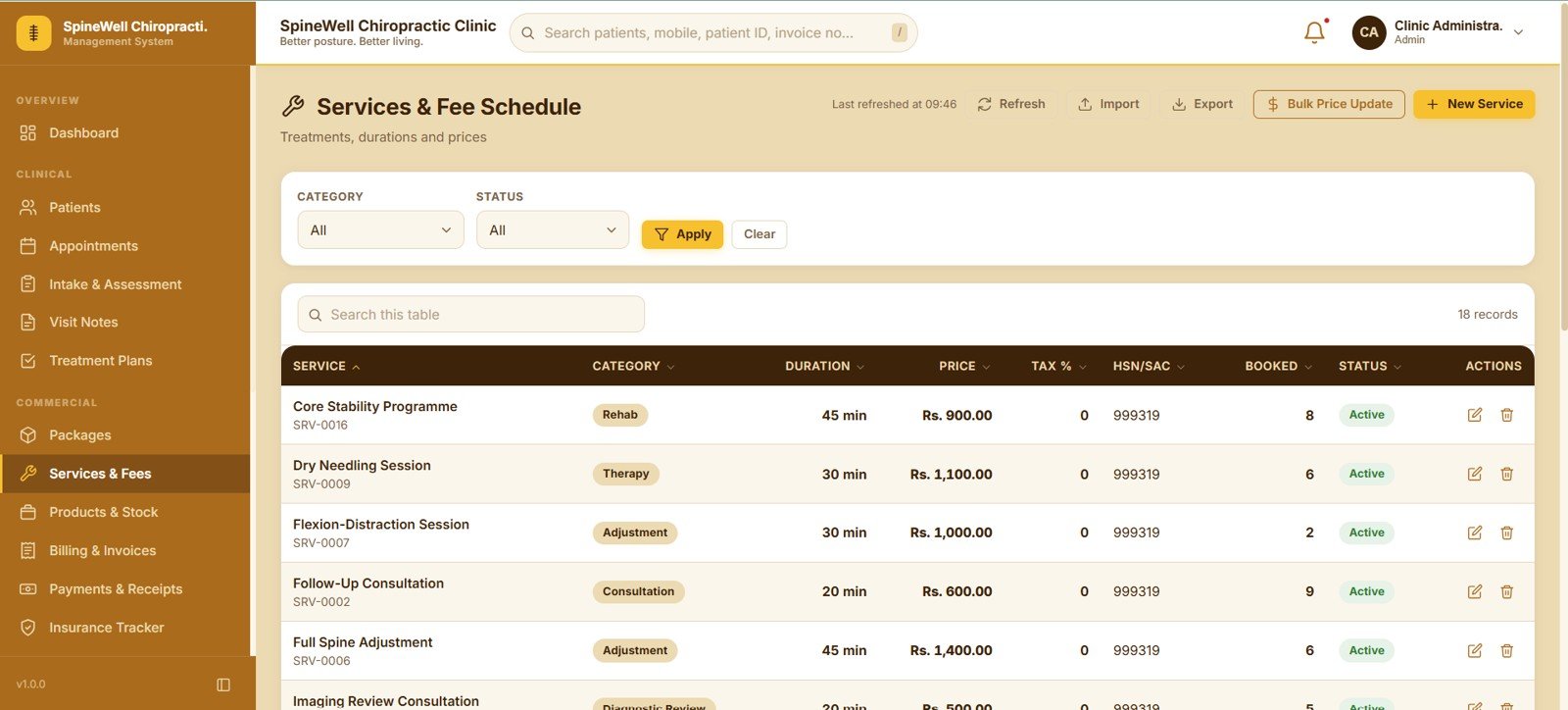
Treatments are stored with category, duration, price, tax percentage, HSN/SAC code and booking count. Bulk Price Update shifts an entire category at once, which makes an annual fee revision a two-minute job.
Products & Inventory
Retail stock such as supports, pillows and supplements is tracked with unit, cost, selling price, stock on hand, reorder level, units sold and supplier. Stock Entry logs each movement and the Below Reorder Level card prevents surprise stock-outs.
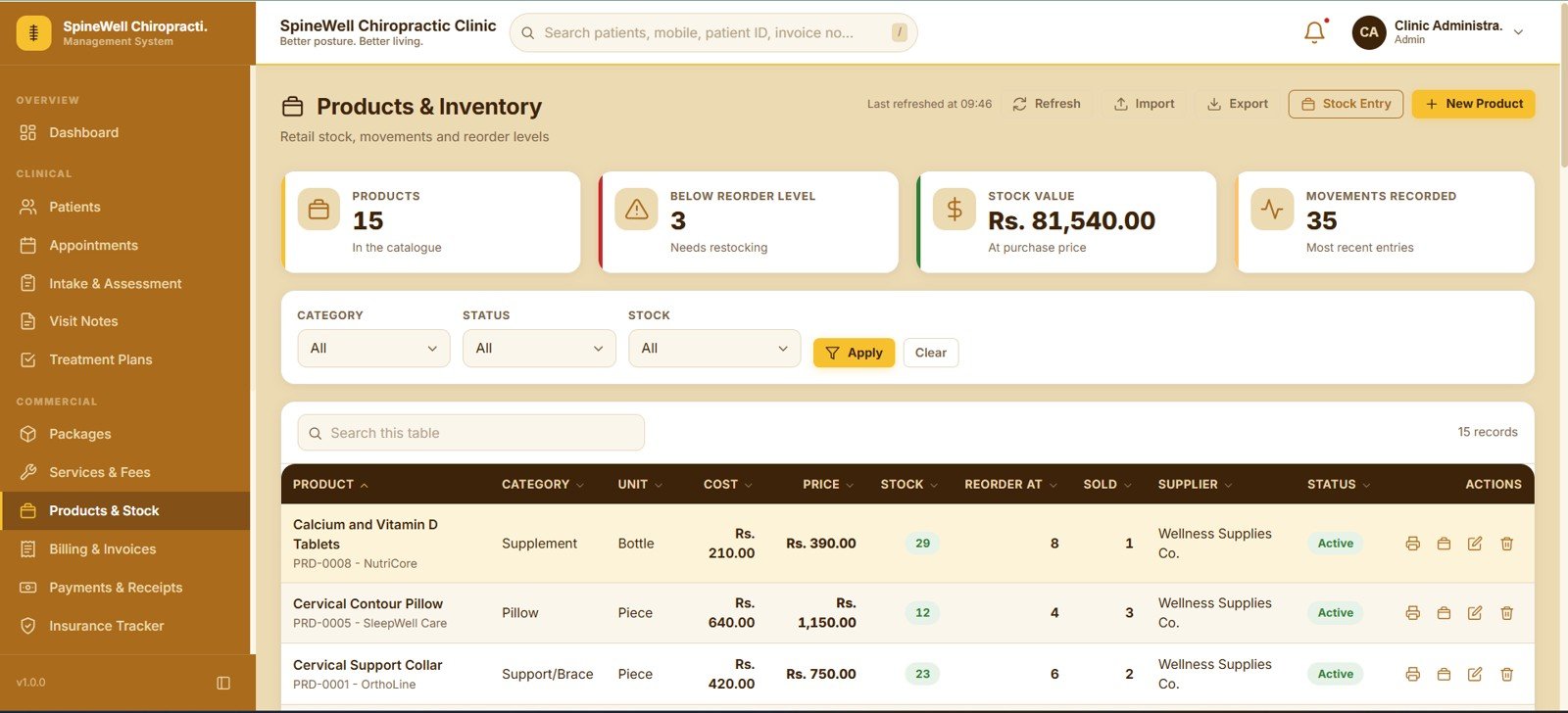
Billing & Invoices
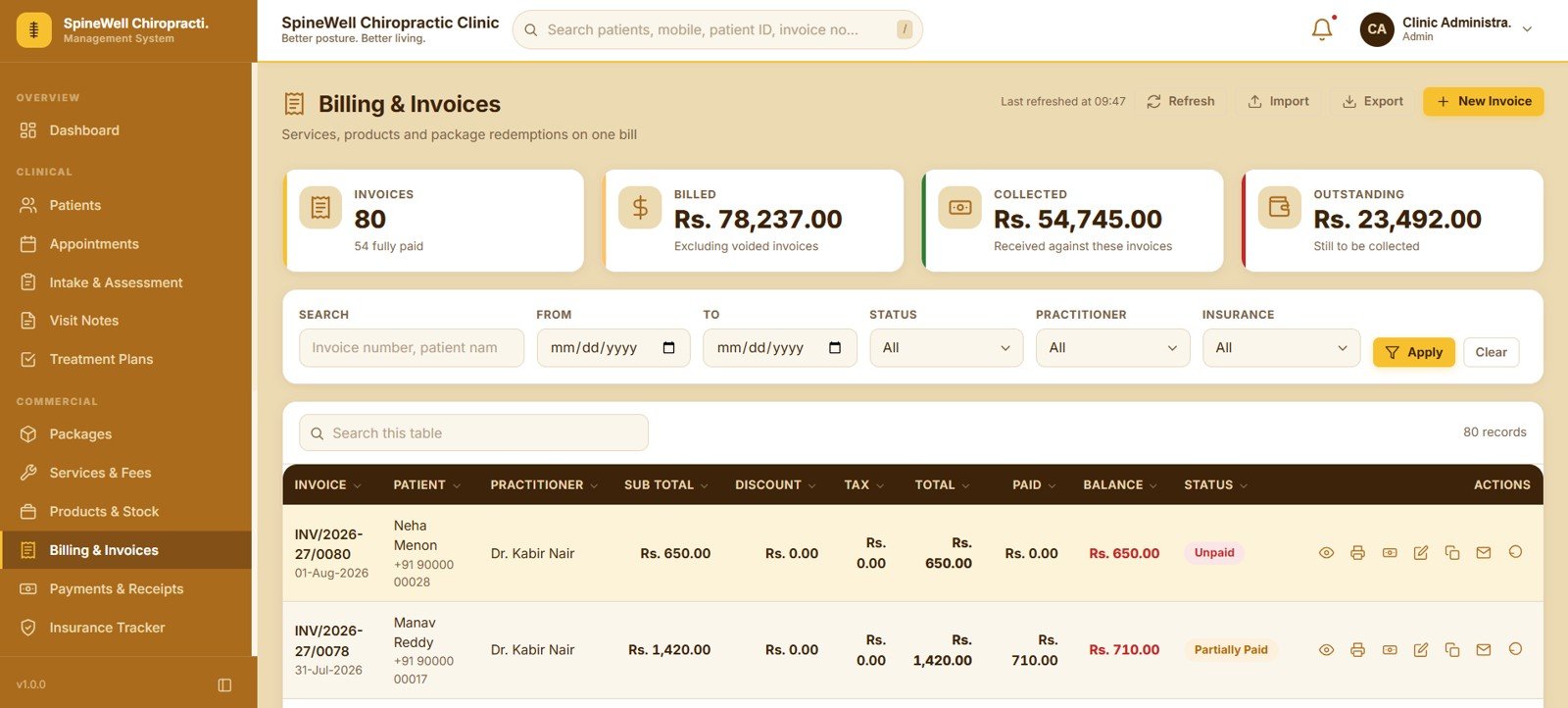
An invoice can combine services, retail products and package redemptions, showing sub total, discount, tax, total, paid and balance. Cards for Invoices, Billed, Collected and Outstanding give the finance picture for any date range.
Payments & Receipts
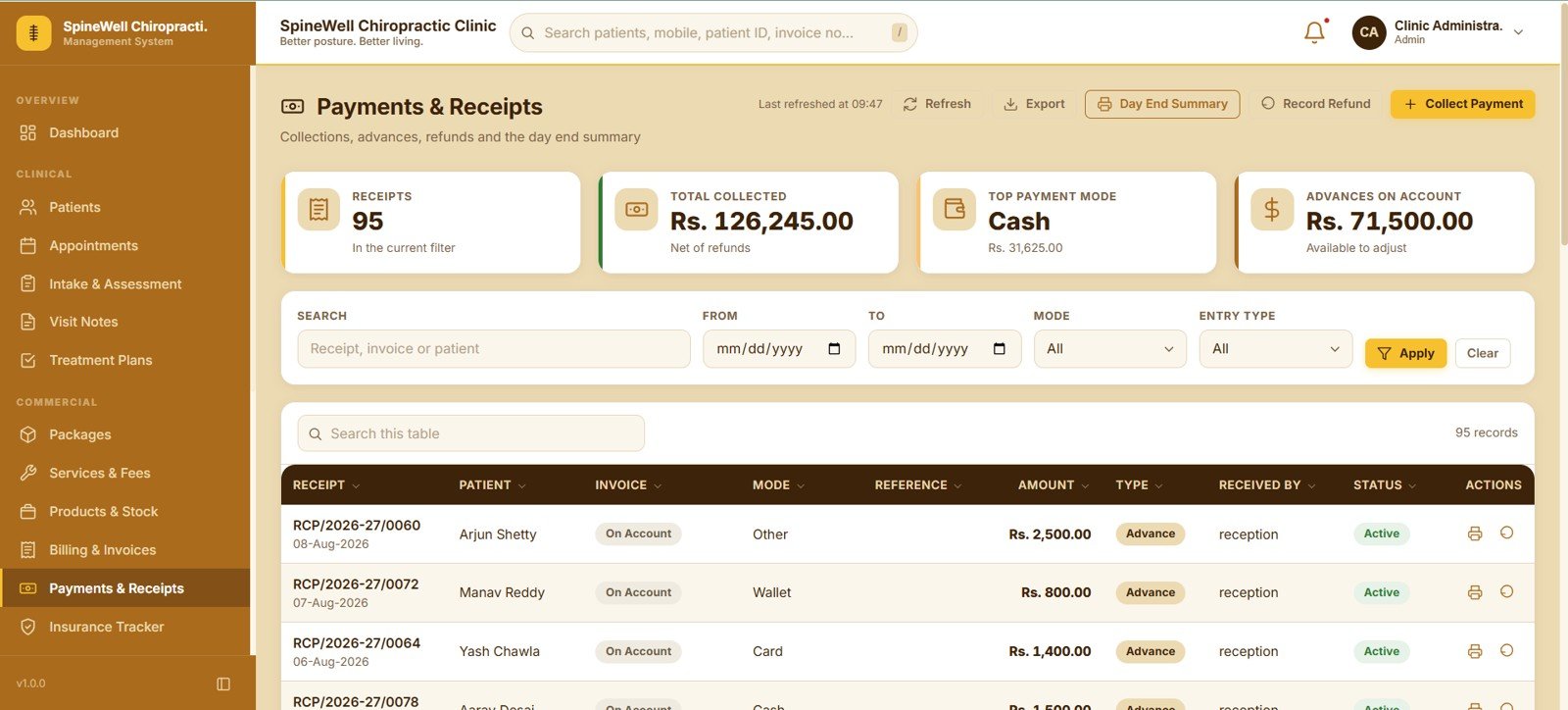
Receipts capture the payment mode, reference, amount, entry type and who received it. Collect Payment, Record Refund and a printable Day End Summary turn the evening cash-up into a single screen rather than a manual reconciliation.
Insurance & Reimbursement Tracker
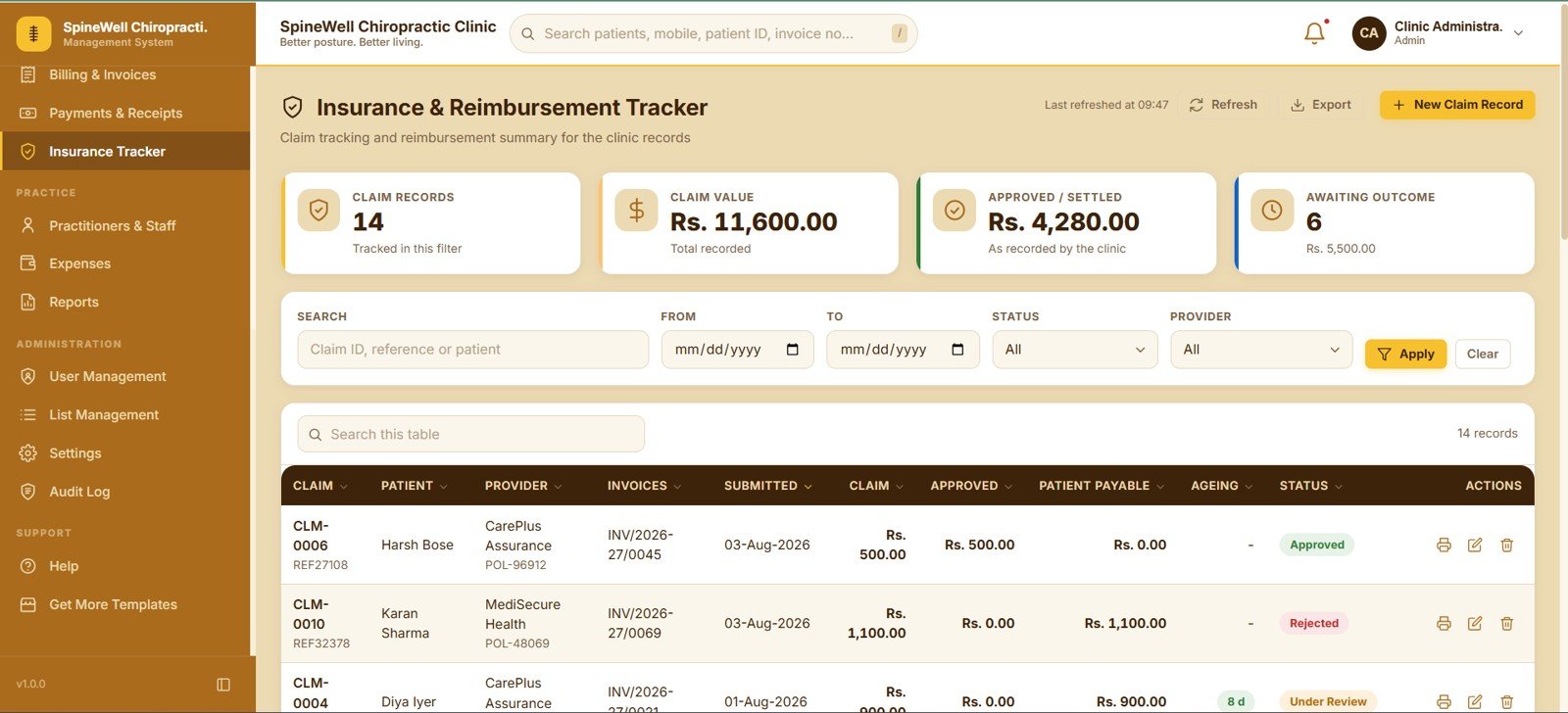
Claim records link patients and invoices to a provider and track submitted date, claim amount, approved amount, patient payable, ageing and status. Cards summarise Claim Records, Claim Value, Approved / Settled and Awaiting Outcome.
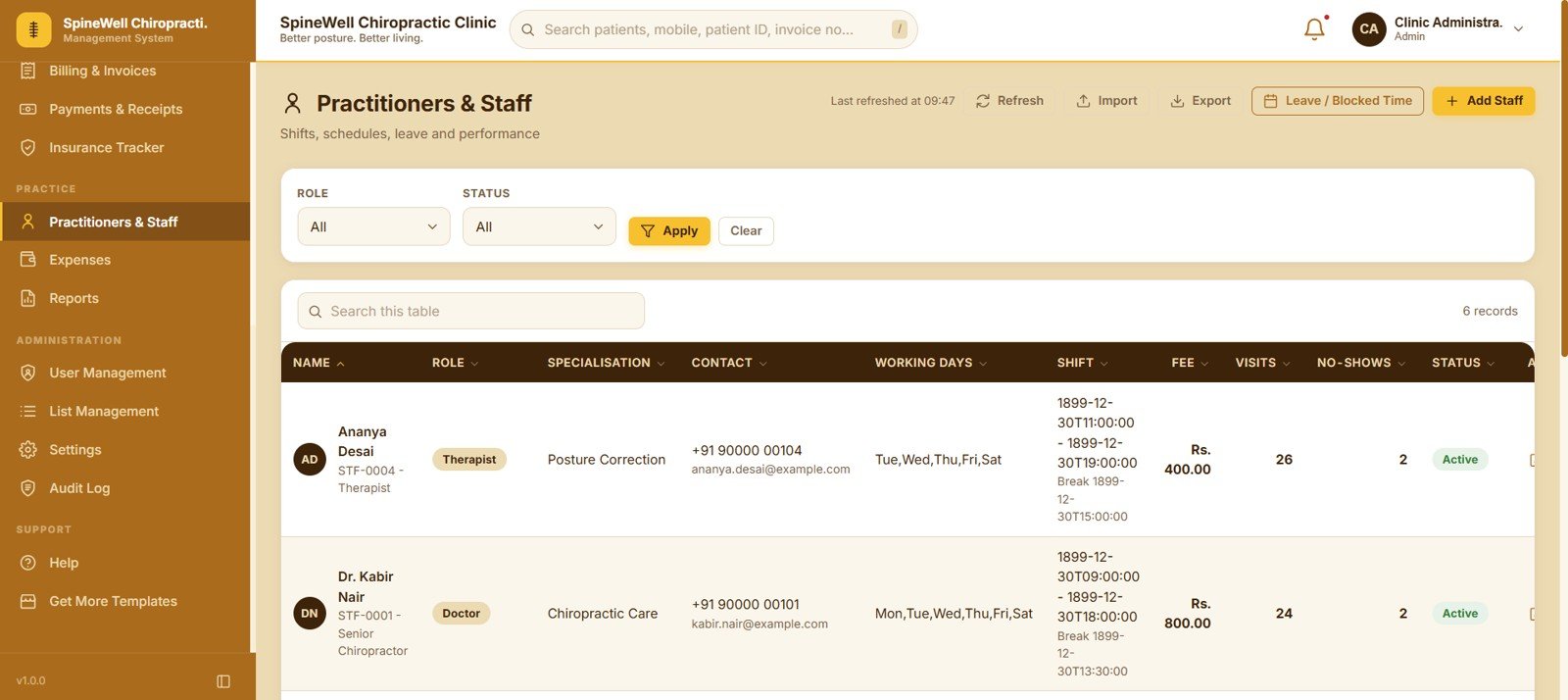
Practitioners & Staff
Staff records hold role, specialisation, contact, working days, shift, consultation fee, visits delivered and no-shows. Leave / Blocked Time removes someone from the booking grid for the dates they are away.
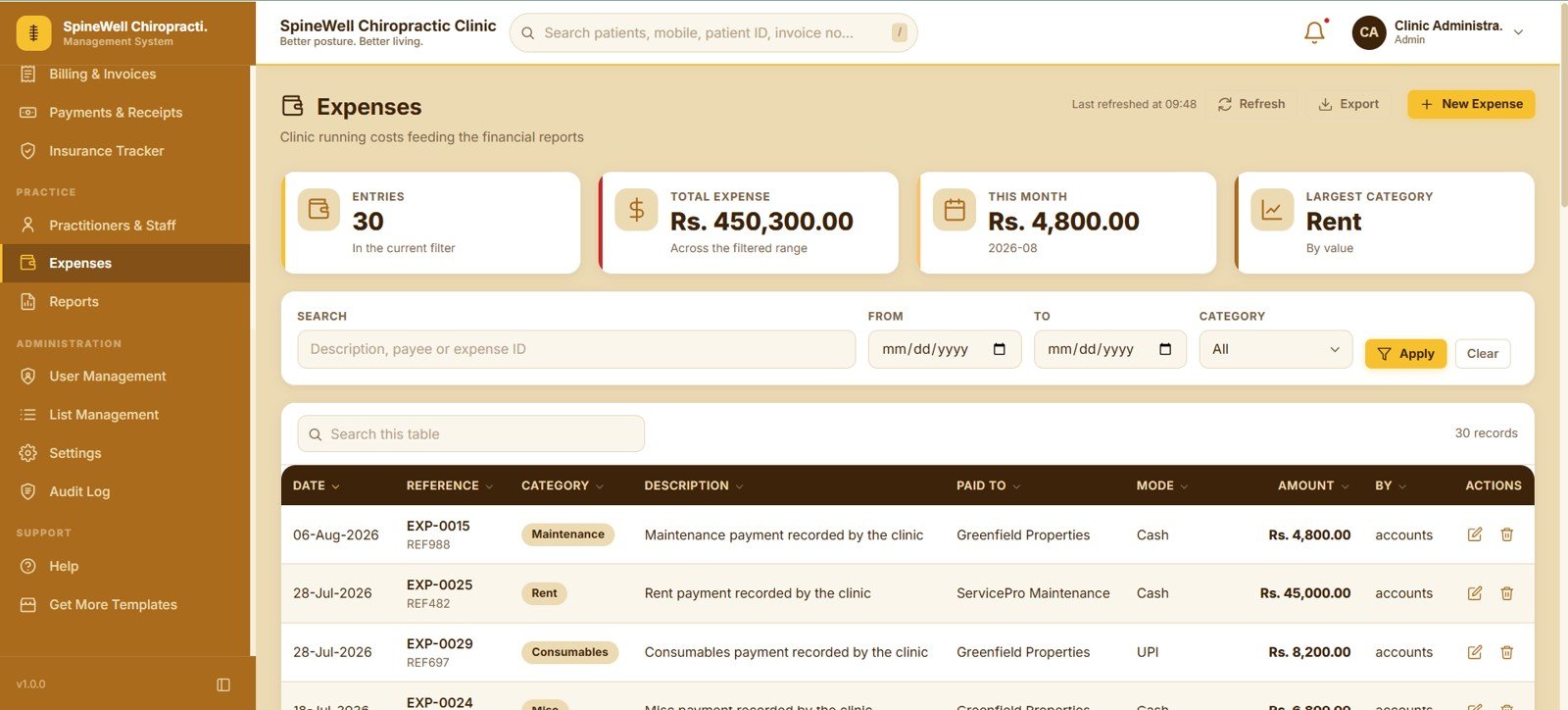
Expenses
Rent, utilities, consumables and other running costs are logged with category, description, payee, mode and amount. Cards show Entries, Total Expense, This Month and Largest Category, and everything feeds the financial reports.
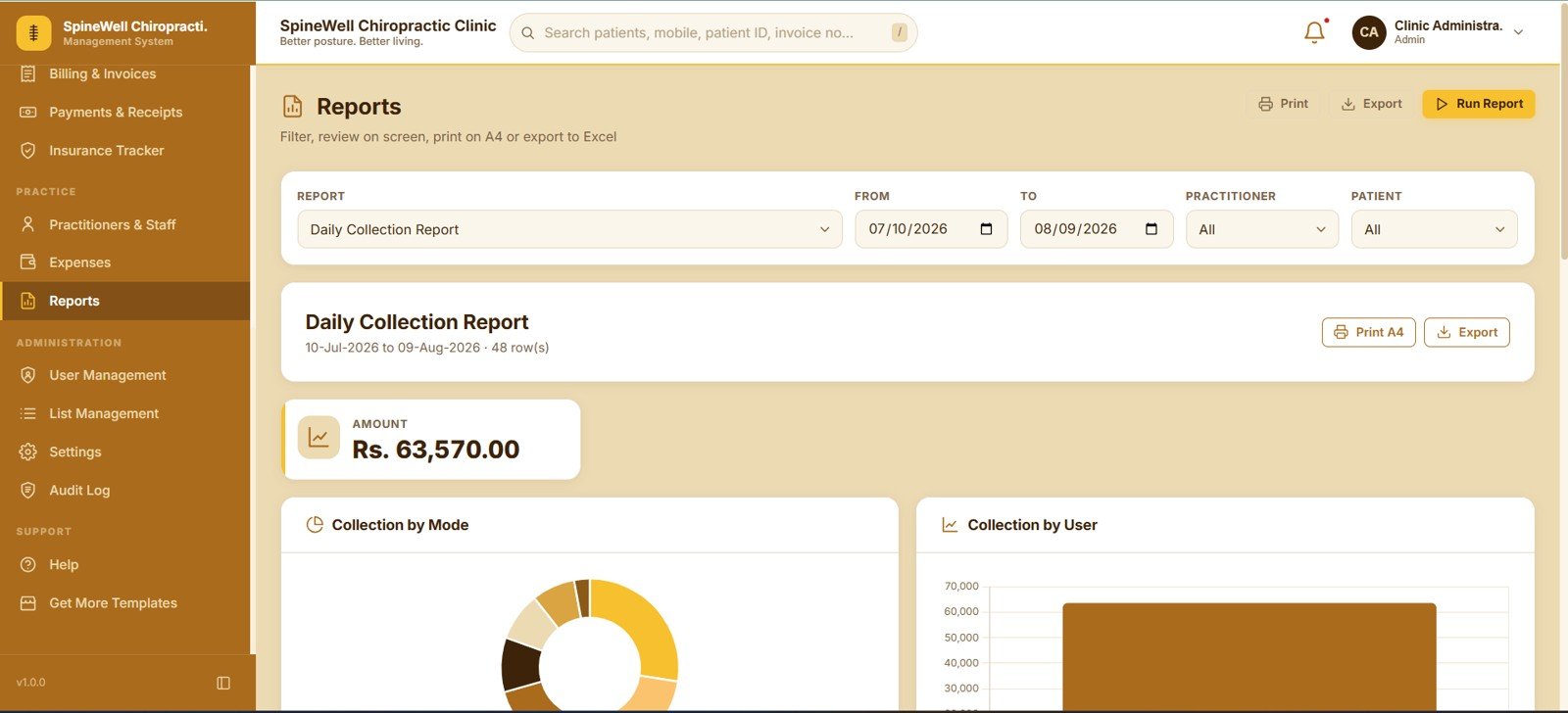
Reports
Choose a report, set the date range, narrow by practitioner or patient, then review on screen. The Daily Collection Report splits takings by Collection by Mode and Collection by User, with Print A4 and Export to Excel both one click away.
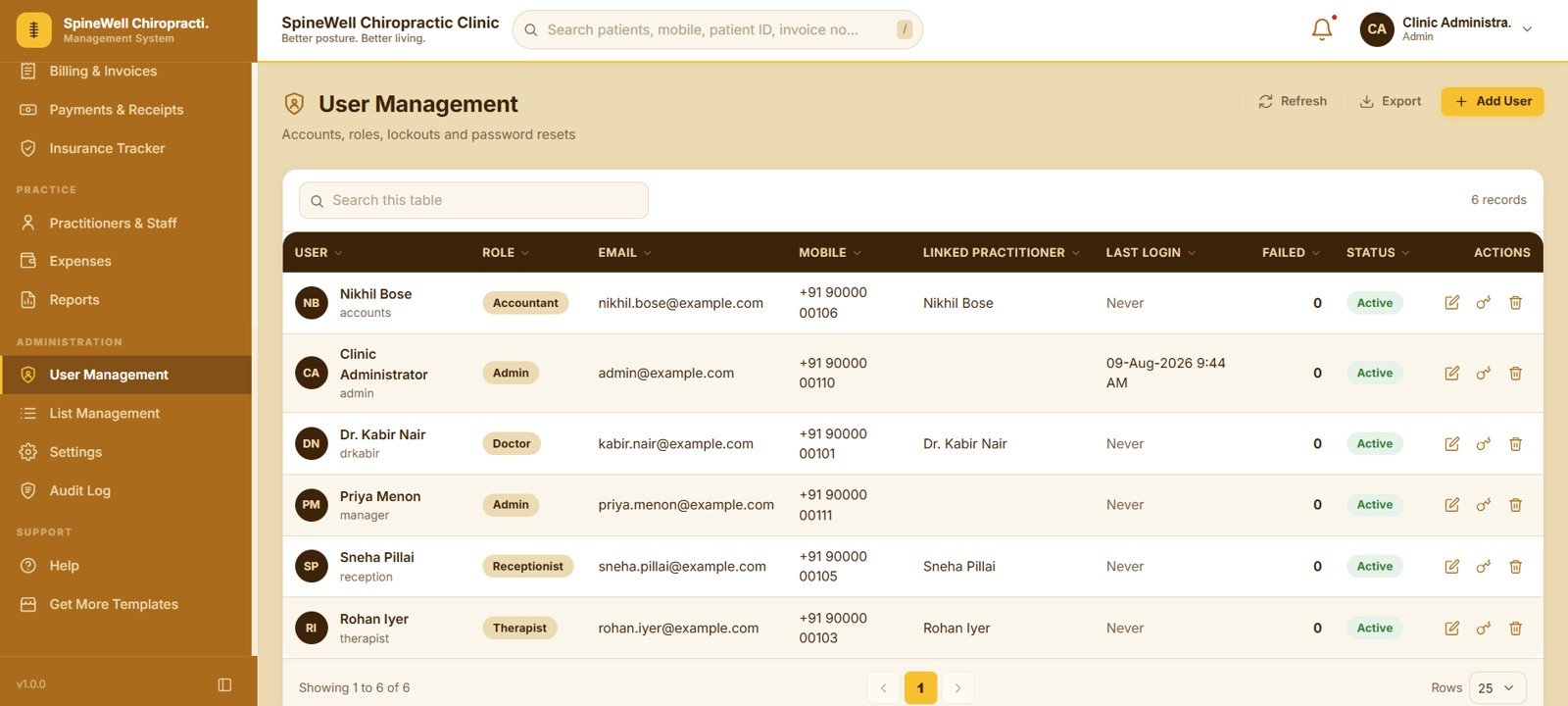
User Management
Admins create accounts, assign roles, link a login to a practitioner, and monitor last login and failed attempts. Edit, Password Reset and Delete actions sit on each row.
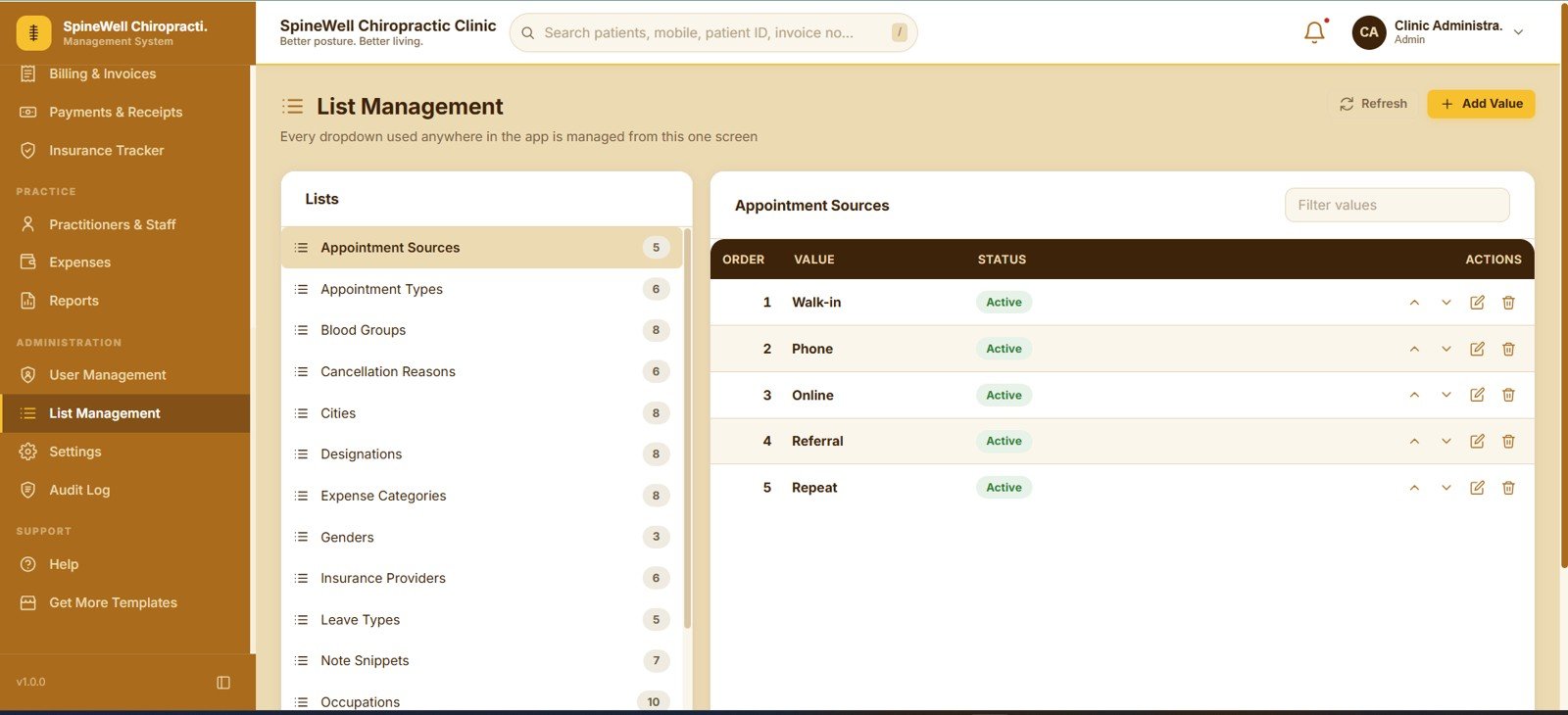
List Management
One screen controls every dropdown in the app — Appointment Sources, Appointment Types, Blood Groups, Cancellation Reasons, Cities, Designations, Expense Categories, Genders, Insurance Providers, Leave Types, Note Snippets and Occupations — each with an order, status and edit actions.
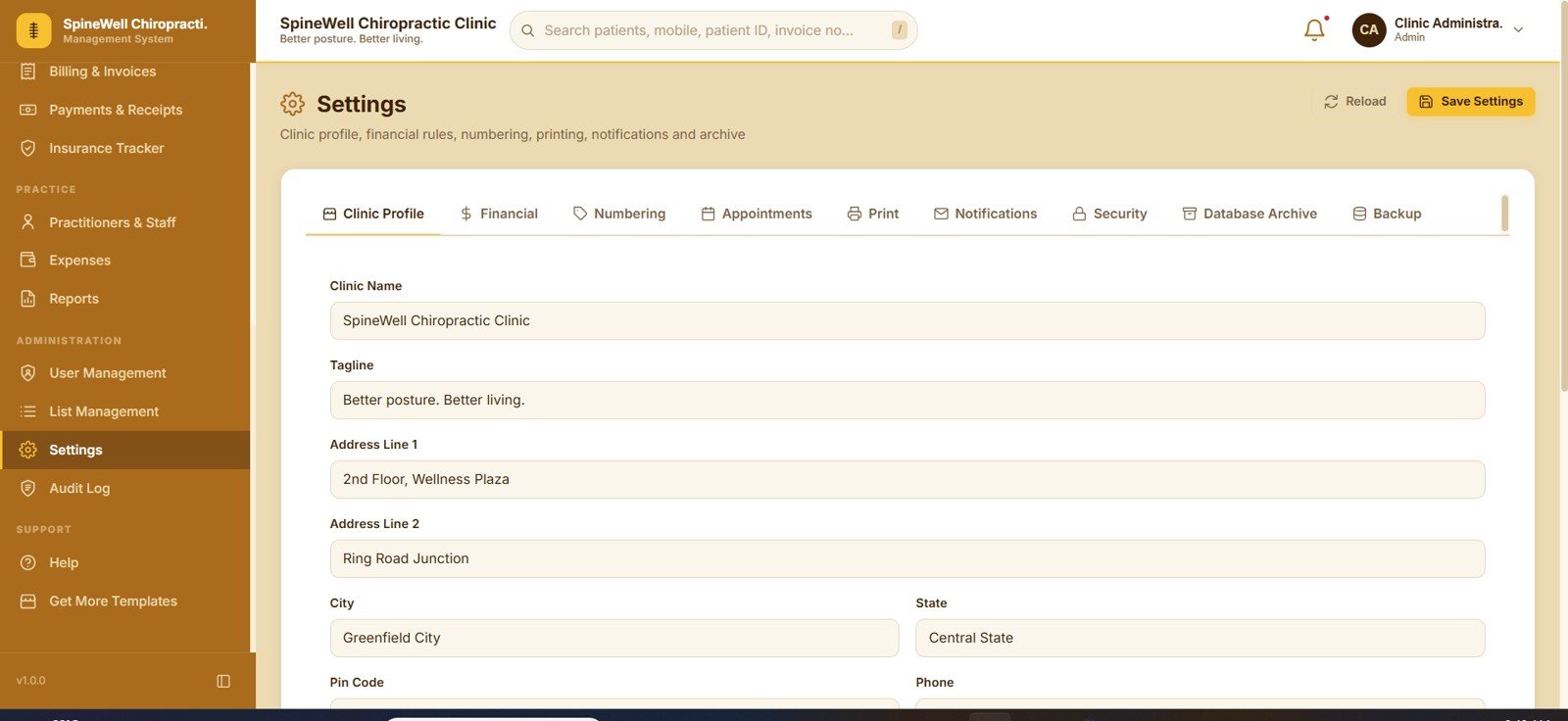
Settings
Nine tabs cover Clinic Profile, Financial, Numbering, Appointments, Print, Notifications, Security, Database Archive and Backup. The clinic name, address and phone entered here flow straight onto printed invoices and receipts.
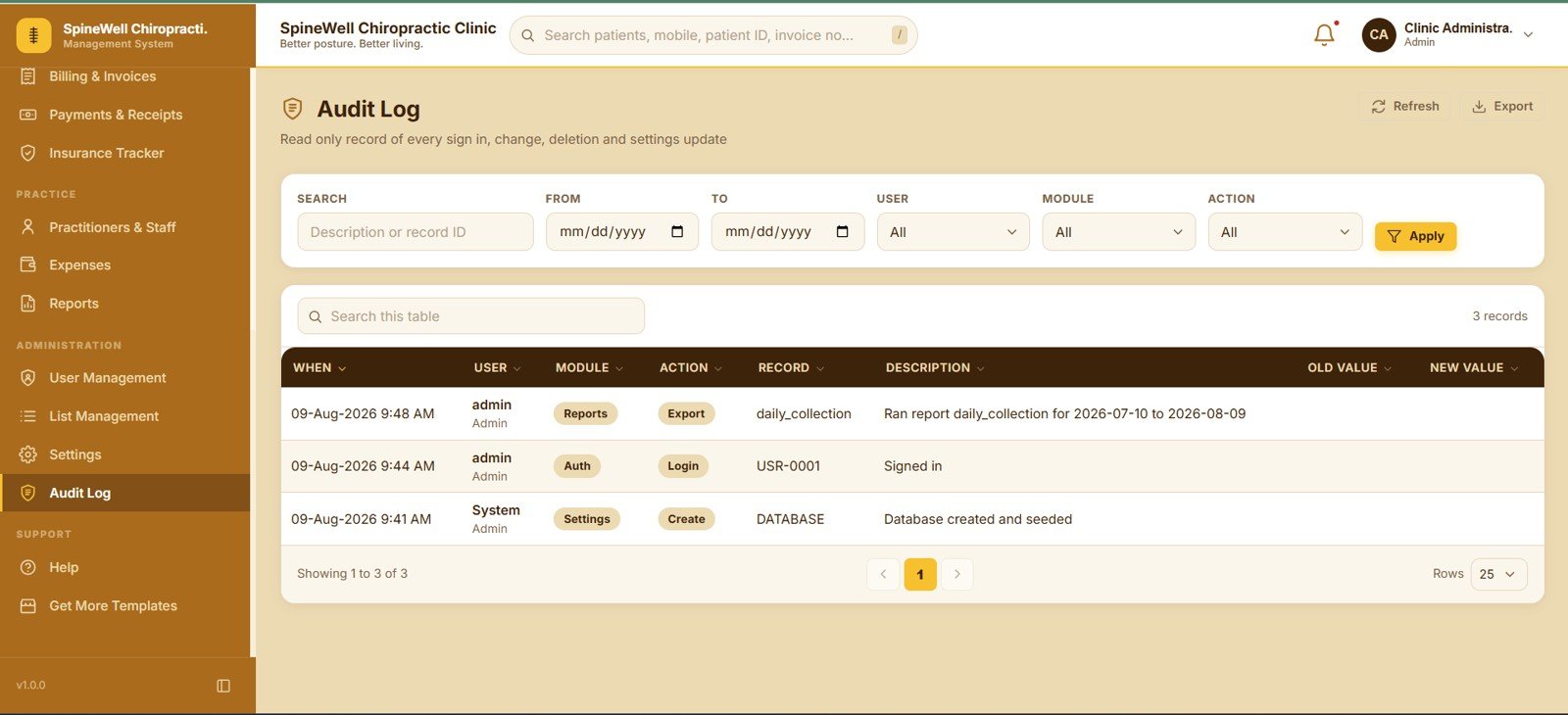
Audit Log
A read-only trail records when something happened, which user did it, the module, action, record, description, old value and new value. Search plus date, user, module and action filters make any investigation quick.
Chiropractic Clinic Management System Web App vs. Excel VBA Clinic System vs. Paid Chiropractic SaaS — Feature Comparison
| Feature | Chiropractic Clinic Management System Web App | Excel VBA Clinic System | ChiroTouch / Jane App / Cliniko |
|---|---|---|---|
| Cost | $39.99 one-time ✅ | $6–$40 one-time | $79–$199 per month |
| Platform | Google Apps Script web app on your own Google account ✅ | Windows Excel with macros enabled | Vendor-hosted cloud |
| Setup time | About 10 minutes ✅ | Under 5 minutes | Days, often with paid onboarding |
| Real-time team collaboration | Yes, unlimited staff logins ✅ | Single machine at a time | Yes, billed per user |
| Mobile access | Yes, opens in any phone browser ✅ | No | Yes |
| Customisable fields and dropdowns | Yes, via List Management and full source code ✅ | Yes, with VBA editing | Limited to vendor settings |
| SOAP notes with pain scoring and visit packages | Both included ✅ | Rarely both | Yes, on higher tiers |
| Data ownership | Your Google Sheet, exportable any time ✅ | Your local file | Vendor database, export on request |
| Year-1 cost at 5 users | $39.99 ✅ | $6–$40 | $1,200–$5,400 |
For clinics that want multi-user scheduling, SOAP notes and package billing without a per-seat monthly bill, the Chiropractic Clinic Management System Web App sits in the sweet spot.
Who Should Use This Template
Perfect for:
- Solo chiropractors and clinics with 1–10 practitioners moving off paper cards or a shared spreadsheet
- Practices that sell visit packages and want credits deducted automatically at billing
- Physiotherapy, osteopathy, sports injury and rehab clinics with the same appointment-notes-billing flow
- Front desk teams who want a tablet-friendly booking grid with no software to install
- Owners who want the full Google Apps Script source so fields and modules can be renamed
Not a fit if:
- You need certified HIPAA-compliant hosting, a signed BAA or SOC 2 evidence from a vendor
- You must file electronic insurance claims directly with payers — this tracks claims, it does not submit them
- You run a 50+ practitioner group with heavy concurrent write volume that needs a dedicated database
- You want a native app from an app store rather than a browser-based web app
Real-World Use Cases
Dr. Kabir, two-practitioner high street clinic. Every morning he opens the Day view, sees both practitioner columns side by side, and sends the day’s reminders with a single click. At month end he checks the No-Show Rate card and the Daily Collection Report instead of counting entries in a diary — and pays nothing per seat to do it.
Ananya, front desk at a sports rehab centre. The centre sells 10-visit and 20-visit packages. The Low Balance card lists everyone down to two credits or fewer, so Ananya has the renewal conversation at the counter while the patient is still there, rather than chasing by email a week later.
Meera, owner of a three-branch physiotherapy practice. She runs the Daily Collection Report per practitioner, exports it to Excel, and reconciles it against the Payments & Receipts day-end summary. What used to be an hour of rebuilding a spreadsheet from receipt books is now a two-minute check.
Advantages of the Chiropractic Clinic Management System Web App
The clearest advantage is cost structure. A paid chiropractic platform at $79–$199 per month runs to roughly $1,200–$5,400 in the first year for a five-person clinic. This is a single $39.99 purchase with unlimited staff logins, so the money saved in month two onwards stays in the practice.
The second advantage is data ownership. Everything sits in a Google Sheet inside your own Google account, so exporting patient lists, invoices or claim records is a normal spreadsheet download rather than a support ticket. Because the app is built on Google Apps Script web apps, hosting, authentication and access control are handled by Google’s own infrastructure.
The third is time. Package credits deduct themselves, treatment plan progress calculates itself, and the audit log writes itself. Those three alone remove most of the manual reconciliation a spreadsheet-based clinic does every week.
Opportunities for Improvement
Being straight about the limits: the insurance module is a tracker, not a clearinghouse — it will not submit electronic claims to payers on your behalf. The app is also not sold as a HIPAA-certified product; clinics with a regulatory obligation should review their own Google Workspace security and compliance settings before storing identifiable patient data.
Google Apps Script also has quota limits on script runtime and daily execution, which are generous for a single clinic but can be felt by a very large multi-site group writing constantly. Finally, appointment reminders send from your own account rather than through a dedicated SMS gateway, so high-volume messaging may need an external service.
Best Practices
- Set up List Management first — cities, insurance providers, appointment types and note snippets — before entering a single patient, so dropdowns are consistent from day one.
- Change the default admin password immediately and give each staff member their own account, so the audit log attributes actions to a real person.
- Enter the full Services & Fee Schedule with tax percentages before raising the first invoice; retro-fixing prices on issued invoices is far more work.
- Run the Day End Summary at closing every day rather than weekly — discrepancies are much easier to find within 24 hours.
- Use the Database Archive option in Settings once the visit note volume grows, to keep the app responsive.
- Review the Packages Expiring in 30 Days card weekly; it is the single highest-value renewal list in the app.
Explore Relevant Templates
- Therapy Center Management System Web App — the same structure tuned for therapy and counselling centres (read the walkthrough).
- Ayurvedic Or Homeopathy Clinic Management System Web App — patient records, prescriptions and billing for alternative medicine practices (read the walkthrough).
- Blood Bank Management System Web App — donor, stock and issue tracking in the same Apps Script framework (read the walkthrough).
- Pharmacy POS Web App — useful if the clinic also runs a dispensing counter.
- Healthcare Management Dashboard in Google Sheets — a reporting-only option when you just need the analytics layer.
Want to learn the spreadsheet skills behind a system like this? The NextGenTemplates Academy learning paths walk through them step by step with practice files.
Frequently Asked Questions
What is included in the Chiropractic Clinic Management System Web App?
The Chiropractic Clinic Management System Web App includes 20 modules: login, dashboard, patients, appointments, intake and assessment, visit notes, treatment plans, packages and visit credits, services and fee schedule, products and inventory, billing, payments, insurance tracker, staff, expenses, reports, user management, list management, settings and audit log.
Do I need programming knowledge to set it up?
No. Setting up the Chiropractic Clinic Management System Web App takes about 10 minutes with no coding. You copy the Google Sheet, click Deploy in the Apps Script editor, authorise the script once, then open the deployment URL and sign in using the admin credentials in the included guide.
How does it compare with ChiroTouch or Jane App?
Paid chiropractic platforms typically charge $79 to $199 per month and bill per practitioner. The Chiropractic Clinic Management System Web App is a one-time $39.99 purchase with unlimited staff logins, and all patient data stays in a Google Sheet you own and can export at any time.
Can multiple practitioners use it simultaneously?
Yes. It is a multi-user web app with role-based access. User Management controls accounts, roles and linked practitioners, while the read-only audit log records every sign-in, edit and deletion with the old and new values stored side by side.
How are visit packages and credits handled?
You define package types once in the Package Master and sell them to patients. Credits are deducted as visits are billed, and the screen shows used credits, credits left, expiry and balance, with alerts for packages expiring within 30 days or holding two or fewer credits.
Does the app submit insurance claims?
No. The Chiropractic Clinic Management System Web App tracks claims for your own records — provider, linked invoices, submitted date, claim amount, approved amount, patient payable, ageing and status — but it does not transmit electronic claims to payers.
Can I customise fields, dropdowns and branding?
Yes. List Management edits every dropdown from a single screen, Settings holds the clinic profile, numbering and print options, and the full Google Apps Script source is included so you can add or rename fields yourself.
About the Author
Built by PK — Microsoft Certified Professional with 15+ years of Excel, Google Sheets and Power BI experience. Founder of NextGenTemplates, reaching 300K+ subscribers across YouTube channels. Every template is hand-built and tested before release.
Conclusion
If your clinic is juggling a diary, a spreadsheet and a receipt book, the Chiropractic Clinic Management System Web App consolidates all three into 20 modules that talk to each other — scheduling that checks for conflicts, notes that measure progress, packages that count themselves down, and billing that reconciles at the end of the day.
Get the Chiropractic Clinic Management System Web App
Instant download · One-time payment · No subscription
Last updated: August 2026