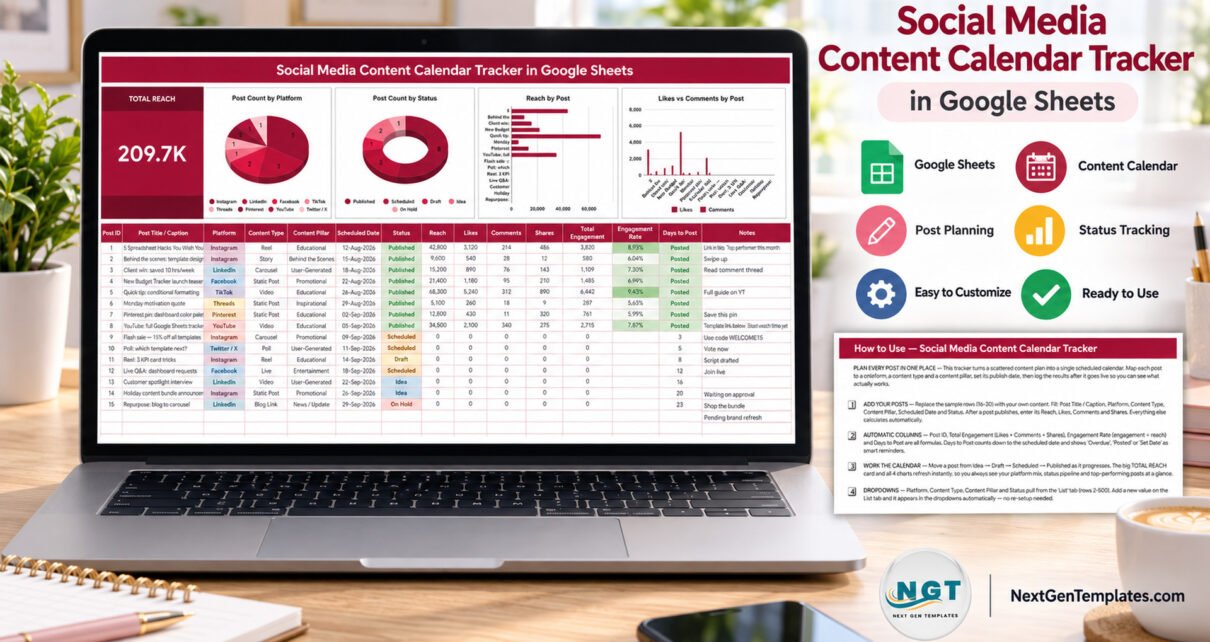
The Social Media Content Calendar Tracker in Google Sheets puts a whole posting plan on one page: a 16-column post log covering 8 platforms, 5 workflow statuses and 7 content pillars, a Total Reach card and 4 live charts. Four columns calculate themselves, so after a post goes live you type only reach, likes, comments and shares. The sample file ships with 15 posts adding up to 209.7K total reach.Social Media Content Calendar Tracker in Google Sheets
Most content teams plan in one place, schedule in another and measure somewhere else. Captions live in a doc, dates in a calendar and results in each platform’s analytics tab, which makes it hard to see which pillar or format actually performs. A social media content calendar tracker brings the plan and the results together in a single Google Sheet that every teammate can open with a link.Social Media Content Calendar Tracker in Google Sheets
Get the Social Media Content Calendar Tracker in Google Sheets
Key Features of the Social Media Content Calendar Tracker
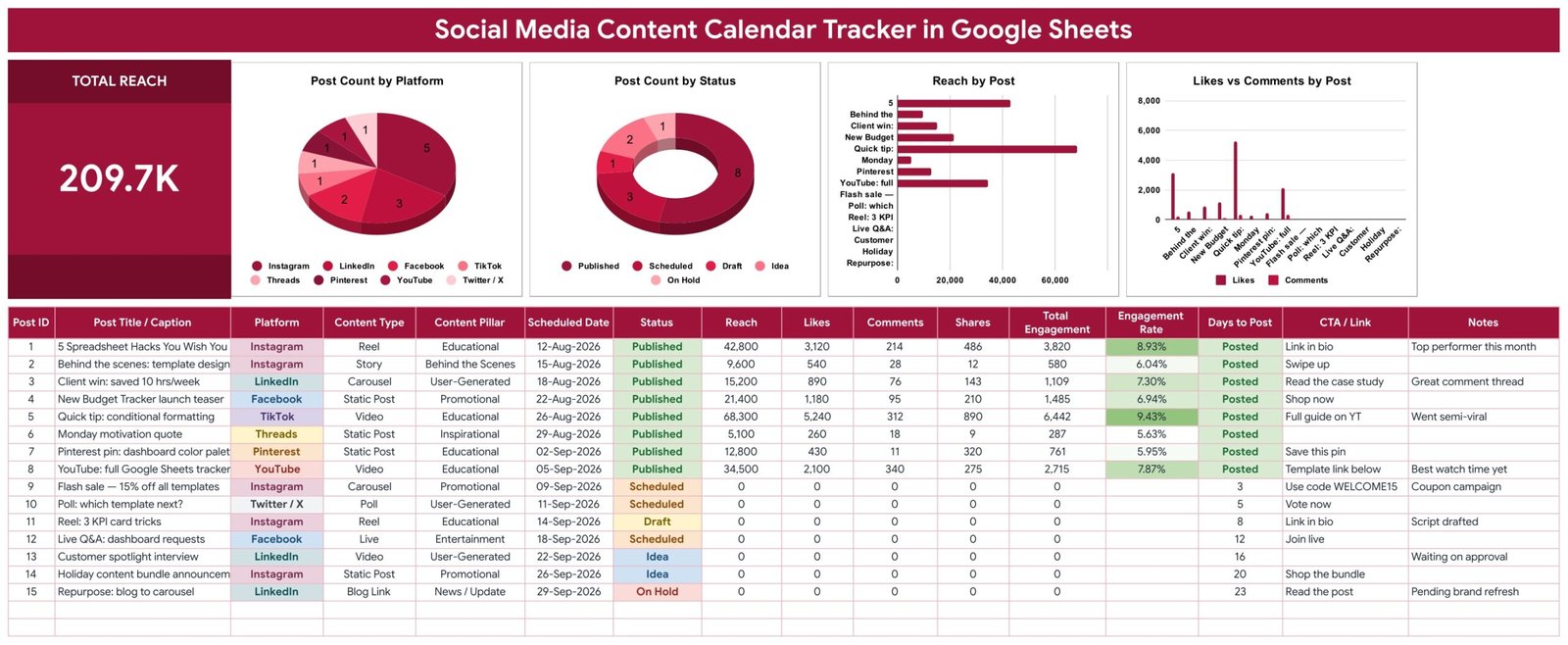
- 📅 One post log for every channel. Each row records Post Title / Caption, Platform, Content Type, Content Pillar, Scheduled Date, Status, Reach, Likes, Comments, Shares, CTA / Link and Notes. The sample covers Instagram, LinkedIn, Facebook, TikTok, Threads, Pinterest, YouTube and Twitter / X.Social Media Content Calendar Tracker in Google Sheets
- 🔄 A five-stage status pipeline. Posts move from Idea to Draft to Scheduled to Published, with On Hold for anything paused. The Post Count by Status chart shows the pipeline at a glance.Social Media Content Calendar Tracker in Google Sheets
- 🧮 Four automatic columns. Post ID, Total Engagement (likes + comments + shares), Engagement Rate (engagement ÷ reach) and Days to Post are formulas. Nobody retypes a total or works out a percentage by hand.Social Media Content Calendar Tracker in Google Sheets
- ⏳ Smart Days to Post reminders. The column counts down to the scheduled date and shows Overdue, Posted or Set Date, so a slipping post stands out before its date passes.Social Media Content Calendar Tracker in Google Sheets
- 📊 A Total Reach card plus 4 charts. Post Count by Platform, Post Count by Status, Reach by Post and Likes vs Comments by Post all read the data columns directly, rows 16 to 1000.
- 🎨 Colour-coded cells. Platform and Status cells carry their own colours, and Engagement Rate is shaded green so the strongest posts are easy to spot.
- 🗂️ Self-extending dropdowns. Platform, Content Type, Content Pillar and Status draw from the List tab (rows 2-500). Add a value there and it shows up in the dropdown straight away.Social Media Content Calendar Tracker in Google Sheets
Tracker Pages Explanation
The file has a tracker sheet, a List tab for the dropdown values, a How to Use tab and an Explore More Templates tab.Social Media Content Calendar Tracker in Google Sheets
Page 1: Social Media Content Calendar Tracker Sheet
The top band holds the Total Reach card (209.7K in the sample) and four charts: Post Count by Platform, Post Count by Status, Reach by Post and Likes vs Comments by Post. Under it sits the 16-column log with 15 sample posts scheduled from 12 August to 29 September 2026, from reels and carousels to polls, lives and blog links.Social Media Content Calendar Tracker in Google Sheets
Page 2: How to Use
This tab walks through the setup in four steps: add your posts, let the automatic columns work, move each post through the calendar and extend the dropdowns. It also covers the one-time chip display style for dropdown columns C, D, E and G, and explains how the charts pick up new rows.Social Media Content Calendar Tracker in Google Sheets

Page 3: Explore More Templates
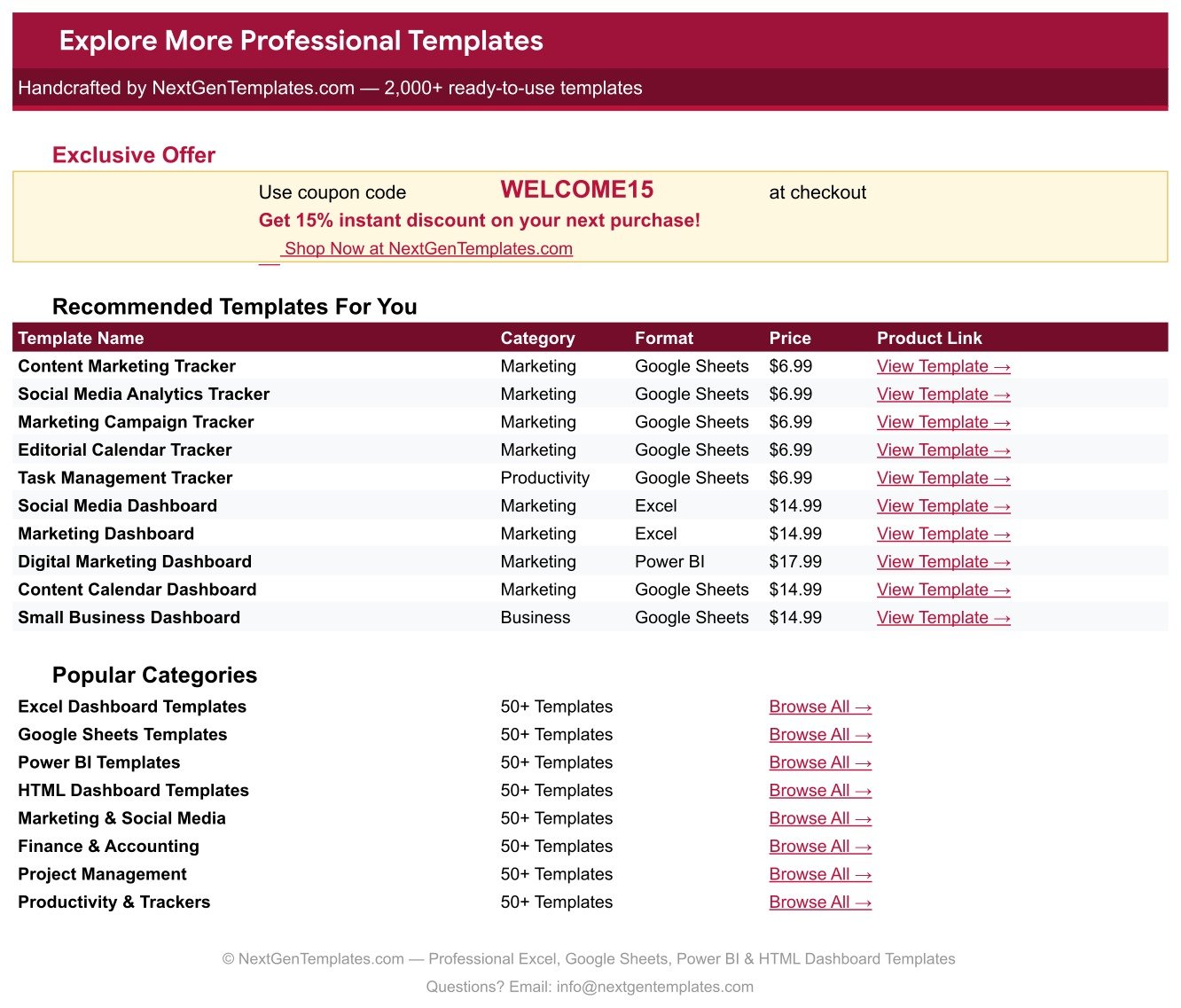
The last tab lists recommended marketing and productivity templates and a WELCOME15 coupon for 15% off your next purchase at NextGenTemplates.com.Social Media Content Calendar Tracker in Google Sheets
Google Sheets Tracker vs. Excel Calendar vs. Paid Scheduling Tools – Feature Comparison
| Feature | This Google Sheets Tracker | Microsoft Excel Content Calendar | Hootsuite / Buffer / Sprout Social |
|---|---|---|---|
| Cost | ✅ $6.99 one-time | One-time template, plus an Excel licence | Recurring monthly subscription |
| Platform | ✅ Any browser, free Google account | Excel desktop or Microsoft 365 | Vendor web app |
| Setup time | ✅ Minutes: make a copy, replace 15 sample rows | Minutes | Account setup and connecting each channel |
| Real-time team collaboration | ✅ Built into Google Sheets | Only with OneDrive / SharePoint | ✅ Yes, usually priced per seat |
| Mobile access | ✅ Google Sheets app | ✅ Excel app | ✅ Native apps |
| Customizable fields | ✅ Edit any column or dropdown list | ✅ Yes | Limited to the vendor’s fields |
| Share with a link | ✅ Yes | Partial | Invite users to the account |
| Year-1 cost at 5 users | ✅ $6.99 total | Template plus 5 licences | Monthly fee for every month of the year |
| Publishes posts to the platforms | No, it plans and tracks | No | ✅ Yes, direct scheduling |
| Engagement rate per post | ✅ Calculated automatically from your numbers | Only if you build the formulas | ✅ Pulled from the platform APIs |
For creators and small teams who want one shared plan-and-results log without a monthly subscription, this Google Sheets tracker sits in the sweet spot. Teams that need automatic publishing still need a scheduling tool.
Who Should Use This Template
✅ Perfect for:
- Solo creators and freelancers running three or more channels who want one planning sheet.
- Small business owners and marketing coordinators who report reach and engagement to a manager.
- Agencies and social media managers who want a simple shared calendar a client can open with a link.
❌ Not a fit if:
- You need posts published automatically. This tracker does not connect to any platform, so posts are still published by hand or through a scheduler.
- You want metrics imported live from platform APIs. Reach, likes, comments and shares are typed in.
Real-World Use Cases
Aisha runs social for a two-person skincare brand. She drafts a month of reels, carousels and stories as Idea rows every Monday, moves them to Scheduled once the artwork is ready and logs results a week after each post. The Likes vs Comments by Post chart showed that her educational reels drew far more conversation than her promotional statics.
Daniel is a freelance social media manager with four clients. He keeps one copy of the tracker per client and shares each by link. The Days to Post column flags any post that turns Overdue, and the Post Count by Status chart shows at a glance how many posts are still waiting for approval.
Priya coordinates marketing for a local training institute. She tags every post with a content pillar and platform, then uses the Post Count by Platform chart and the green Engagement Rate shading to decide where next month’s effort should go.
Advantages of the Social Media Content Calendar Tracker
- 💸 No subscription. A one-time $6.99 purchase replaces a planning spreadsheet you would otherwise build and debug yourself.
- ⚡ Less manual maths. Total Engagement, Engagement Rate and Days to Post are already formulas, so results are comparable post by post.
- 👥 Easy to share. Everyone works in the same Google Sheet, with version history built in.
- 🧩 Fits your own workflow. Add platforms, formats or pillars on the List tab without touching a formula.
Opportunities for Improvement
- Metrics are entered by hand. There is no import from Instagram, TikTok, LinkedIn or YouTube analytics.
- Engagement Rate uses reach as the base, not follower count, so it may differ from the rate a platform reports.
- The charts cover every row in the log. There is no built-in date or platform filter, so use a Google Sheets filter view to focus on one month.
- There is no monthly grid view. The calendar is a dated list sorted by Scheduled Date.
- The coloured chip look on dropdowns has to be switched on once by hand, because Google does not let scripts set it.
Best Practices
- Set up the List tab first, with your real platforms, content types and pillars, before replacing the sample rows.
- Log reach and engagement at a fixed interval, for example 7 days after publishing, so posts are compared fairly.
- Keep one content pillar per post so the platform and pillar mix stays readable.
- Switch the dropdown columns to chip style in Google Sheets data validation for the coloured pill look shown in the screenshots.
- Resize or restyle any of the four charts with Google’s guide to adding and editing a chart. They keep reading the data columns directly.
Explore Relevant Templates
- 🗓️ Need only a posting schedule? Read about the Social Media Posting Calendar in Google Sheets.
- 📰 For blog and long-form planning, see the Editorial Calendar in Google Sheets.
- 🤝 Working with creators? The Social Media Influencer Tracking Dashboard in Google Sheets covers influencer results.
- ▶️ YouTube-first channels can pair this with the YouTube Channel Performance Tracker in Google Sheets.
- 🎨 Planning the design work behind your posts? Try the Marketing Asset Creation Calendar in Google Sheets.
- 💎 Building a full marketing stack? The Marketing Manager Toolkit – 9 Premium Templates bundles Excel and Google Sheets templates in one purchase.
Want to build spreadsheet skills like this step by step? The NextGenTemplates Academy learning paths walk you through trackers and planners with practice files.
Get the Social Media Content Calendar Tracker in Google Sheets
Frequently Asked Questions
What does the Social Media Content Calendar Tracker in Google Sheets track?
It logs every post’s title, platform, content type, content pillar, scheduled date, status, reach, likes, comments, shares, CTA and notes. It then calculates Post ID, Total Engagement, Engagement Rate and Days to Post, and summarises everything in a Total Reach card and four charts.
How long does setup take?
Most users are running in under 15 minutes. Open the PDF in your download, click the link to make your own copy, update the List tab with your platforms and pillars, then replace the 15 sample rows with your posts. The formulas and charts already point at rows 16 to 1000.
How does this compare to Hootsuite or Buffer?
Hootsuite and Buffer publish posts for you and pull metrics automatically, for a monthly fee. This tracker costs $6.99 once and is for planning, workflow status and result logging. You still publish on each platform or in a scheduler and type the numbers in.
Can I add new platforms like Bluesky or Snapchat?
Yes. Type the new platform on the List tab, anywhere in rows 2 to 500, and it appears in the Platform dropdown immediately. The Post Count by Platform chart picks it up as soon as a post uses it, with no re-setup needed.
How is Engagement Rate calculated?
Engagement Rate is Total Engagement (likes + comments + shares) divided by reach for each post. A post with no reach entered yet shows no rate, so scheduled and draft posts do not drag the numbers down.
Do I need Excel or any paid software?
No. The template runs in Google Sheets with a free Google account, in any modern browser or the Google Sheets mobile app. Nothing needs installing.
About the Author
Built by PK, a Microsoft Certified Professional with 15+ years of Excel, Google Sheets and Power BI experience. PK founded NextGenTemplates and reaches 300K+ subscribers across YouTube channels. Every template is hand-built and tested before release.
Conclusion
If your posting plan is spread across docs, calendars and analytics tabs, this tracker pulls it into one shared Google Sheet: a dated post log, a five-stage status pipeline, automatic engagement maths and four charts that show what is working.
✅ Instant download · One-time payment · No subscription
Last updated: September 2026